

Client Objection Handling: Scripts, Framework, and Drills That Work
Only 43.5% of sales professionals hit quota right now. Win rates have dropped 18% since 2022, the average B2B deal involves 7.4 decision-makers, and 80% of sales require five or more follow-ups - yet 92% of reps quit after four. The reps who still close aren't smoother talkers. They're better at client objection handling - what happens after the pushback.
The Short Version
One framework: A-R-C (Acknowledge, Respond, Close).
One rule: The first objection is never the real objection. Ask a diagnostic question before you respond.
One drill: Role Reversal - play the prospect. You'll learn more in 10 minutes than a week of reading scripts.
One stat: A study of 67,149 sales calls found top reps pause longer after an objection, respond with fewer words, and ask more questions. Average reps monologue for 21 seconds and lose the deal.
What the Call Data Actually Shows
Gong studied 67,149 recorded demos from a database of 1M+ calls. The findings aren't subtle.
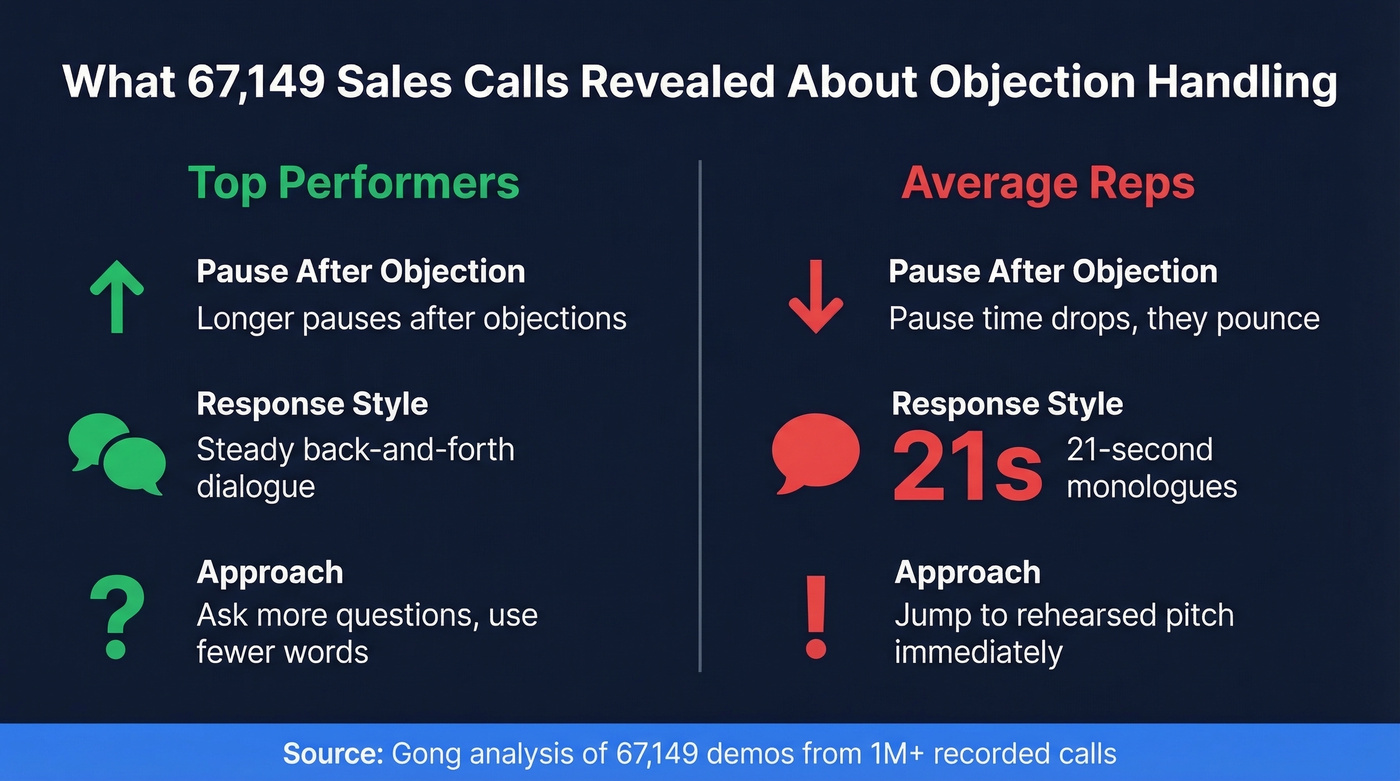
Top-performing reps pause longer after hearing an objection than during normal conversation. Average reps do the opposite - their pause time drops, they pounce, interrupt, and launch into a rehearsed pitch. The back-and-forth stays steady for top reps; for average reps, it collapses into a one-sided monologue averaging 21 seconds. That's an eternity of talking at someone who just told you they have a concern.
Here's the thing: the best advice is boring and consistent. Stop trying to "overcome" and start asking questions. Objections aren't obstacles - they're buying signals. Nobody wants to be "handled." The reps who treat pushback as a conversation, not a battle, are the ones who move pipeline forward.
The Only Framework Worth Memorizing
A-R-C: Acknowledge, Respond, Close.
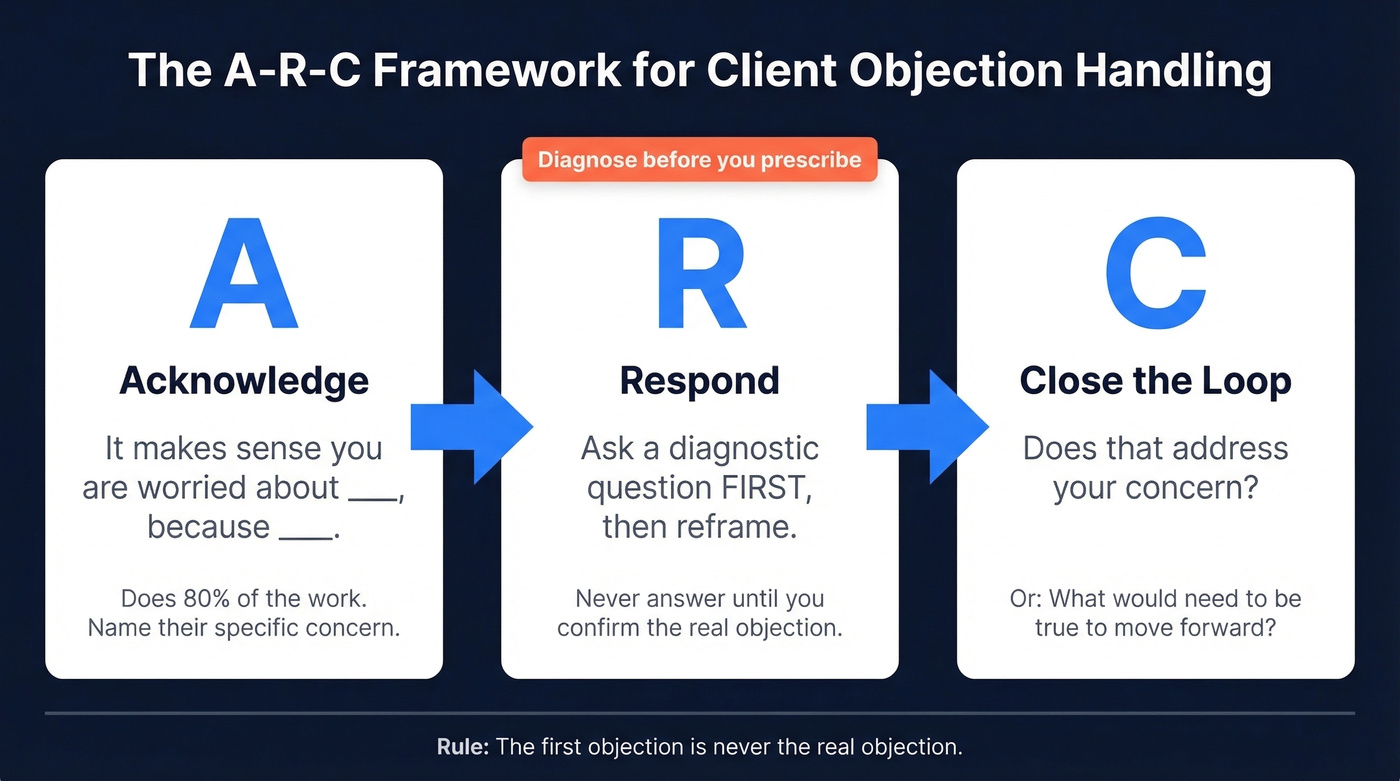
Most frameworks overcomplicate this. A-R-C is three steps, and the first one does 80% of the work.
Acknowledge - "It makes sense you're worried about ___, because ___."
Respond - Ask a diagnostic question first, then reframe. Never answer until you've confirmed you're answering the right objection.
Close the loop - "Does that address your concern?" or "What would need to be true for us to move forward?"

The best objection handling framework won't help if you're reaching the wrong person. Prospeo's 300M+ verified profiles with 30+ filters - including buyer intent and job changes - let you target prospects who actually need what you sell. Fewer brush-offs, more real conversations.
Stop memorizing scripts for people who were never a fit.
Scripts for the 6 Objections You Hear Every Week
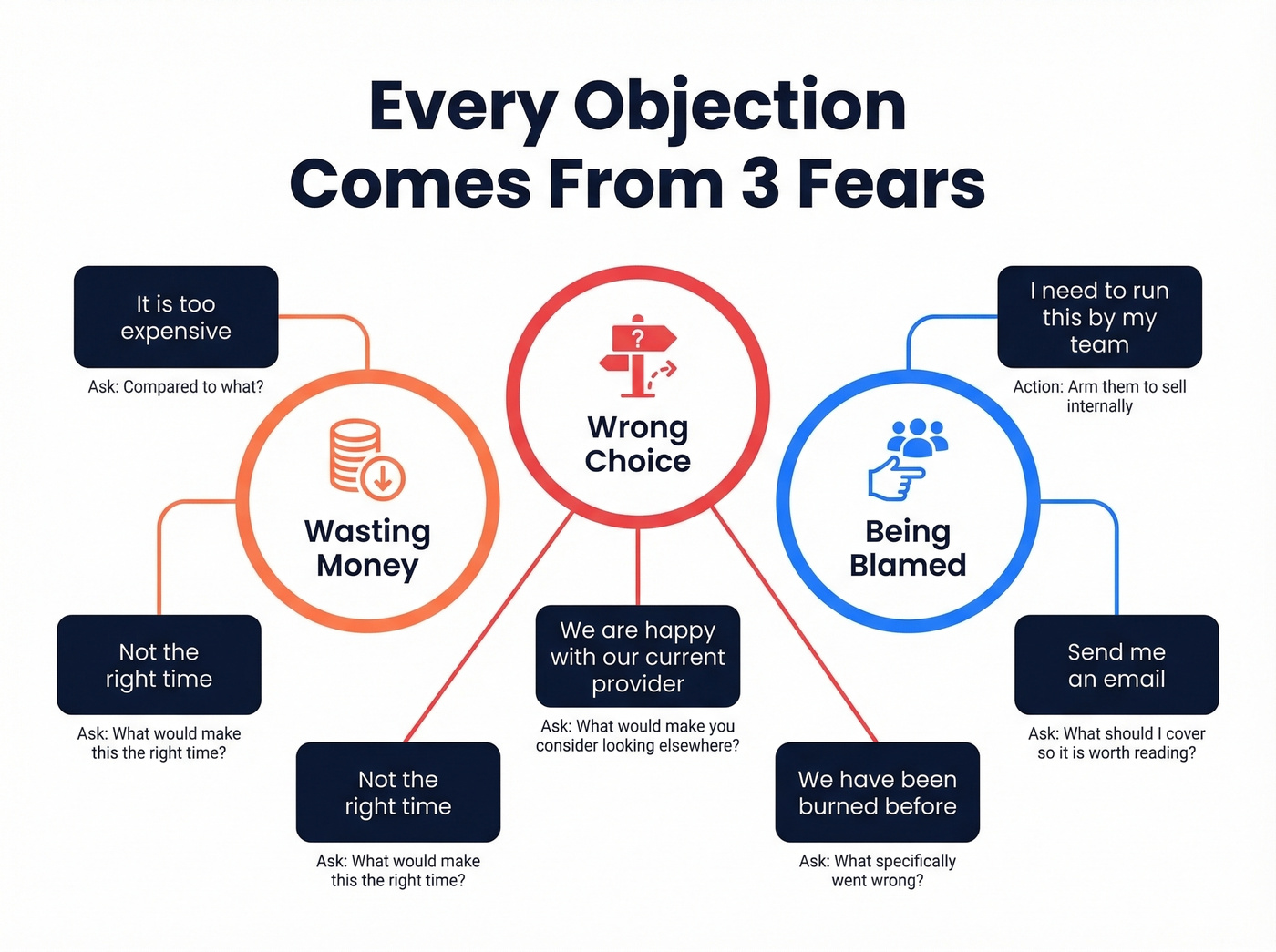
Objections stem from three fears - wasting money, making the wrong choice, or being blamed for the decision. Every script below targets the fear underneath the words.
"It's Too Expensive"
They don't see enough value to justify the number. Ask: "Compared to what?" This forces a benchmark - their current solution, a competitor, doing nothing.
Then: "The teams we work with find the cost of not solving this runs about $___/quarter. Does it make sense to walk through that math?"
Alternative diagnostic: "If budget wasn't an issue, would this be a fit?" If the answer is no, price was never the real objection.
"Not the Right Time"
They don't feel enough urgency. Ask: "What would make this the right time?"
Then: "Every quarter you wait, that cost compounds. Would a phased rollout starting in Q[X] take the pressure off?"
"I Need to Run This by My Team"
They aren't confident enough to champion this alone. Skip the diagnosis - arm them instead.
"What does your team care about most - cost, timeline, or results? I'll build a one-page summary hitting those points, or I can jump on a 15-minute call with them directly." Your job is to turn this stakeholder into your internal champion. We've seen deals stall for weeks because the rep didn't offer to help the champion sell internally - don't make that mistake.
"We're Happy with Our Current Provider"
Switching feels risky. Ask: "What would they need to do for you to even consider looking elsewhere?" The answer reveals the gap.
"We hear that a lot - usually the gap shows up in [specific area]. Worth a 10-minute comparison to see?"
"Send Me an Email"
This is a brush-off, not an objection. Don't treat it like one.
Say: "Happy to - what specifically should I cover so it's worth reading?" If they can't name a topic, they weren't interested. If they do, you've got a real conversation.
If you need a clean follow-up sequence, use these follow-ups instead of winging it.
"We've Been Burned Before"
A previous vendor wasted their time with bad data or broken promises. This one's legitimate - and a huge share of "not interested" responses happen because the prospect was poorly targeted in the first place.
If you're seeing bounce rates north of 30%, you're training prospects to ignore you before the conversation starts. Tools like Prospeo verify emails in real time with 98% accuracy on a 7-day refresh cycle, so you're reaching the right person - not burning trust before the first word.
Say: "What specifically went wrong? [Wait.] Here's how we're different - [address the specific failure]. Would a small pilot change the equation?"
Five Mistakes That Kill Deals
- Monologuing after the objection. Call data is unambiguous: 21-second monologues lose deals. Pause. Ask a question.
- Answering the wrong objection. The first objection is rarely the real one. Diagnose before you prescribe.
- Getting defensive. The moment you defend, you've made it adversarial. Acknowledge first.
- Using hollow acknowledgments. "I totally understand" without specifics sounds like a script. Name the specific concern back to them.
- Treating a brush-off like an objection. "Send me an email" means you haven't earned attention yet. Different problem, different response.
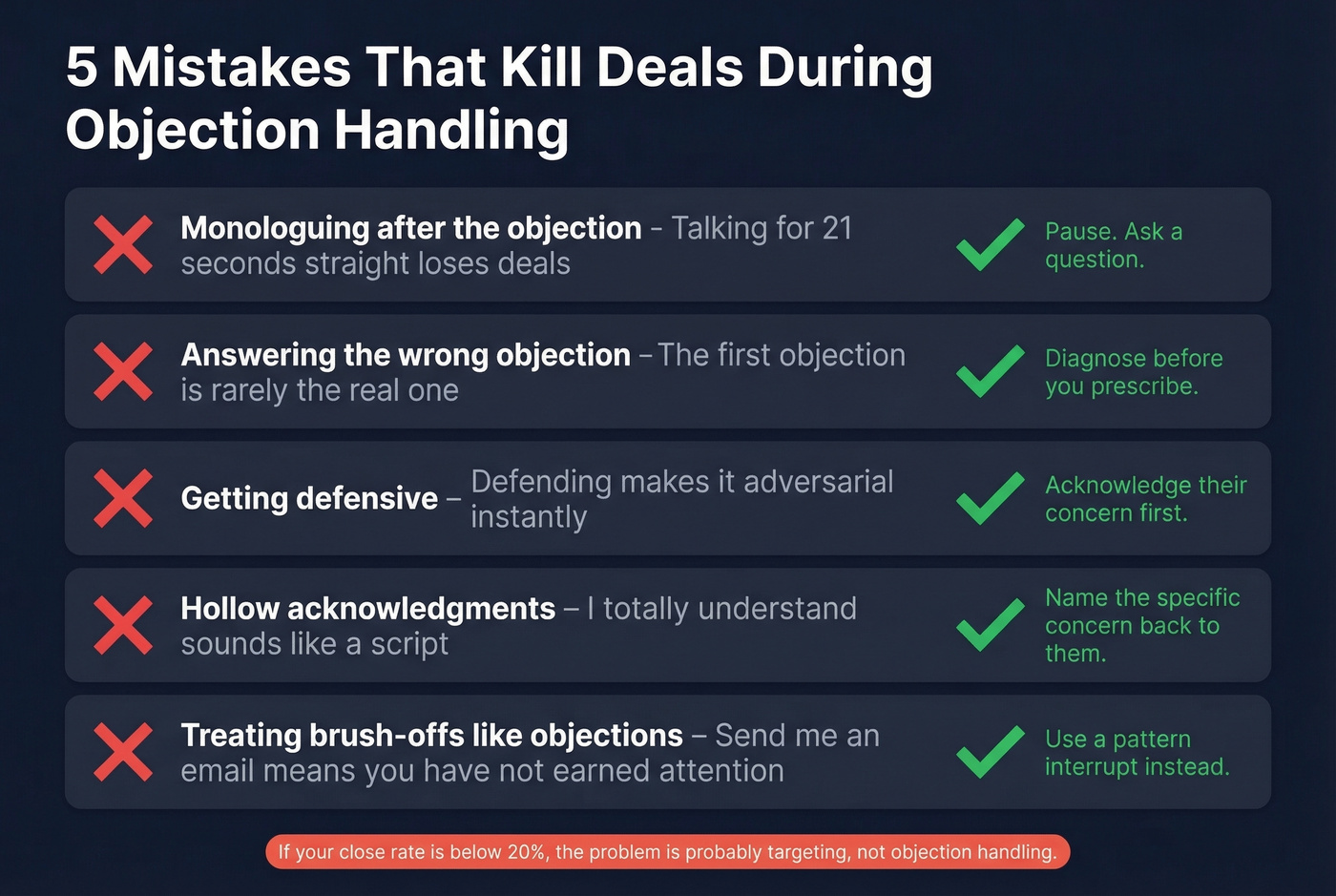
Let's be honest: if your close rate is below 20%, your problem probably isn't objection handling - it's targeting. You're pitching people who were never a fit. Fix your data and your ICP before you memorize another script.
Three Drills for Handling Objections Under Pressure
Objection Island. One rep, one objection, 5 seconds to respond. If the response doesn't move the conversation forward, they're voted off. Sounds silly. It builds rapid recall under pressure faster than anything else we've tried.
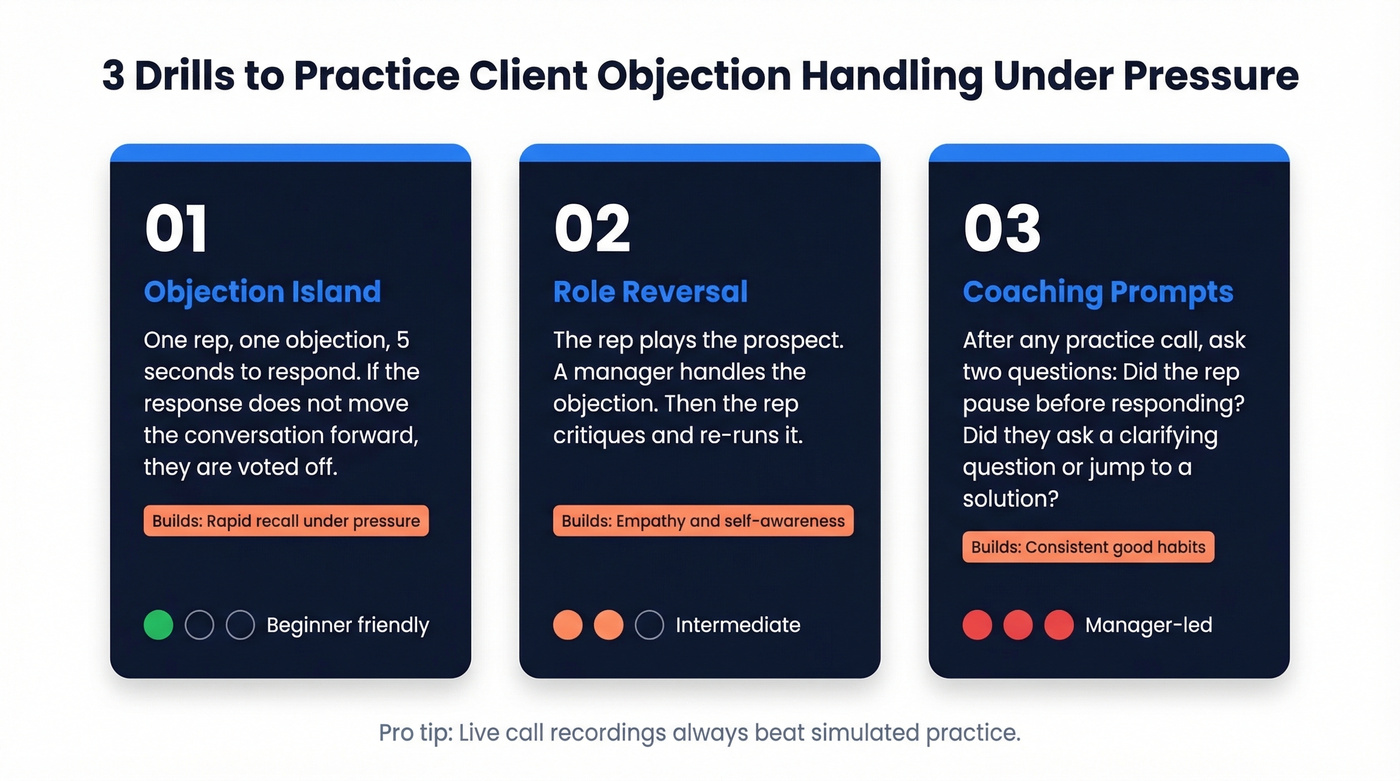
Role Reversal. The rep plays the prospect. A manager handles the objection. Then the rep critiques what they saw and re-runs it. In our experience, this drill produces more breakthroughs than any other exercise because reps finally feel what bad objection handling sounds like from the other side - the defensive tone, the rushed pivot, the hollow "I totally understand." You can't unhear it once you've been on the receiving end.
Coaching Prompts. After any practice call, managers should ask two questions from Highspot's role-play framework: "Did the rep pause before responding?" and "Did they ask a clarifying question or jump to a solution?" Those two checks catch most bad habits. Skip this if your team already records and reviews real calls - live tape is always better than simulated practice.
If you want a tighter system for what happens after the call, build it into your sequence management instead of relying on memory.
"We've been burned before" is the objection that starts before the call. When 35% of your emails bounce, you're training prospects to ignore you. Prospeo's 98% email accuracy and 7-day data refresh mean you reach real buyers at verified addresses - so trust is intact before you say a word.
Kill the objection at the source: bad data. Start at $0.01/email.
FAQ
What's the difference between an objection and a brush-off?
An objection signals genuine engagement - the prospect is wrestling with a real concern like price, timing, or risk. A brush-off like "send me an email" means you haven't earned their attention yet. Apply the A-R-C framework to objections; use a pattern interrupt for brush-offs.
How many objection-handling frameworks should a rep learn?
One. A-R-C covers every scenario you'll face in B2B sales. Memorizing five frameworks means you'll freeze trying to pick the right one mid-call. Master one deeply and adapt it to context.
What if the prospect's objection is about bad outreach data?
It's a trust problem that starts before the conversation. Prospects burned by bounced emails or wrong numbers won't engage regardless of your script. Fixing your data source is the prerequisite - teams like Snyk cut bounce rates from 35% to under 5% and added 200+ new opportunities per month after switching to verified contact data.
Does client objection handling differ for enterprise deals?
Yes - enterprise deals involve more stakeholders and longer cycles, so objections compound across a buying committee. The A-R-C framework still applies, but you'll need to arm your internal champion with objection-ready materials like ROI summaries and risk comparisons they can use in rooms you'll never enter.