

Closed Deals: What They Are & How to Win More in 2026
Most sales teams obsess over closing techniques when their real problem is upstream. Bad qualification, stale contact data, unclear next steps - these kill deals long before a rep gets to the ask. Stop learning new closing tricks. Fix your inputs, and the close takes care of itself.
What Are Closed Deals?
Every sales opportunity ends in one of three buckets. Closed-won means the customer signed, revenue's booked, and the opportunity leaves the active pipeline. Closed-lost means the customer declined - a competitor won, budget disappeared, or the prospect went dark. Closed-other covers administrative closures like duplicates and disqualified opportunities.
A closed-won deal triggers a cascade most reps underestimate: contract execution, automatic CRM stage updates, forecast reconciliation, handoff to customer success, and revenue recognition in finance systems. In PLG-driven companies, an in-product upgrade can mark the opportunity as closed-won without a single sales call. And in 2026, AI increasingly validates deal likelihood and flags inconsistencies before close, while conversation intelligence tools extract win/loss reasons automatically.
The KPIs that flow from closed deals - win rate, closed-won revenue, forecast accuracy, average deal size, sales cycle length - are the metrics your leadership team actually cares about. Everything else in your pipeline is a leading indicator. The scoreboard is what actually closed.
Three Things You Need to Know
- The benchmark is lower than you think. The average B2B opportunity-to-closed-won rate is 6-9%. If you're consistently above 15%, you're either exceptional or your pipeline is too narrow.
- Most close rate problems are input problems. Bad qualification, bad data, and clunky handoffs do more damage than weak closing technique.
- Your CRM's deal hygiene matters more than you realize. How you mark, track, and report on outcomes directly shapes your forecast accuracy and pipeline visibility.
How CRMs Handle Closed Deals
Every CRM treats deal closures slightly differently, and those differences matter for reporting and forecasting.
| Feature | Salesforce | Dynamics 365 | Close CRM |
|---|---|---|---|
| Default stages | 10 (custom) | Custom + Won/Lost | Active -> Won/Lost |
| Forecast update | Manual or automated | Auto-updates category | Won adds revenue |
| Reopen closed deal? | Yes | Yes | Yes |
| Lost deal handling | Stage = Closed Lost | Captures competitor + reason | Removes from expected revenue |
Salesforce uses 10 default opportunity stages from Prospecting through Closed Won and Closed Lost. Most teams customize the middle stages, but Closed Won/Lost are sacred - they're what your forecast rolls up from.
Dynamics 365 automatically updates the forecast category to Won or Lost based on your closure selection and captures actual revenue, competitor info, and close date. You can reopen a closed opportunity if the customer re-engages.
Close CRM is the simplest of the three. It distinguishes between pipelines and statuses, and the Won and Lost status types are hardwired into revenue calculations. Marking an opportunity Won adds its value as revenue; marking it Lost removes it. We've included Close CRM here because its closure mechanics are unusually clean - worth studying even if you use a different platform.
Your CRM says you have 200 open opportunities. Be honest: how many are actually alive?
Benchmarks Worth Knowing
Full-Funnel Conversion Rates
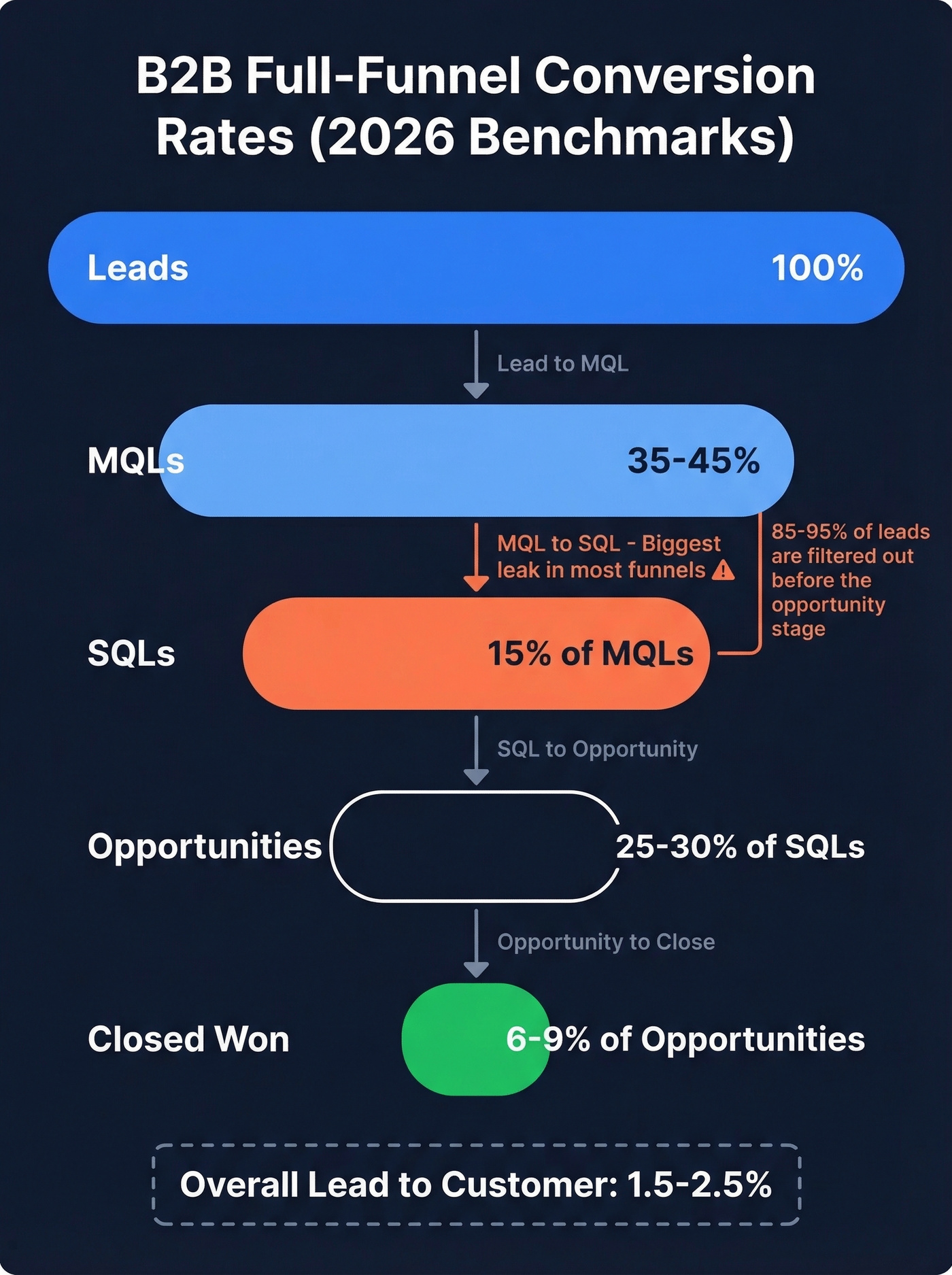
The average B2B deal involves 13 decision-makers, and 80% of buyer interactions now happen digitally. Your funnel leaks at every stage, and the biggest drops happen earlier than most teams realize.
| Stage | Conversion Rate |
|---|---|
| Lead -> MQL | 35-45% |
| MQL -> SQL | 15% |
| SQL -> Opportunity | 25-30% |
| Opportunity -> Closed-Won | 6-9% |
| Overall lead-to-customer | 1.5-2.5% |
That MQL-to-SQL handoff at 15% is consistently the biggest leak in most funnels. It's where marketing and sales alignment either works or doesn't. By the time a deal reaches the opportunity stage, you've already filtered out 85-95% of your leads, and the 6-9% close rate on what's left is the final filter.
Industry Close Rates
Close rates vary dramatically by industry. Biotech runs around 15%, Software hits roughly 22%, and Finance lands near 19%. The cross-industry average sits around 29% as a commonly cited benchmark, though that number gets inflated by industries with shorter sales cycles and simpler buying committees.
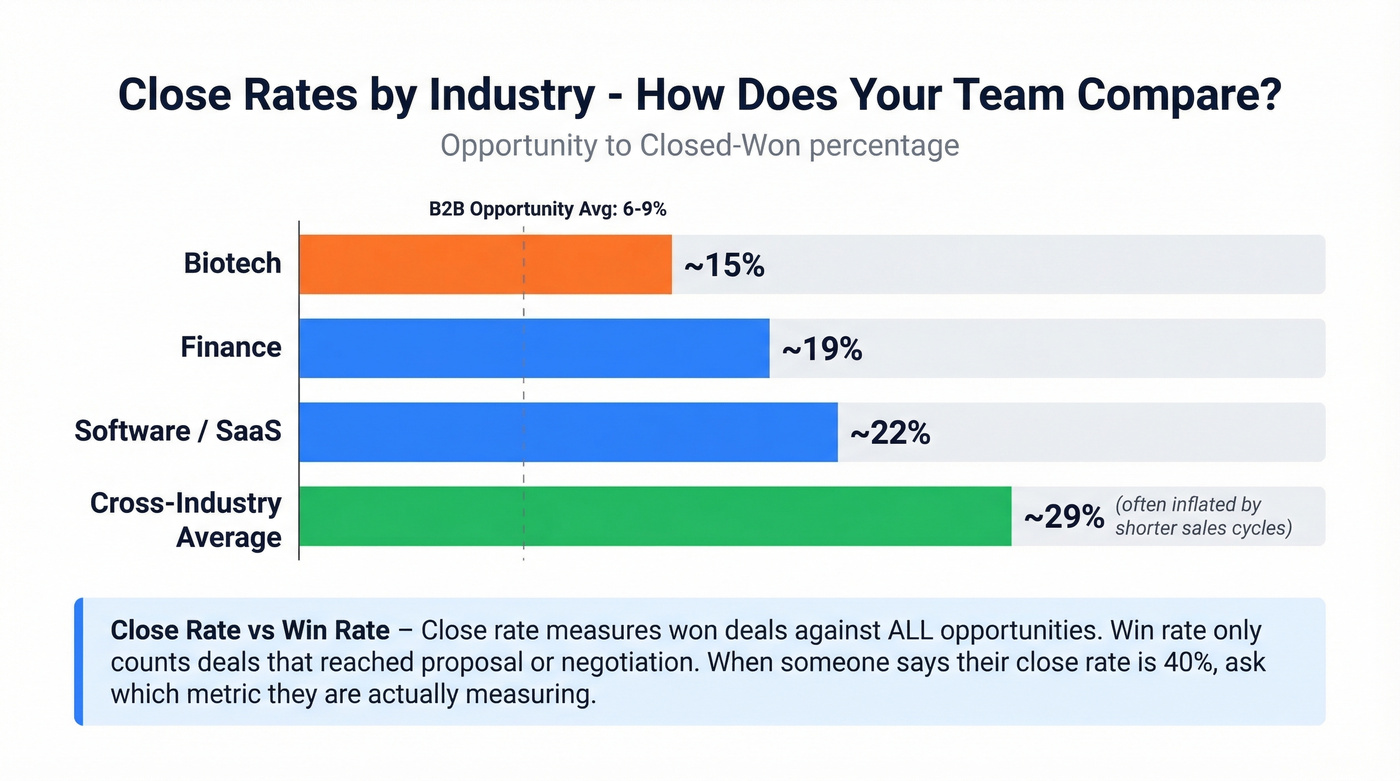
The formula is straightforward: (Closed-won deals / total opportunities) x 100. If you closed 18 deals from 200 opportunities, your close rate is 9% - right at the B2B average.
One distinction worth understanding: close rate measures won deals against all opportunities. Win rate measures won deals against only those that reached proposal or negotiation - a narrower, later-funnel metric. When someone tells you their "close rate" is 40%, ask which metric they're actually measuring. It's almost always win rate.

You read it above: bad contact data is the silent deal killer. Bounced emails and wrong numbers mean reps never reach the 13 decision-makers involved in a typical B2B deal. Prospeo's 98% email accuracy and 125M+ verified mobiles cut bounce rates below 4% - so your pipeline actually converts.
Stop losing deals to bad data. Start reaching real buyers.
Why Deals Fall Apart
B2B Deal Killers
Buyers are 70% through the buying process before they ever engage with sales. By the time your rep gets on a call, the prospect has already formed opinions, compared alternatives, and built internal consensus - or hasn't.
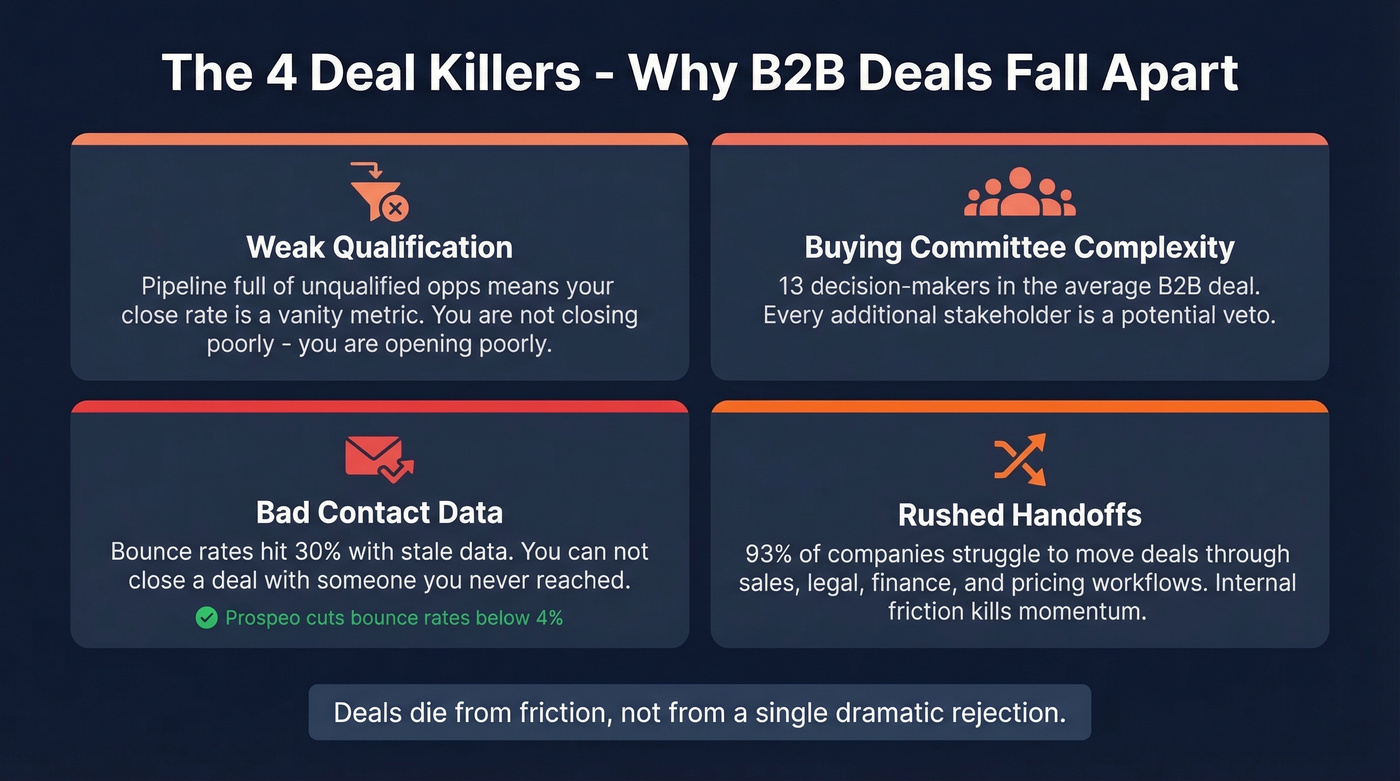
Weak qualification is the most common killer. If your pipeline is full of unqualified opportunities, your close rate is a vanity metric. You're measuring how well you close deals that should never have been opened.
Buying committee complexity comes next. With 13 decision-makers involved in the average B2B deal, every additional stakeholder is a potential veto. The more times you make a customer repeat their story to a new internal champion, the lower your win rate drops.
Bad contact data is the silent assassin. Bounced emails and wrong phone numbers mean reps never reach the people who matter. In many outbound programs, bounce rates hit ~30% when data is stale - and then teams wonder why their pipeline isn't converting. Here's the thing: you can't close a deal with someone you never reached.
Rushed handoffs round out the list. Research from Conga shows that deals frequently struggle to move through sales, legal, finance, and pricing workflows at 93% of companies. The deal stalls not because the buyer said no, but because internal friction killed momentum.
Real Estate and M&A Failures
Deals fall apart in every industry, not just B2B SaaS. According to Redfin's October 2025 analysis, 15.1% of U.S. home-purchase agreements were canceled in August 2025 - roughly 56,000 deals and the highest August rate on record since 2017. A survey of 443 agents revealed the top reasons: 70.4% cited inspection and repair issues, 27.8% said buyer financing fell through, 21% pointed to buyers who couldn't sell their current home, and 14.9% flagged a change in the buyer's financial situation.
M&A tells a similar story. A BCG analysis of 175 deals found that roughly 40% failed to close within the projected schedule, and nearly two-thirds of those slipped by three or more months. The closing stage - not diligence or valuation - is where most M&A deals die.
The pattern across all these contexts is the same: deals die from friction, not from a single dramatic rejection. Whether a deal succeeded or collapsed at the finish line usually comes down to operational readiness, not negotiation skill.
How to Improve Your Close Rate
Qualify Harder Upfront
BANT and MEDDICC exist for a reason. The frameworks aren't sexy, but they force the right conversations early: Does this prospect have budget? Authority? A real timeline? A compelling event?
If your pipeline is full of unqualified opportunities, your close rate is a vanity metric. You're not closing poorly - you're opening poorly. The fix isn't a better closing technique. It's a higher bar for what counts as an opportunity.
Fix Your Data Before Your Pitch
Let's walk through the math on this one, because it matters more than most teams realize.
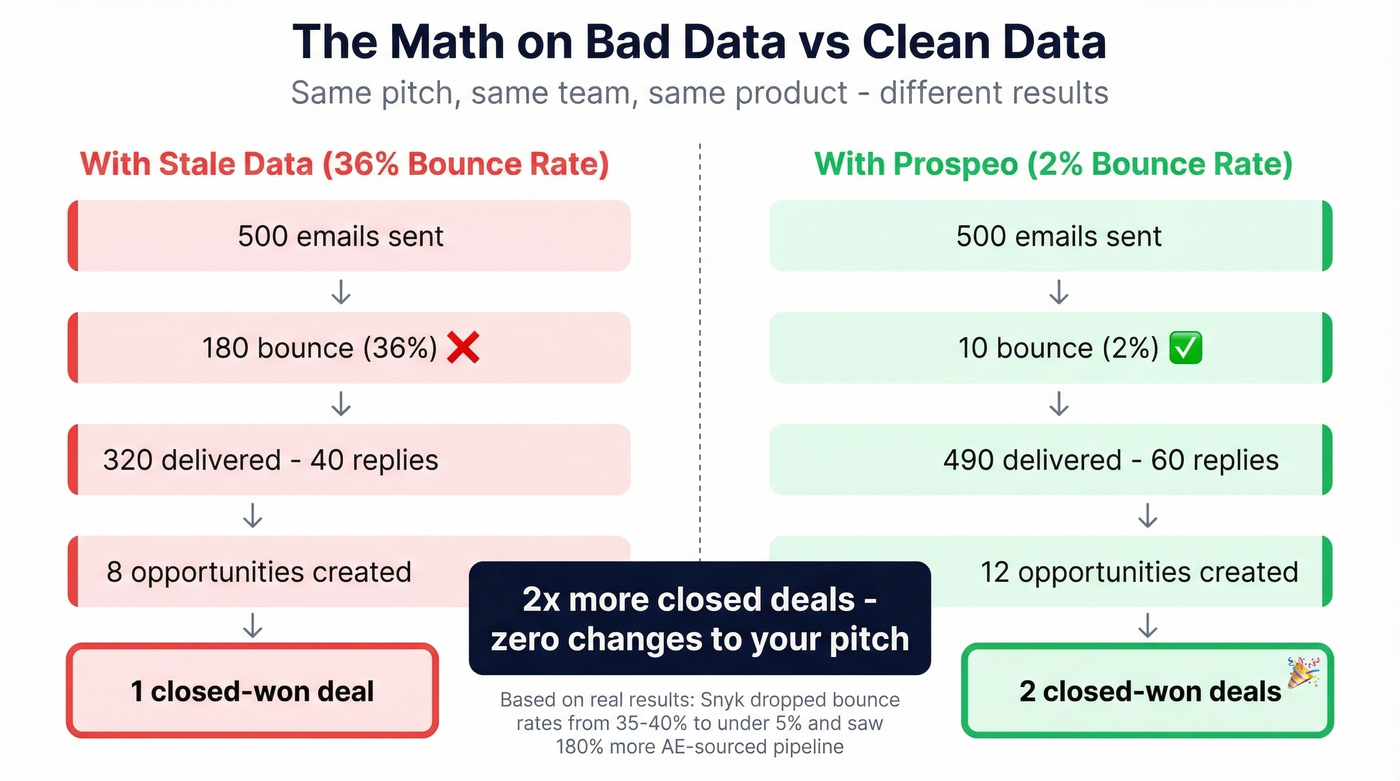
Your SDR sends 500 emails. 180 bounce. Of the 320 that land, 40 get replies. 8 become opportunities. You close 1. Now imagine the bounce rate was 2% instead of 36%. That's 490 delivered emails, roughly 60 replies, 12 opportunities, and 2 wins. You just doubled your closed-won count without changing a single word in your pitch.
Snyk's 50-person AE team saw this firsthand with Prospeo: bounce rates dropped from 35-40% to under 5%, AE-sourced pipeline jumped 180%, and they generated 200+ new opportunities per month. That's the difference a 7-day data refresh cycle makes versus the six-week industry average.
Bad data doesn't just waste sends. It damages your sender reputation, which means even your good emails start landing in spam. The downstream effect on close rates is invisible but massive.
Reduce Handoff Friction
Every time a buyer has to repeat their story - to a new AE, to a solutions engineer, to legal - your win rate drops. We've seen this pattern across dozens of teams: deals stall due to missing context, unclear next steps, and buyers needing time to align internally.
The fix is operational. Fast follow-ups. Simple one-page summaries that buyers can forward to their internal stakeholders. And alignment between your pitch and the buyer's actual intent - not the intent you wish they had.
Closing Techniques That Still Work
High-pressure trick closes are dead. Buyers have more information, more options, and less patience for manipulation. Fake urgency isn't just ineffective - deceptive deadline tactics can violate FTC Act Section 5, which prohibits unfair or deceptive sales practices.
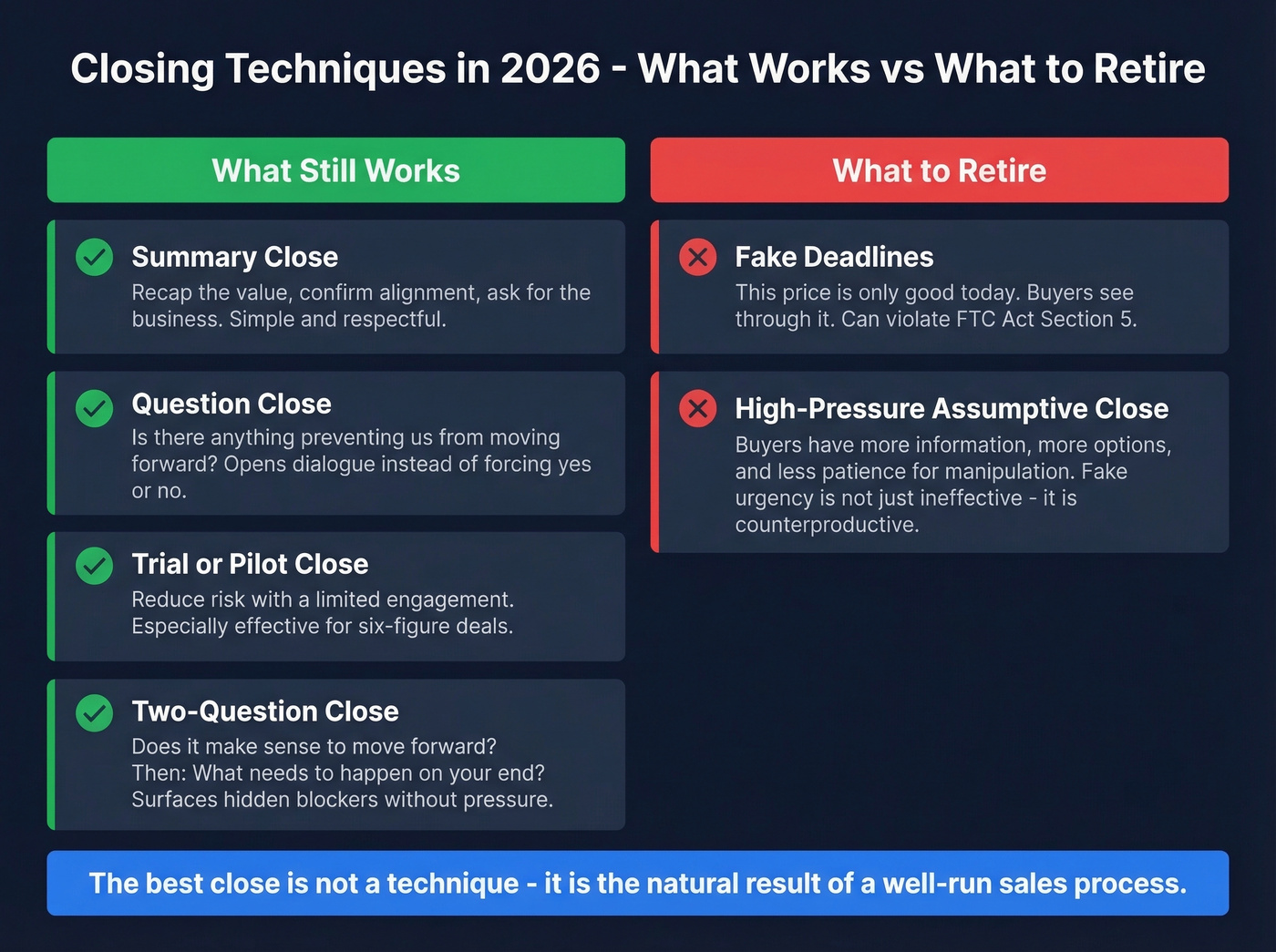
What works:
- Summary close - recap the value, confirm alignment, ask for the business.
- Question close - "Is there anything preventing us from moving forward?" Opens dialogue instead of forcing a yes/no.
- Trial or pilot close - reduce risk with a limited engagement. Especially effective for six-figure deals.
- The two-question close - "Does it make sense to move forward?" followed by "What needs to happen on your end to get this done?" This sequence surfaces hidden blockers without pressure.
What to retire:
- Fake deadlines - "This price is only good today." Buyers see through it.
- High-pressure assumptive close - acting as if the deal is done before the buyer agrees.
- Sharp-angle close - "If I can get you X, will you sign today?" Puts the buyer on the defensive.
In our experience, the best closers aren't closing at the end. They're closing throughout the process - getting micro-commitments at every stage. "Can you confirm your team is aligned on the timeline?" "Will you introduce me to your CFO next week?" Each small yes builds momentum toward the final one.
Hot take: If your average contract value is under $15k, you probably don't need a sophisticated closing methodology. You need more at-bats. Fix your data quality, send more emails that actually land, and let volume do the work. Save MEDDICC for enterprise.
Training Your Team to Close
Closing isn't a talent - it's a skill. Three exercises that move the needle:
The objection laboratory. Log every objection your team hears for two weeks. Categorize them. You'll find 80% fall into 4-5 buckets. Develop specific approaches for each, then drill them until the responses are automatic.
The "price is wrong" drill. Present pricing to a colleague playing the buyer. The buyer reacts negatively. The rep must ask two discovery questions before defending or discounting. This builds curiosity over defensiveness.
The 30-second challenge. Have reps record their pitch, then watch it twice: once with sound off for body language, once with sound on. The gap between what they think they're communicating and what actually comes across is always eye-opening.
Set a training rhythm: weekly 30-minute skills lab, monthly 2-hour deep dive, quarterly full-day reset. Track before and after on close rate, sales cycle length, average deal size, and meetings-to-close.
Skip the training budget if your team's prospect lists are garbage. One fix that requires zero training: verify your list before every campaign. It takes about two minutes to upload a CSV and get results - and it'll do more for your close rate than any roleplay session.
If you need a tighter system end-to-end, start with sales prospecting techniques and a repeatable lead generation workflow.
Your close rate is only as good as the contacts feeding your pipeline. Stale data decays fast - Prospeo refreshes every 7 days, not the 6-week industry average. Teams using Prospeo book 26% more meetings than ZoomInfo users, at $0.01 per verified email.
Close more deals by fixing the biggest leak in your funnel.
FAQ
What is a closed deal?
A sales opportunity that reached a final outcome - closed-won (customer purchases) or closed-lost (customer declines). Once marked in either direction, the status triggers CRM forecast updates, revenue recognition, and customer success handoffs.
What's a good close rate in B2B?
The average opportunity-to-closed-won rate is 6-9%. Software averages ~22%, Finance ~19%, Biotech ~15%. Consistently above 15% means you're either exceptional or undercounting your pipeline.
How do you calculate close rate?
Divide closed-won deals by total opportunities, then multiply by 100. Eighteen wins from 200 opportunities equals a 9% close rate - right at the B2B average.
What's the difference between close rate and win rate?
Close rate measures won deals against all opportunities. Win rate measures won deals against only those reaching proposal stage - a narrower metric that's almost always higher. Always clarify which one someone's citing.
How does bad contact data affect close rates?
Bounced emails and wrong numbers prevent reps from ever reaching decision-makers, shrinking the pool of closeable opportunities. Snyk cut bounce rates from 35-40% to under 5% and grew pipeline 180% after switching to verified data with a 7-day refresh cycle.