

Cloud GTM Strategy: The Practitioner's Playbook for 2026
A RevOps lead we know spent six months building a co-sell pipeline with AWS - then watched it stall because half the contact data for target accounts bounced. The cloud GTM opportunity is real, the money is real, but execution eats strategy for breakfast. Here's the playbook that actually works.
The Short Version
- List on one hyperscaler marketplace first. AWS if you're unsure - 83% of ISVs co-sell with AWS.
- Make your listing transactable. A "Contact Us" button doesn't unlock co-sell or committed spend.
- Build a co-sell target list of enterprises actively burning committed cloud spend.
- Invest in joint value props before co-marketing. Skipping this is the #1 reason co-sell programs die.
The macro tailwind: enterprise software sales through hyperscaler marketplaces are projected to hit $163B by 2030, up from roughly $30B in 2024 - a ~29% CAGR.
What Cloud Go-to-Market Actually Means
Cloud GTM is selling your software through - and alongside - AWS, Microsoft Azure, and Google Cloud. Three pillars make it work: marketplace listings where buyers discover and transact, co-sell where hyperscaler reps bring you into deals, and committed spend where enterprises burn pre-committed cloud budgets on your software instead of letting those dollars expire.
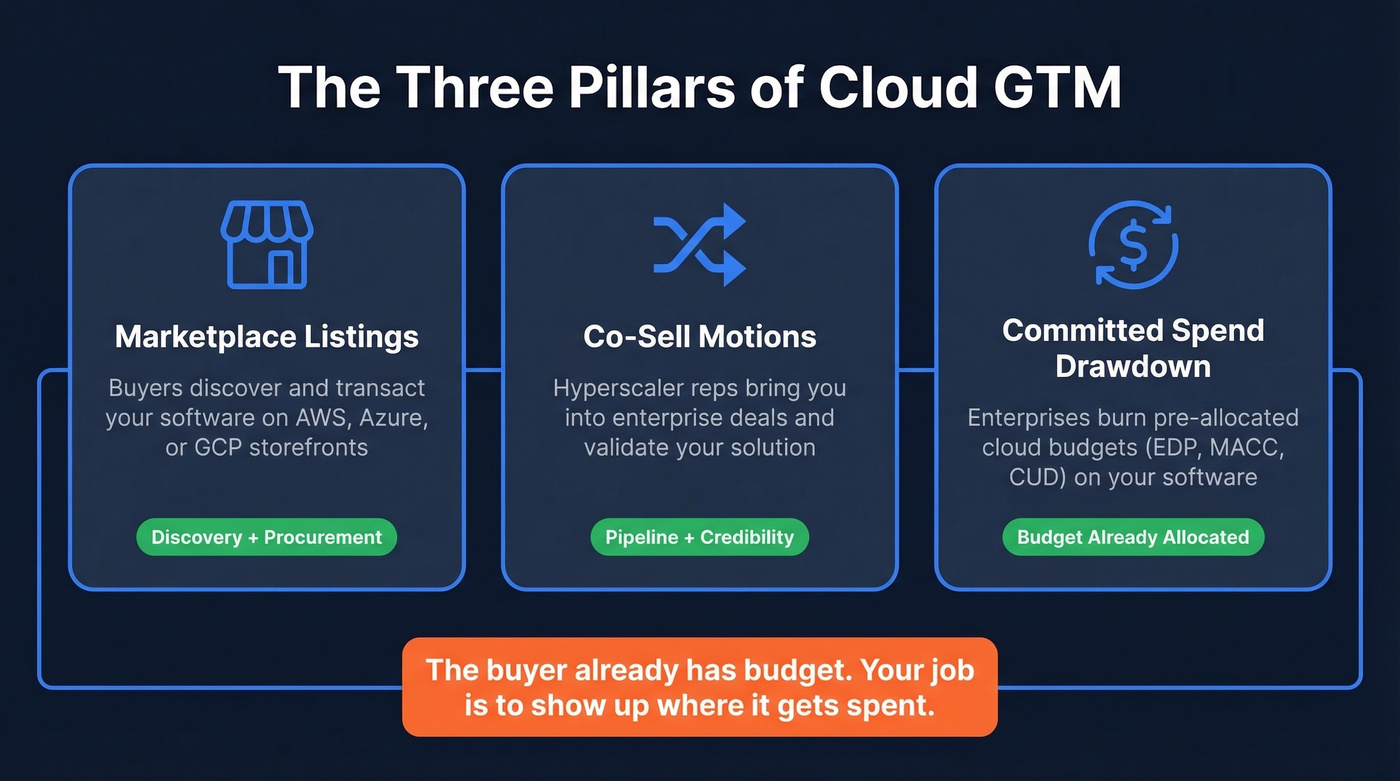
Think of it as a distribution channel with built-in procurement rails. The buyer already has budget allocated. Your job is to show up where that budget gets spent.
Why This Matters Right Now
The cloud infrastructure market hit $419B+ in 2025, ending the year growing about 30% year-over-year. AWS holds roughly 29% market share, Microsoft 20%, and Google 13%. Global committed cloud spend agreements - the pre-allocated "use it or lose it" budgets enterprises agree to burn - exceeded $460B in 2025.
75% of ISVs cite access to committed spend as the top advantage of marketplace selling. A Futurum study of 30 high-performing Google Cloud partners found marketplace deals average 112% larger than direct deals, with 70% structured as multi-year agreements and procurement cycles shortened by up to four weeks. One practitioner on r/SaaS put it simply: cloud marketplaces aren't just a listing - they're an enterprise discovery engine and a procurement shortcut rolled into one.
The Step-by-Step Playbook
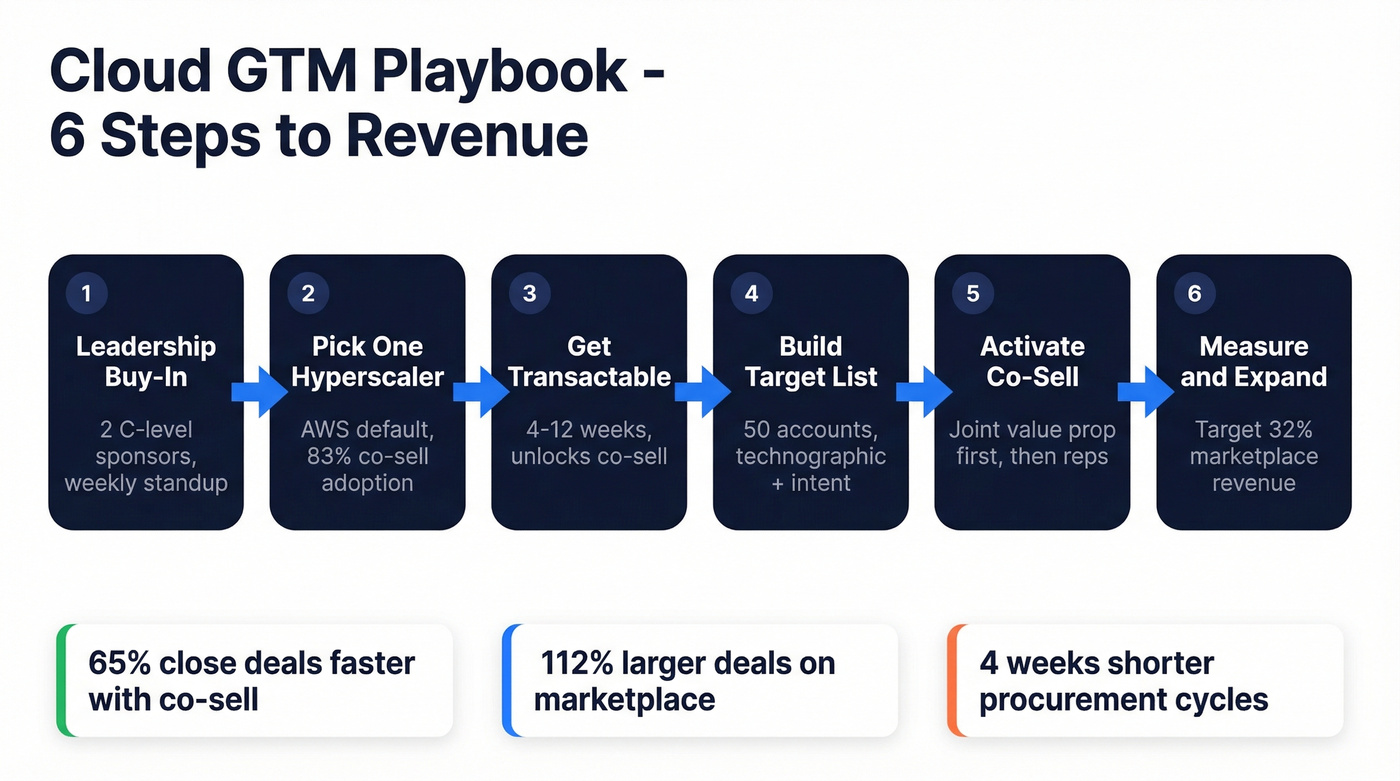
Step 1: Get Leadership Buy-In
You need at least two C-level sponsors. Cloud go-to-market touches product, engineering, sales, and finance - it won't survive as a side project. Nominate a CxO-level owner and set up a weekly cross-functional standup from day one. Without this, your marketplace listing becomes an orphan that nobody updates and nobody sells through.
Step 2: Pick One Hyperscaler
Don't launch on all three simultaneously.
83% of ISVs co-sell with AWS, 51% with Microsoft, 35% with Google Cloud. Start with AWS unless your ICP skews heavily toward Azure or GCP workloads. You can go multi-cloud later - 80% of ISVs are already working with multiple clouds or plan to - but nail one first.
As of January 2026, AWS ISV Accelerate partners can access Market Development Funds from day one of enrollment. That's free money most teams leave on the table.
Step 3: Get Listed and Transactable
A non-transactable listing is a brochure. A transactable listing is what unlocks co-sell motions, private offers, and committed spend drawdown. Expect 4-12 weeks for the listing process depending on your engineering readiness and the hyperscaler's review queue. GCP requires being transactable to get listed at all. Azure lets you start with a "Contact Us" button, but you won't see real traction until you're transactable.
Step 4: Build Your Co-Sell Target List
Here's where most teams fumble. You need enterprises that run workloads on your target hyperscaler, have active committed spend agreements, and match your ICP. That means using technographic filters to identify companies running AWS or Azure infrastructure, layering intent data to find accounts researching your category, and exporting verified contacts for the buying committee.
We've seen teams waste months on co-marketing before nailing this step. The first 50-account target list is what separates programs that ship from programs that stall. If you're sending bounced emails to the enterprise accounts your PDM referred you to, you're torching credibility before the relationship even starts - this is exactly why tools like Prospeo with 98% email accuracy and technographic filters powered by Wappalyzer matter for building co-sell lists.
Step 5: Activate the Co-Sell Motion
Sequencing matters more than budget. A practitioner on r/techsales nailed it: build your joint value proposition first, then coach your reps on hyperscaler value, then target accounts. The data backs this up - 65% of partners close deals faster by co-selling, and 54% report larger deal sizes.
Know the committed spend programs by name:
- EDP - AWS, typically $1M+ annual commitment
- MACC - Microsoft Azure Consumption Commitment, requires $100K in Marketplace Billed Sales or Azure Consumed Revenue for IP co-sell eligibility
- CUD - Google, 1- or 3-year terms
When talking to a prospect, ask whether their software purchases can draw down against their cloud commitment. That single question changes the procurement conversation entirely. As CircleCI's team noted, the marketplace has become the "go-to mechanism for procurement" at large enterprises.
Step 6: Measure and Expand
Track marketplace revenue as a percentage of total. The ISV average sits at 20%, with expectations to hit 32% in the next 12 months. Co-sell influenced 22% of net-new deals last year and is trending toward 30%. Channel partners now touch 27% of marketplace transactions - rising to 37% - so don't ignore your partner ecosystem.
Once your first hyperscaler motion is producing, replicate the playbook on your second.

Your cloud GTM motion dies when emails bounce. Prospeo gives you 98% verified emails, technographic filters powered by Wappalyzer to find companies running AWS or Azure workloads, and intent data across 15,000 topics to spot accounts actively researching your category.
Build your first 50-account co-sell target list in minutes, not months.
AWS vs Azure vs GCP Compared
| AWS | Azure | GCP | |
|---|---|---|---|
| Listing type | Transactable | Contact Us or transactable | Transactable required |
| Reviews | Yes (imports G2) | Yes (imports G2) | No |
| API maturity | Mature | Mature | Less accessible |
| Marketplace fee | ~3% | ~3% | ~3% |
| Private offers | Yes | Yes | Yes |
| Rep visibility | No | Yes | Yes |
| Committed spend | EDP ($1M+ annual) | MACC | CUD (1- or 3-year) |
| Co-sell eligibility | ISV Accelerate enrollment | $100K MBS/ACR threshold | Partner Advantage portal |
| Co-sell adoption | 83% | 51% | 35% |
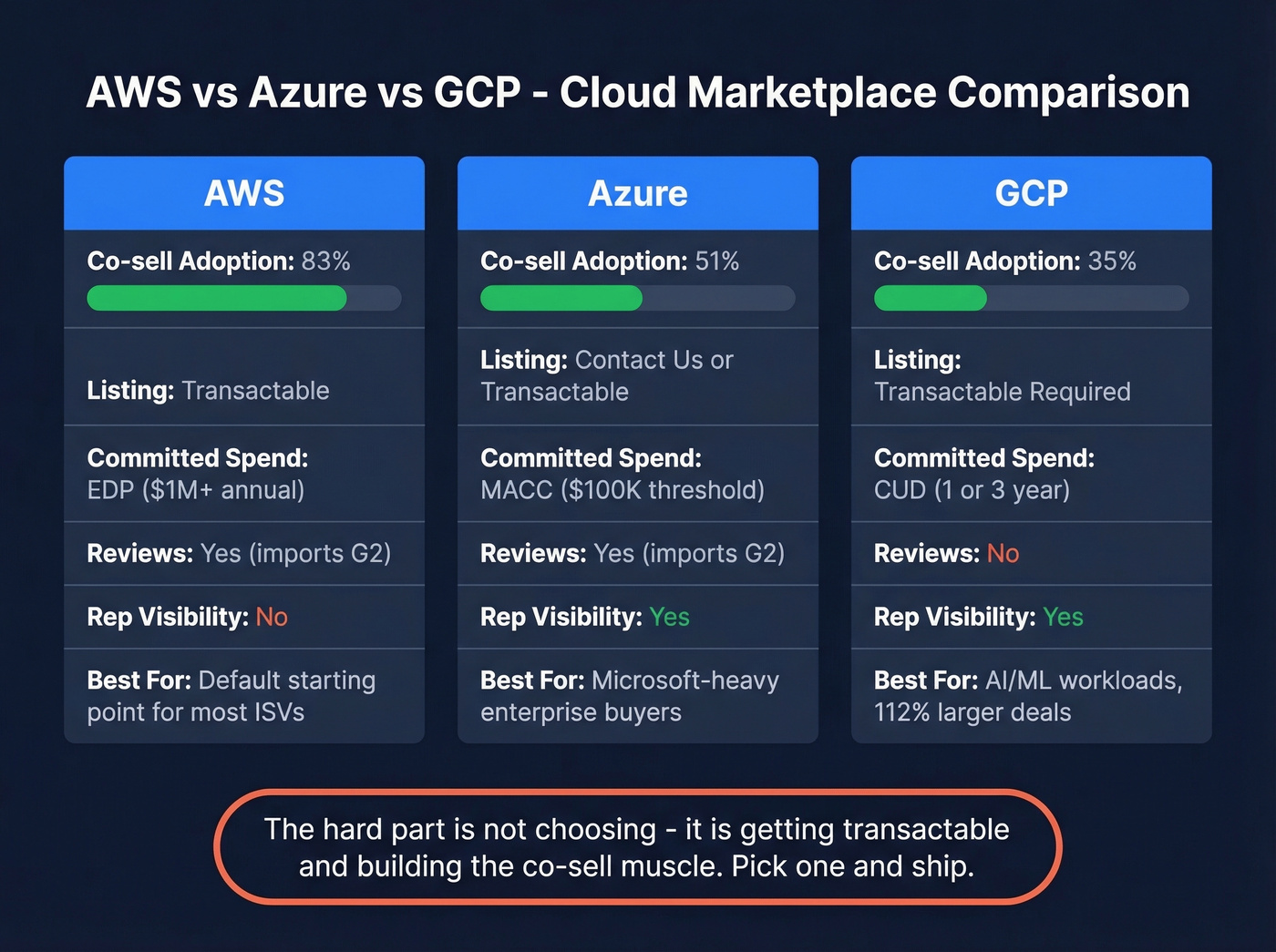
AWS is the default starting point for most ISVs. The co-sell adoption rate is nearly double Azure's, and the marketplace is the most mature. But if your buyers are Microsoft shops, Azure's rep visibility and MACC drawdown make it compelling. GCP tends to be a strong fit for AI/ML-heavy buyers - and the Futurum data showing 112% larger deal sizes is a big reason many partners prioritize Google Cloud Marketplace.
Let's be honest: most ISVs agonize over which hyperscaler to pick first. It barely matters. The hard part isn't choosing AWS vs. Azure - it's getting transactable and building the co-sell muscle. Pick one, ship, expand later.
Why Co-Sell Programs Fail
The consensus on r/techsales is blunt: most hyperscaler co-sell programs feel ineffective. Only 25% of ISVs have a dedicated co-sell resource. Only 17% train cloud provider field teams on their product. And 46% rate access to Partner Development Managers as "extremely challenging."
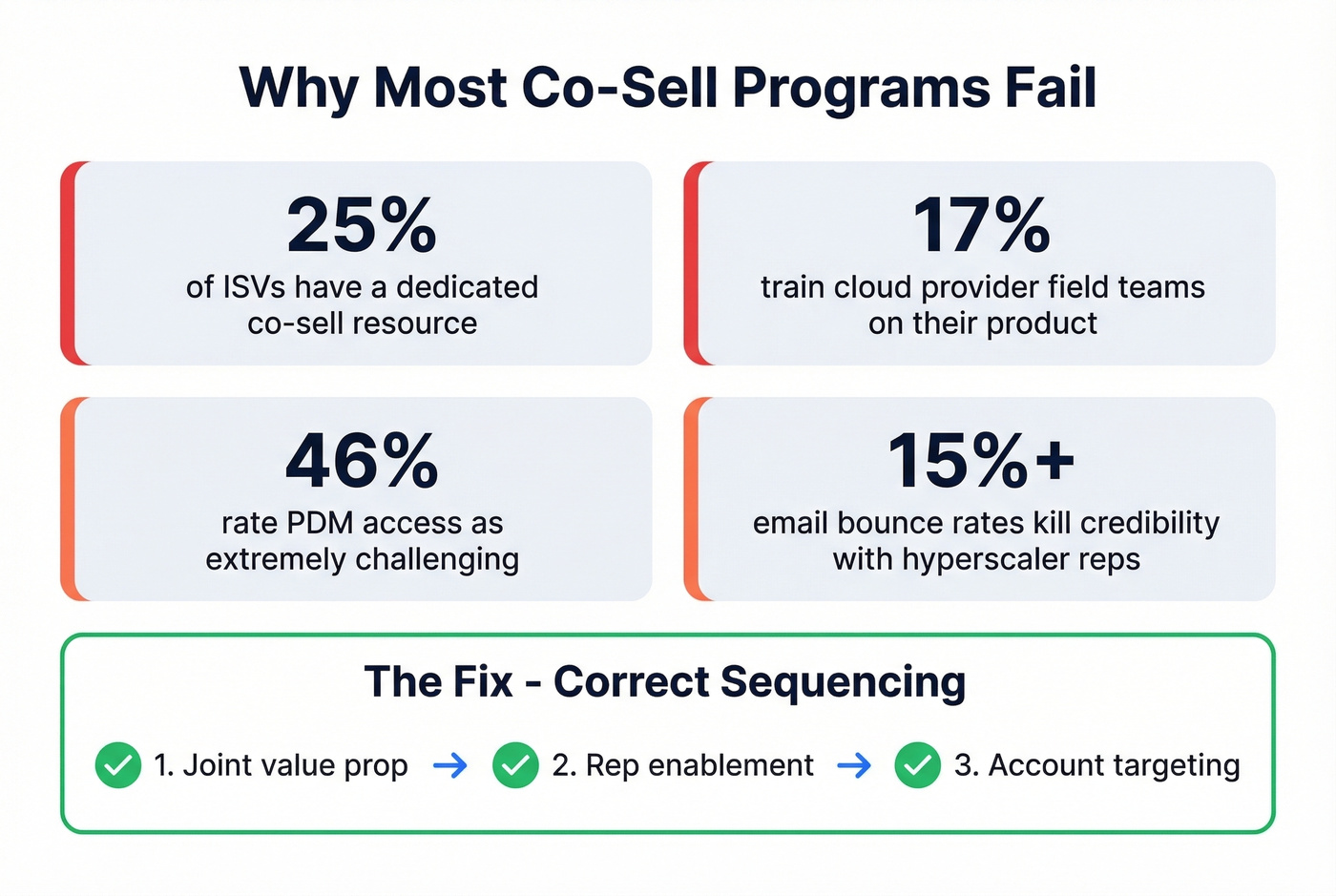
The fix isn't more co-marketing spend. It's sequencing. Joint value prop first, rep enablement second, account targeting third. None of it works if your contact data is bad - and by "bad" we mean bouncing at 15%+ rates when you're trying to reach the exact enterprise accounts your PDM just referred you to. That's a credibility killer you don't recover from.
Skip the co-sell platform entirely if you haven't closed your first private offer yet. You need to understand the motion before you automate it.
CrowdStrike: What $1B Looks Like
CrowdStrike exceeded $1B in cumulative AWS Marketplace sales in under six years, then topped $1B in a single calendar year in 2024. Deals transacted through AWS Marketplace average 4x larger than direct deals. Marketplace customers use 7 modules on average. Growth was 91% globally, 136% in public sector, and 3,548% through distributors.
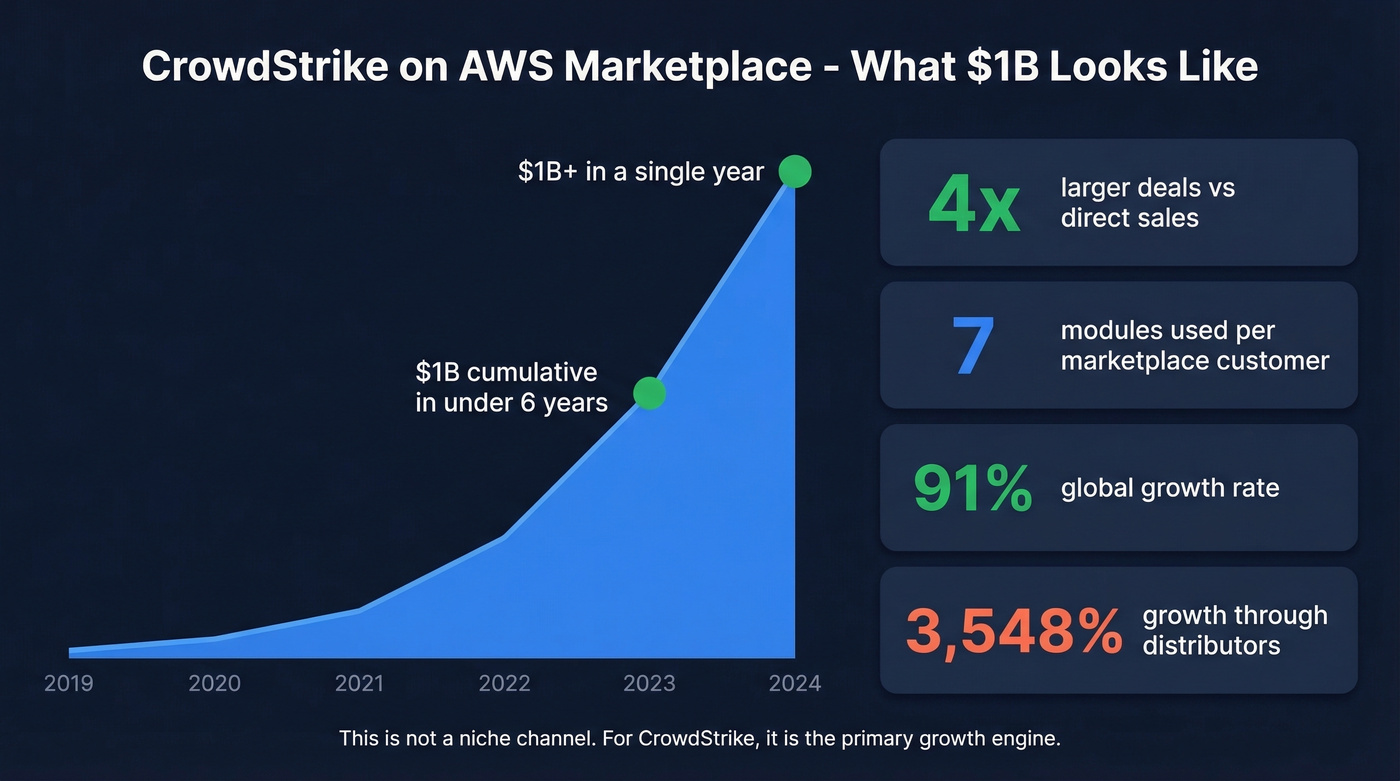
This isn't a niche channel. For CrowdStrike, it's the primary growth engine.
Cloud GTM Platforms Worth Evaluating
You don't need a platform on day one. Manual operations work fine until you're running regular private offers. When you're ready:
| Platform | G2 Rating | Reviews | Pricing | Best For |
|---|---|---|---|---|
| Tackle | 4.7/5 | 71 | Custom (enterprise) | Mid-market ISVs, strong support |
| Labra | 4.9/5 | 59 | Free starter tier | Getting started without budget |
| Invisory | 4.9/5 | 11 | Custom | Small teams, simple UX |
Tackle is the incumbent with great support, though G2 reviewers tag it "expensive" six times across reviews. Labra's free starter tier includes your marketplace listing and is the smartest way to start without committing budget. Invisory skews toward smaller companies with the easiest setup, though the review count is still thin.
Co-sell programs stall when you can't reach the buying committee. Prospeo's 300M+ profiles, 125M+ verified mobiles, and 30+ filters - including headcount growth, funding, and tech stack - let you build the exact enterprise account list your PDM needs to greenlight the deal.
Stop torching hyperscaler credibility with bad contact data.
Get Started This Week
Your cloud GTM strategy doesn't need to be perfect - it needs to be live. Here's the minimum viable action plan:
- Secure one executive sponsor (ideally two - CRO + CPO)
- Pick your hyperscaler (AWS if you're unsure)
- Submit your marketplace listing application
- Build your first 50-account co-sell target list with technographic and intent filters
- Schedule a weekly cross-functional standup
Six months from now, you'll either have a transactable listing generating co-sell pipeline or you'll still be "evaluating." Pick your hyperscaler and ship.
FAQ
What is a cloud GTM strategy?
A cloud GTM strategy is selling your software through hyperscaler marketplaces (AWS, Azure, GCP) and their co-sell programs, letting enterprise buyers pay with pre-committed cloud budgets. It combines marketplace listings, co-sell motions with hyperscaler reps, and committed spend drawdown into a single distribution channel.
How long does it take to get listed on a cloud marketplace?
Expect 4-12 weeks from application to a live transactable listing, depending on the hyperscaler and your engineering readiness. GCP requires transactability before listing; AWS and Azure allow non-transactable listings but you won't unlock co-sell or committed spend without a transactable offer.
Which hyperscaler marketplace should ISVs start with?
AWS is the default for most ISVs - 83% co-sell with AWS, and its marketplace is the most mature. Choose Azure if your ICP runs Microsoft workloads, or GCP if you sell to AI/ML-heavy buyers where marketplace deals average 112% larger than direct sales.
How do I build a co-sell target list with verified contacts?
Use a B2B data platform with technographic and intent filters to identify enterprises running workloads on your target hyperscaler. Filter by technology stack, layer intent signals to spot in-market accounts, and export contacts with verified emails so your first outreach to a PDM-referred account doesn't bounce.