

Cold Calling Conversion Rate: What 300M+ Calls Actually Show
Your SDR team made 1,000 calls last week and booked 3 meetings. Your VP wants to know if that's good or terrible. The honest answer: it depends entirely on which cold calling conversion rate you're measuring - and most teams are measuring the wrong one.
Cold calling isn't dying. Connect rates are. Stop obsessing over a single conversion percentage and start obsessing over your connect rate.
What "Conversion Rate" Actually Means
Nobody agrees on this term, and that's half the problem. When someone says "2% conversion rate," they could mean dials to meetings, dials to qualified opportunities, or conversations to closed deals. These are wildly different numbers.
The formula most SDR teams should care about: meetings booked / total dials x 100. That's your dial-to-meeting rate. But it's really two rates multiplied together - your connect rate (how many people pick up) and your set rate (how many conversations turn into meetings). Conflating them hides where the real problem lives.
You'll see competitors push a "30/50/50" framework - reach 30%+ of your list, qualify 50%, close 50%. It's a neat mental model, but it obscures the metric that actually separates top reps from average ones: connect rate. A rep who connects with twice as many prospects doesn't need a better set rate to blow past quota.
Benchmarks From 300M+ Calls
The dataset of 300M+ cold calls analyzed by Gong is the most reliable benchmark we've found:
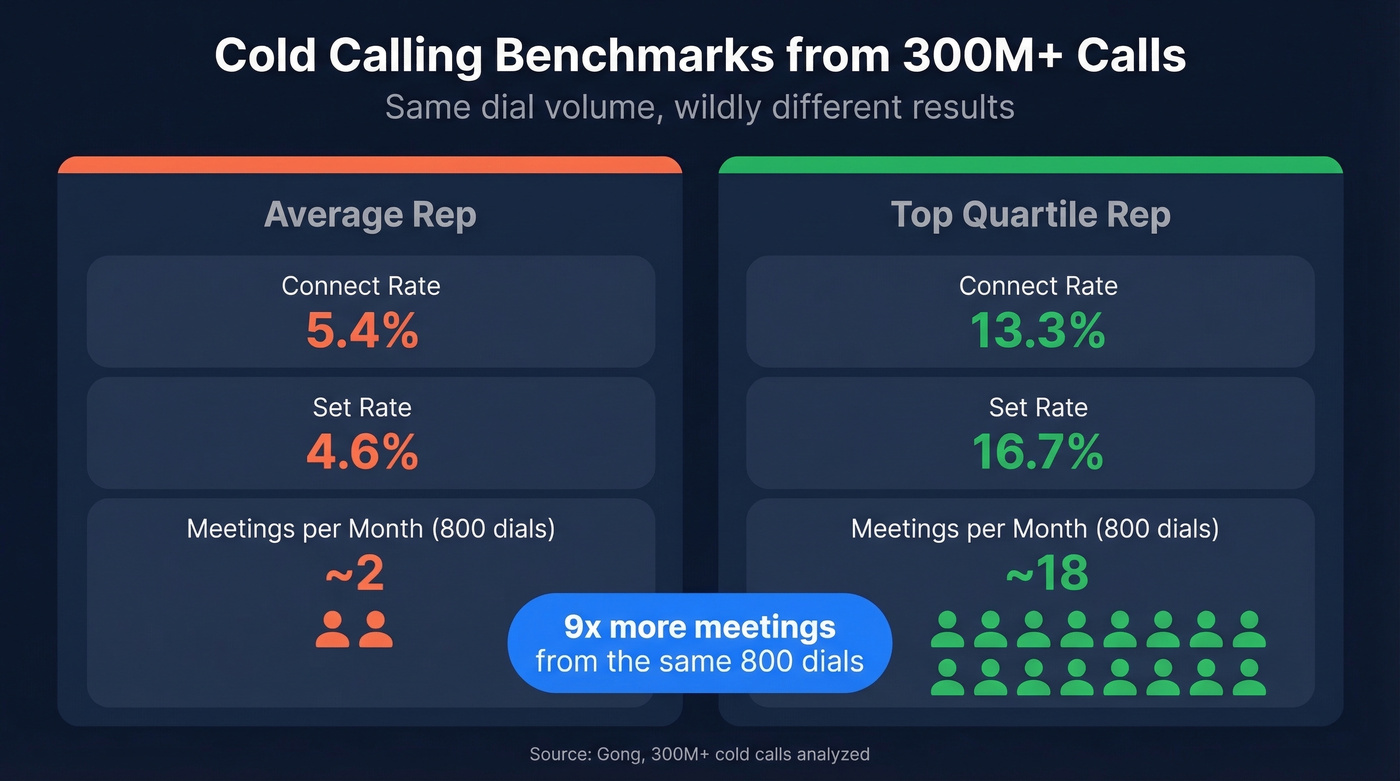
| Metric | Average Rep | Top Quartile |
|---|---|---|
| Connect rate | 5.4% | 13.3% |
| Set rate | 4.6% | 16.7% |
| Meetings/mo (800 dials) | ~2 | ~18 |
With the same 800 dials per month, top-quartile reps book about 9x more meetings (~18 vs ~2). That's not a marginal gap. It's a completely different business outcome.
Let's break that down. An average rep dialing 800 times connects with about 43 people and books ~2 meetings (43 connects x 4.6% set rate). A top-quartile rep connects with about 106 people and books ~18 meetings (106 connects x 16.7% set rate). The connect rate gap alone accounts for most of that difference - the set rate compounds it, but the foundation is who picks up the phone.
Cognism's published data tells a grimmer story for the broader market: the average cold calling conversion rate dropped from 4.82% to 2.3% year-over-year. On Reddit, SaaS SDRs consistently report roughly 1 meeting per 200 calls with a 5-8% connect rate, which tracks with the average-rep numbers almost exactly.
Conversion by Industry and Deal Size
Not all cold calls are created equal. Focus Digital's 2026 breakdown shows meaningful variance by vertical:
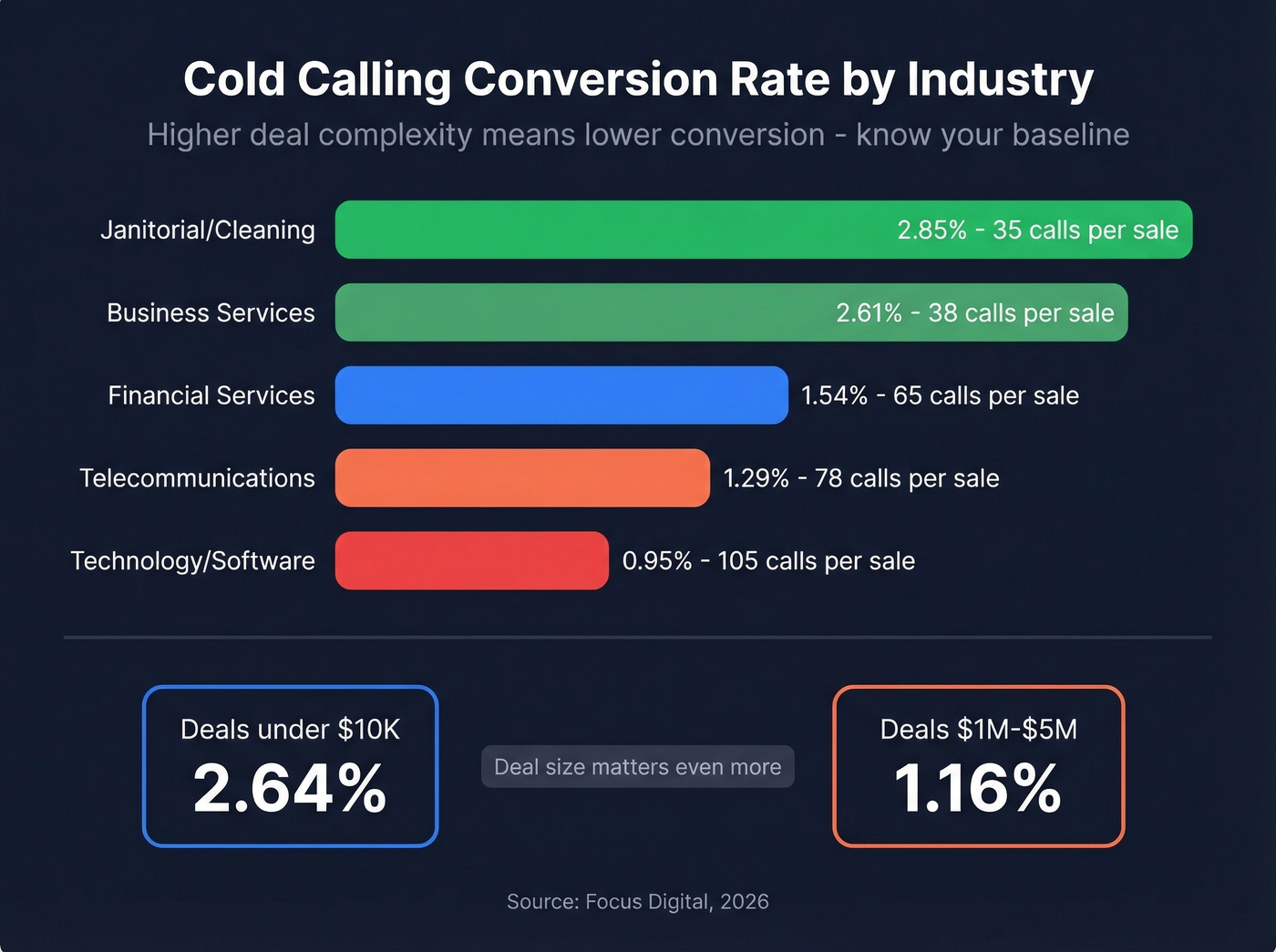
| Industry | Conversion Rate | Calls per Sale |
|---|---|---|
| Janitorial/Cleaning | 2.85% | 35 |
| Business Services | 2.61% | 38 |
| Financial Services | 1.54% | 65 |
| Telecommunications | 1.29% | 78 |
| Technology/Software | 0.95% | 105 |
Deal size matters even more. Deals under $10K convert at 2.64% of dials, while $1M-$5M deals convert at 1.16%. If you're selling enterprise software and comparing yourself to a 2.5% benchmark from janitorial services, you're measuring against the wrong baseline.

The gap between 5.4% and 13.3% connect rates starts with your data. Prospeo's 125M+ verified mobile numbers are refreshed every 7 days - not every 6 weeks. Meritt tripled their connect rate to 20-25% and went from $100K to $300K/week in pipeline after switching.
Stop dialing dead numbers. Start connecting with real buyers.
Why These Numbers Keep Falling
STIR/SHAKEN, carrier-level spam filtering, and TCPA compliance pressure have created a hostile environment for outbound dialing. One outbound operator on r/b2bmarketing laid it out bluntly: their connect-through rate dropped from ~60% to ~15%, and their conversion fell from 3.5% to 0.8%.
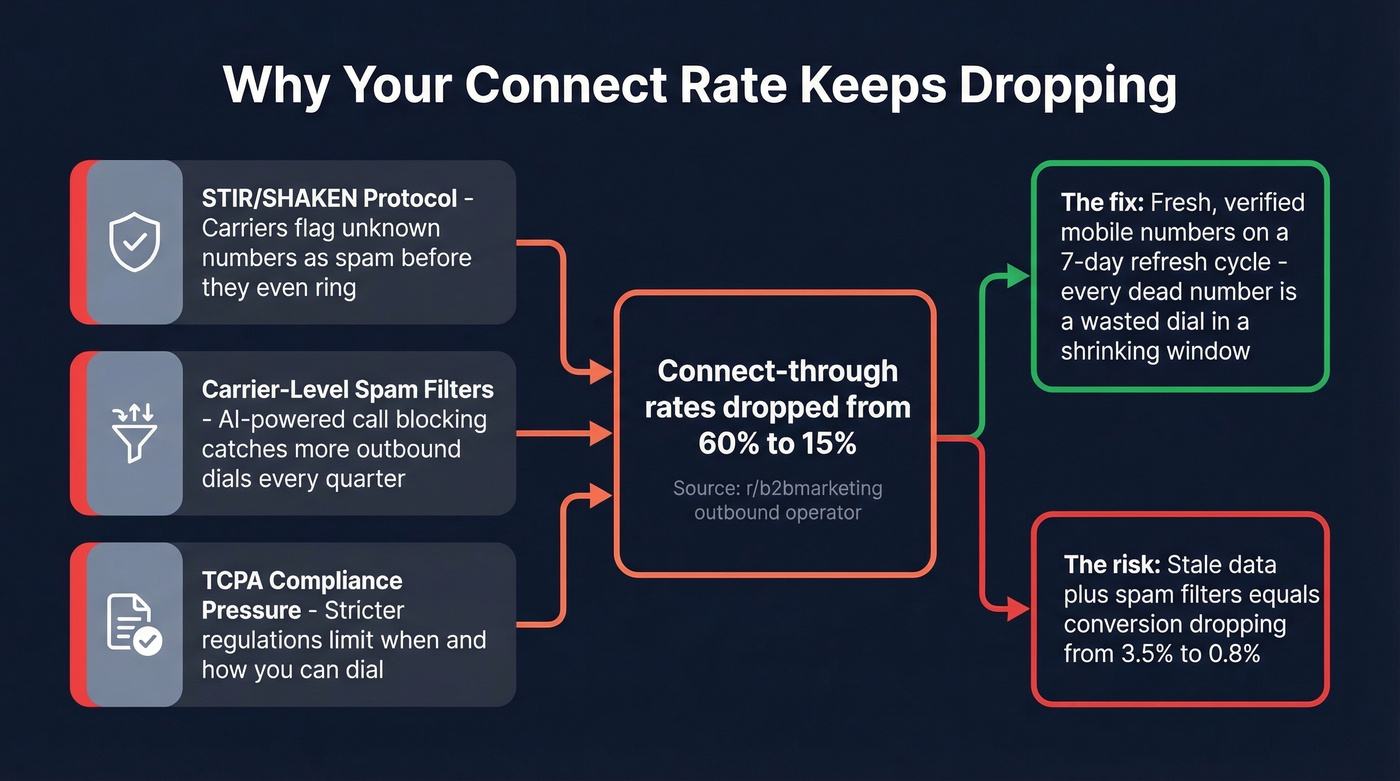
The calls themselves aren't worse - fewer of them are getting through. That makes data quality and number freshness more important than ever, because every dead number or spam-flagged dial is a wasted attempt in an already shrinking window.
How to Improve Your Dial-to-Meeting Rate
Fix Your Data First
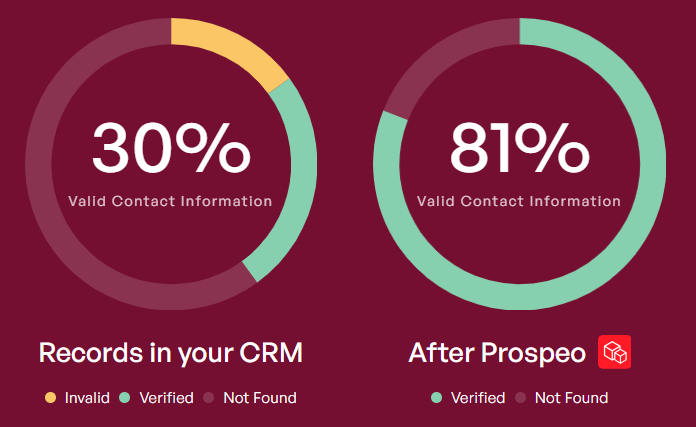
B2B contact data decays at about 2.1% per month - roughly 22.5% annually. If your phone numbers aren't being refreshed constantly, your connect rate gets kneecapped before a single rep opens their mouth.
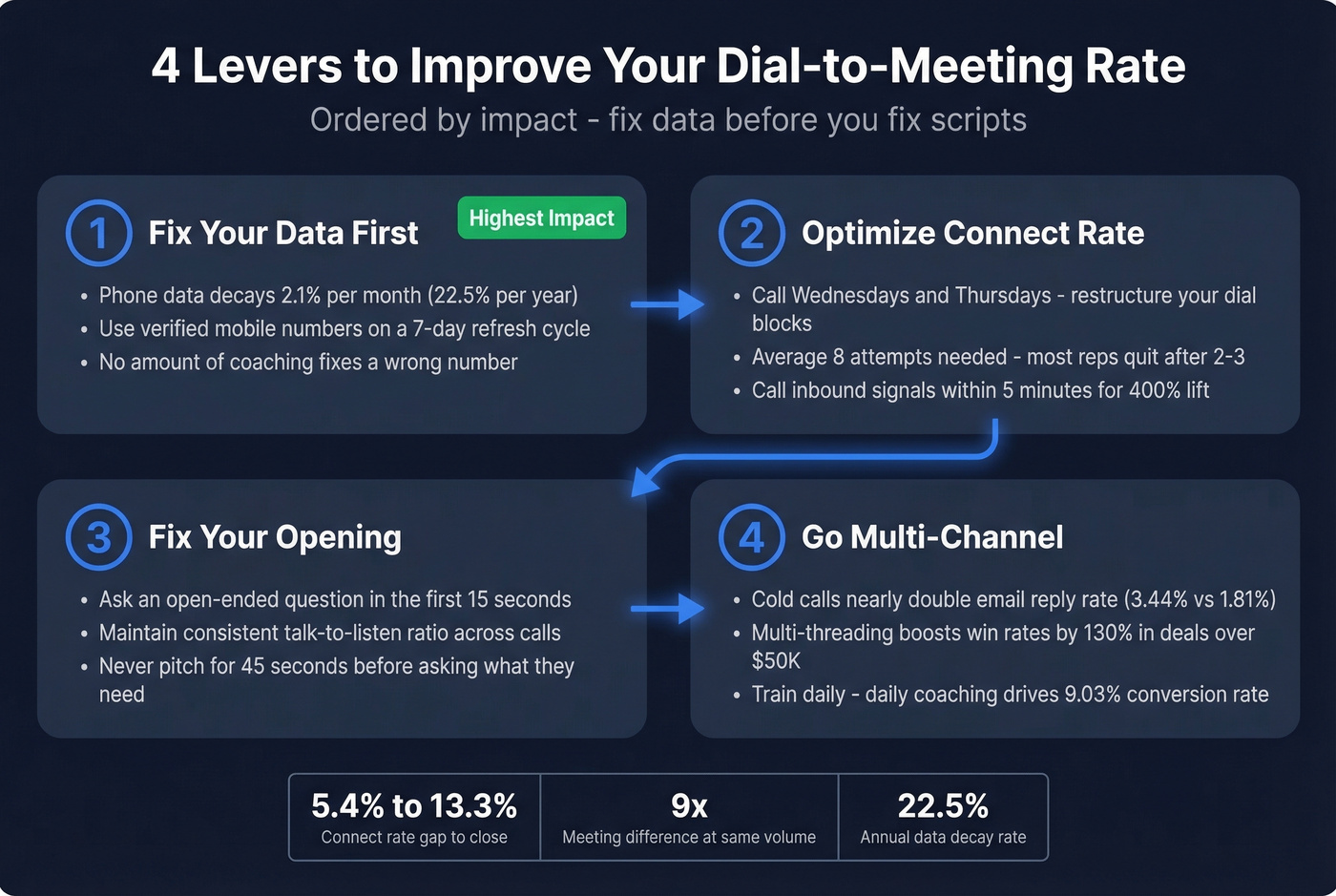
Bad phone data is the invisible conversion killer. We've watched teams agonize over scripts and objection handling while sitting on a database where a quarter of the numbers are dead. Here's the thing: no amount of coaching fixes a wrong number.
When Meritt switched to Prospeo's verified mobile numbers - 125M+ mobiles on a 7-day refresh cycle - their connect rate tripled to 20-25%, and pipeline went from $100K to $300K per week. That's not a script change. It's just better numbers.
Optimize Your Connect Rate
Connect rate is the single biggest gap between top and average performers. Here's what actually moves the needle:
Time your calls. Wednesdays and Thursdays tend to outperform other days. Not by a little - enough to restructure your weekly dial blocks around.
Persist. It takes an average of 8 attempts to reach a prospect. Most reps give up after 2-3. That's leaving meetings on the table.
Respond fast. Calling within the first minute of an inbound signal can improve conversion rates by nearly 400%. Best practice is to call new inbound signups within 5 minutes.
Open with relevance. Cognism's published benchmark shows asking a prospect how they've been can push success rates up to 10.01% - but only because it signals a warm, human tone rather than a robotic script read.
The difference between a 5.4% and 13.3% connect rate isn't luck. It's calling the right people at the right time with numbers that actually work.
Fix Your Opening, Not Your Pitch
A prospect on r/b2b_sales absolutely dismantled an SDR's approach and the feedback was gold: don't open with "how are you doing" (it signals generic sales call instantly), ask an open-ended question in the first 15 seconds, and never pitch for 45 seconds before asking what the prospect actually needs.
The 300M-call dataset backs this up. High-performing reps maintain a consistent talk-to-listen ratio across calls. Low performers swing ~10% - talking 54% in won deals but 64% in lost ones. Consistency signals confidence. Swinging signals nervousness.
If you want a repeatable outbound motion, build a cold calling system that ties data, timing, and talk tracks together.
Go Multi-Channel and Multi-Thread
Cold calling nearly doubles email reply rate - 3.44% vs 1.81% - even when you don't connect on the phone. The voicemail or missed call creates enough pattern recognition that the follow-up email gets opened.
Sopro's analysis of 151M outreach points puts cold email response at 5.1%. Omnichannel sequences drive roughly 25% higher reply rates than email alone.
Multi-threading matters just as much. 77% of deals involve multiple contacts, and closed-won deals have 2x as many buyer contacts as lost deals. In deals over $50K, multi-threading boosts win rates by 130%. Don't just call one person - map the buying committee.
To tighten the email side of the sequence, keep sales follow-up templates ready for every outcome (no answer, voicemail, “not now,” and referral).
Train Daily, Not Quarterly
Focus Digital's training-frequency data shows daily training produces a 9.03% conversion rate - the single largest lift of any variable they measured. The biggest ROI lever isn't hiring more reps. It's giving existing reps better data and daily coaching.
RAIN Group's research across 488 buyers and 489 sellers found top performers drive 2.7x more conversions than the rest. That gap comes from daily reps, not annual SKOs.
If you’re rebuilding your outbound motion, start with proven sales prospecting techniques and then measure what actually changes connect and set rates.
What Cold Calling Actually Costs
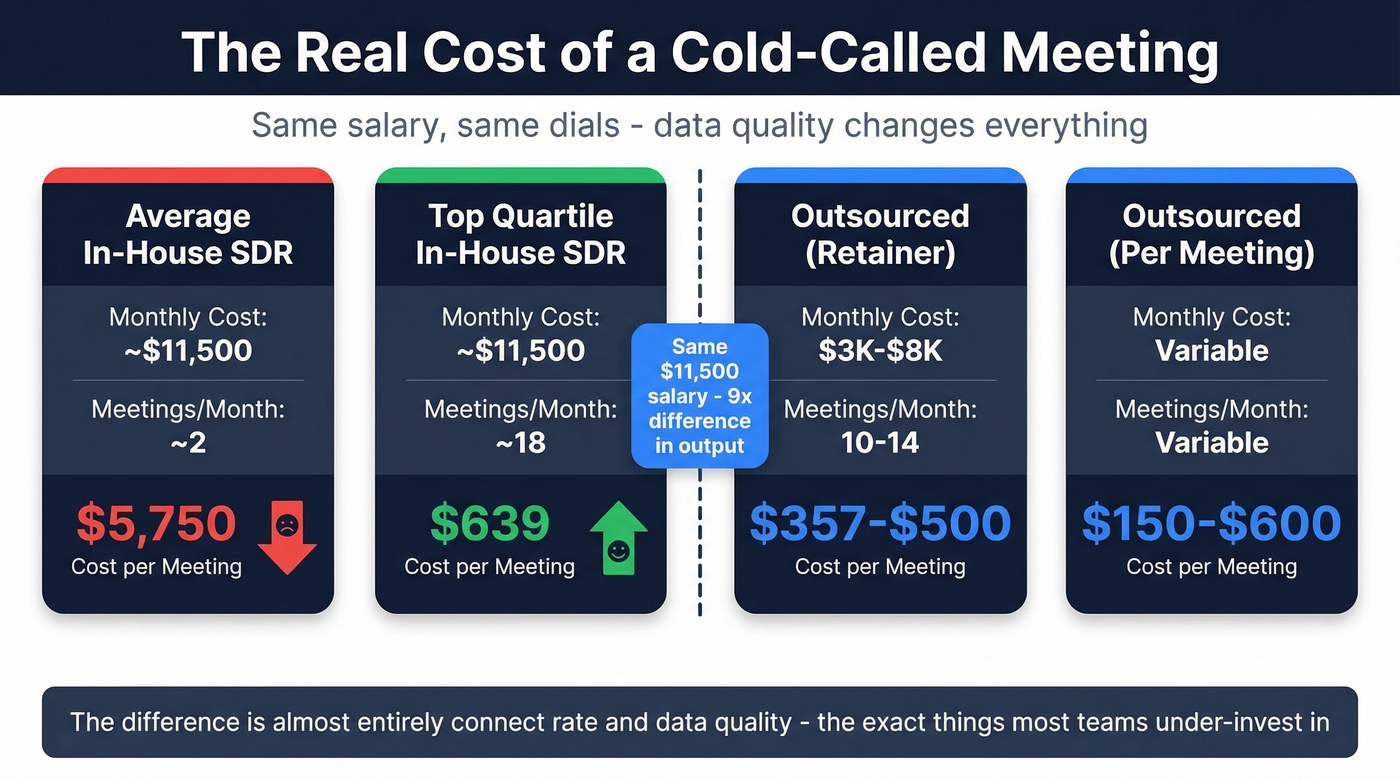
Here's a simple unit-econ model using a typical fully-loaded in-house SDR cost midpoint (~$11,500/month) and Gong's 800-dial benchmark:
| Scenario | Monthly Cost | Meetings/Mo | Cost/Meeting |
|---|---|---|---|
| In-house SDR (avg, 800 dials) | ~$11,500 | ~2 | ~$5,750 |
| In-house SDR (top, 800 dials) | ~$11,500 | ~18 | ~$639 |
| Outsourced (retainer) | $3K-$8K | 10-14 | $357-$500 |
| Outsourced (per-meeting) | Variable | Variable | $150-$600 |
Look: an average in-house SDR costs you nearly $6,000 per meeting booked on that dial volume. A top-quartile rep doing the same dials at the same salary costs ~$639. We've seen this pattern across dozens of outbound teams - the difference is almost entirely connect rate and data quality, the exact things most teams under-invest in while over-investing in scripts and coaching decks.
If your average deal is under $15K, you probably don't need a full-time SDR at all. A founder with fresh mobile data and a multi-channel sequence will outperform an average SDR at a fraction of the cost. Skip the hire until your deal size justifies the overhead.
If you want to benchmark this against broader funnel math, compare it to your overall sales conversion rate and where leads are dropping.
B2B phone data decays 22.5% per year. If your reps are already fighting spam filters and STIR/SHAKEN, stale numbers make it worse. Prospeo's 7-day refresh cycle and 30% mobile pickup rate mean more conversations per dial block - not more wasted attempts.
Every dead number is a meeting you'll never book. Fix your data today.
Cold Calling vs. Other Channels
| Channel | Reach Rate | Meeting Conversion | Best For |
|---|---|---|---|
| Cold calling | 5-10% connect | 2-4% of dials | High-value, complex sales |
| Cold email | 1-5% reply | ~1-2% of sends | Scale and top-of-funnel |
| Social outreach | 20-40% accept | 1-3% of accepts | Warm-up and multi-touch |
| Omnichannel | 25% lift vs email | Highest overall | Serious pipeline generation |
Cold calling converts 2-4x higher than email once you actually connect. Email scales better. The right answer for any team doing real outbound is both - the channels compound each other. Tracking your dial-to-meeting rate alongside email reply rates gives you the full picture of outbound performance.
To operationalize this, most teams end up standardizing on an SDR tool stack and a clean sequence management process.
FAQ
What's a good cold calling conversion rate?
Above 2% dial-to-meeting is solid for B2B SaaS. Top-quartile reps hit 5-6%+ by combining 13%+ connect rates with strong openers. Industry and deal size shift the baseline significantly - enterprise software averages under 1%, while business services sits closer to 2.6%.
How many cold calls does it take to book one meeting?
For an average rep, 200-400 dials per meeting. Top performers book one every 40-50 dials. The gap is almost entirely connect rate - not scripting or closing ability.
Is cold calling still effective in 2026?
Yes - with fresh data and a multi-channel approach. Cold calling nearly doubles email reply rates (3.44% vs 1.81%) even when you don't connect. Fix the data, layer in email and social touches, and the math works.
What tools help improve cold call connect rates?
A verified mobile database is the highest-leverage investment. Pair that with a parallel dialer and call-timing optimization for maximum reach. The consensus on r/sales is that data quality matters more than any dialer feature - you can't connect with someone if the number's dead.