

Cold Calling Mistakes That Are Costing You Meetings
You made 180 dials yesterday. Nine people picked up. Zero meetings booked. Your manager calls it a "numbers game," but the math isn't working - and you're starting to wonder if the channel is broken.
It's not. In a recent survey, 69% of buyers said they picked up a call from a new vendor. Rippling SDRs book 650+ demos per month through cold calls. Hockeystack attributes 90% of their meetings to phone since launching outbound. The channel is alive. Your infrastructure probably isn't.
Most cold calling mistakes have nothing to do with what you say. The real problems are upstream - invisible until you know where to look. Let's walk through each one, starting with the foundations that matter most.
Fix These in Order
Before you rewrite your script or buy a new dialer, work through this sequence:
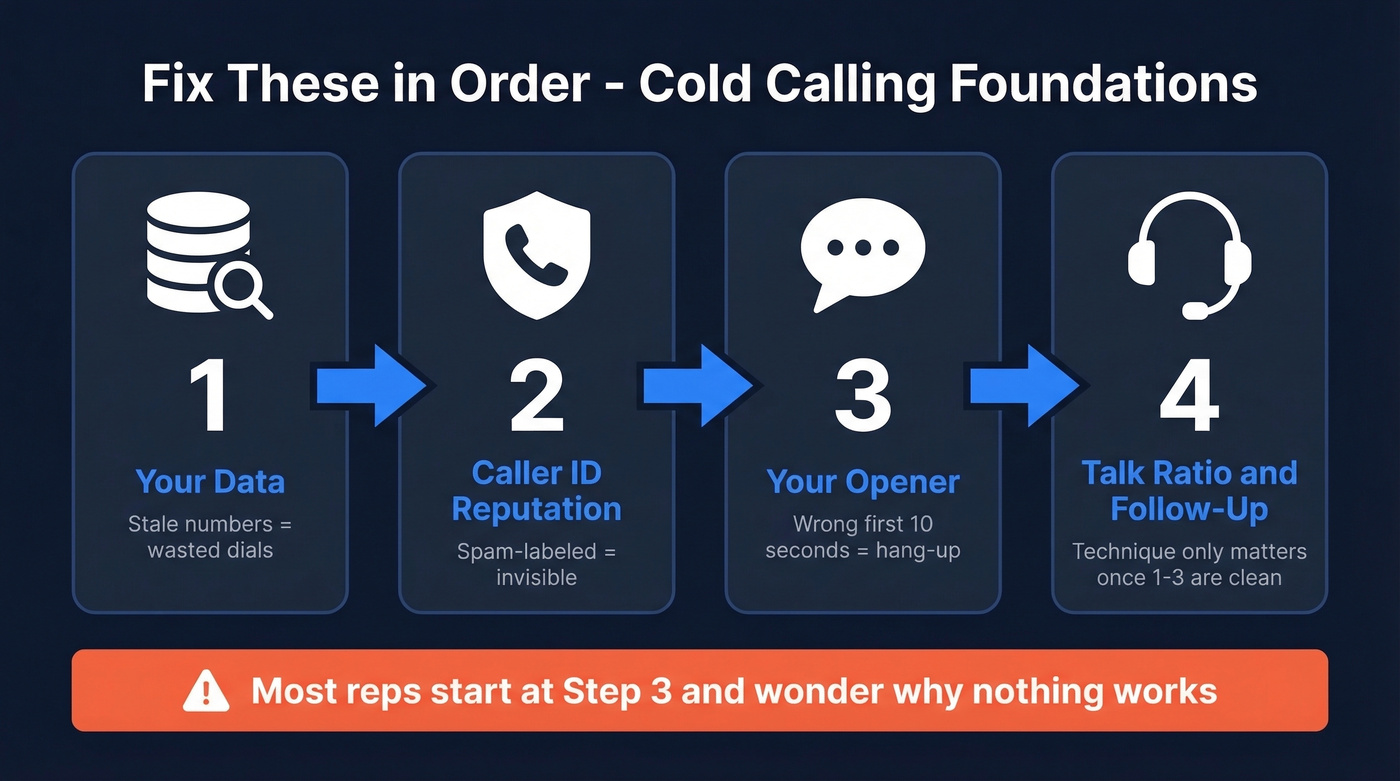
- Your data - stale numbers mean wasted dials
- Your caller ID reputation - spam-labeled means invisible
- Your opener - wrong first 10 seconds means hang-up
- Your talk ratio and follow-up cadence - technique only matters once 1-3 are clean
Most reps start at #3 and wonder why nothing works.
8 Mistakes to Avoid (and How to Fix Each One)
1. Dialing Bad Data
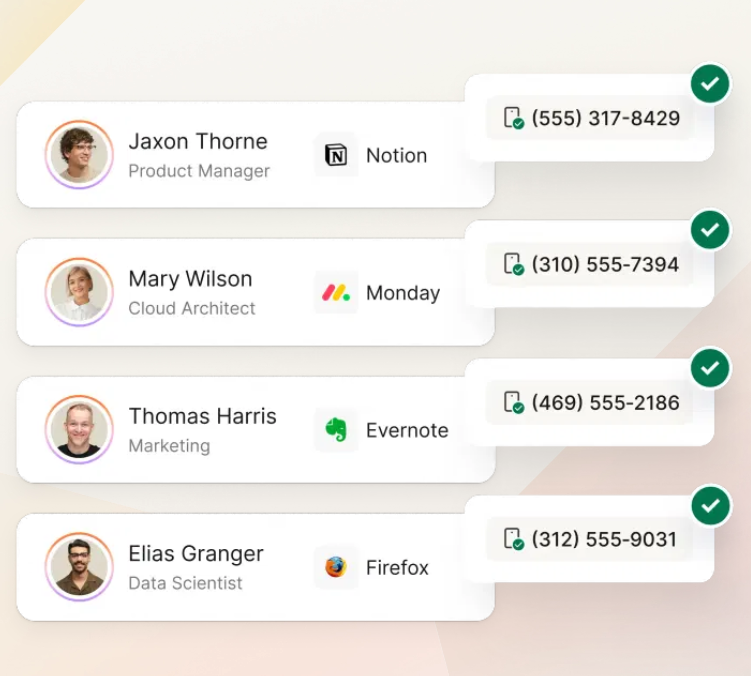
This is the mistake that makes every other mistake worse. B2B data decays roughly [2.1% per month](https://www.hubspot.com/database-decay) - about 22.5% annually. Load a list in January and nearly a quarter of those numbers are dead by December. Reps lose 27.3% of their productive time to bad contact data, which makes it the single biggest reason cold calls fail at scale.
The fix is straightforward: use a provider with verified mobile numbers on a fast refresh cycle. Meritt tripled their connect rate to 20-25% after switching to Prospeo's 125M+ verified mobile database, which refreshes records every 7 days instead of the 6-week industry average. Their pipeline jumped from $100K to $300K per week. When your data is fresh, the "numbers game" actually starts working in your favor.
2. Ignoring Caller ID Reputation
Americans receive roughly 2.56B robocalls per month. Phone fraud cost consumers $948M in 2024, with a median loss of $1,500 per victim. The result: 46% of unidentified calls go unanswered, even legitimate ones.
The infrastructure meant to fix this isn't keeping up. Only 44% of the 9,242 registered voice service providers have proper STIR/SHAKEN caller ID authentication installed. If you aren't monitoring your caller ID reputation, rotating numbers strategically, and investing in branded caller ID, you're invisible before the phone even rings. This is one of the most overlooked problems in the entire outbound process - and it's completely fixable.
3. Using the Wrong Opener
Skip "Hey, is this a bad time?" That phrase decreases your meeting chances by 40%.
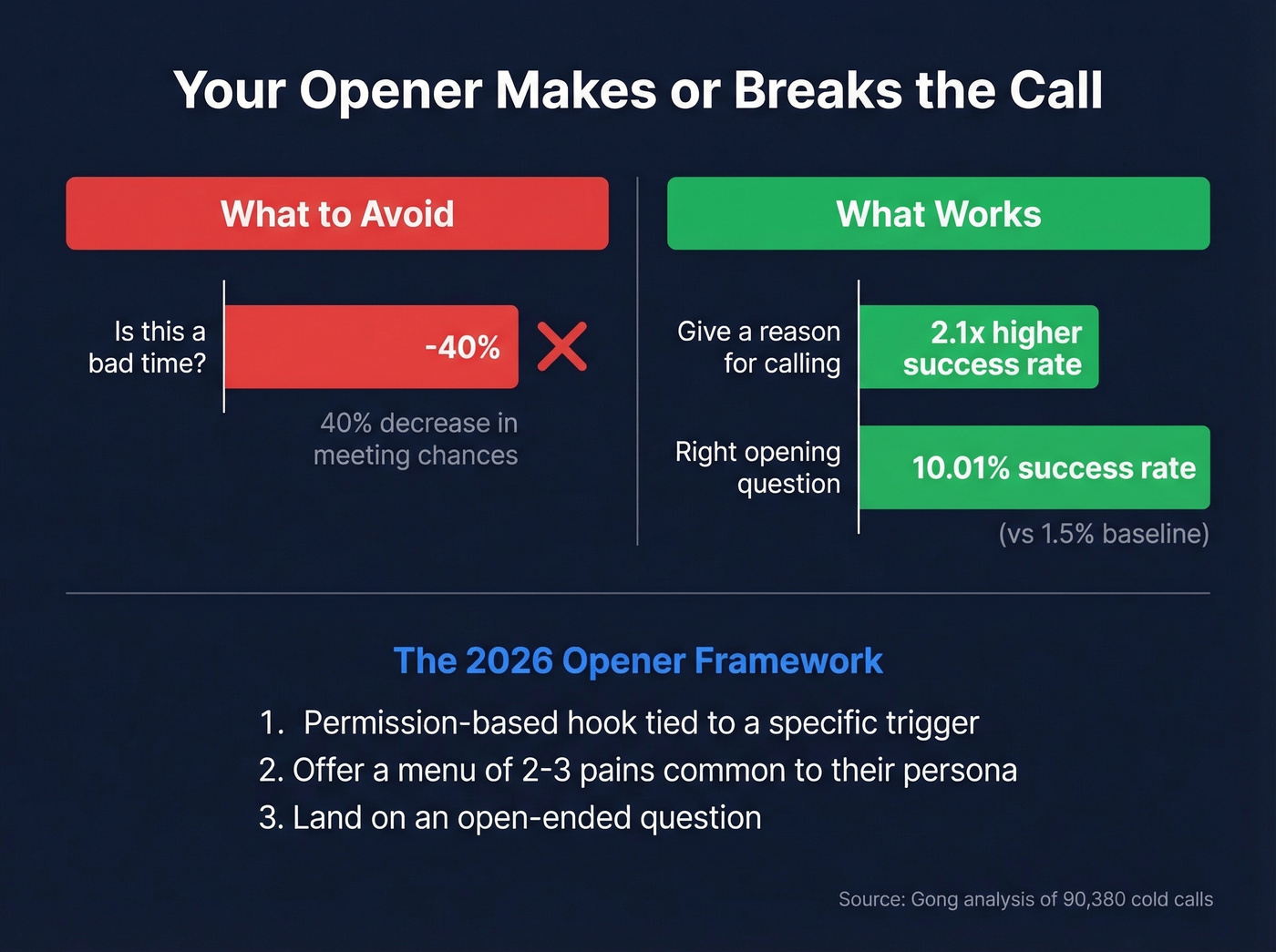
State why you're calling instead. An analysis of [90,380 cold calls by Gong](https://www.gong.io/blog/cold-call-opening-lines) showed that giving a reason for the call leads to 2.1x higher success rates, with the right opening question hitting a 10.01% success rate versus a 1.5% baseline.
Here's the thing: the framework that's working in 2026 isn't complicated. Open with a permission-based hook tied to a specific trigger ("I noticed your engineering team grew 40% this quarter - had a quick question"), offer a menu of 2-3 pains common to their persona, then land on an open-ended question. Spend no more than 5 minutes on pre-call research. Enough to personalize, not so much that you're reading a dossier instead of dialing.
If you want a full stack approach (not just scripts), build a repeatable cold calling as a system so your data, deliverability, and talk track improve together.
4. Talking Too Much
The optimal talk-to-listen ratio is 43% talk, 57% listen. But the real insight isn't the ratio itself - it's consistency. Top performers maintain the same balance whether they win or lose. Low performers swing wildly: 54% talk time on won deals, 64% on lost ones.
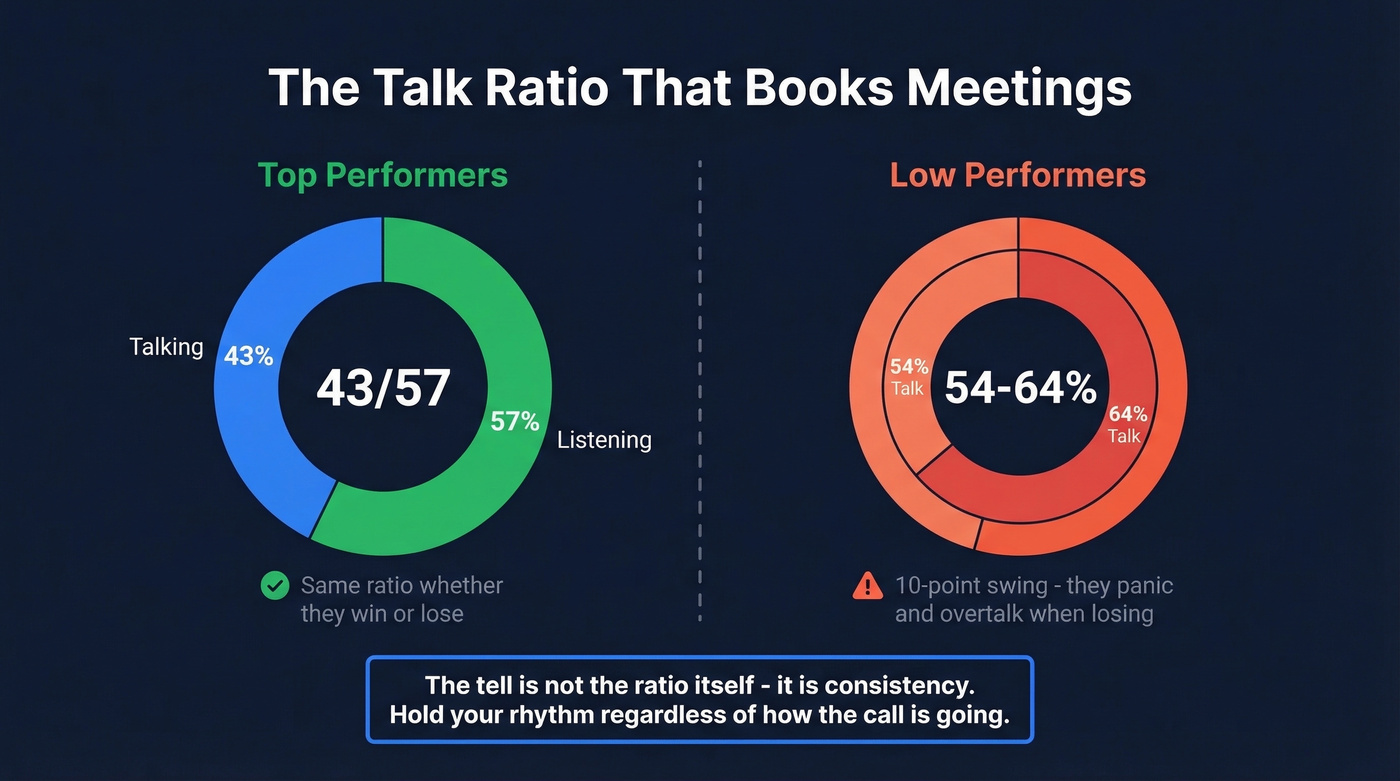
That 10-point swing is the tell. When a call goes sideways, average reps start talking faster and louder, trying to rescue it with more information. The best reps hold their rhythm regardless. Your tone matters too - top performers match their cadence and energy to the prospect's style rather than defaulting to "enthusiastic sales voice." We've reviewed hundreds of call recordings across our team, and the pattern is unmistakable: the reps who sound the same on call #3 and call #150 are the ones booking meetings.
5. Pitching Instead of Selling the Meeting
Successful cold calls average 5:50 in duration. Failed ones average 3:14.
The difference isn't that winners talk longer. They're having a conversation instead of speed-running a pitch deck. Only about 2% of cold calls result in an appointment, and your job on the call isn't to close the deal. It's to earn 30 minutes on the calendar. Every second you spend explaining features is a second you're not discovering whether this person has a problem worth solving. If you're still ramping up your outbound motion, this distinction is the single most important mindset shift you can make.
If your calls are turning into mini demos, tighten your discovery questions so you earn the meeting with curiosity, not features.
6. Calling at the Wrong Time
The data here is consistent across multiple studies:
- Best day: Tuesday, followed by Wednesday
- Best windows: 11am-12pm and 4-5pm local time
- Dead zones: Monday mornings and the lunch hour
These aren't dramatic differences. But when you're making 150+ dials a day, even a 2-3% connect rate improvement from timing adds up to extra conversations every week. Stack your highest-priority dials into the hot windows and save admin work for the dead zones.
7. No Voicemail Strategy
80% of cold calls go to voicemail. Reps spend roughly 15% of their time leaving messages. If you don't have a tight 20-second voicemail script, you're wasting the vast majority of your dials.
The fix: pre-record a voicemail drop that names one specific pain point, gives your name and number, and creates a reason to pick up next time. "I'm calling about [specific problem] - I'll try you again Thursday." No product pitch, no "when you get a chance." Drop and dial simultaneously. This is what separates high-volume teams from high-output teams.
To keep the follow-through consistent after missed connects, use a simple set of sales follow-up templates your whole team can run.
8. Giving Up After One Touch
It takes an average of 8 touchpoints to reach a prospect. Analysis of 1.8M opportunities by Gong found that 77% of closed-won deals involve multiple contacts, and multi-threading boosts win rates 130% on deals over $50K.
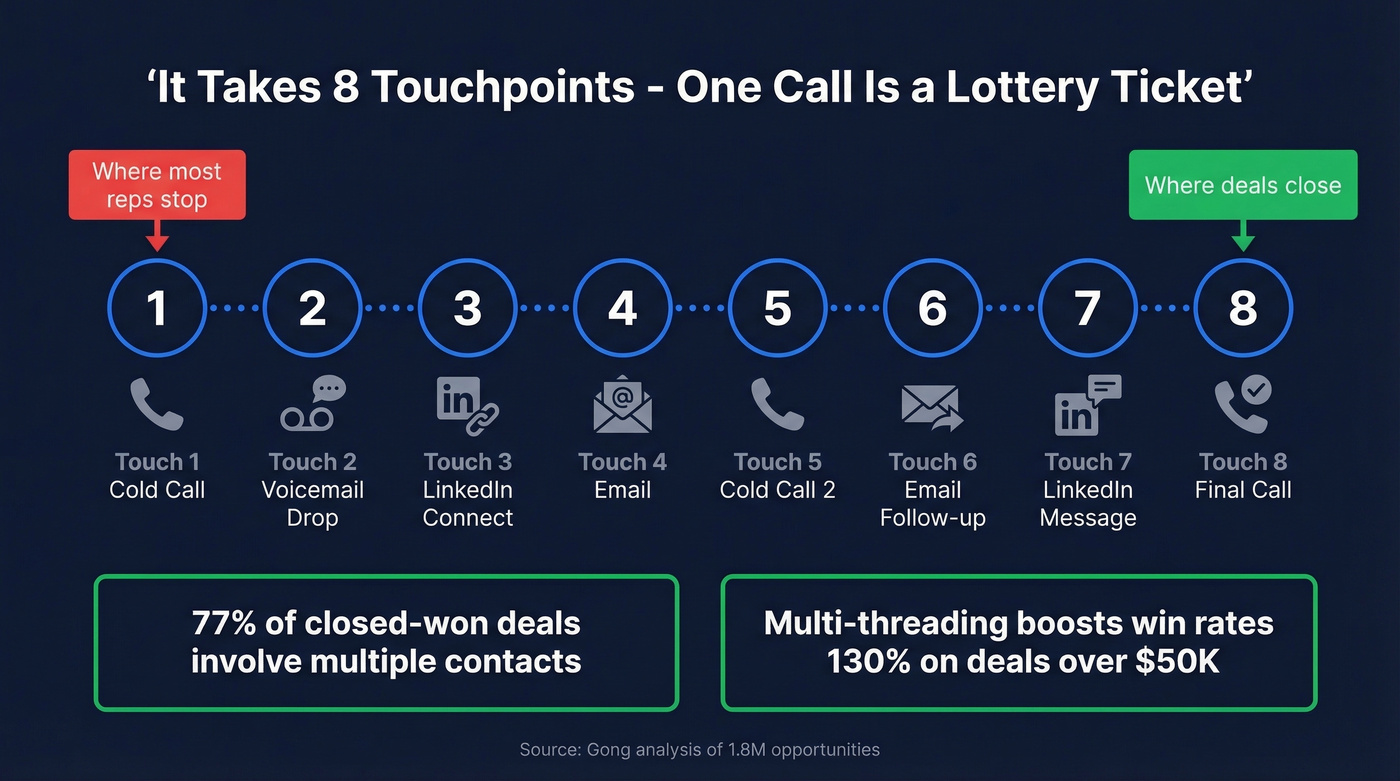
Look - if your average deal size clears five figures, a single cold call without a multi-touch, multi-channel, multi-contact sequence around the target account is malpractice. One call isn't a strategy. It's a lottery ticket.
If you’re building that multi-touch motion, start with proven sales prospecting techniques so calls, email, and LinkedIn reinforce each other.

Bad data is the #1 cold calling mistake - and the easiest to fix. Prospeo's 125M+ verified mobile numbers refresh every 7 days, not the 6-week industry average. Meritt switched and tripled their connect rate to 20-25%, jumping pipeline from $100K to $300K/week.
Stop wasting dials on dead numbers. Start with data that picks up.
Diagnose by the Numbers
Not sure which mistakes are killing your pipeline? Let your metrics tell you. We've adapted this framework from C-Level Partners' KPI diagnostic approach:
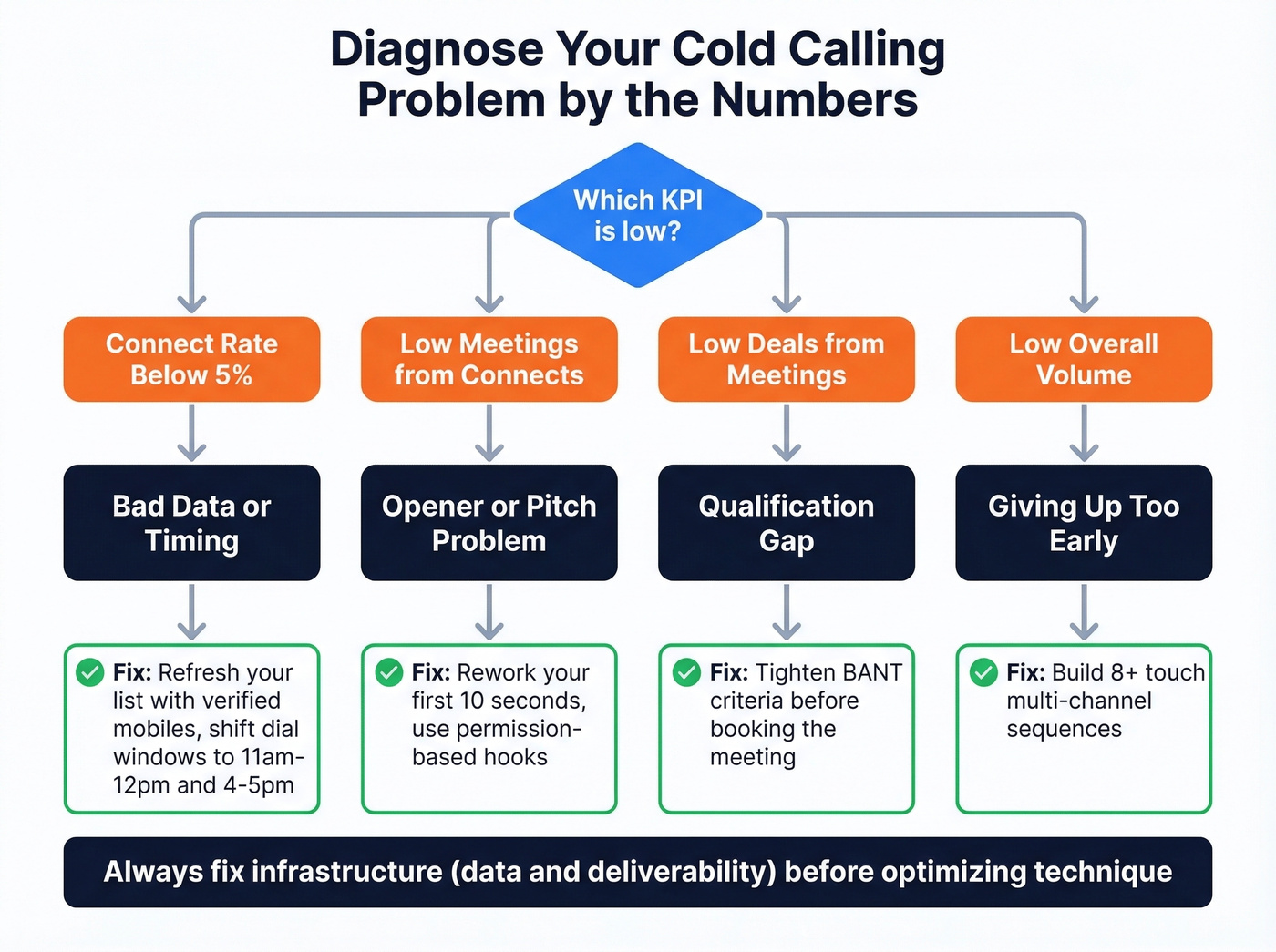
| KPI That's Low | Likely Root Cause | Fix |
|---|---|---|
| Connect rate | Bad data or timing | Refresh list, shift dial windows |
| Meetings from connects | Opener or pitch | Rework your first 10 seconds |
| Deals from meetings | Qualification gap | Tighten BANT before booking |
| Overall volume | Giving up too early | Build 8+ touch sequences |
A common practitioner benchmark is ~5% connect rate with high daily volume. When connect rates crater, it's usually an infrastructure problem - data quality and deliverability - before it's a scripting problem. Fix the infrastructure first, then optimize the technique. That's how you treat cold calling as a system, not a series of isolated dials.
If you’re trying to standardize what “good” looks like across the funnel, align your team on funnel metrics so connect rate, meeting rate, and win rate tell one story.
The consensus on r/sales backs this up: threads about low connect rates almost always trace back to list quality and caller ID issues, not scripts. The reps posting 15%+ connect rates are the ones obsessing over data hygiene.
What Top Performers Do Differently in 2026
Beyond avoiding the mistakes above, a few strategies separate the best from everyone else.
Treat every call as training data. Record your calls, review them weekly, and track which openers convert. In our experience, live review sessions with your team accelerate improvement faster than any course or coaching program. One SDR we work with found that swapping a single opening line boosted her meeting rate by 18% in two weeks - she only caught it because she was tracking.
If you’re building a repeatable outbound motion, a curated set of SDR tools can help you track, score, and iterate faster.
Compare cold calling vs. referrals honestly. Referrals convert at higher rates, but they don't scale. Cold calling fills the top of the funnel when warm introductions dry up, especially during periods when inbound slows. For teams that need predictable pipeline, phone is still the fastest path.
Focus on listening, not scripting. The best reps internalize frameworks, not word-for-word scripts. That flexibility is how they handle conversations that go off-script - and it's why rigid scripts actually hurt experienced reps more than they help.
If you’re newer to the channel, a structured guide to cold calling for beginners can help you ramp without building bad habits.
Eight touchpoints to reach a prospect means eight chances to dial a wrong number - unless your data is clean. Prospeo delivers 30% pickup rates on verified mobiles at $0.01/lead, so every dial in your multi-touch sequence actually connects you to a real person.
Make every dial in your sequence count with 98% accurate contact data.
FAQ
How many cold calls does it take to book a meeting?
At typical 5-10% connect rates and a 2% appointment conversion, expect roughly 200+ dials per day to reliably book one meeting. That number drops fast when you're dialing verified mobile numbers instead of outdated office lines. Internalize the activity math before worrying about scripts.
What's a good connect rate in 2026?
Most B2B teams land between 5-10%. Below 5% consistently means your data or caller ID reputation is the bottleneck, not your pitch. The old 15-20% benchmarks aren't realistic unless your data refreshes weekly and you're dialing verified mobiles.
What's the best time to make cold calls?
Tuesday through Thursday, 11am-12pm and 4-5pm local time consistently outperform other windows. Mondays and the lunch hour are dead zones. Stack your highest-value dials into the hot windows and batch admin tasks into off-peak hours.
Is cold calling still effective in 2026?
Yes. 69% of buyers pick up calls from new vendors. Rippling books 650+ demos per month through cold calls, and Hockeystack attributes 90% of meetings to phone. The channel works, but clean data, caller ID management, and modern openers aren't optional anymore.
What should you never say on a cold call?
Don't lead with "Is this a bad time?" - it drops meeting rates by 40%. Avoid filler phrases like "I'm just checking in" or "Did I catch you at a bad time?" Both signal you don't have a real reason to be on the line. State a specific reason for calling and tie it to a trigger relevant to the prospect.