

Cold Calling Objections & Rebuttals: 2026 Guide
Only 10% of cold calls make it past two minutes. The average call lasts 93 seconds. Every objection you face in that window either kills the conversation or keeps it alive - and the cold calling objections rebuttals you deploy determine which.
Here's the short version: about half (49.5%) of objections are dismissive brush-offs, not real pushback. The framework that handles all of them: Agree, Incentivize conversation, Sell the next step. Master the top 5 objections and you'll cover 74% of what you hear.
Why Prospects Object on Cold Calls
When a buyer feels pressured, their brain kicks into a threat response. The amygdala fires, the prefrontal cortex - the rational, decision-making part - gets sidelined. The first words out of their mouth are defensive. Not because your offer is bad, but because an unknown call registers as a threat.
Losses hit roughly 2x harder than equivalent gains, so every benefit you pitch gets quietly weighed against what they might lose: budget, time, political capital. And only 13% of customers believe a salesperson can understand their requirements. You're fighting biology and reputation.
This is why tone matters more than your script. Smile before you dial - it physically changes your vocal tone, and prospects hear the difference immediately. Slow down, drop your pitch by a register, and sound like a human instead of a quota machine.
Objection Categories at a Glance
An analysis of 300M+ cold calls by Gong found that the top 5 objections account for 74% of all pushback. Every one falls into three buckets:
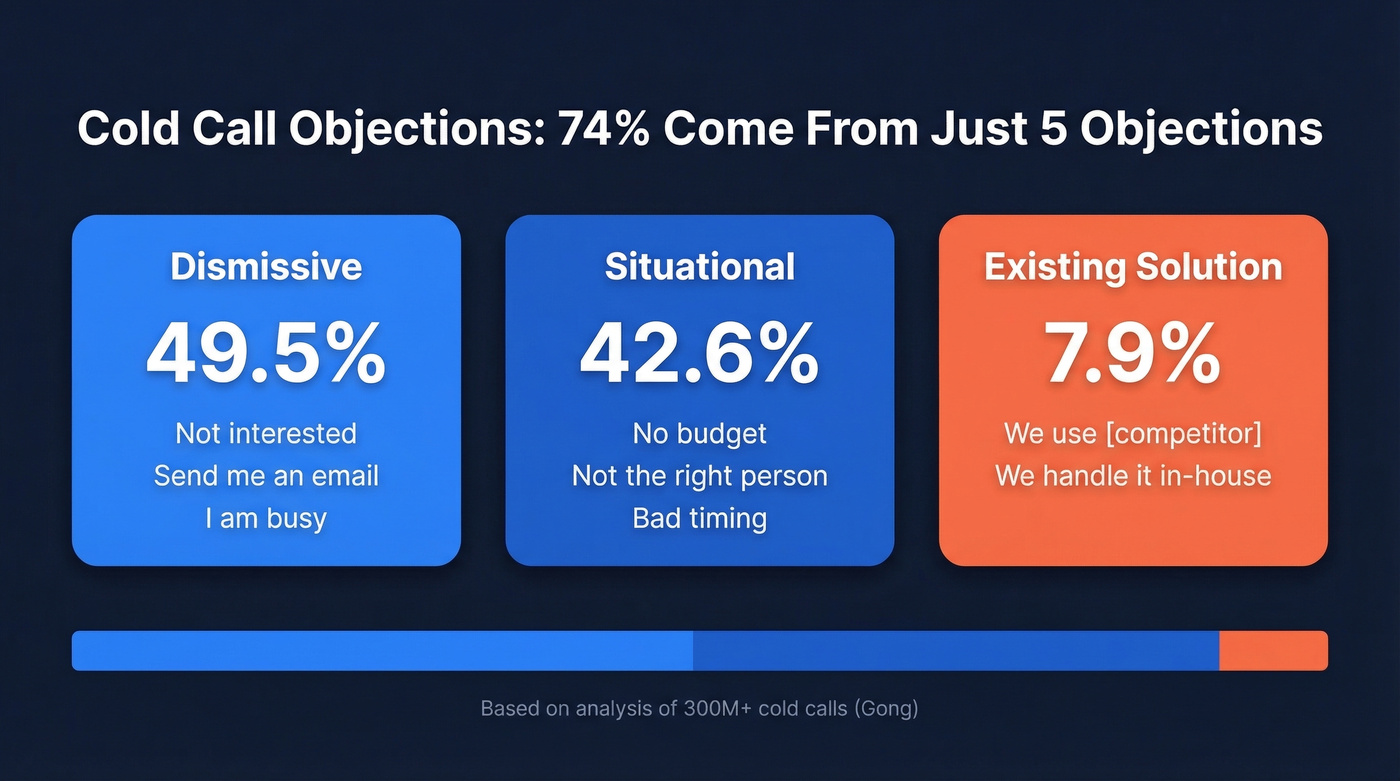
| Category | % of All Objections | Examples |
|---|---|---|
| Dismissive | 49.5% | "Not interested," "Send me an email," "I'm busy" |
| Situational | 42.6% | "No budget," "Not the right person," "Bad timing" |
| Existing Solution | 7.9% | "We use [competitor]," "We handle it in-house" |
Nearly half of all objections are dismissive brush-offs - the reflex talking, not the decision-maker. That's good news. Dismissive objections are the easiest to handle with a consistent framework and the right rebuttals.
Rebuttals for Every Objection Type
Dismissive Objections
"Not interested."
They don't know enough to be uninterested. They're ending the call on autopilot.
"That's fair - most people say that before they know why I'm calling. Can I take 30 seconds to explain, and you tell me if it's worth a follow-up? If not, I'll hang up."
You're selling 30 seconds, not a product. The "does that sound fair?" framing taps into reciprocity - most people won't reflexively say "no" to a small, reasonable request.
"I'm busy / call me back."
This is the objection reps fumble most, according to r/sales. The mistake: immediately conceding with "Sure, when's a good time?" You'll never get them back.
| Don't do this | Do this instead |
|---|---|
| "No problem, when should I call back?" | "I know I caught you cold - can I level with you briefly to see if it even makes sense to follow up?" |
| Gives them an easy escape they'll take | Asks for permission to qualify - a much smaller ask |
One rep on r/sales reported that single line moves the conversation forward about 80% of the time. We've seen similar results - even a modest version of this approach dramatically outperforms the polite retreat.
"Send me an email."
A polite exit, not a request. If you send it, it dies in their inbox. Flip it:
"Happy to. So I don't waste your time with a generic email - what's the one thing that'd make it worth opening?"
Now they're telling you what they actually care about. And you've got a real reason to follow up. If you need a fast follow-up, keep a few sales follow-up templates ready so you can send something specific, not generic.
"Is this a sales call?"
Don't dodge it. Disarming bluntness works best here.
Prospect: "Is this a sales call?" You: "It is - I'll be upfront. I'm calling because [one-sentence reason tied to their role]. If that's not relevant, I'll let you go."
Transparency reduces tension fast. They expected you to squirm. When you don't, the dynamic shifts.
Situational Objections
"No budget right now."
They might be telling the truth - but your job on a cold call isn't to close a deal. It's to sell the test drive. Remove purchase pressure entirely:
"Totally get it - I'm not asking you to buy anything today. Would it make sense to see how [specific outcome] works so you have options when budget opens up?"
"Not the right person."
Don't argue. Use it as a referral:
"Appreciate that. Who handles [specific function]? I'll mention you pointed me their way."
Short, respectful, and it turns a dead end into a warm intro.
Existing Solution Objections
"We already use [competitor]."
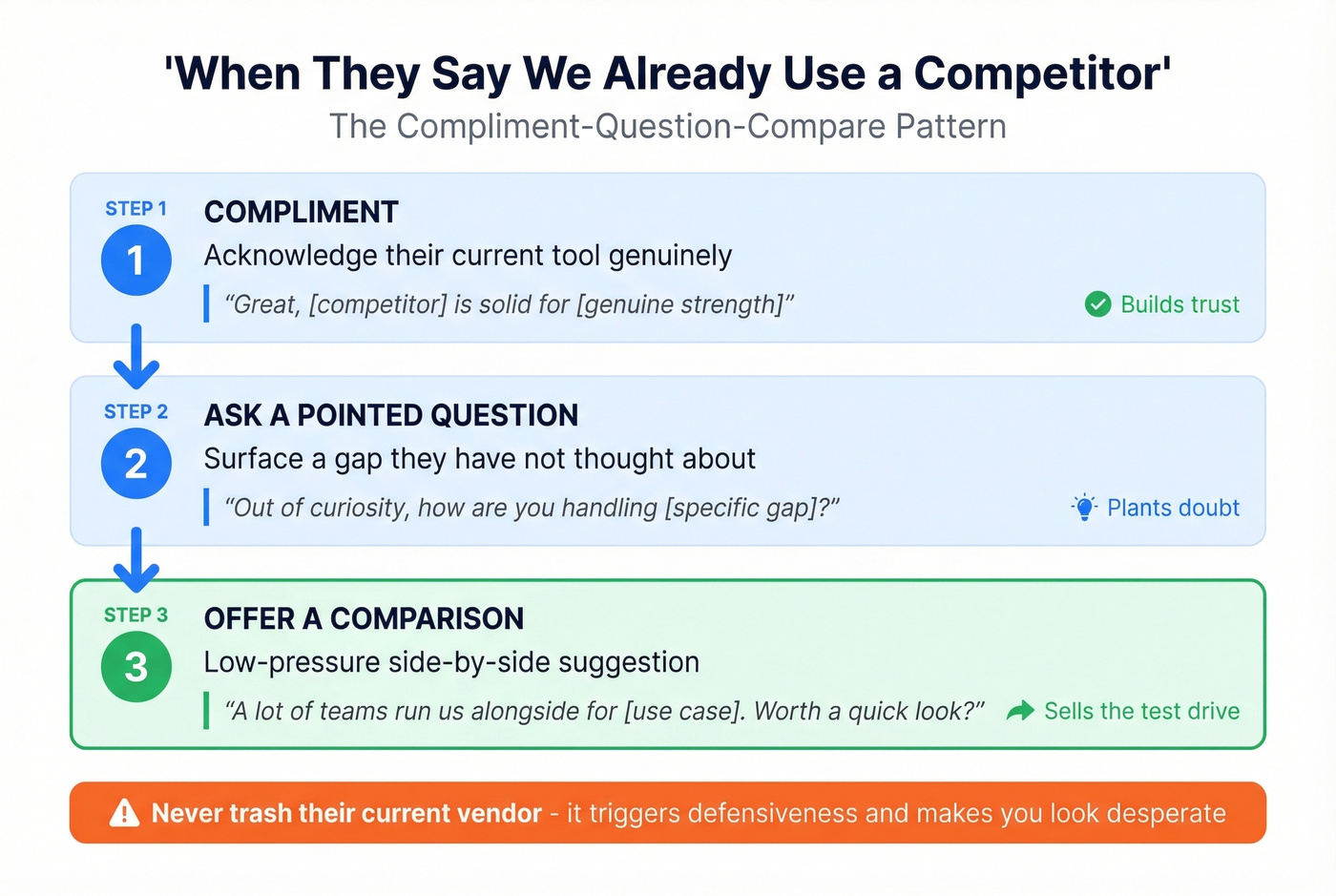
Let's be honest: this is the best objection you can get. It means they've bought into the category. They understand the problem. They have budget allocated. The response follows what we call the Compliment-Question-Compare pattern:
- Agree - "Great, [competitor] is solid for [genuine strength]."
- Ask a pointed question - "Out of curiosity, how are you handling [specific gap]?"
- Offer a comparison - "A lot of teams run us alongside for [use case]. Worth a quick look?"
Never trash their current vendor. It triggers defensiveness and makes you look desperate. Compliment the competitor, then plant a seed of doubt with a question they can't easily answer.
"We're locked in a contract."
Contracts end. Plant the seed now:
"When does it come up for renewal? I'd love to give you a comparison point before then so you're not scrambling."
Persistence isn't pushiness - it's follow-through. But respect the 3 No Rule: three genuine "no" signals in a single call means stop. Pushing past that burns the account.
If you want a deeper system for handling pushback across the whole motion (not just on the phone), see our guide on how to reduce sales objection rate.

Every rebuttal in this guide assumes you're talking to a real decision-maker. But 22.5% of B2B contact data decays annually - meaning 1 in 5 calls hits the wrong person or a dead line. Prospeo's 7-day data refresh and 125M+ verified mobile numbers mean your rebuttals land on live prospects, not voicemail boxes.
Stop perfecting rebuttals for people who'll never pick up.
The Three-Step Rebuttal Framework
Every rebuttal above follows the same structure:
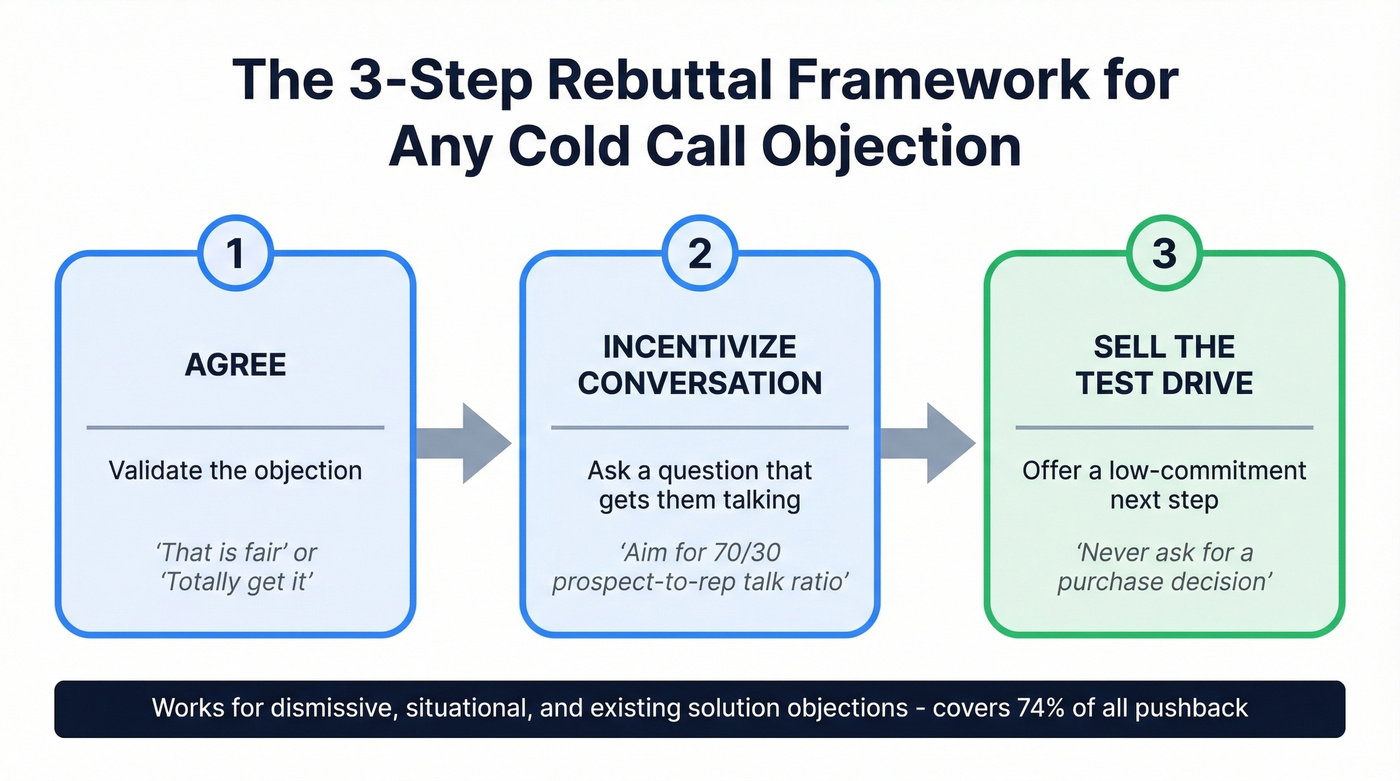
- Agree - Validate the objection. ("That's fair," "Totally get it.")
- Incentivize conversation - Ask a question that gets them talking. Aim for a 70/30 prospect-to-rep talk ratio.
- Sell the test drive - Offer a low-commitment next step, never a purchase decision.
An older variant worth knowing: Feel-Felt-Found. "I understand how you feel. Other [role] felt the same. What they found was [outcome]." It works, but it sounds rehearsed if you don't make it your own. The best reps internalize the framework and adapt their language to each prospect's tone and context rather than reading from a script word-for-word.
If you're building a repeatable outbound motion around this, it helps to document it as a full cold calling system and train to it.
Prevent Objections Before They Happen
The best rebuttal is the one you never need. Explaining why you're calling increases success rate by 2.1x. Asking "Is this a bad time?" decreases meeting chances by 40%.
But the biggest objection-prevention move isn't your script - it's your contact data. B2B contact data decays at 2.1% per month. That means 22.5% of your list is wrong by year's end, and bad data costs the average company $12.9 million per year. When you call a number belonging to someone who left six months ago, you're not facing a real objection. You're facing a data problem disguised as hostility.
We've seen teams cut objection rates dramatically just by fixing their data. Prospeo's 125M+ verified mobile numbers carry a 30% pickup rate on a 7-day refresh cycle, which means you reach the right person with current information - and face real objections you can actually handle instead of confused strangers wondering why you're calling.
If you're pairing calls with email, a tight B2B cold email sequence reduces "send me an email" as a brush-off because the follow-up is already planned.
"Not the right person" disappears as an objection when your data is accurate. Prospeo's 30+ search filters - job title, department, seniority, buyer intent - put you on the phone with the actual decision-maker. At $0.01 per verified email, bad data stops costing you conversations.
Reach the right person and skip the referral runaround entirely.
Benchmark Your Calls
How do you know if your rebuttals are working? Track these numbers:
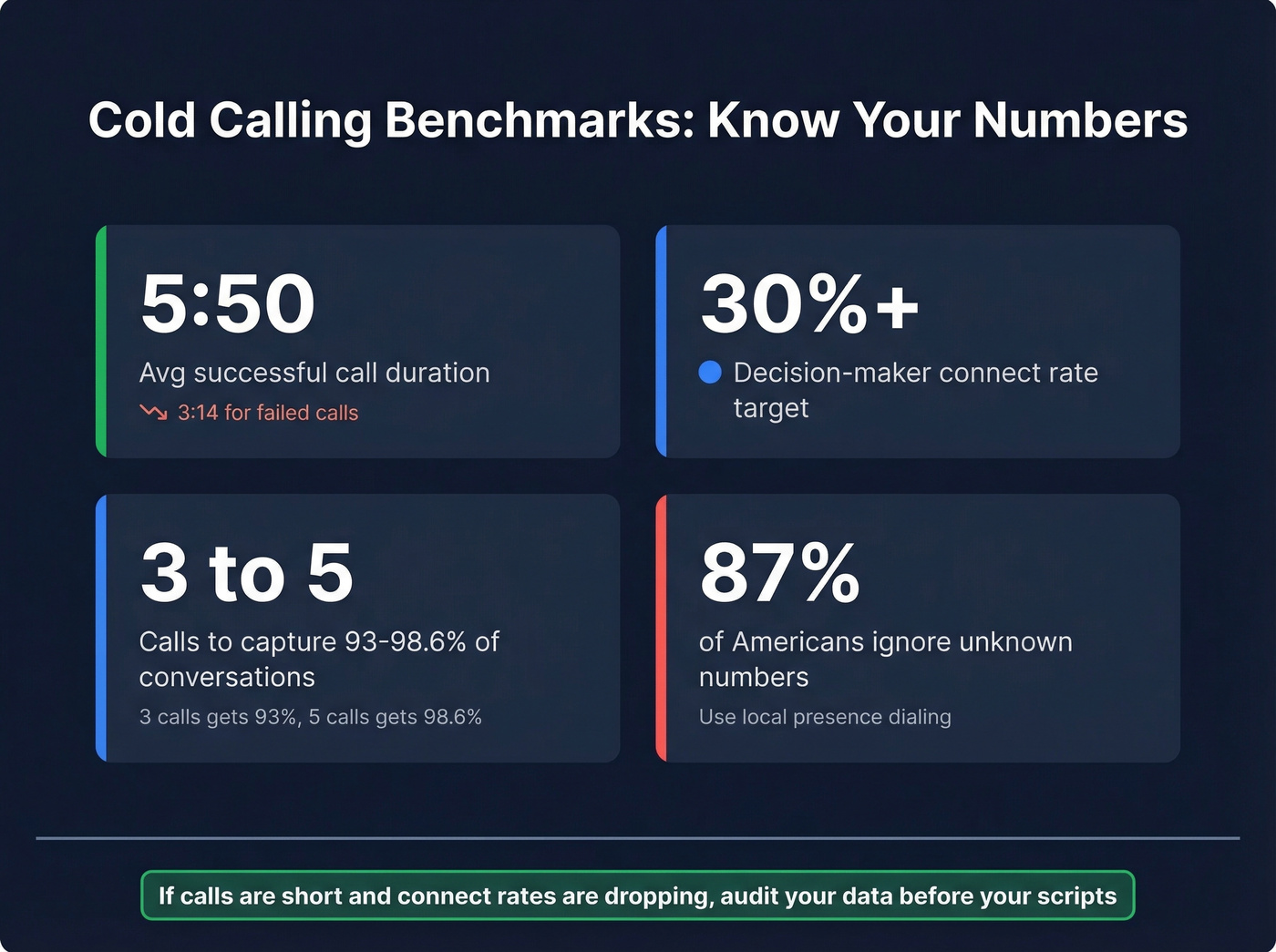
- Successful call duration: 5:50 avg vs. 3:14 for failed calls
- Decision-maker connect rate target: 30%+
- Attempt sweet spot: 3 calls captures 93% of total conversations; 5 calls gets you to 98.6%
- Unknown number problem: 87% of Americans ignore unknown numbers - use local presence dialing
To improve these benchmarks, align your daily dials with a clear set of sales activities and a broader set of sales prospecting techniques so you’re not relying on brute force.
FAQ
How many objection responses should I memorize?
The top 5 objections cover 74% of all pushback. Master those across three categories - dismissive, situational, and existing solution - then expand to edge cases as you gain confidence.
What's the best response to "I'm not interested"?
Agree, then pivot: "Can I take 30 seconds to explain, and you tell me if it's worth a follow-up?" You're selling the next 30 seconds, not the product. This reframe converts roughly 40-50% of brush-offs into real conversations.
How does data quality affect cold call objections?
Wrong numbers and departed contacts generate hostile responses no script can fix. B2B data decays at 2.1% per month - tools like Prospeo refresh records every 7 days versus the 6-week industry average, so you're dialing verified mobiles instead of dead numbers.
Should I use the same rebuttal script every time?
No. Internalize the Agree, Incentivize, Test Drive framework, then adapt your language to each prospect's tone and context. Scripted responses sound robotic and trigger more resistance. Flexibility within a proven structure outperforms rigid scripts every time.
Objections aren't the problem. How you handle cold calling objections and rebuttals is. Nail the framework, clean up your data, and the numbers take care of themselves.