

The Cold Calling PPT Your Sales Team Actually Needs
Most cold calling PPT templates are pretty shells. You grab one from SlideTeam or SlideGeeks, get 15 slides of gradient backgrounds and placeholder text that says "Insert your script here," and you're no closer to training anyone. What your team needs isn't a polished deck - it's accurate content backed by real numbers.
We've built and rebuilt cold calling training decks for years, and the version below is what actually sticks. Here's a slide-by-slide outline with 2026 benchmarks, tested scripts, and objection responses your reps can use tomorrow. Copy it into Google Slides or PowerPoint and you're done.
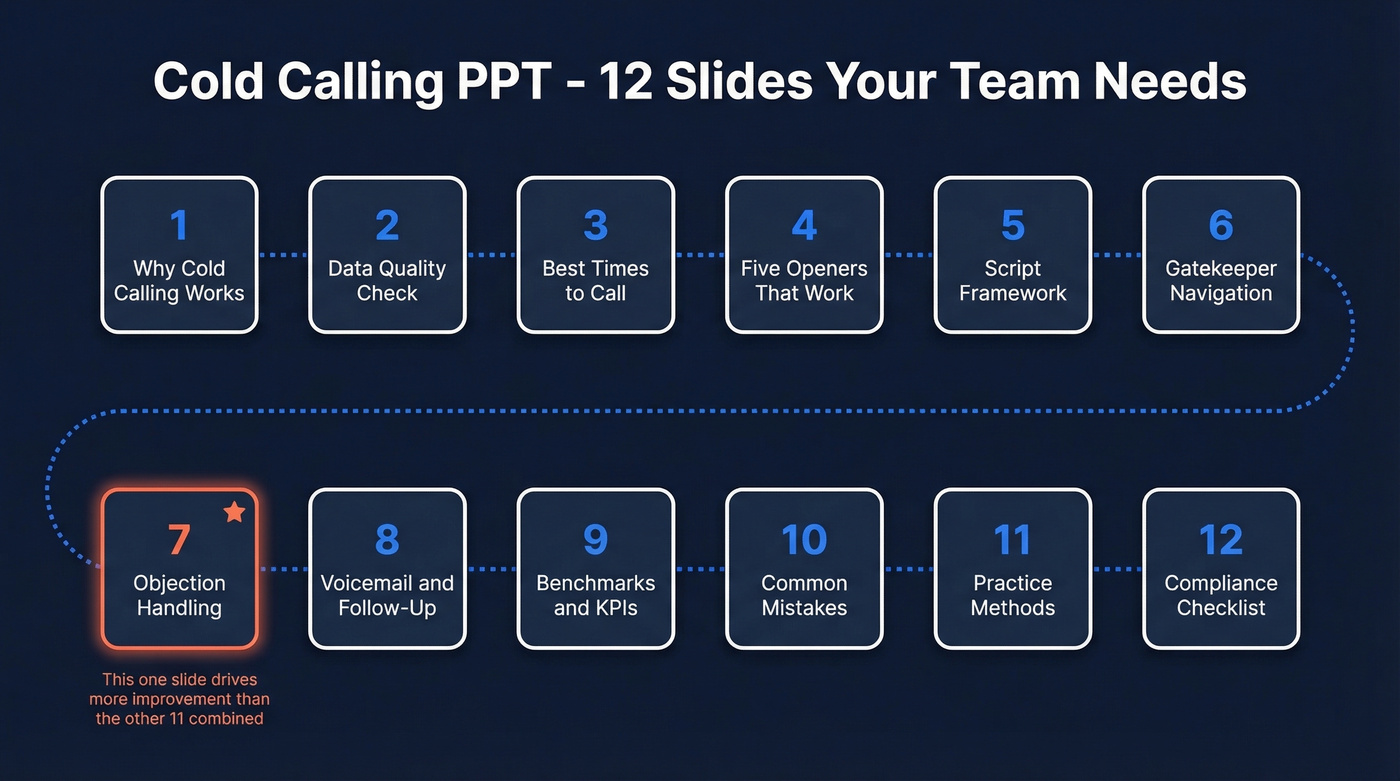
Complete Cold Calling Presentation - 12 Slides
Slide 1: Why Cold Calling Still Works
Open with proof, not motivation. 69% of buyers picked up a call from a new vendor in the past year. 69% of buyers picked up a call from a new vendor in the past year. The conversation-to-meeting rate sits at 4.82% - not huge, but compounding across a team of 10 reps, that's pipeline. Cold calling isn't dead; it's just done badly most of the time.
If you've browsed r/sales or r/Entrepreneur threads on cold calling, you'll notice the same pattern: reps who track their numbers and iterate consistently outperform those chasing silver-bullet scripts. Put the data on this slide and let it speak.
Slide 2: The Data Quality Prerequisite
Include this slide if your team dials from CRM lists older than 90 days. Skip it if you're already running verification before every call block - but let's be honest, almost nobody is.
B2B contact data decays roughly 2.1% per month, meaning about 22.5% of your list is wrong by year's end. Poor data quality costs companies an average of $12.9M per year. That's not a training problem - it's an infrastructure problem, and it belongs in your deck before any talk tracks. We use Prospeo's mobile finder for this step: 125M+ verified mobile numbers with a 30% pickup rate, refreshed on a 7-day cycle. Any verification tool that catches stale numbers will save hours of wasted dials. Verify before you train.
Slide 3: Best Time and Day to Call
Put this table on a slide. Reps should have it memorized within a week.
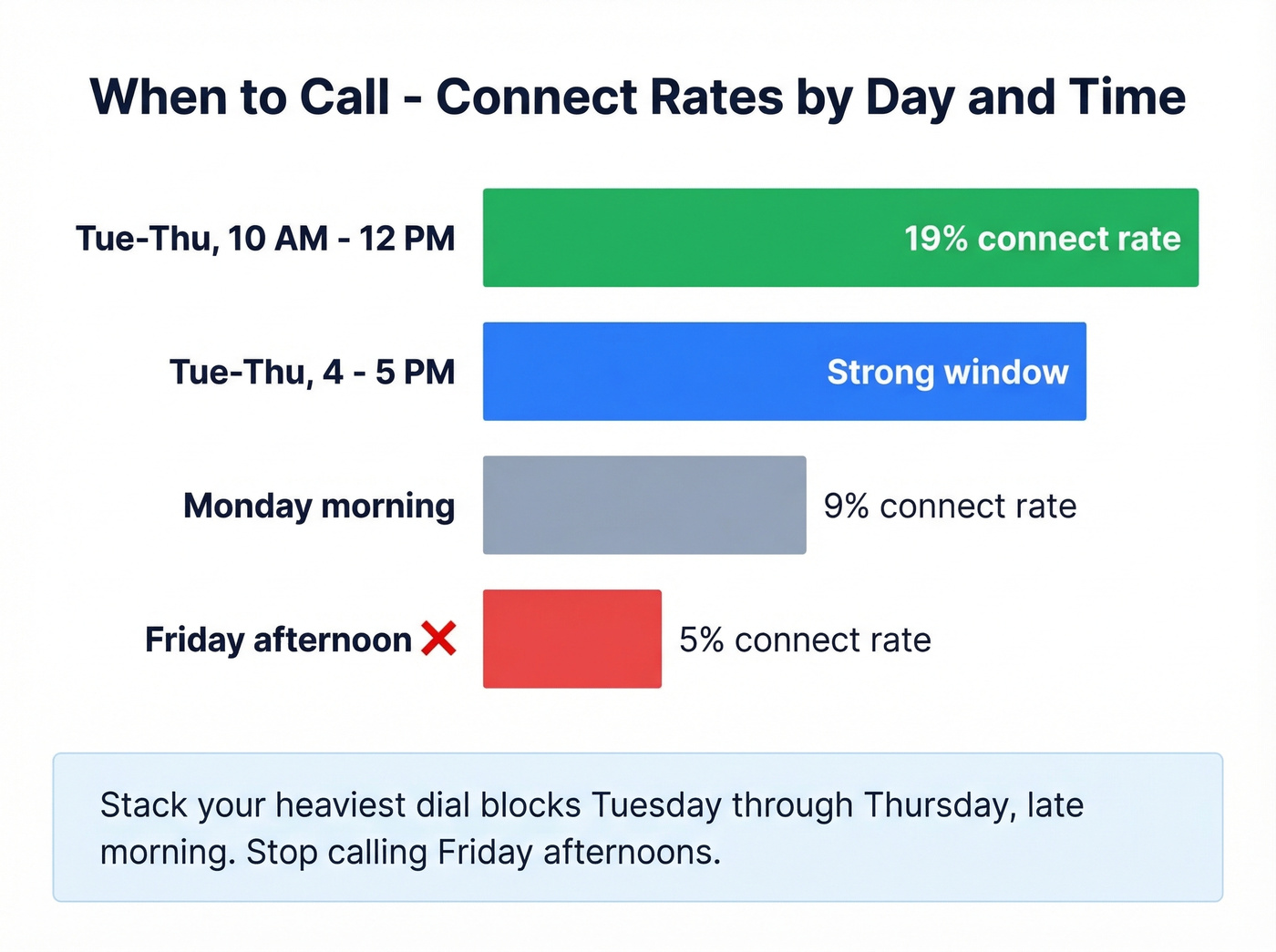
| Day / Time | Connect Rate |
|---|---|
| Tue-Thu, 10 AM-12 PM | 19% |
| Tue-Thu, 4-5 PM | Strong window |
| Monday morning | 9% |
| Friday afternoon | 5% |
Stack your heaviest dial blocks Tuesday through Thursday, late morning. Stop calling Friday afternoons - the data doesn't justify it.
Slide 4: Five Openers That Work
Field-tested stay-on-line rates past 30 seconds:
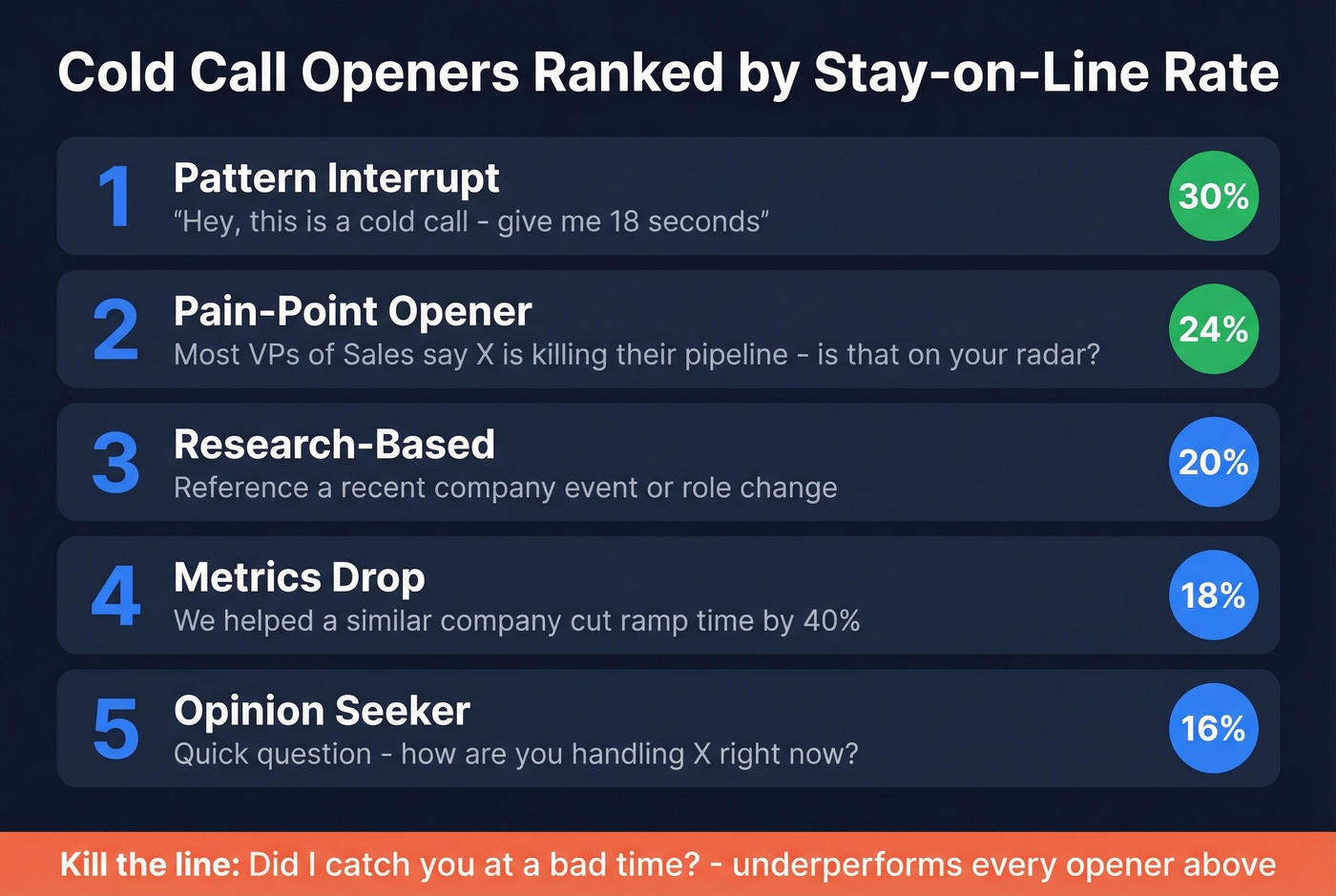
- Pattern interrupt ("Hey, this is a cold call - give me 18 seconds"): 30%
- Pain-point ("Most VPs of Sales I talk to say X is killing their pipeline - is that on your radar?"): ~24%
- Research-based (reference a recent company event or role change): ~20%
- Metrics drop ("We helped [similar company] cut ramp time by 40% - curious if that number means anything to you"): ~18%
- Opinion seeker ("Quick question - how are you handling X right now?"): ~16%
The classic "Did I catch you at a bad time?" underperforms a pattern-interrupt opener in every tracked test we've seen. Kill that line in every training deck. Practitioners like Justin Michael have popularized rapid-fire pattern interrupts and tonality shifts that align with this data - if your reps want to go deeper, his methodology is worth studying.
Slide 5: Cold Call Script Framework
Don't give reps a rigid script. Give them a flexible framework: opener, permission, value, question, next step.
"Hey Sarah, this is Jake from [Company]. I know I'm calling out of the blue - mind if I take 18 seconds to tell you why, and you can decide if it's worth continuing?"
Get the micro-yes, deliver a tight value statement, then ask a discovery question. Here's the thing: delivery matters as much as the words. Confidence and genuine curiosity outperform a perfect script read in monotone every single time. Jordan Belfort's "straight line" approach around tonal certainty reinforces this - how you sound in the first four seconds determines whether the prospect stays on the line.
Slide 6: Gatekeeper Navigation
The ask-for-help approach outperforms everything else.
"I'd feel much better if I knew your name before I asked for a favor. What's the best way to reach [decision maker]?"
Treat gatekeepers as allies, not obstacles. They remember reps who are respectful - and they remember the ones who aren't. Townsend Wardlaw's training emphasizes this exact principle: building rapport with gatekeepers as a repeatable skill, not a one-off tactic.
Slide 7: Objection Handling
This is the most important slide in the deck. Reps can improvise openers, but freezing on "I'm not interested" kills the call. Use Listen, Clarify, Respond:
| Objection | Response |
|---|---|
| "Not interested" | "Totally fair. Mind if I share the one reason I called? If it's not relevant, I'll hang up." |
| "Too busy" | "I get it - can I have 25 seconds? If it's not worth it, say the word." |
| "Send me an email" | "Happy to. What's the best time to follow up after you've reviewed it?" |
| "Not the decision maker" | "Who would be the right person? I'd rather not waste your time." |
| "We already have a solution" | "Good - most people I call do. Curious how you're handling [specific pain point]?" |
In our experience, reps who drill this table three times a week for two weeks stop freezing entirely. That one slide drives more improvement than the other eleven combined.
Slide 8: Voicemail and Follow-Up
Voicemails are basically dead. One practitioner tracked 310 voicemails and got 7 callbacks - roughly 1%. When they switched to sending a social message within 5 minutes of a missed call, they got 22 responses from 156 attempts (14%). A 3-channel approach - call, social message, and email within 24 hours - increased meeting rates 37% within a month.
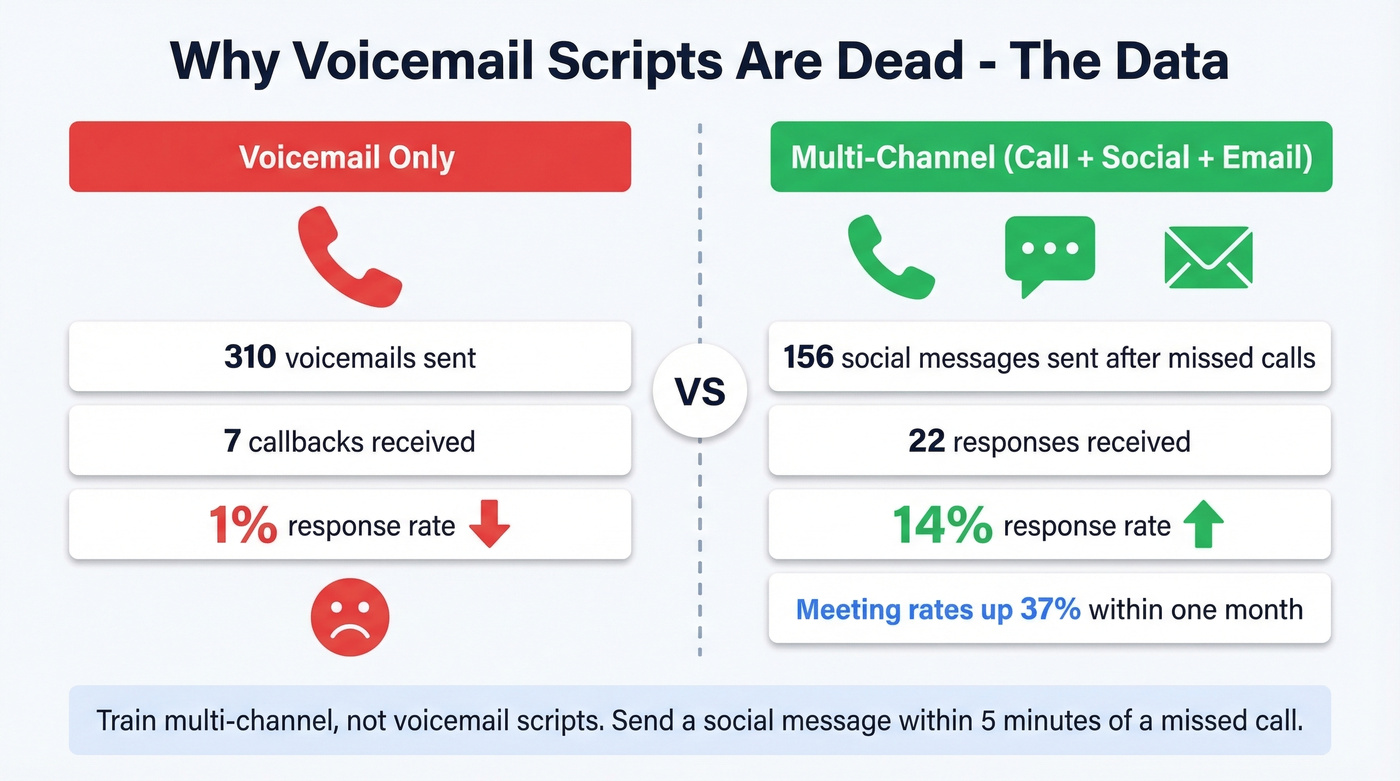
Train multi-channel, not voicemail scripts. (If you need plug-and-play copy, use these sales follow-up templates.)
Slide 9: Benchmarks and KPIs
Print this table and tape it next to every rep's monitor.
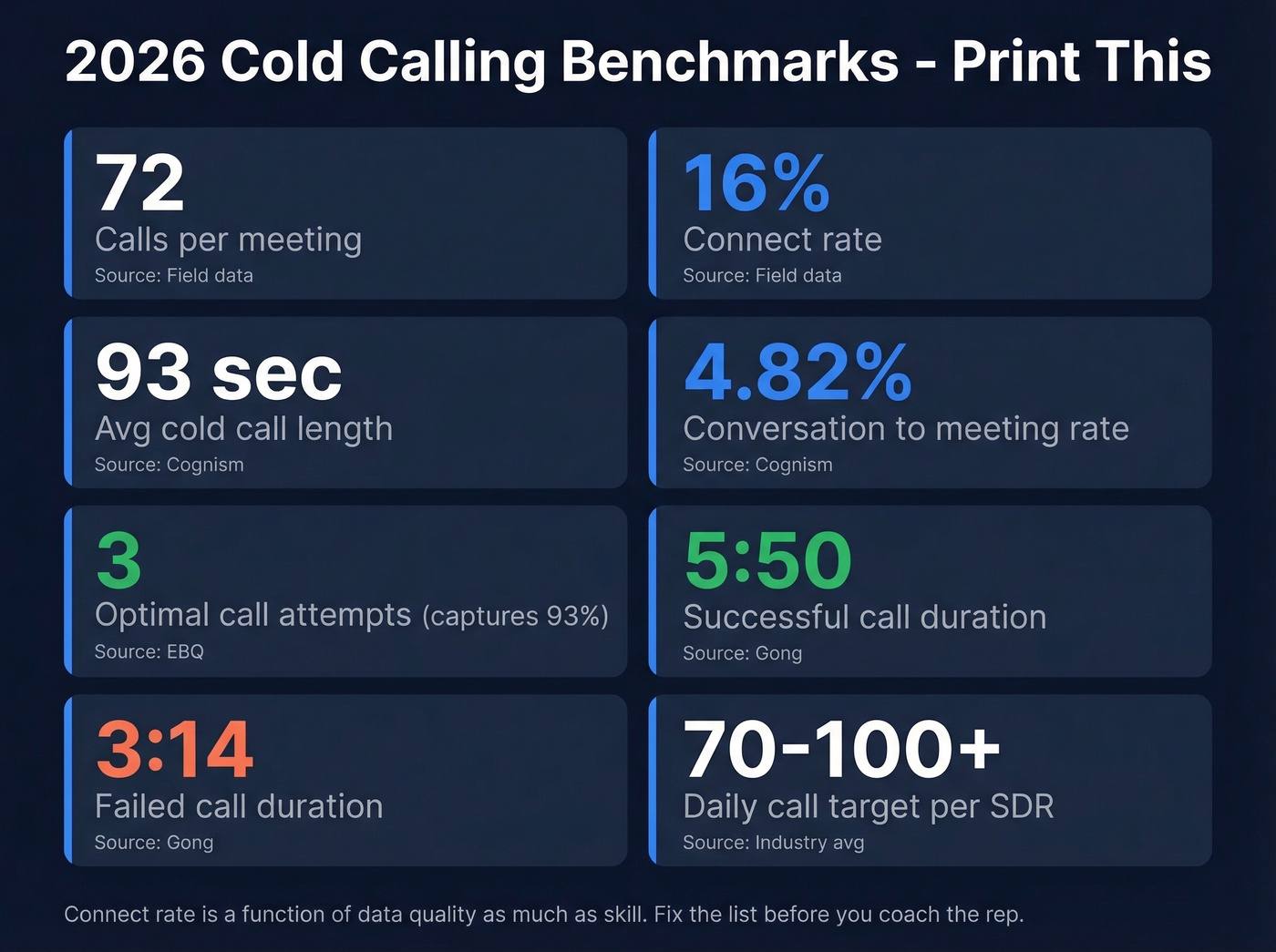
| Metric | Number | Source |
|---|---|---|
| Calls per meeting | ~72 | Field data (tracked month) |
| Connect rate | 16% | Field data (tracked month) |
| Avg. cold call length | 93 seconds | Cognism |
| Conversation to meeting | 4.82% | Cognism |
| Optimal call attempts | 3 (captures 93%) | EBQ |
| Successful call duration | 5:50 | Gong |
| Failed call duration | 3:14 | Gong |
| Daily call target (SDR) | 70-100+ | Industry avg. |
Connect rate is a function of data quality as much as skill. If your reps are dialing disconnected lines from last quarter's export, no amount of coaching fixes a 6% connect rate.
Slide 10: Common Mistakes
Put these on a slide as a pre-call checklist:
- Not researching the prospect before dialing
- Sounding scripted (reading verbatim instead of conversing)
- Talking more than 50% of the call
- Pitching the product instead of the problem
- Not asking for a clear next step before hanging up
Slide 11: Practice Methods
Three ways to build muscle memory. First, AI role-play tools - Highspot recommends them for objection practice, and they're surprisingly good at simulating resistant prospects. Second, peer role-play sessions using the objection table from Slide 7. Third, call recording reviews where the team listens to real calls and identifies what worked.
Schedule one session per week. Supplement live practice with sales books - Fanatical Prospecting by Jeb Blount and New Sales. Simplified. by Mike Weinberg give reps frameworks they can internalize between sessions.
Slide 12: Compliance Checklist
Three things every rep must know. TCPA - follow consent and dialing rules, especially for mobile numbers and automated dialing. GDPR - calling EU prospects requires a legitimate interest basis. DNC - scrub against Do Not Call lists and honor opt-outs immediately.

Slide 2 of your deck should be about data quality - and here's why. B2B data decays 2.1% per month, killing connect rates before reps even open their mouths. Prospeo's mobile finder delivers 125M+ verified numbers on a 7-day refresh cycle with a 30% pickup rate. Fix the data and your training actually works.
Stop training reps to dial disconnected lines.
Why Most Cold Calling Decks Fail
Here's the uncomfortable truth: most sales teams spend 10 hours building a beautiful presentation and zero hours verifying the phone numbers their reps will dial. I've watched teams run full-day training workshops, hand out gorgeous slide decks, then send reps back to their desks to dial a list where a quarter of the numbers are disconnected. The frustration compounds fast - reps lose confidence, managers blame "effort," and nobody looks at the data underneath.
A plain-text Google Doc with accurate data and five practiced objection responses will outperform a 40-slide cinematic PowerPoint backed by a rotten call list. Fix the data first, then worry about the slides. (If you're building a repeatable outbound motion, start with a cold calling system.)
Where to Get Templates
If you want a polished starting point, SlideTeam, SlideGeeks, and SketchBubble sell cold calling PowerPoint templates ranging from $10-50 per deck or via subscriptions. Most are visual shells - nice gradients, generic icons, zero substance.
The content above is what makes a deck useful. Copy this outline into a free template and you'll have something better than 90% of what's on those marketplaces. For teams with tight budgets, Google Slides templates work fine - nobody's booking meetings because of your slide transitions.
Your KPI slide says 72 calls per meeting. Bad data inflates that number by 30-40%. Prospeo gives your team 98% accurate emails and verified direct dials at $0.01 per lead - so every call block in your cold calling PPT hits real decision-makers, not voicemail graveyards.
Cut your calls-per-meeting ratio by fixing the data first.
FAQ
How many slides should a cold calling PPT have?
Aim for 10-15 slides. That's enough to cover openers, scripts, objection handling, benchmarks, and practice methods without losing attention. If a slide doesn't change rep behavior, cut it.
What's the single most important slide?
Objection handling. Reps can improvise openers, but freezing on "I'm not interested" kills the call and kills confidence. Give them the Listen, Clarify, Respond framework with five ready responses - that one slide drives more improvement than the other eleven combined.
How do I make sure my team's call list is accurate?
Verify before you train. B2B data decays about 22.5% per year, so run your list through a verification tool to catch disconnected numbers before reps waste an entire call block dialing dead lines. Tools like Prospeo refresh data on a 7-day cycle, which keeps decay from compounding.
What connect rate should my team target?
Healthy outbound teams see 14-18% connect rates on verified mobile numbers. Below 10%, your data or timing needs work before you invest in coaching. Above 20%, you're in top-decile territory and the focus shifts to conversion skill.