

Cold Calls vs Warm Calls: The Data Says You're Asking the Wrong Question
It's 9:47 AM on a Tuesday. You've made 40 dials. Three pickups. One hung up mid-sentence, one asked you to email them, and the third turned out to be the wrong person because your data was six months stale. Meanwhile, your colleague just booked two meetings from a "warm" list - except half those leads downloaded a whitepaper nine weeks ago and don't remember your company's name.
The cold calls vs warm calls debate is a distraction. The real question isn't how warm the lead is - it's whether your data is any good and whether you're calling someone who actually has a reason to care right now.
The Short Version
Cold calling isn't dead, but at a 2.3% average success rate, blind dialing is. Use intent data to prioritize who you call. Warm calls convert better on paper, but only when the data is fresh - a "warm" lead with a dead number is worthless. The real 2026 move: smart cold calls to verified numbers at in-market accounts outperform warm calls to stale lists every time.
Cold Calling vs Warm Calling in 2026
A cold call is outreach to someone who hasn't interacted with you or your company. No form fill, no webinar attendance, no prior conversation. You're a stranger with a phone number and a pitch.
The numbers are sobering. Cognism's 2025 study pegged the average cold-calling success rate at 2.3%, down from 4.82% the year before. Gartner's data suggests it takes roughly 22.5 cold calls to land one meaningful conversation. That's a lot of rejection before breakfast.
But here's what the "cold calling is dead" crowd misses. HubSpot's survey of 379 sales professionals found that 24% use cold calling as their primary prospecting channel and another 25% use it as secondary. Separately, Close.com cites data that 75% of buyers are willing to accept a cold call and book an appointment from one. The channel isn't dead. The lazy version of it is.
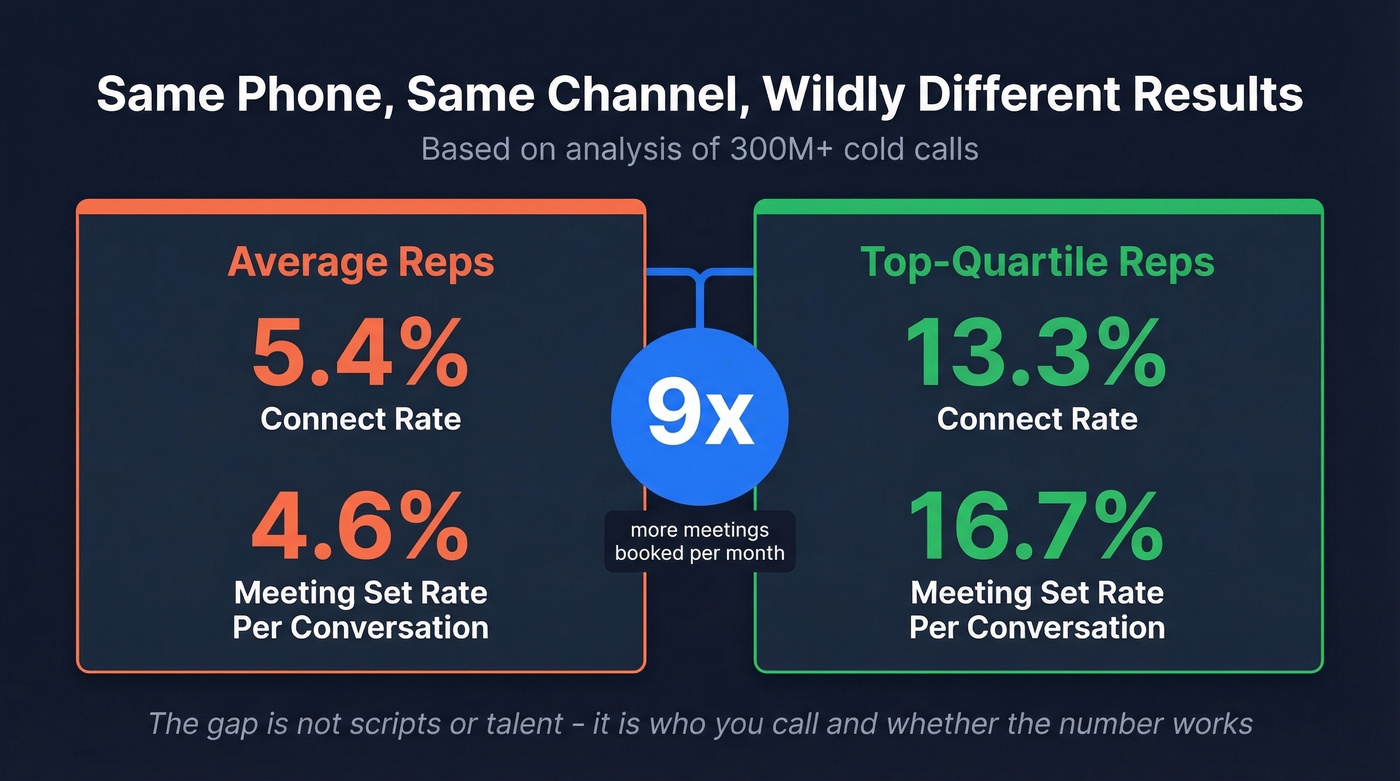
The gap between average and elite is staggering. An analysis of 300M+ cold calls found top-quartile reps connect at 13.3% versus 5.4% for average reps, with a meeting-set rate per conversation of 16.7% versus 4.6%. Same channel, same phones, wildly different outcomes.
That gap isn't about scripts. It's about who you're calling and whether the number actually works.
What Makes a Call "Warm"
A warm call is outreach to someone who's already had some interaction with your brand - they downloaded content, attended a webinar, visited your pricing page, or got referred by a colleague. There's a thread of familiarity, however thin.
Not all warm leads are created equal. Close.com breaks them into useful tiers: lukewarm (opened an email, visited a page), toasty (downloaded a resource, attended an event), and red hot (requested a demo, got a referral). Some frameworks add a separate "hot call" tier for inbound hand-raisers, but that's just a warm call with stronger signals.
Here's the thing: no rigorous benchmark exists for warm-call conversion rates. You'll see claims like "warm calls convert at 20-30%" floating around, but those numbers are qualitative at best and vendor marketing at worst. What we do know is that warm calling has its own operational headaches - each call requires pre-call research on prior interactions, content consumed, and company context. Lead assignment gets messy when multiple reps touch the same account. And having downloaded your ebook doesn't mean they're sitting by the phone waiting for your call.
Side-by-Side Comparison
| Dimension | Cold Call | Warm Call | Edge |
|---|---|---|---|
| Prior engagement | None | Some interaction | Warm |
| Trust level | Zero | Low to moderate | Warm |
| Conversion range | 1-3% avg | ~10-30% (industry estimates, unverified) | Warm (on paper) |
| Effort per call | Low prep, high volume | High prep, lower volume | Cold (efficiency) |
| Scalability | High | Limited by lead flow | Cold |
| Best for | New market entry, TAM coverage | Inbound follow-up, nurture | Depends on goal |
| Key risk | Wasted dials on bad data | Stale leads, false warmth | Tie - both lose to bad data |
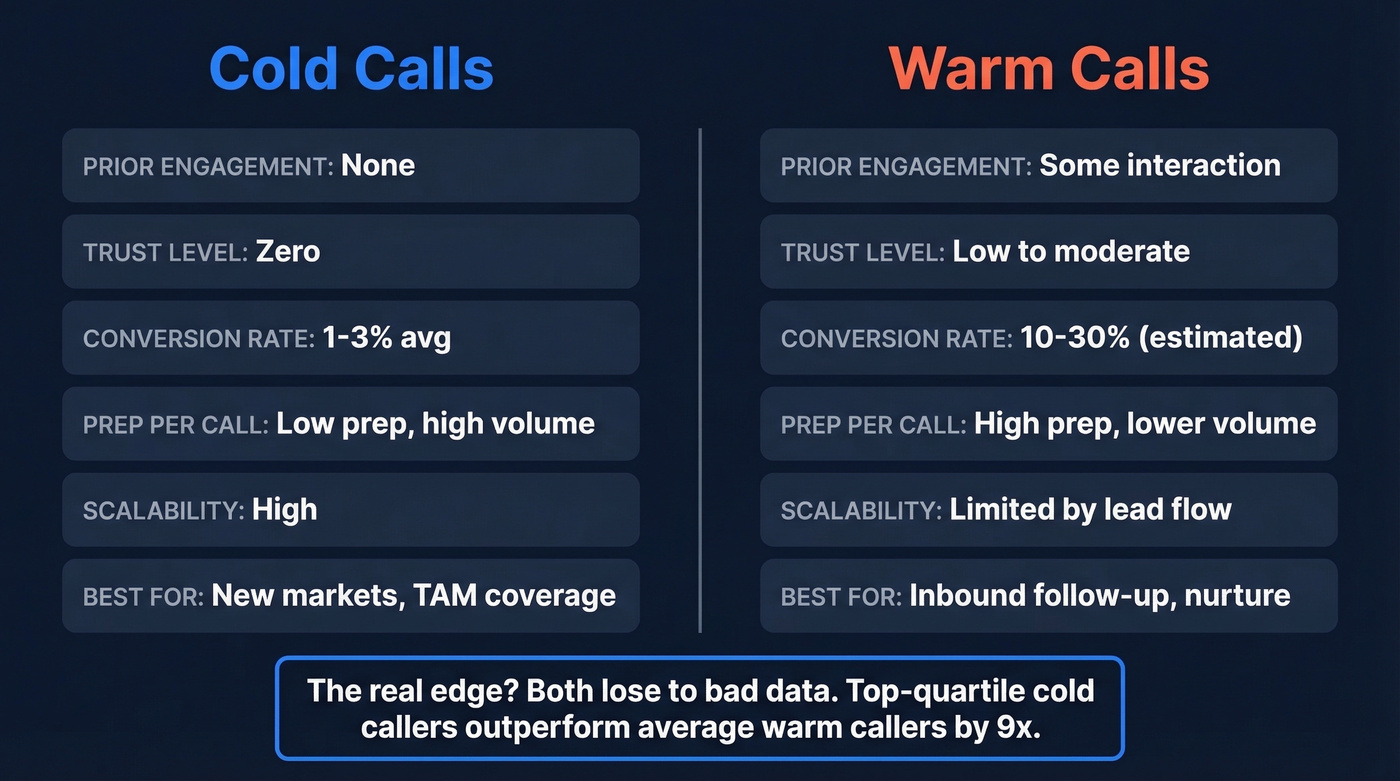
The table obscures the real story, though. The 300M-call dataset shows top-quartile cold callers outperform average reps by roughly 9x on meetings booked per month. A great cold caller with verified data will crush a mediocre rep working a "warm" list every single day.
If your average deal size is under $15K and your team has fewer than five reps, you're better off investing in data quality and call execution than building an elaborate warm-nurture machine. The ROI math just doesn't work at that scale.

The article says it: top-quartile reps outperform average ones by 9x - and the gap is data, not talent. Prospeo gives you 125M+ verified mobile numbers with a 30% pickup rate, refreshed every 7 days. Layer in intent data across 15,000 topics so every "cold" call lands at exactly the right moment.
Turn every cold dial into a warm cold call with numbers that actually connect.
Why the Binary Is Dead
So what's the real difference between cold calling and warm calling in practice today? Less than you'd think. The most effective outbound motion in 2026 isn't cold or warm - it's what practitioners call the "warm cold call." You've never spoken to the prospect, but you know they're in-market because intent signals say so.
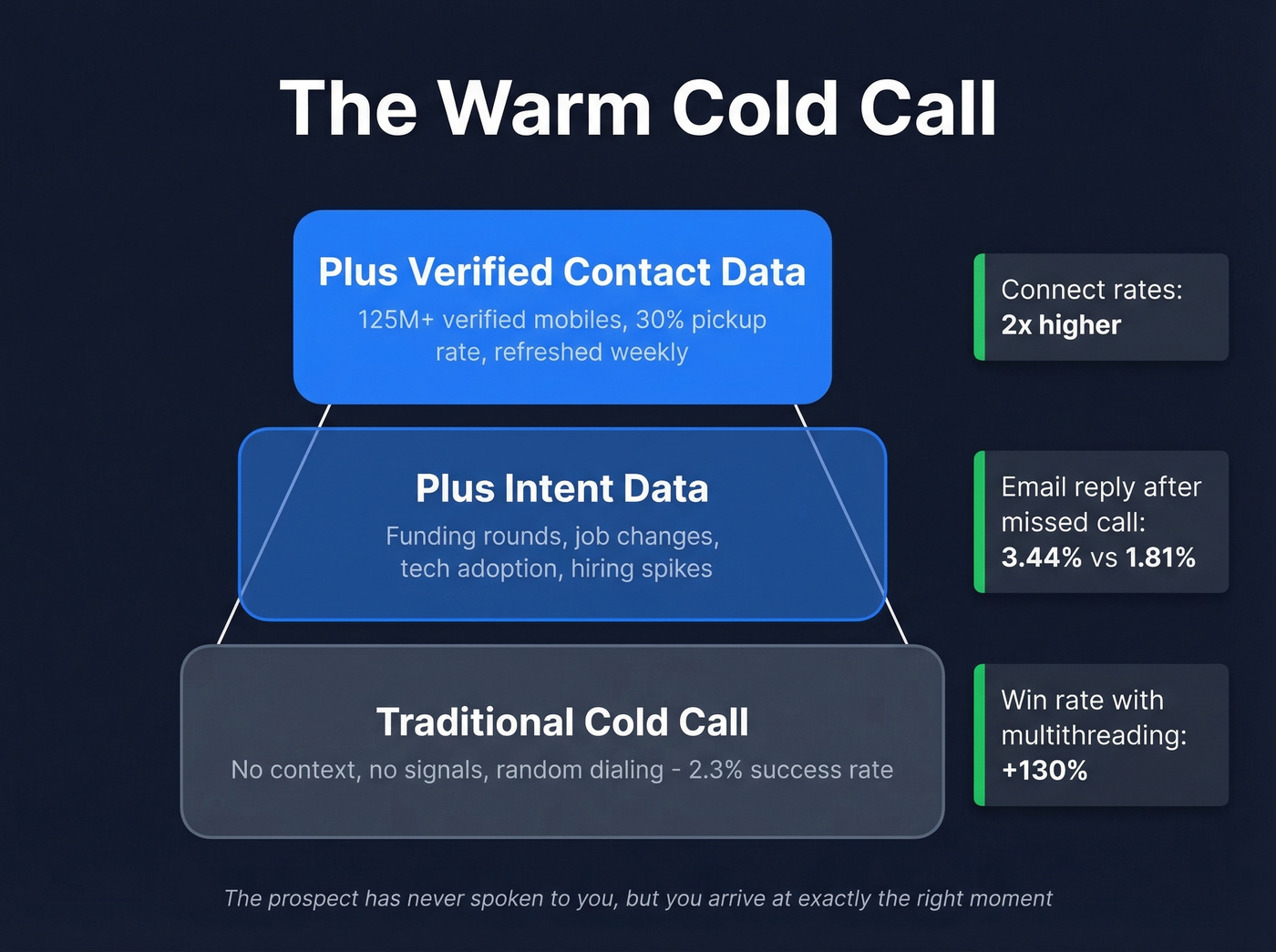
The data backs this up. The 300M-call study found that cold calls nearly double email reply rates - 3.44% versus 1.81% - even when the call doesn't connect live. The voicemail or missed call creates enough familiarity that the follow-up email lands differently. And Sopro's 2026 roundup reinforces the point: 81% of sales and marketing decision-makers engage with cold outreach when it's tailored to them. Generic outreach gets ignored. Relevant outreach gets meetings.
Anthony Iannarino makes a contrarian point worth hearing: emailing someone before calling them doesn't make the call warm. The prospect still isn't expecting you. What actually warms a call is context and relevance.
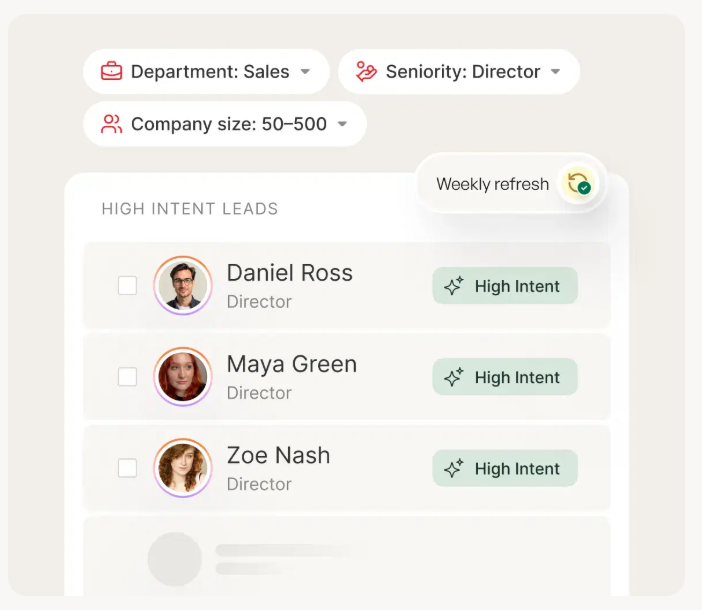
That's where intent signals come in. When you know an account is researching your category - through funding announcements, job changes, tech adoption signals, or hiring spikes - your "cold" call arrives at exactly the right moment. We've seen teams double their connect rates just by layering intent data on top of their existing call lists, filtering for accounts showing active buying signals before anyone picks up the phone.
AI-assisted dialing and personalization tools are adding another layer - auto-researching prospects, suggesting openers, even scoring call priority in real time. But the AI is only as good as the underlying data. Feed it stale contacts and you get efficiently delivered garbage.
Don't sleep on multithreading, either. An analysis of 1.8M opportunities found that engaging multiple contacts at the same account boosts win rates by 130% on deals over $50K. Calling the VP of Sales is a cold call. Calling them after their colleague attended your webinar and their company just raised a Series B? That's a warm cold call.
Scripts That Actually Work
Cold Call Openers
Gatekeeper bypass:
"Hi, this is [name] from [company]. I'm trying to reach [prospect] about [specific initiative]. Could you connect me?"
One line of context beats "Is [prospect] available?" every time. Name the initiative, not your product. The 2025 cold calling report found that simply including a reason for calling increases success rates by 2.1% - small in isolation, compounding over hundreds of dials.
Trigger-event opener:
"Hey [prospect], congrats on the Series B. I work with three other companies at your stage who ran into [specific problem] right around this point. Worth a 10-minute conversation?"
The trigger event earns you 30 seconds. Use them to connect the event to a problem, not to pitch.
Objection pivot:
Prospect: "We're not interested." You: "Totally fair - most people aren't until [specific pain] hits. Quick question before I go: are you handling [process] in-house or outsourcing it?"
The pivot keeps the conversation alive without being pushy. You're asking a question, not arguing.
Warm Call Framework
Keep the whole call under five minutes. The advantage of a warm call is a prior touchpoint to reference - that's the entire edge, and most reps waste it by reciting a generic pitch with the prospect's name inserted.
- Introduce yourself - name, company, one sentence.
- Reference how you got their info - "You downloaded our guide on [topic] last week."
- Deliver a value prop - tie it to what they consumed: "Companies reading that guide are usually dealing with [problem]."
- Ask about pain points - "Is that something your team's running into?"
- Offer a relevant solution - don't pitch everything, just the piece that matches their pain.
- Suggest a low-pressure next step - "Would a 15-minute call Thursday make sense to dig into this?"
Optimal Call Attempt Strategy
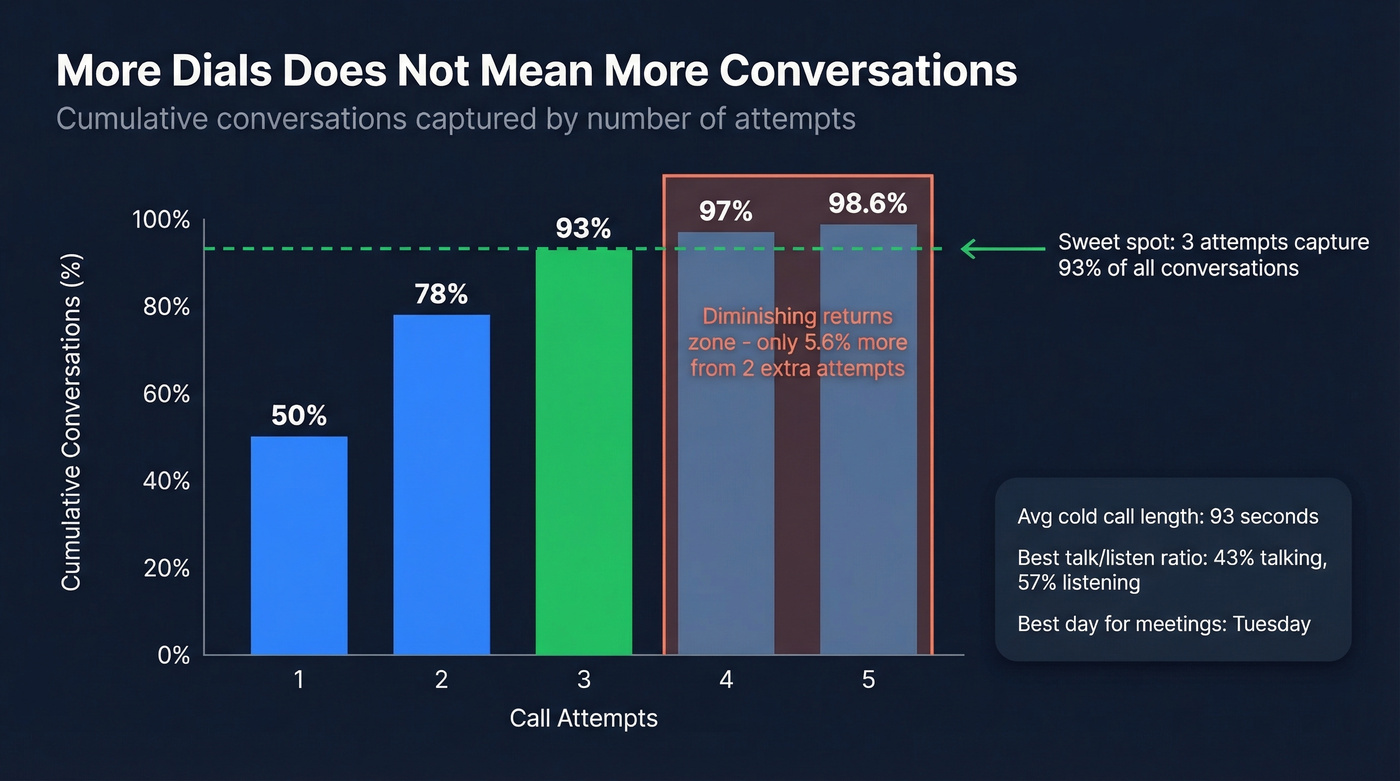
More dials doesn't always mean more conversations. The Cognism/WHAM dataset reveals a sharp diminishing-returns curve regardless of whether you're dialing cold or warm prospects:
| Attempts | Cumulative Conversations |
|---|---|
| 1 | ~50% |
| 2 | ~78% |
| 3 | 93% |
| 4 | ~97% |
| 5 | 98.6% |
Three attempts capture 93% of all conversations you'll ever get from a prospect. Five gets you to 98.6%. After that, you're burning dials for almost zero incremental return.
The average cold call lasts about 93 seconds. The optimal talk/listen ratio sits at 43% talking, 57% listening - and the consistency of that ratio matters more than hitting it perfectly. Low performers swing wildly, talking 54% on won deals but 64% on lost ones. Top reps stay steady. Tuesday is the best day for booking meetings. Friday? Decent for conversations, terrible for commitments.
If you want a repeatable outbound motion, build a cold calling system instead of winging it.
Mistakes That Kill Your Calls
We've audited dozens of outbound teams, and the same problems show up every time - regardless of whether reps are focused on warm or cold outreach.
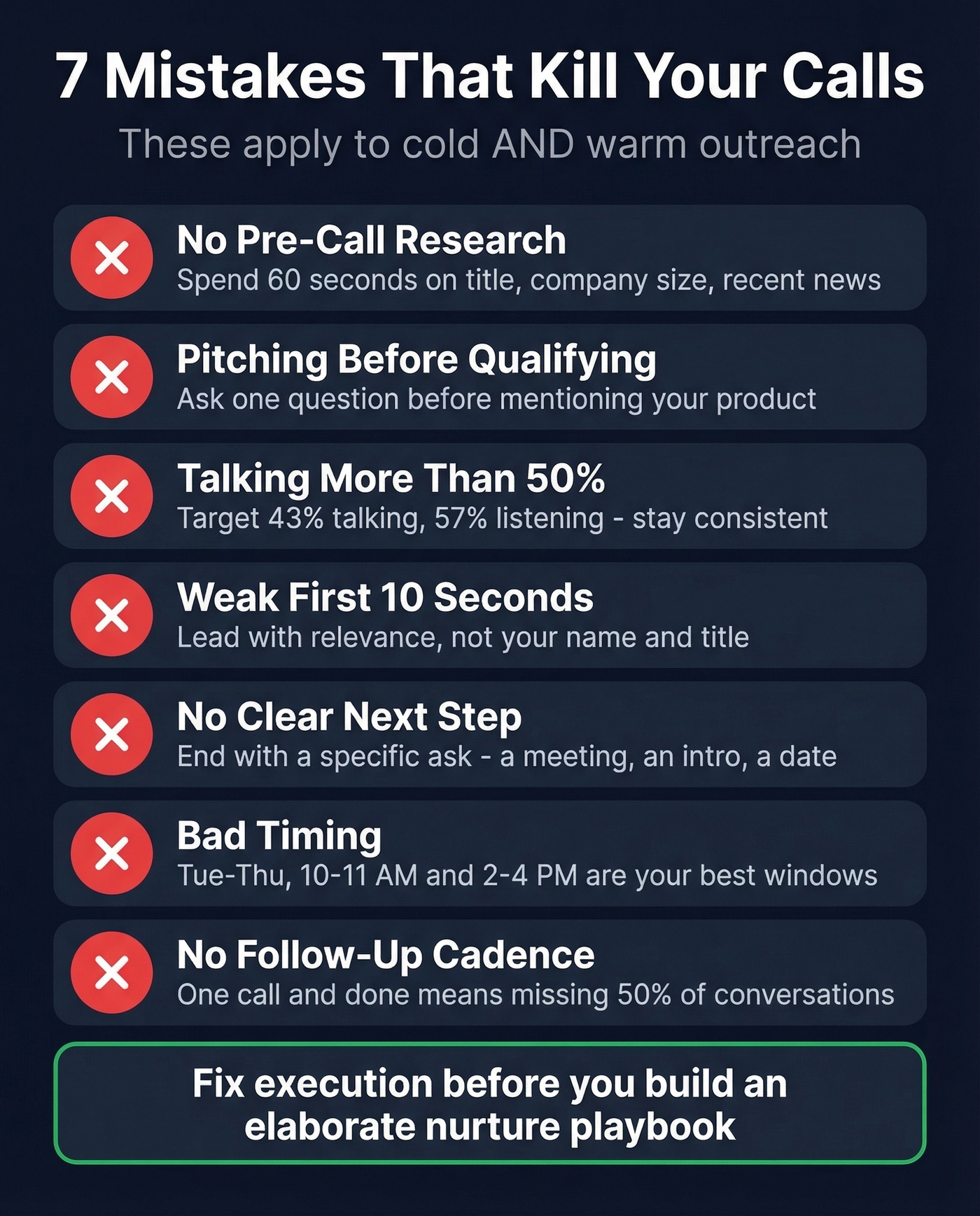
- No pre-call research. Spend 60 seconds checking their title, company size, and any recent news. That's enough.
- Pitching before qualifying. Ask one question before you talk about your product. Just one.
- Talking more than 50% of the call. If you're over 50%, you're monologuing. The 43/57 ratio exists for a reason.
- Weak first 10 seconds. You have one sentence to earn the next 30 seconds. Lead with relevance, not your name and title.
- No clear next step. Every call ends with a specific ask - a meeting, an intro, a follow-up date. "I'll send some info" isn't a next step.
- Bad timing. Tuesday through Thursday, 10-11 AM and 2-4 PM are strong windows.
- No follow-up cadence. One call and done means you're missing 50% of your potential conversations. Build a 10-14 day multi-touch sequence.
Skip the elaborate warm-nurture playbook if you're still making these basic errors. Fix sales execution first.
Data Quality Beats the Label
Here's the uncomfortable truth that neither camp wants to acknowledge: your calls are only as good as your data. The entire distinction between cold and warm calling collapses when your contact information is wrong.
B2B contact data decays at roughly 2.1% per month - that's 22.5% of your database going stale every year. Sales reps lose 27.3% of their selling time to bad contact data. At scale, bad data costs organizations $12.9M annually.
Look at the connect rate gap again: 5.4% average versus 13.3% top quartile. In our experience working with outbound teams, the difference isn't script quality or charisma. It's whether the phone number actually reaches the right person. A "warm" lead with a disconnected number converts at exactly 0%.
The proof is in the results. Meritt tripled their connect rate to 20-25% after switching to verified contact data. Snyk dropped their bounce rate from 35-40% to under 5% and saw AE-sourced pipeline jump 180%. Prospeo delivers this at the source: 125M+ verified mobile numbers with a 30% pickup rate, refreshed every 7 days instead of the 6-week industry average. Email accuracy runs at 98% across 143M+ verified addresses.
If you're rebuilding your list hygiene, start with lead enrichment and a proper sales prospecting database before you scale dials.
Let's be honest - the cold calls vs warm calls debate is a red herring when half your dials go to voicemail boxes that haven't been checked since 2024. Fix the data first. Everything else - scripts, timing, warmth - is optimization on top of a working foundation.
You just read that 22.5 cold calls produce one conversation - on average. Cut that number in half by calling verified direct dials at in-market accounts. Prospeo combines 125M+ verified mobiles, 98% email accuracy, and Bombora intent signals so your reps spend time talking, not listening to dial tones.
Bad data killed your last call block. Fix it for $0.01 per lead.
FAQ
Is cold calling dead in 2026?
No. 49% of sales professionals still use cold calling as a primary or secondary channel per HubSpot's survey of 379 reps. Blind dialing without research is dead; top performers use intent signals and verified numbers to make every dial count. The channel works when the execution does.
What's a good cold call conversion rate?
The average success rate is 2.3%, but top-quartile reps hit 16.7% meeting-set rates per conversation according to the 300M-call study. The gap comes down to data accuracy and execution quality - not luck or natural talent.
How many times should I call a prospect?
Three attempts capture 93% of all conversations you'll ever get from that prospect, and five attempts reach 98.6%. After five, you're burning time for near-zero incremental return. Build a multi-touch cadence across calls and emails over 10-14 days.
Does emailing before a cold call make it warm?
Not really - the prospect still isn't expecting your call. But calling after emailing nearly doubles reply rates (3.44% vs 1.81%), so the multi-touch sequence works even without a live connect. Use the sequence; just don't kid yourself that it's a warm call.
What's a good free tool for getting verified phone numbers?
Prospeo's free tier includes 75 email credits and 100 Chrome extension credits per month with no contract - enough to test data quality on real campaigns. Most competitors gate mobile numbers behind paid plans or return unverified data that wastes your dials.