

Cold Email in 2026: What 31 Million Emails Tell Us About What Actually Works
You sent 2,000 cold emails last month. You got 11 replies - four were "please remove me from your list." Your domain reputation's slipping, and you're starting to wonder if cold email is dead.
It's not. But the way most teams run it is.
Does Cold Email Still Work in 2026?
Hunter's 2026 report analyzed 31 million emails sent over the past year. The average reply rate: 4.5%, up from 4.1% the year before. Here's the spread:
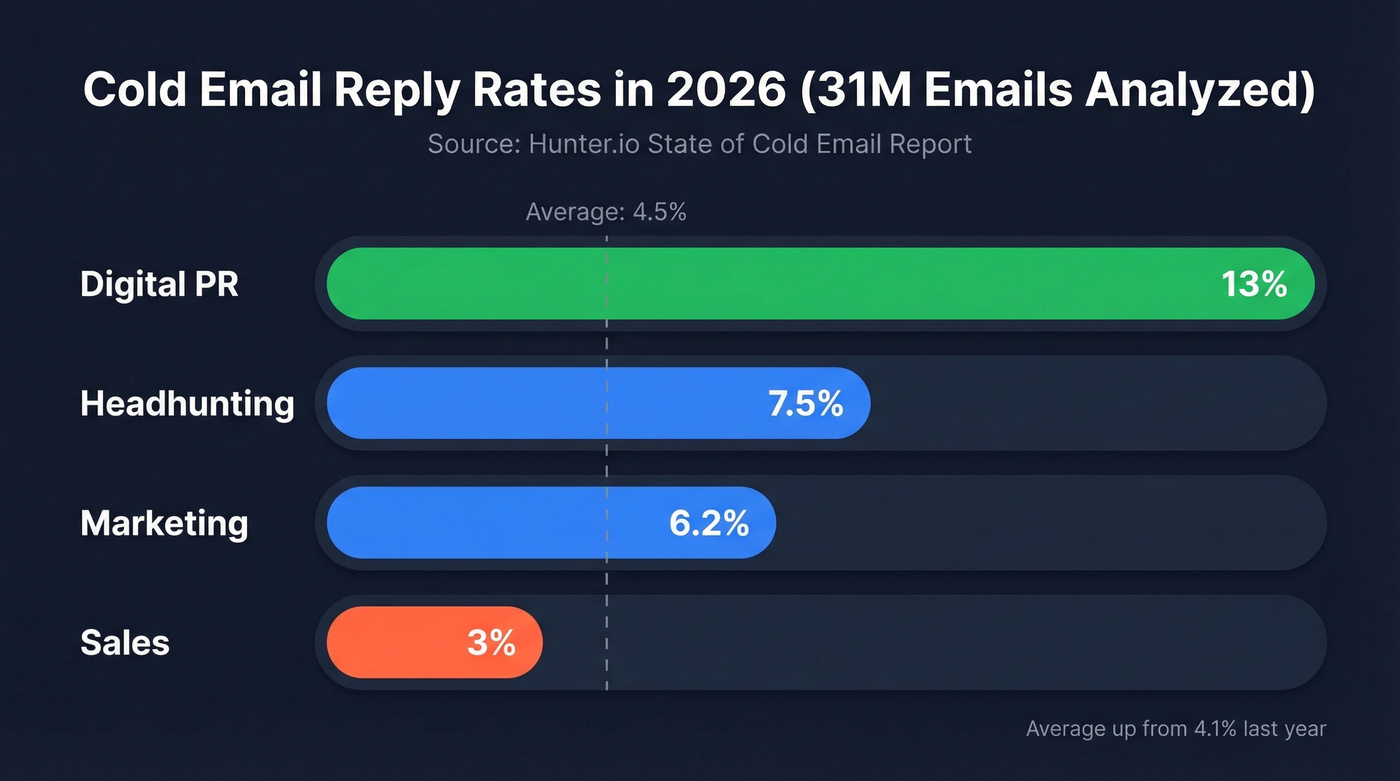
| Use Case | Reply Rate |
|---|---|
| Sales | 3% |
| Marketing | 6.2% |
| Headhunting | 7.5% |
| Digital PR | 13% |
About half of decision makers say they prefer being contacted through professional networks, versus 25% who prefer email. That hasn't killed the channel - it's raised the bar. Email still wins on scalability and cost. But the gap between average and top-performing campaigns comes down to infrastructure and targeting, not copywriting tricks.
The Foundation (Before You Write a Word)
- Verify emails before sending. Prospeo's 5-step verification catches spam traps, honeypots, and catch-all domains before they tank your sender reputation.
- Set up SPF, DKIM, and DMARC. Non-negotiable. Gmail and Outlook both enforce this now.
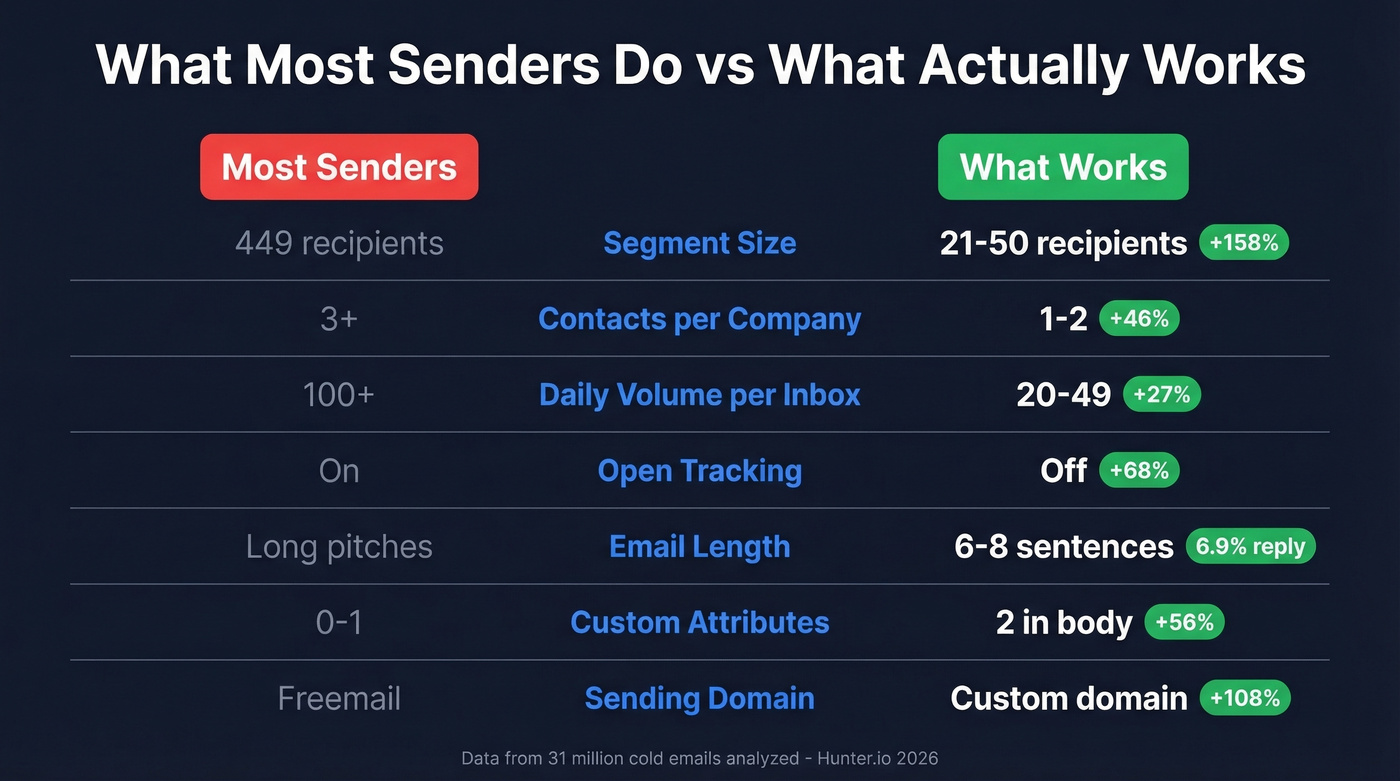
- Keep segments tight - aim for 21-50 people. Smaller lists dramatically outperform blasts.
- Turn off open tracking. Reply rates jump when open tracking is off.
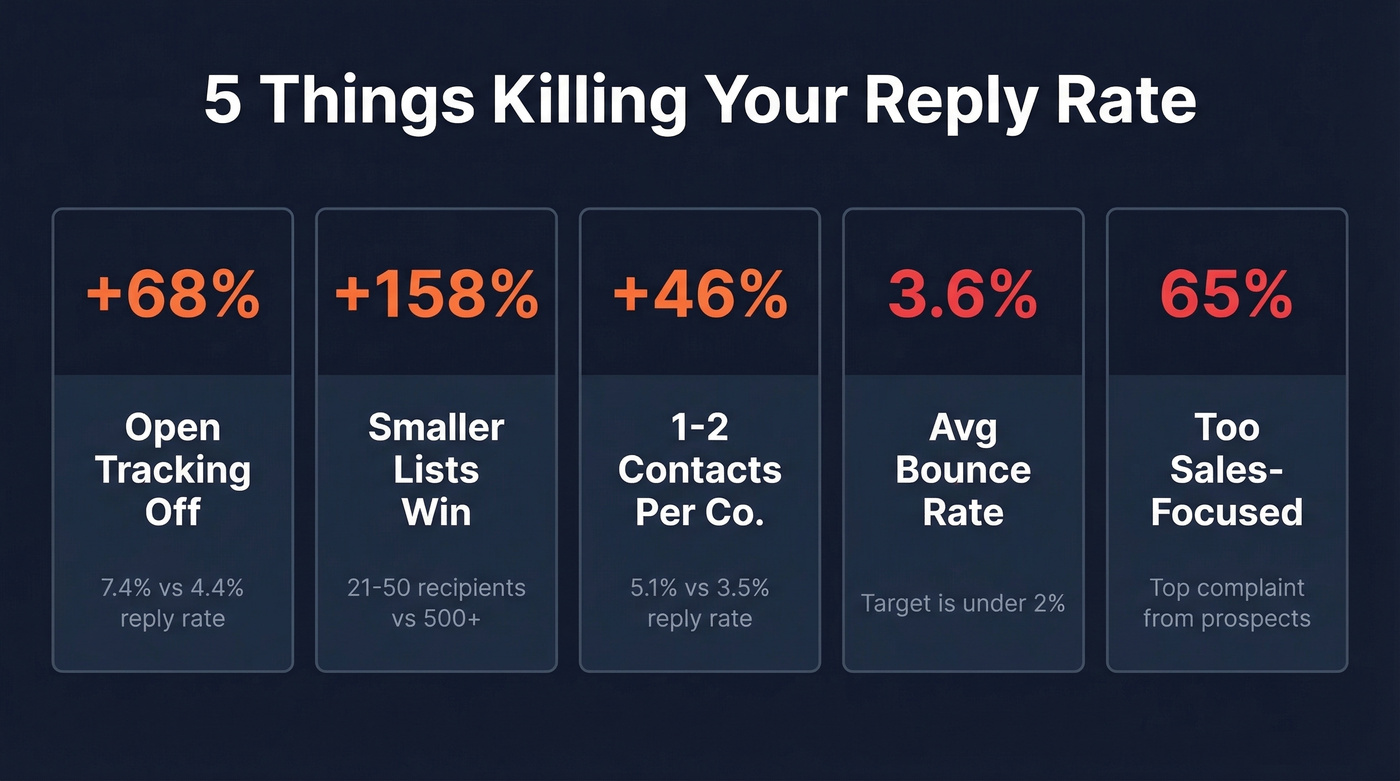
Five Things Killing Your Reply Rate
Open Tracking Is On
The single easiest fix. Campaigns without open tracking had a 68% higher reply rate - 7.4% vs 4.4%. Turn it off. You don't need open rate data badly enough to sacrifice replies.
Your Lists Are Too Big
Sequences targeting 21-50 recipients outperformed 500+ lists by 158% - a 6.2% reply rate vs 2.4%. We've seen this pattern across dozens of campaigns: smaller lists force better targeting and more relevant copy. The "spray and pray" approach doesn't just underperform. Inbox providers actively penalize it.
Too Many Contacts Per Company
Emailing 1-2 people per company yields a 5.1% reply rate. Hit 3+ contacts and it drops to 3.5%. When multiple people at the same company get your outreach, it looks like spam. Because it is. Pick your best-fit contact and commit.
Bad Contact Data
Every problem above gets worse with bad data. A bounced email doesn't just waste a send - it damages your sender reputation, and ISPs see high bounce rates as a signal to start routing your legitimate emails to spam too. The average bounce rate across all campaigns sits at 3.6%, well above the sub-2% target most deliverability playbooks recommend.

Here's the thing: in our experience, list quality moves the needle more than any copywriting tweak. Stack Optimize scaled to $1M ARR running client campaigns with 94%+ deliverability and under 3% bounce across every client - the foundation was verifying every address through a multi-step process before anything hit a sending tool.
Generic, Sales-Focused Copy
Decision makers said it plainly: 65% find cold emails too sales-focused, 61% said irrelevant, 48% called them generic. The consensus on r/coldemail is blunt - there's no "best template." Once a proven template gets shared widely, prospects recognize the pattern and it stops working. Template decay is real and accelerating.

Bad data is the #1 cold email killer in 2026. Every bounce tanks your sender reputation and pushes real emails to spam. Prospeo's 5-step verification - with catch-all handling, spam-trap removal, and honeypot filtering - delivers 98% email accuracy. That's how Stack Optimize kept bounce rates under 3% across every client on the way to $1M ARR.
Fix your list before you fix your copy. Start free, no credit card.
What Good Outreach Looks Like
Six to eight sentences under 200 words hit the sweet spot - a 6.9% reply rate. Emails with 2 custom attributes in the body saw a 56% higher reply rate, and manually edited emails outperformed fully automated ones by 18%. AI can draft your emails, but a human needs to touch them before they go out.
If you're building a repeatable outbound motion, start with a solid B2B cold email sequence and keep your personalization consistent across touches.
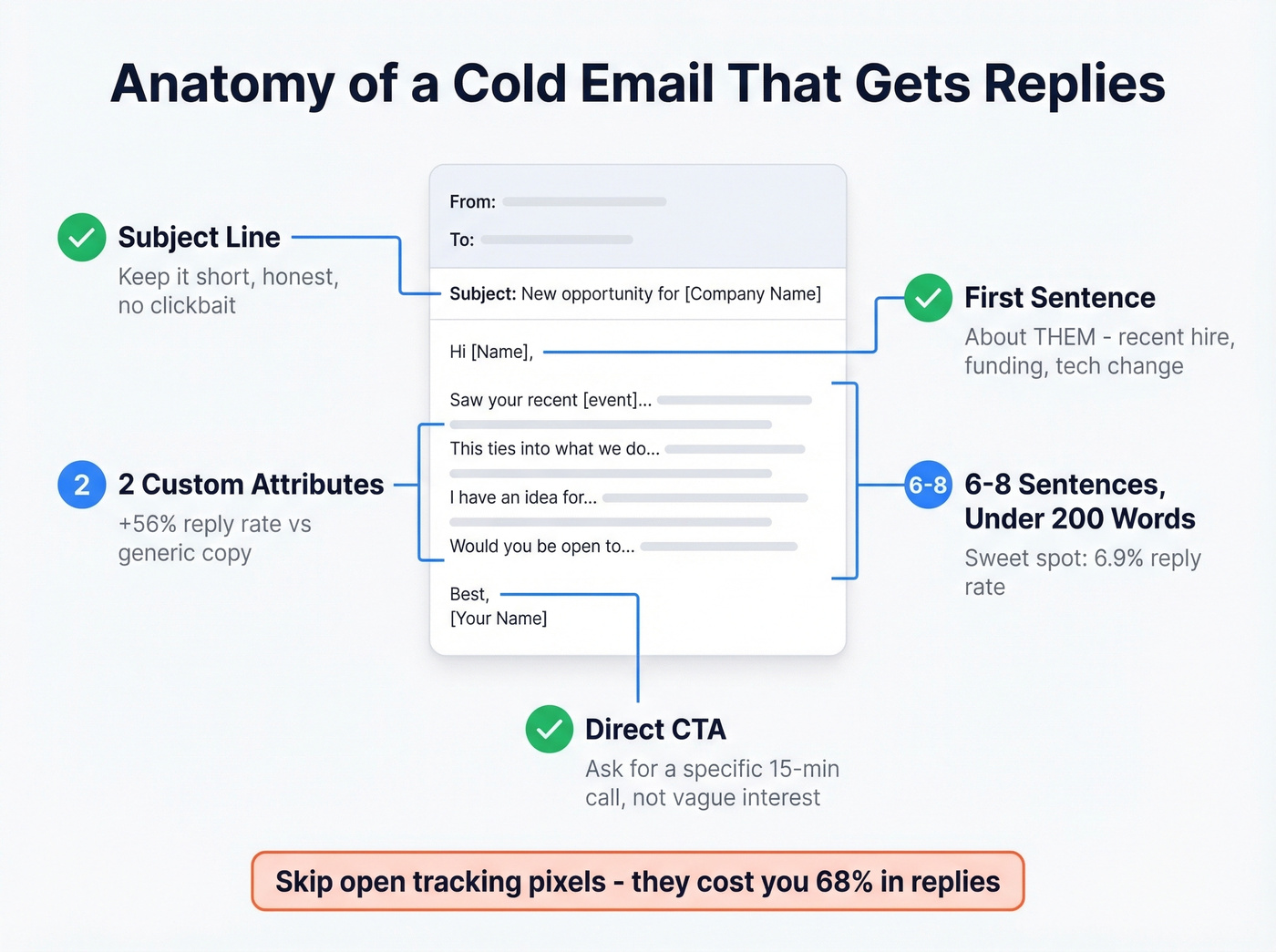
Let's be honest about where most teams waste their time. They obsess over subject lines and CTAs when the real difference-maker is the first sentence. If your opener is about you or your product, you've already lost. Make it about something specific to the prospect - a recent hire, a tech stack change, a funding round. And skip the soft "would love to pick your brain" CTA. A direct ask for a 15-minute call outperforms vague interest checks because it's easier to say yes or no to.
If you want more options, pull from proven cold email subject line examples instead of guessing.
Deliverability Checklist
None of this matters if your emails land in spam. The 2026 baseline:
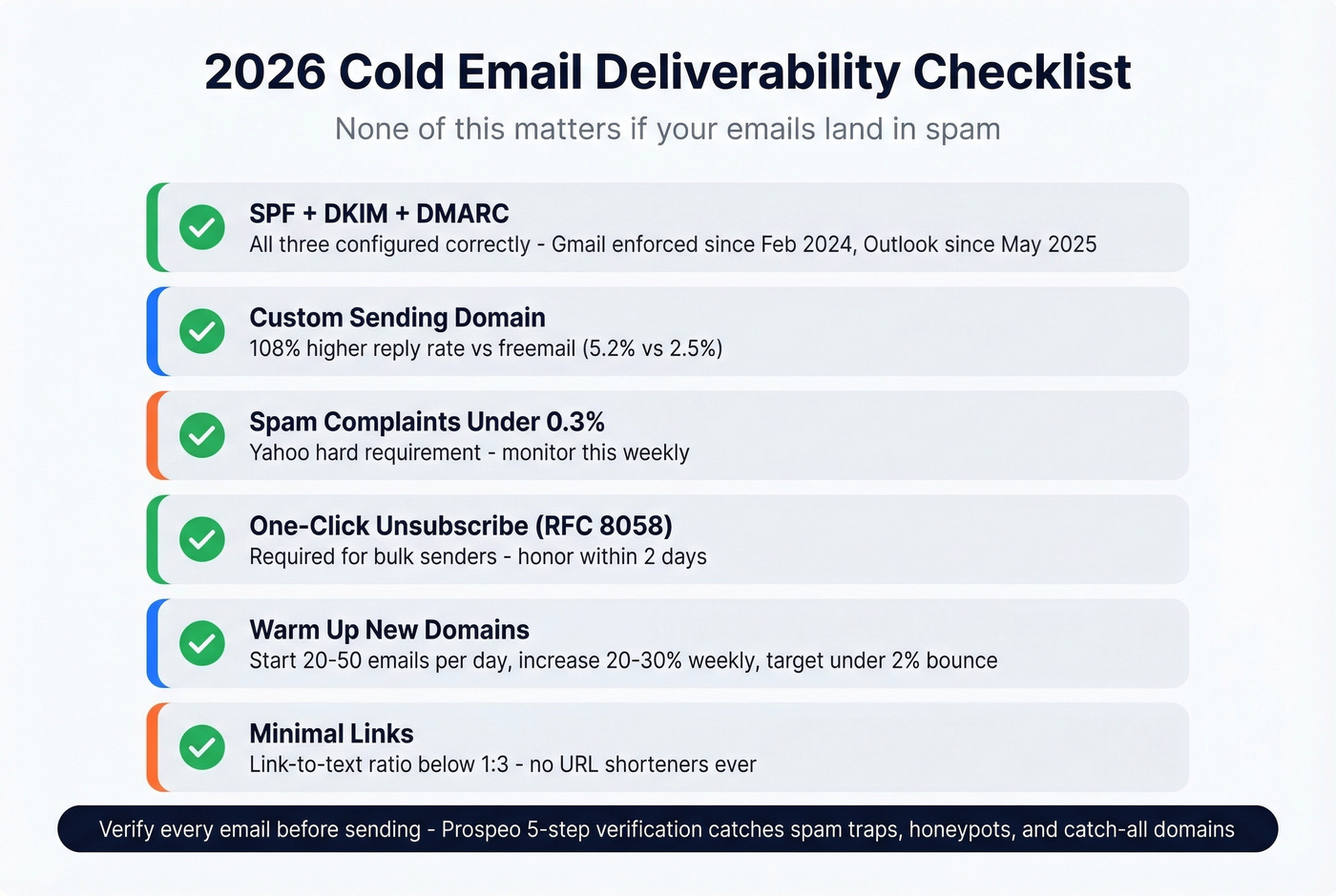
- SPF + DKIM + DMARC - all three, configured correctly. Gmail enforced this since Feb 2024. Outlook followed on May 5, 2025.
- Custom sending domain - 108% higher reply rate vs freemail (5.2% vs 2.5%).
- Spam complaint rate under 0.3% - Yahoo's hard requirement.
- One-click unsubscribe (RFC 8058) - required for bulk senders. Honor within 2 days.
- Email warmup for new domains - start at 20-50 emails/day, increase 20-30% weekly. Target inbox placement with bounce under 2% and complaints under 0.1%. (If you need a stack, see unlimited email warmup tools.)
- Minimal links - link-to-text ratio below 1:3. No URL shorteners. If you're troubleshooting, use an email spam checker and an email deliverability guide.
You just read that segments of 21-50 people crush 500+ blasts by 158%. But tight targeting only works when every contact is real. Prospeo's database gives you 30+ filters - buyer intent, tech stack, job changes, headcount growth - across 300M+ profiles, all refreshed every 7 days. Build the small, surgical lists this data demands at ~$0.01 per verified email.
Build smaller lists that actually convert. 75 free emails to start.
Timing, Volume, and Follow-Ups
| Factor | Most senders | What works |
|---|---|---|
| Segment size | 449 recipients | 21-50 (+158% replies) |
| Contacts/company | 3+ | 1-2 (+46% replies) |
| Daily volume/inbox | 100+ | 20-49 (+27% replies) |
| Open tracking | On | Off (+68% replies) |
| Email length | Long pitches | 6-8 sentences, <200 words |
| Custom attributes | 0-1 | 2 in body (+56% replies) |
| Sending domain | Freemail | Custom (+108% replies) |
Thursday pulls the highest reply rate at 6.87%, with Monday the worst at 5.29%. The 8-11 PM window peaks at 6.52% - people check email at night when they aren't in back-to-back meetings.
Follow-ups matter, but there's a cliff. Three messages generate 106% more total replies than a single email. Spam complaints jump from 0.5% on the first email to 1.6% by the fourth, though, so three touches is the sweet spot. Four is pushing it. Skip this if you're already seeing complaint rates above 0.2% on your first send - adding follow-ups will only accelerate the damage.
If you need copy that fits this cadence, use these cold email follow-up templates or broader sales follow-up templates.
FAQ
Is cold email legal in 2026?
Yes, in most jurisdictions. CAN-SPAM requires a physical address, opt-out mechanism, and honest subject lines. GDPR requires legitimate interest for EU prospects. Gmail and Yahoo now mandate one-click unsubscribe for bulk senders.
What's a good reply rate?
The average across 31 million emails is 4.5%. Sales sequences average 3%, digital PR hits 13%. Above 5% in sales outbound means you're outperforming most teams.
Should I use AI to write cold emails?
Use AI for drafts, then manually edit before sending. Manually edited emails outperform fully automated ones by 18%. The bigger risk is template decay - AI generates messages that sound like every other AI-written pitch in your prospect's inbox.
What's the best free tool for verifying email lists?
Prospeo's free tier includes 75 verified emails per month at 98% accuracy - enough to validate a small campaign list. Hunter offers 25 free searches monthly. For teams sending real volume, even a basic verification step cuts bounce rates from 3.6% to under 2%.
Cold email in 2026 works when the infrastructure does. Fix the foundation, then worry about the copy.