

The Cold Email Call to Action That Books Meetings (Backed by 304K Emails)
You've written the subject line. Nailed the opener. Personalized the first sentence. Then you slap "Would you be open to a 30-minute call next week?" at the bottom and wonder why nobody replies.
That last line - your cold email call to action - is doing more damage than every other line combined. The average cold email reply rate sits at 3.43%, with 58% of those replies coming from the very first email. Your CTA is the highest-leverage sentence you'll write today.
The Short Version
Interest-based CTAs outperform meeting asks on first touch. A study of 304K emails confirmed it. Emails with a single clear CTA see up to 371% higher click-through rates than emails with multiple asks. The framework below escalates your CTA across four stages - from soft interest ask to breakup - so you're never asking for too much too soon. Top senders hit 10.7%+ reply rates by getting this progression right.
What 304K Emails Tell Us About CTAs
The Gong Labs study analyzed 304,174 emails and defined success as a meeting booked within the next 10 days. It tested three CTA buckets: interest CTAs ("worth exploring?"), open-ended CTAs ("meet next week?"), and specific CTAs ("Tuesday at 2pm?"). For cold outreach, interest CTAs won. The behavioral explanation is straightforward - asking for a meeting triggers loss aversion. Time is finite, and the recipient mentally calculates the cost of 30 minutes with a stranger. As one practitioner who tested 2M+ emails put it on r/LeadGeneration, asking for a meeting in a first cold email is like asking someone to marry you on the street.
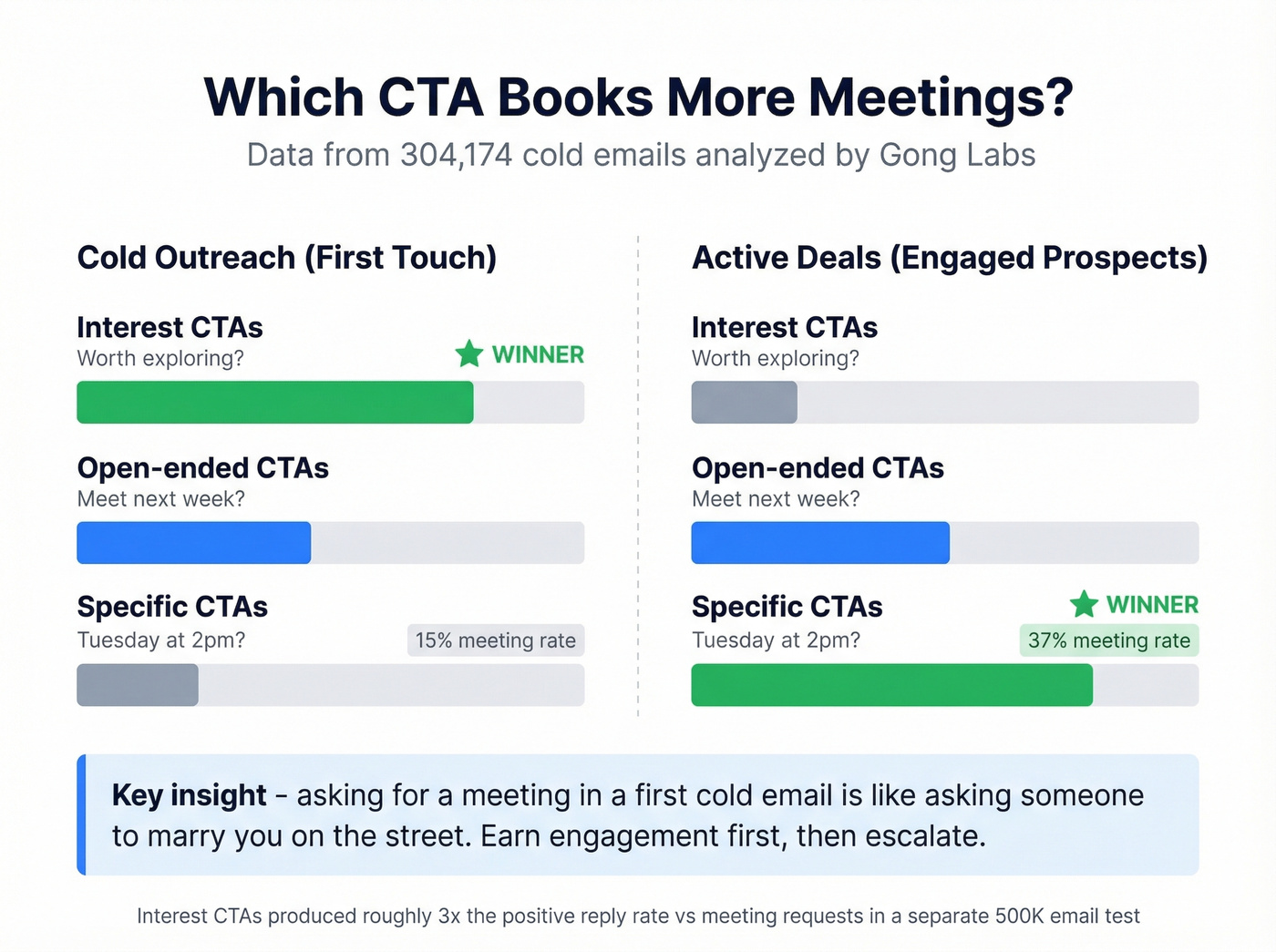
Once a deal is active, the math flips. Specific CTAs hit a 37% meeting rate, up from 15% when used on cold prospects.
A sender who tested 500K emails across roughly 15-20 campaigns on r/coldemail found the same pattern. Soft-ask CTAs - offering a case study, resource, or quick insight - produced about 3x the positive reply rate compared to meeting requests. In that 500K-email test, a meeting request CTA in the first email was the lowest-converting option they tried.
The 4-Stage CTA Framework
Don't use the same CTA across your entire sequence. Escalate friction as you earn attention. In our testing, 2-step sequences outperform 5-step sequences by about 50% across 12 campaigns - so keep it tight and make every closing line count.
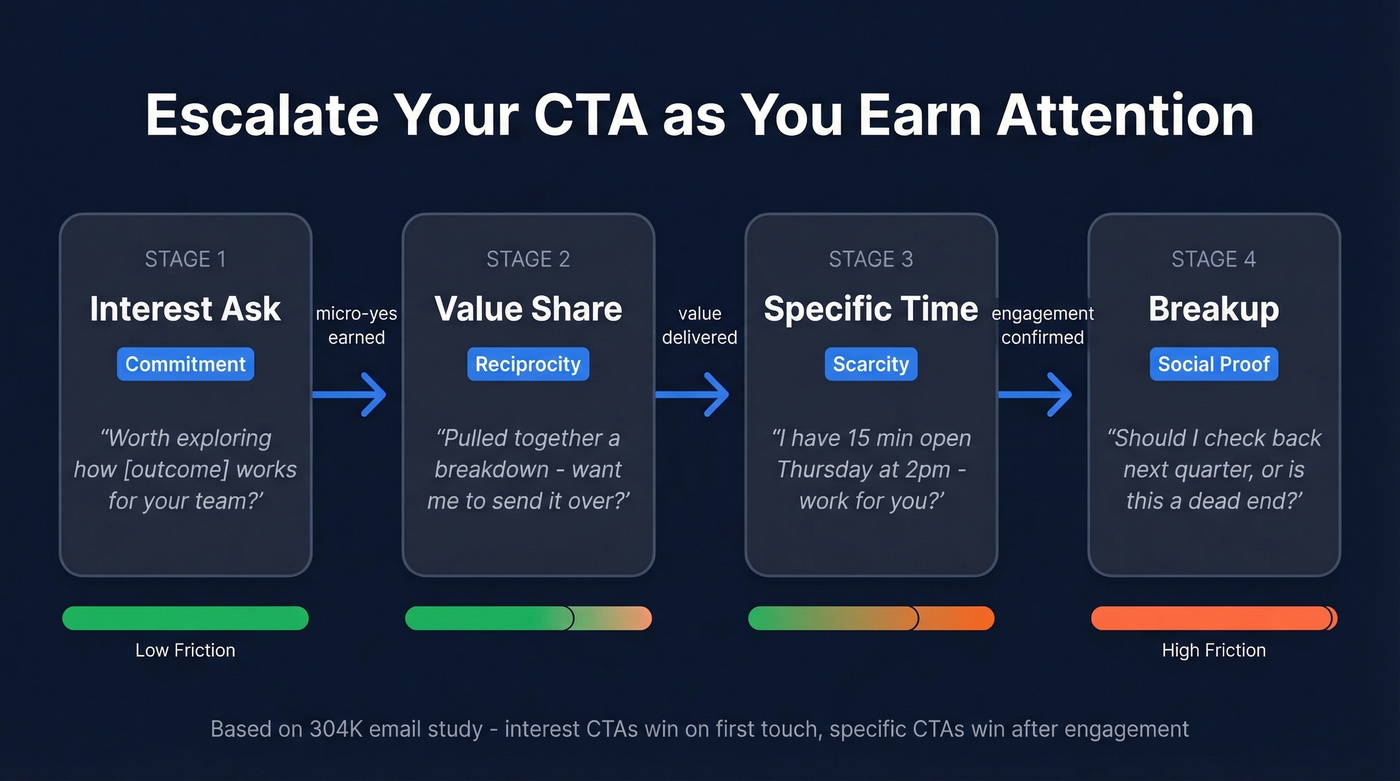
Stage 1: The Interest Ask
Principle: Commitment (Cialdini). Get a micro-yes before asking for anything real. You're requesting permission to share value, not demanding time.
- "Would it be worth exploring how [specific outcome] works for teams like yours?" - Best for SaaS selling to VP-level buyers
- "Curious - is [pain point] something your team's actively solving for?" - Best for agencies targeting SMB owners
- "Open to seeing how [company in their space] cut [metric] by [number]?" - Best for any outbound with a strong case study
Stage 2: The Value Share
Principle: Reciprocity. Now you're giving before asking. Step-2 emails that feel like casual replies outperform formal follow-ups by about 30%. We've seen the best results when the value share reads like something you'd send a colleague - not a prospect. Drop the formality. Write like you're forwarding a link to a friend who'd find it useful.
"Pulled together a quick breakdown of how [competitor/peer] handles this - want me to send it over?" works because it's specific and low-commitment. "We just published benchmarks on [relevant topic]. Happy to share if useful" works because you're leading with the resource. And "Quick follow-up - found a case study that's eerily similar to your setup. Worth a look?" works because curiosity does the heavy lifting.
Stage 3: The Specific Time
Principle: Scarcity (genuine, not manufactured). You've earned engagement. Now escalate. This is where the 304K-email study shows the 15% to 37% jump kicks in.
- "I've got 15 minutes open Thursday at 2pm or Friday at 10am - either work?" - Best for warm prospects who replied to Stage 1 or 2
- "We're running a limited pilot with [industry] teams this quarter. Worth a quick call to see if you qualify?" - Best for product-led companies with genuine capacity constraints
- "Can we grab 10 minutes this week? I'll share the exact playbook [peer company] used." - Best for competitive industries where peer intel has high value
Stage 4: The Breakup
Principle: Social proof. This isn't guilt-tripping - it's giving the prospect a graceful exit. The breakup email works because it removes pressure, and people respond to the absence of a hard sell more than they respond to one more push.
Here's the thing most reps get wrong: they make the breakup passive-aggressive. "I guess you're not interested" isn't a breakup - it's a guilt trip. Try these instead:
- "Totally understand if the timing's off. Should I check back next quarter, or is this a dead end?"
- "Last note from me - if [pain point] becomes a priority, here's a 2-min overview you can bookmark: [link]."
- "No hard feelings if this isn't relevant. Just reply 'not now' and I'll circle back in 6 months."

The 304K-email study proves interest CTAs win - but only if your email reaches the inbox. Pre-built lists bounce at 8-15%, killing your reply rate before your CTA gets read. Prospeo's 5-step verification delivers 98% email accuracy with a 7-day refresh cycle, so every carefully crafted closing line lands where it should.
Fix your data first. Your CTA will do the rest.
CTAs That Kill Reply Rates
We've reviewed thousands of cold emails across client campaigns, and these four patterns destroy response rates every time.
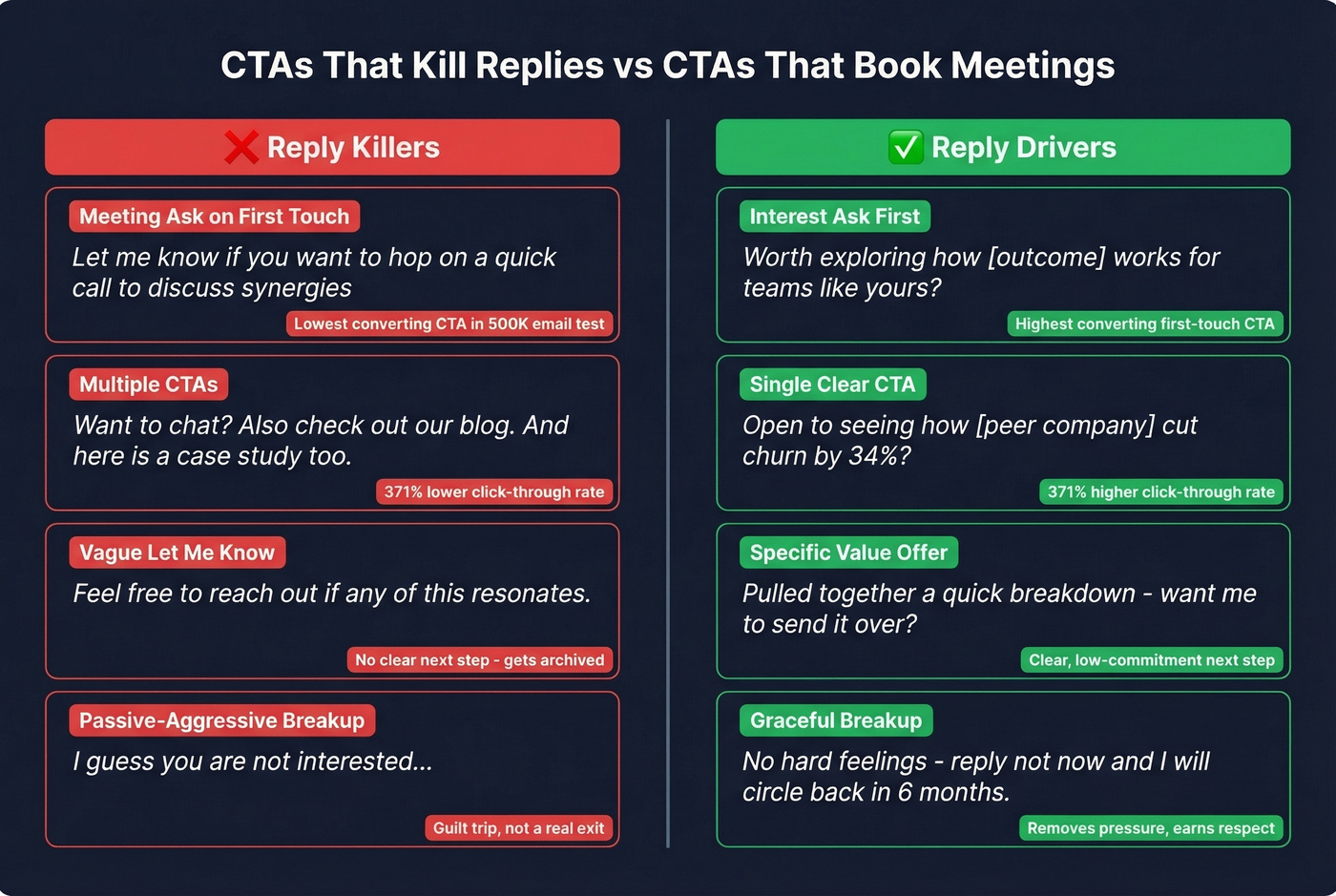
Meeting ask on first touch. Lowest-converting CTA in the 500K-email test. You haven't earned the right to ask for 30 minutes yet. We saw one that read "Let me know if you want to hop on a quick call to discuss synergies" - three vague asks crammed into one sentence.
Multiple CTAs in one email. Every additional ask dilutes the reader's decision. One CTA. Always. The 371% click-through gap between single and multiple CTAs isn't subtle.
Vague "let me know." No clear next step. The recipient reads it, nods, and archives. Another real example: "Feel free to reach out if any of this resonates." Resonates with whom? About what? There's nothing to act on.
Celebrating open rates. Apple Mail Privacy Protection inflates opens to meaningless levels - one sender reported 85% open rates with less than 1% human engagement. Replies are the only metric that matters.
Let's be honest: if your reply rate is under 2%, your CTA probably isn't the problem - your list is. The best cold email call to action in the world can't save an email that bounces or lands in spam. Fix your data before you rewrite a single word of copy.
Before You Send
Your CTA is irrelevant if your email bounces. The factor most teams ignore isn't copywriting - it's data quality. Pre-built prospect lists bounce at 8-15%. That's not a deliverability problem you can fix with warm-up tools; it's a data problem you fix before hitting send.
Timeline-based hooks average 10% reply rates versus 4.4% for generic problem hooks, so your opening line matters almost as much as your CTA. And a 3-7-7 cadence (3 days between email 1 and 2, then 7-day gaps) captures 93% of replies by Day 10 - front-load your strongest asks early in the sequence.
Prospeo's 5-step email verification keeps bounce rates under 3%, with 98% accuracy across 143M+ verified emails. The free tier covers 75 verifications per month, enough to clean a test batch before your next campaign launches. Upload a CSV, get results in minutes, and push verified contacts straight into Instantly or Lemlist.

You just learned the 4-stage CTA framework that top senders use to hit 10.7%+ reply rates. Now you need a list that won't waste it. Prospeo gives you 300M+ verified contacts with 30+ filters - buyer intent, job changes, technographics - so your interest asks land with prospects who actually have the pain point you're solving. At $0.01 per email, one booked meeting pays for thousands of contacts.
Stop perfecting CTAs for prospects who'll never see them.
Quick Benchmarks
| Metric | Average | Top Quartile | Top 10% |
|---|---|---|---|
| Reply rate | 3.43% | 5.5%+ | 10.7%+ |
| Replies from step 1 | 58% | - | - |
| Replies from follow-ups | 42% | - | - |
| Open rate | ~42% | ~55% | ~65% |
| Positive response | ~2% | - | - |
| Meetings booked | ~1% | - | - |
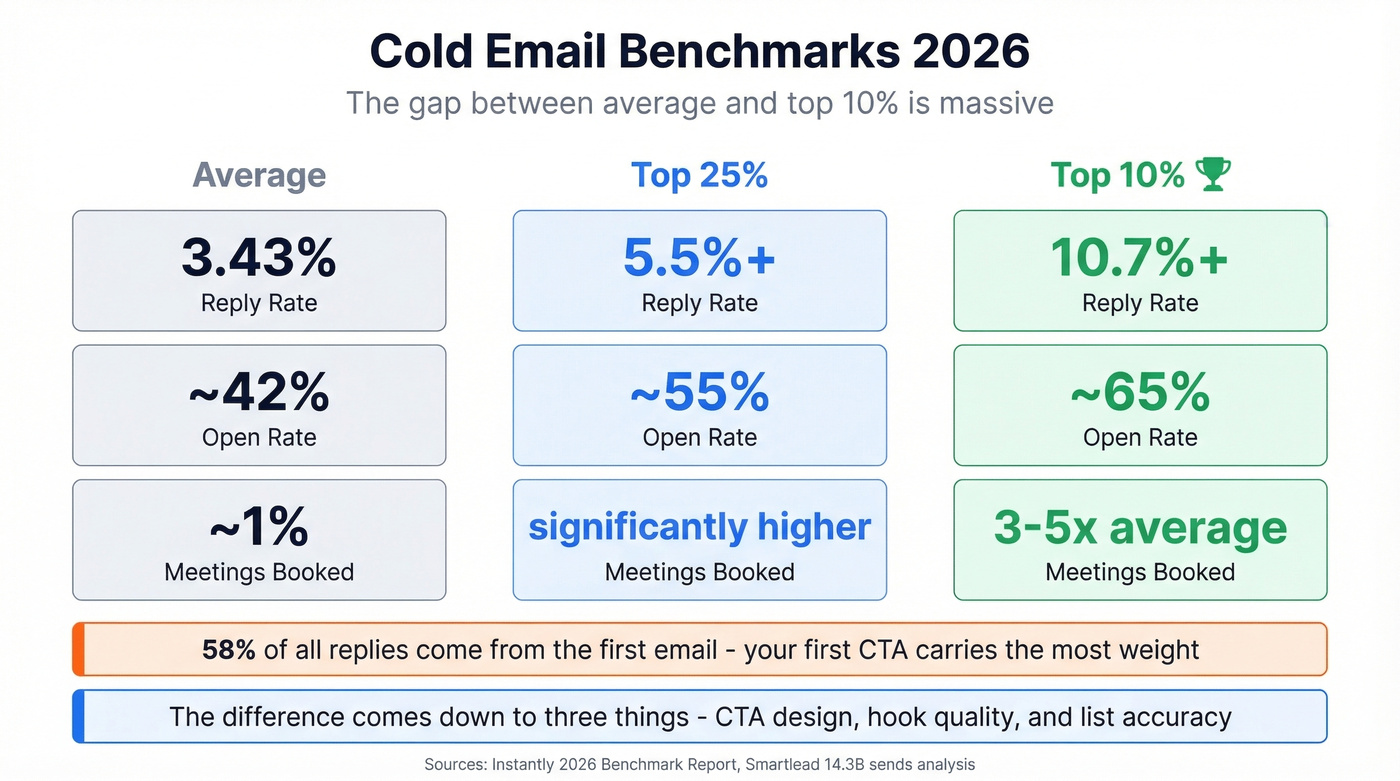
Data from Instantly's 2026 benchmark report and LevelUp Leads' analysis of Smartlead's 14.3B sends. The gap between average and top 10% is massive - and most of it comes down to CTA design, hook quality, and list accuracy.
If you want a deeper set of rules and examples beyond cold outreach, see our guide to email call to action.
FAQ
What's the best call to action for a first-touch cold email?
An interest-based question like "Would it be worth exploring how [specific outcome] works for your team?" outperforms meeting asks on first touch, according to the 304K-email Gong Labs study. Save the calendar link for email 3 or later, after you've earned engagement.
How many CTAs should a cold email have?
One. Single-CTA emails see up to 371% higher click-through rates than multi-CTA emails. Every additional ask dilutes the reader's decision and drops reply rates.
Should I include a calendar link in cold emails?
Not in your first email. A calendar link triggers loss aversion - the recipient calculates the time cost before they've seen any value. Introduce it in stage 3 of your sequence, once the prospect has replied or engaged with earlier messages.
How do I improve reply rates beyond the CTA?
Three levers matter most: your hook (timeline-based hooks average 10% reply rates vs 4.4% for generic ones), your data quality (bounced emails never reach a CTA), and your sequence length (2-4 steps outperform 7-step drips). Skip this if your bounce rate is already under 3% - but for most teams, cleaning your list is the single fastest way to lift reply rates before touching a word of copy.