

Cold Email Copywriter: Hire One, DIY, or Let AI Handle It?
You sent 500 cold emails last week. Three replies - two of them "please remove me from your list." Before you blame the copy, consider this: copy is only one piece of a three-part system. Data quality, targeting, and deliverability do more heavy lifting than any subject line ever will. The best cold email copywriter in the world can't save a campaign built on a bouncing list and a burned domain.
That doesn't mean copy doesn't matter. It absolutely does. But the decision you're actually making isn't "should I hire a copywriter?" - it's "where should I invest first to move my reply rate?"
Three Paths, Quick Version
Depending on where you are right now:
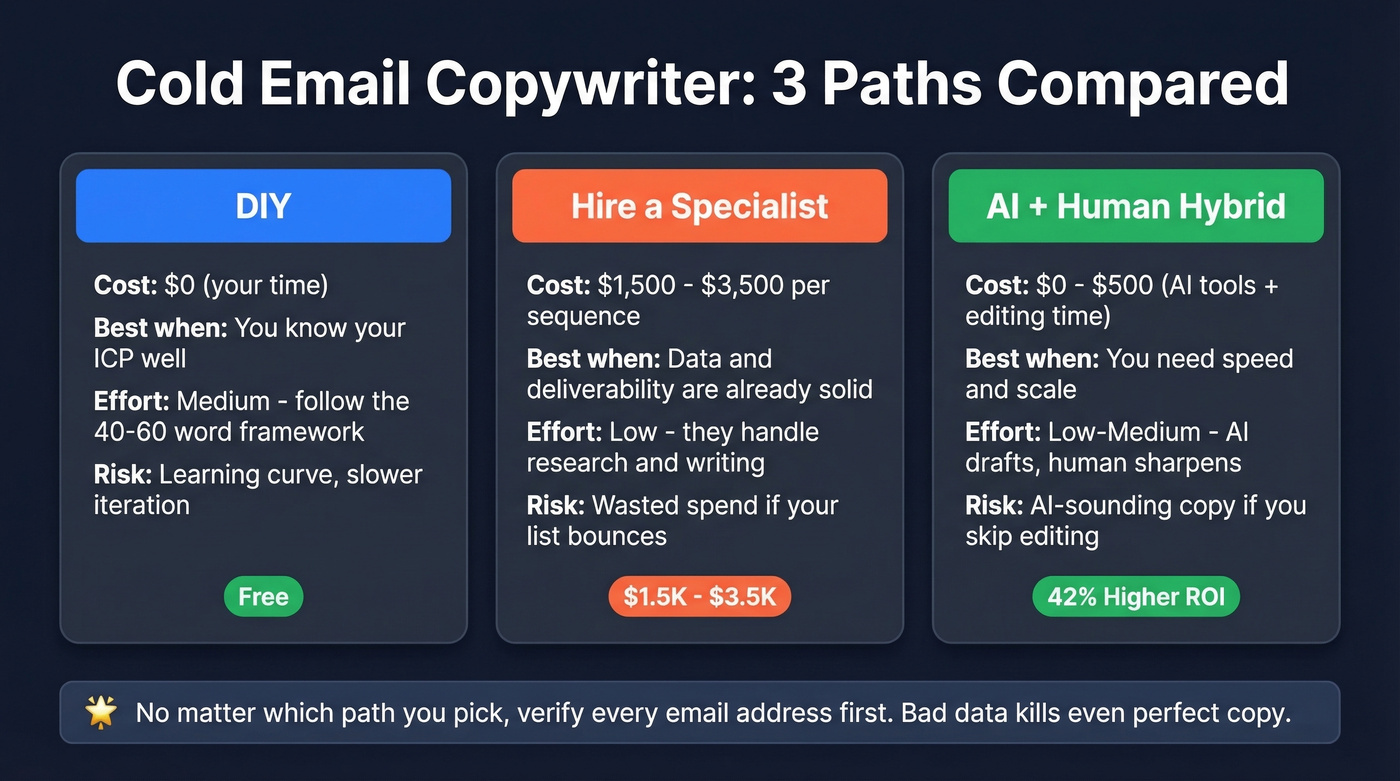
- DIY - Follow the 40-60 word framework below. Verify your list before sending. This is free and works if you understand your ICP.
- Hire a specialist - Expect $1,500-$3,500 for a 5-email sequence. Worth it only after your data and deliverability are already solid.
- AI + human hybrid - Use AI for first drafts, then have a human sharpen the copy. Hybrid teams see 42% higher ROI than either approach alone.
Whichever path you choose, verify every email address first. Bad data kills even perfect copy.
What a Cold Email Copywriter Actually Does
A cold email copywriter today isn't just someone who writes emails. They research your ICP, study your offer, craft multi-touch sequences, A/B test subject lines and CTAs, and optimize based on reply data over time. The good ones think like strategists who happen to write.
This is different from a general email marketing copywriter. Newsletter copy, drip campaigns, and promotional blasts follow different rules entirely. Cold outbound is a conversation starter with a stranger - the constraints are tighter, the tolerance for fluff is zero, and the feedback loop is brutally clear: reply rate, positive reply rate, meetings booked.
2026 Cold Email Benchmarks
Before you evaluate any copywriter - or your own writing - you need to know what "good" looks like right now.
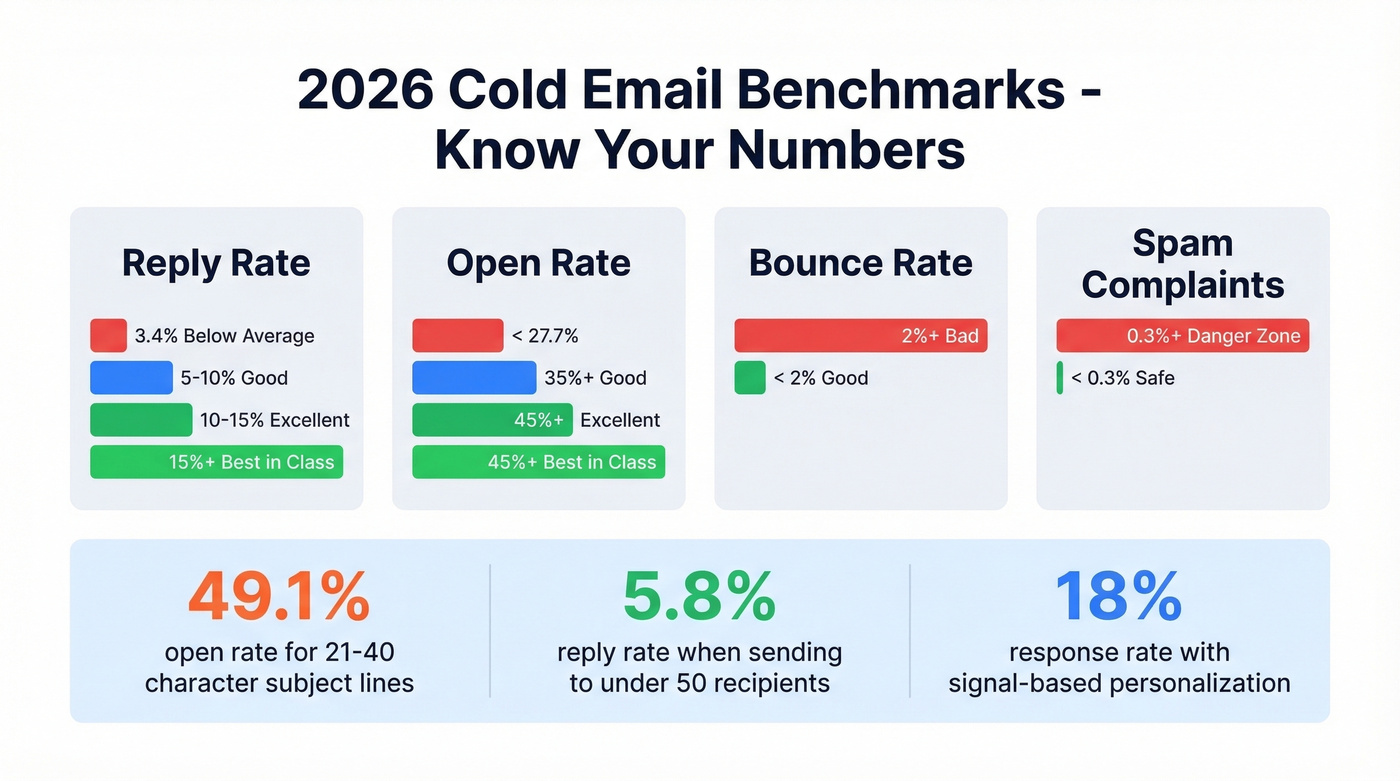
| Metric | Below Average | Good | Excellent | Best-in-Class |
|---|---|---|---|---|
| Reply rate | 3.43% | 5-10% | 10-15% | 15%+ |
| Open rate | <27.7% | 35%+ | 45%+ | 45%+ |
| Bounce rate | 2%+ | <2% | <2% | <2% |
| Spam complaints | ≥0.3% | <0.3% | <0.3% | <0.3% |
A few numbers that should change how you think about cold email. Subject lines between 21-40 characters hit a 49.1% open rate. Campaigns sent to 50 or fewer recipients average a 5.8% reply rate - nearly 3x the 2.1% that campaigns over 1,000 recipients get. For broader context, Backlinko's outreach study across millions of emails found an ~8.5% average response rate, but that includes highly targeted, personalized campaigns. Signal-based personalization - referencing funding rounds, new hires, or tech-stack changes - drives an 18% response rate versus 3.4% for generic outreach.
Tight targeting beats volume every time.
The Copy Framework That Works Now
The 2017 playbook is dead. A practitioner on r/copywriting put it bluntly: "Most of what worked last year is dead now." Two-hundred-word emails with "I noticed your company is growing" openers get deleted before the second sentence loads.
Structure: Brief context, specific offer, soft CTA. That's it. Target 40-60 words for the initial email. The optimal range is 50-125 words, but shorter within that window consistently outperforms longer.
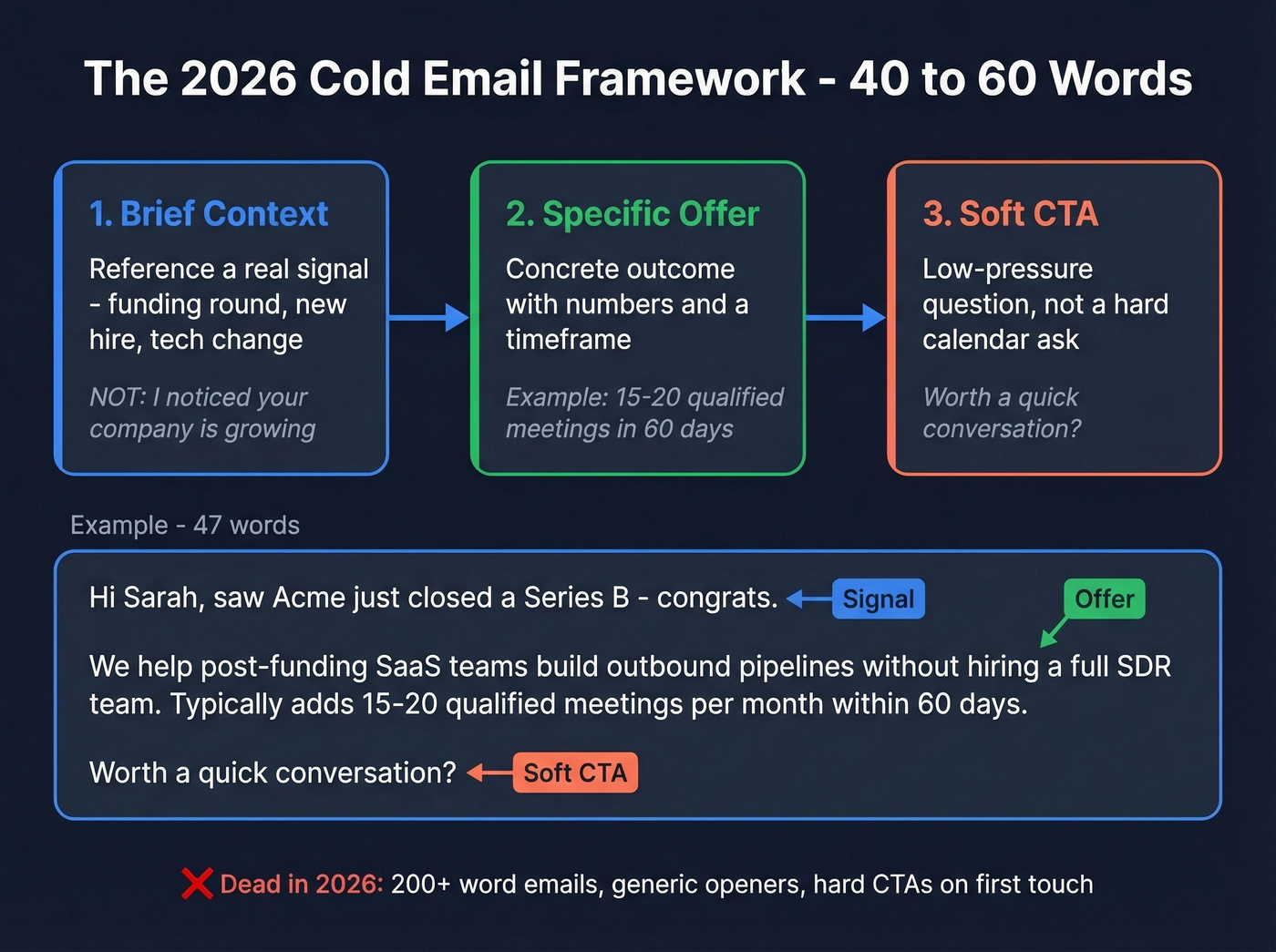
Some frameworks suggest a 5-step structure - hook, problem, proof, action, CTA - but that's too many steps for a first touch in 2026. Save multi-step approaches for follow-ups. Here's a 47-word example that nails the short format:
Hi {{firstName}}, saw {{company}} just closed a Series B - congrats. We help post-funding SaaS teams build outbound pipelines without hiring a full SDR team. Typically adds 15-20 qualified meetings/month within 60 days. Worth a quick conversation?
Why this works: the context is specific. A funding round is a real signal, not "I noticed your company." The offer is concrete - 15-20 meetings in 60 days. And the CTA is soft. "Worth a quick conversation?" feels lighter than a hard calendar ask from a stranger.
Subject Lines That Earn Opens
Keep them to 4-7 words. Trigger-event subject lines like "re: your Series B" hit 54.7% open rates. Don't overthink this - short, relevant, and lowercase tends to win.

Signal-based personalization drives 18% reply rates - but only if your emails actually land. Prospeo's 98% email accuracy and 7-day data refresh mean your carefully crafted copy reaches real inboxes, not dead ends. At $0.01 per email, fixing your data costs less than a single hour of copywriter time.
Stop paying $2,500 for copy that bounces. Fix the data first.
AI vs. Human: Who Writes Better Cold Emails?
AI writes passable first drafts, but it usually needs human editing to perform well in cold outbound.
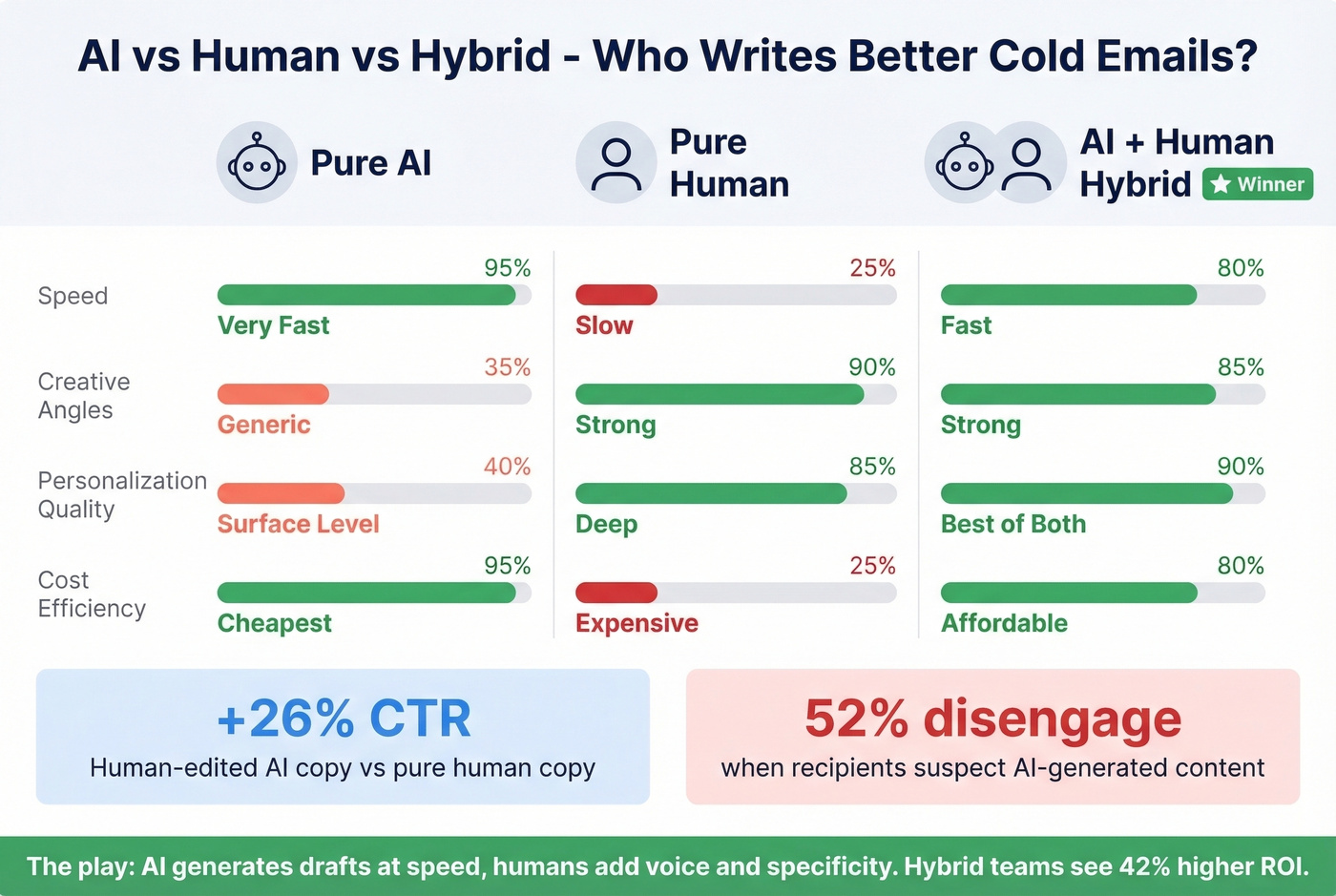
An agency owner on r/coldemail put it well - they've got AI agents handling copy, but "they just don't do the job 100% right." The creative spark, the weird angle that makes someone actually reply, still comes from a human brain. And the numbers back this up: human-edited AI copy produces 26% higher CTR than pure human copy alone. But 52% of recipients disengage when they suspect content is AI-generated.
Here's the thing: use AI to generate first drafts and variations at speed, then have a human - you, a teammate, or a hired copywriter - edit for voice, specificity, and that slightly-off-kilter angle that sounds like a real person wrote it. One practitioner reported hitting 8.2% reply rates with exactly this hybrid workflow.
Pure AI loses. Pure human is slow. Hybrid wins.
What a Cold Email Copywriter Costs
| Pricing Model | Range | Best For |
|---|---|---|
| Per email | $100-$500 | One-off tests |
| Per sequence (3-12 emails) | $1,000-$5,000+ | Full outbound sequence |
| Hourly | $50-$200+ | Consulting + copy |
| Monthly retainer | $1,000-$8,000+ | Ongoing optimization |
| Rush fee | +25-100% surcharge | <48hr turnarounds |
For most teams, the per-sequence model makes the most sense. A solid 5-email outbound sequence from a specialist runs $1,500-$3,500, including ICP research, subject line variants, and at least one round of revisions.
If someone quotes you $200 for a full campaign, they're using ChatGPT and a template. You can do that yourself for free.
Our take: If your deals average under $15k, you probably don't need a dedicated specialist at all. The hybrid AI approach with 30 minutes of human editing will get you 80% of the way there. Save the $2,500 for data and deliverability.
When is hiring worth it? After you've confirmed your deliverability is clean, your list is verified, and your offer resonates with at least some segment. A copywriter amplifies a working system - they don't create one from scratch. If your bounce rate is above 5%, spend that budget on data quality first.
The Data Problem Nobody Talks About
We've seen this play out dozens of times. A team hires a copywriter for $2,500. Reply rate goes from 2% to 2.3%. Everyone's disappointed. But when you dig in, 35% of the list bounced, the sender domain's reputation cratered, and half the emails that didn't bounce landed in spam. The copy was fine. The data was garbage.
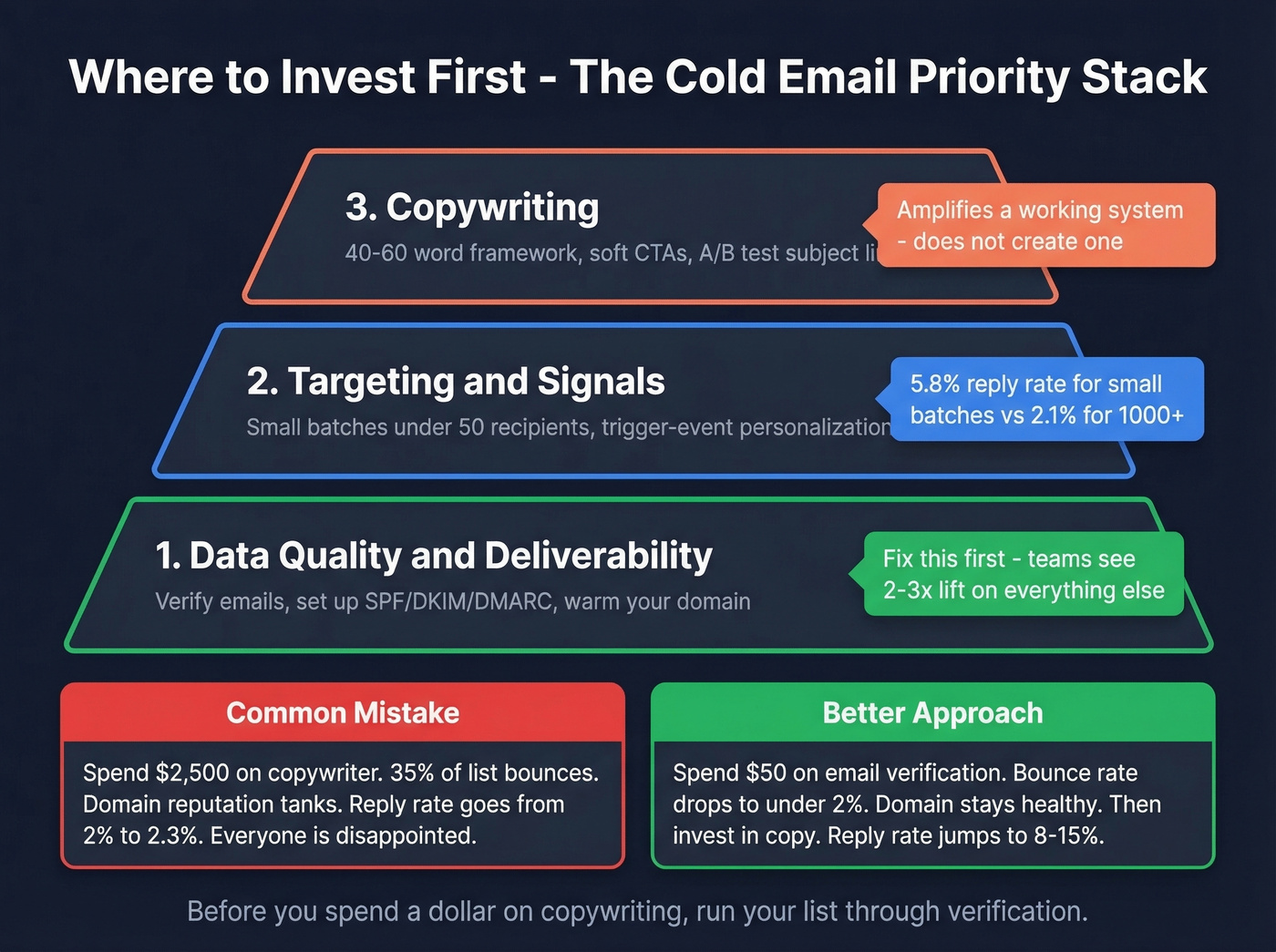
Deliverability is the prerequisite. SPF, DKIM, and DMARC authentication aren't optional anymore. Domain warm-up takes around 2-4 weeks. And list hygiene is the foundation everything else sits on.
In our experience, teams that fix data quality first see 2-3x the lift when they eventually invest in copywriting. Stack Optimize built from $0 to $1M ARR running cold outbound with 94%+ deliverability and under 3% bounce rates across every client. Meritt cut their bounce rate from 35% to under 4%. Both verified every address with Prospeo before sending a single sequence.
Before you spend a dollar on copywriting, run your list through verification. If 20% bounces, no copywriter on earth saves that campaign.

You just read that funding rounds, new hires, and tech-stack changes drive 5x higher reply rates. Prospeo tracks all three - plus 15,000 intent topics - so your cold emails reference real signals, not generic openers. Layer buyer intent with 30+ filters and send copy that actually earns replies.
Turn trigger events into reply-worthy cold emails with real-time signals.
Your Cold Email Tool Stack
You need three layers: verified contact data, a sequencer, and a CRM. Everything else is optional.
| Layer | Tool | Starting Price |
|---|---|---|
| Data & verification | Prospeo | Free (75/mo), ~$0.01/email |
| Sequencing | Instantly | Free tier, from ~$30/mo |
| Sequencing | Lemlist | From ~$59/mo |
| Sequencing | Smartlead | From ~$39/mo |
| Enrichment | Clay | Free tier, from ~$149/mo |
| CRM | HubSpot | Free tier available |
| CRM | Salesforce | From ~$25/user/mo |
Start with the data layer. 98% email accuracy and a 7-day refresh cycle mean you aren't sending to stale addresses. Add a sequencer, then plug in a CRM when volume justifies it. Native integrations between these tools mean verified contacts push directly into your sequencer without manual CSV exports.
If you’re evaluating platforms, it helps to compare your outbound lead generation tools and broader SDR tools stack side-by-side.
Mistakes That Kill Cold Emails
Buying lists tanks your sender reputation immediately. Build or verify your own. Sending to unverified addresses is just as bad - bounces above 2% trigger spam filters.
Writing 200+ word emails ignores the data. 50-125 words wins, and shorter within that range is almost always better. Generic openers like "I noticed your company" tell the prospect you noticed nothing. Reference a specific signal instead.
Hard CTAs on first touch feel aggressive from a stranger. "Worth a conversation?" outperforms a hard calendar ask nearly every time. And don't stop after one email - 55% of replies come from follow-ups. Send 1-3 follow-ups over 7-14 days. (If you need copy, start with these follow-ups.)
Skip SPF/DKIM/DMARC setup and you're dead on arrival. Same goes for ignoring GDPR/CAN-SPAM - these aren't just compliance issues, they're deliverability killers. Include an unsubscribe mechanism and don't use no-reply addresses.
FAQ
How long should a cold email be?
Target 40-60 words for the initial touch. The optimal range is 50-125 words, but shorter consistently outperforms longer in 2026. Anything over 125 words should be cut ruthlessly.
What reply rate should I expect?
The 2026 average is 3.43%. Well-targeted campaigns with verified data and strong copy hit 5-10%. Signal-based personalization - referencing funding rounds or tech-stack changes - can push you to 15%+.
Is hiring a cold email copywriter worth it?
Only after your data and deliverability are solid. If your bounce rate is above 5%, fix your list first. A specialist amplifies a working system - expect $1,500-$3,500 for a quality 5-email sequence.
Can AI replace a cold email copywriter?
Not fully. AI generates decent first drafts, but 52% of recipients disengage from suspected AI content. The hybrid approach - AI draft plus human editing - delivers 42% higher ROI than either alone.
How do I verify my email list before sending?
Use a verification tool with real-time checks, spam-trap removal, and catch-all domain handling. Prospeo's free tier gives you 75 verified emails a month with 98% accuracy - enough to test list quality before scaling.