

Stop Looking for a Cold Email CRM - Build a Stack Instead
Three reps on the same team email the same prospect in the same week. That's not a tool problem - it's an architecture problem. The single product most teams are searching for doesn't exist. What works is a stack: a sender, a CRM, and a data layer that keeps them honest.
Our Picks
Close - Best CRM-first option. Pipeline management with built-in email sequences, calls, and SMS. From $9/mo.
Apollo - Best all-in-one. 275M contacts, sequencing, and deal management in one platform. From $49-59/user/mo.
Instantly - Best pure sender. Unlimited email accounts, built-in warmup, and a 450M+ contact database (sold as a separate lead package). From $37-47/mo.
Built-In CRM vs. Dedicated CRM
Think of built-in CRMs like the scissors on a Swiss Army knife - they'll cut, but you wouldn't use them all day. The CRMs inside Instantly and Saleshandy are Kanban-style triage boards for sorting replies by status. They're not pipeline managers.
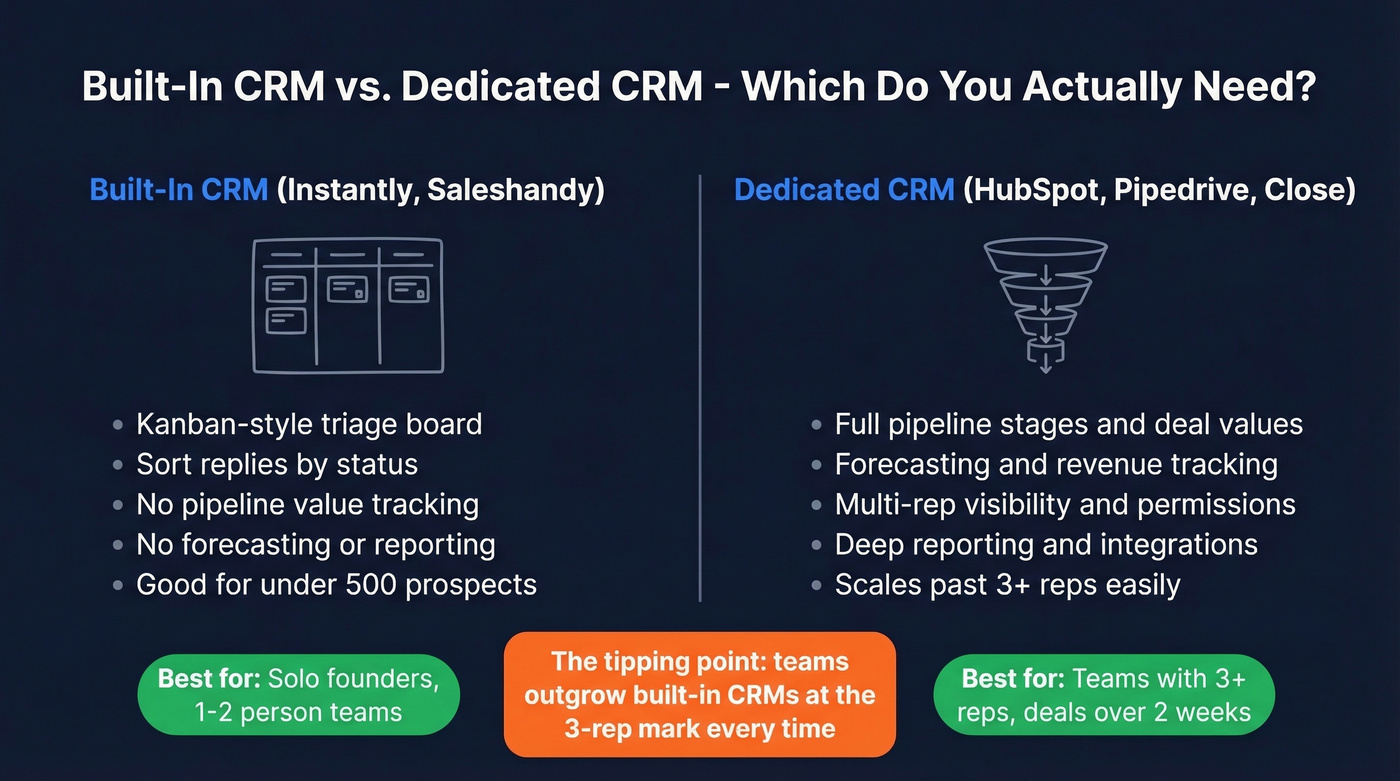
Use a built-in CRM if you're a solo founder or two-person team running fewer than 500 active prospects. Deal stages are simple: interested, meeting booked, closed.
Skip it and use a dedicated CRM if your team has three or more reps, deals take longer than two weeks to close, or you need visibility into pipeline value by stage. We've watched teams outgrow built-in CRMs around the 3-rep mark every single time. HubSpot's free tier, Pipedrive at roughly $15/user/mo, or Close starting at $9/mo are the go-to options.
Here's the thing: if your average deal size sits below five figures, you probably don't need a $49/user/mo all-in-one. A $47 sender plus a free CRM will outperform it - as long as your data is clean.
Why BCC-to-CRM Breaks at Scale
BCC logging feels like a shortcut until you realize what it doesn't capture. Campaign metadata - sequence name, step number, mailbox used, reply classification - none of that makes it into the CRM. You get a flat email record with zero context.
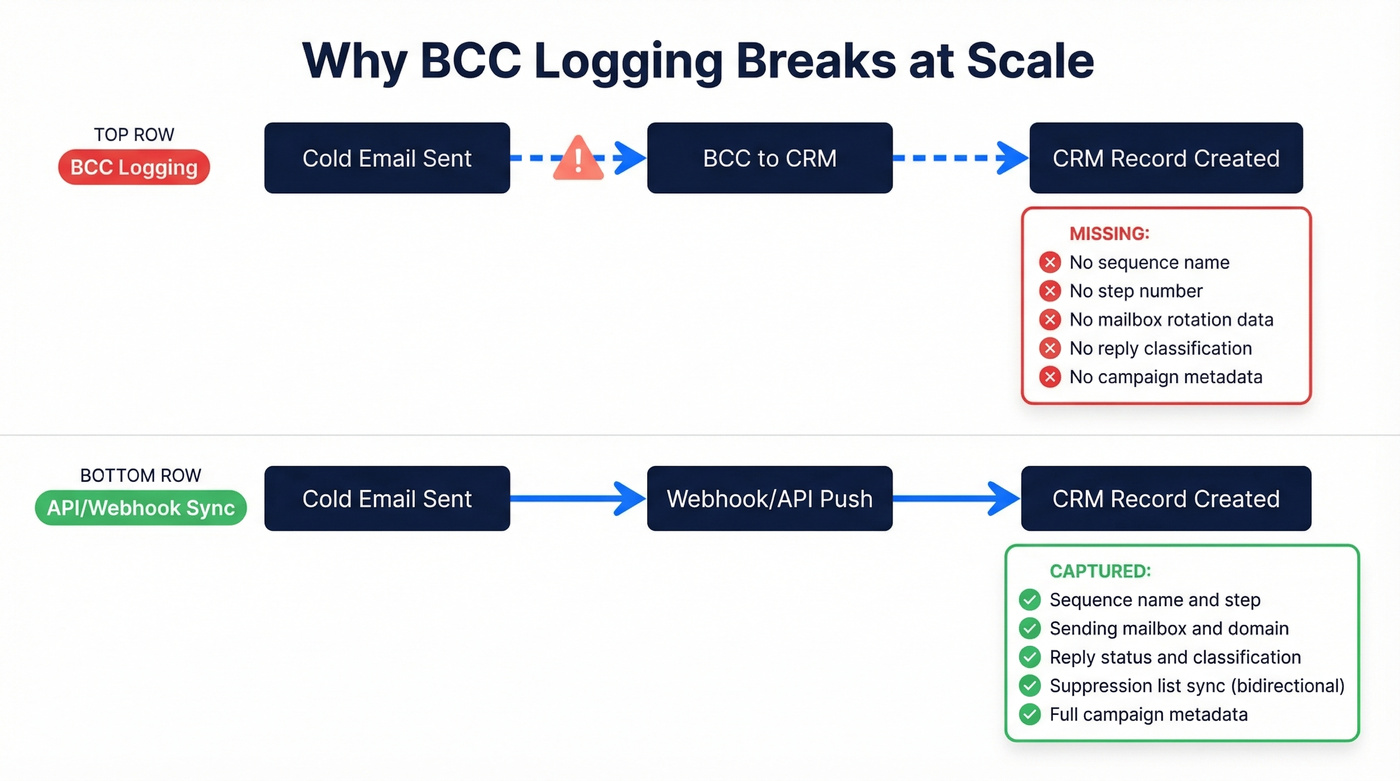
Reply logging is unreliable unless every sending inbox is connected to the CRM. It gets worse with mailbox rotation: HubSpot's BCC acceptance typically requires the "From" address to be a connected inbox or approved alias, and when you're rotating across 10+ sending domains, that's an admin nightmare nobody warns you about. The durable approach is webhook or API integration that pushes structured events and syncs suppression lists bidirectionally.

BCC logging breaks because it wasn't built for cold email. Prospeo's native integrations with HubSpot, Salesforce, Instantly, and Smartlead push structured contact data directly into your CRM - 50+ data points per contact, 92% match rate, refreshed every 7 days.
Stop syncing dead records. Start with data your CRM can actually use.
Best Tools for CRM-Integrated Cold Email
Close
Close is the only real CRM that also does cold email well. Smart Views build dynamic lead segments, and Workflows chain together emails, calls, SMS, and tasks into multi-step sequences that pause automatically when a prospect replies. Everything lives in one place - no Zapier glue, no syncing headaches.
The Power Dialer on the Growth plan at $99/user/mo and Predictive Dialer on Scale at $139/user/mo make it especially strong for teams blending email and phone outreach. 4.7/5 on G2.
The tradeoffs are real, though. Reporting is limited enough that teams often export to Google Sheets, the native integration ecosystem is small compared to HubSpot, and there's no lead scoring. Use Close if you want one tool for outreach and pipeline. Skip it if you need deep reporting or you're already locked into HubSpot.
Let's do the math: a 5-person team on Close Growth pays $495/mo but gets calling built in. The same team on Apollo starts around $245-295/mo without a dialer. That gap matters depending on whether phone outreach is part of your motion.

Prospeo
Prospeo is the data layer that makes any cold email and CRM stack work. The database covers 300M+ professional profiles with 143M+ verified emails at 98% accuracy - compared to 87% for ZoomInfo and 79% for Apollo. At 79% accuracy, one in five emails bounces, tanking your sender reputation and polluting your CRM with dead records.
The 7-day data refresh cycle is the real differentiator. The industry average sits around six weeks, which means most databases serve you contacts who've already changed jobs. CRM enrichment returns 50+ data points per contact at a 92% match rate, with native integrations covering Salesforce, HubSpot, Instantly, Lemlist, and Smartlead - no Zapier required.
At roughly $0.01 per lead, the ROI math is straightforward. Meritt, an agency running Prospeo, dropped their bounce rate from 35% to under 4% and tripled their pipeline from $100K to $300K per week.

Apollo
Apollo is the closest thing to a true all-in-one for cold email with integrated CRM workflows. The database spans 275M contacts across 73M companies, and built-in deal management gives you pipeline stages, forecasting, and activity tracking without a separate tool. From $49-59/user/mo on annual billing, with integrations for Salesforce, HubSpot, and Pipedrive if you want to layer it on top of an existing CRM.
The sequencing builder has a learning curve - G2 reviewers consistently flag this. More importantly, email accuracy outside the US runs 60-72%, meaning you're importing bad data into your CRM unless you verify separately. Use Apollo if your market is primarily North America. Skip it if you sell internationally.
Instantly
Best pure sender on the market. Unlimited email accounts, built-in warmup across a 4.2M+ account network, and done-for-you inbox setup that handles domain registration and DNS config. Outreach plans run $47-97/mo with send limits of 5,000 emails/mo on Growth. The full stack with the leads database starts at $122.50/mo.
The consensus on r/coldemail is clear: pair Instantly with HubSpot, Pipedrive, or Close for actual deal management. The built-in CRM is a glorified Kanban board for sorting reply statuses, not a pipeline tool. One useful feature worth noting - you can remove recipients from a campaign mid-sequence when they reply or book a meeting, keeping your sends clean and your CRM free of duplicate touches.
Saleshandy
Saleshandy sits in the middle ground. Its built-in CRM offers a Kanban pipeline plus an activity timeline, meaningfully better than Instantly's but lighter than Apollo's full deal management. It also includes a cold email client portal where agencies can give customers visibility into campaign performance without sharing login credentials. The database runs 830M+ contacts, and pricing starts at $25/mo. For teams that want basic pipeline visibility without bolting on a separate CRM, it's a solid pick.
Smartlead
High-volume sending engine built for agencies. Sends up to 6,000 emails/mo on the basic plan, with HubSpot sync plus API-based integrations covering most CRM workflows. Zapier fills the gaps. Plans run $39-94/mo. If you're already running a dedicated CRM and just need raw sending power, Smartlead does that well.
Lemlist
Multichannel sequences covering email and social touches, with CRM integrations for HubSpot and Salesforce. A free plan is available, and paid tiers run $55-79/mo. Shared sequence templates and team-level analytics make it a solid collaboration tool for small sales teams running coordinated outreach.
Integration Comparison
Here's how each tool handles CRM integration and what you get for the price.
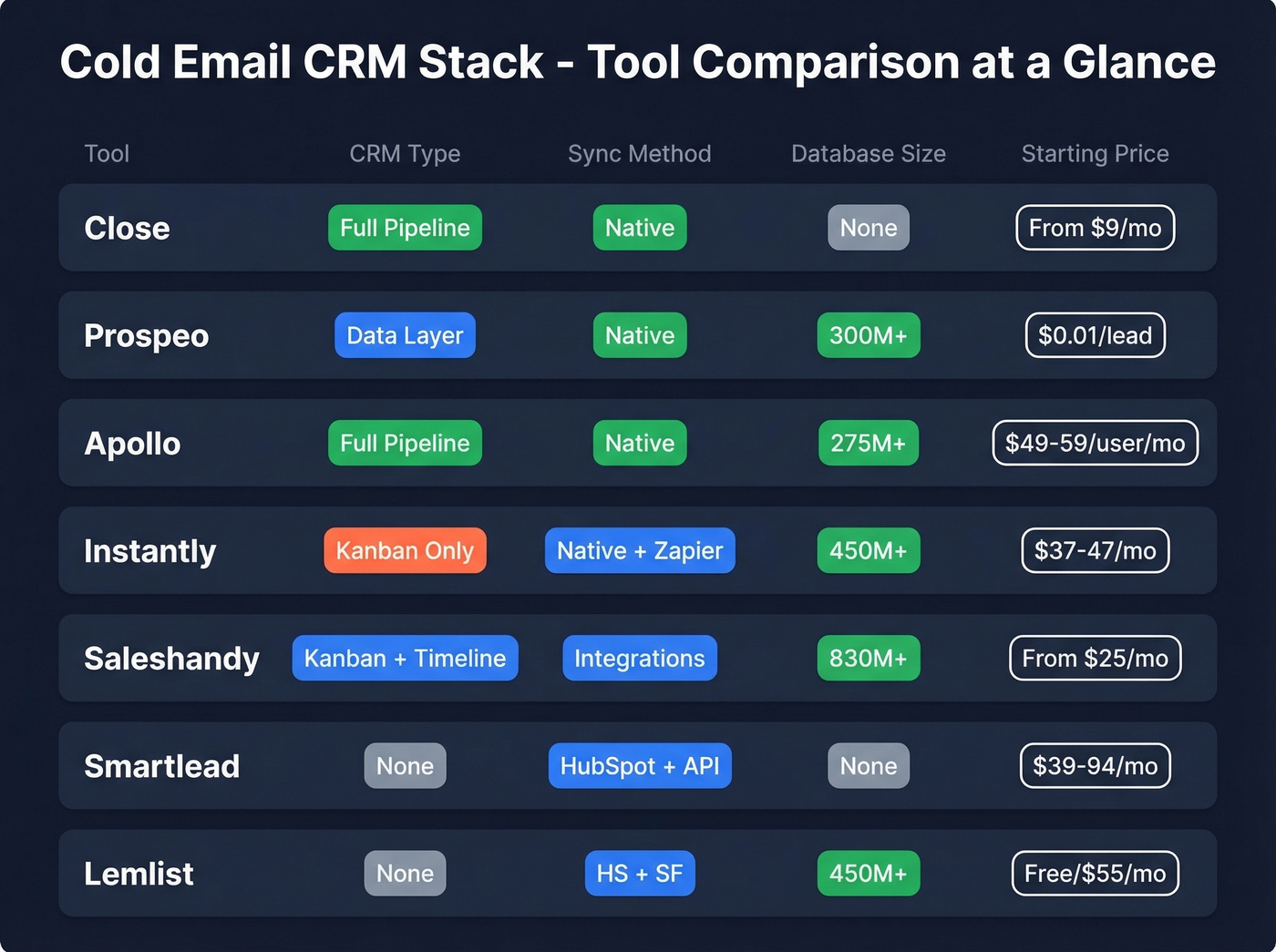
| Tool | CRM Type | CRM Sync | Database | From |
|---|---|---|---|---|
| Close | Full pipeline | Built-in (native) | None | $9/mo |
| Prospeo | Data layer | Native (SF, HS, + more) | 300M+ | ~$0.01/lead |
| Apollo | Full pipeline | Native (SF, HS, PD) | 275M+ | $49-59/user/mo |
| Instantly | Kanban board | Native for HS/SF/PD + Zapier/Make | 450M+ | $37-47/mo |
| Saleshandy | Kanban + timeline | CRM integrations available | 830M+ | $25/mo |
| Smartlead | None | HubSpot + API (Zapier common) | None | $39/mo |
| Lemlist | None | HubSpot + Salesforce | 450M+ | Free/$55/mo |
Fix the Data Before Your Stack Breaks
Your stack is only as good as the data flowing through it. With a 4-5% average cold email reply rate, every bounced email is a wasted slot. If your email accuracy is 79%, one in five contacts bounces - and that's not a deliverability problem. It's a data problem that cascades into CRM pollution, wasted sequences, and domain reputation damage.

We've seen teams import 5,000 contacts from a cheap database and watch 800+ bounce in the first week. The sender domain gets flagged, the CRM fills with invalid records, and the SDR team loses trust in the entire system. Verify every contact before it touches your CRM. That's the baseline, not a nice-to-have.
If you want a deeper playbook on keeping inboxes healthy, start with sender reputation and then tighten up your email deliverability fundamentals.
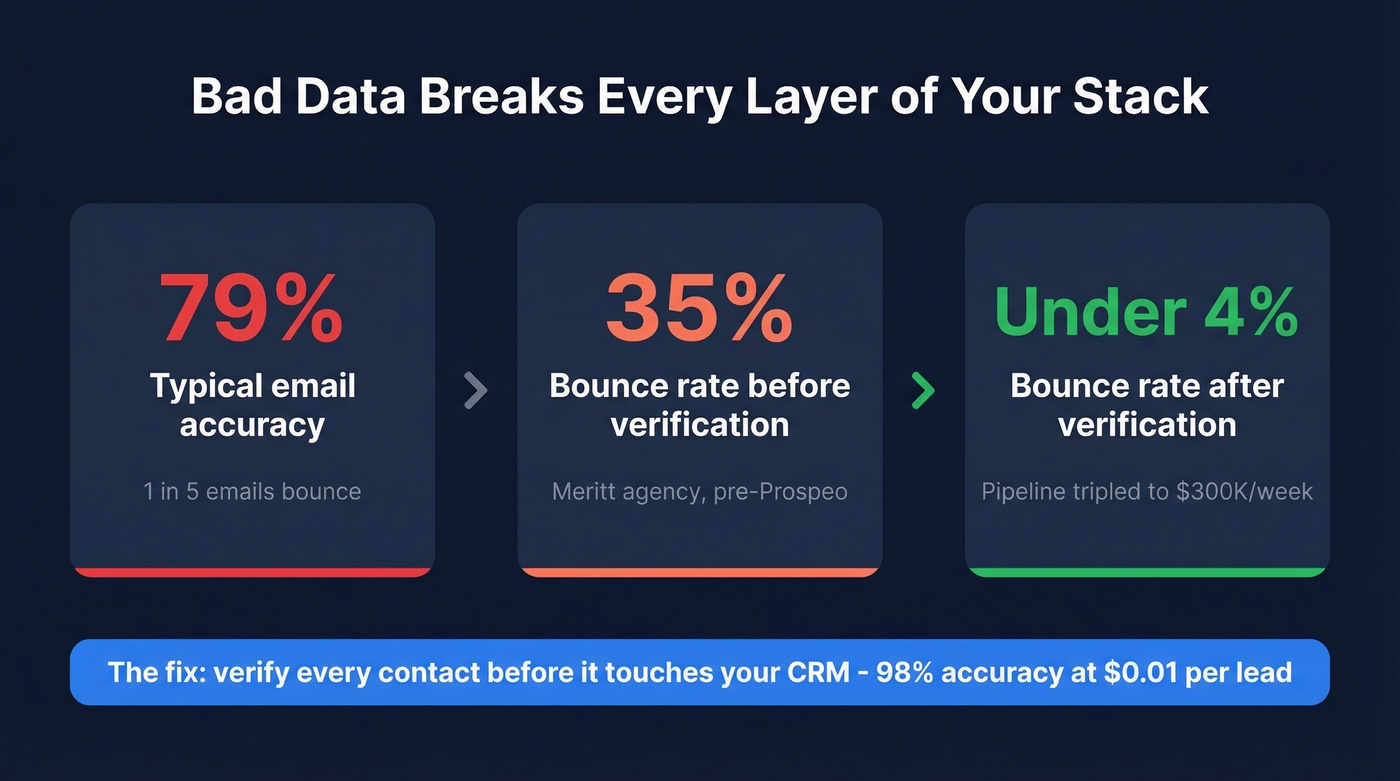
At 79% email accuracy, one in five sends bounces - wrecking your sender reputation and flooding your CRM with garbage. Prospeo delivers 98% verified emails across 300M+ profiles at $0.01 per lead. Meritt cut their bounce rate from 35% to under 4% and tripled pipeline.
Clean data is the stack layer most teams skip. Don't.
FAQ
Can I use Instantly as my CRM?
Instantly's built-in CRM is a Kanban triage board, not a pipeline tool. Use it to sort replies by status (interested, not now, unsubscribe), then push warm leads to HubSpot, Pipedrive, or Close for deal management and forecasting.
What's the best CRM pairing for cold email?
HubSpot's free tier handles most early-stage teams - up to 1M contacts and basic pipeline. Pipedrive at $15/user/mo is simpler for small sales orgs. Close is best if you want built-in calling and sequences without a separate outreach tool.
How do I keep bad data out of my CRM?
Verify every contact before importing. Multi-step verification filters out spam traps and invalid addresses - Meritt cut bounce rates from 35% to under 4% using 5-step verification before any record hit their CRM. Pair verification with a weekly data refresh to prevent records from going stale.
Is there a free tool for cold email data verification?
Prospeo offers 75 free email lookups plus 100 Chrome extension credits per month - enough to test data quality before committing. Hunter gives 25 free searches/mo but caps enrichment. For teams running real campaigns, the free tier covers more ground.