

Companies That Buy Data: Industries, Pricing & the Buyer's Guide for 2026
Most guides about companies that buy data answer the wrong question. They list who sells data - Experian, Acxiom, ZoomInfo - which is like answering "who eats at restaurants?" with a list of restaurants. The actual buyers are hedge funds spending millions on satellite imagery, sales teams paying $30K/year for email lists, and insurance underwriters licensing geospatial risk models.
The global data broker market hit $277.97 billion in 2024 and it's growing at 7.3% annually. North America alone accounts for 41.2% of that revenue. Somebody's buying all that data. Let's talk about who, what they pay, and how to do it without getting burned.
The Quick Picture
Every industry from hedge funds to political campaigns purchases data - the global market is $278B and climbing toward $512B by 2033. What you'll pay ranges from roughly $0.01 per verified email on self-serve platforms to $45,000+/year for enterprise tools like ZoomInfo. One rule above all others: test before you commit. Any vendor that won't let you validate accuracy before signing a contract is hiding something.
Who Buys Data in 2026?
| Industry | What They Buy | Typical Entry Point |
|---|---|---|
| Finance & Investment | Alt data, transaction data | $10K-$500K+/dataset |
| Sales & Marketing | B2B contacts, intent data | $5K-$20K/year |
| Insurance | Risk models, geospatial data | $50K-$500K+/year |
| Real Estate | Property records, demographics | $10K-$100K+/year |
| Advertising & AdTech | Audience segments, behavioral | $20K-$200K+/year |
| Political Campaigns | Voter files, consumer profiles | $5K-$50K+/cycle |
| Healthcare & Pharma | Claims data, provider records | $50K-$1M+/year |
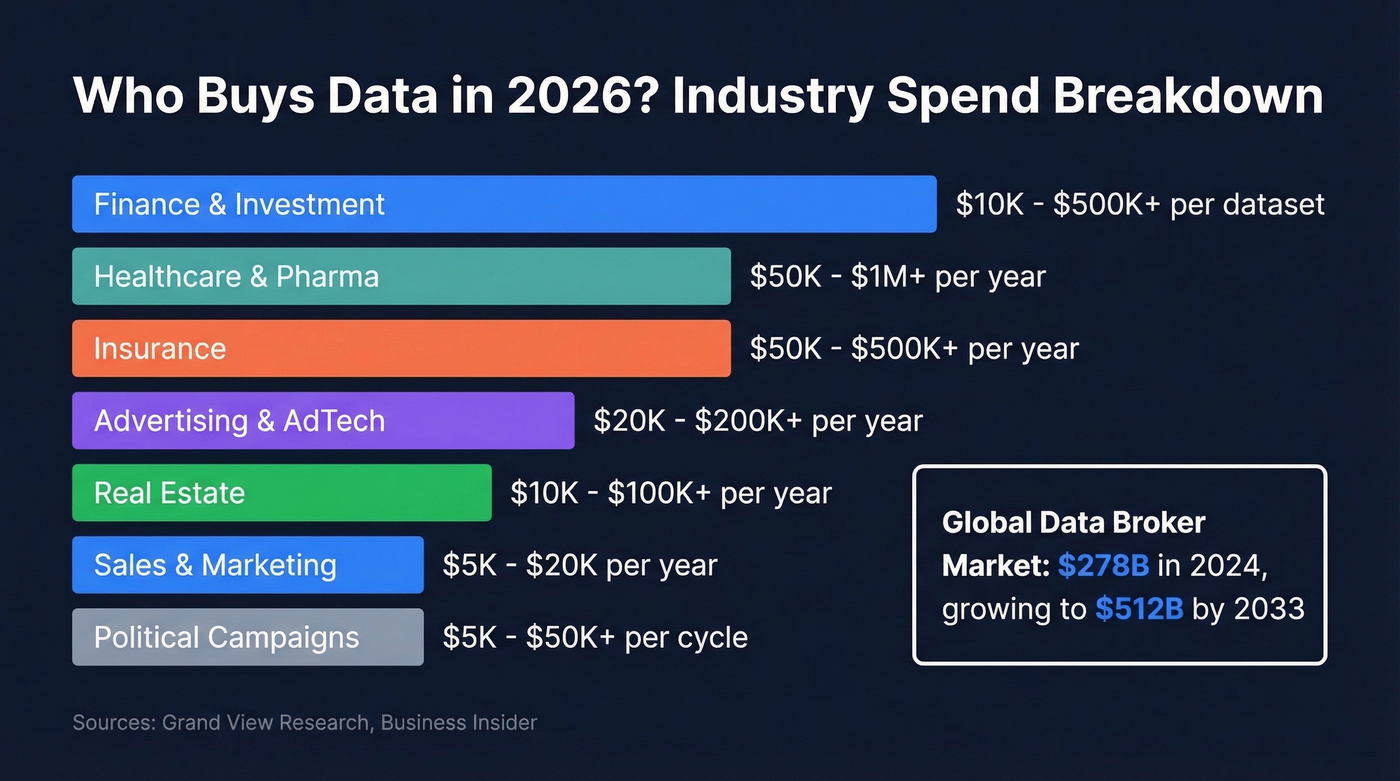
Finance and investment is the biggest story. Asset managers spent $2.8 billion on alternative data in 2025, a 17% jump year-over-year. Bull-case projections put that number above $23 billion by 2030. These firms buy credit-card transaction feeds, cellphone geolocation data, satellite imagery of retail parking lots, and web-scraping outputs - anything that gives them an edge before earnings reports drop.
Sales and marketing teams are the most visible data buyers, and the category we know best. Every outbound team running cold email or cold call campaigns needs contact data - verified emails, direct dials, firmographic filters. This is where platforms like ZoomInfo, Apollo, Cognism, and Prospeo operate. The spend ranges from a few hundred dollars a month for self-serve tools to $45K+/year for enterprise contracts with intent data bundled in.
Insurance and real estate companies license geospatial data, property records, and risk models from vendors like CoreLogic and LexisNexis. Underwriters use flood-zone mapping, historical claims data, and demographic overlays to price policies. Real estate investors buy transaction histories and zoning data to identify acquisition targets.
Advertising and AdTech firms purchase audience segments and behavioral data to target campaigns. Consumer data is the largest segment of the broker market at 35.1% of total revenue, which tells you how much demand exists for this category. The ROR Partners enforcement case in California is instructive - the company built profiles using billions of data points on 262 million Americans and sold custom audience segments. CalPrivacy's position was blunt: "A sale is a sale," even when data is bundled into broader marketing services.
Tech companies also acquire data to power their own products - embedding property data into a real estate app, or licensing business records for a CRM enrichment feature. For these buyers, API reliability and schema stability matter more than per-record cost.
Political campaigns and healthcare round out the major buyer categories. Campaigns license voter files enriched with consumer behavior data. Pharma companies buy provider directories and claims data to target HCP outreach. Both operate under heavy regulatory scrutiny, and the compliance overhead alone can double the effective cost of the data.
What Types of Data Get Bought?
| Data Type | What It Includes | Primary Buyers | Typical Cost |
|---|---|---|---|
| B2B Contact | Emails, phones, titles | Sales teams, agencies | $0.01-$0.60/record |
| Consumer | Demographics, purchase history | Advertisers, insurers | $0.14-$0.30/record |
| Financial/Alt Data | Transactions, satellite, web traffic | Hedge funds, asset mgrs | $10K-$500K+/year |
| Intent/Behavioral | Buying signals, topic research | B2B marketing, ABM teams | $10K-$50K+/year |
| Geospatial/Location | GPS, foot traffic, mapping | Real estate, retail, insurance | $5K-$100K+/year |
| Technographic | Tech stack, tool usage | Sales teams, VCs | Bundled or $5K-$20K/year |
The hedge fund world has its own taxonomy worth understanding. Web-scraping offerings alone accounted for 15% of total alternative data spend in 2025. Social and engagement data from platforms like Reddit, TikTok, and X feeds sentiment analysis models. Wikipedia page views serve as leading indicators for brand interest. And consumer transaction data - anonymized credit-card receipts - remains the gold standard for predicting retail earnings.
Where to Buy Data
Data Marketplaces
The marketplace model is booming. Platforms like AWS Data Exchange, Snowflake Marketplace, Databricks Marketplace, Datarade, and Nasdaq Data Link let you browse, sample, and license datasets without negotiating directly with providers. The data marketplace platform market hit $1.49 billion in 2024 and is projected to reach $5.73 billion by 2030.
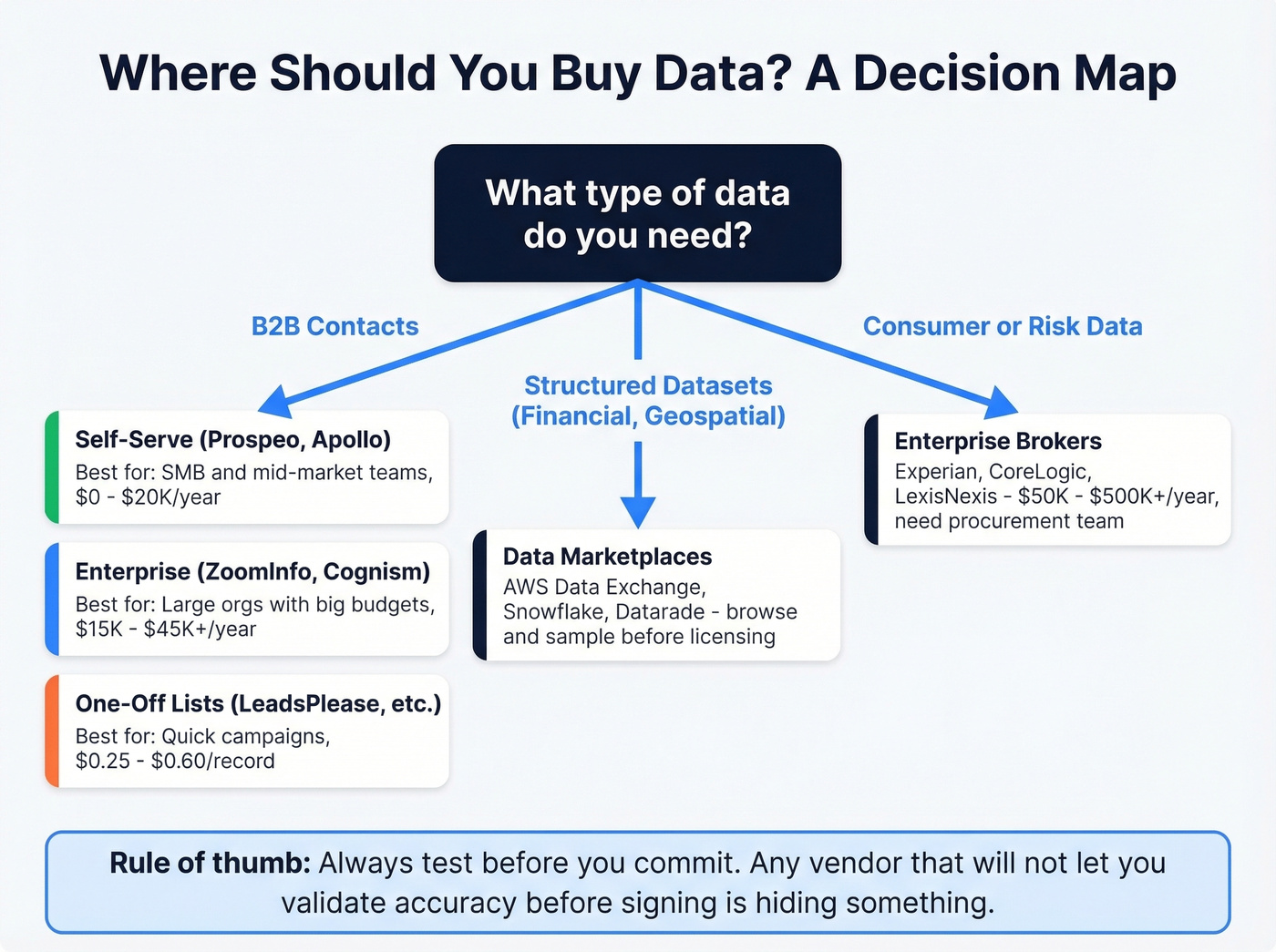
Marketplaces work best for structured datasets: financial feeds, geospatial layers, and aggregated consumer panels. They're less useful for real-time B2B contact data.
B2B Contact Data Vendors
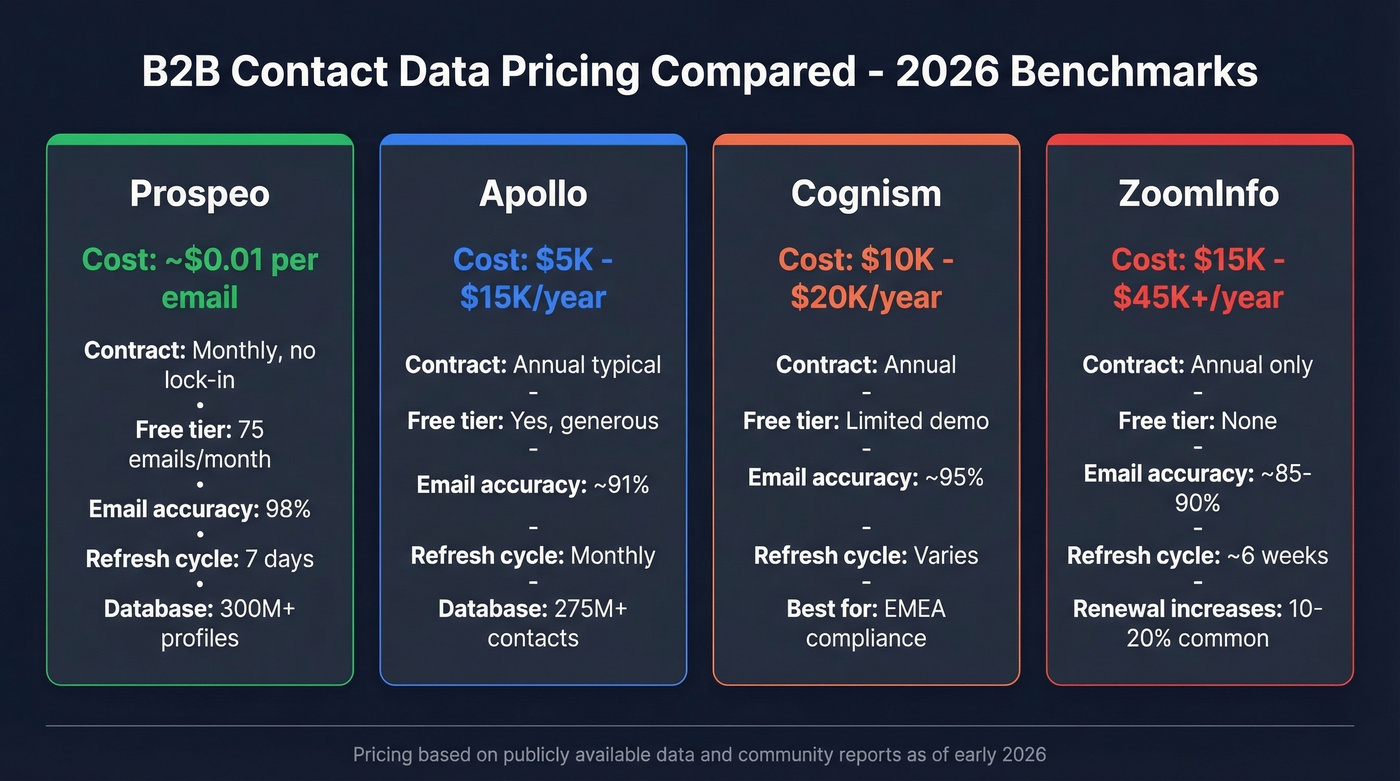
This is where most sales and marketing teams spend. ZoomInfo is the enterprise default - deep US database, intent data, and workflow tools, but you're looking at $15K-$45K+/year with annual contracts. Apollo offers a generous free tier and solid coverage for SMB teams. Cognism leads in EMEA compliance and mobile verification.
For teams that need accurate contact data without enterprise overhead, Prospeo covers 300M+ professional profiles with 98% email accuracy on a 7-day refresh cycle. It starts free with 75 emails/month and scales at roughly $0.01 per verified email - no annual contracts, no "talk to sales" gates. The 5-step verification process includes catch-all handling, spam-trap removal, and honeypot filtering, which matters when your domain reputation is on the line. We've seen outbound agencies like Stack Optimize run deliverability above 94% with bounce rates under 3% across all their clients using this approach.

Consumer Data Brokers
The consumer broker landscape is dominated by a handful of massive players. Experian, Equifax, and Acxiom hold data on hundreds of millions of individuals. CoreLogic specializes in property and mortgage data. LexisNexis covers legal, risk, and identity verification. These aren't self-serve tools - you're negotiating enterprise contracts, often $50K-$500K+/year depending on data volume and use case. Skip this category entirely if you're a startup or SMB without a dedicated procurement team.

You're comparing data vendors - so compare what matters. Prospeo delivers 300M+ profiles at 98% email accuracy on a 7-day refresh cycle, while ZoomInfo charges $15K-$45K/year for data that refreshes every 6 weeks. At ~$0.01 per verified email with no annual contracts, you get enterprise-grade data at 90% less cost.
Test 75 emails free and see the accuracy difference before you spend a dollar.
How Much Does Data Cost?
Pricing in the data industry is deliberately opaque. Let's fix that.
| Tier | Example | Typical Cost | Contract |
|---|---|---|---|
| Self-serve B2B | Prospeo | Free-~$0.01/email | Monthly, no lock-in |
| Mid-market B2B | Apollo, Cognism | $5K-$20K/year | Annual typical |
| Enterprise B2B | ZoomInfo | $15K-$45K+/year | Annual only |
| One-off lists | LeadsPlease, etc. | $0.25-$0.60/record | Per purchase |
| Alt data (finance) | Various providers | $10K-$500K+/dataset | Annual license |
ZoomInfo's pricing deserves special attention because it's the benchmark everyone compares against. Professional tier runs $15K-$18K/year. Advanced hits $22K-$28K. Elite packages with intent data and advanced features push $35K-$45K+. All annual-only, and renewal increases of 10-20% are common. We've seen teams locked into $40K renewals for four users who only use the search bar.
Here's the thing: the consensus on r/sales is that enterprise data contracts auto-renew at 15-20% increases with no performance guarantees. You're paying more for the same data that decayed 25% since you signed.
Most sales teams don't need a $30K data platform. They need verified contacts for the 200 accounts they're working this quarter. A self-serve tool at $0.01/email handles that without the overhead, the annual lock-in, or the renewal surprise.
On the other end, per-record list buying still exists. Business email lists run roughly $0.25-$0.60 per record depending on volume. Consumer email lists are cheaper at $0.14-$0.30 per record. But one-off lists decay fast and accuracy is a gamble.
If you're comparing providers, start with a ranked list of the best B2B databases and then narrow down by your region, ICP, and workflow needs.
Risks of Buying Data
Before you sign anything, understand what can go wrong.
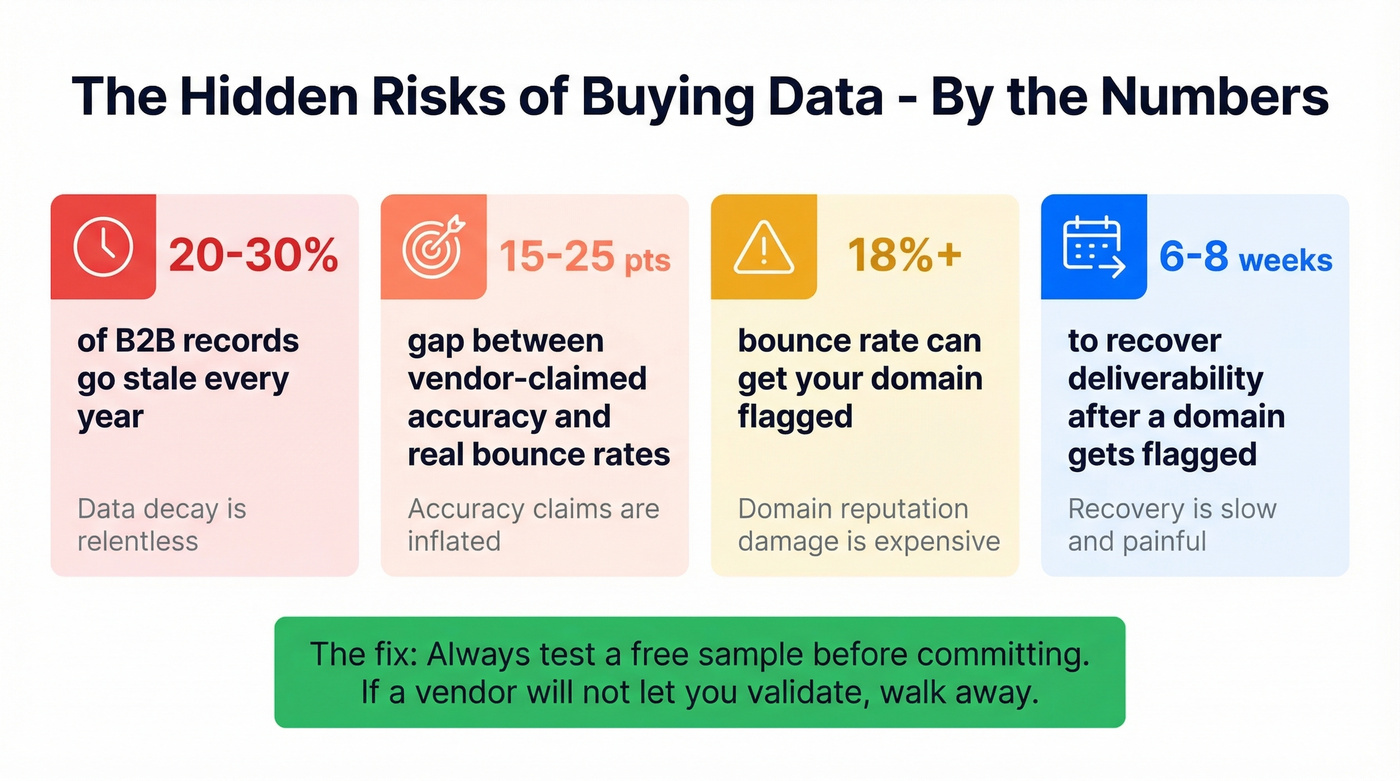
Data decay is relentless. Roughly 20-30% of B2B contact records go stale every year. People change jobs, companies rebrand, email domains rotate. A list that's 90% accurate in January could be 65% accurate by December.
Accuracy claims are inflated. Vendors market "95%+ accuracy," but real-world deliverability often lands at 60-70% for third-party lists. We've tested dozens of data vendors - the ones that won't give you a free sample almost always have accuracy problems. The gap between vendor-claimed accuracy and real-world bounce rates consistently runs 15-25 percentage points.
Consent gaps create compliance risk. Third-party contacts haven't opted into hearing from you. They may have consented to data collection by the original source, but that doesn't mean they want your cold email. This increases spam complaints and regulatory exposure. If you're operating in the EU/UK, use a GDPR compliant database checklist before you buy.
Domain reputation damage is real and expensive. Picture this: you buy 10,000 "verified" emails, load them into your sequencer, and hit an 18% bounce rate on the first send. Your domain gets flagged. Deliverability tanks - not just for that campaign, but for every email your company sends. Recovery takes weeks. I've watched it happen to teams that thought they were saving money by going with the cheapest list provider.

As Forbes has noted, third-party data scores lowest in accuracy and timeliness because information changes between capture and use. The collect-aggregate-sell pipeline introduces lag that's impossible to eliminate entirely.
Regulatory Shifts in 2026
The regulatory environment for data buying has shifted dramatically. If you're purchasing contact or consumer data this year, you need to understand three things.
California's DELETE Act created the Delete Request and Opt-out Platform (DROP), which launched January 1, 2026. Starting August 1, 2026, every registered data broker must begin processing deletion requests through DROP at least once every 45 days. The system uses hashed consumer identifiers - standardized formatting before hashing prevents brokers from claiming "no match." Penalties include $200/day for failing to register and $200 per consumer per day for failing to delete matched personal information. With more than 500 registered brokers in California alone and a unified database of 750+ brokers across five state registries, this isn't theoretical.
Enforcement is already happening. CalPrivacy fined ROR Partners LLC $56,600 for failing to register as a data broker - a company with data on more than 262 million Americans. The CFPB also moved to bring data brokers under FCRA oversight in mid-2025, signaling federal-level scrutiny beyond state laws.
The bottom line for data buyers: you share compliance responsibility. Purchasing data from a non-compliant broker doesn't insulate you from regulatory risk. Ask vendors about their registration status, GDPR/CCPA compliance, and how they handle deletion requests before you sign. For a deeper framework, see our guide to B2B compliance.
How to Evaluate a Data Vendor
Use this checklist before committing budget:
- Accuracy verification: Demand 95%+ email deliverability with evidence. Run a sample through your own verification tool before buying in bulk. (If you need options, compare email verifier tools.)
- Refresh cadence: Monthly is the minimum. Ask specifically how often records are re-verified - 7-day cycles exist; the industry average is 6 weeks.
- Compliance certifications: GDPR and CCPA compliance aren't optional. Ask for DPAs, data sourcing documentation, and registration status.
- Free trial or sample data: Any vendor that won't let you test before buying is a red flag. Validate quality on your own data before spending a dollar.
- Match-rate benchmarks: Ask what percentage of your target accounts the vendor can actually cover. A 300M-profile database means nothing if it doesn't have the 500 accounts you care about. (This is easier when you start from an ideal customer profile.)
- Transparent pricing: Prioritize vendors with published pricing and no annual lock-in. The "talk to sales" gate exists to maximize what they charge you, not to help you.
If you're buying lists specifically for outbound, it's also worth reviewing the best B2B list providers and how they source/verify records.
Bad data doesn't just waste budget - it burns your domain. Prospeo's 5-step verification with catch-all handling, spam-trap removal, and honeypot filtering keeps bounce rates under 3%. Stack Optimize built a $1M agency on that deliverability. Intent data across 15,000 topics tells you who's actually in-market.
Stop buying data that damages your sender reputation.
FAQ
Is it legal to buy data?
Yes, buying data is legal in most jurisdictions, but GDPR, CCPA, and California's DELETE Act impose strict rules on collection, sale, and usage - and buyers share compliance responsibility with sellers. Always verify your vendor's regulatory standing and confirm your use case complies with applicable privacy laws before signing.
How much does a business email list cost?
Expect $0.25-$0.60 per record for one-off business email lists from traditional vendors. Self-serve platforms charge roughly $0.01 per verified email with no minimum commitment. Enterprise platforms like ZoomInfo run $15K-$45K+/year on annual contracts.
What's the difference between first-party and third-party data?
First-party data is collected directly from your own audience - website visitors, customers, form fills. Third-party data is aggregated by brokers and sold to multiple buyers. Third-party data scales faster but is less accurate, decays quicker, and carries higher compliance risk.
How fast does B2B contact data go stale?
Roughly 20-30% of B2B records decay annually due to job changes, email rotations, and company turnover. A list purchased in January could be only 70-80% accurate by year-end. Weekly or monthly refresh cycles from your data vendor are critical to maintaining deliverability.
What is alternative data?
Alternative data refers to non-traditional datasets - satellite imagery, credit-card transactions, web traffic, social sentiment, app usage - used primarily by hedge funds and asset managers to generate investment signals. The market hit $2.8 billion in 2025 and could exceed $23 billion by 2030.