

IP Reputation vs Domain Reputation: What Actually Matters in 2026
A RevOps Manager lead on r/Emailmarketing switched from Klaviyo to Zoho last year. Day one, they blasted their full 12,000-person list through a fresh IP. Within hours, 90% of emails landed in spam. Open rates cratered from 70% to 10%. The domain wasn't blacklisted - the IP was cold. But here's what stung: even after warming the IP, the domain's reputation had already taken collateral damage from all those spam complaints. Understanding the difference between IP reputation and domain reputation would've prevented the whole mess.
The Short Version
Domain reputation matters more than IP reputation in 2026. Gmail and Yahoo have shifted hard in this direction, and Microsoft followed.
Gmail retired its old reputation dashboards on Sept 30, 2025. Monitoring now means checking compliance status, not scores. And the fastest way to destroy both reputations? Sending to bad data. Keep bounces under 2%, complaints under 0.1%. (If you need bounce benchmarks and fixes, see our email bounce rate guide.)
How IP and Domain Reputation Differ
IP reputation is a trustworthiness score assigned to the sending IP address. ISPs use it to decide whether to deliver, quarantine, or block your messages. It's shaped by sending volume patterns, spam complaints, bounce rates, and blacklist presence. Think of it as the reputation of the mail truck.
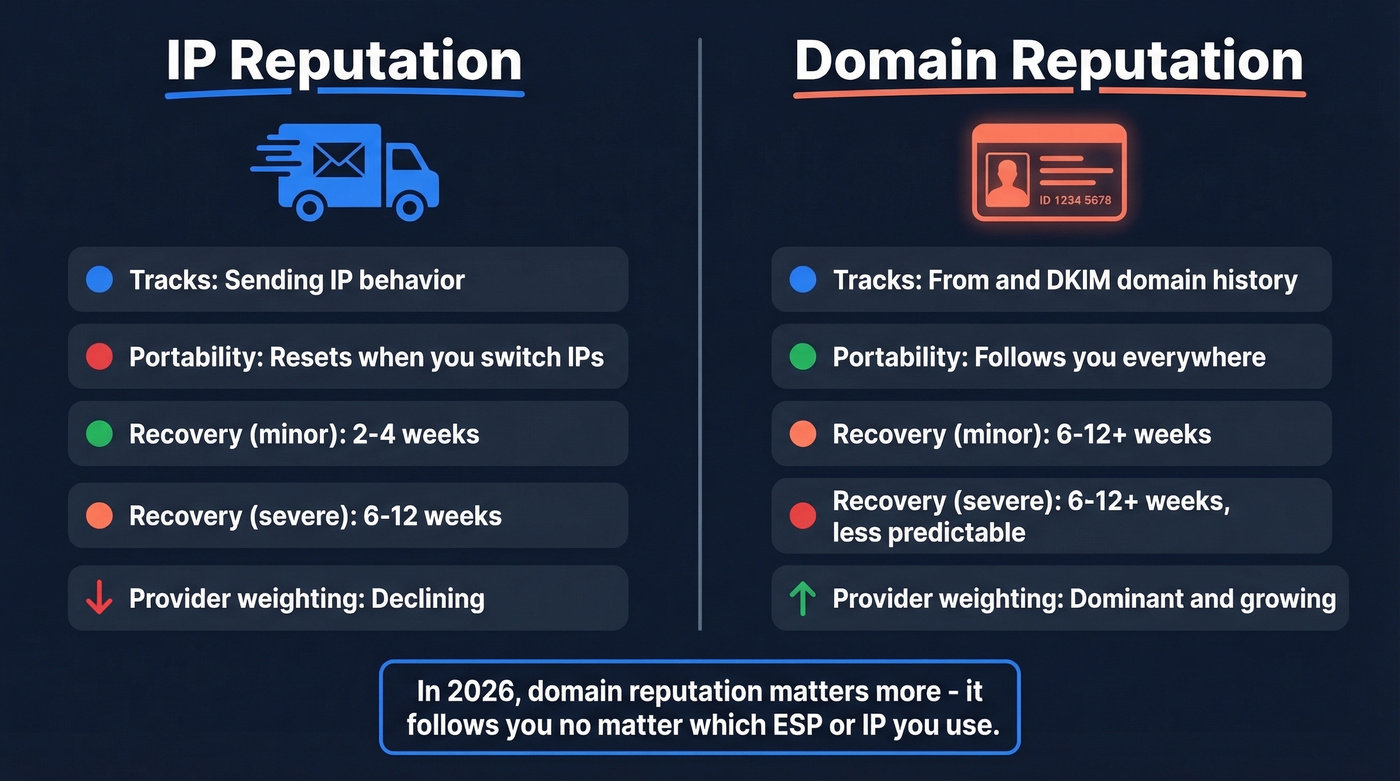
Domain reputation is the portable identity tied to your From address and DKIM-signing domain. It follows you regardless of which ESP or IP you send from. It's your driver's license - it identifies you no matter which vehicle you're driving.
| Factor | IP Reputation | Domain Reputation |
|---|---|---|
| What it tracks | Sending IP behavior | From/DKIM domain history |
| Portability | Resets when you switch IPs | Follows you everywhere |
| Shared vs dedicated | Critical distinction | Less affected |
| Recovery (minor) | 2-4 weeks | 6-12+ weeks |
| Recovery (severe) | 6-12 weeks | 6-12+ weeks, less predictable |
| Provider weighting | Declining | Dominant and growing |
What Resets When You Switch
This is the table most guides leave out.
| You Change... | IP Reputation | Domain Reputation |
|---|---|---|
| ESP (Klaviyo to Zoho) | Resets - new IP, zero history | Stays - follows your domain |
| Dedicated IP only | Resets - must warm again | Stays - unaffected |
| From domain | Unaffected | Resets - new domain, zero history |
| DKIM-signing domain | Unaffected | Resets for DKIM signals |
That Klaviyo-to-Zoho migration went sideways because the IP reset, but the domain carried the damage from the resulting spam complaints. Two reputations, one disaster.
Which One Matters More?
Domain reputation. And it's not close anymore.
Gmail removed its IP and domain reputation dashboards when it retired Postmaster Tools v1 on Sept 30, 2025. The shift is clear: compliance status and enforcement matter more than a visible "reputation score." Google had already introduced a compliance-focused Postmaster Tools dashboard in March 2024, and after the v1 retirement, the old reputation charts simply disappeared.
For teams on a shared IP worried about neighbors tanking deliverability, domain signals are stickier than IP signals. A bad shared IP causes short-term pain, but sustained domain-level authentication and low complaint rates override IP noise over time. Dedicated IPs still matter for high-volume senders, but if you're under ~100k emails per month, a dedicated IP usually isn't worth the headache.
Let's be honest: if your monthly send volume is under 50,000, stop obsessing over dedicated vs. shared IPs. That energy is better spent on authentication and list hygiene - the two things that actually move domain reputation. (More on safe sending limits in our email velocity guide.)


Domain reputation takes 6-12+ weeks to recover. Bounce rates over 5% trigger blocklists. Prospeo's 5-step email verification delivers 98% accuracy - keeping your bounce rate well under the 2% danger zone that tanks your sending reputation.
Stop gambling your domain reputation on unverified data.
The 2025 Enforcement Shift
The rules didn't just change - they got teeth.
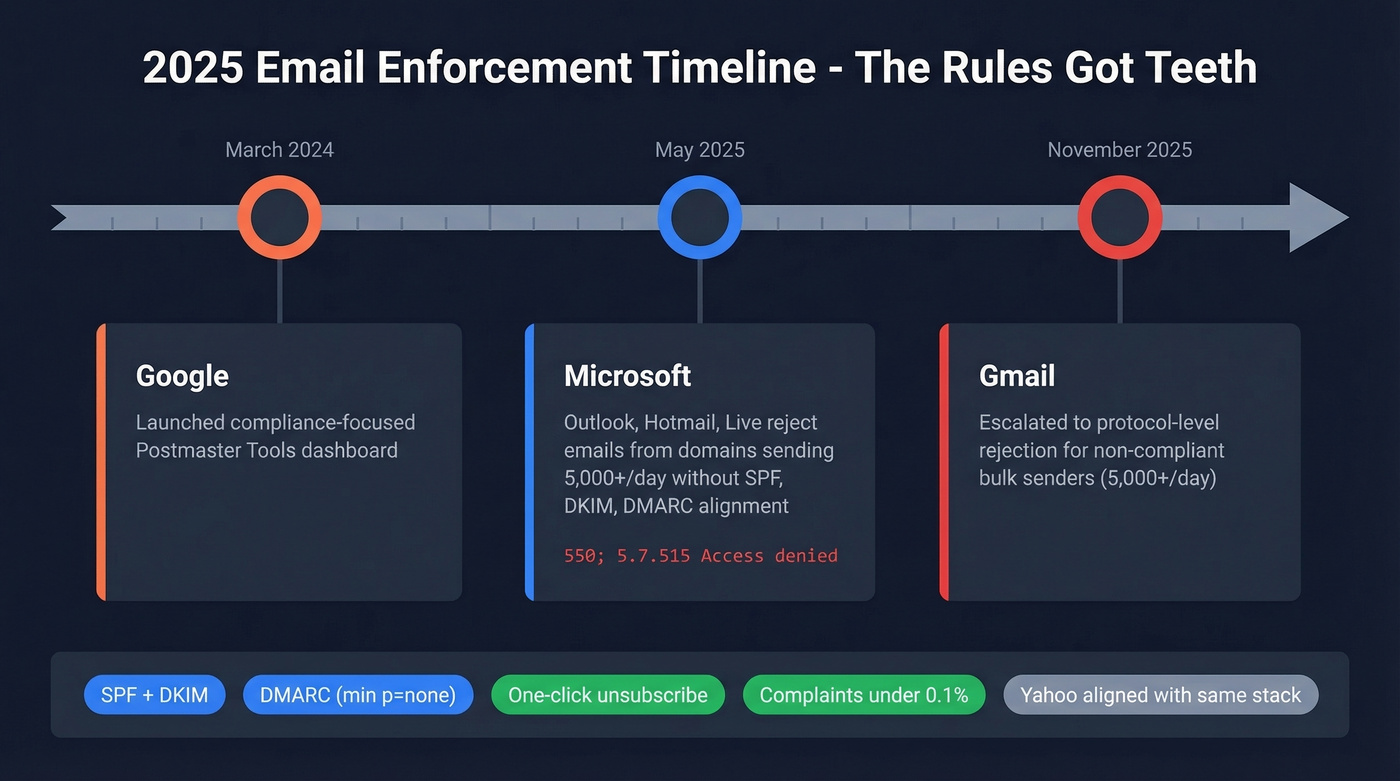
Gmail (November 2025): Google escalated from spam-folder placement to protocol-level rejection for non-compliant bulk senders sending 5,000+ messages per day. Requirements include SPF + DKIM alignment, a DMARC record with at least p=none, one-click unsubscribe honored within two business days, and a complaint rate below 0.3% (target under 0.1%). Fail these, and your emails don't land in spam - they bounce. (If you want the technical breakdown, see DMARC alignment.)
Microsoft (May 2025): Outlook.com, Hotmail, and Live.com domains now reject messages outright from domains sending 5,000+/day without SPF, DKIM, and DMARC with alignment. The rejection code is blunt: [550; 5.7.515 Access denied](https://support.microsoft.com/en-us/topic/fix-ndr-error-550-5-7-515-in-outlook-com-34cfe8f8-6fbf-457e-9e8b-9e4dbaf4e0ef) , sending domain does not meet the required authentication level.
Yahoo: Aligned with Google's bulk-sender requirements and the same authentication stack - SPF, DKIM, DMARC, and one-click unsubscribe.
If you're troubleshooting bounces, these SMTP codes tell you exactly what failed:
| Issue | Temp Code | Reject Code |
|---|---|---|
| SPF fail | 4.7.27 | 5.7.27 |
| DKIM fail | 4.7.30 | 5.7.30 |
| Alignment fail | 4.7.32 | 5.7.26 |
| rDNS/PTR missing | 4.7.23 | 5.7.25 |
How to Monitor Reputation in 2026
If you're still following a guide that says "check your domain reputation score in Postmaster Tools," that dashboard doesn't exist anymore. Here's what works now:
Google Postmaster Tools v2 shows compliance status in a pass/fail framing, not reputation scores. The old charts are gone. Microsoft SNDS gives IP-level visibility for Outlook.com traffic and is still useful for dedicated IP senders. Yahoo Sender Hub provides domain-level signals and sender insights.
For quick checks, Sender Score offers a free IP reputation lookup on a 0-100 scale, and Cisco Talos handles free reputation lookups for both IPs and domains. (If you want a full stack, see our roundup of email reputation tools.)
We use all five together. No single tool gives you the full picture anymore.
Thresholds That Actually Matter
| Metric | Safe | Danger | Context |
|---|---|---|---|
| Spam complaints | < 0.1% | > 0.3% | Gmail/Yahoo enforce |
| Bounce rate | < 2% | > 5% | Triggers blocklists |
| Inbox placement | 83-87% | Below 80% | ~1 in 6 emails fail |
| IP recovery (minor) | 2-4 weeks | - | Clean sending only |
| Domain recovery | 6-12+ weeks | - | Much harder to fix |
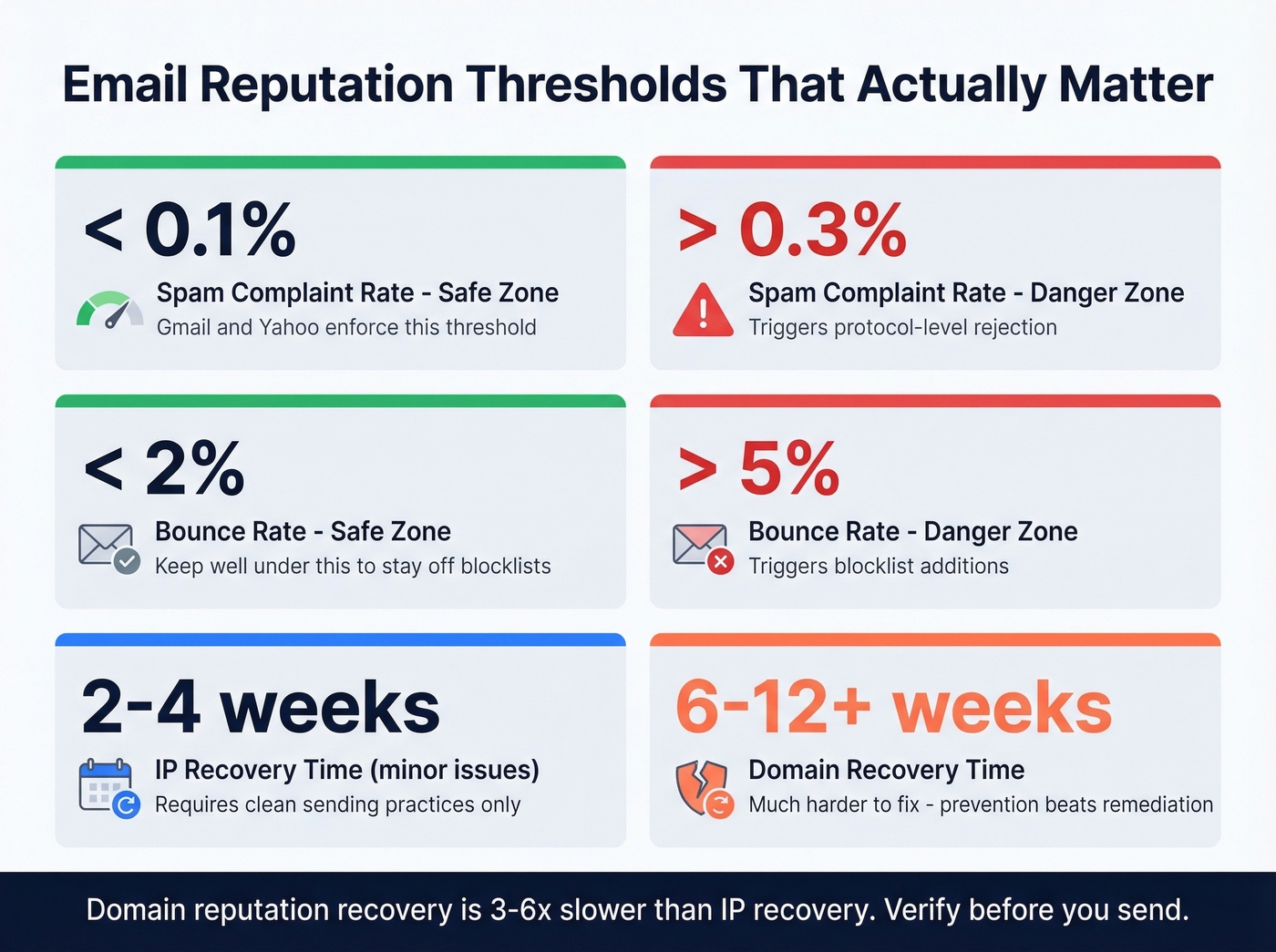
Domain reputation recovery taking 6-12+ weeks is why prevention matters so much more than remediation. You can't just "fix it next month."
How to Protect Both Reputations
Authentication is table stakes. Set up SPF, DKIM, and DMARC before you send a single email. DMARC at p=none is the minimum - move toward p=quarantine or p=reject as you gain confidence in your authentication alignment. (Need syntax examples? Use these SPF record examples.)
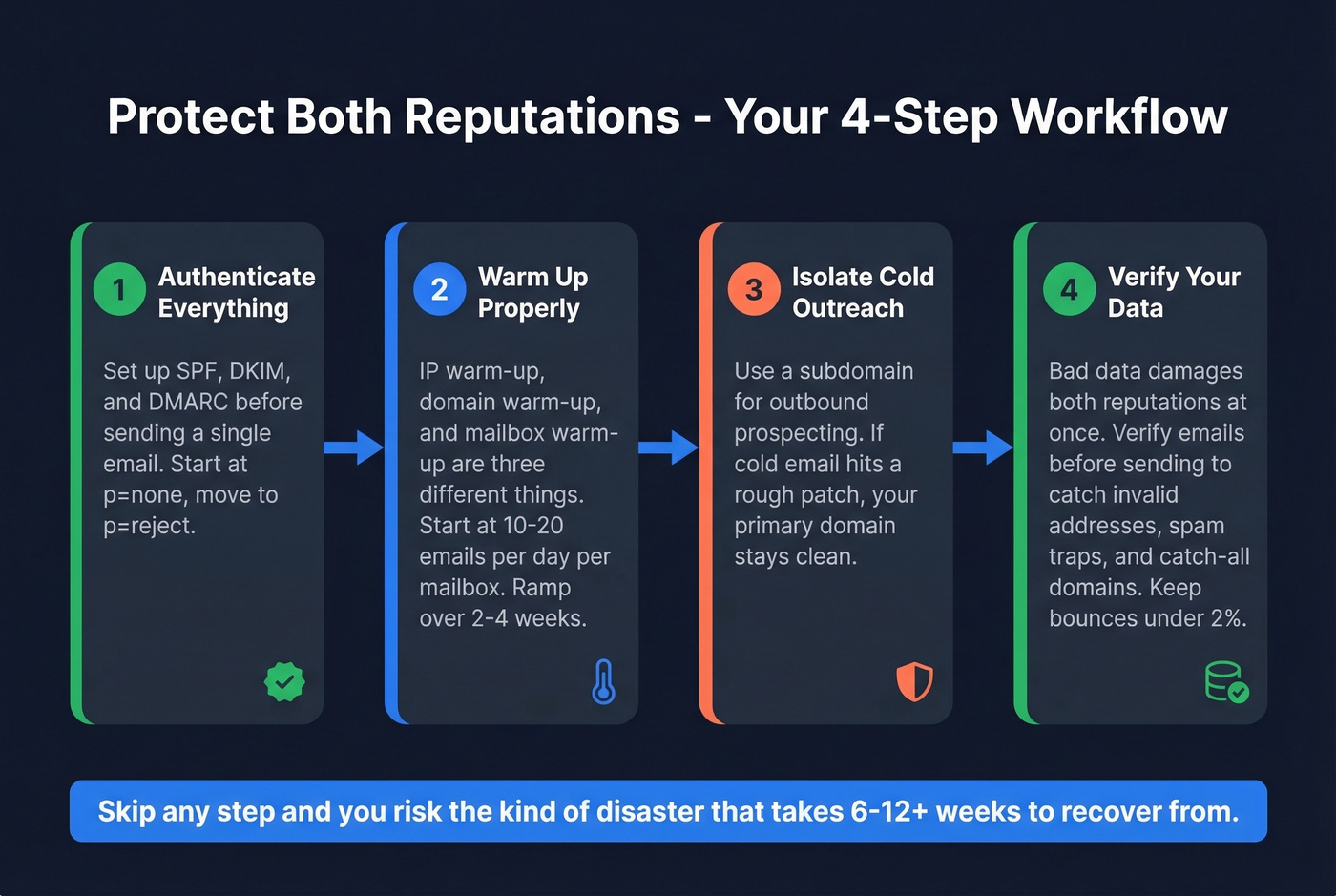
Warm up correctly. Most people conflate three distinct warm-ups, and that confusion causes real damage. IP warm-up builds reputation for a dedicated IP. Domain warm-up establishes trust for your sending domain. Mailbox warm-up creates engagement history for individual accounts. Start at 10-20 emails per day per mailbox and ramp over 2-4 weeks. Skipping this is exactly how that Klaviyo-to-Zoho disaster happened. (If you're building a safer outbound motion, see our guide to the best unlimited email warmup tools.)
Isolate cold outreach on a subdomain. Subdomains carry separate reputations. If your cold outbound hits a rough patch, your primary domain stays clean. Skip this step if you only send marketing emails to opted-in lists - it's mainly for teams running outbound prospecting alongside marketing. (Related: what is a tracking domain.)
Data quality is the #1 controllable factor. Bad data - invalid emails, spam traps, catch-all domains - damages both IP and domain reputation simultaneously. Every bounced email and every spam trap hit compounds. In our experience, teams that verify before sending avoid the vast majority of reputation crises. Prospeo's 5-step verification catches invalid addresses, spam traps, and catch-all domains before they touch your sender reputation, with 98% email accuracy on a 7-day data refresh cycle. Stack Optimize built to $1M ARR using Prospeo while maintaining 94%+ deliverability, sub-3% bounce rates, and zero domain flags across all clients. (If you're cleaning up after a deliverability incident, start with spam trap removal.)
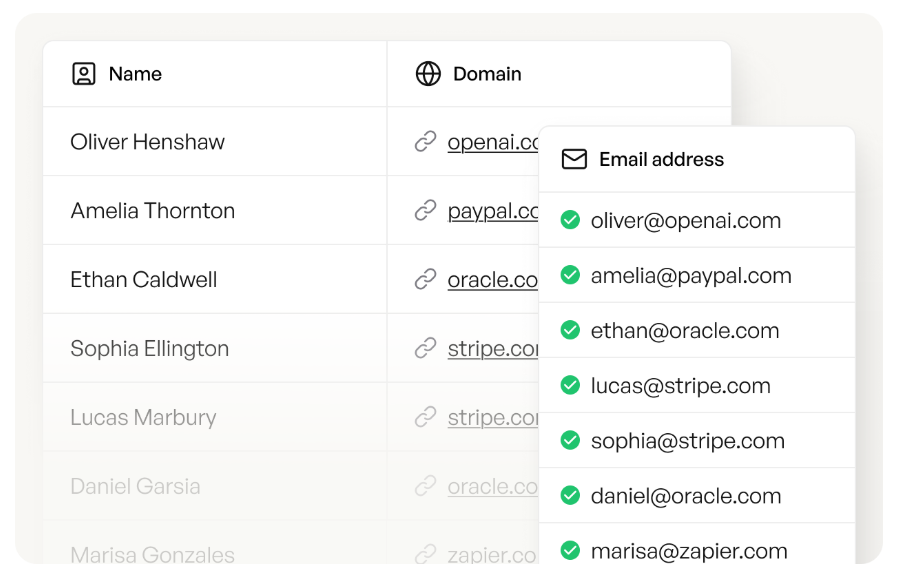
You just read that bad data is the fastest way to destroy both IP and domain reputation. Prospeo refreshes 300M+ profiles every 7 days - not every 6 weeks like competitors - so you're never sending to stale, bouncing addresses that wreck deliverability.
Clean data every 7 days means your domain stays bulletproof.
FAQ
Does switching ESPs reset my IP or domain reputation?
Your domain reputation follows you - it's tied to your From and DKIM-signing domain, not your provider. Your new IP starts at zero and needs warming. Plan 2-4 weeks of gradual volume ramp on the new IP before sending at full capacity.
Can a shared IP hurt my domain reputation?
Short-term, yes - a neighbor's spam activity can cause temporary delivery issues. But sustained authentication and complaint rates under 0.1% override shared-IP noise within weeks. Domain signals outweigh IP signals at every major mailbox provider now.
How do I check my domain reputation now that Postmaster Tools changed?
Google Postmaster Tools v2 shows compliance status, not the old reputation scores. Supplement with Microsoft SNDS for IP data and Yahoo Sender Hub for domain signals. All three are free and take under 10 minutes to set up.
What's the fastest way to recover a damaged sender reputation?
For IP reputation, switch to clean sending practices and expect 2-4 weeks for minor issues. Domain reputation takes 6-12+ weeks and requires consistent low complaint rates, zero spam trap hits, and proper authentication. Prevention through verified data is far cheaper than recovery - removing invalid addresses and spam traps before sending is the single best investment you can make.