

How to Search for Company Data Without Losing Your Mind
You need a company's revenue, headcount, decision-makers, or legal status - and you've just spent 40 minutes bouncing between three state registries, a paywalled SEC filing, and a Crunchbase profile that hasn't been updated since the last funding round. Sound familiar?
The US doesn't have a single federal business registry. It has 50+ separate state-level registers, each with different fields, different formats, and different fees. That structural mess is why company data search is one of the most frustrating tasks in B2B - the answer depends entirely on what you're actually trying to do. Let's sort that out.
Define the Question First
Before you pick a tool, figure out what you're actually answering:
- Verifying a legal entity? Start with your state's Secretary of State registry or OpenCorporates (both free). You'll confirm formation date, status, and registered agent - but not much else. A simple company address search through these registries can also surface the registered office location.
- Running due diligence or compliance checks? D&B Investigate covers 550M+ global records with corporate linkage and beneficial ownership. Nexis Diligence+ handles litigation and sanctions screening.
Stop searching for "company data" as a generic concept. Define the question, then pick the tool that answers it.
Six Types of Business Data
Not all company data is the same, and confusing the categories is how teams end up buying the wrong tool.
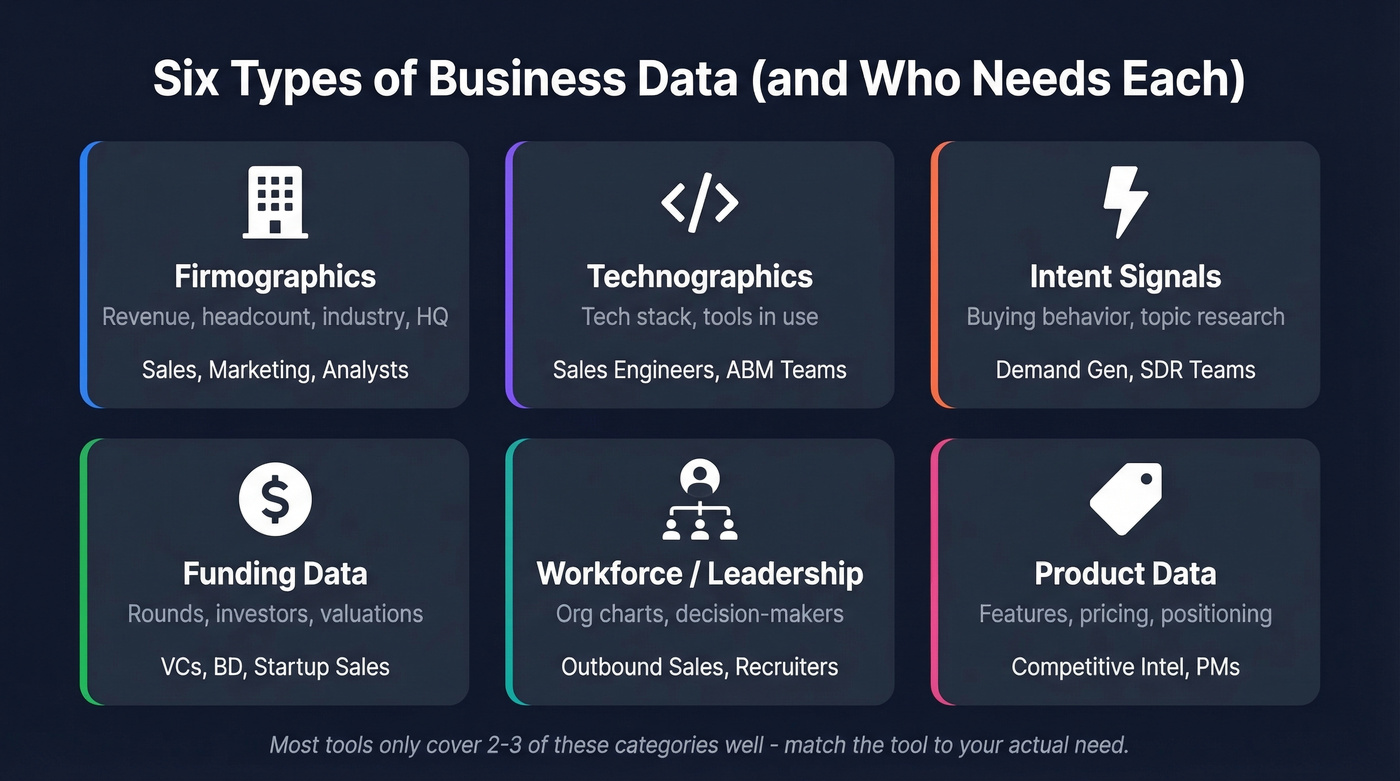
| Type | What It Covers | Who Needs It |
|---|---|---|
| Firmographics | Revenue, headcount, industry, HQ | Sales, marketing, analysts |
| Technographics | Tech stack, tools in use | Sales engineers, ABM teams |
| Intent signals | Buying behavior, topic research | Demand gen, SDR teams |
| Funding data | Rounds, investors, valuations | VCs, BD, startup sales |
| Workforce/leadership | Org charts, decision-makers | Outbound sales, recruiters |
| Product data | Features, pricing, positioning | Competitive intel, PMs |
When you evaluate a provider later, map their strengths back to these categories. A tool that excels at firmographics and intent signals won't help you with funding data.
One caveat on technographics: real users report that AI-powered tech stack detection ranges from solid to "pure guessing." If you're buying a tool primarily for technographic data, plan on manual verification for high-value accounts.
Free Sources for Company Data Search
State Registries
Every US state maintains its own business registry, and the experience varies wildly. Florida gives you comprehensive entity profiles with scanned documents. Delaware lets you confirm a company exists but charges $10-$20 for a detailed status report. Texas doesn't offer a bulk dataset at all - you're paying $1 per search through SOSDirect. Minnesota, on the other end, charges just $30 for bulk data.
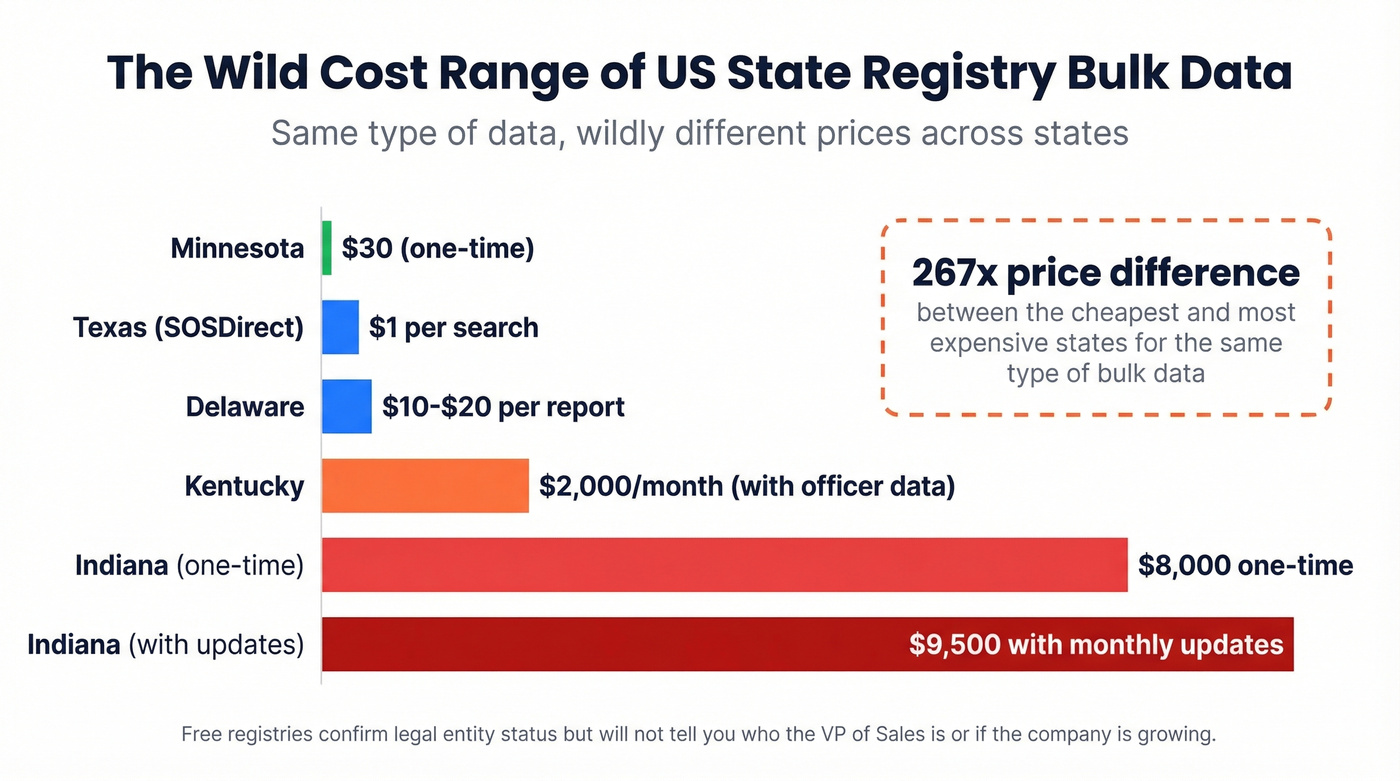
The cost range for bulk access is staggering: Indiana charges $8,000 for a one-time bulk download ($9,500 with monthly updates), while Kentucky runs $2,000/month for a subscription with officer data. That's roughly a 267x price difference between Minnesota and Indiana for the same type of data.
Free registries are essential for confirming legal entity status. They won't tell you who the VP of Sales is, whether the company is growing, or if they're in-market for your product.
SEC EDGAR & Federal Sources
SEC EDGAR is the gold standard for SEC filings - 10-Ks, 10-Qs, proxy statements, insider transactions. It's free, well-structured, and covers everything filed with the SEC. The catch: it only covers public companies and other SEC filers. There are 70M+ businesses in the US, the vast majority private, and EDGAR can't help with them.
OpenCorporates & Free Datasets
OpenCorporates aggregates data from all 50 US state registers into a single searchable interface with a standardized schema. For basic searches - confirming an entity exists, checking its status across states - it's the fastest free option. You can also run a company name lookup by domain through tools like Prospeo's Chrome extension when all you have is a website URL. OpenCorporates' paid API unlocks bulk access and richer data.
For analysts and ML teams, CC0-licensed datasets on GitHub cover millions of companies worldwide with revenue, employee size, and industry classification. Raw and unverified, but free and useful for large-scale analysis.
Commercial Platforms
Free sources confirm that a company exists. Commercial platforms tell you everything else - who works there, how fast they're growing, what tech they use, and whether they're actively buying.
Prospeo
Prospeo's database covers 300M+ professional profiles with 143M+ verified emails and 125M+ verified mobile numbers. The accuracy numbers set it apart: 98% email accuracy and a 30% mobile pickup rate across all regions. The gap between a 98% and a 79% verified list is the difference between a healthy domain reputation and a spam folder.
The 7-day data refresh cycle is the real differentiator - most providers update on around a 6-week cadence. Search filters cover 30+ dimensions including buyer intent powered by Bombora across 15,000 topics, technographics, funding, and department headcount. Teams like Meritt have seen bounce rates drop from ~35% to under 4% after switching from lower-quality data, tripling their pipeline from $100K to $300K per week.
Pricing is credit-based with transparent self-serve plans, working out to about $0.01 per email. There's a free tier with 75 emails and 100 Chrome extension credits per month, no credit card required.

ZoomInfo
ZoomInfo is the incumbent for a reason: 100M+ companies, 150M+ contacts, daily updates, and a platform layer that combines intent data with workflow and orchestration features. If you're a 200+ person sales org running outbound and ABM from one platform, it's a strong choice.
Here's the thing: most teams aren't that. A 10-seat ZoomInfo contract typically starts at $15,000-$20,000/year, and that's before you add intent modules or mobile number credits. For a Series A company with five SDRs, you're spending more on data than on one of those reps' salaries. The consensus on r/sales is that price is the biggest pain point - specifically, paying for modules you never activate.
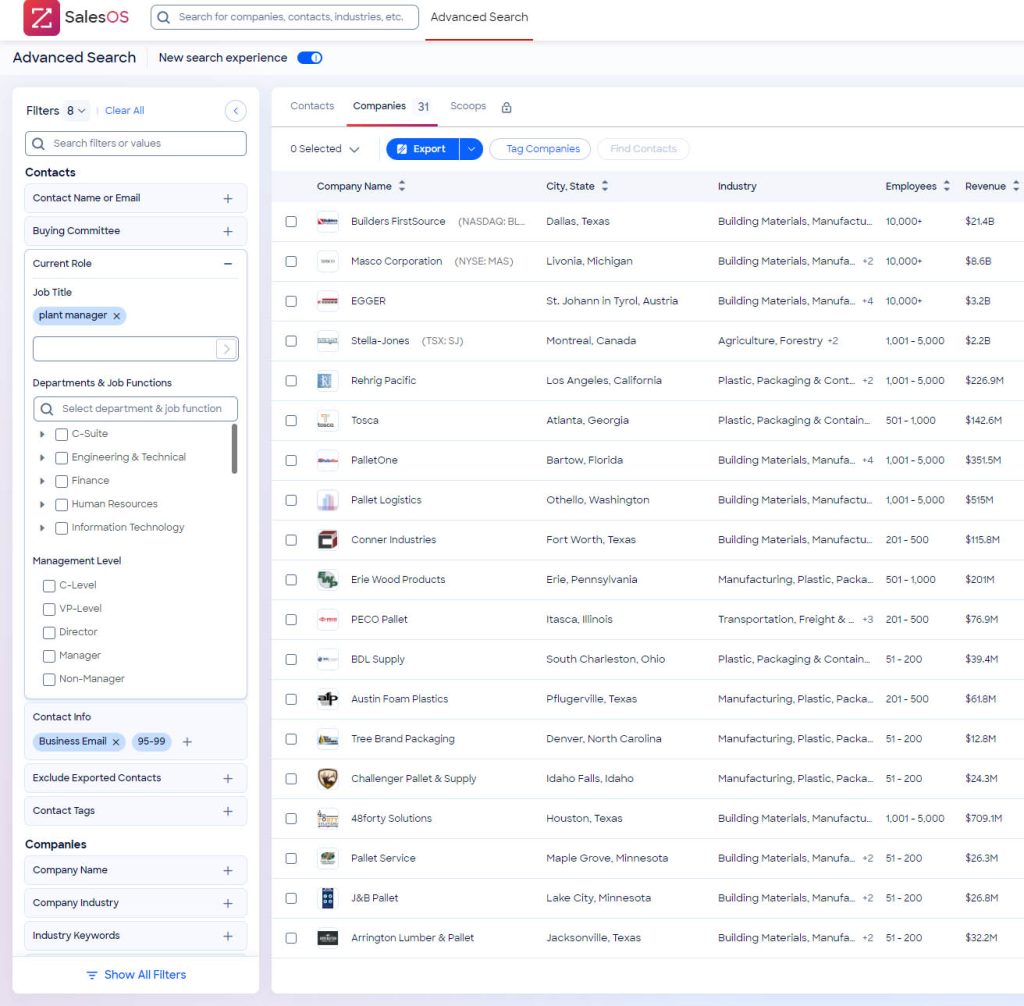
Skip ZoomInfo if you're under 50 employees or your primary need is verified contact data. Use ZoomInfo if you need a unified GTM platform with intent and orchestration, deep US coverage, and you've got the budget to match.
Apollo.io
Apollo covers 275M contacts with a genuinely useful free tier - limited searches and exports without paying anything. The basic paid plan starts at $49/mo per user, making it the default starting point for SMB teams building their first outbound motion.
The tradeoff is accuracy. Reddit threads consistently flag freshness concerns - practitioners say they're "not too impressed" with Apollo's data timeliness for company-level signals like headcount growth and decision-maker mapping. Apollo is great for getting started fast. It's less great when you need high-confidence data for enterprise outbound where every bounced email costs you domain reputation.
Crunchbase
For startup and funding research, Crunchbase remains the default. It covers millions of public and private companies with funding rounds, acquisition data, investor profiles, executive profiles, financial signals, and predictions. The Starter plan runs $29/mo, and Pro at $49/mo per user unlocks advanced search, export, and CRM integrations.
Few tools cover the venture-backed ecosystem as thoroughly. The limitation: firmographic data outside the startup world is thinner, and company-level signals like headcount can lag behind reality. We've found Crunchbase most useful as a research layer alongside a dedicated prospecting tool, not as a standalone data source.
Dun & Bradstreet (D&B)
D&B Investigate is the heavyweight for due diligence and compliance. It covers 550M+ global records with corporate family tree mapping, beneficial ownership data, and risk scoring. The Commerce Department's research library recommends it for corporate linkage across jurisdictions. Expect enterprise pricing around $10K+/year - this isn't a self-serve tool. D&B makes sense when you need to verify corporate hierarchies, assess financial risk, or satisfy KYB requirements. For pure sales prospecting, it's overkill.
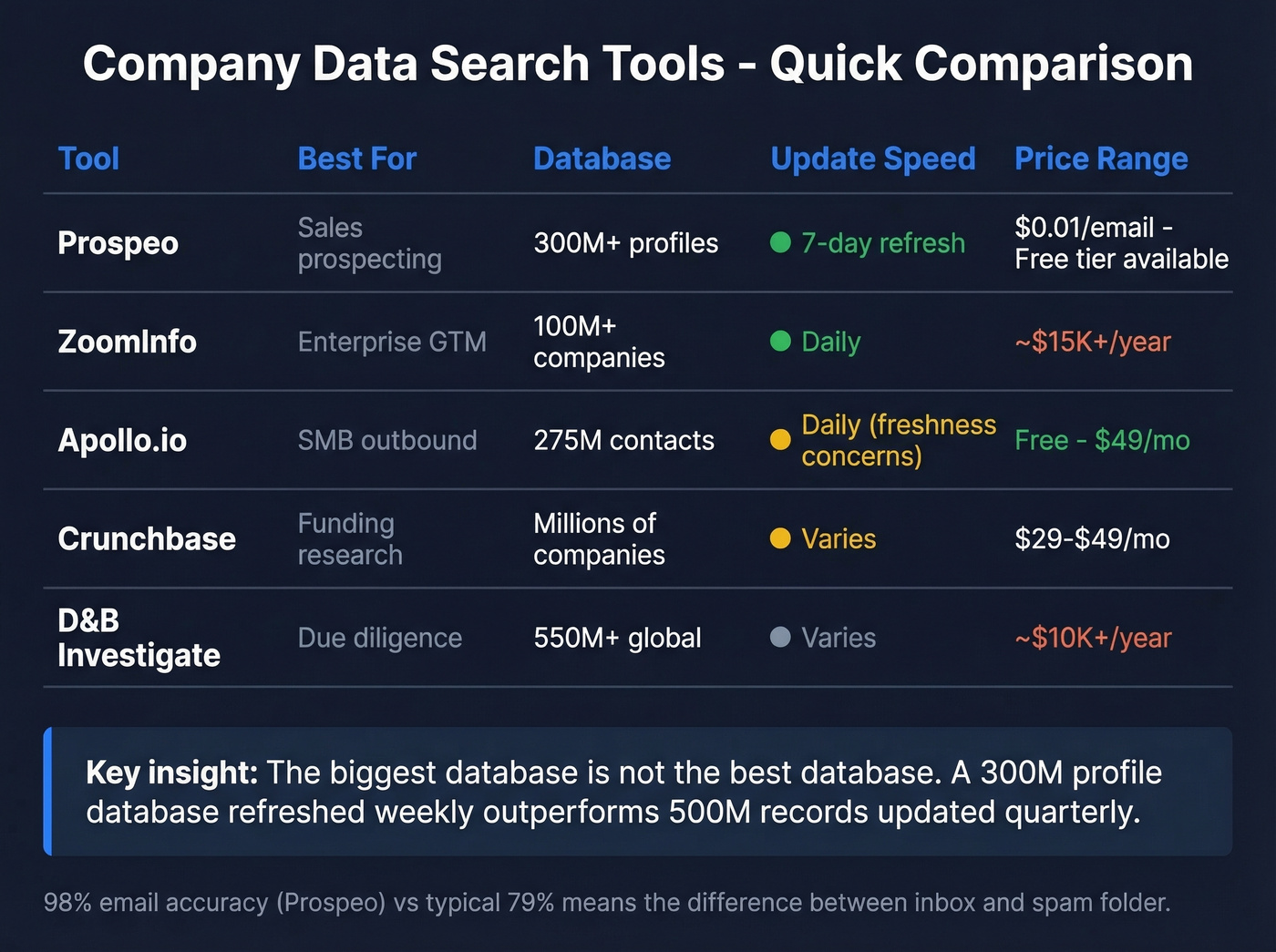
All Tools at a Glance
| Tool | Database Size | Update Cadence | Best For | Starting Price |
|---|---|---|---|---|
| ZoomInfo | 100M+ companies | Daily | Enterprise GTM | ~$15K/yr |
| Apollo.io | 275M contacts | Daily | SMB outbound | Free; $49/mo |
| Crunchbase | Millions of companies | Varies | Funding/startup research | $29/mo |
| D&B | 550M+ global records | Varies | Due diligence, compliance | ~$10K+/yr |
| Clearbit (Breeze) | 400M+ contacts | Weekly | Enrichment/API | $30-$700/mo |
| Lusha | 200M+ contacts | Credit-based | Quick lookups | ~$49/mo |
| Saleshandy | 700M+ contacts | Varies | Budget outbound | ~$24/mo |
| Cognism | 200M+ contacts | Varies | European outbound | Custom; ~$15K+/yr |
| NameScan | 170M+ legal entities | Real-time | AML/sanctions screening | ~$0.15-$0.30/search |
If your average deal size sits below five figures, you probably don't need ZoomInfo-level data. A $15K/year data contract eating into smaller deals is a math problem, not a strategy.

Free registries confirm a company exists. Prospeo tells you who to contact, whether they're growing, and if they're in-market - across 300M+ profiles with 98% email accuracy and a 7-day refresh cycle. 30+ filters including intent, technographics, and funding.
Replace 40 minutes of tab-hopping with one search that actually works.
Choosing the Right Tool
The biggest database isn't the best database. A 300M-profile database refreshed weekly outperforms 500M records updated quarterly - because stale data doesn't just waste time, it actively damages your outreach.
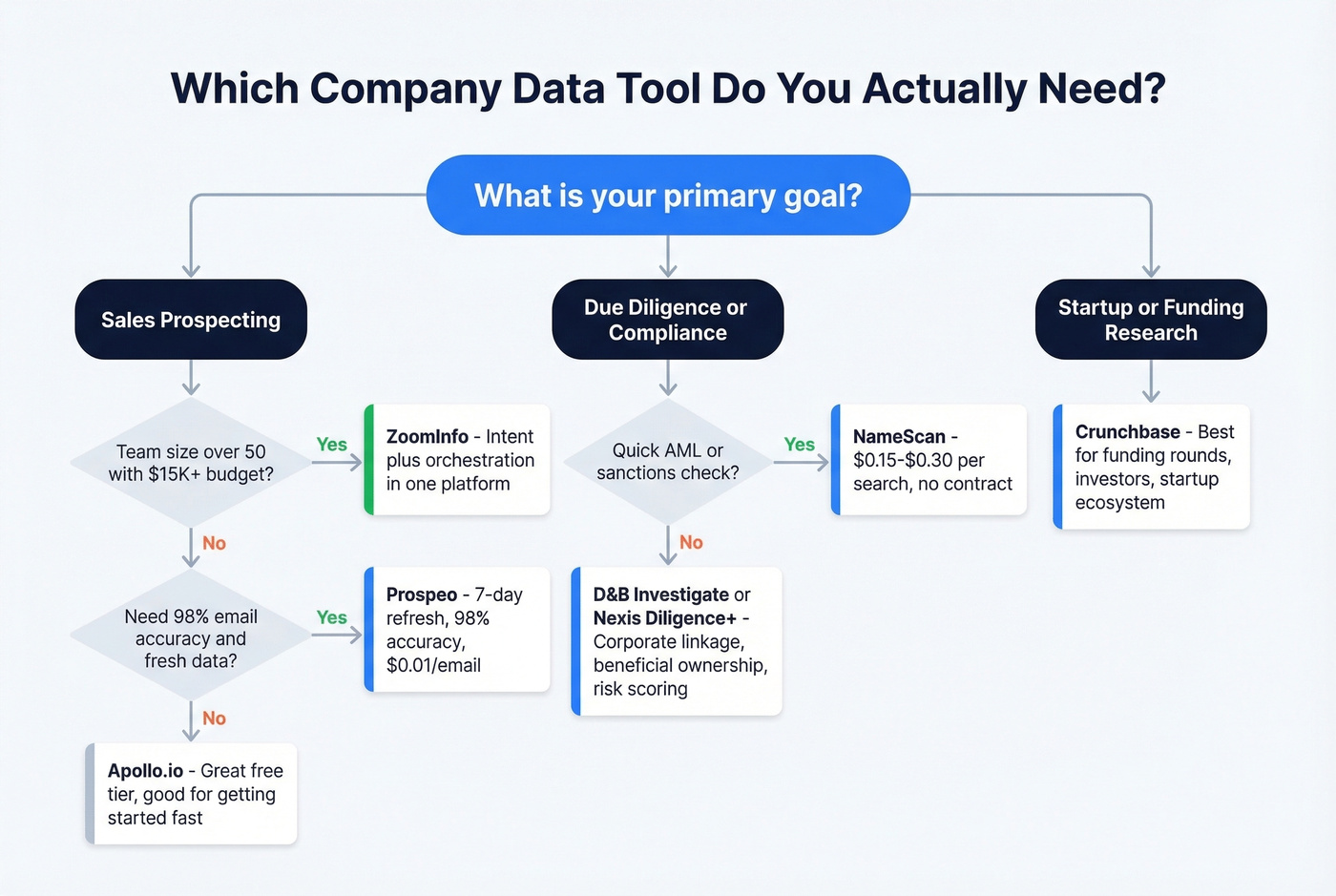
Sales prospecting: Prospeo, then Apollo, then ZoomInfo. Start with accuracy and freshness, then scale up to workflow complexity as your team grows. Apollo's free tier lets you test without commitment. ZoomInfo makes sense when you need intent plus orchestration in one platform.
Due diligence / KYB: D&B Investigate, Nexis Diligence+, or NameScan. You need corporate linkage, beneficial ownership, litigation history, and sanctions screening. Key risk categories to verify include litigation exposure, beneficial ownership chains, IP encumbrances, sanctions and AML flags, and ESG compliance. NameScan at ~$0.15-$0.30/search handles quick AML checks without an enterprise contract.
Startup and funding research: Crunchbase Pro at $49/mo per user gives you funding rounds, investor profiles, and acquisition data for millions of public and private companies. Few tools cover this niche as well.
Legal entity verification: State registries, then OpenCorporates. Free, authoritative, and sufficient for confirming formation, status, and registered agents. OpenCorporates saves you from searching 50 sites individually.
Enrichment / API: Clearbit (Breeze Intelligence) runs $30-$700/mo on credit packs. Proxycurl starts at $49/mo for developer-focused use cases.
Scaling Company Data Collection
Once you've picked a source, the next challenge is building a repeatable process around it. Ad hoc lookups don't scale - especially when your sales team needs hundreds of enriched records per week.
Effective company data collection means connecting your data provider to your CRM via API or native integration so new records are enriched automatically at the point of entry. Most commercial platforms support webhook-based or batch enrichment workflows. The key is setting up deduplication rules and decay alerts so your CRM doesn't fill with stale duplicates. In our experience, teams that automate this step cut manual research time by 60-80% and maintain cleaner pipelines throughout the quarter.
Why No Database Stays Accurate
Contact data decays at roughly 2.1% per month - about 22.5% annually. Emails degrade 23-30% per year. Phone numbers churn at 18%. People change jobs, companies restructure, domains expire. The average cost of poor data quality runs $12.9M annually for mid-to-large organizations.
This is why refresh cadence matters more than database size. We've seen teams pick the "biggest" provider and end up with bounce rates above 20% within three months. In our testing, weekly-refresh databases consistently outperform monthly ones on bounce rate by a wide margin - it's not even close.
How to Evaluate a Provider
Before you commit to any platform, run it through these criteria:
Source variety. Does the provider pull from multiple data sources, or is it a single-origin dataset? More sources mean better coverage and cross-validation.
Refresh cadence. Ask specifically: how often is the data updated? "Real-time" usually means "when you query it." Get a number.
Global coverage. If you sell outside the US, check whether the provider actually covers your target markets or just claims to.
Delivery model. Do you need a UI for reps, an API for enrichment workflows, or bulk CSV exports? Not every tool does all three.
Trial availability. Any provider confident in their data will let you test before buying. If they won't, that's a signal.
Compliance. GDPR, CCPA, and regional privacy laws aren't optional. Confirm the provider has DPAs available and enforces opt-outs. If you're auditing vendors, use a GDPR checklist.
Look, no single provider has perfect data. The smart move is to triangulate - use two sources and cross-reference before making high-stakes decisions. Specialized providers like Coresignal and Global Database can fill gaps that the major platforms miss.
Bounce rates above 5% destroy your domain reputation. Teams switching to Prospeo's 98% verified emails see bounces drop from 35% to under 4% - and pipeline triple. 143M+ verified emails, 125M+ mobile numbers, all refreshed every 7 days.
Start with 75 free emails. No credit card, no sales call.
FAQ
Is there a free company data search tool?
Yes. State Secretary of State registries are free for basic entity lookups, SEC EDGAR covers public filings, and OpenCorporates aggregates 50+ US state registers into one interface. Apollo also offers a limited free tier for contact searches. Prospeo's free plan includes 75 verified emails and 100 Chrome extension credits monthly - enough for real prospecting, not just browsing.
How often does company data go stale?
Contact data decays about 22.5% annually - emails degrade 23-30% per year, and phone numbers churn at 18%. A list built six months ago has already lost roughly one in eight contacts. Weekly refresh cycles catch changes that monthly or quarterly updates miss entirely, which is why cadence matters more than raw database size.
Can I search company data globally?
OpenCorporates aggregates registry data across many jurisdictions worldwide, and D&B maintains 550M+ global records with corporate linkage. The US is uniquely fragmented because registration is state-level - countries with centralized registries are often easier to search. For global contact data, Prospeo covers 125M+ verified mobile numbers across all regions.
How do I find a company's address?
Start with state Secretary of State registries, which list the registered agent address for every entity on file. OpenCorporates surfaces this across multiple states in one query. For headquarters and office locations, commercial platforms like ZoomInfo and Clearbit include verified address data alongside firmographic fields like revenue and headcount.