

Competitive Intelligence Best Practices for 2026
Your VP of Sales just forwarded a lost-deal email. The rep didn't know the competitor launched new pricing three weeks ago. According to Crayon's State of CI report, 68% of B2B deals involve at least one direct competitor, yet sales teams rate their own competitive preparedness 3.8 out of 10. Most articles on this topic tell you to "stay informed." That's not a practice - it's a platitude.
Here's the short version: build a framework before you buy tools, focus on 3-5 competitors instead of 50, and automate monitoring or accept a 6-9 week lag behind every move your rivals make.
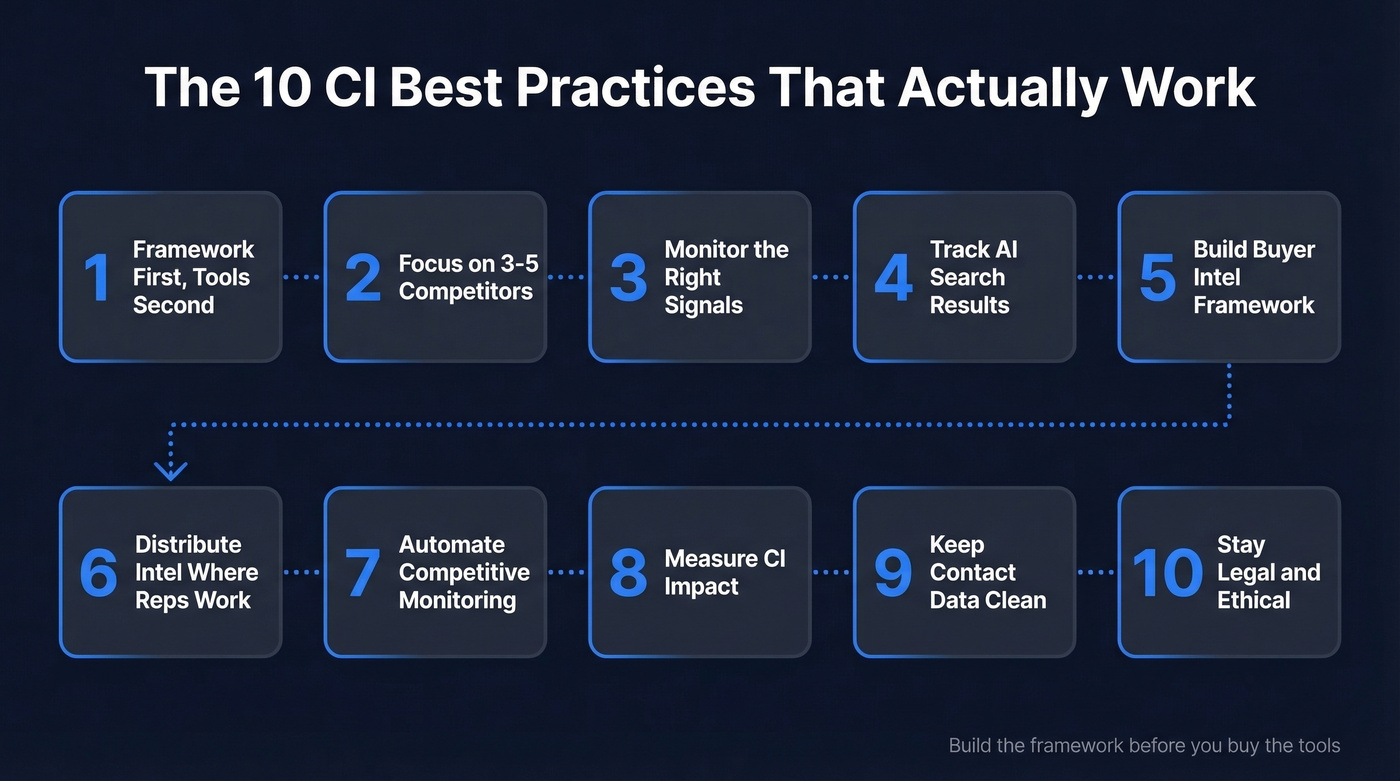
10 CI Best Practices Worth Following
Framework First, Tools Second
Most CI programs fail because they're built around tools, not frameworks. Before you sign a $20K-$40K/year CI contract, define who consumes the intelligence, what decisions it informs, and how you'll measure impact.
One product marketer on r/ProductMarketing put it bluntly - they wanted something "simpler than manually going through every competitor all the time" and were skeptical that Klue's results weren't just good marketing. Fair concern. We've seen the same pattern: a Notion doc with clear ownership beats an expensive platform that nobody actually checks. Get the operating rhythm right first.
Focus on 3-5 Competitors
Pull your CRM win/loss data. A Klue survey of 300+ revenue leaders found nearly half of reps don't know who they're competing with until negotiation - and 13% can't name the competitor even after the deal closes. That's staggering.
Pick the 3-5 names that appear most in closed-lost reasons and go deep. Everything else is noise.
Monitor the Right Signals
Not all competitive signals matter equally. These move the needle for B2B teams:
- Pricing page changes - one of the highest-signal, lowest-noise indicators
- Job postings - hiring a "Head of Enterprise" tells you more than a press release ever will
- Integration announcements - reveals product strategy and target market shifts
- G2 review velocity - a sudden spike means a competitor is pushing adoption hard
- Changelogs and support docs - as Mindy Regnell of Postscript puts it: "If I only had one resource, I would almost always take support documentation." Help docs are written for customers, not prospects, so the marketing gloss is stripped away.
Don't waste time comparing competitor conversion rates. Strategies and channels differ too much for meaningful comparison.
Track AI Search Results
Buyers are asking ChatGPT, Gemini, and Perplexity "best X tool" before they visit your website. What those AI models say about you shapes perception before a rep ever gets on a call.
Query these tools monthly with your category terms and track how your brand shows up versus competitors. This is a CI battleground most teams are still ignoring in 2026, and the early movers have a real edge.
The 5-Phase Buyer Intel Framework
Monitoring tells you what competitors do. Buyer interviews tell you why customers choose them. We use this five-phase structure:
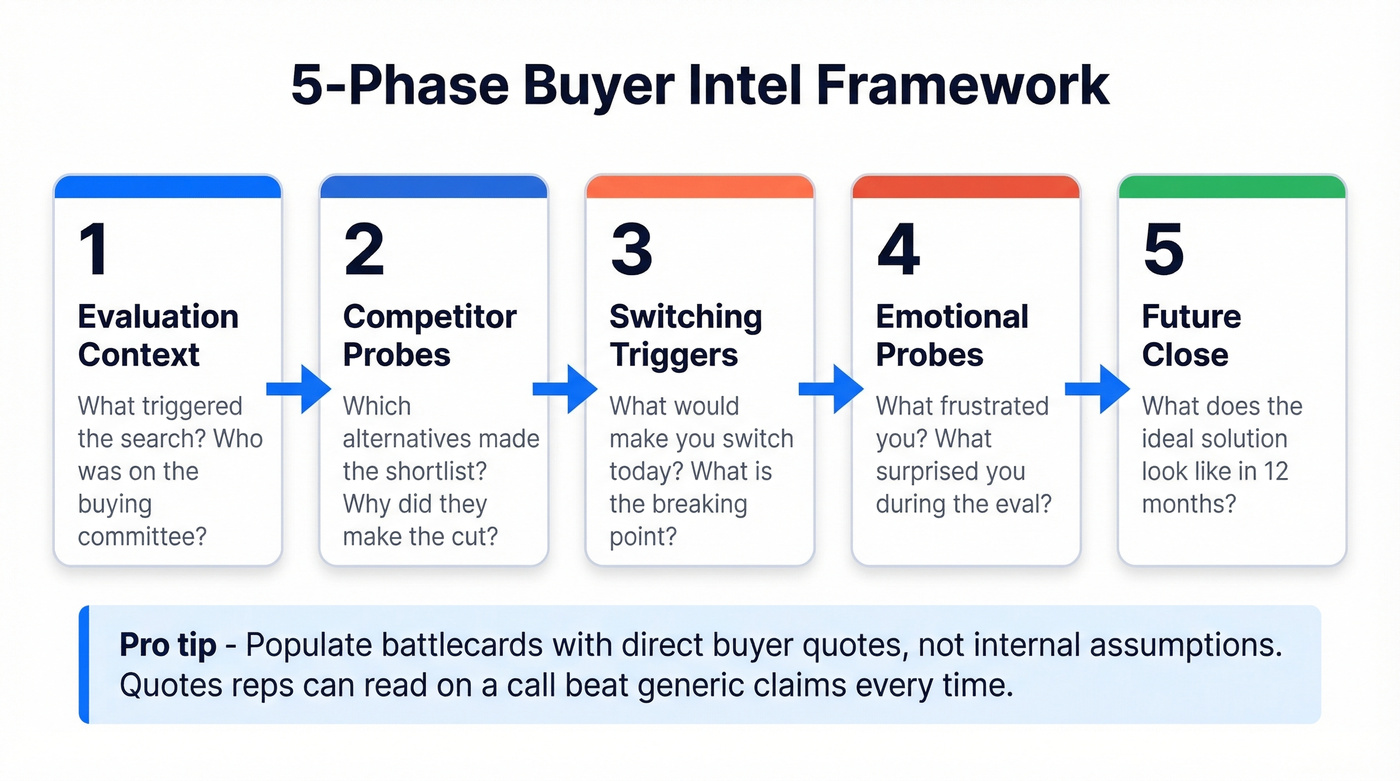
- Evaluation context - What triggered the search? Who was on the buying committee?
- Competitor probes - Which alternatives made the shortlist? Why?
- Switching triggers - What would make you switch today?
- Emotional probes - What frustrated you? What surprised you?
- Future close - What does the ideal solution look like in 12 months?

Buyer interviews are the backbone of competitive intelligence - but they don't happen if your outreach bounces. Prospeo's 7-day data refresh and 98% email accuracy mean your CI team reaches real buyers, not dead inboxes. At $0.01 per email, scaling your interview pipeline costs less than one lost deal.
Stop losing buyer intel to bad contact data.
Populate battlecards with direct buyer quotes, not internal assumptions. The difference between a battlecard that says "customers value our uptime" and one that quotes a buyer saying "their dashboard crashed twice during our eval" is the difference between a card reps ignore and one they actually pull up mid-call.
Distribute Intel Where Reps Work
Push intel into Slack channels, CRM fields, or call-prep tools. If you're still emailing PDF battlecards, skip this step and fix that first - nobody opens them. Battlecards go stale within 30 days, so distribution speed matters as much as content quality.
Automate Competitive Monitoring
Here's the thing: sales reps spend 8-12 hours per month on competitor research. For a 50-person org, that's over $400K in annual labor - and the result is a 6-9 week lag between a competitor move and your reps knowing about it.
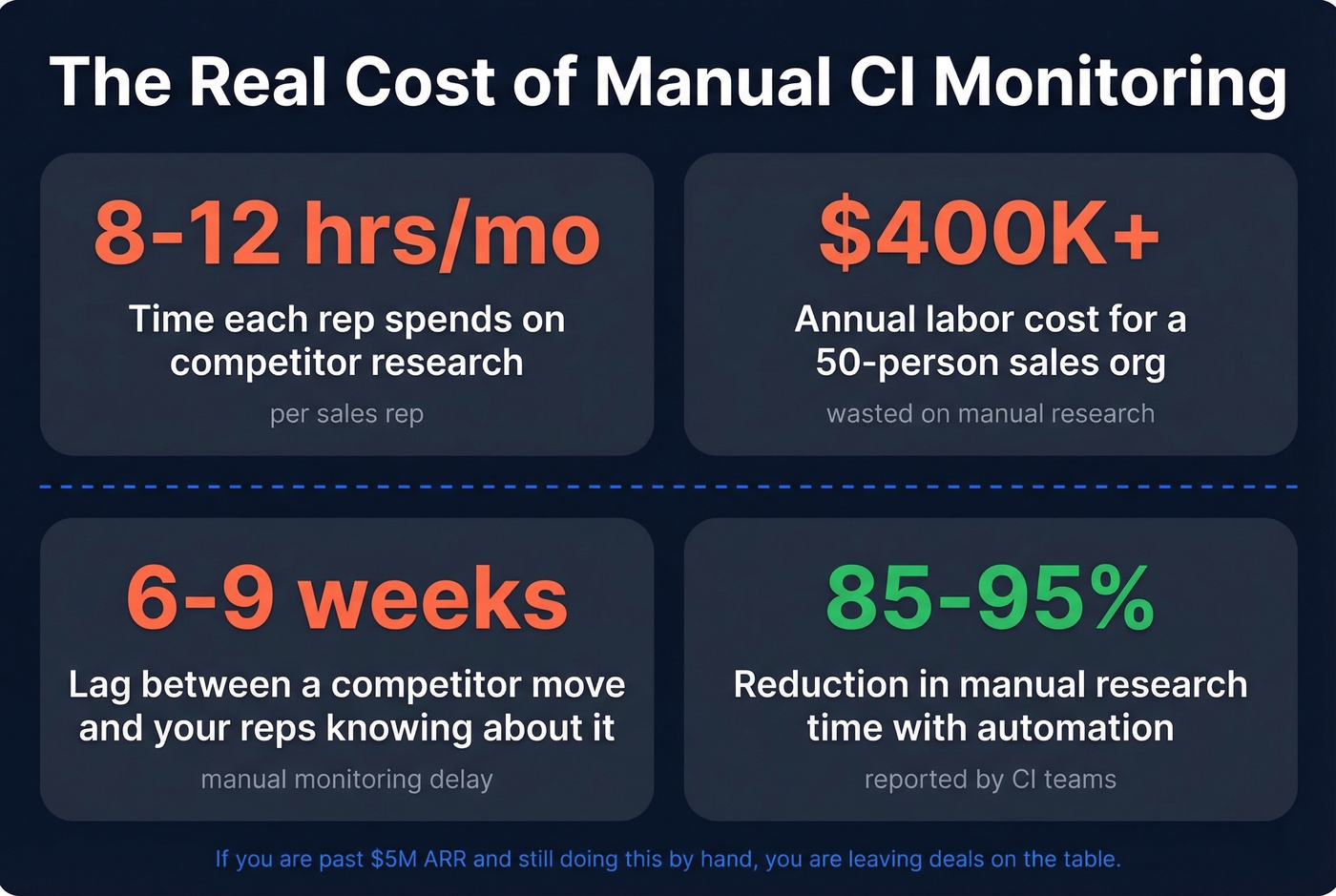
A skilled analyst can monitor about 15-20 sources manually. Most scale-stage companies have 150+ monitoring points. Automation closes that gap, with teams reporting 85-95% reduction in manual research time. Let's be honest - if you're past $5M ARR and still doing this by hand, you're leaving deals on the table.
Measure CI Impact
In our experience, competitive win rate is the only metric that survives budget reviews. But track these four together:
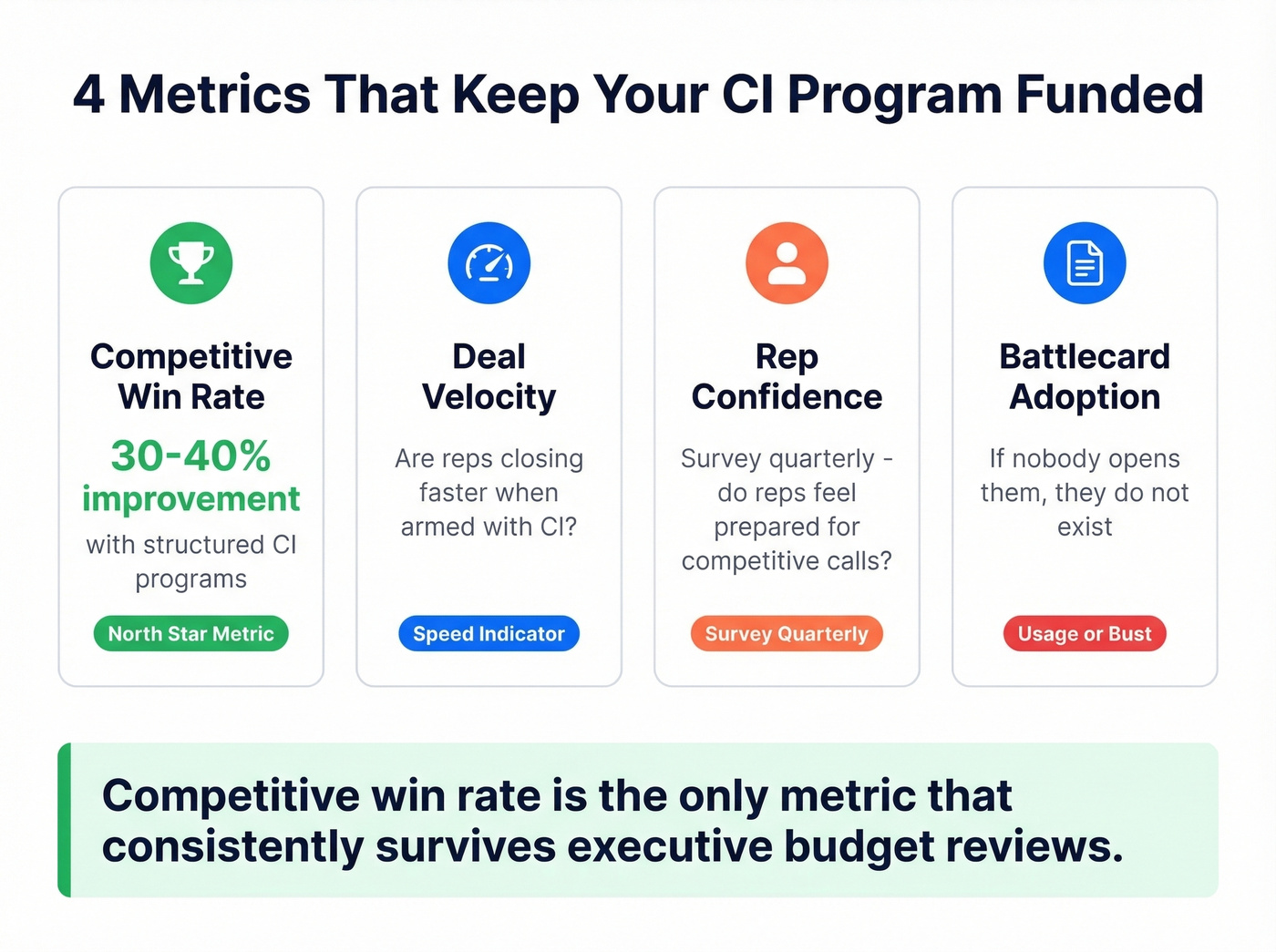
- Competitive win rate - the north star
- Deal velocity - are reps closing faster when armed with CI? (If you need a baseline, start with pipeline velocity.)
- Rep confidence scores - survey quarterly
- Battlecard adoption - if nobody opens them, they don't exist
Teams using automated CI report 30-40% improvement in competitive win rates. That's the number that gets your program funded next year.
Keep Your Contact Data Clean
CI improves when field intel is consistent, and that starts with reaching the right prospects with accurate contact data. Bad emails break the feedback loop at the source - you can't run buyer interviews if your outreach bounces.
As the Competitive Intelligence Alliance notes: "Assume if you hear something from a sales rep, customer, or agency partner, they might be wrong." You need volume and accuracy to triangulate. That means a data provider running a fast refresh cycle, not one serving you contacts that were verified six weeks ago. If you're evaluating vendors, start with a B2B database and then layer in data enrichment where it actually improves targeting.

Stay Legal and Ethical
The SCIP code of ethics boils down to three principles: disclose your identity, respect confidentiality, and comply with applicable laws. The Economic Espionage Act carries fines up to $5M and prison terms up to 10 years.
Clearly legal: public filings, published content, buyer interviews, product purchases, reverse engineering.
Clearly illegal: hacking, bribery, misrepresentation, trade secret theft.
If you wouldn't explain your method to a journalist, don't do it. (If you need a practical framework, use a B2B compliance checklist.)
CI Tools and Pricing
Most teams under $5M ARR don't need a dedicated CI platform. I've watched startups sign $30K Klue contracts and then realize nobody had time to maintain the battlecards. Start with Notion and a structured process, then graduate when manual monitoring breaks down.
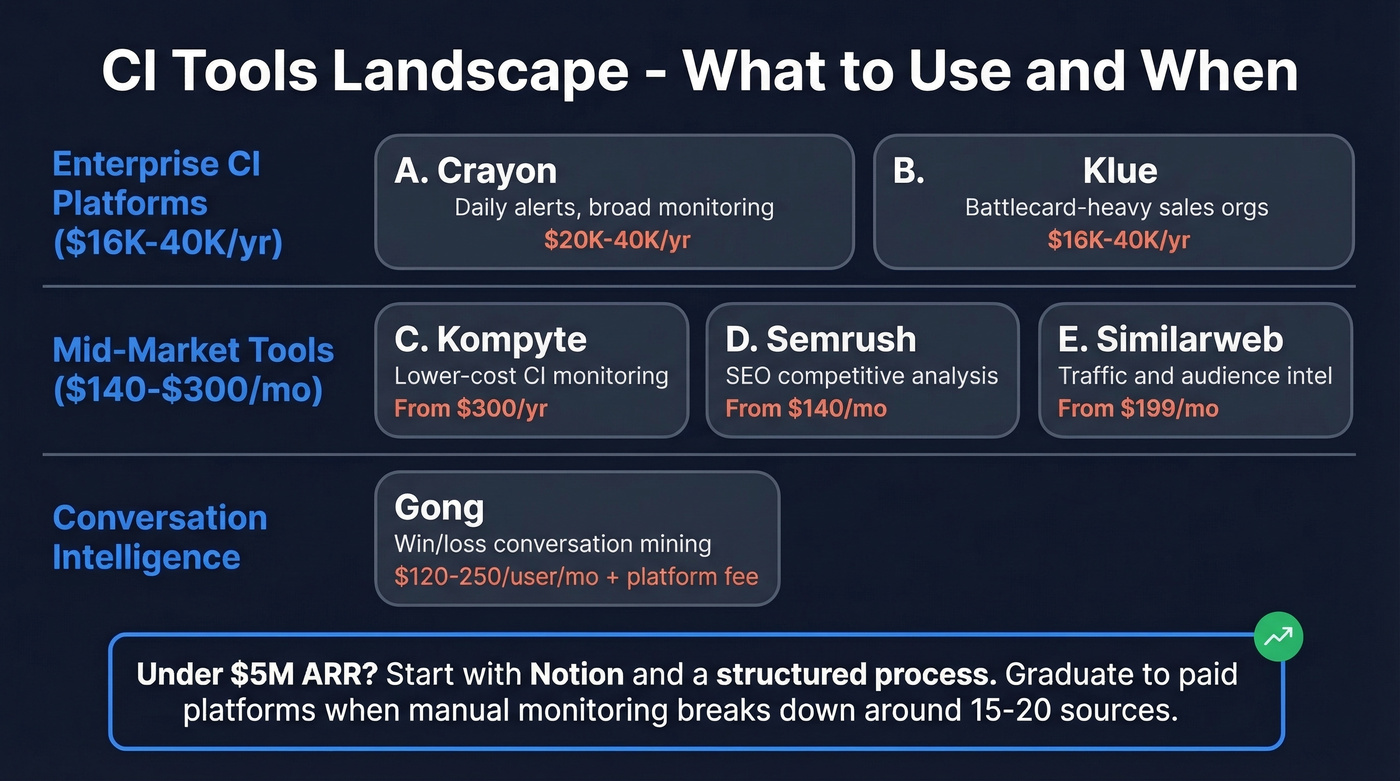
| Tool | Best For | Pricing |
|---|---|---|
| Crayon | Daily alerts with $20K+ budget | ~$20K-40K/yr |
| Klue | Battlecard-heavy sales orgs | ~$16K-40K/yr |
| Kompyte | Lower-cost CI monitoring | From ~$300/yr |
| Gong | Win/loss conversation mining | ~$120-250/user/mo + platform fee |
| Semrush | SEO competitive analysis | From ~$140/mo |
| Similarweb | Traffic and audience intel | From ~$199/mo |
For the contact data layer underneath your CI program, Prospeo runs a 7-day refresh cycle with 98% email accuracy across 300M+ profiles - which matters when you're running buyer interviews at scale and can't afford bounces eating into your sample size. If you're building lists for interviews, a B2B list provider can help you scale faster, and an email verifier keeps your outreach from collapsing.
The CI tools market is projected to hit $1.46B by 2030, and Gartner projects 40% of tech providers will use commercial CI tools by 2026.
You just read that sales reps waste 8-12 hours monthly on competitor research with stale data underneath. Prospeo refreshes 300M+ profiles every 7 days - not every 6 weeks like most providers. Clean contact data closes the CI feedback loop so your battlecards are built on real conversations, not assumptions.
Fresh data fuels better competitive intelligence. Start for free today.
FAQ
How often should you update competitive intelligence?
Weekly for high-priority competitors, focusing on pricing and product changes. Monthly for broader landscape reviews. Battlecards need continuous updates - treat them as living documents, not quarterly projects.
Can you do CI without expensive tools?
Absolutely. Start with Notion, Google Alerts, G2 reviews, and competitor changelogs. Graduate to paid platforms when manual monitoring can't keep up - typically around 15-20 sources. For contact data to fuel buyer interviews and outreach, free tiers from data providers can cover early-stage CI without a budget commitment.