

How to Build a Competitive Intelligence Database That Actually Gets Used
Your VP of Sales wants to know why the team lost three deals to the same competitor last quarter. You pull up the battlecard - it's from 2024. The competitor field in Salesforce? Blank. Nearly half of revenue leaders say reps don't know who they're competing against until the negotiation stage, and 13% say reps still don't know even after the deal closes.
You don't have a CI problem. You have a competitive intelligence database problem.
Three Tiers of CI Database Maturity
Before we get into schema design and tool selection, here's the quick version so you can orient yourself:
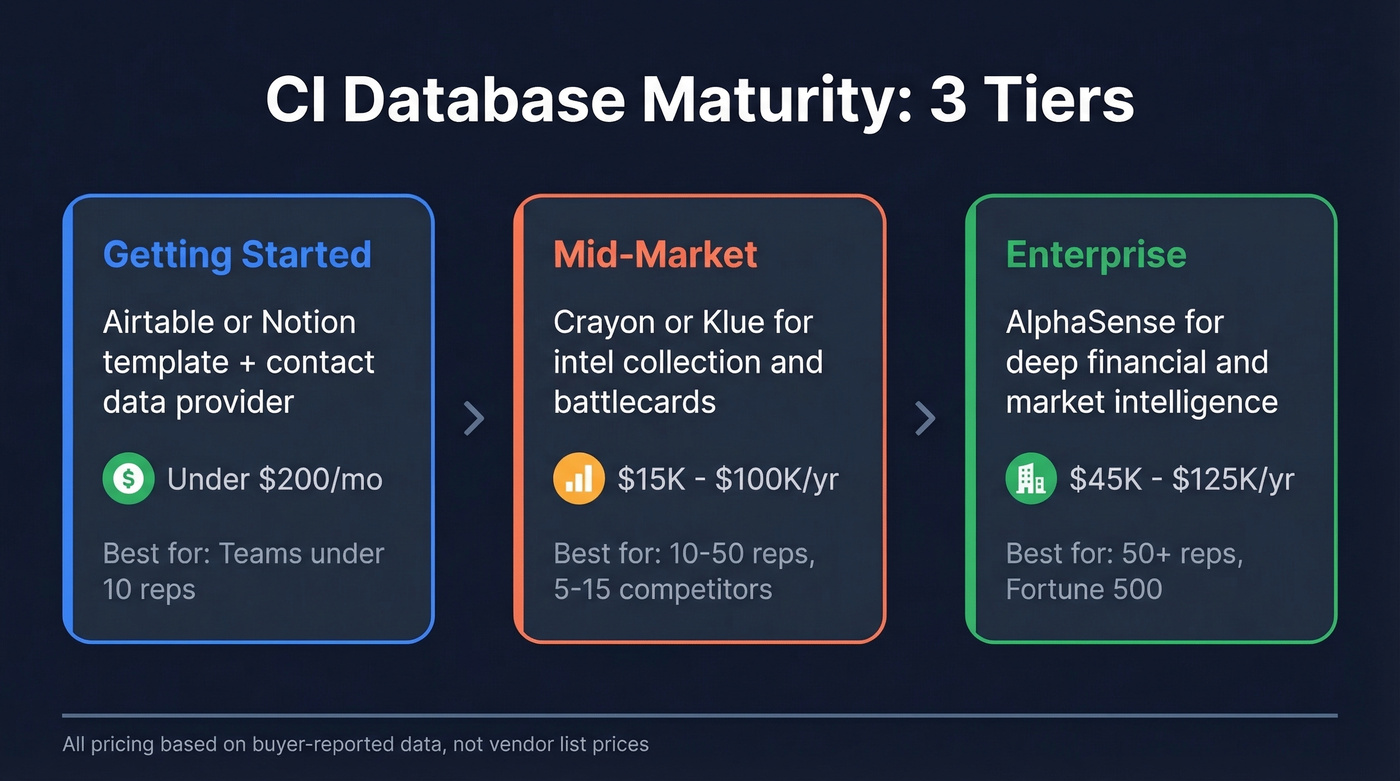
- Getting started: Airtable or Notion template plus a contact data provider. Under $200/mo total.
- Mid-market: Crayon (~$15K-$100K/yr) or Klue (~$15K-$40K/yr) for intel collection and battlecards.
- Enterprise: AlphaSense (~$45K-$125K/yr) for deep financial and market intelligence.
Klue, Crayon, and AlphaSense all hide their pricing. We dug up the real numbers so you don't have to sit through three demos.
What Is a CI Database, Exactly?
A competitive intelligence database isn't a CI tool - it's the structured, centralized repository where you store everything you know about competitors. The tool is just software that helps you collect and distribute intel. You need the database design before you pick the tool.
The CI market hit $50.87B in 2024 and is projected to reach $122.77B by 2033. 90% of Fortune 500 companies use CI tools or techniques. But everyone tells you to buy a platform. That's step 3. Step 1 is deciding what to track.
The CI Database Schema
Start by tiering your competitive landscape into four buckets: direct competitors, indirect competitors, aspirational competitors (the ones you want to become), and perceived competitors (the ones your buyers mention even if you don't consider them rivals).
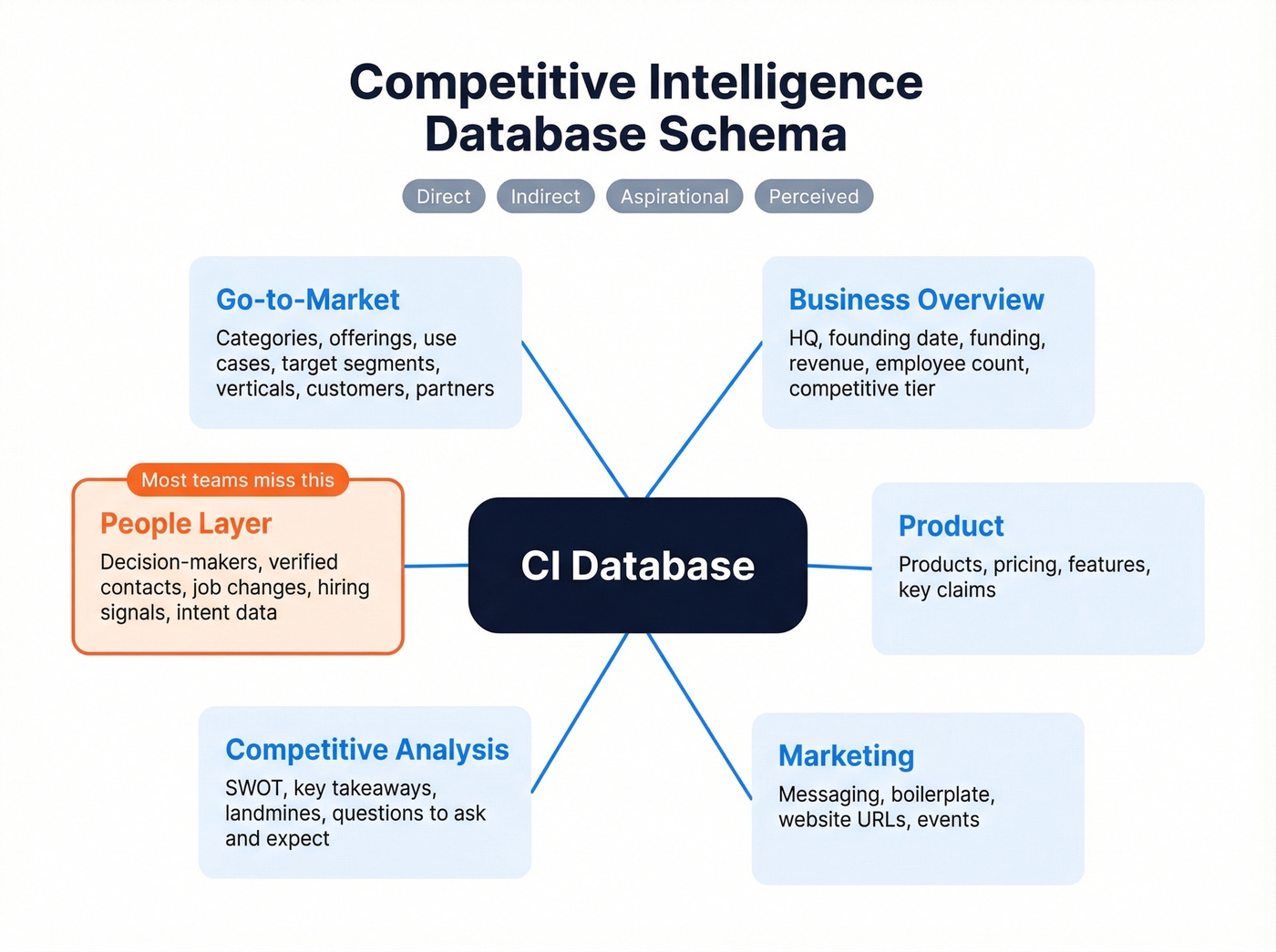
Your database needs five core field groups, based on Crayon's centralized database framework:
- Go-to-Market: categories, offerings, use cases, target segments, verticals, customers, partners
- Business Overview: HQ, founding date, public/private, funding, revenue, employee count, competitive tier
- Product: products, pricing, features, key claims
- Marketing: messaging, boilerplate, website URLs, events
- Competitive Analysis Outputs: strengths, weaknesses, opportunities, threats, key takeaways, landmines, questions to ask and expect
Most CI frameworks stop there. They shouldn't.
The People Layer
Here's the dimension no competitor page addresses: the people layer - key decision-makers at competitor companies, verified contact info, job changes, and hiring signals. When a competitor's VP of Engineering leaves, that's intel. When a target account starts researching your category, that's a buying signal.
On r/Database, a CI team described outgrowing Excel worksheets and PDFs and needing searchable document storage with API connections - the exact inflection point where a real schema matters. The people layer is usually what breaks first because contact data decays fast. You need a provider with a refresh cycle measured in days, not months. Prospeo covers 300M+ professional profiles with 98% email accuracy on a 7-day refresh cycle and tracks intent signals across 15,000 topics, which means you know when key contacts change roles or a target account enters your category.
Sources That Feed the Database
Klue's CI sources taxonomy splits inputs into internal and external. Ten sources cover most of what you need: stakeholder interviews, internal Slack channels, win-loss interviews, CRM deal notes, call recordings, PR and news, web and social content, product and pricing pages, personnel and hiring signals, and customer review sites.
The "30-in-30 interviews" method - thirty interviews, thirty minutes each - is the fastest way to capture tribal knowledge when building from scratch. We've seen teams go from zero documented CI to a usable database in under two weeks with this approach.

The people layer is what breaks CI databases first - contact data decays faster than any other field. Prospeo covers 300M+ professional profiles with 98% email accuracy on a 7-day refresh cycle and tracks buyer intent across 15,000 topics, so you know when competitors lose key hires and when target accounts start researching your category.
Start feeding your CI database real-time people data for $0.01/email.
Best Tools for Your Competitive Intelligence Database
You're not choosing one tool. You're assembling a stack.
| Tool | Category | Best For | Pricing | Gartner Peer Insights |
|---|---|---|---|---|
| Crayon | CI platform | Intel collection | ~$15K-$100K/yr | 4.5 (10 reviews) |
| Klue | CI platform | Battlecards & enablement | ~$15K-$40K/yr | 4.7 (20 reviews) |
| Prospeo | Contact data | People layer & verification | Free-~$0.01/email | N/A |
| AlphaSense | Market intel | Financial & research | ~$45K-$125K/yr | 4.6 (63 reviews) |
| Airtable | Template DB | Getting started | Free-paid plans | N/A |

Crayon skews toward intel collection and automated monitoring. Median annual cost runs $28,750/yr based on buyer-reported data from Vendr, though enterprise contracts push past $100K. Use this if your bottleneck is gathering intel.
Klue skews toward sales enablement and battlecard delivery. Expect $15K-$40K/yr for mid-market teams. Use this if your bottleneck is distributing intel to reps. Skip this if you're a team of five who just needs a spreadsheet - you'll be paying for features nobody touches.
AlphaSense is the enterprise play for deep financial and research intelligence. SMB contracts average $44,754/yr; enterprise averages $125,124/yr, and those numbers are climbing 17.81% and 48.36% year over year respectively.
Airtable is where most teams start. Their Competitor Research template includes six modules: Competitor Directory, Research Dashboard, Customer Records, Win/Loss Analysis, Revenue Tracker, and AI Insights. Free tier works for small teams, and honestly, it's more than enough until you're tracking 10+ competitors across 20+ data sources.
Let's be honest: most teams under 50 reps don't need a $30K CI platform. A well-structured Airtable database with a reliable contact data layer will outperform a Crayon instance that nobody maintains. The schema matters more than the software.
Monitoring Competitive Intelligence Web Data
A skilled CI analyst can manually monitor 15-20 sources. Beyond that, coverage becomes sporadic. Competitive intelligence web data - pricing pages, job boards, press releases, review sites - is the richest and most frequently updated category of external intel, which is why automated scrapers and change-detection tools pay for themselves quickly.
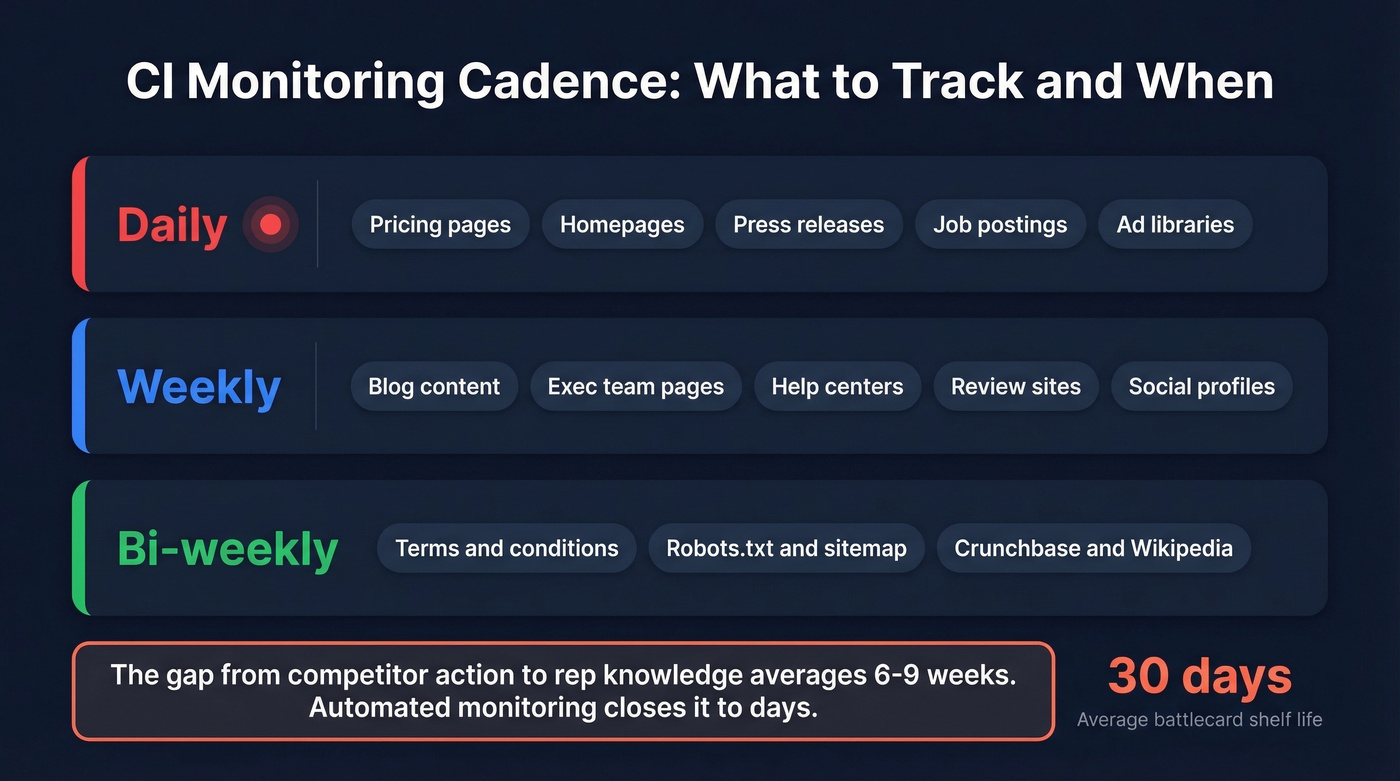
Here's a prioritization framework from Visualping's research:
| Frequency | What to Monitor |
|---|---|
| Daily | Pricing pages, homepages, press releases, job postings, ad libraries |
| Weekly | Blog content, exec team pages, help centers, reviews, social profiles |
| Bi-weekly | Terms & conditions, robots.txt/sitemap, Wikipedia, Crunchbase |
Battlecards become outdated within 30 days, but most teams update quarterly. That 6-9 week gap from competitor action to rep knowledge is where deals die. Automated monitoring closes it from weeks to days.
Mistakes That Kill CI Databases
Skipping the schema. Teams buy Crayon or Klue before defining what to track. The platform fills with noise, and you're back to ad-hoc Slack messages within three months. We've watched this happen at companies spending $50K+ on CI tooling.
Decentralized intel. Multiple battlecard versions across Google Drive, Notion, and someone's desktop. Reps grab whichever they find first - usually the oldest one.
Dirty CRM data. If your competitor field in Salesforce is blank, you can't run win-loss analysis or track displacement trends. This is the single most common failure point we see. (If this sounds familiar, fix your CRM data quality before you add more tools.)
Manual, occasional monitoring. A competitor launches a new pricing tier on Tuesday; your team finds out three weeks later from a prospect. Reliable data for competitive monitoring - collected automatically and on a set cadence - is what separates teams that react in days from those that react in quarters.
Data dumps without recommendations. If your competitive intelligence database doesn't answer "so what?" and "now what?", it's a filing cabinet. Nobody opens filing cabinets.
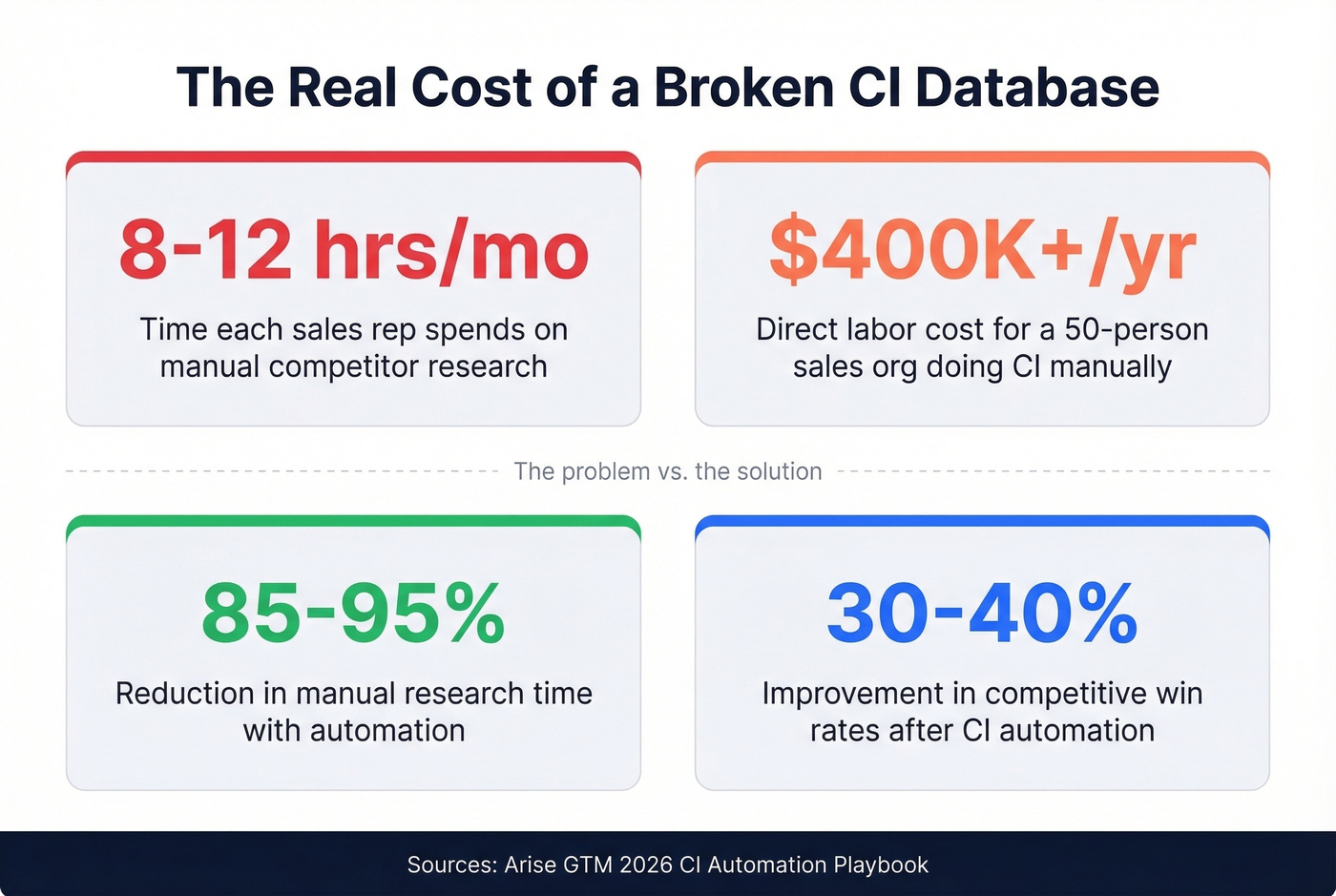
The cost of getting this wrong is real. Sales reps spend 8-12 hours/month on competitor research, and product marketing burns 30-40 hours per quarter updating battlecards. For a 50-person sales org, that's $400K+/year in direct labor alone. Automation delivers 85-95% reduction in manual research time and 30-40% improvement in competitive win rates.
You don't need a $30K CI platform to build a competitive intelligence database that works. Pair your Airtable schema with Prospeo's 30+ search filters - buyer intent, job changes, technographics, headcount growth - and you'll surface hiring signals and decision-maker moves that Crayon and Klue can't touch.
Track competitor personnel changes and buying signals from one platform.
FAQ
What's the difference between a CI database and a CI tool?
A competitive intelligence database is the structured repository where you store and organize intel - the schema, fields, and records. A CI tool like Crayon or Klue is the software that helps you collect, monitor, and distribute that intel. You need the database design before you pick the tool, or you'll end up with an expensive platform full of unstructured noise.
Can I build a competitive intelligence database in a spreadsheet?
Yes - most teams start in Google Sheets or Airtable. Airtable's Competitor Research template covers six modules, including a Competitor Directory and Win/Loss Analysis. Graduate to a dedicated CI platform when you outgrow relational tables or need automated monitoring across 20+ sources.
How often should I update my competitive intelligence database?
Pricing pages and job postings deserve daily monitoring. Blog content, review sites, and exec team pages work on a weekly cadence. The biggest mistake is quarterly updates - battlecards go stale within 30 days, and that 6-9 week lag from competitor action to rep awareness is where you lose deals. Automated change-detection tools like Visualping or built-in monitoring from Crayon and Klue make daily coverage realistic even for small teams.