

Direct vs Indirect Competitors - And the 3 Types Most Guides Ignore
Your biggest deal this quarter just went dark. Two weeks of silence, then the dreaded email: "We've decided to go a different direction." You check the CRM. They didn't pick your main rival. They went back to spreadsheets.
The most dangerous competitor you had wasn't even on your battlecard.
Understanding direct vs indirect competitors isn't academic - it's the difference between watching the right scoreboard and getting blindsided. Most teams list three to five competitors and call it done. Reality? You're competing against 20+ alternatives, and the ones you aren't tracking are the ones eating your pipeline. Klue found that 91% of 300+ revenue leaders say deals got more competitive year over year, and over 80% of companies agree competitive research is essential for growth. The market is waking up. Let's make sure you're not still asleep.
The Cheat Sheet
Before we go deep:
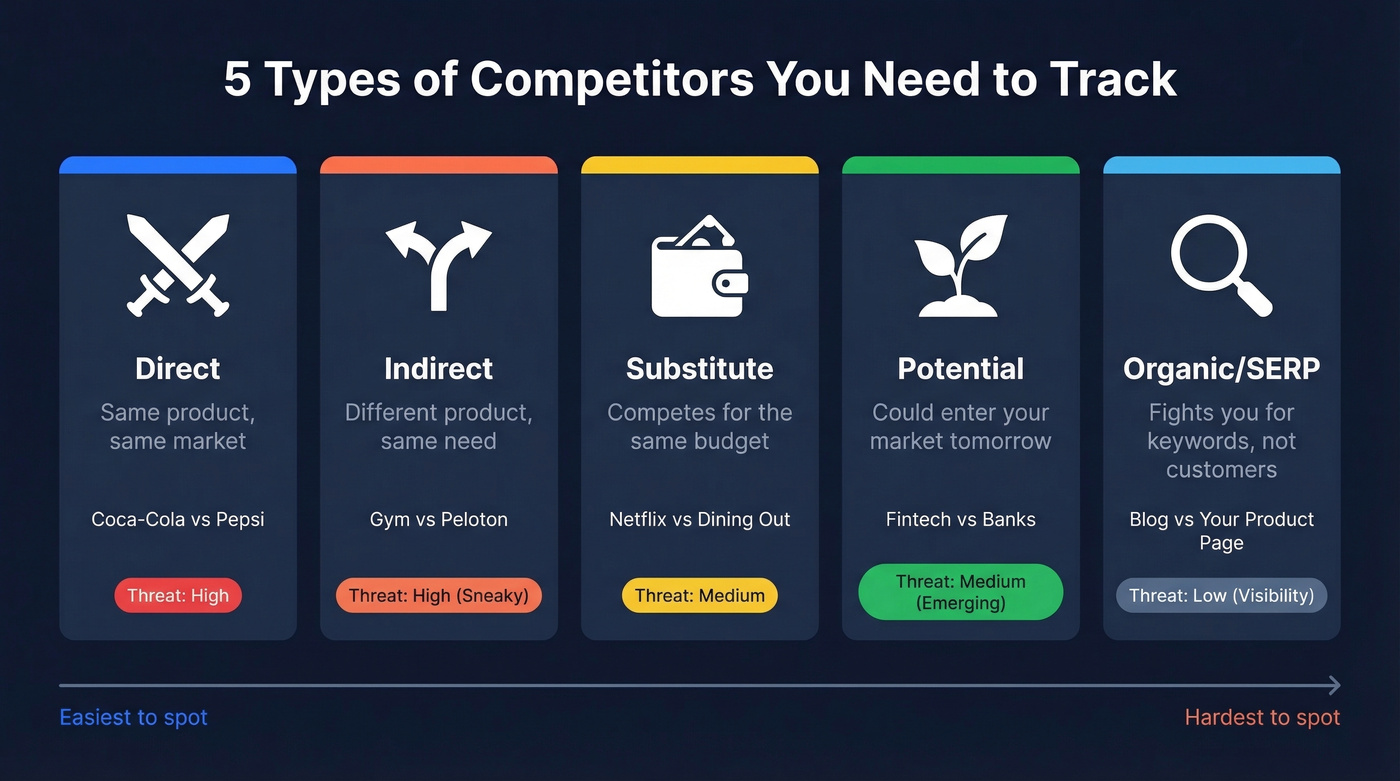
- Direct competitors sell the same product to the same customers - Coca-Cola vs Pepsi.
- Indirect competitors solve the same problem with a different product - a gym vs Peloton.
- Substitute competitors compete for the same budget across entirely different categories - Netflix vs dining out.
- Potential competitors don't compete with you today but could tomorrow - fintech vs traditional banks.
- Organic competitors fight you for search visibility, not customers - your SERP rivals.
Here's the core argument: indirect competitors are more dangerous than direct ones. Direct competitors you can see coming. Indirect ones rewrite the rules while you're busy watching the wrong scoreboard.
What Are Direct Competitors?
Direct competitors are the obvious ones. Same product, same market, same customer, same shelf. In Porter's Five Forces framework, this is "rivalry among existing competitors" - the force that drives down prices and dissipates profits when too many players chase the same buyer.
Coca-Cola vs Pepsi. Uber vs Lyft. Asana vs Monday.com. These companies wake up every morning trying to win the same deal from the same person. The dynamics are predictable: price wars, feature parity races, and messaging that sounds increasingly identical.
Direct competition is the easiest to track and the hardest to differentiate in.
What Are Indirect Competitors?
Indirect competitors solve the same customer problem with a fundamentally different product. In Porter's Five Forces, this shows up as the threat of substitutes - different solutions that meet the same underlying need through a different mechanism.
A gym and a Peloton both solve "I need to get fit." A bowling alley and a mini-golf course both solve "we need something fun to do for two hours." Shopify's guide nails this framing - indirect competitors compete for the same customer dollars even though their products look nothing alike.
In B2B, think Miro vs Figma or Notion. Different products, but when a product team needs to organize their thinking, both get evaluated. Substitutes place a ceiling on prices your entire industry can charge. If the alternative is "good enough" and cheaper, your pricing power evaporates.
Beyond the Binary - 5 Types of Competitors
The direct/indirect split is a starting point, not the full picture. Here's the expanded taxonomy that actually covers everyone you're up against:
| Type | Definition | Example | Threat Level | Monitoring Cadence |
|---|---|---|---|---|
| Direct | Same product, same market | Uber vs Lyft | High - immediate | Weekly |
| Indirect | Different product, same need | Gym vs Peloton | High - sneaky | Monthly |
| Substitute | Budget competition | Netflix vs dining out | Medium - structural | Quarterly |
| Potential | Could enter your market | Fintech vs banks | Medium - emerging | Quarterly |
| Organic/SERP | Competes for your keywords | Blog vs your product page | Low - visibility | Monthly |
Let's break down the three most teams miss.
Substitute competitors don't solve the same problem - they compete for the same budget. When a marketing team debates whether to spend $50k on a conference or a demand gen tool, those two options are substitutes. Porter explicitly separates substitutes from direct rivalry because the economic dynamics differ: substitutes cap your industry's pricing power, while indirect competitors erode market share from adjacent categories. That distinction matters for how you respond.
Potential competitors are the startups with $20M in Series B funding building something that overlaps with 40% of your product. Traditional banks didn't take fintech seriously until fintech started pulling customers away at scale. Track Crunchbase funding rounds and job postings in your space - that's where potential competitors reveal themselves before they show up in your pipeline.
Organic competitors are the sites ranking for your keywords even though they don't sell a competing product. A blog post ranking for "project management software" is an organic competitor to a project management landing page. They're not stealing customers directly, but they're stealing attention and shaping buyer perception before you ever get a shot at the conversation.
How Blockbuster Lost to an Indirect Competitor
Everyone knows the Blockbuster story. Few people frame it correctly.
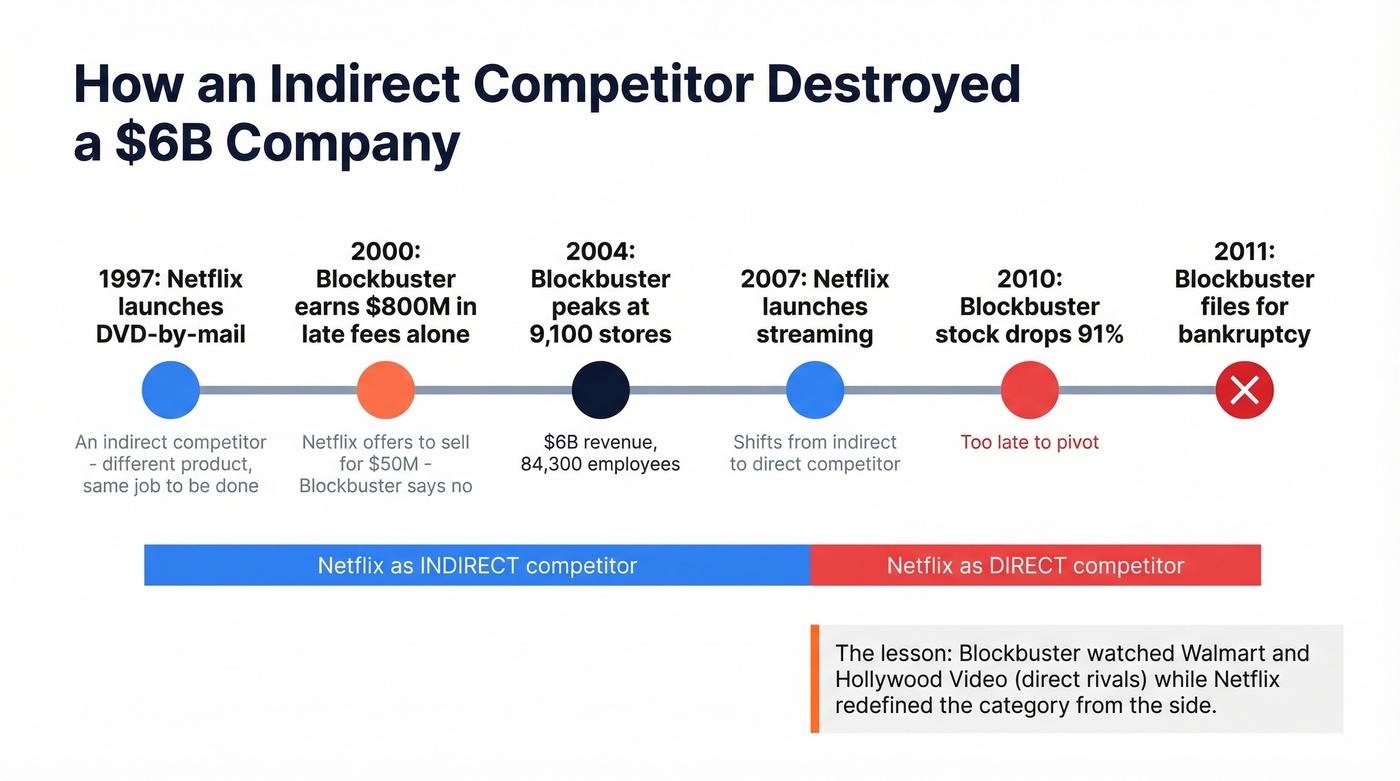
At its peak in 2004, Blockbuster operated 9,100 stores with 84,300 employees and pulled in $6 billion in revenue. Late fees alone generated $800 million in 2000 - and massive customer resentment. That same year, Netflix offered to sell itself to Blockbuster for $50 million. Blockbuster passed.
Here's the thing: Netflix wasn't a direct competitor in 2000. Blockbuster was in the "drive to a store, browse shelves, rent a physical disc" business. Netflix was in the "mail-order DVD" business. Different product, different experience, different model. It was an indirect competitor solving the same job - "watch a movie tonight" - through a completely different mechanism.
By the time Netflix launched streaming and became a head-to-head rival, it was too late. Blockbuster's shares dropped 91% by January 2010. Bankruptcy followed in 2011. The company that could've bought Netflix for $50 million was worth nothing.
The lesson isn't "Netflix was smarter." The lesson is that Blockbuster was watching Walmart and Hollywood Video - direct competitors - while Netflix quietly redefined the category from the side. Indirect competitors don't announce themselves. They just show up in your churn data.

Your competitors - direct and indirect - are already targeting your buyers. Prospeo tracks 15,000 intent topics via Bombora so you can see which accounts are actively researching alternatives. Layer buyer intent with 30+ filters like technographics, funding, and headcount growth to spot threats before they show up in your churn data.
See exactly who's shopping your category - before they go dark.
How to Identify Your Competitors
Knowing the types isn't enough. You need a repeatable process that covers all five categories. Quick distinction worth making: competitive analysis is a time-bound snapshot; competitive intelligence is the ongoing process of gathering and distributing that information. This framework covers both.
Step 1 - Search Your Core Keywords
Google your product category. Check G2, Capterra, and Product Hunt. Note who ranks for your terms - these are your organic competitors, and many will also be direct or indirect rivals. If someone's bidding on your branded keywords, they've already identified you as competition. Return the favor.
Step 2 - Ask Your Customers
The most underused competitive intelligence source is your own customer base. Add "What else did you evaluate?" to onboarding surveys. Run win/loss interviews quarterly. And ask the budget-substitution question that reveals indirect and substitute competitors: "If you didn't buy us, where would that budget have gone?"
That last question is gold. When the answer is "we would've done it manually," you've just identified your real competitor - and it's not the other SaaS tool on your battlecard.
For a more quantitative approach, tag every closed-lost deal in your CRM with where the budget actually went. After a quarter, you'll have hard data on which indirect and substitute competitors are actually taking your revenue.
Step 3 - Gather Intelligence
For each competitor, collect features, pricing model, target customers, channels, strengths, weaknesses, funding, team size, and review sentiment. SimilarWeb, Semrush, and Ahrefs handle traffic and keyword data. Crunchbase covers funding and growth signals. G2 and Capterra surface what real users love and hate.
Once you know who the competitors are, the next question is: who are their customers? Prospeo's B2B database lets you filter with 30+ search criteria - including technographics - to find companies running a competitor's tech stack, then gives you verified emails with 98% accuracy for decision-makers at those accounts. With a 7-day data refresh cycle, you're working with current information, not records that went stale six weeks ago.
Step 4 - Build a Competitive Matrix
Competitors as columns, evaluation criteria as rows. Include pricing tier, target segment, key differentiator, biggest weakness, and primary channel. Keep it to 8-12 criteria - a 47-column spreadsheet is a procrastination tool, not a strategy document.
If you want a faster way to operationalize this in sales, build Sales Battle Cards alongside the matrix so reps can actually use the insights live.
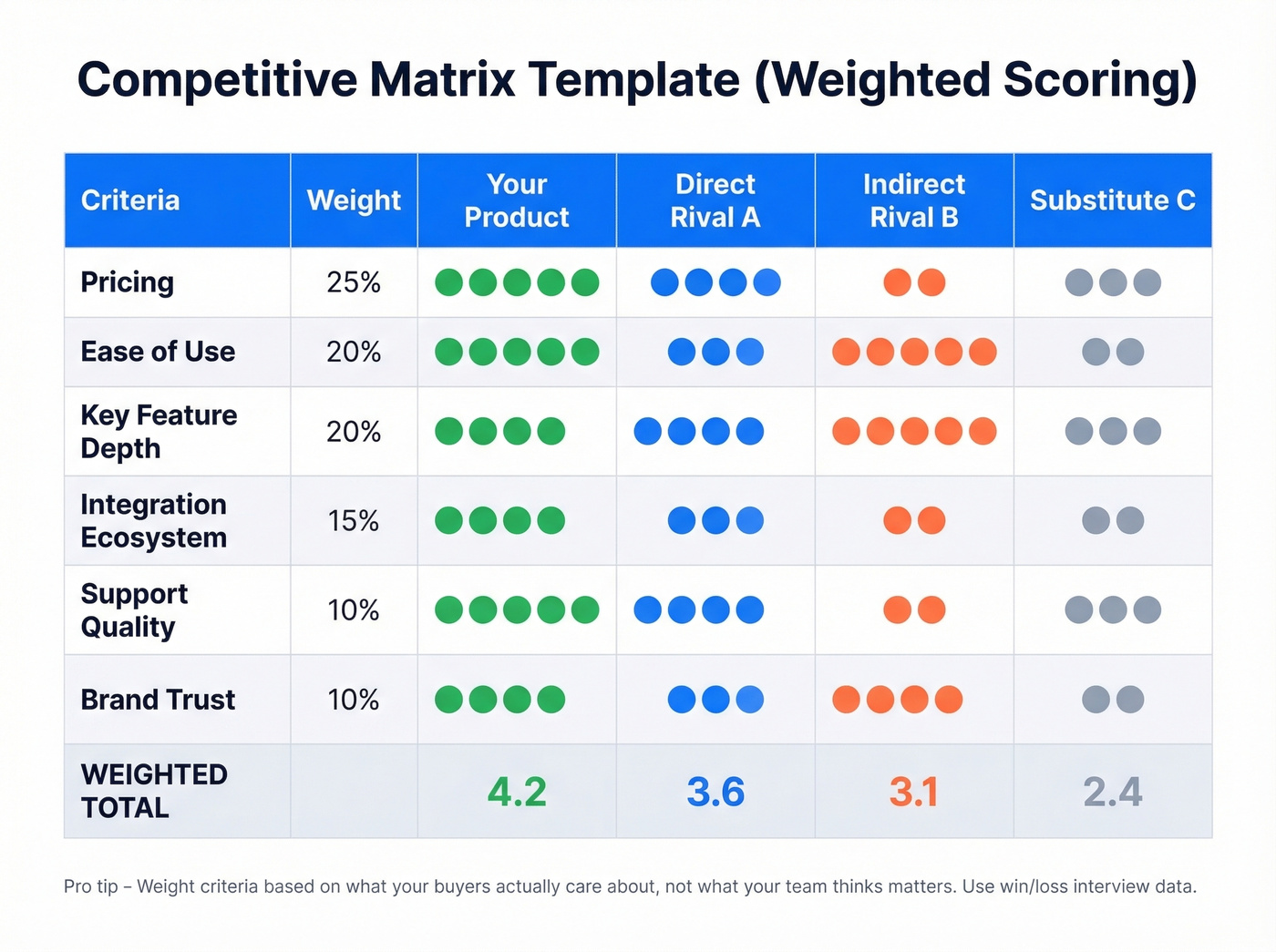
Weighted scoring helps if you need to present this to leadership. Assign importance weights to each criterion based on what your buyers actually care about, then score each competitor 1-5. Beyond basic matrices, consider a capabilities analysis where you rate each competitor's strengths as unique, best, same, or poor - or an imitability analysis that asks how easily competitors can copy your value.
Step 5 - Map Positioning on a 2x2
Pick two axes that matter to your market. Price vs features. Simplicity vs power. Niche vs broad. Plot yourself and your top competitors. The white space on the map is where your differentiation lives - or where an emerging competitor is about to plant a flag.
This isn't a one-time exercise. Set Google Alerts for competitor names. Follow their social accounts and newsletters. Revisit the matrix every quarter.
How to Prioritize - The Tiering Model
You can't monitor 30 competitors with equal intensity. Tier them.
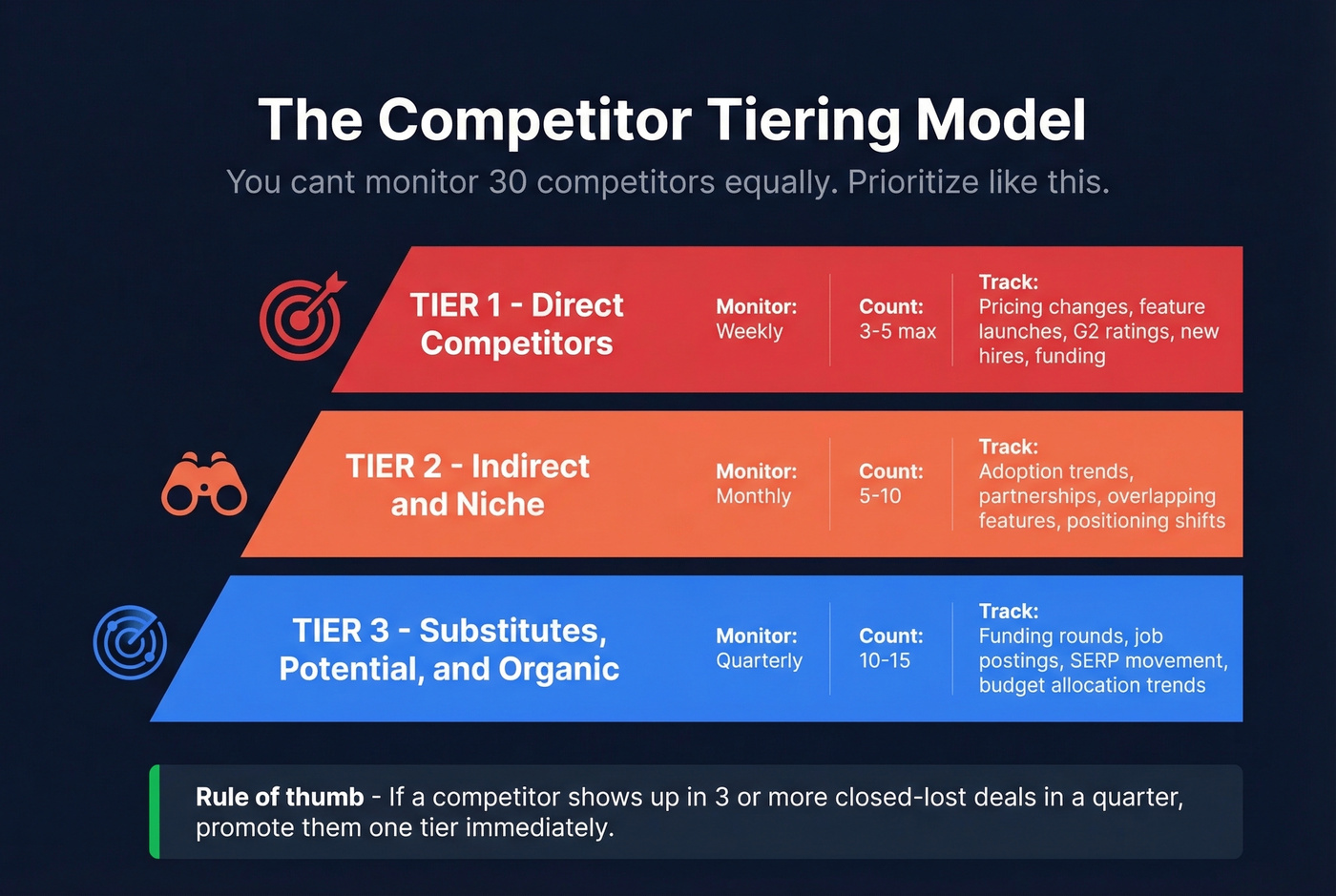
Tier 1 (Direct) - Track weekly. These are the names that show up in your win/loss data. Monitor pricing changes, feature launches, G2 ratings, new hires, and funding rounds. Three to five companies, max.
Tier 2 (Indirect/Niche) - Track monthly. Watch for adoption trends, partnerships, and overlapping user bases. If a Tier 2 competitor starts showing up in your deals, promote them to Tier 1 immediately. Five to eight companies here.
Tier 3 (Aspirational/Emerging) - Track quarterly. These are the market leaders you learn from and the funded startups that could become threats. Review their annual reports, keynotes, and ecosystem plays. Keep a watchlist, not a war room.
We've seen this play out firsthand: teams that structure competitive tracking into tiers outperform the ones winging it. An r/SaaS thread on competitive analysis frameworks makes the same point in founder language - people either ignore competitors entirely or obsess in the wrong direction. The fix is a repeatable system, not a one-time spreadsheet.
Use Jobs-to-Be-Done to Find Hidden Rivals
The Jobs-to-Be-Done framework reframes competition entirely. Instead of asking "who sells a similar product?" you ask "who else gets hired for the same job?"
Take the job "unwind after a stressful day." The competitors aren't just other relaxation apps. They're a glass of wine, a Netflix episode, a yoga class, scrolling social media, or calling a friend. Every one of those "solutions" competes for the same moment in the customer's life.
This lens reveals two competitor types that traditional analysis misses. "Do nothing" is a competitor - the customer decides the problem isn't worth solving. DIY workarounds are competitors - the prospect builds a janky spreadsheet instead of buying your tool. In our experience, teams lose more deals to "do nothing" than to any named competitor on their battlecard.
Here's my hot take: if your average deal size is under five figures, "do nothing" and DIY workarounds are usually your top competitors - not the funded startup with the slick landing page. Most competitive analysis frameworks completely ignore this reality.
Look at what happened to the iPod. Customers didn't want a better MP3 player. They wanted the job done - create a mood with music - without the hassle of buying, downloading, and organizing files. Spotify and Pandora didn't build a better iPod. They eliminated the need for one entirely. That's indirect competition at its most lethal.
How to Win Against Each Type
Beating Direct Competitors
Klue's value wedge framework is the most practical tool we've found for head-to-head competition. Picture three overlapping circles: your capabilities, competitor capabilities, and what the buyer needs. The sliver where your capabilities meet buyer needs but the competitor can't follow - that's your value wedge. Every sales conversation should anchor there.
Build "quick dismiss" talk-tracks for your top three direct competitors. When a prospect mentions a rival, your reps should have a confident, two-sentence response that redirects to your value wedge. Not trash-talking - repositioning.
Compete on value, not price. Price wars against direct competitors destroy margins for everyone. If discounting is a recurring theme, train reps on overcoming the price objection instead of defaulting to concessions.
Beating Indirect Competitors
Indirect competitors require a different playbook. You're not arguing "we're better than them" - you're arguing "our approach is better than theirs."
Own a specialist lane. If you're a dedicated project management tool competing against Notion, which does everything, your pitch is depth vs breadth. Educate buyers on why the specialized approach wins for their specific use case.
Confront the status quo directly in sales conversations. "What happens if you keep using spreadsheets for another year? How many deals slip through the cracks? What's the cost of that?" The indirect competitor often isn't a product - it's inertia. And inertia doesn't have a sales team fighting back.
Indirect competitors can also become partners. If you're a project management tool and Notion is an indirect competitor, a Notion integration captures users who use both - turning competition into distribution.
Against substitutes, your job is to reframe the budget conversation entirely. Against potential competitors, move fast - by the time they're in your deals, it's too late to differentiate.
Blockbuster lost because they watched the wrong competitors. Don't repeat that mistake with your pipeline. Prospeo gives you 300M+ profiles with 98% email accuracy and real-time intent signals across 15,000 topics - so you reach decision-makers while they're still evaluating, not after they've already chosen your indirect competitor.
Reach buyers before your unseen competitors do. Starting at $0.01 per email.
Common Mistakes
Treating all indirect competitors equally. A Peloton and a yoga studio are both indirect competitors to a gym, but they represent completely different threat vectors. Tier them.
Ignoring budget competition. If your buyer's alternative is "spend that $40k on another headcount instead," you're competing against an HR requisition, not a software vendor.
Over-indexing on direct competitors while indirect ones disrupt you. This is the Blockbuster mistake. The competitor you're watching isn't always the one that kills you.
Building a 47-column spreadsheet instead of a focused 2x2. Analysis paralysis disguised as rigor. A simple positioning map reveals more strategic insight than a feature-by-feature matrix with 200 cells.
Treating competitive analysis as a one-time exercise. Markets move. Competitors pivot. Funded startups emerge. Set a quarterly cadence at minimum, with weekly monitoring for Tier 1 rivals. If you need a system to keep it alive, borrow a few sales pipeline management rhythms (weekly reviews, stage definitions, and ownership) and apply them to competitor tracking.
FAQ
What's the difference between indirect and substitute competitors?
Indirect competitors solve the same customer need with a different product - a gym vs Peloton both address fitness. Substitutes compete for the same budget across entirely different categories - Netflix vs dining out both vie for Friday night discretionary spend. Porter separates substitutes explicitly because they cap your industry's pricing power rather than eroding share from an adjacent category.
Can an indirect competitor become a direct one?
Yes, and it happens constantly. Netflix started as an indirect competitor to Blockbuster through mail-order DVDs vs in-store rentals. Once streaming launched, it became a head-to-head rival for the same "watch a movie tonight" job. Monitor indirect competitors for product expansions, market pivots, and funding rounds that signal ambition beyond their current lane.
How many competitors should I actively track?
Focus on 3-5 Tier 1 direct competitors with weekly monitoring, 5-8 Tier 2 indirect or niche players on a monthly cadence, and a quarterly watchlist of emerging threats. Tracking more than 15-20 total dilutes your focus and turns competitive intelligence into busywork.
How do I find companies using a competitor's product?
Use technographic filters in a B2B data platform to surface companies running a competitor's tech stack, then pull verified emails and direct dials for decision-makers. Combine that with G2 reviews, win/loss interviews, and job postings mentioning competitor products to build both qualitative intelligence and actionable prospect lists.
Remember the deal that went dark? Next time, you'll know it wasn't just your direct vs indirect competitors you should've been mapping - it was all five types. Tier them, track them on a cadence, and stop being surprised by the threats you never saw coming.