

CRM Data Quality: Why Yours Is Worse Than You Think (And How to Fix It)
It's Monday morning. Your VP of Sales pulls up the pipeline report and asks why 40% of "active" opportunities haven't been touched in 90 days. Half the contacts have bounced emails. A dozen accounts are duplicated. The forecast is fiction.
76% of organizations say less than half their CRM data is accurate and complete - and if you've ever tried to pull a clean segment list from Salesforce, you know exactly how that feels. As one practitioner on r/salesforce put it, their CRM is "a total mess," making it nearly impossible to segment clients or pull accurate service lists. The dirty data problem is universal, and it's getting worse.
The Short Version
This is a management problem, not a tech problem. Three things to do this week:
- Run a data quality audit using five KPI dimensions: accuracy, completeness, consistency, relevancy, and timeliness.
- Assign ownership with a RACI matrix - if nobody owns data quality, nobody fixes it.
- Set up a quarterly enrichment workflow to fight the ~22.5%/year decay rate that's silently rotting your database.
The rest of this guide shows you how.
The Real Cost of Bad Data
Bad data isn't an inconvenience. It's a revenue leak with a dollar sign attached.
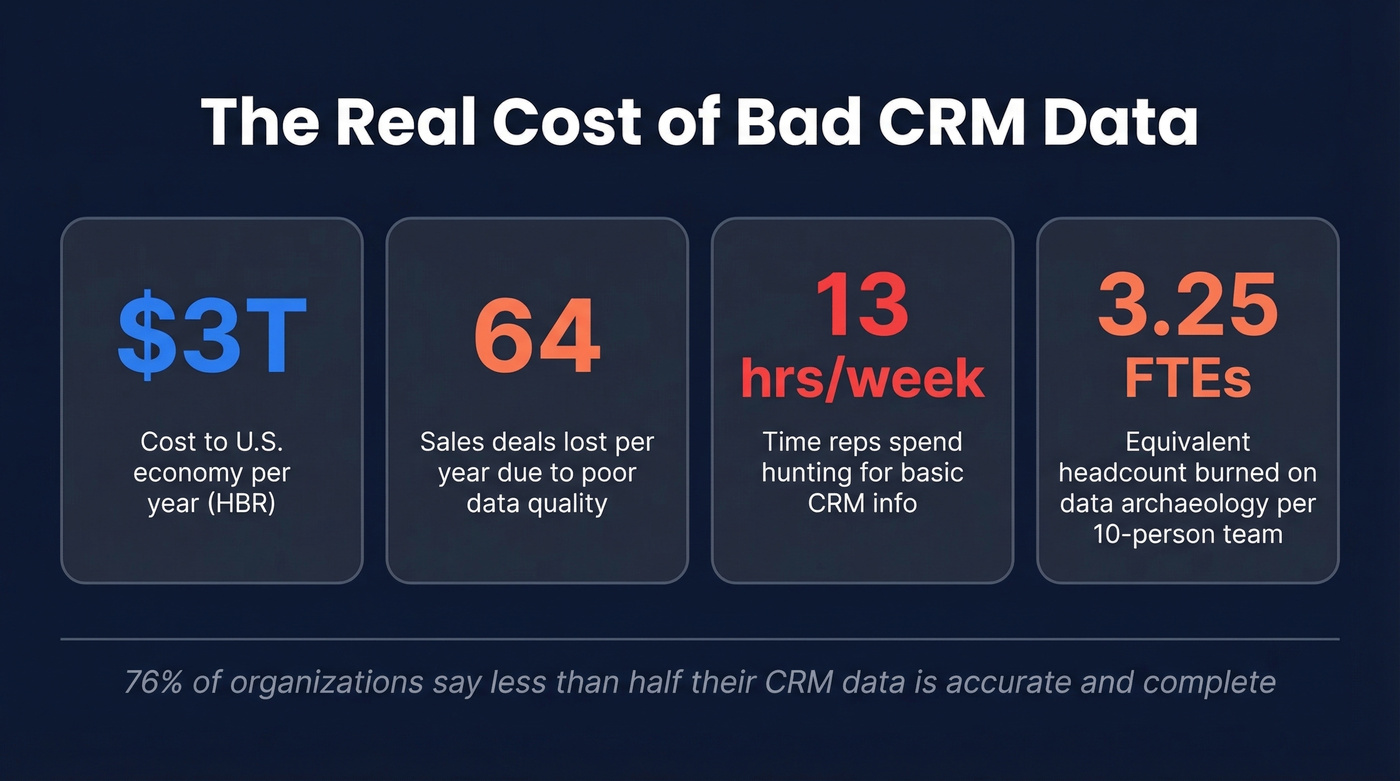
Bad data costs the U.S. economy $3 trillion per year - a 2016 HBR figure that's almost certainly grown since. The micro number is worse: 37% of organizations lose revenue as a direct result of inaccurate records, and 1 in 4 companies report a 20%+ drop in annual revenue tied to it. The impact compounds across every team that touches the pipeline, from marketing attribution to customer success renewals.
Companies lose an average of 16 sales deals per quarter - roughly 64 per year - because of poor-quality data. Your reps are spending 13 hours per week hunting for basic information in the CRM. That's 32.5% of a 40-hour workweek spent not selling. Multiply that across a 10-person team and you're burning the equivalent of 3.25 full-time headcount on data archaeology.
37% of Your Team Fabricates Data
Here's the thing: 37% of staff regularly fabricate CRM data to tell leaders what they want to hear. Before you blame the reps, blame the system design.
We've seen this pattern repeatedly. A company rolls out Salesforce with a pile of required fields on the opportunity object. Reps need to log a call? They're staring at mandatory dropdowns for MEDDIC criteria, competitor intel, and next steps - just to save a note. So they pick whatever clears the validation rule and move on. One HubSpot user on Reddit described reps making a "lousy effort" at intentional data entry, and honestly, can you blame them? This is the bad data problem at its root: systems that punish honest input.
Fewer required fields, gated by deal stage rather than dumped upfront, produce cleaner data. The problem isn't lazy reps. It's lazy system design.
How Fast CRM Data Decays
B2B contact data decays at roughly 22.5% per year - about 2.1% per month. If you enriched your entire CRM in January, nearly a quarter of it is stale by December. High-turnover industries can hit 30-40%.
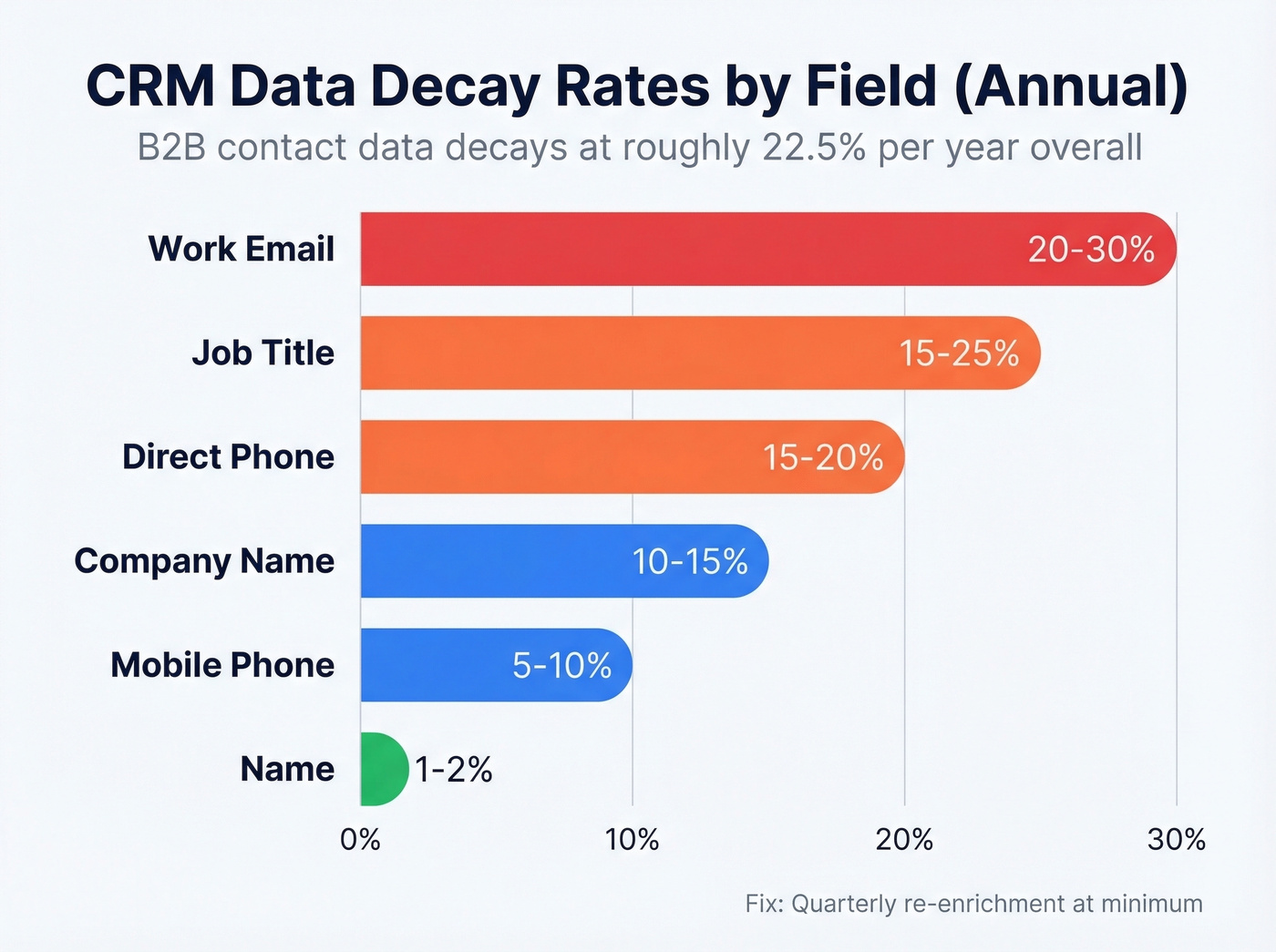
Some fields rot faster than others:
| Field | Annual Decay Rate |
|---|---|
| Work email | 20-30% |
| Job title | 15-25% |
| Direct phone | 15-20% |
| Company name | 10-15% |
| Mobile phone | 5-10% |
| Name | 1-2% |
Work emails decay fastest because people change jobs. Job titles shift with promotions and reorgs. Mobile numbers are the most stable contact field after name. Left unchecked, this decay is the primary source of record degradation across every industry.
The fix is quarterly re-enrichment at minimum. Snyk's team saw bounce rates drop from 35-40% to under 5% after switching to Prospeo - proof that enrichment cadence matters as much as enrichment quality.

Snyk cut bounce rates from 35-40% to under 5% by enriching their CRM with Prospeo. With a 92% API match rate and 50+ data points per contact, Prospeo's enrichment workflows replace the manual cleaning that 57% of teams still rely on.
Stop losing 64 deals a year to data you could fix today.
A Framework That Actually Works
Process beats tools every time. Here's a framework that holds up in production.
Governance: Who Owns What
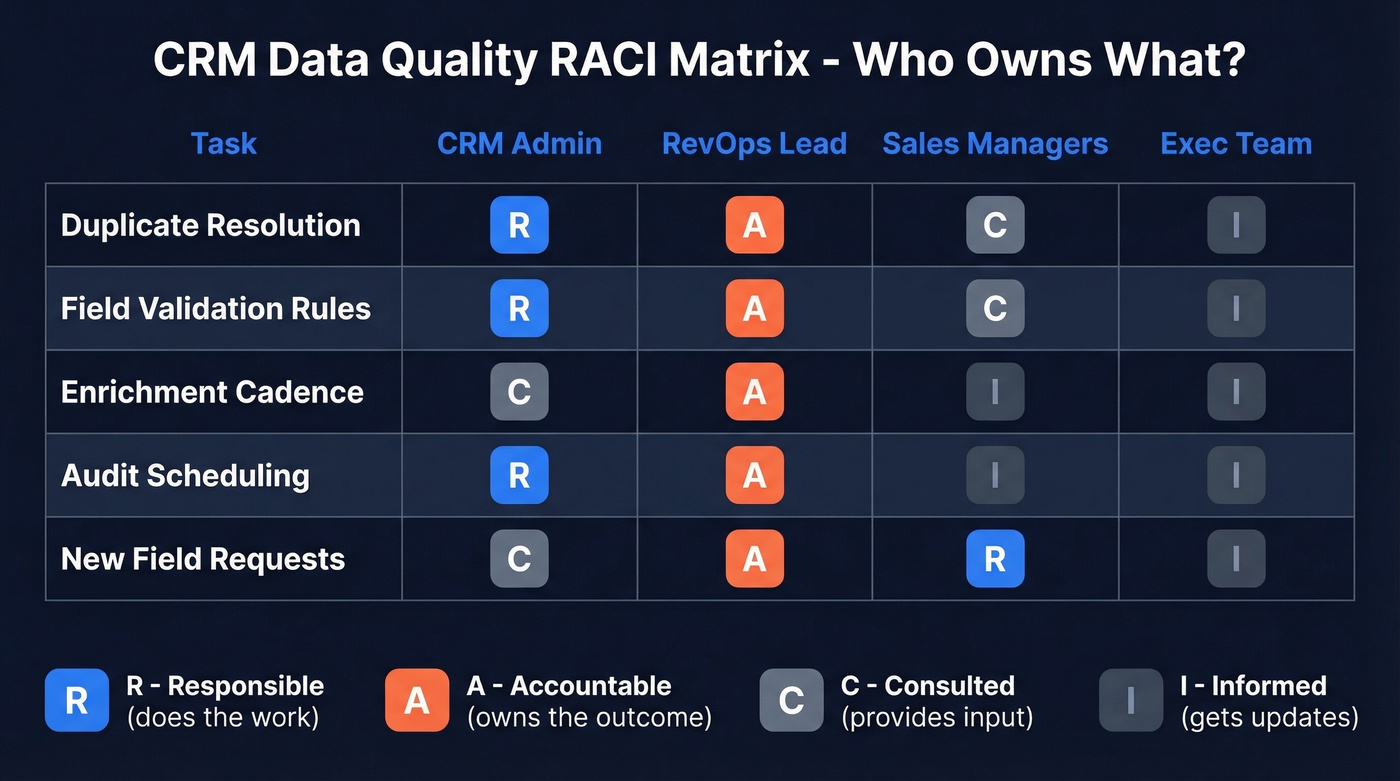
If nobody owns data quality, nobody fixes it. A RACI matrix makes ownership explicit:
| Task | CRM Admin | RevOps Lead | Sales Managers | Exec Team |
|---|---|---|---|---|
| Duplicate resolution | Responsible | Accountable | Consulted | Informed |
| Field validation rules | Responsible | Accountable | Consulted | Informed |
| Enrichment cadence | Consulted | Accountable | Informed | Informed |
| Audit scheduling | Responsible | Accountable | Informed | Informed |
| New field requests | Consulted | Accountable | Responsible | Informed |
RevOps is accountable for the program and standards. The CRM admin executes. Sales managers provide input on what fields actually matter. Execs get dashboards, not decisions.
Prevention: Stop Bad Data at the Door
Set validation rules at point of entry - format checks on email, phone, and country fields. Gate required fields by deal stage, not all at once: Stage 1 needs company and contact; Stage 3 needs budget and timeline. Turn on native duplicate detection before records are created, and use role-based access so marketing can't overwrite sales-owned fields and vice versa.
These validation rules also serve a compliance function. GDPR's right-to-erasure and CCPA's data accuracy obligations both require you to know what data you hold and keep it current. Clean data isn't just a revenue play - it's a regulatory one. (If you need a deeper compliance lens, see our B2B compliance guide.)
Every required field you add increases the odds of fabricated data. Be ruthless about what's truly required versus nice-to-have. And enable MFA plus quarterly access reviews - data quality includes data security.
Maintenance: The Quarterly Loop
Quarterly audits are the minimum viable cadence. Each cycle should cover stale record identification (no activity in 90+ days), automated re-enrichment of active contacts, and purging of records that can't be verified.
57% of organizations have implemented manual data cleaning as their primary approach - while simultaneously cutting investment in dedicated data quality personnel. That math doesn't work. Automated enrichment workflows through your CRM's API or a dedicated enrichment tool are the most practical way to scale and address poor record quality before it spreads through your pipeline. (If you're comparing vendors, start with the best data enrichment tools roundup.)
Measurement: 5 KPIs to Track
- Accuracy: >95% of records match verified external sources
- Completeness: >90% of required fields filled across active records
- Consistency: Cross-system match rate between CRM, marketing automation, and billing
- Relevancy / Duplication rate: Under 2% of total records are duplicates; inactive or irrelevant records flagged and archived quarterly
- Timeliness: % of records updated within the last 90 days (target: >80%)
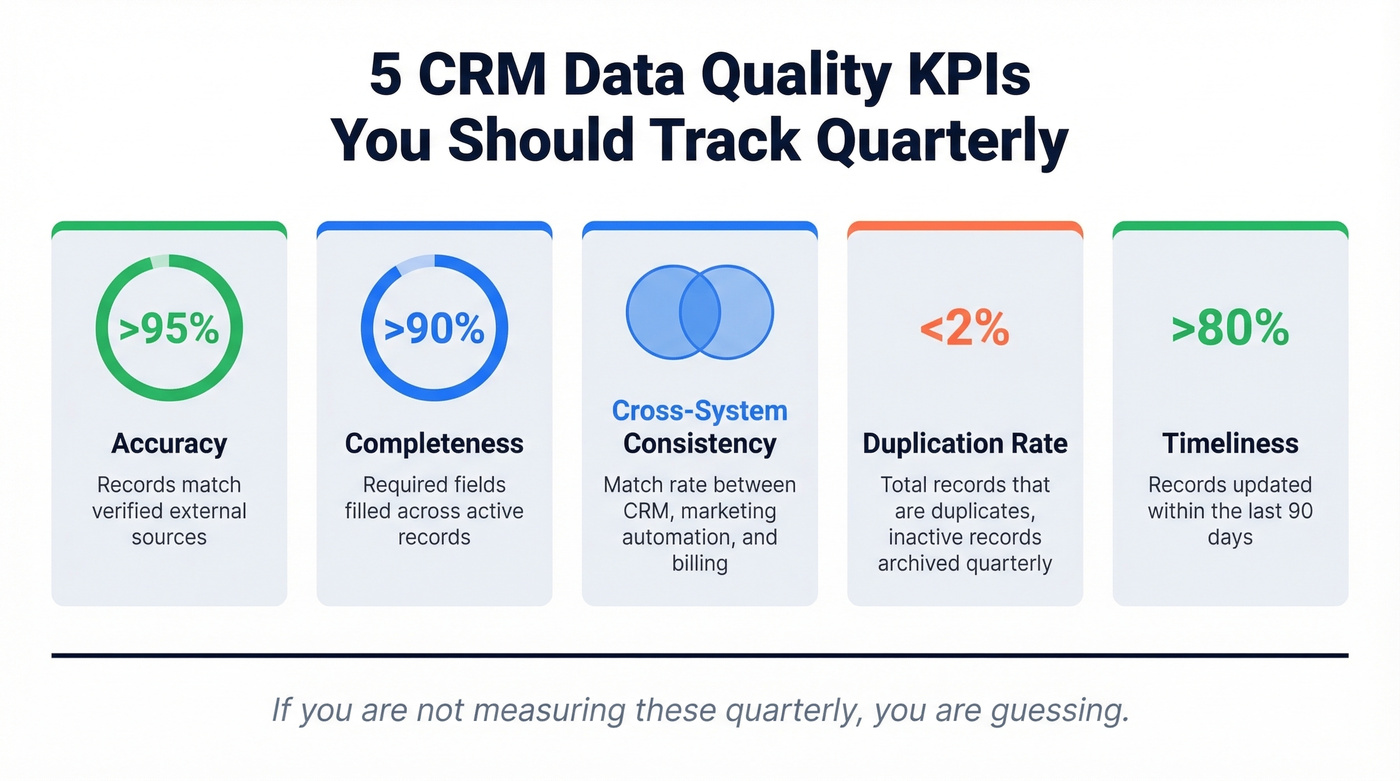
If you're not measuring these quarterly, you're guessing. (For pipeline-side benchmarks, see account executive KPIs.)
How AI Changes the Equation
45% of CRM users say their data isn't prepared for AI. Meanwhile, 54% of organizations are already deploying generative AI tools. That's a collision course.
AI-driven enrichment is genuinely useful - tools can pull contact updates from meeting transcripts, call recordings, and calendar data, automatically updating CRM records without rep intervention. But AI also amplifies the garbage-in-garbage-out problem. Feed an AI scoring model dirty data and it'll confidently prioritize the wrong accounts. Feed it duplicates and it'll double-count engagement signals. The foundation has to be clean before the AI layer adds value. (More on this in our GTM AI breakdown.)
AI-native CRMs that auto-create contact records from meeting invites and email threads introduce a new class of duplicates - records created without human review. Let's be honest: if your average deal size is under $10K, you probably don't need AI-powered CRM features at all. You need clean data and a rep who picks up the phone. (If you're rebuilding your stack, start with how to choose a CRM.)
The most concerning trend: only 18% of organizations without a dedicated data quality owner plan to hire one - a 56% decrease from the prior year. Companies are betting on AI to solve a problem that AI can't solve alone.
Tools That Fix Dirty CRM Data
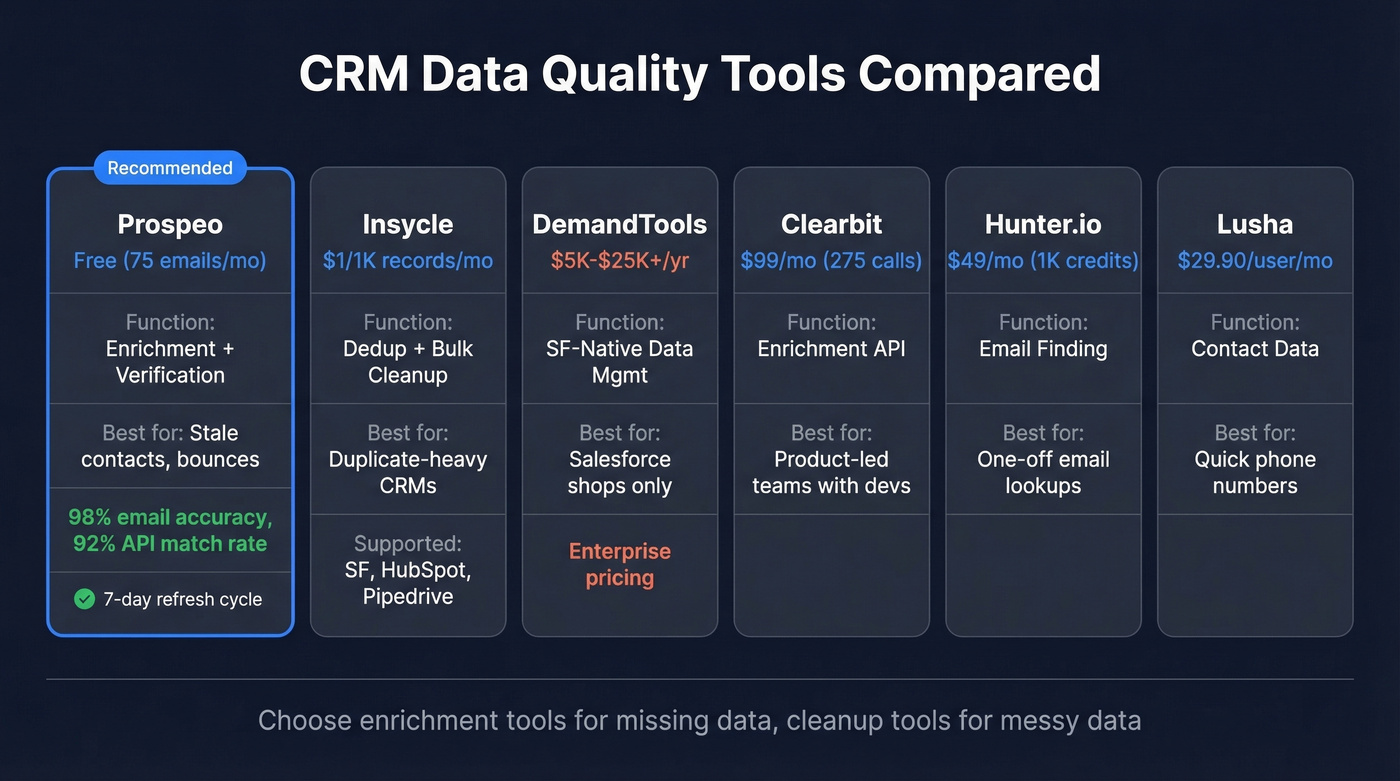
| Tool | Primary Function | Starting Price | Best For |
|---|---|---|---|
| Prospeo | Enrichment + verification | Free (75 emails/mo) | Stale contacts, bounces |
| Insycle | Dedup + bulk cleanup | $1/1K records/mo | Duplicate-heavy CRMs |
| DemandTools | SF-native data mgmt | $5,000-$25,000+/yr | Salesforce shops |
| Clearbit | Enrichment API | $99/mo (275 calls) | Product-led teams |
| Hunter.io | Email finding | $49/mo (1K credits) | One-off email lookups |
| Lusha | Contact data | $29.90/user/mo | Quick phone numbers |
Prospeo
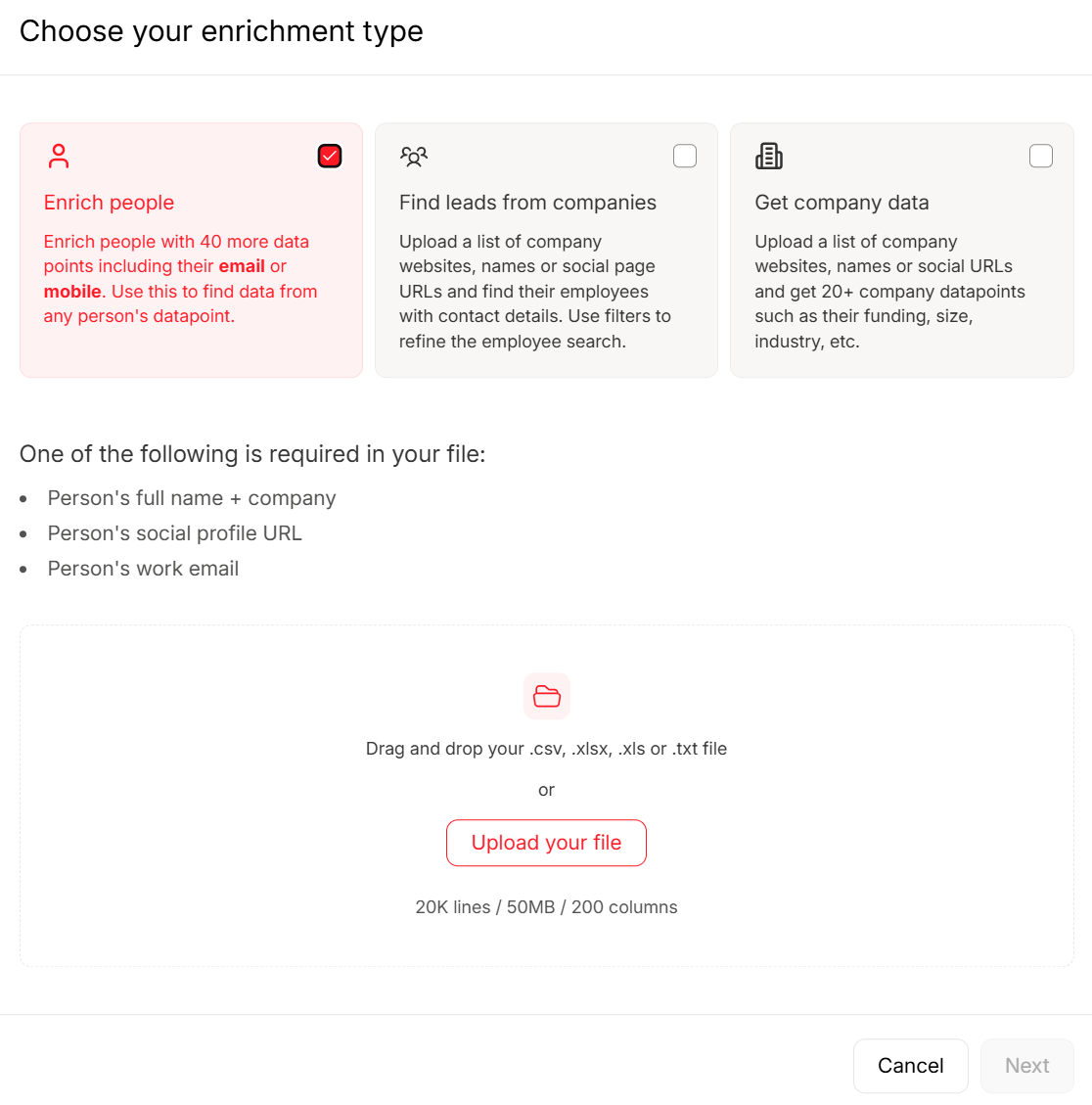
Meritt's team was running a 35% bounce rate before switching their enrichment provider. After moving to Prospeo, bounces dropped under 4% and pipeline tripled from $100K to $300K per week. That kind of result comes from a 7-day data refresh cycle - while most enrichment tools refresh on a 6-week cycle, Prospeo catches job changes and email bounces weekly. Enrichment returns 50+ data points per contact at a 92% API match rate with 98% email accuracy.
The free tier gives you 75 verified emails and 100 Chrome extension credits per month - enough to audit a CRM segment before committing. Paid plans start at ~$0.01 per email with no annual contracts. (If you’re also evaluating sources, compare options in our best B2B database guide.)
Insycle
If your primary problem is duplicates and inconsistent formatting - thousands of "IBM" vs "IBM Corp" vs "International Business Machines" records cluttering your CRM - Insycle handles deduplication, bulk cleanup, and field standardization across Salesforce, HubSpot, and Pipedrive. Starting at $1 per 1,000 records/month, it's affordable for cleanup projects. Skip this if your problem is missing data rather than messy data. Insycle cleans what's there but doesn't enrich gaps.
DemandTools by Validity
DemandTools is the heavy-duty option for Salesforce-native data management: mass deduplication, import/export transformations, and standardization at scale. It's part of Validity's broader platform bundle, so expect enterprise pricing - typically $5,000-$25,000+/year depending on seats and modules. Skip this if you're on HubSpot or Pipedrive. It doesn't translate.
Clearbit, Hunter.io, Lusha
Clearbit is an enrichment API starting at $99/month for 275 API calls - best for product-led teams with developer resources to build custom workflows. Hunter.io handles email finding and verification from $49/month for 1,000 credits; solid for one-off lookups but not built for ongoing CRM enrichment at scale. Lusha starts at $29.90/user/month and works well for individual reps who need a quick phone number, though it's better suited for spot lookups than full database cleanup. (If deliverability is the pain, start with an email verifier before you send.)
Your quarterly re-enrichment loop needs a source that keeps pace with decay. Prospeo refreshes 300M+ profiles every 7 days - not 6 weeks like competitors - so your CRM stays accurate between audits. At $0.01 per email, cleaning your entire database costs less than one lost deal.
Replace data archaeology with automated enrichment at scale.
CRM Data Quality FAQ
How often should you audit CRM data?
Quarterly at minimum. B2B contact data decays roughly 22.5% per year, so a 90-day cycle catches most rot before it compounds into pipeline-wrecking inaccuracy. High-turnover industries like tech and staffing should audit monthly.
What's a good accuracy benchmark?
Aim for 95%+ accuracy and under 2% duplication rate. The Validity 2026 report found 76% of organizations fall well below this - most have less than half their data accurate and complete. If you're above 90%, you're already ahead of the pack.
What causes bad data in a CRM?
Three forces work against you simultaneously. Natural decay erodes about 22.5% of contact records per year as people change jobs and get promoted. Manual entry errors compound the problem - 37% of staff admit to fabricating data when faced with too many required fields. And system fragmentation creates duplicates every time marketing, sales, and support tools sync imperfectly.
What's a cost-effective way to keep CRM records fresh?
Automated enrichment tools beat manual cleanup at scale. Prospeo's free tier lets small teams start re-verifying stale contacts immediately, while Insycle handles deduplication from $1 per 1,000 records. Pair either with quarterly audits and you'll stay ahead of the 22.5% annual decay curve without hiring a dedicated data team.