

Competitive Intelligence Services: What They Cost, Who's Best, and How to Choose
You scheduled a demo with a CI vendor last Tuesday. Forty-five minutes of slides, a polished account executive, and zero mention of price until you asked directly - at which point you got "it depends on your needs" and a follow-up call with a solutions engineer. That experience is so universal among buyers of competitive intelligence services it's practically a meme in product marketing circles. We've sat through enough of these to know the pattern.
Here are real pricing ranges, the platforms worth evaluating, and a framework for building a CI stack that doesn't require a six-figure commitment.
The 3-Layer CI Stack (Quick Version)
You don't need 32 tools. You need three layers:
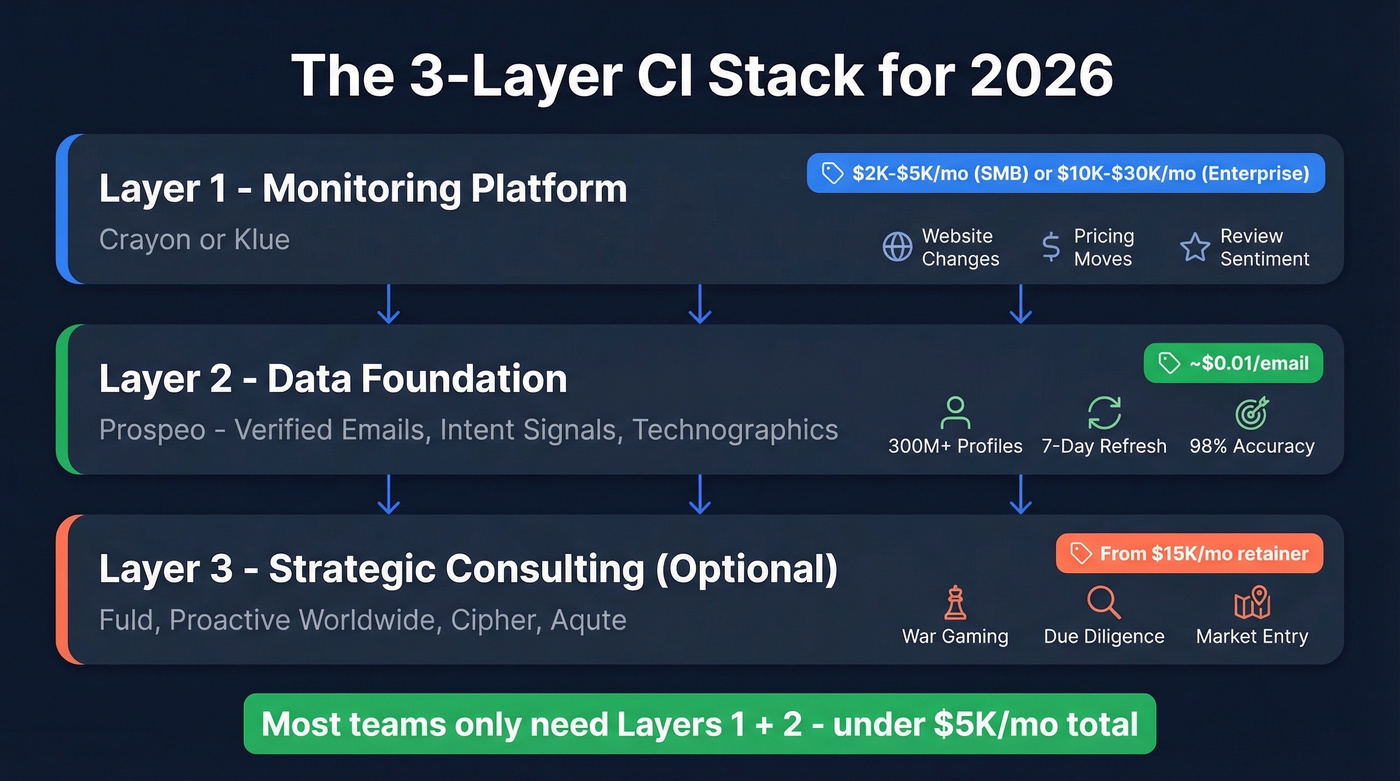
- Layer 1 - Monitoring platform (Crayon or Klue): Tracks competitor website changes, messaging shifts, pricing moves, product launches, and review sentiment. Budget $2,000-$5,000/mo for SMB, $10,000-$30,000/mo for enterprise.
- Layer 2 - Data foundation: Feeds your CI workflows with accurate contact and company data - verified emails, direct dials, intent signals, technographics. Without clean data, your monitoring platform is tracking ghosts. Budget ~$0.01/email.
- Layer 3 - Strategic consulting (optional): For market entry analysis, due diligence, or deep competitive assessments your team can't staff internally. Budget from $15,000/mo on retainer.
Most teams only need Layers 1 and 2. If you're under $5K/mo total, you can run a legitimate CI program that outperforms what 80% of mid-market companies are doing manually.
What These Services Actually Include
CI tools and CI services are different things, and most buyers blur the two. Tools automate monitoring - they crawl competitor websites, aggregate news, and surface changes. Services layer human analysis, strategic frameworks, and deliverables on top of that data.
Gartner Peer Insights labels the category as "Competitive and Market Intelligence Tools (Transitioning to Competitive and Market Intelligence Platforms)" - a signal that the market expects more than dashboards. Five service types dominate:
Monitoring and tracking is what Crayon and Klue do well: automated crawling of competitor websites, pricing pages, job postings, review sites, and news. Strategic consulting comes from firms like Fuld & Co, Proactive Worldwide, Cipher, and Aqute Intelligence, which provide analyst-led competitive assessments, war gaming, and scenario planning. Due diligence and investigative CI covers deep-dive research for M&A, partnerships, supply chain integrity, or litigation support - often project-based with fixed deliverables. Sales enablement means battlecards, competitive positioning guides, and win/loss analysis designed to arm reps in live deals. And market entry analysis handles landscape mapping, TAM sizing, and competitive positioning for new geographies or verticals.
The AI shift is accelerating all five. With global AI spending projected to exceed $500B and growing 30%+ annually, CI platforms are moving toward AI-driven workflows that synthesize competitor moves in near real-time rather than quarterly slide decks.
What CI Costs in 2026
Almost nobody in CI publishes pricing. So we've compiled ranges from industry benchmarks, vendor conversations, and community discussions.
| CI Service Type | Typical Cost | Best For |
|---|---|---|
| Entry-level monitoring | $2K-$5K/mo | SMBs, 3-5 competitors |
| Enterprise monitoring | $10K-$30K/mo | Mid-market/enterprise, 10+ |
| Per-competitor model | $500-$1,500/competitor/mo | Granular, scalable coverage |
| Consulting retainer | From $15K/mo | Strategy, due diligence |
| Data layer | ~$0.01/email, free tier | Contact/company accuracy |
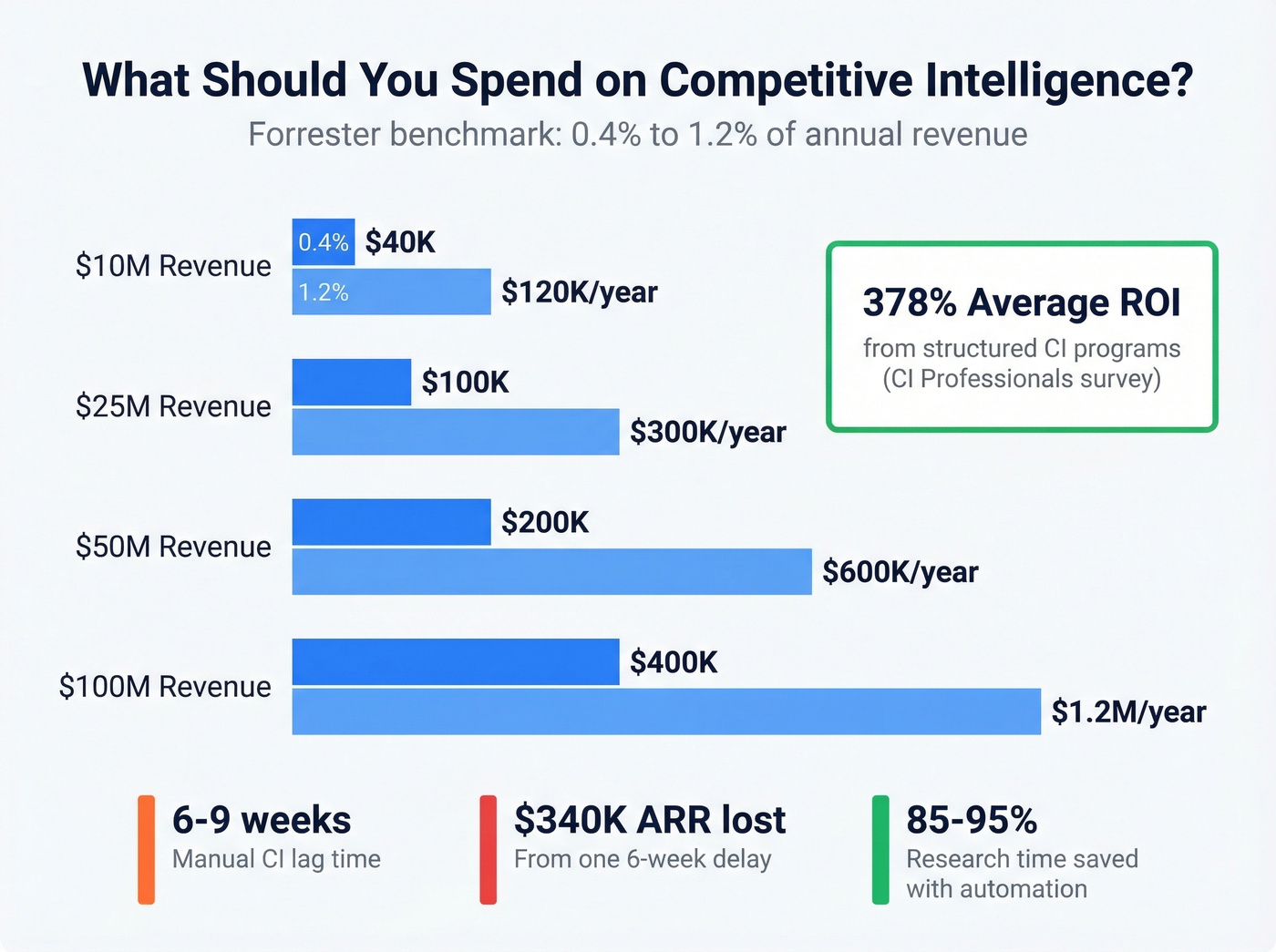
| Budget as % of revenue | 0.4%-1.2% of revenue | Mature CI benchmark |
Forrester's benchmark - 0.4%-1.2% of annual revenue - is the number to anchor against when talking to your CFO. For a $50M company, that's $200K-$600K/year across tools, data, and consulting. For a $10M company, you're looking at $40K-$120K/year. CI Professionals survey data shows a 378% average ROI from structured competitive intelligence programs. That's the number to put on the slide.
The per-competitor model is worth considering if you're in a concentrated market. Tracking five direct competitors at $800/each runs $4,000/mo - competitive with an entry-level subscription but with more focused output.
The Hidden Cost of DIY Intelligence
A RevOps lead we work with ran the math on their 50-person sales org's CI habits. Reps were spending 8-12 hours per month each researching competitors - pulling up websites, reading reviews, scanning job postings, asking colleagues on Slack. That's 400-600 hours per month of sales capacity burned on ad-hoc research, or $200K-$400K per year in fully loaded labor cost, for intelligence that's outdated by the time it reaches a battlecard.
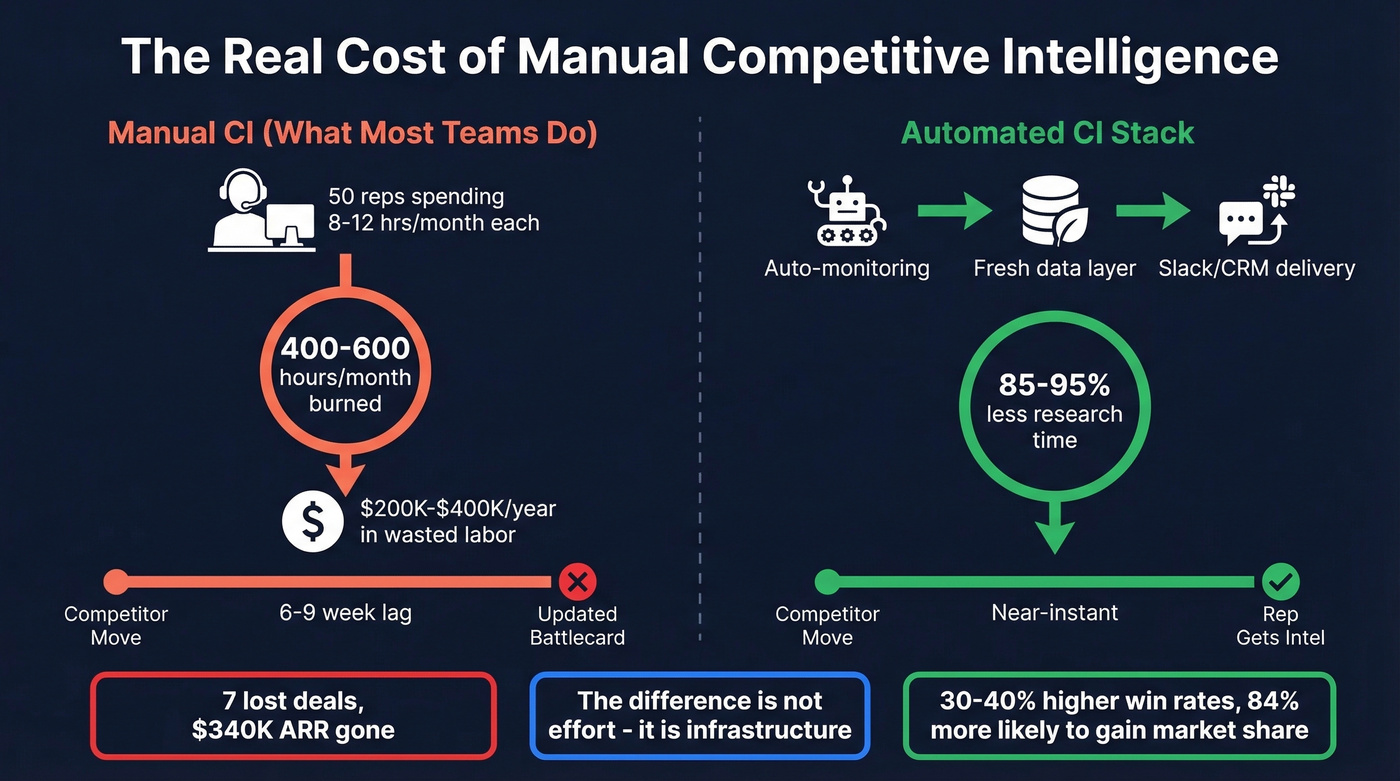
The real damage isn't just the hours - it's the lag. Manual CI creates a 6-9 week gap between a competitor's move and your team's updated response. One anonymized case study tracked a 6-week delay after a competitor launched a key feature: 7 lost deals, $340K in ARR, and a post-mortem that showed 5 of those 7 were winnable with timely battlecard updates. The reps had the relationships. They just didn't have the intelligence.
Automation reduces manual research time by 85-95% and improves competitive win rates 30-40%. Companies with continuous monitoring are 84% more likely to increase market share than those relying on periodic reports. But automation is only as good as the data feeding it - if your contact database is stale, every insight built on top of it inherits that staleness.

Your monitoring platform tracks competitor moves. Your consulting firm builds the strategy. But without accurate contact and company data, every insight dies before it reaches a buyer. Prospeo refreshes 300M+ profiles every 7 days - not every 6 weeks - so your battlecards, intent signals, and outreach always reflect reality. At $0.01/email with 98% accuracy, it's the cheapest layer in your CI stack and the one that makes every other layer work.
Stop building competitive intelligence on top of stale data.
Top CI Platforms and Tools
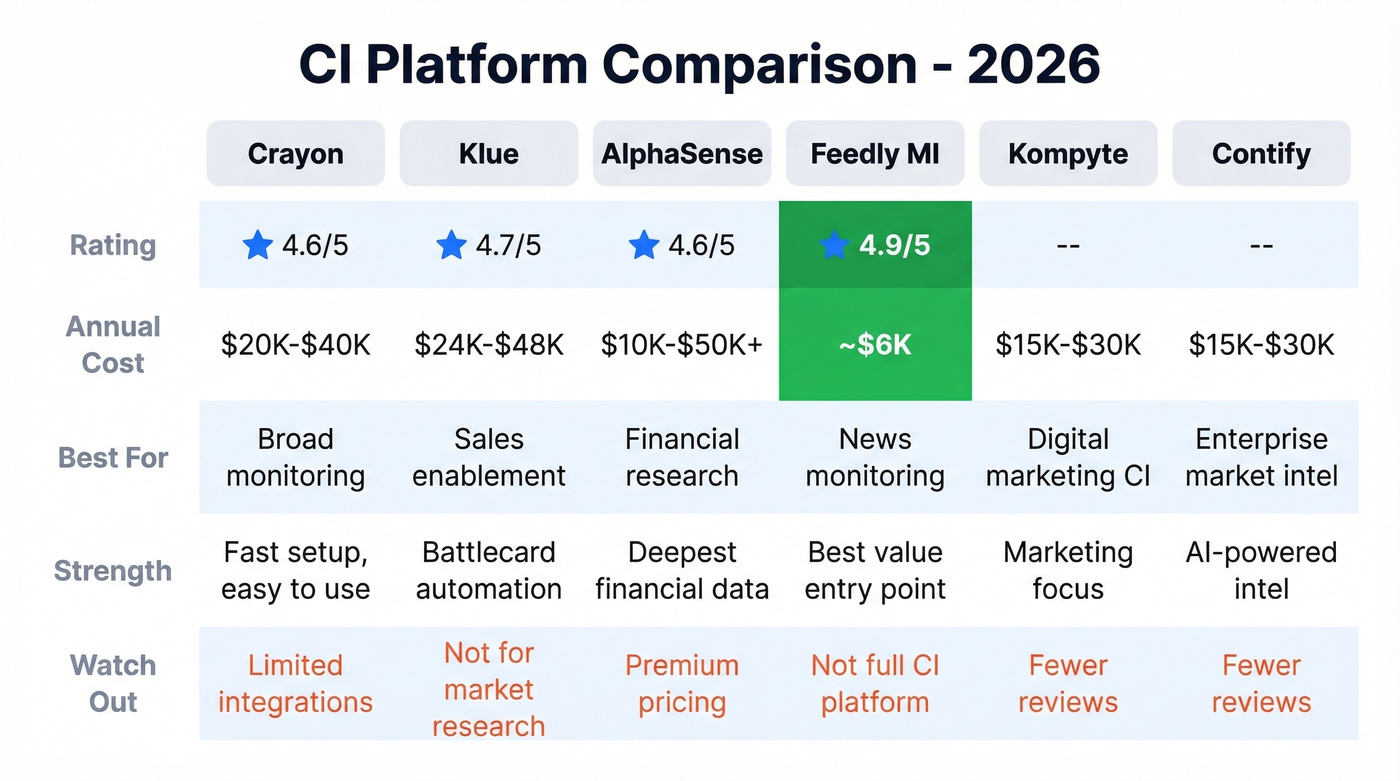
| Platform | Rating | Est. Annual Cost | Best For |
|---|---|---|---|
| Crayon | 4.6/5 G2 (385 reviews) | $20K-$40K | Broad monitoring |
| Klue | 4.7/5 Gartner (20 reviews) | $24K-$48K | Sales enablement |
| AlphaSense | 4.6 Gartner (63 reviews) | $10K-$50K+ | Financial/market research |
| Feedly MI | 4.9 Gartner (40 reviews) | ~$6K | News monitoring |
| Kompyte | - | $15K-$30K | Digital marketing CI |
| Contify | - | $15K-$30K | Enterprise market intel |
Crayon
Use this if you want the fastest path to automated competitive monitoring with minimal setup. Crayon's G2 rating sits at 4.6/5 across 385 reviews, with implementation averaging about a month. Users consistently praise the ease of use and customer support - the platform surfaces competitor website changes, messaging shifts, and pricing moves without requiring a dedicated analyst.

Skip this if you need deep integrations or mobile access. The most common G2 complaints center on limited integrations and the lack of a mobile app. In product marketing communities, integration gaps are the number-one reason teams evaluate alternatives after year one. ROI timeline runs about 14 months per G2's aggregate data, which means you're committing for over a year before the investment pays back. Expect $20K-$40K/year based on team size and competitor count.
Klue
Klue's entire value proposition is getting competitive intelligence into reps' hands during live deals. The platform excels at battlecard automation - pulling competitive data and packaging it into formats sales teams actually use. Gartner Peer Insights rates it 4.7/5 across 20 reviews, and G2 gives it a 4.7/5. In our evaluation, Klue is the strongest option when your CI program's primary audience is the sales floor, not the strategy team.

The sales enablement impact is measurable: teams using structured battlecard programs report 8-18% win-rate increases and 15-25% faster sales cycles. Klue forces the connection between product marketing's competitive research and the rep who needs it at 4pm before a demo. Pricing runs $24K-$48K/year. Skip it if you're primarily doing market research or financial intelligence - Klue is built for the sales enablement workflow, not broad market analysis.
AlphaSense
AlphaSense plays in a different lane entirely. It's a market intelligence and financial research platform - earnings call transcripts, SEC filings, expert interviews, and broker research, all searchable with AI. Gartner rates it 4.6 across 63 reviews, the largest review base in the category. Pricing ranges from $10K-$50K+/year depending on the data sets you need. Best for finance teams, corporate strategy, and investor relations rather than day-to-day competitive monitoring for sales.
Feedly Market Intelligence
Feedly's market intelligence product carries the highest Gartner Peer Insights rating in the category - 4.9 across 40 reviews. It's a supercharged news monitoring engine with AI-powered categorization and competitive tracking. At around $6K/year, it's the most accessible entry point for teams that want structured competitive news feeds without a full platform commitment.
Kompyte and Contify
Both sit in the mid-market CI space as alternatives to Crayon. Kompyte focuses on automated competitive tracking with a digital marketing angle - expect $15K-$30K/year. Contify positions as an AI-powered market and competitive intelligence platform for enterprises, priced similarly. Neither has the review depth of Crayon or Klue, but both deserve a look if the top two don't fit your workflow.
Build Your 3-Layer CI Stack
Here's the hot take: most teams spending $30K+/year on a CI platform would get better results spending $5K/mo across three layers that actually work together. The platform becomes a dashboard nobody checks. The stack becomes a system that delivers intelligence to the right person at the right time.
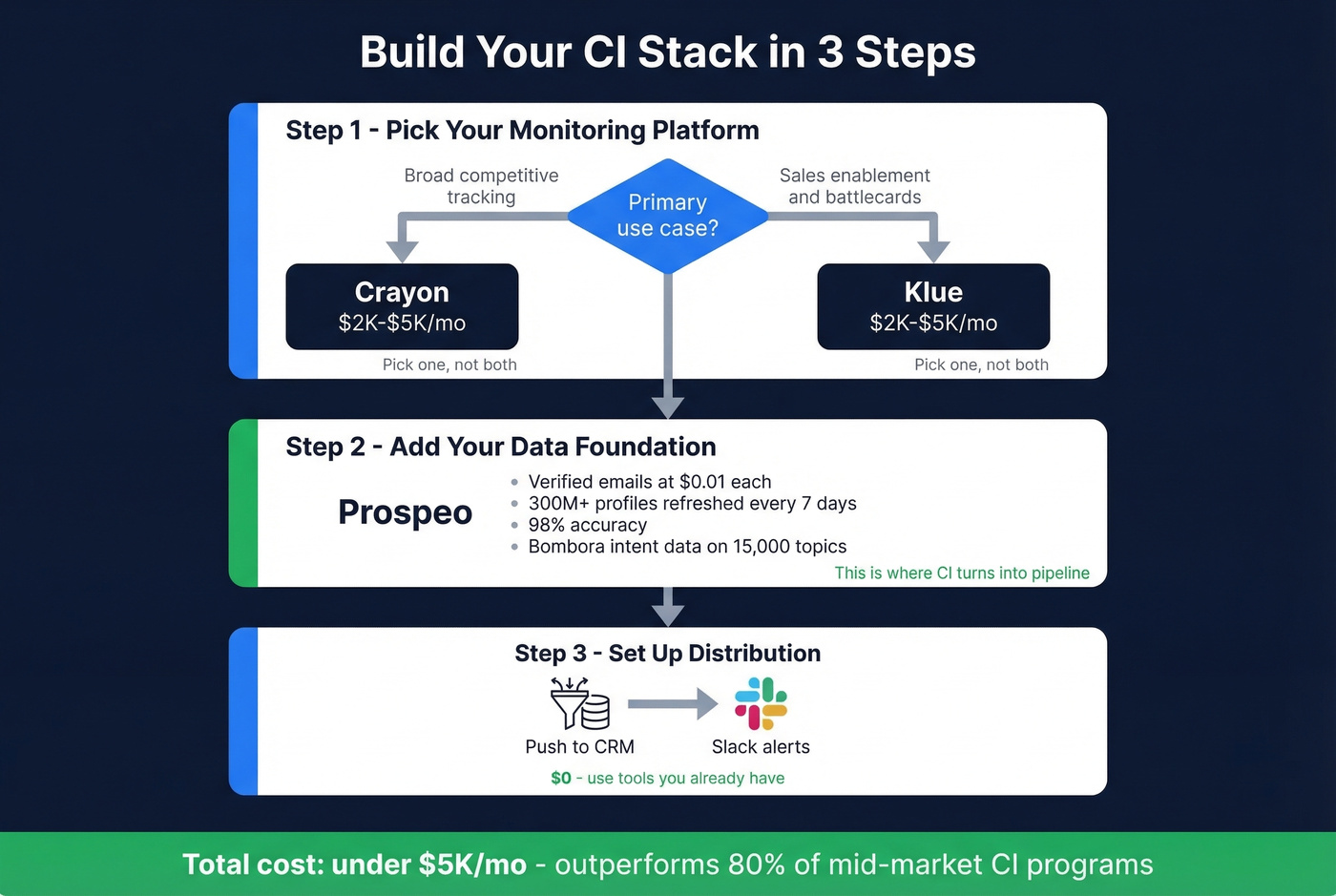
Layer 1 - Monitoring (Crayon or Klue, $2K-$5K/mo): Pick based on your primary use case. Crayon for broad competitive tracking, Klue for sales enablement and battlecards. One platform, not both.
Layer 2 - Data foundation (~$0.01/email): This is where most CI stacks have a blind spot. Your monitoring platform tracks what competitors do publicly. Your data layer tells you who's behind those moves - and gives you verified paths to reach them. Stale data means you're tracking the wrong people at the wrong companies. Prospeo's 7-day refresh cycle and 98% email accuracy across 300M+ profiles means your CI workflows are built on a foundation that's actually current, and intent data tracking 15,000 topics through Bombora lets you see which competitors' customers are actively researching alternatives. That's where CI turns into pipeline.

Layer 3 - Distribution (CRM + Slack, $0): Intelligence that lives in a dashboard nobody checks is worthless. Push competitive alerts to Slack channels, embed battlecards in your CRM, and build a weekly CI digest. This layer costs nothing beyond the tools you already have.
That 6-9 week intelligence gap costs deals. Prospeo's 7-day data refresh, 15,000 Bombora intent topics, and 30+ search filters - including technographics, job changes, and headcount growth - let you act on competitor signals while they're still fresh. Layer buyer intent on top of competitive monitoring and your reps know who's in-market before the battlecard even loads.
Turn competitive intelligence into competitive action in days, not months.
How to Evaluate a CI Provider
Before you sign anything, run every vendor through these five criteria:
Methodology transparency. How do they collect intelligence? Automated crawling, human analysts, or both? If they can't explain their process, walk away.
Data freshness. A 7-day refresh cycle is the gold standard. Quarterly updates are a liability. Ask specifically how often data is verified and refreshed.
Integration depth. Does it connect to your CRM, Slack, and sequencing tools natively? Manual export/import workflows kill adoption.
Pricing model clarity. Per-seat, per-competitor, or platform fee? Get the total cost for your actual use case, not the "starting at" number.
Deliverable format. Do you get raw alerts, structured reports, battlecards, or all three? Match the output to how your team actually consumes information.
Industry expertise matters too - a CI provider specializing in SaaS delivers different value than one focused on pharma or manufacturing. Ask for case studies in your vertical. And look for actionability guarantees: the best providers build distribution and enablement into their service, not just data delivery.
Red flags that should end the conversation: no methodology explanation, quarterly-only update cycles, no integration beyond CSV export, and the classic - refusing to discuss pricing until you've sat through three calls.
Why Most CI Programs Fail
The most common failure mode isn't bad data - it's insights that never reach the people who need them. A deck gets presented to leadership, everyone nods, and nothing changes. CI becomes a research exercise instead of a strategic driver.
In our experience, four patterns kill CI programs repeatedly.
Insights don't translate to action. The analysis is solid, but there's no mechanism to push it into sales conversations, product roadmaps, or pricing decisions. Fix this by tying every CI deliverable to a specific decision or workflow. Competitive pricing intelligence drives 3-15% revenue increases when it reaches pricing teams and gets translated into price optimization.
Only tracking the usual suspects. Teams fixate on three known competitors and miss the Series B startup that just hired 40 engineers and filed two patents. Scan funding rounds, exec moves, patent filings, and job postings - not just websites and press releases. The consensus on r/ProductMarketing is that this blind spot is the single biggest CI failure: "We had perfect intel on our top 3 competitors and got blindsided by a company we'd never heard of."
Quarterly reporting in a weekly market. By the time your Q2 competitive landscape deck is ready, three competitors have shipped new features and one has changed pricing. Near real-time alerting isn't optional anymore. Organizations that make strategic decisions 45% faster see 23% higher revenue growth and 67% higher market-entry success rates - they get there by operationalizing continuous CI and measuring outcomes.
No leadership buy-in. Without executive sponsorship, CI programs get deprioritized at the first budget review. Prove value by measuring ROCI (Return on Competitive Intelligence) - tie CI directly to win rates, deal velocity, and revenue.
FAQ
What's the difference between CI tools and consulting services?
Tools automate monitoring - crawling websites, aggregating news, and surfacing competitor changes. Consulting services add human analysis, strategic frameworks, and deliverables like battlecards or market entry reports. Most mid-market companies need both: a platform for continuous monitoring ($2K-$5K/mo) and occasional consulting for strategic deep-dives ($15K+/project).
How much should a mid-market company budget for CI?
Forrester benchmarks mature programs at 0.4%-1.2% of annual revenue. A $50M company should expect $200K-$600K/year across monitoring platforms, data providers, and consulting. Smaller teams can run an effective program for $3K-$5K/mo using a 3-Layer CI Stack - monitoring, data foundation, and distribution through existing tools.
How long does it take to see ROI from a CI platform?
G2 data shows about 14 months for Crayon specifically. Automation-first approaches focused on sales enablement - battlecards, competitive alerts in Slack, real-time pricing intelligence - tend to show win-rate improvements within 3-6 months. Tying CI outputs directly to deal outcomes accelerates payback.
Can I build competitive intelligence in-house instead of buying services?
Yes, but the labor cost is steep. A 50-person sales org doing CI manually burns $200K-$400K/year in rep time alone. A monitoring platform plus a solid data provider costs a fraction of that while delivering fresher, more consistent intelligence. Even teams that build in-house often engage an external provider for periodic deep-dives like market entry analysis or M&A due diligence.