

The Best Competitive Tracking Tools in 2026 - And How to Actually Use Them
Sellers face competitors in 68% of deals. The average team rates its competitive tracking readiness at 3.8 out of 10. That gap - between knowing competitors exist and actually being prepared for them - costs mid-market companies $2M-$10M per year in deals they should've won.
Everyone knows they should monitor competitors. Most teams cobble together Google Alerts and a stale battlecard doc, then wonder why reps get blindsided in negotiations. Real competitor intelligence requires the right tools, the right signals, and a workflow that turns intelligence into action before the deal slips.
Our Picks
| Category | Tool | Why |
|---|---|---|
| Enterprise CI | Klue ($20K-$40K/yr) | Dedicated compete teams with budget for battlecards and win-loss |
| Budget stack | Visualping + SEMrush + Google Alerts (<$250/mo) | Website, SEO, and news monitoring without enterprise pricing |
If you're running a compete program with headcount and executive sponsorship, Klue or Crayon earn their price tag. Bootstrapping? The budget stack covers more ground than you'd expect.
What Should You Actually Monitor?
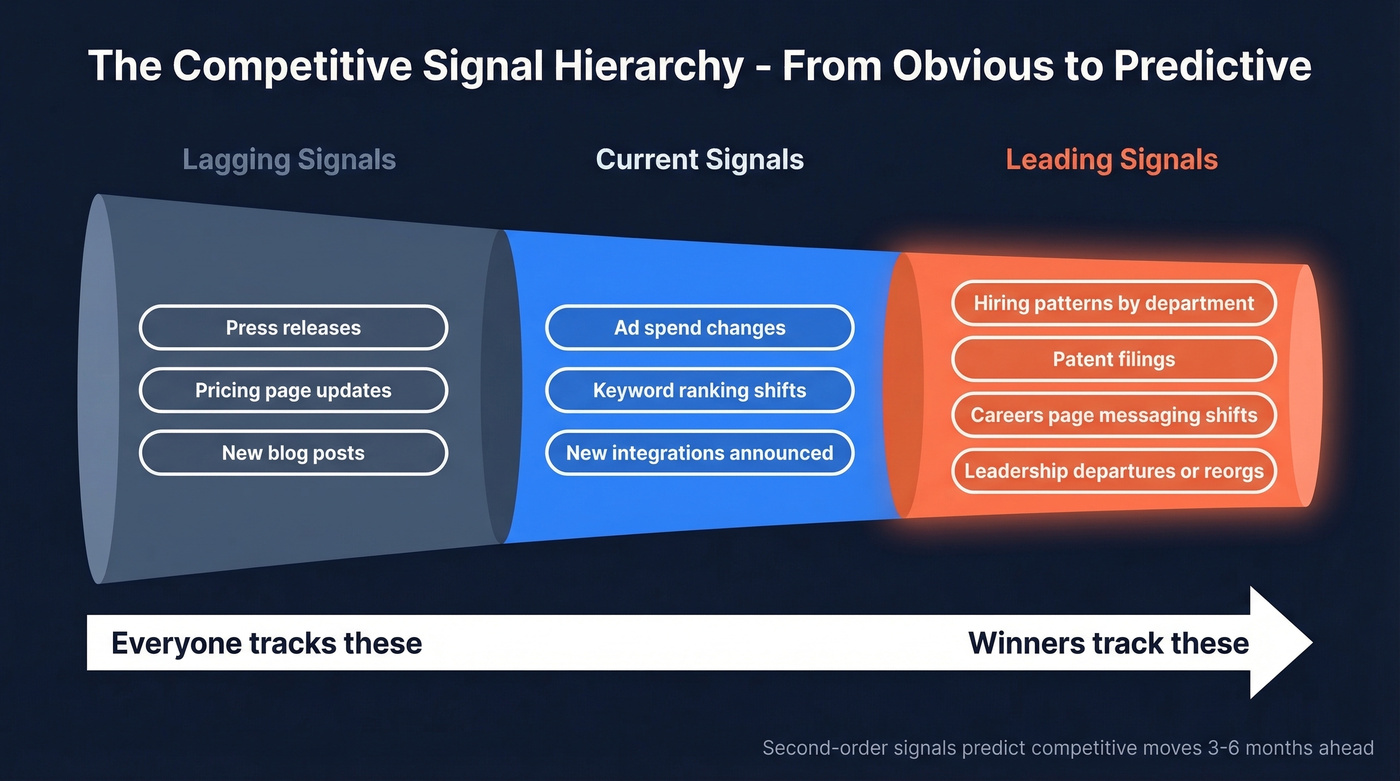
Most teams watch the obvious stuff - pricing pages and press releases - and miss the signals that predict competitive moves.
| Signal Type | What to Monitor | Cadence |
|---|---|---|
| Website & pricing | Pricing pages, feature pages, landing page copy | Daily |
| SEO & content | Keyword rankings, new blog posts, backlink campaigns | Weekly |
| Social & ads | Ad creative, social messaging, campaign launches | Weekly |
| Hiring signals | Job postings by department, seniority, location | Bi-weekly |
| Tech stack | New tools adopted, integrations announced | Monthly |
| Org changes | Leadership hires, departures, reorgs | Bi-weekly |
The real edge comes from second-order signals - what Octopus Intelligence calls "ripple effects." A competitor hiring five enterprise AEs in EMEA doesn't just mean they're growing. It means they're about to compete for your European accounts in six months. Patent filings, messaging shifts on their careers page, sudden changes in ad spend - these are leading indicators, not lagging ones. Track them or get surprised.
Five Mistakes That Kill Tracking Programs
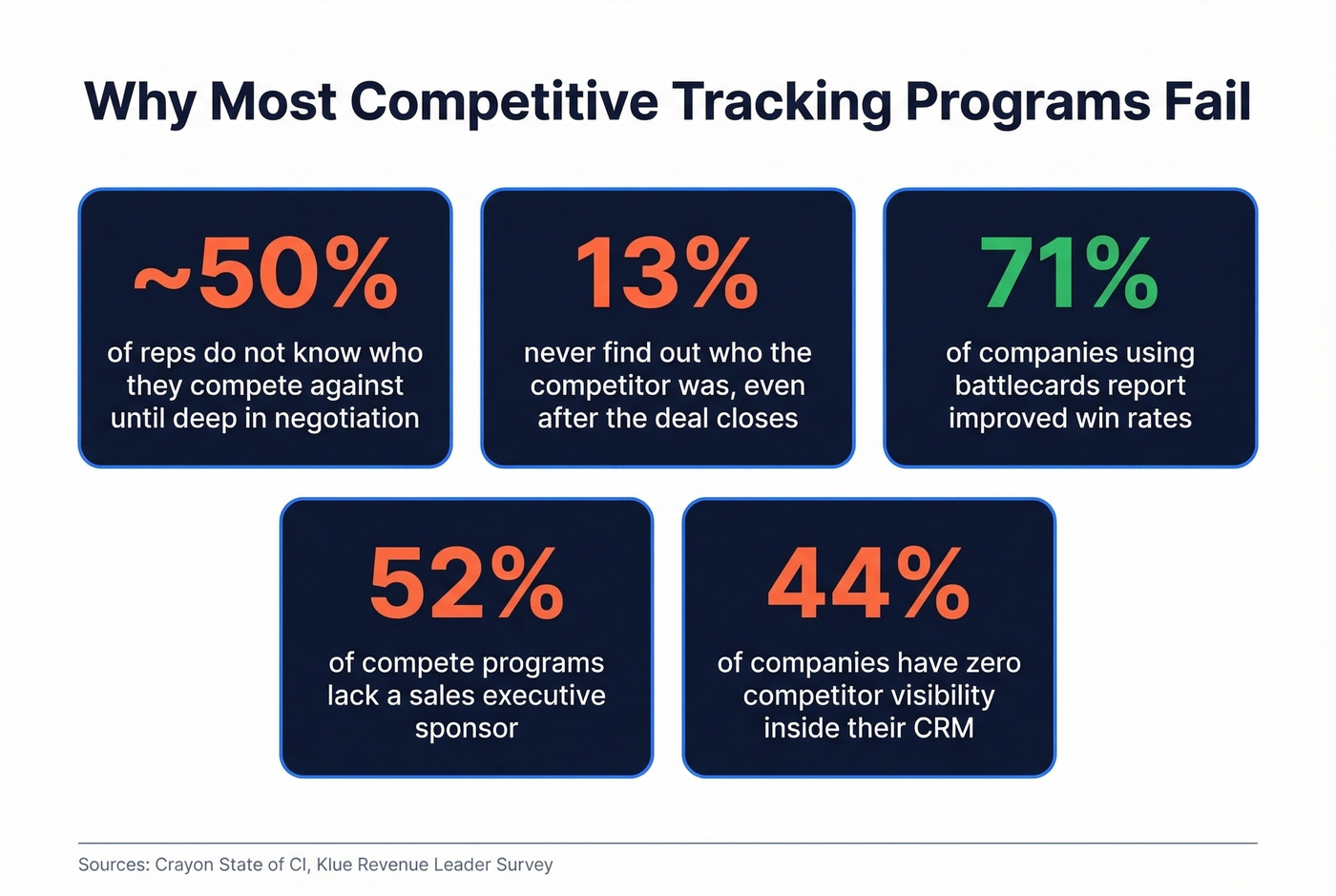
1. Generic battlecards. A Klue survey of 300+ revenue leaders found that nearly half of reps don't know who they're competing against until they're deep in negotiation. Thirteen percent never find out - even after the deal closes. Among companies using battlecards, 71% report improved win rates, but only when those battlecards are specific and actionable. If yours reads like a Wikipedia comparison table, reps won't touch it.
2. Scattered intel with no single source of truth. Competitive insights buried across Slack threads, Google Docs, and someone's Notion page aren't intelligence - they're noise. If a rep can't find the latest competitor positioning in under 30 seconds, the system has failed.
3. No executive sponsor. 52% of compete programs don't have a sales executive sponsor. Without one, monitoring competitors becomes a side project that dies the moment pipeline pressure hits. The programs that work have a VP of Sales or CRO who actively asks "what's the competitive landscape on this deal?" in forecast calls.
4. Metrics without meaning. Tracking a competitor's keyword rankings or ad spend is useless if you never ask why. A competitor slashing prices could signal desperation, a land-and-expand pivot, or a response to board pressure. The interpretation matters more than the data point. We've seen practitioners on r/sales try ChatGPT for competitor SWOT analysis and find the output generic - AI tools help synthesize, but they can't replace a structured workflow with human judgment.
5. Tracking without acting. 44% of companies lack competitor visibility within their CRM. That means even when someone spots a signal, there's no systematic way to identify which open deals are affected, update the relevant battlecard, and trigger outreach. Monitoring without an action workflow is just expensive voyeurism.

Spotted a competitor hiring five enterprise AEs in EMEA? Now find the accounts they're targeting. Prospeo's 30+ filters - including headcount growth, job changes, and intent data across 15,000 topics - turn competitive signals into prospect lists you can act on today.
Stop watching competitors win deals. Start reaching buyers before they do.
Best Competitive Tracking Tools in 2026
Enterprise CI Platforms
Klue
Use this if you have a dedicated compete team, a $20K+ annual budget, and reps who'll actually open battlecards in their workflow. Klue's G2 rating sits at 4.7/5 - the battlecard and win-loss capabilities are genuinely best-in-class, and CRM integrations help reps see competitive context without breaking their process.

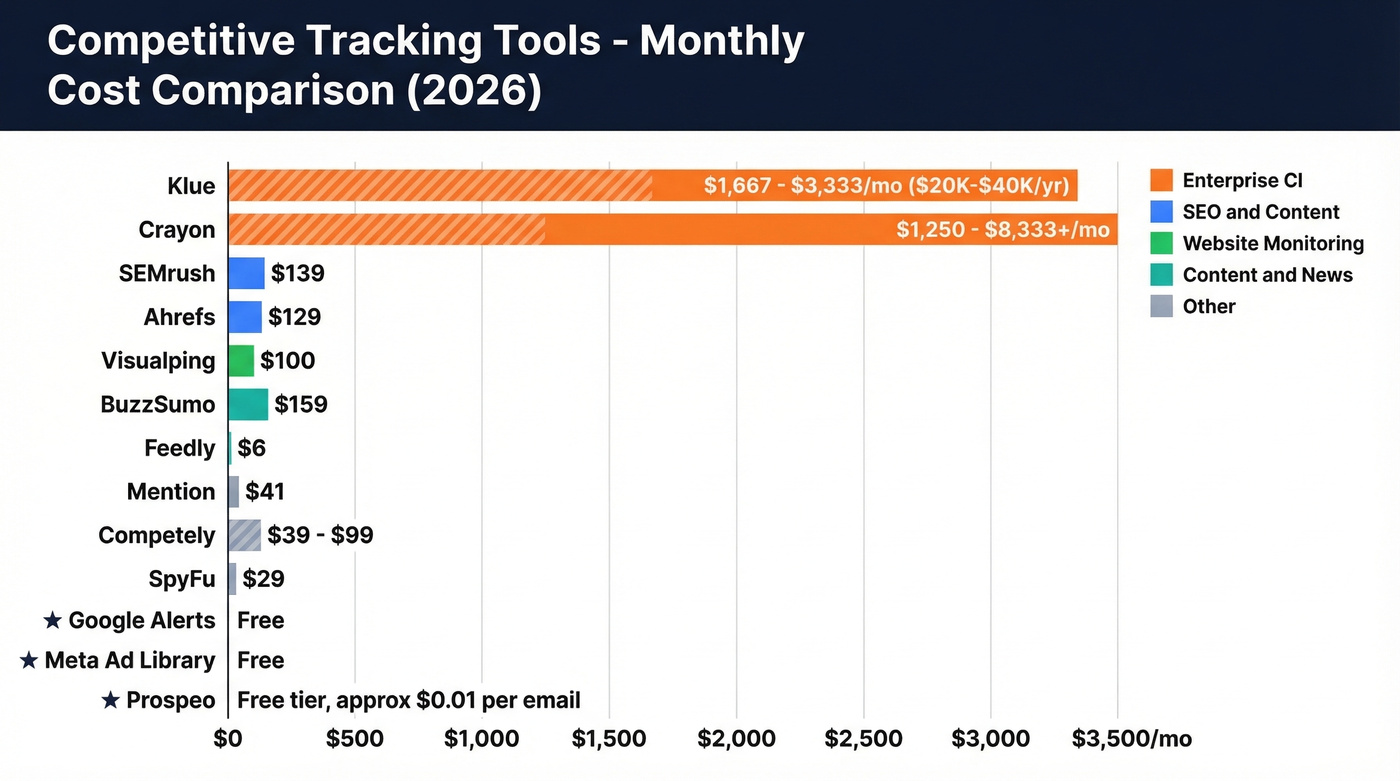
Klue offers four tiers - Plus, Starter, Pro, and Essentials - with typical mid-market contracts running $20,000-$40,000/year. Setup and certain integrations cost extra.
Skip this if you're a team of under 20 reps, don't have someone owning the compete program full-time, or your annual software budget for competitive tools is under $15K. We've seen smaller teams buy Klue, get excited for a month, then let it gather dust because nobody had time to maintain the battlecards.
Crayon
Use this if you want AI-powered monitoring that surfaces competitor changes automatically - website updates, messaging shifts - and you need the analytical layer to make sense of it all. Crayon's G2 rating is 4.6/5. Pricing is frustrating, though. Crayon doesn't publish rates, and you won't escape the demo call in under 45 minutes. Vendr's contract data puts the median annual contract at $28,750, ranging from $15,000 for small teams up to $100,000+ for enterprise deployments. For teams tracking dozens of rivals, Crayon's automated web scraping and AI summarization justify the spend.
Skip this if you need transparent, self-serve pricing or you're tracking fewer than three serious competitors.
Website & Pricing Monitoring
Visualping
Dead simple to set up. No technical expertise needed. G2 rates it 4.6/5 across 403 reviews, and email notifications include screenshots of exactly what changed. Three tiers: Free ($0, 5 pages daily), Personal ($10/mo, 25 pages), and Business ($100/mo with 5-minute intervals, API access, and Slack/Teams integration).
The downside is noise. Minor layout changes, cookie banner updates, and ad rotations all trigger alerts. As one G2 reviewer put it, "cheap usage is very limited" - useful features keep migrating to higher tiers. For competitor pricing monitoring specifically, Visualping is the most accessible option. Just don't expect it to replace a full CI platform.
SEO & Content Monitoring
SEMrush
SEMrush is the default competitive SEO tool. From $139/mo, you get competitor keyword tracking, backlink monitoring, content gap analysis, and ad research in one dashboard. We've used it to catch competitors quietly building content clusters around keywords we owned - the kind of signal that doesn't show up in Google Alerts but absolutely shows up in pipeline six months later.
The tradeoff: it's expensive if competitor monitoring is your only use case. If your marketing team already has a license, lean into the competitive features. If not, consider whether $1,700/year is justified for this alone.
Ahrefs
Ahrefs starts at $129/mo and arguably has the strongest backlink index in the industry. For primarily SEO-focused monitoring, Ahrefs edges out SEMrush on raw data depth. The interface is more analyst-friendly than marketer-friendly - teams that want dashboards prefer SEMrush, teams that want to dig prefer Ahrefs.
News Monitoring
Feedly
Starting at $6/mo, Feedly is the most cost-effective way to monitor competitor content, press coverage, and industry news at scale. The AI-powered topic tracking learns what matters to you and filters out noise. Integrates with Slack for piping competitor mentions into a dedicated channel. As the news layer of a competitive stack, nothing beats it at this price.
Quick Mentions
SpyFu (from $29/mo, billed annually) is purpose-built for PPC and keyword espionage - see competitor keyword bids and historical ad copy. BuzzSumo (from $159/mo) tracks which competitor content gets shared and by whom; great for content marketing teams, overkill for everyone else. Competely ($39-$99/mo) generates AI-powered competitor snapshots - promising concept, but with just one Product Hunt review and 444 followers, it's too early to bet on. Watch it, don't commit. Google Alerts is free and covers the bare minimum - news mentions and blog posts - but misses social, Reddit, and anything behind a paywall. It's a starting point, not a strategy. Mention (from $41/mo) handles social listening and brand monitoring solidly at a mid-tier price. Meta Ad Library is free and lets you see any competitor's active ads on Meta platforms - zero reason not to use it.
Pricing at a Glance
| Tool | Category | Starting Price | Best For |
|---|---|---|---|
| Klue | Enterprise CI | $20K-$40K/yr | Battlecards + win-loss |
| Crayon | Enterprise CI | $15K-$100K+/yr | AI-powered monitoring |
| Prospeo | Contact data | Free; ~$0.01/email | Signal-to-outreach action |
| Visualping | Website monitoring | Free; $10-$100/mo | Pricing page changes |
| SEMrush | SEO & content | $139/mo | Full competitive SEO |
| Ahrefs | SEO & content | $129/mo | Backlink-focused SEO |
| Feedly | News monitoring | $6/mo | Content + press tracking |
| SpyFu | PPC tracking | $29/mo (annual) | PPC keyword + ad copy intel |
| BuzzSumo | Content tracking | $159/mo | Social share analysis |
| Competely | AI snapshots | $39-$99/mo | Quick competitor briefs |
| Google Alerts | News monitoring | Free | Basic news mentions |
| Mention | Social listening | $41/mo | Brand monitoring |
Recommended Stacks by Budget
Bootstrap ($0-$50/mo): Google Alerts + Visualping free tier + Google Trends + Meta Ad Library. Total cost: $0. You'll cover news mentions, up to five competitor pages monitored daily, search trend shifts, and active ad creative. Limited, but infinitely better than nothing.
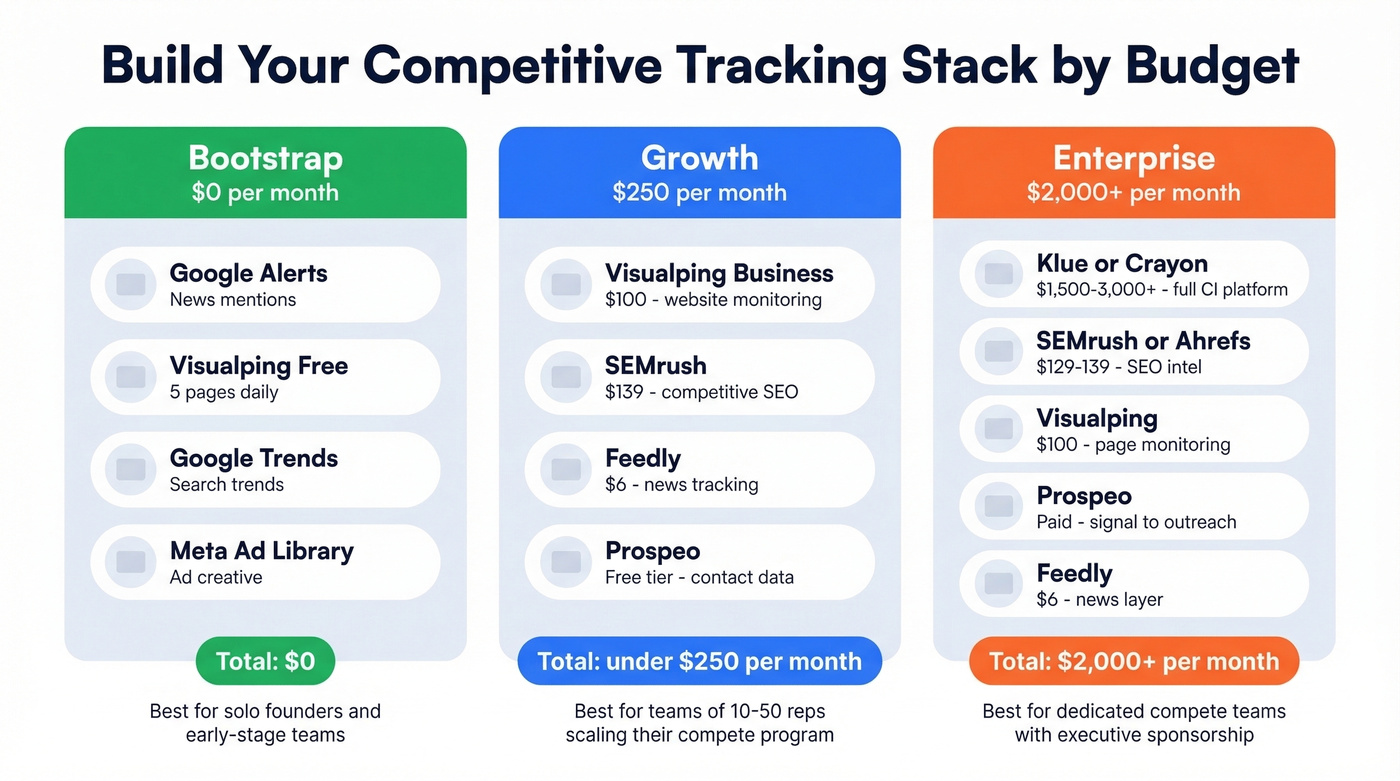
Growth ($100-$500/mo): Visualping Business ($100/mo) + SEMrush ($139) + Feedly ($6) + Prospeo (free tier or paid). Total: under $250/mo for website monitoring, competitive SEO, news tracking, and verified contact data. When monitoring surfaces a signal, Prospeo helps you find decision-makers at affected accounts - with 98% email accuracy and data refreshed every 7 days, you're not emailing ghosts. This is the sweet spot for most teams.
Enterprise ($20K+/yr): Klue or Crayon + SEMrush + Gong or Chorus for conversational intelligence. Companies using conversational intelligence tools for compete increase sales effectiveness by 82%. AI adoption in competitive intelligence has surged 76% year-over-year, with 60% of CI teams now using AI daily - the enterprise stack is becoming as much about synthesis as monitoring.
Here's the thing: most teams don't need the enterprise stack. If your average deal size is under $25K and you're competing in fewer than five deals per quarter, the growth stack will outperform a $40K Klue deployment that nobody maintains. The best compete program is the one your team actually uses.
How Real-Time Monitoring Changes Outcomes
Let's be honest about a scenario we've seen play out dozens of times. A team loses three deals to the same competitor in a quarter. They had the signals - the competitor launched a new pricing tier, hired an enterprise sales leader, started running aggressive comparison ads. But nobody connected those signals to the open pipeline. Nobody updated the battlecard. Nobody reached out to at-risk accounts proactively.
That gap between signal detection and outbound action is where competitive tracking programs die.
The workflow that works follows four steps: detect the signal, score its impact on your pipeline (which accounts are affected, how many open deals, what's the revenue at risk), act by enriching affected accounts with fresh contact data and launching targeted outreach within 48 hours, and log the outcome back into your CRM so you can measure what worked.
If you want to systematize the scoring and logging steps, start with B2B sales pipeline management and a simple weighted pipeline management model.
If you're in the 44% of companies without competitor visibility in your CRM, fix that before investing in any tool. The scoring step is what separates teams that react from teams that respond strategically. A competitor launching a free tier affects your SMB pipeline differently than your enterprise pipeline - treat them differently.
Speed matters. A competitive signal that's a week old is stale. Two weeks old? Useless. The teams that win compress the time between "we noticed something" and "we're in the prospect's inbox with a relevant message." Real-time monitoring - not weekly report reviews - is what separates the top quartile of compete programs from everyone else. Every 24 hours of delay should require acknowledgment from whoever owns the compete program, because if nobody's accountable, nobody acts.
If your next step is turning signals into lists and sequences, pair this with an ideal customer profile refresh, then build a repeatable sales outreach strategy and multichannel sales outreach cadence.
44% of companies lack competitor visibility in their CRM. Prospeo's native Salesforce and HubSpot integrations enrich every deal with 50+ data points - verified emails at 98% accuracy, direct dials, tech stack, and funding signals - so reps see the full competitive picture without leaving their workflow.
Turn competitive intel into pipeline for $0.01 per verified email.
FAQ
What is competitive tracking?
Competitive tracking is the systematic monitoring of competitor activities - pricing changes, product launches, hiring patterns, content strategies, and market positioning - to inform sales, marketing, and product decisions. It's about ongoing signal detection rather than one-off research, turning raw data into intelligence you can act on.
How often should you monitor competitors?
Website and pricing changes warrant daily automated checks. SEO and content shifts need weekly review. Hiring and org changes are best monitored bi-weekly. Strategic positioning deserves monthly deep dives. Automate high-frequency signals and reserve human analysis for interpretation.
What's the best free tool for tracking competitors?
Google Alerts + Meta Ad Library + Google Trends covers news, ads, and search trends for $0. Add Visualping's free tier for five competitor pages monitored daily. For contact enrichment when you spot a signal, Prospeo's free plan includes 75 email credits monthly - enough to act on early findings without spending a dollar.
How much do enterprise CI platforms cost?
Klue runs $20,000-$40,000/year for mid-market deployments. Crayon's median contract is $28,750/year, ranging from $15,000 to $100,000+ depending on competitors tracked, seats, and add-ons. Both require demos and annual commitments.
How do you act on competitive intelligence data?
Detect the signal, score its pipeline impact, enrich affected accounts with verified contact data, update your battlecard, and launch targeted outreach within 48 hours. Speed is the differentiator - stale signals don't win deals.