

Consultative Selling Is Very Prominent in These Industries and Sales Environments
If this question showed up on a quiz, here's your short answer: consultative selling is very prominent in B2B sales environments - specifically complex, high-value transactions with long sales cycles and multiple decision-makers. If you're a practitioner and not just a test-taker, keep reading for the full industry breakdown.
The Textbook Answer
Textbooks tie consultative selling to B2B contexts where deals are large, cycles are long, and buying committees run deep. Mack Hanan coined the term in 1970, and it became one of the dominant approaches as sales evolved past transactional pitching into relationship-driven partnerships. So if your exam asks "consultative selling is very prominent in ___," write "complex B2B sales environments" and move on.
But the real story is more interesting than the textbook version.
Why Complex B2B Sales Demand This Approach
This methodology isn't just prominent in B2B - it's practically required. Today's buyers are more informed, they demand tailored solutions, and they involve multiple decision-makers in every purchase. Feature-benefit pitching doesn't survive that gauntlet.
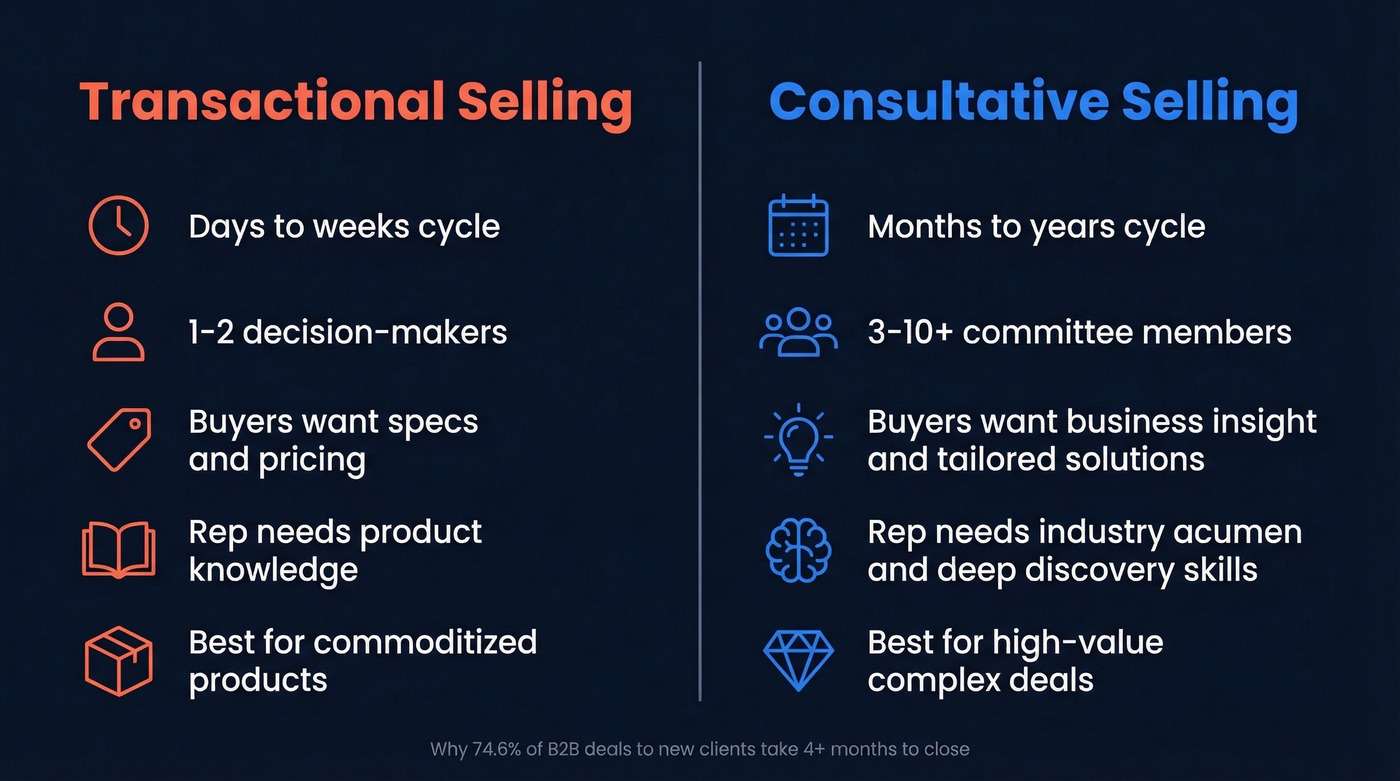
The numbers reinforce this. One dataset puts it at 74.6% of B2B sales to new clients taking at least 4 months to close. You can't sustain a four-month cycle by reading a spec sheet. You need to understand the buyer's business well enough to consult on it, which is exactly where transactional tactics fall apart and consultative selling takes over.
| Transactional Selling | Consultative Selling | |
|---|---|---|
| Cycle length | Days to weeks | Months to years |
| Decision-makers | 1-2 | 3-10+ (committee) |
| Buyer expectation | Product info, pricing | Business insight, tailored solutions |
| Rep skill | Product knowledge | Industry acumen + discovery |
| Best for | Commoditized products | High-value, complex deals |
That's why consultative selling dominates industries where the cost of a wrong purchase is high and procurement, technical evaluation, and executive sign-off all gate the deal.
Industries Where It Dominates
Enterprise SaaS and Technology
This is the big one. Evaluation cycles often run for months, involve IT, security, procurement, and line-of-business stakeholders, and frequently require integration scoping before anyone signs anything. A cybersecurity vendor selling to a CISO isn't closing on a single demo call - they're running proof-of-concept trials and building a business case across multiple stakeholders. We've seen SaaS deals with eight-person buying committees where the rep who won was the one who understood the prospect's tech stack before the first meeting even started.
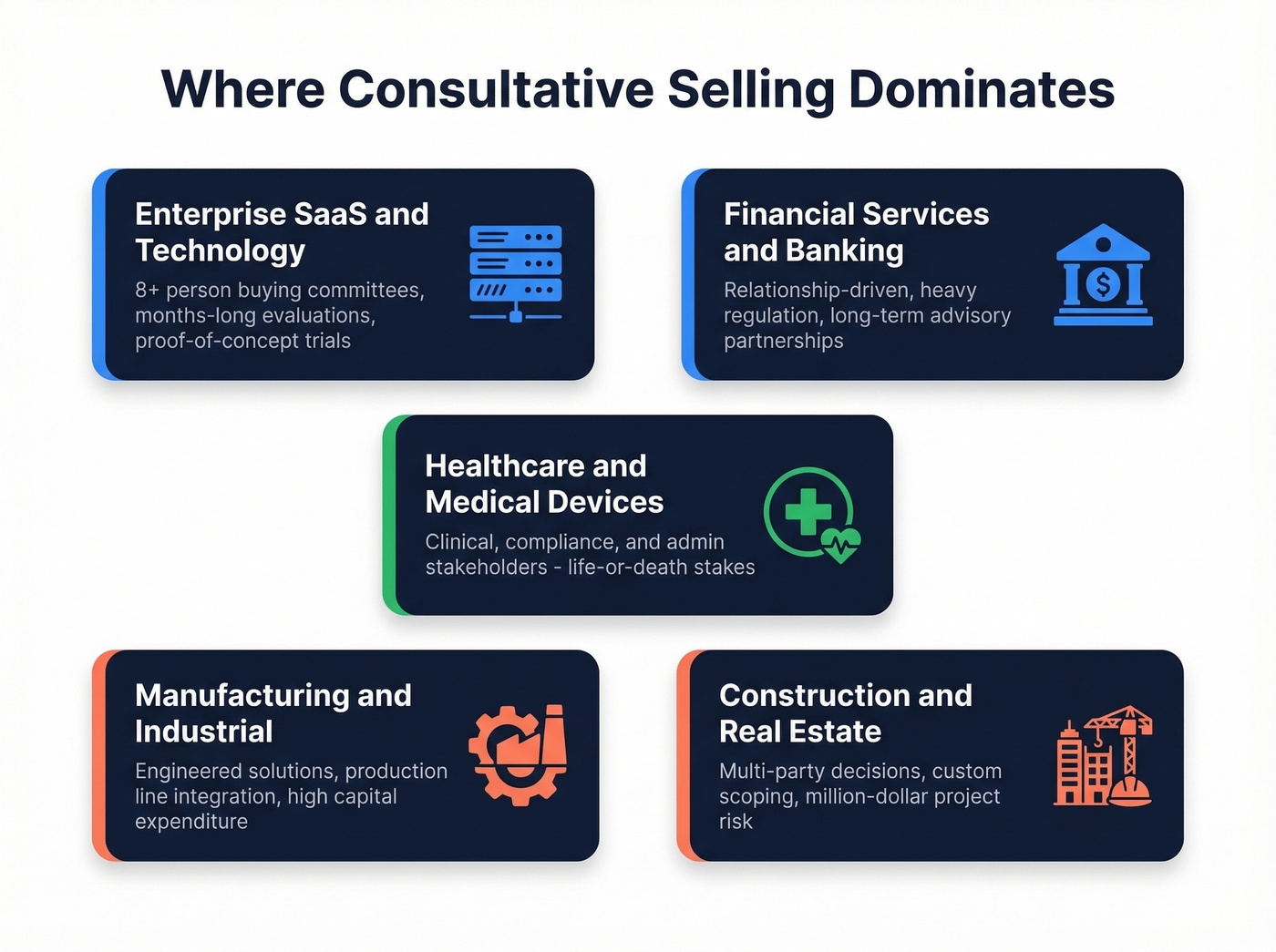
Financial Services and Banking
"I am in a banking role... our sales model is Consultative Selling."
- r/sales commenter
Banking and financial services roles are relationship-driven and operate in a regulatory environment that's too complex for transactional tactics. Skip this approach in banking and you won't last a quarter.
Healthcare and Medical Devices
Hospital buying decisions often involve clinical, compliance, and administrative stakeholders with competing priorities. Reps succeed by consulting on outcomes and fit, not reciting product specs. The stakes are too high - literally life and death in some cases - for a pitch-and-close approach.
Manufacturing and Industrial
When a manufacturer evaluates a high-value automation system, they need a seller who understands their production line, throughput targets, and integration constraints. These are engineered solutions, not catalog purchases.
Construction and Real Estate
Multi-party decisions, long timelines, and custom scoping define many deals here. Choosing the wrong construction supplier or commercial real estate partner can derail a project worth millions.

You can't consult on a business you don't understand. Prospeo surfaces buyer intent across 15,000 topics, maps buying committees with 30+ filters, and gives you verified emails and direct dials for every stakeholder - so your first call sounds like a tenth meeting.
Stop interrogating prospects. Start showing up prepared.
What Modern Research Actually Shows
Here's the thing: consultative selling works, but not the way most training programs teach it. RAIN Group studied over 700 B2B purchases across 42 factors that separate winners from second-place finishers. "Deepened my understanding of my needs" - the classic consultative move - ranked 40th out of 42.
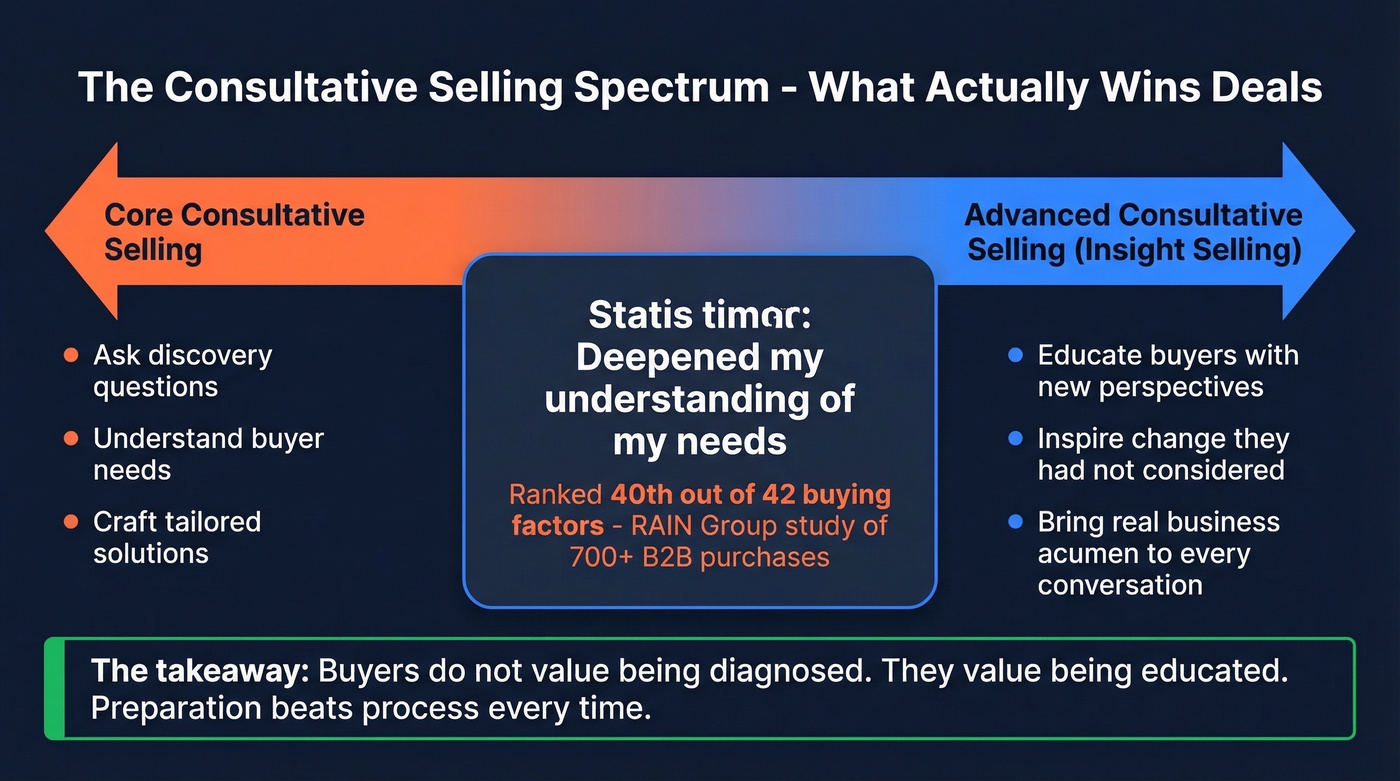
That doesn't mean discovery is useless. It means buyers don't value being "diagnosed" as much as being educated. In our experience, the reps who win consultative deals aren't the best questioners - they're the best-prepared.
RAIN Group draws a line between "core consultative selling" (understanding needs and crafting solutions) and "advanced consultative selling" (insight selling: inspiring buyers and driving change with ideas they hadn't considered). The modern version looks less like scripted discovery and more like bringing perspectives the buyer hasn't thought about yet, which requires real business acumen and not just a framework.
Let's be honest: most consultative selling training overinvests in questioning frameworks and underinvests in business acumen. A rep who deeply understands the buyer's P&L will always outperform a rep with a perfect discovery questions script.
The Biggest Pitfall: Scripted Discovery
Hanan himself warned about this decades ago. He saw sellers adopting the consultative label to gain access to senior decision-makers without actually performing as consultants. The fix isn't a better script - it's understanding the customer's business well enough to think like a manager inside their company, not a vendor reading from a playbook.
A rep on r/sales proved the point perfectly: after six hours of training, they tried the prescribed opener - "What's keeping you up at night?" - and the prospect responded, "Are you reading from a script?" Then hung up. We've all been on the receiving end of that call. Preparation beats process every single time.
How to Execute It Well
Consultative selling lives or dies in preparation. Here's what actually moves the needle:
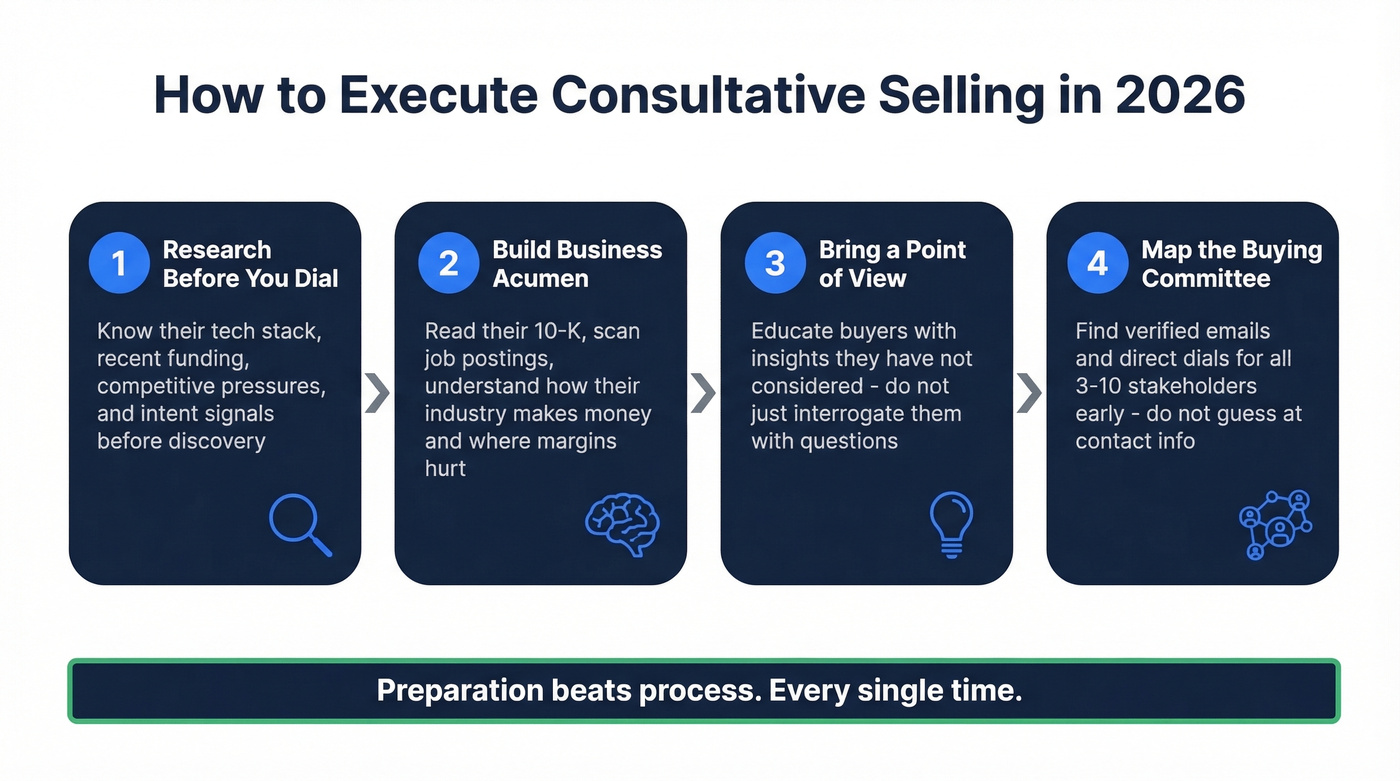
- Research before you dial. Know the prospect's company, tech stack, recent funding, and competitive pressures before discovery. Tools like Prospeo give you verified contact data plus intent signals across 15,000 topics, so every conversation starts informed rather than scripted.
- Build business acumen, not question lists. Understand how your prospect's industry makes money and where margins are under pressure. Read their 10-K. Scan their job postings. Know what they're hiring for.
- Bring a point of view. The RAIN Group data is clear - buyers value sellers who educate them, not sellers who interrogate them.
- Map the buying committee early. For deals with 3-10 stakeholders, you need verified emails and direct dials for each one. Guessing at contact info wastes the preparation you've already done.
If you're building a repeatable motion, it also helps to standardize your sales prospecting techniques and tighten your sales process optimization so reps can spend time preparing, not reinventing the wheel.
Consultative deals die when you can't reach the full committee. Prospeo delivers 98% accurate emails and 125M+ verified mobile numbers so you connect with every decision-maker - not just the one who answered your cold call.
Reach all 10 stakeholders, not just the gatekeeper.
FAQ
What's the textbook answer to "consultative selling is very prominent in"?
Consultative selling is very prominent in B2B sales environments involving complex, high-value, long-cycle transactions with multiple decision-makers. Textbooks typically frame this within the partnering era of sales - the shift from transactional pitching to solution-oriented advising that Mack Hanan popularized in 1970.
How is consultative selling different from transactional selling?
Transactional selling focuses on features, price, and closing quickly for commoditized products. The consultative approach focuses on understanding the buyer's business problems and acting as a trusted advisor. It takes more time per deal but wins larger, stickier contracts - typically six-figure-plus engagements with 3-10 stakeholders involved.
What tools help with consultative selling preparation?
CRM systems for tracking relationship history, intent data platforms for identifying in-market buyers, and contact data tools for finding verified emails and direct dials before discovery calls. The goal is walking into every conversation already knowing the prospect's situation so you can consult, not interrogate.