

Best Contact Data Providers for B2B Sales in 2026
Your SDR manager just showed you the bounce report - 18% of last week's campaign bounced. Domain reputation is tanking, reps are blaming the list, and the sequences everyone spent two weeks writing are going to waste. The tool isn't the problem. The data is.
A survey of 1,200+ sales professionals found that verified, recently refreshed data lifts cold email reply rates from 4.2% to 6.1% - same sequences, same CTAs, different data. That's a 45% improvement from fixing the inputs alone. And here's the stat that should bother you: 67% of contacted prospects have at least one stale data point in their record. The sales intelligence market hit $5.37B in 2026 and is on pace to reach $12.45B by 2034. Teams finally understand that business contact data quality is the foundation everything else sits on.
Here are the 12 providers worth evaluating, with real pricing, accuracy tradeoffs, and the three we'd trial first.
Our Picks (TL;DR)
| Provider | Email Accuracy | Mobile Numbers | Starting Price | Best For | Data Refresh |
|---|---|---|---|---|---|
| Prospeo | 98% | 125M+ verified | ~$0.01/email | Email accuracy, self-serve | 7 days |
| Apollo.io | ~85% (US) | Yes (credit-based) | Free-$119/user/mo | Free tier, US prospecting | ~30 days |
| Cognism | ~90% | Phone-verified (Diamond) | ~$15K-$100K+/yr | EMEA direct dials | ~30-90 days |
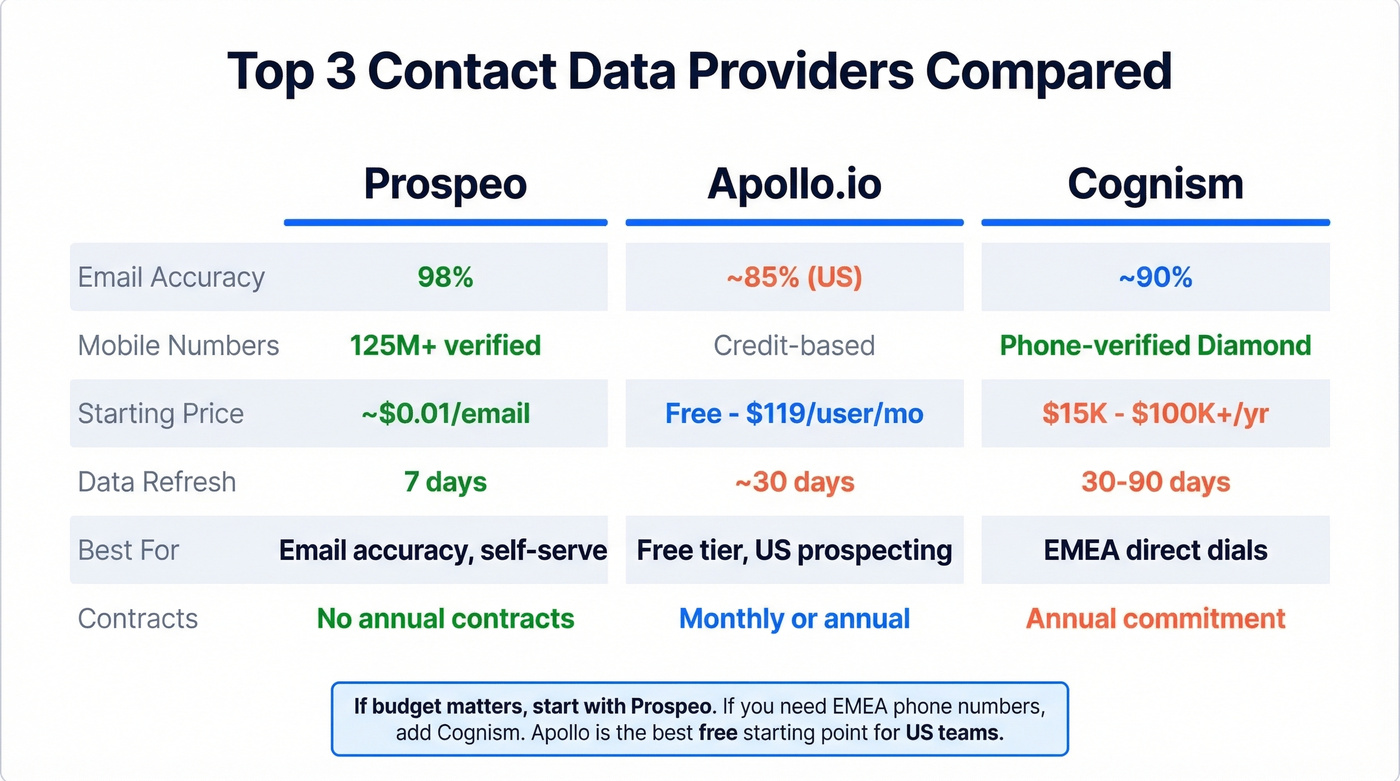
If you need enterprise-grade coverage and budget isn't a constraint, go with ZoomInfo. If budget matters at all, start with the three above.
How to Evaluate a Contact Data Provider
Database size is the most misleading metric in this category. 800M profiles means nothing if 28% of B2B contact data decays annually. Five criteria actually predict whether a sales intelligence platform will work for your team.
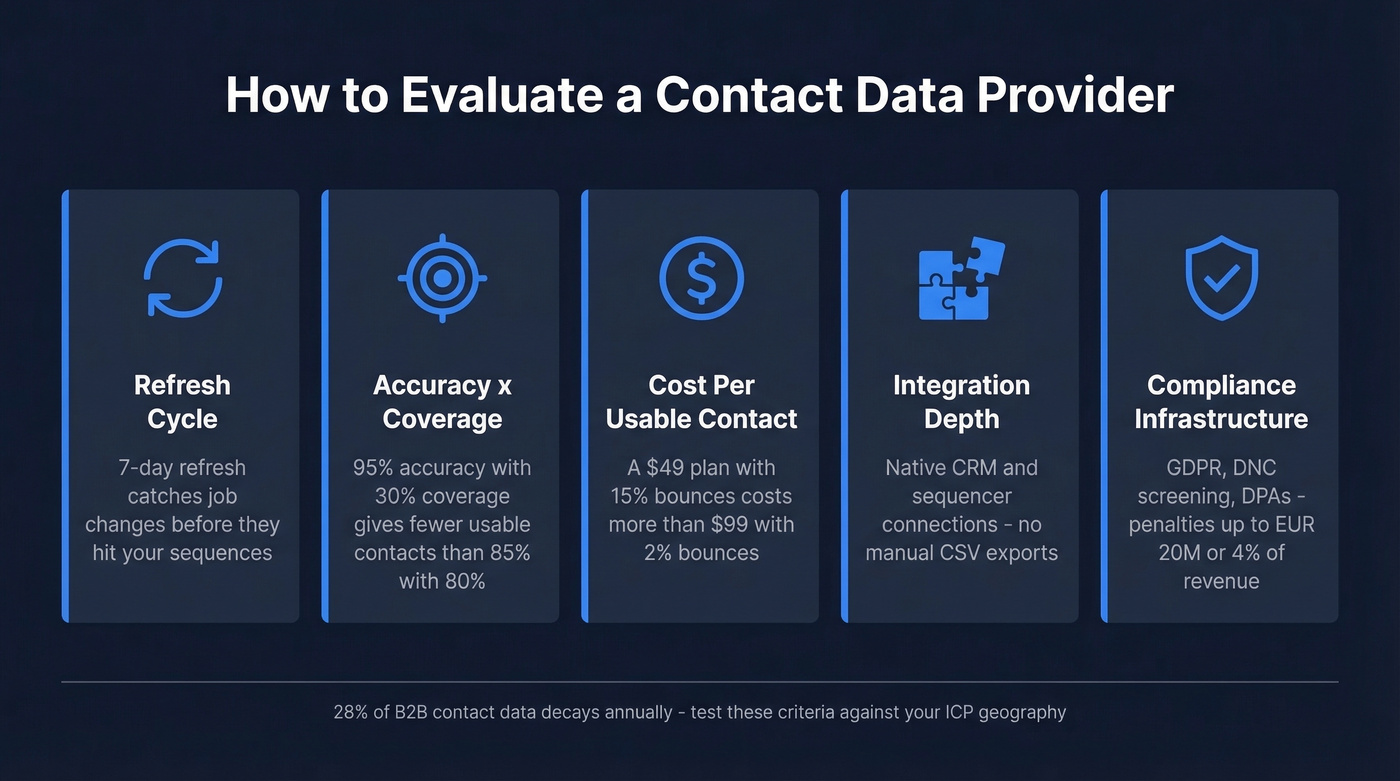
Refresh cycle. How often does the provider re-verify its records? A 7-day refresh catches job changes and bounced emails before they hit your sequences. Many providers refresh on a 4-6 week cycle, which means you're always working with stale edges.
Accuracy x coverage. A provider with 95% accuracy but 30% coverage gives you fewer usable contacts than one with 85% accuracy and 80% coverage. You need both numbers. Accuracy also varies dramatically by region - US data is often 10-20 points more accurate than EMEA or APAC across many providers, so always test against your specific ICP geography.
Cost per usable contact. Sticker price is meaningless. A $49/mo plan that bounces 15% of emails costs more per working contact than a $99/mo plan that bounces 2%. Always do the math on what you actually get to use.
Integration depth. Your contact database software needs to push clean B2B contact information into your CRM and sequencer without manual CSV exports. Salesforce, HubSpot, and at least one outreach tool - Outreach, Salesloft, Instantly, Lemlist - should be native.
Compliance infrastructure. GDPR applies based on where your prospect sits, not where you sit. Ask about DNC screening, Data Processing Agreements, and Standard Contractual Clauses for cross-border transfers. Penalties run up to EUR 20M or 4% of global turnover.
The 12 Best B2B Contact Data Providers
Prospeo
Use this if: You need the highest email accuracy in the category, a weekly data refresh, and transparent pricing with no contracts.
Prospeo's database covers 300M+ professional profiles, 143M+ verified emails, and 125M+ verified mobile numbers - all refreshed on a 7-day cycle. The 98% email accuracy comes from a proprietary 5-step verification process that includes catch-all handling, spam-trap removal, and honeypot filtering. We've tracked the results across customer case studies closely: Snyk's 50-person AE team saw bounce rates drop from 35-40% to under 5% after switching, Meritt tripled pipeline from $100K to $300K per week, and GreyScout saw pipeline increase 140% with bounce rates dropping from 38% to under 4%.

The 30+ search filters include Bombora intent data across 15,000 topics, technographics, job changes, headcount growth, and funding signals. The Chrome extension has 40K+ users and works on company websites and professional profiles for one-click prospecting. Native integrations cover Salesforce, HubSpot, Smartlead, Instantly, Lemlist, Outreach, Clay, Zapier, and Make.
Pricing starts with a free tier offering 75 emails and 100 Chrome credits per month. Paid plans run about $0.01 per email, 10 credits per mobile. No annual contracts, no sales calls, cancel anytime.
ZoomInfo
ZoomInfo is the default, not necessarily the best. Its 500M+ professional contacts and 100M+ company profiles make it the largest lead generation database in the category, and the platform's workflow features - intent data, chat, web forms, orchestration - run deep. If you're a 500-person sales org running outbound, ABM, and intent from one platform, ZoomInfo earns its price tag.
Here's the thing: most teams don't use half of what they're paying for.
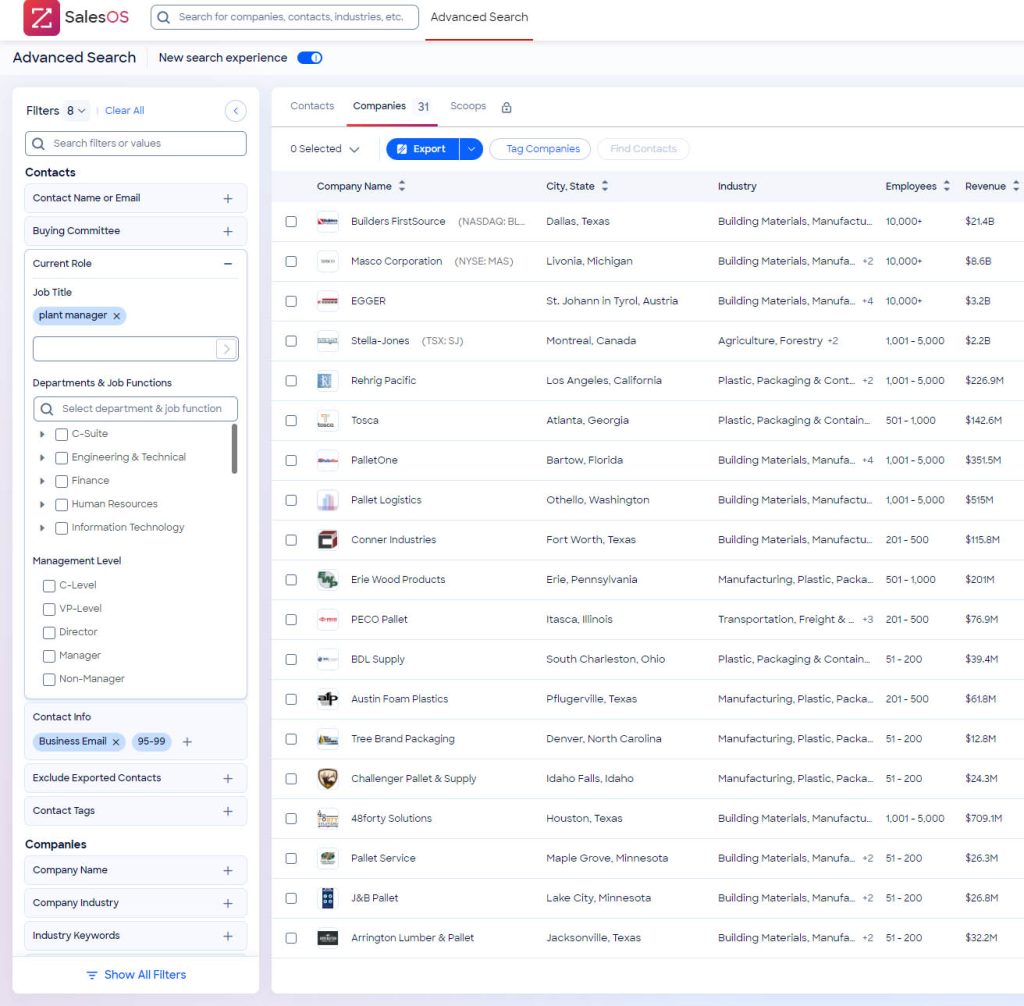
Pros: Deepest US database, broadest feature set, strong intent signals, mature integrations.
Cons: Professional runs $15K-$18K/year, Advanced $22K-$28K, Elite $35K-$45K+. Then add extra credits ($3K per 5K), NeverBounce verification ($3K), global data ($9,995), and additional seats ($1,500+/user/year). Most teams land at $40K-$50K/year after add-ons. Renewals climb 10-20%. Annual contracts only, with 60-90 day auto-renewal windows.
The cost per usable contact works out to roughly $0.80-$1.50. That math only makes sense if you're heavily using the platform features beyond the company and contact data itself.
Apollo.io
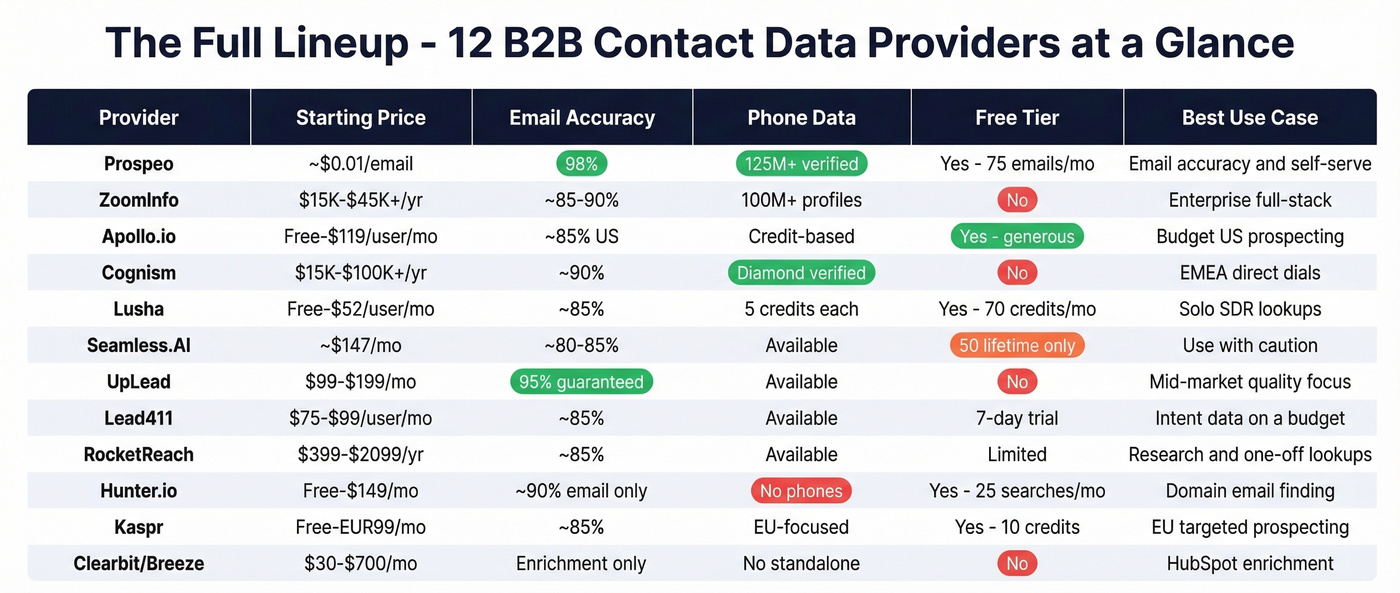
Apollo is the obvious starting point for budget-conscious, US-focused teams. The free tier is legitimately useful - you get access to the database, basic sequencing, and enough credits to validate whether the data works for your ICP before spending a dollar.
Pros: Free tier with real functionality. Paid plans at $49/$79/$119 per user/month (billed annually) are reasonable. Built-in sequencing is a genuine differentiator - you can prospect and send from one tool. G2 rating sits at 4.7/5.
Cons: Accuracy falls off a cliff outside the US. Testing shows international match rates around 68-74%, and phone coverage in EMEA is noticeably thinner. The sequencing engine, while convenient, doesn't match dedicated tools like Outreach or Salesloft for complex multi-step campaigns.
Where Apollo beats ZoomInfo: price-to-value for small teams, speed to first sequence, self-serve simplicity. Where ZoomInfo still wins: database depth at the enterprise level, intent data maturity, and workflow breadth.
Cognism
Use this if: Your team sells into the UK, DACH, or Nordics and needs phone-verified mobile numbers that actually connect.
Cognism's Diamond Data is the standout feature - human-verified mobile numbers with DNC screening baked in. For EMEA-focused outbound, no other vendor matches their phone verification depth in European markets. They also bundle Bombora intent data, which helps prioritize accounts showing buying signals.
Skip this if: You're US-only and budget-sensitive. Pricing runs roughly $15K platform fee plus $1,500/user/year on the Grow tier, scaling to $25K platform plus $2,500/user/year on Elevate. Typical contracts land between $15K and $100K+ annually, and they're annual commitments.
Where Cognism wins over ZoomInfo: EMEA compliance, mobile verification quality, DNC screening. Where ZoomInfo still wins: US database depth, platform feature breadth, and workflow automation.
Lusha
Lusha is Chrome-first and SMB-focused. Free tier gives you 70 credits/month, Pro runs $22.45/user/month, Premium $52.45/user/month on annual billing. Phone numbers cost 5 credits each, which means your credit balance drains fast if you're pulling mobiles. The interface is dead simple - install the extension, browse profiles, reveal contacts. For solo SDRs or small teams doing targeted lookups rather than bulk prospecting, it's a solid lightweight option. Watch the credit math carefully; what looks cheap per seat gets expensive per contact.
Seamless.AI
Seamless.AI's data can be useful, but the business practices are a problem. The free tier gives you 50 lifetime credits - barely enough to test. Basic runs ~$147/month on annual billing, Pro ranges $79-$299/user/month depending on seat count.
The bigger issue: cancellation and auto-renewal are the #1 complaint across Trustpilot, G2, and Capterra. The consensus on r/sales threads is pretty damning - people regularly warn others about getting locked into contracts they can't escape. We'd skip this one unless you're comfortable with aggressive auto-renewal terms. If you do sign up, cancel 30-60 days before renewal and get written confirmation.
UpLead
UpLead deserves credit for transparent pricing in a category that hides it. Essentials starts at $99/month for 170 credits, Plus at $199/month. They offer a 95% accuracy guarantee with credit refunds for bad data - one of the few providers willing to put money behind their accuracy claims. The database is smaller than ZoomInfo or Apollo, but data quality per contact tends to be higher. Strong mid-market option for teams that value predictability over scale.
Lead411
Lead411 bundles Bombora intent data into its plans, which is unusual at its price point. Basic runs ~$75-$99/user/month, with Pro/Enterprise packages at $3K-$6K/year. They offer a 7-day free trial - actually free, not "free with a credit card and auto-renewal." Solid for teams that want intent signals without paying Cognism or ZoomInfo prices.
RocketReach
Essentials at $399/year, Pro $899/year, Ultimate $2,099/year. Broad coverage across roles and industries, but better suited for one-off lookups than bulk prospecting workflows. Think of it as a research tool, not a pipeline engine.
Hunter.io
Free tier with 25 searches per month, Starter $49/month, Growth $149/month. Email-only - no phone numbers. Best for domain-level email finding and verification. If all you need is "find me every email at company.com," Hunter does that well and nothing more.
Kaspr
Free tier with 10 credits, Starter EUR 59/month, Business EUR 99/month. Europe-focused with a solid Chrome extension for quick lookups. Think of it as Lusha's European cousin - lightweight, credit-based, good for targeted prospecting in EU markets.
Clearbit (Breeze Intelligence)
Now folded into HubSpot as Breeze Intelligence. Credit packs run $30-$700/month. Best for HubSpot-native data enrichment workflows, not standalone prospecting. If you're already deep in HubSpot's ecosystem, it's a natural add-on. Otherwise, skip it.

You just read that 28% of B2B contact data decays annually. Prospeo refreshes every 7 days - not 4-6 weeks like most contact data providers. That's why teams like Snyk cut bounce rates from 35% to under 5%.
Stop paying for stale contacts. Start with 75 free verified emails.
Pricing Comparison
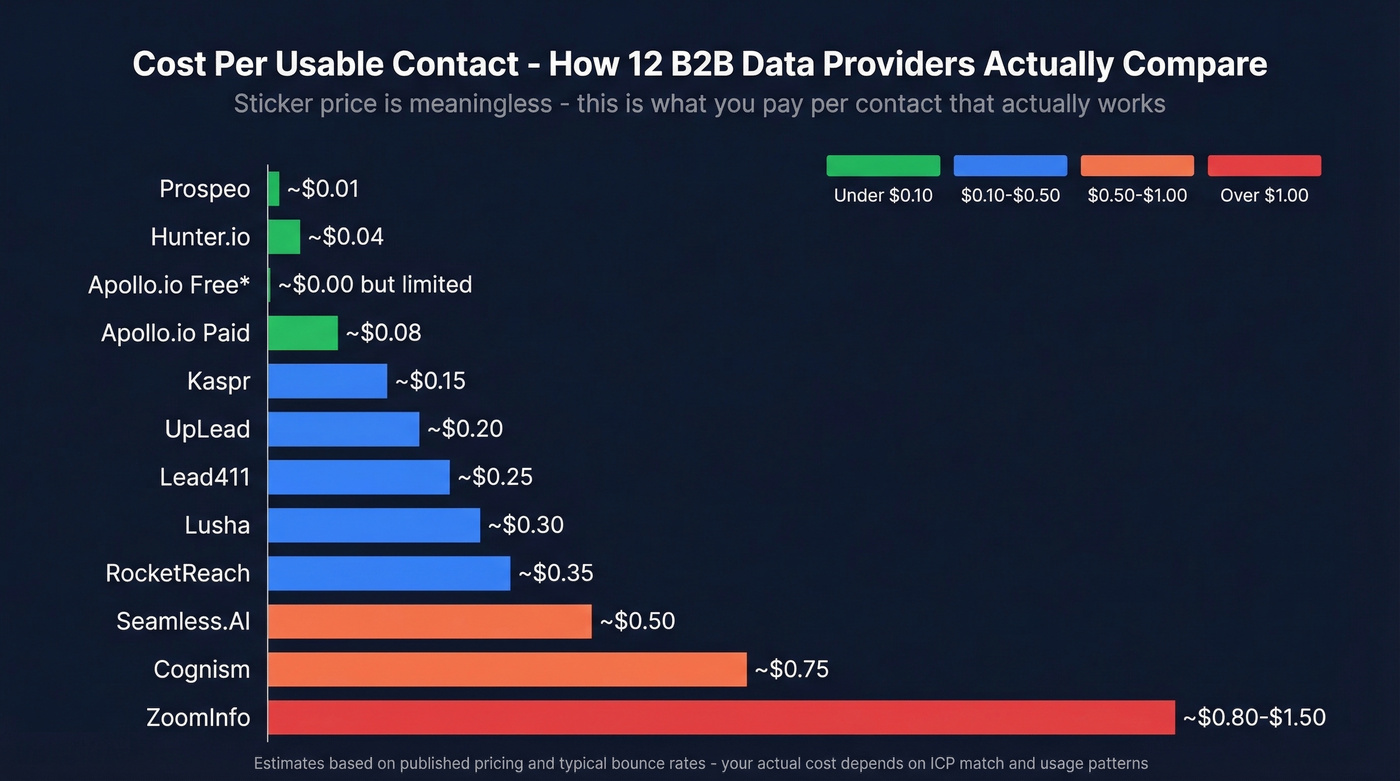
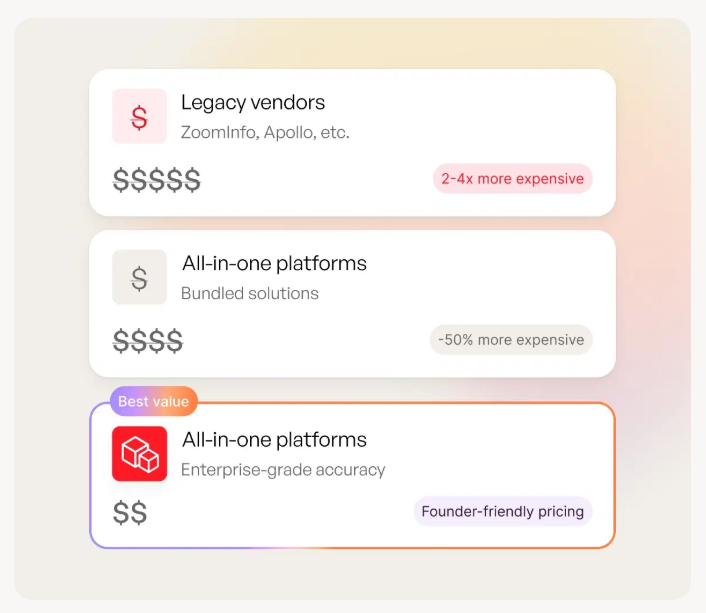
Sticker price is meaningless. Cost per usable contact is the only metric that matters.
| Tool | Starting Price | Credit Model | Contract | Est. Cost/Contact |
|---|---|---|---|---|
| Prospeo | Free; ~$0.01/email | Per-credit | None | ~$0.01 |
| Apollo.io | Free-$119/user/mo | Per-credit | Monthly/annual | ~$0.15-$0.30 |
| Lusha | Free-$52.45/user/mo | Per-credit | Monthly/annual | ~$0.20-$0.50 |
| Hunter.io | Free-$149/mo | Per-credit | Monthly/annual | ~$0.15-$0.40 |
| Kaspr | Free-EUR 99/mo | Per-credit | Monthly/annual | ~$0.20-$0.50 |
| UpLead | $99/mo | Per-credit | Monthly/annual | ~$0.30-$0.60 |
| Lead411 | ~$75/user/mo | Per-credit | Annual | ~$0.25-$0.50 |
| RocketReach | $399/yr | Per-credit | Annual | ~$0.30-$0.60 |
| Seamless.AI | ~$147/mo | Per-credit | Annual | ~$0.40-$0.80 |
| Clearbit | $30-$700/mo | Credit packs | Monthly | ~$0.50-$2.00 |
| Cognism | ~$15K/yr | Platform + seat | Annual | ~$0.50-$1.00 |
| ZoomInfo | ~$15K-$45K+/yr | Platform + seat | Annual | ~$0.80-$1.50 |
Phone Accuracy Benchmarks
A Salesfinity benchmark tested 307 verified contacts across 9 providers-accuracy-coverage-real-results) and found accuracy ranging from 63% to 91%, with coverage spanning 26% to 92%. The variance is enormous.
The metric that matters isn't accuracy or coverage alone - it's accuracy multiplied by coverage. A provider hitting 91% accuracy on 30% of your list gives you fewer usable dials than one hitting 80% accuracy on 75% of your list. This is why waterfall enrichment exists: run your list through Provider A first, then pass unmatched contacts through Provider B. Tools like Clay and BetterContact automate this workflow so you're not doing it manually.
Look, if your average deal size is under $10K, you probably don't need ZoomInfo-level data. A self-serve provider at $0.01/contact paired with a waterfall enrichment tool will get you 90% of the results at 5% of the cost. Save the enterprise budget for when you actually have enterprise deal sizes.
Compliance Isn't a Checkbox
GDPR applies based on where your prospect sits, not where your company is headquartered. A US-based SDR emailing a VP in Munich is subject to GDPR. Professional email addresses count as personal data when they identify an individual. One company was fined EUR 85,000 simply for lacking lawful basis documentation for their outreach data.
The good news: cold B2B outreach can rely on legitimate interest rather than explicit consent. But you need documentation - a legitimate interest assessment, opt-out handling, and a suppression list. Penalties reach EUR 20M or 4% of global turnover.
Before signing with any provider, confirm four things: DNC registry screening, a Data Processing Agreement, Standard Contractual Clauses for cross-border transfers, and clear opt-out and suppression list handling. Compliance is ultimately your responsibility, not your vendor's.
How to Choose the Right Provider
You don't need 12 providers. You need 2-3, max.
Budget-conscious, US-focused: Start with Apollo's free tier for prospecting and sequencing. Layer in email verification before you send - bad emails will tank your sequences regardless of which database you pick.
EMEA phone-heavy: Cognism. Their Diamond Data and DNC screening are unmatched for European direct dials. Pair with a verification layer for emails and you've got both channels covered.
ABM/intent-first: Lead411 bundles Bombora intent at a fraction of ZoomInfo's price. For teams running account-based plays that need buying signals without a $40K platform commitment, start here.
Enterprise, unlimited budget: ZoomInfo gives you the deepest platform with intent, orchestration, and the largest US database. Go in with eyes open on the total cost - and actually use the features you're paying for.
Accuracy-first, no contracts: Prospeo. 98% email accuracy, 7-day refresh, transparent credit pricing, and a free tier to start today. In our experience, this is the path for teams that have been burned by bounced emails and stale data.
Let's be honest about the contrarian take here: pick one primary database, one verification layer, and maybe one intent source. Anything more adds complexity without proportional value.
The best contact data provider isn't the biggest - it's the most accurate. Prospeo delivers 98% email accuracy at $0.01/email with 300M+ profiles, 125M+ verified mobiles, and zero annual contracts.
Compare that to $1/lead at ZoomInfo. Same team, 90% less spend.
FAQ
What is a contact data provider?
A contact data provider is a platform that supplies verified business contact information - emails, phone numbers, job titles, and company data - for sales prospecting and outreach. These platforms maintain large databases of professional profiles and use verification processes to keep records current and deliverable.
How accurate are B2B contact databases?
Phone number accuracy ranges from 63% to 91% based on independent benchmarks, and email bounce rates range from under 2% with top-tier verified providers to 15%+ with unverified sources. Always run a test batch against your ICP before committing annual budget. Prospeo delivers 98% email accuracy; most competitors land between 79% and 90%.
How much does a contact data provider cost?
Pricing spans from free tiers to $50,000+/year for enterprise platforms like ZoomInfo. Cost per usable contact ranges from $0.01 at the self-serve end to $1.50+ at the enterprise end. Focus on cost per verified contact, not sticker price - a cheap plan with high bounce rates costs more than it looks.
Do I need multiple data providers?
For most teams, 2-3 providers is the sweet spot. One primary database for email and phone, one verification layer, and optionally one intent data source. Waterfall enrichment across providers improves coverage but adds workflow complexity - tools like Clay automate the process.
Are contact data providers GDPR compliant?
A vendor's compliance doesn't automatically make your outreach compliant. You need legitimate interest documentation, opt-out handling, suppression list management, and a provider that offers DPAs and DNC screening. GDPR applies based on prospect location, not yours - penalties reach EUR 20M or 4% of global turnover.