

The Best Conversational Intelligence Software for Sales Teams in 2026
Most CI guides are written by CI vendors selling their own platform. We're a data company - not a CI tool - so we've got no horse in this race. Here are 12 conversational intelligence software tools worth evaluating, what they actually cost, and the upstream problem most of them ignore.
What Is Conversation Intelligence Software?
Conversational intelligence software records, transcribes, and analyzes sales or support conversations using NLP and speech analytics. The output: coaching insights, deal risk signals, and performance patterns across your team. It's a $27.4 billion market in 2026, growing at 8.2% CAGR - real budget is flowing here.
The ROI data backs up the spend. Teams using conversation intelligence report 15% higher win rates and a 90% reduction in manual documentation time. But here's the gap most buyers miss: enterprises capture less than 30% of their conversation data. The tools work - when they have enough conversations to analyze.
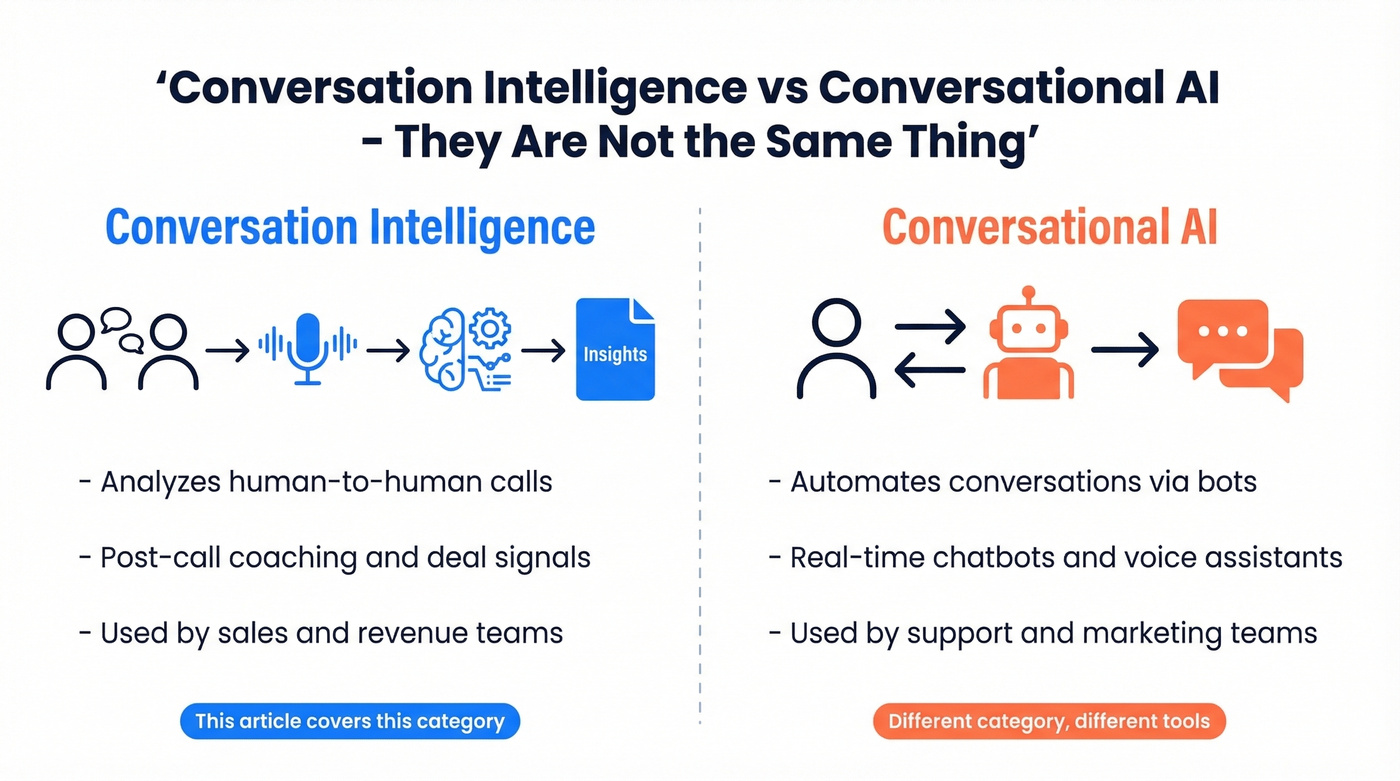
One distinction worth nailing down early. Conversation intelligence and conversational AI aren't the same thing. Conversation intelligence analyzes human-to-human conversations after they happen. Conversational AI conducts automated conversations via chatbots or voice assistants. One analyzes. The other interacts. This article covers the analysis side - the tools that help revenue teams understand why deals are won or lost.
Quick distinction: Conversation intelligence = analyzes your calls. Conversational AI = chatbots and voice assistants. Different category, different tools, different budget line.
Our Picks (TL;DR)
| Tool | Best For | Starting Price | Our Take |
|---|---|---|---|
| Fathom | Free CI to evaluate | Free | Best free tier, period |
| Avoma | Mid-market teams | $29/user/mo | Best value for CI |
| Gong | Enterprise (50+ reps) | ~$1,600/user/yr + fees | Category leader pricing |
| Chorus | ZoomInfo customers | $8K/yr base + seats | The bundle play |
| Salesloft | Existing Salesloft users | Custom (~$100-$150/user/mo) | CI as feature, not product |
| Claap | Remote-first teams | Free / $25/user/mo | Lightweight + transparent |
| Clari Copilot | Revenue forecasting | Custom pricing | Pipeline-focused CI |
| CallMiner | Contact centers (60+) | ~$50K-$150K+/yr | Enterprise QA/compliance |
| Jiminny | Coaching-first teams | From ~$20/user/mo | Solid mid-tier option |
| Fireflies.ai | Budget transcription | Free / $18/user/mo | Broad but clunky |
| Observe.AI | Contact center AI | ~$30K-$100K+/yr | Real-time agent assist |
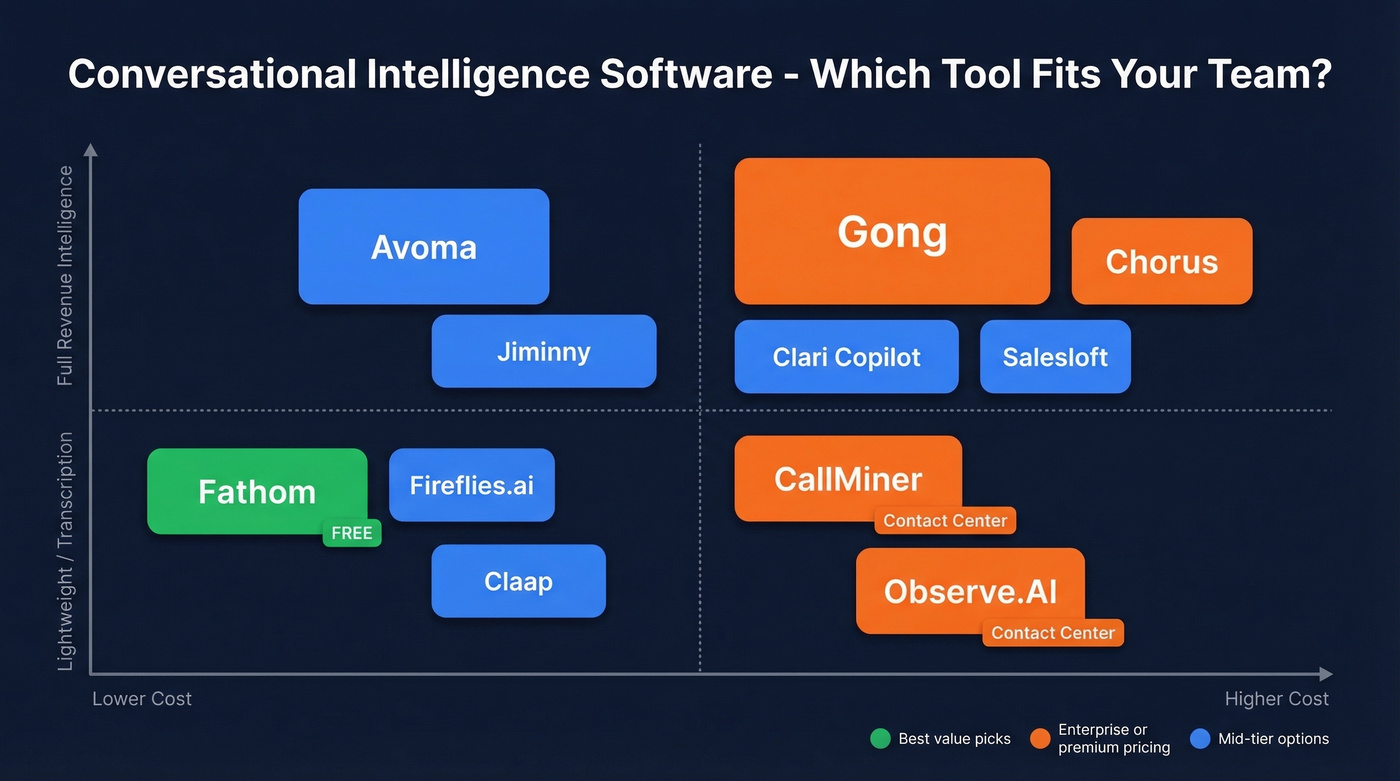
Top CI Tools Reviewed
Gong - The Enterprise Standard
Gong is the category leader. It's also one of the most expensive tools on this list, and the contract structure creates real lock-in.
Pros:
- Strongest deal intelligence and coaching workflows on the market
- Deep CRM integration and pipeline visibility
- Massive ecosystem of integrations and trained RevOps talent
Cons:
- Three-part pricing model is brutal: platform fee ($5K-$50K/yr) + per-user license ($1,360-$1,600/user/yr) + mandatory professional services ($7,500-$28,500+)
- 2-3 year contracts with annual prepayment are standard, and a 5-15% renewal uplift is common
- First-year spend often runs 40-60% above the initial seat math once fees and services land
Gong restructured its pricing in early 2025 with a $50K platform fee for the Foundations tier. For a 25-user team, expect $90K-$120K+ in year one. Negotiated per-user rates can drop to $1,000-$1,349 with leverage, but the platform fee and services still add up. Add-ons like Gong Forecast ($700/user/yr) and Gong Engage ($800/user/yr) push costs higher. Sticker shock is common - even among teams that love the product.
For 50+ rep teams with dedicated RevOps and a coaching culture, Gong earns its price. For everyone else, keep reading.

Fathom - Best Free CI Tool
If you're evaluating CI tools for the first time, start here. Fathom costs nothing, it works, and it'll teach your team the habit of reviewing calls before you commit $50K+ to an enterprise platform.
Fathom offers unlimited free recording, storage, and transcription - no minutes cap, no meeting limit. The consensus on r/sales is that it's a "shockingly good free plan." AI-generated summaries and action items genuinely save time, and the interface stays focused instead of trying to be a full revenue platform.
The trade-offs are minor. The meeting bot notification can be disruptive - multiple users flag it as "loud." Timestamps drift slightly on longer calls. Team features and advanced analytics sit on paid plans starting at $15/user/mo. But the free plan is genuinely sufficient for individual reps and small teams looking to build the call-review muscle.
Avoma - Best Mid-Market Value
For mid-market teams (10-50 reps) that want real CI without Gong's pricing complexity, Avoma is the obvious pick.
Transparent pricing at $29/user/mo (billed annually) for the CI add-on - no "talk to sales" gate. The platform covers the full meeting lifecycle from scheduling through follow-up, with deal intelligence, coaching scorecards, and pipeline analytics built in. Self-serve onboarding means you don't need a dedicated RevOps person to get value in week one. Reddit threads mention it's "not cheap" for solo users and potentially overkill if you just need transcription, but the price-to-value ratio is the best we've seen in the conversation intelligence sales category.

Chorus (ZoomInfo) - The Bundle Play
Use this if: You're already a ZoomInfo customer and can negotiate Chorus into your existing contract. A Chorus + ZoomInfo Professional bundle runs $35K-$50K/yr for 10 users. The marginal cost of adding Chorus drops significantly when you're already paying for ZoomInfo data.
Skip this if: You're evaluating Chorus standalone. At $8K/yr base (3 seats) + $1,200/seat/yr, 10 users costs ~$16,400/yr - not terrible, but you're typically locked into 2-year contracts and bundling pressure is real at renewal. Chorus is a ZoomInfo upsell, and the standalone experience reflects that.
SalesLoft - CI as a Platform Feature
Salesloft doesn't sell CI as a standalone product. It's a feature embedded in their sales enablement platform with custom pricing (typically ~$100-$150/user/mo for the full suite). Teams already living in Salesloft for sequences and cadences get built-in conversation intelligence with no extra vendor and no extra integration.
But buying Salesloft just for CI means overpaying for functionality you won't use. The CI capabilities are solid but not as deep as Gong or Avoma's dedicated offerings.
Claap - Lightweight and Transparent
Use this if: You're a remote-first team that values async video review alongside call analysis. Claap's hybrid approach - part meeting recorder, part async video platform - works well for distributed teams. The free plan includes up to 10 recordings/month. Pro starts at $25/user/mo, Business at $50/user/mo. Pricing is published and straightforward.
Skip this if: You need deep deal intelligence or pipeline analytics. Claap is a lightweight CI tool, not a revenue intelligence platform. Great for recording and reviewing; limited for coaching workflows at scale.
Clari Copilot vs. Jiminny: Two Mid-Tier Paths
These two tools occupy similar "mid-market CI" territory but solve different problems.
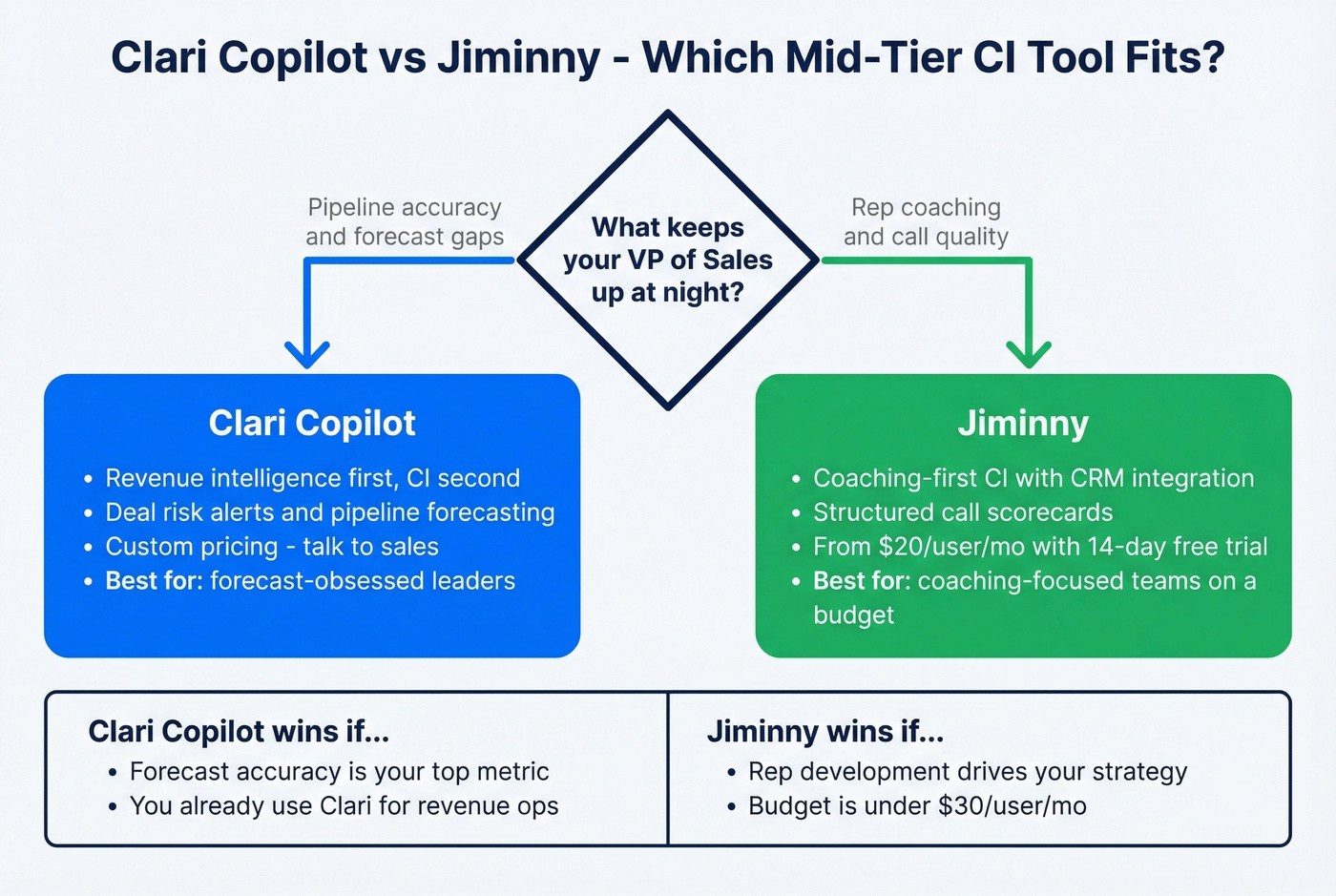
Clari Copilot (custom pricing) approaches CI from the revenue intelligence side. Instead of leading with call coaching, it leads with deal risk alerts and pipeline forecasting - then layers in conversation coaching as a supporting feature. If your VP of Sales loses sleep over pipeline coverage ratios, Clari Copilot speaks their language.
Jiminny (from ~$20/user/mo, billed annually, with a 14-day free trial) focuses on coaching-first CI with tight CRM integration. Not the deepest feature set, but the price-to-value ratio is strong for teams that want structured call coaching without the complexity or cost of Gong.
Pick Clari Copilot if forecast accuracy matters more than rep development. Pick Jiminny if coaching is the priority and budget is tight.
CallMiner - Contact Center CI
CallMiner isn't a sales CI tool. It's an enterprise contact center analytics platform targeting teams of 60+ agents. The platform analyzes calls, chat, email, and social interactions for compliance, QA, and agent coaching at scale. Pricing is packaged based on agent count and interaction volume - expect mid-five to six figures annually. For a 200-agent support center needing omnichannel conversation analytics with compliance scoring, CallMiner is built for exactly that. For a 15-person sales team, look elsewhere.
Fireflies.ai - Budget Transcription
Free plan available, paid plans start at $18/user/mo. Fireflies excels at searchable meeting databases with broad platform support. The Reddit consensus: useful features, clunky UI, and processing slows on longer meetings. A budget-friendly transcription tool, not a full CI platform. Worth mentioning: tl;dv occupies a similar space with a cleaner interface and generous free tier - worth evaluating alongside Fireflies if lightweight meeting intelligence is your goal.
Observe.AI - Contact Center Agent Assist
Enterprise contact center CI with real-time agent assist capabilities. Custom pricing based on agent count - typically $30K-$100K+/yr. Competes with CallMiner in the contact center space, with a stronger emphasis on real-time coaching during live interactions rather than post-call analytics.

Conversation intelligence only works when reps are actually talking to the right people. If your team captures less than 30% of conversation data, the fix isn't a better CI tool - it's more conversations with verified buyers. Prospeo's 300M+ profiles with 98% email accuracy and 125M+ verified mobiles mean your reps fill the pipeline CI tools need to deliver ROI.
More real conversations in. Better intelligence out.
The Pricing Reality Check
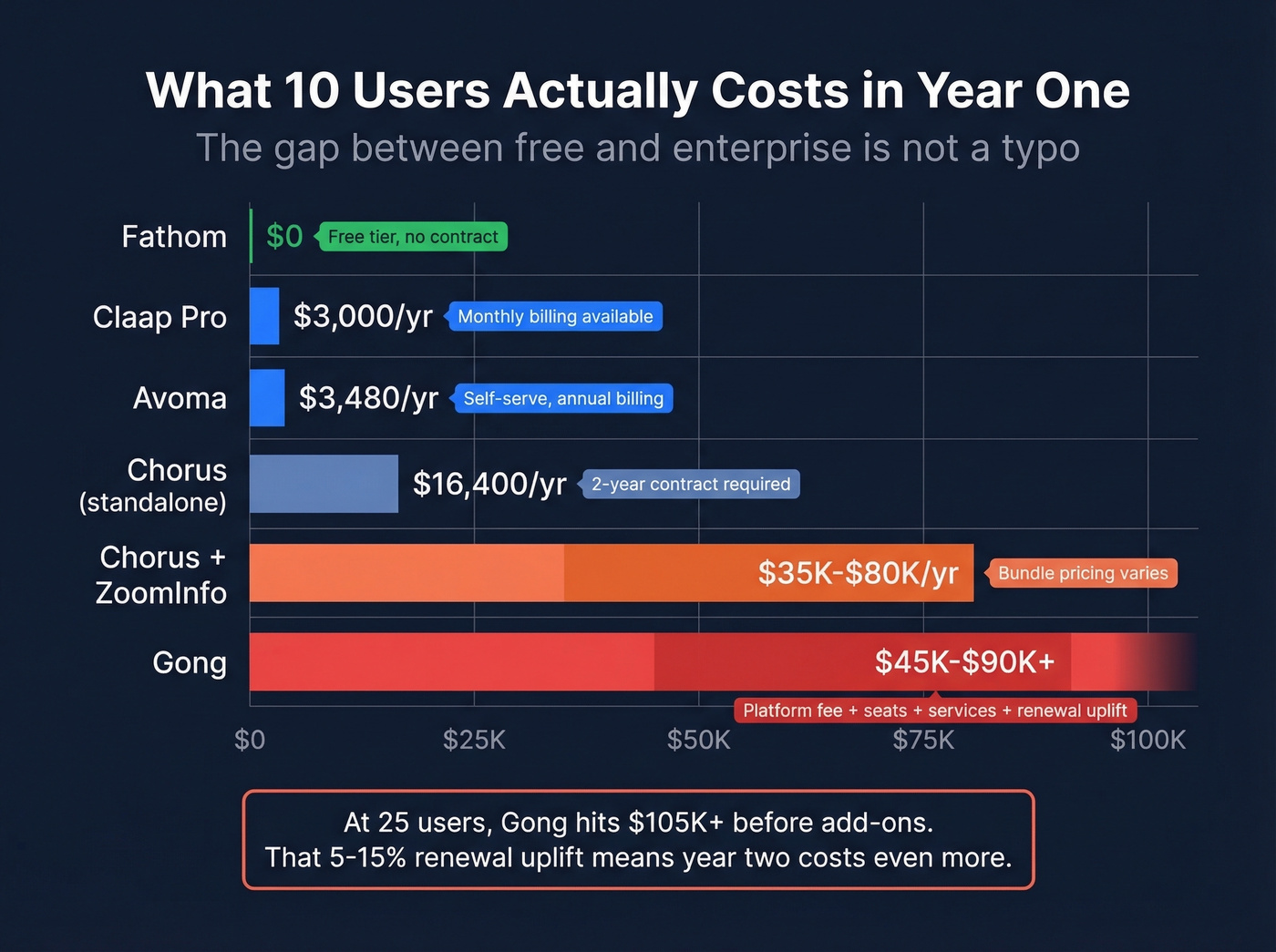
Here's what a 10-user team actually pays in year one:
| Tool | Year 1 (10 users) | Contract | Notes |
|---|---|---|---|
| Gong | $45K-$90K+ | 2-3 yr | Platform + seats + services |
| Chorus (standalone) | ~$16,400 | 2 yr | $8K base + $1.2K/seat |
| Chorus + ZoomInfo | $35K-$80K | 2 yr | Depends on bundle tier |
| Avoma | ~$3,480 | Annual | $29/user/mo, self-serve |
| Claap (Pro) | ~$3,000 | Monthly available | $25/user/mo |
| Fathom | $0 | None | Free tier, unlimited usage |
The gap between Fathom at $0 and Gong at $45K+ isn't a typo. It reflects fundamentally different products - but also fundamentally different pricing philosophies.
At 25 users, the Gong math gets serious: $50K platform fee + $40K in seats (at $1,600/user) + $15K in services = $105K before add-ons. At 50 users, you're looking at $130K-$180K+ depending on negotiation leverage. That 5-15% renewal uplift means year two costs more than year one - automatically.
Don't forget implementation labor. Budget 40-80 hours of internal time for any enterprise CI deployment. That's your RevOps lead, your Salesforce admin, and your sales managers all pulled into configuration, training, and workflow design. At a blended internal cost of $75-$100/hr, that's another $3K-$8K in opportunity cost nobody accounts for.
How to Choose the Right CI Tool
Not all CI tools solve the same problem. The market breaks into three categories, and picking the wrong one is the most expensive mistake you can make.
Here's the thing: if your average deal size is under $15K and your team is under 20 reps, you almost certainly don't need enterprise CI. Start with Fathom, graduate to Avoma, and spend the $80K you saved on pipeline generation.
Sales-Focused CI Platforms
- Tools: Gong, Chorus, Avoma, Salesloft, Clari Copilot
- Built for: B2B sales teams running complex deals with 30+ day cycles and multiple stakeholders
- Deploy time: Enterprise tools (Gong, Chorus) take 4-8 weeks. Mid-market tools (Avoma) are same-week.
- Pick this when: Pipeline visibility, deal coaching, and revenue intelligence drive your buying decision
Contact Center Analytics
- Tools: CallMiner, Observe.AI
- Built for: QA, compliance, and agent coaching across 60+ agents analyzing thousands of interactions
- Deploy time: 6-12 weeks typical for full omnichannel rollout
- Pick this when: Regulatory adherence and agent performance scoring are the priority
Meeting Intelligence / Lightweight CI
- Tools: Fathom, Fireflies.ai, Claap, Jiminny, tl;dv
- Built for: Transcription, summaries, and async review without full revenue intelligence overhead
- Deploy time: Same day. Literally.
- Pick this when: You want to build the call-review habit before committing to enterprise CI
What's Coming Next
The CI category is evolving fast. Three capabilities worth watching: real-time in-call coaching cards that prompt reps mid-conversation, behavioral signal analysis that reads tone, silence, and hesitation patterns beyond just words, and CI as persistent memory for AI agents - where your conversation data feeds autonomous sales workflows. These aren't future concepts; they're shipping now in various stages of maturity.
83% of buyers expect reps to understand their needs before engagement. CI tools can help optimize the conversations you have - but only if reps are connecting with the right people in the first place. Sellers spend roughly 25% of their time actually selling. If half your dials hit disconnected numbers, your CI tool is analyzing a tiny, skewed sample. Fixing the data layer upstream with a tool like Prospeo - 98% email accuracy, 125M+ verified mobiles, 7-day refresh cycle - means your CI investment has a representative dataset to work with.
What CI Can't Fix
Let's be honest about this one. I've talked to VPs of Sales who are staring at a dashboard six months after signing an $80K/yr Gong contract, wondering why win rates haven't moved. The calls are recorded. The AI summaries are generated. The coaching scorecards exist. Nobody's using any of it.
This is more common than vendors admit. McKinsey's 2025 State of AI report found that 88% of organizations use AI regularly in at least one function - but roughly two-thirds haven't scaled it enterprise-wide, and only 39% report measurable EBIT impact. CI tools are no exception.
Bad data upstream. When your contact database is stale and your dials hit dead numbers, CI analyzes a tiny, skewed sample. You've bought an expensive tape recorder for the six calls a day that actually connect. Fix the data first with data enrichment, increase your connect rate, then let CI do its job on a larger sample.
Low activity volume. A 3-person SDR team making 20 dials a day doesn't generate enough conversations for CI pattern recognition to be statistically meaningful. You need volume before you need analysis. Tighten the basics with sales activities and a clear sales pipeline management cadence.
No coaching culture. The biggest ROI from CI doesn't come from AI insights - it comes from forcing managers to actually listen to calls. If your managers won't review recordings and run coaching sessions, the most sophisticated CI platform in the world is just generating reports nobody reads. We've seen teams get more lift from a shared Google Doc of call notes than from a six-figure CI contract, simply because the managers were engaged. If this is your bottleneck, start with sales culture and manager enablement.
You're about to spend $50K-$120K on a CI platform. That investment is wasted if reps are dialing wrong numbers and bouncing emails. Prospeo delivers verified direct dials with a 30% pickup rate and emails at $0.01 each - so your shiny new CI tool actually has calls to analyze.
Fix the upstream data problem before you buy downstream analytics.
FAQ
What is conversational intelligence software?
Software that records, transcribes, and analyzes sales or support conversations using AI to surface coaching insights, deal risks, and performance patterns. It turns unstructured call data into structured, actionable intelligence for managers to coach reps and forecast revenue more accurately.
What's the difference between conversation intelligence and conversational AI?
Conversation intelligence analyzes human conversations after they happen to extract insights. Conversational AI conducts automated conversations via chatbots or voice assistants. One analyzes, the other interacts - different categories, different vendors, different budgets entirely.
Is Gong worth the price?
For 50+ rep teams with dedicated RevOps and a real coaching culture, yes - it's the category leader for a reason. For smaller teams, the TCO (often $90K-$120K+ in year one for 25 users) is hard to justify when Avoma delivers solid CI at $29/user/mo and Fathom is free.
Do I need CI if I have a small team?
Start with Fathom (free) to build the habit of reviewing calls. Graduate to Avoma ($29/user/mo) when you need deal intelligence and coaching scorecards. Don't overspend on enterprise CI for a 5-person team - the ROI math doesn't work until you have enough call volume for pattern recognition.
How does data quality affect CI results?
CI tools analyze only the conversations you actually have. If half your dials hit disconnected numbers, your insights come from a tiny, skewed sample. Verifying contact data upstream - Prospeo delivers 98% email accuracy with a 7-day refresh cycle - means reps connect more often, giving CI a larger, more representative dataset to work with.