

Conversion Rate Lead Generation: Benchmarks, Formulas, and How to Fix a Leaky Funnel
Most "conversion rate" articles obsess over visitor-to-lead metrics. That's the wrong place to look. The real gains in lead generation conversion rates happen mid-funnel - Lead to MQL to SQL to Close - where small improvements compound into serious pipeline. The average lead conversion rate is 2.9% across 14 industries. That 2.9% breaks down to 1.7% from forms and 1.2% from phone calls, which means if you aren't tracking calls, you're missing roughly 40% of your conversions.
Here's what follows: the benchmarks and formulas that tell you exactly where your funnel is broken, and three fixes that actually move the number.
What Is Lead Conversion Rate?
Lead conversion rate measures the percentage of leads that become paying customers - not your landing page conversion rate. A 5% landing page rate means nothing if those leads never close.
The metric that actually correlates with revenue is lead-to-customer conversion. Higher-value products and services tend to have below-average rates, so context matters more than raw numbers. Don't panic over a 1.5% rate if your average deal is $80K.
How to Calculate It
Lead Conversion Rate = (Customers / Leads) x 100
If you generated 1,200 leads last quarter and 84 became customers, your rate is 7.0%. Here's what most teams get wrong: they calculate by calendar month. A lead created in March that closes in June gets counted against June's lead pool, inflating or deflating your rate depending on seasonality.
The fix is cohort-based calculation - track all leads created in a given month and follow them to close, even if that takes 60-90 days. In our experience, teams that switch to cohort tracking discover their actual rate is 10-15% different from what they'd been reporting. Deduplicate by person or company ID so the same prospect filling out two forms doesn't count twice.

Cohort tracking only works when you're counting real leads. If duplicates and bad contacts inflate your numbers, every benchmark comparison is fiction. Prospeo deduplicates automatically and delivers 98% verified emails - so your conversion rate reflects reality.
Stop measuring a funnel full of ghost leads.
Benchmarks by Channel and Industry
By Channel
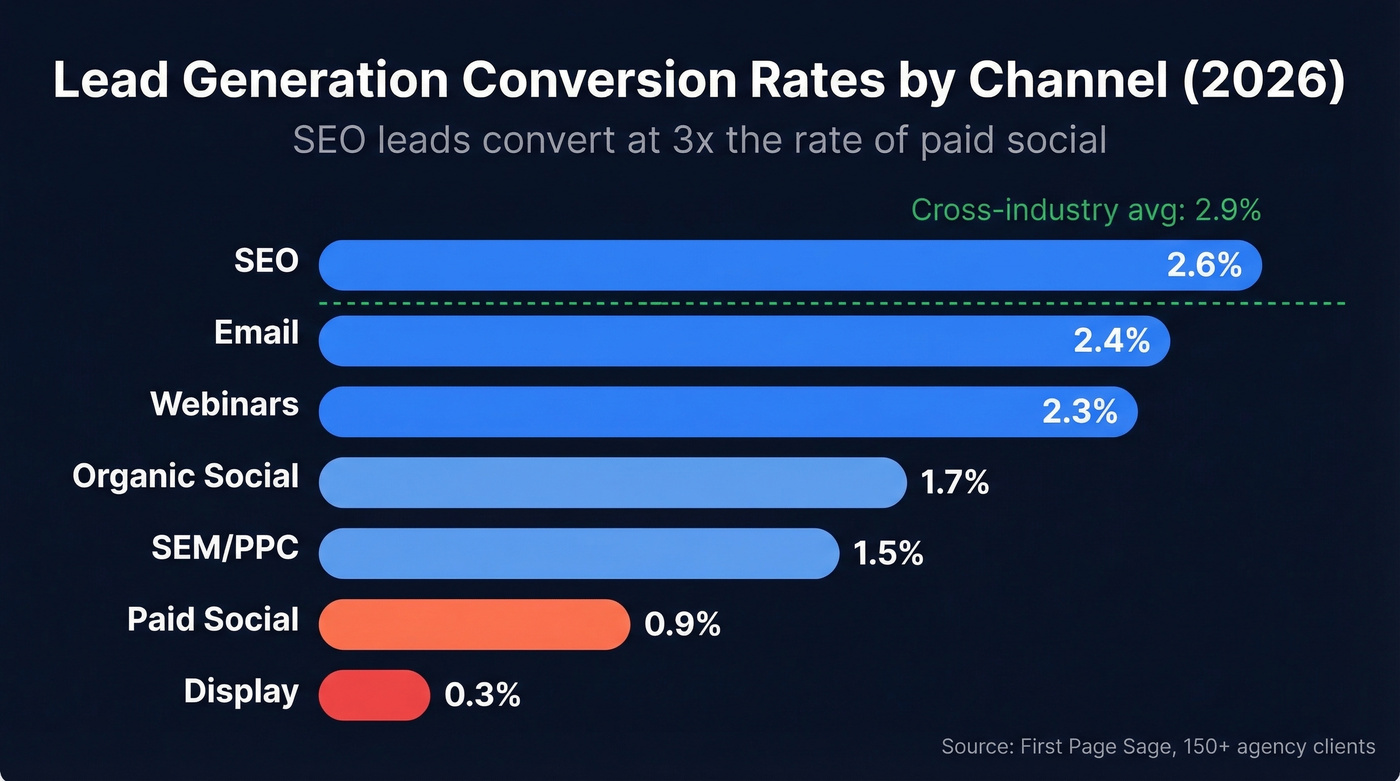
SEO leads convert at about 3x the rate of paid social. That's not a rounding error - it's a structural advantage worth building your budget around.
| Channel | Conversion Rate |
|---|---|
| SEO | 2.6% |
| 2.4% | |
| Webinars | 2.3% |
| Organic Social | 1.7% |
| SEM/PPC | 1.5% |
| Paid Social | 0.9% |
| Display | 0.3% |
Data from First Page Sage's B2B conversion rate report, covering 150+ agency clients. "Conversion" here means demos, free trials, form fills, and phone calls - not gated-content downloads.
The channel gap compounds through every funnel stage. SEO leads convert at 51% MQL-to-SQL, while PPC leads convert at just 26%. Industry matters too: SaaS sees its highest conversion from SEO (1.9%) and webinars (1.2%), while IT and managed services convert best from email (1.4%), paid social (1.1%), and SEO (1.1%).
By Funnel Stage
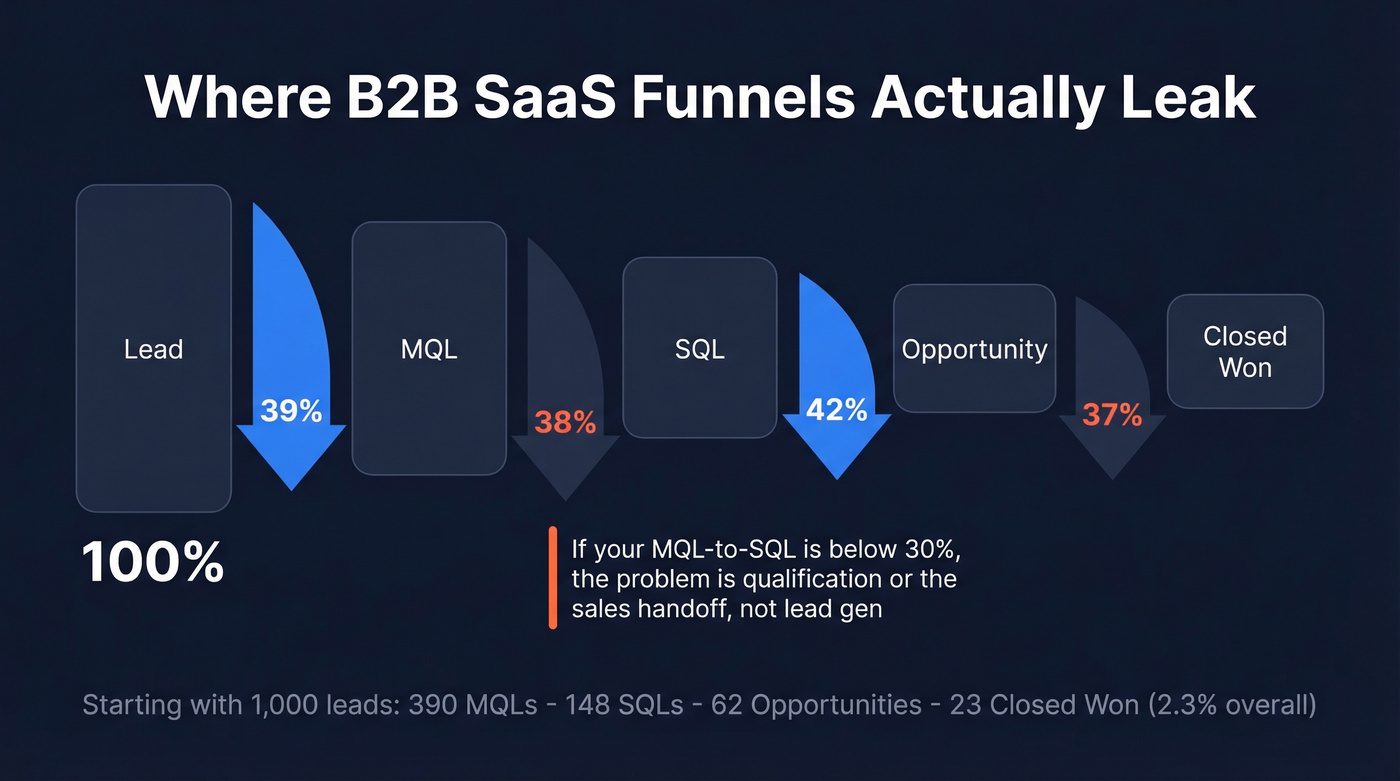
Here's where most B2B SaaS funnels actually leak, per funnel benchmarks:
| Stage | Avg. Conversion |
|---|---|
| Lead to MQL | 39% |
| MQL to SQL | 38% |
| SQL to Opportunity | 42% |
| SQL to Closed Won | 37% |
If your MQL-to-SQL rate is below 30%, the problem isn't lead gen. It's qualification criteria or the handoff process between marketing and sales.
SMB vs. Enterprise
SMB and mid-market companies convert visitors to leads at 1.4%, roughly double the enterprise rate of 0.7%. Enterprise funnels leak more at MQL-to-SQL (31% vs. 39% for SMB), and Opportunity-to-Close follows the same pattern. Longer sales cycles, more stakeholders, more friction at every stage.
Let's be honest: if your average deal size is under $15k, you probably don't need enterprise-grade numbers to build a great business. A 2% rate on a high-volume SMB motion can beat a 0.5% enterprise rate simply because you can run more at-bats through a shorter cycle. Don't benchmark against the wrong segment.
Why Your Leads Aren't Converting
Before optimizing, diagnose. A PPC practitioner on Reddit shared a useful reality check: 447 leads entered a 6-step funnel, only 58 completed it - a 13% step-completion rate. But 48% of completions reached proposal stage or better. The funnel wasn't broken. It was filtering. Sometimes a low top-line number masks a healthy pipeline underneath.
Run through these questions:
- Are you optimizing for form fills instead of sales outcomes? If marketing celebrates CPL while sales complains about lead quality, you have a misalignment problem, not a volume problem.
- Do sales and marketing agree on what "qualified" means? If not, every metric downstream is unreliable.
- How fast are you following up? We'll get to this - it's the single biggest lever most teams ignore.
- Is your contact data actually good? Bounced emails and wrong numbers kill follow-up before it starts.
Three Fastest Ways to Improve
1. Respond in Under 5 Minutes
The average B2B company takes 42 hours to respond to a new lead. Forty-two hours. That's not a process - that's lead abandonment.
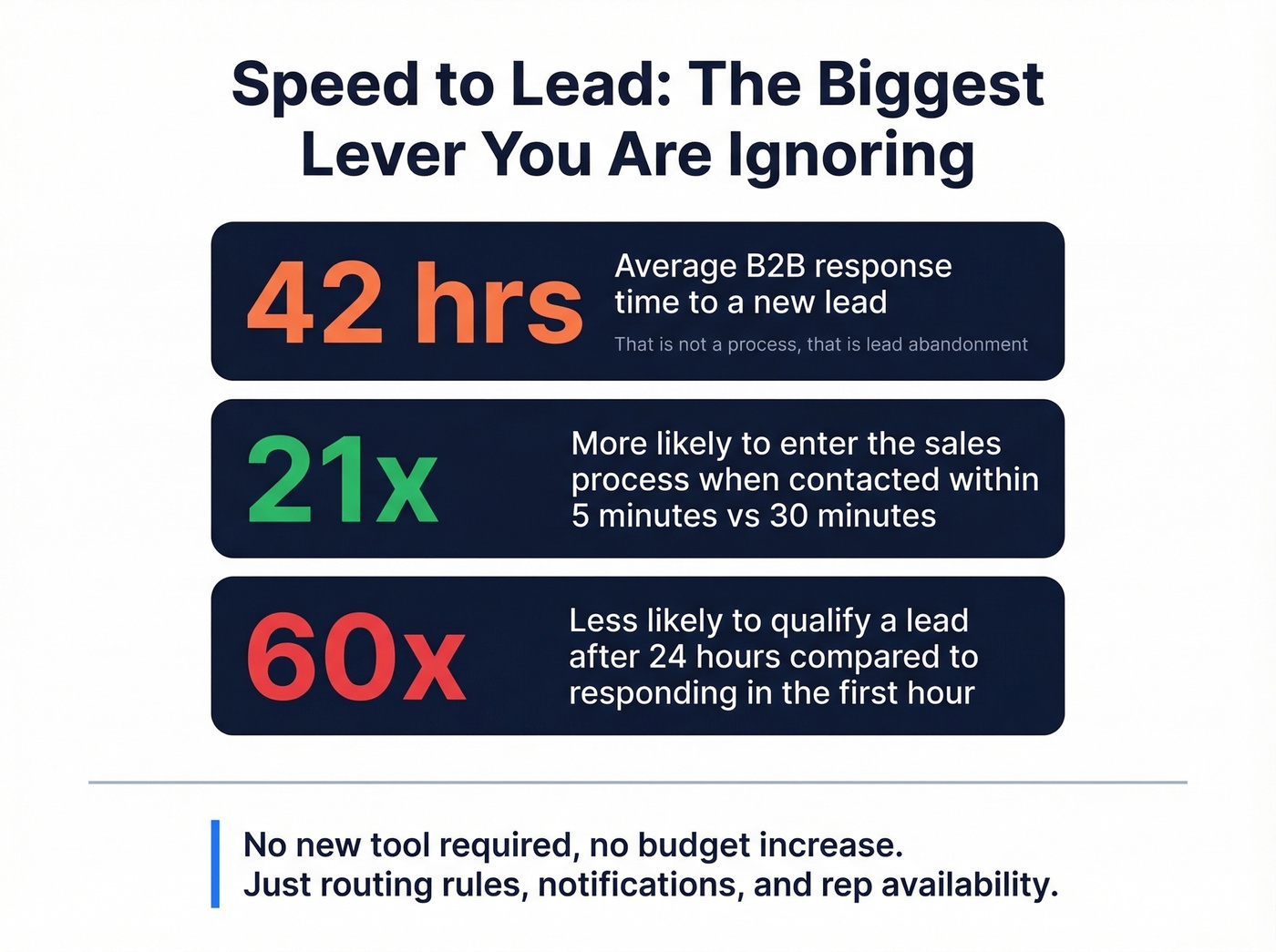
The Oldroyd study found that contacting leads within 5 minutes makes them 21x more likely to enter the sales process compared to waiting 30 minutes. Wait 24 hours and you're 60x less likely to qualify them compared to responding within the first hour. The gap between average and top performer here is entirely operational: routing rules, notifications, rep availability. No new tool required, no budget increase, just discipline. This matters especially for demo requests, where someone who actively books a call has peak intent that decays by the minute.
2. Score Leads So Reps Prioritize
If your SDRs call every lead in the order it arrived, they're wasting their best hours on the worst prospects. Belkins shared their internal model: pricing page view = +10, form fill = +15, 10+ email clicks = +10, email bounced = -25. The specific weights matter less than adjusting them quarterly based on what actually closes.
Referral leads tend to convert at significantly higher rates than cold outbound, so weighting referral source as a scoring factor gives reps a clear signal on where to spend time first. Skip this if your monthly lead volume is under 50 - at that scale, just call everyone fast.
3. Fix Your Contact Data
Bad data is the silent conversion killer. Your speed-to-lead can be under 5 minutes and your scoring model perfect, but if 35% of your emails bounce, your follow-up sequences never reach anyone.
We've seen this pattern repeatedly: teams blame messaging or timing when the real problem is stale contact info. One customer, Meritt, had a 35% bounce rate before switching to Prospeo's email finder, which dropped it under 4%. Their pipeline tripled from $100K to $300K per week. When your data is unverified, every other optimization you make is wasted on contacts who never see your outreach.
If you're seeing bounces, start with email bounce rate benchmarks, then tighten your email deliverability basics before scaling volume.

Speed-to-lead and lead scoring won't save you if a third of your emails never arrive. Meritt cut their bounce rate from 35% to under 4% with Prospeo and tripled pipeline to $300K/week. At $0.01 per email, fixing your data costs less than one lost deal.
Every bounced email is a conversion you'll never get back.
FAQ
What's a good conversion rate for lead generation?
The cross-industry average is 2.9% lead-to-customer. B2B SaaS typically lands between 2-5%, depending on deal size and sales motion. Above 3% means you're outperforming most teams; below 2% signals a funnel-stage leak worth diagnosing with the benchmarks above.
How often should I measure lead conversion?
Monthly, using cohort-based calculation. Track leads created in a given month and follow them to close, even if that takes 90 days. Quarterly reviews catch trends that monthly noise obscures.
What affects conversion rate most?
Channel mix, response speed, lead scoring, and data quality have the biggest impact. Verified contact data matters more than most teams realize - a bounce rate above 10% quietly undermines every other optimization you've made.