

How to Convert Sales Meetings Into Pipeline Opportunities
Last quarter, a VP of Sales we know pulled her pipeline report and found that 60% of meetings her team ran never converted into an opportunity. Not lost deals - meetings that simply evaporated. Reps were busy. Calendars were full. Pipeline was empty.
The problem wasn't meeting volume. It was converting meetings into opportunities. A team converting 35% of 50 meetings beats a team converting 10% of 100 meetings every single quarter, and it's not even close.
Here's the thing: most sales orgs don't have a pipeline generation problem. They have a pipeline conversion problem. Fix the meetings you're already running before you spend another dollar on top-of-funnel.
The Quick Version
- Know your number. Inbound meetings should convert at 20-40%, outbound at 10-15%. If you're below that, the problem is usually meeting quality, readiness, or what happens immediately after the call.
- Every meeting must end with a confirmed next step - not "I'll send you some info."
- Your follow-up window is 2 hours. Stale contact data kills that window before you open your laptop.
Meeting-to-Opportunity Benchmarks
| Metric | SMB / Mid-Market | Enterprise |
|---|---|---|
| SQL to Opportunity | 42% | 36% |
| Outbound Meeting to Opp | 10-15% | 10-15% |
| Inbound Meeting to Opp | 20-40% | 20-30% |
| Qualified to Booked | 62% median (all segments) | - |
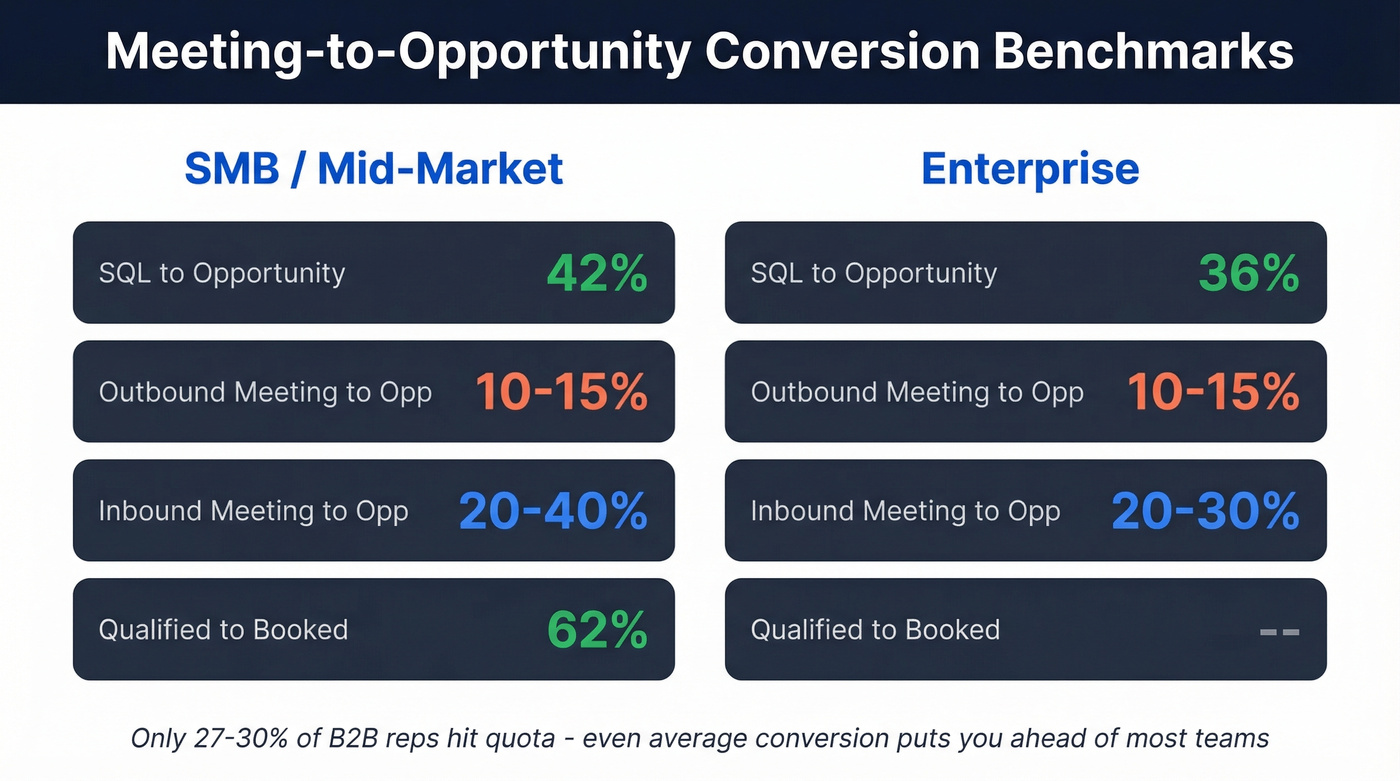
The gap between inbound and outbound is massive - inbound prospects raised their hand, outbound prospects didn't ask for your call. But only 27-30% of B2B reps hit quota. If your conversion rates are even average, you're outperforming most of the market. The real gain comes from moving from average to top-quartile on the meetings you already have.
One Reddit thread on r/sales captured this perfectly: a team converting 58% of inbounds into opportunities thought they were underperforming - when in reality they were well above benchmark. Nobody talks about their numbers, so perception gets warped.
Before the Meeting
Most reps prepare by reviewing the prospect's website for five minutes. That's not preparation - that's skimming.
Real pre-call work answers three questions: What business problem does this person likely have? Who else is involved in the decision? And why would they act now instead of next quarter? If you can't articulate a hypothesis for all three before the call starts, you're walking in blind and hoping the prospect does the work for you.
Funnel Clarity frames this well: before every meeting, ask yourself, "What must be different for the buyer when this call ends?" If you can't answer that, you don't have a call plan. You have a demo scheduled.
Speed matters too. Leads contacted within 5 minutes are 21x more likely to convert than those contacted after 30 minutes. That principle applies to every touchpoint.
If you're tightening this process, it helps to standardize your lead scoring so reps walk into calls with a clear hypothesis.

Speed kills deals - in a good way. But your 2-hour follow-up window means nothing if you're chasing outdated emails and disconnected phone numbers. Prospeo's 300M+ profiles are refreshed every 7 days with 98% email accuracy, so your recap lands in the right inbox before the prospect forgets your name.
Stop losing meetings to stale data. Start converting them into pipeline.
During the Meeting
Most meetings fail because the rep presented instead of diagnosed. They walked through slides, showed the product, answered questions politely, and left the prospect thinking "that was interesting" instead of "I need to solve this." We've sat through hundreds of these calls in pipeline reviews, and the pattern is always the same.
Stop explaining what your product does. Start diagnosing what the buyer's situation requires.
If you want a tighter structure for this part of the conversation, use a consistent set of discovery questions and keep the rep focused on buyer evidence.
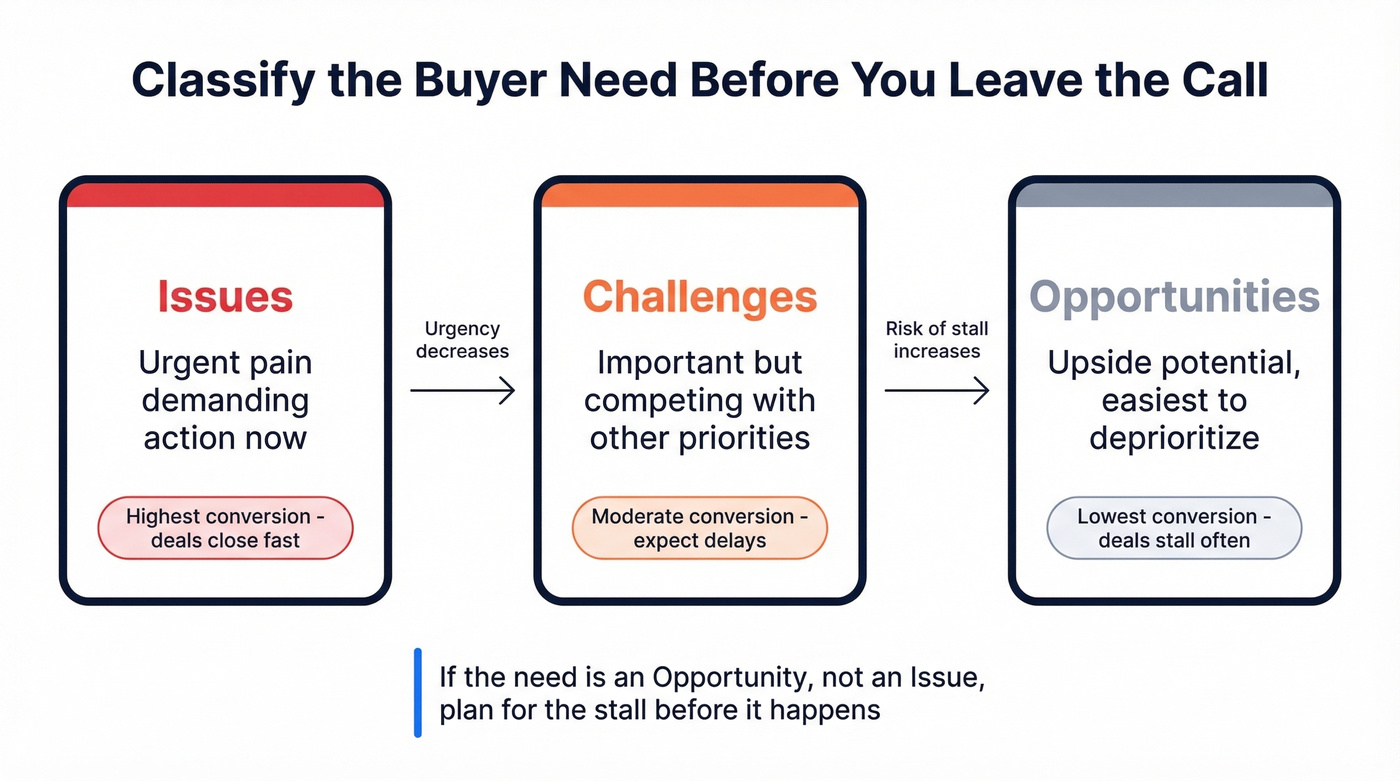
Revenue Funnel UK classifies buyer needs into three categories: Issues (urgent pain demanding action now), Challenges (important but competing with other priorities), and Opportunities (upside potential, easiest to deprioritize). If your prospect's need falls into the Opportunity bucket rather than the Issue bucket, expect the deal to stall - and plan accordingly.
Before you end the call, confirm a specific date, time, and agenda for the next conversation. If the prospect won't commit to that, you don't have an opportunity. You have a polite conversation going nowhere.
The Handoff Tax
An SDR books a meeting. Sends the AE a Slack message: "Meeting booked with VP Ops at Acme, seems interested." The AE walks in cold, asks the same discovery questions, and the prospect mentally checks out.
Sales teams on r/sales flag this pattern constantly: weak qualification, thin handoff notes, and suspicion of "ghost dialing" to hit activity KPIs - which produces meetings with no real buyer intent behind them.
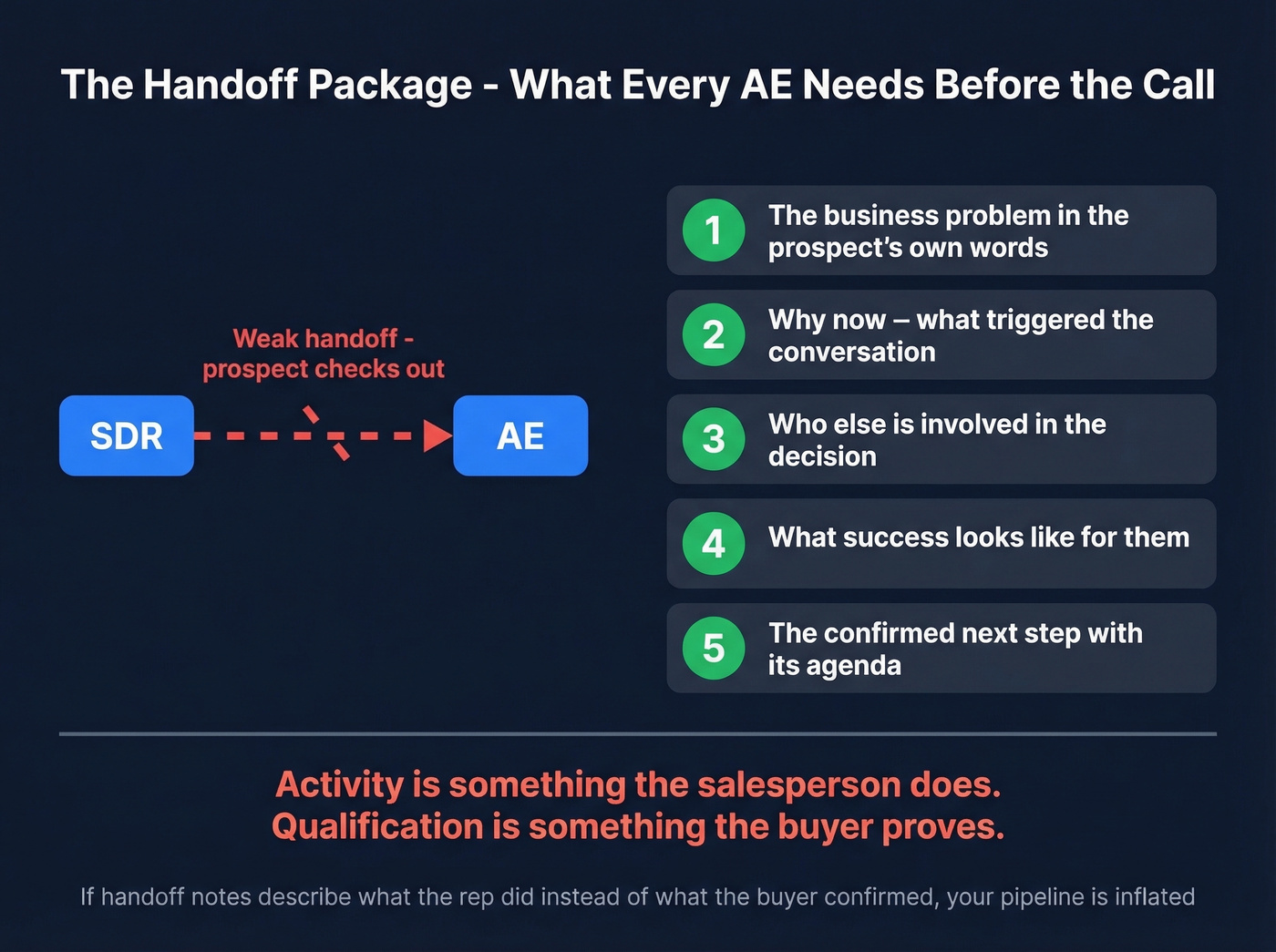
The handoff package needs five things:
- The business problem in the prospect's own words
- Why now - what triggered the conversation
- Who else is involved
- What success looks like for them
- The confirmed next step with its agenda
If you want to make this repeatable, keep a set of handoff email templates so SDRs and AEs share the same structure.
Let's be honest about the root cause here. "Activity is something the salesperson does. Qualification is something the buyer proves." That distinction should be on every SDR dashboard. If your handoff notes describe what the rep did instead of what the buyer confirmed, you're creating a bloated pipeline that never had real buyer proof behind it. Leads are names on a list. Opportunities have verified buyer intent.
The Follow-Up Playbook
80% of sales require at least five follow-ups. 44% of reps quit after one. That gap is where pipeline goes to die.
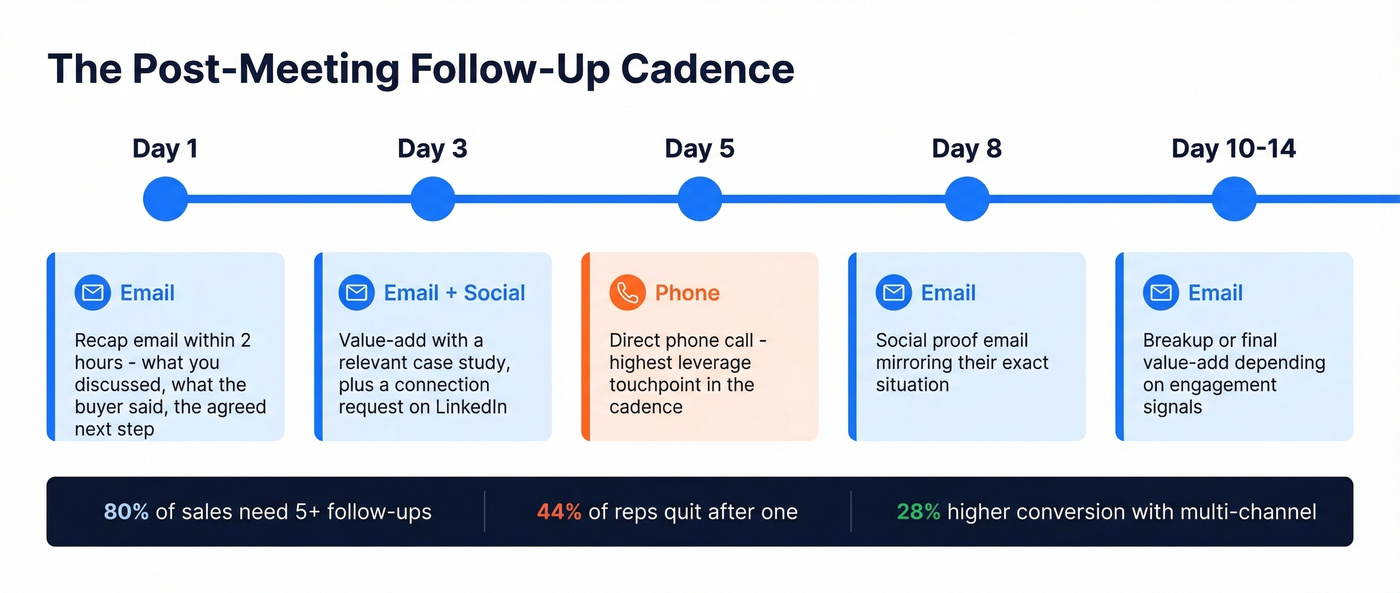
- Day 1 (within 2 hours): Recap email - what you discussed, what the buyer said their problem was, the agreed next step.
- Day 3: Value-add email with a relevant case study, plus a connection request on a professional network.
- Day 5: Direct phone call.
- Day 8: Social proof email mirroring their situation.
- Day 10-14: Breakup or final value-add depending on engagement signals.
If you need copy you can deploy fast, pull from proven sales follow-up templates and adapt them to your buyer-evidence criteria.
Multi-channel campaigns yield 28% higher conversion than email-only. Rescheduling sequences alone can recover 10-15% of stalled leads. Plan for 8-12 touchpoints over 17-21 days.
That Day 5 phone follow-up only works if the number actually connects. In our experience, bad phone data is the silent killer of otherwise solid cadences - you've built the sequence, written the scripts, and the number just rings out to a dead line. Prospeo maintains 125M+ verified mobile numbers with a 30% pickup rate, refreshed every 7 days instead of the 6-week industry average. If your cadence is solid but connect rates are terrible, the problem isn't your process. It's your data.
If your team is still building consistency here, a documented cold calling system helps keep connect-rate improvements from evaporating.
When to Create the Opportunity
Don't create the opportunity after the first meeting. Create it when the buyer has proven readiness - there's a meaningful difference between an SQL and an SQO. Before anything moves into your pipeline, confirm these buyer-evidence criteria:
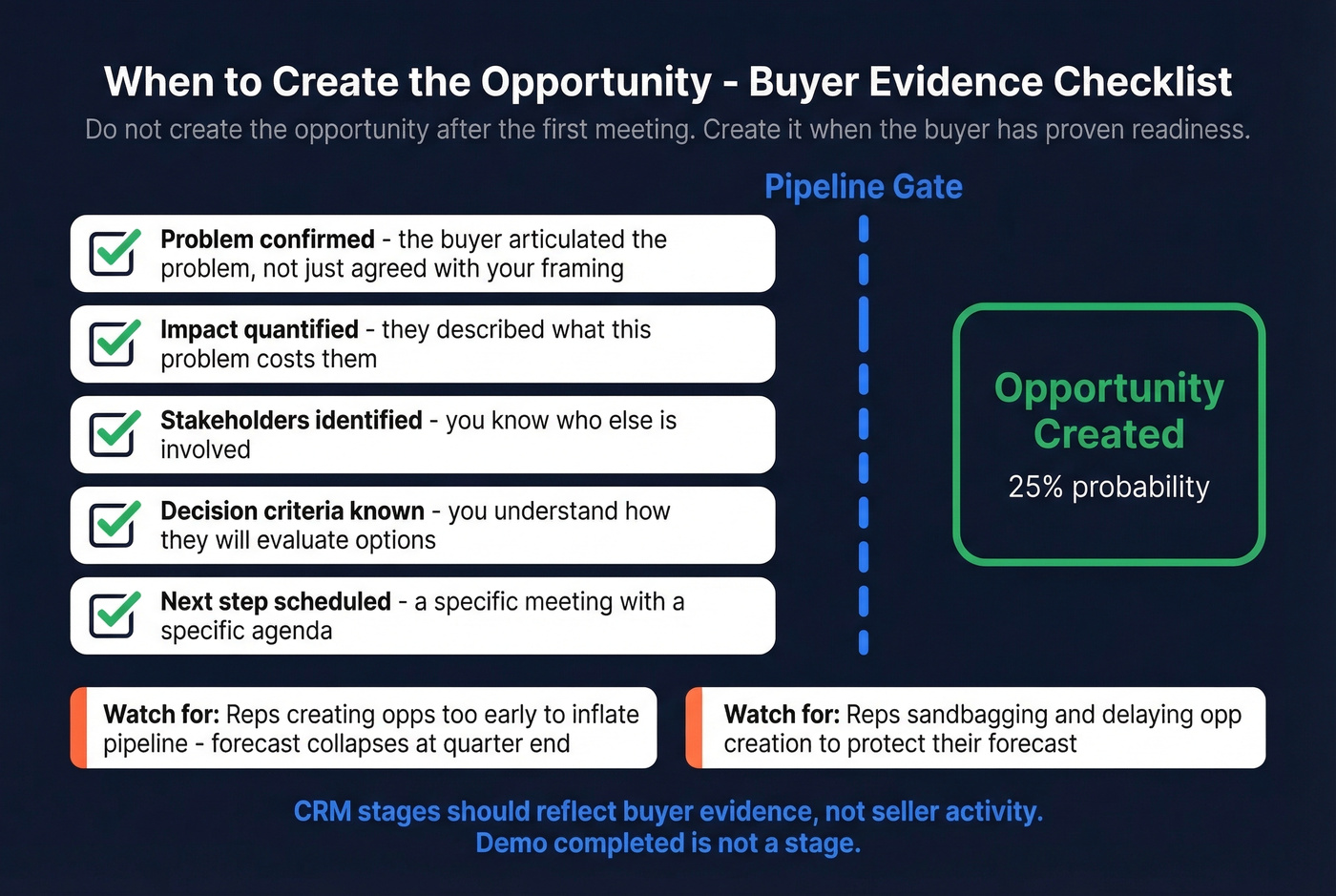
- Problem confirmed - the buyer articulated the problem, not just agreed with your framing
- Impact quantified - they can describe what this problem costs them
- Stakeholders identified - you know who else is involved
- Decision criteria known - you understand how they'll evaluate options
- Next step scheduled - a specific meeting with a specific agenda
Assign 25% probability at this stage. Anything higher without these proof points is wishful thinking. And watch for sandbagging - the opposite problem, where reps delay creating opportunities to protect their forecast. Both distortions destroy pipeline accuracy, and early-stage deals are especially vulnerable because without rigorous buyer evidence, they inflate your forecast and collapse at quarter-end.
To keep this clean, align your stages to sales pipeline benchmarks and audit whether each stage reflects buyer proof (not rep activity).
Your CRM pipeline is lying to you if stages reflect seller activity instead of buyer proof. "Demo completed" isn't a stage - it's something you did. "Buyer confirmed problem and impact with VP sponsor" is a stage. Configure your CRM so stage names reflect buyer evidence, not rep actions. Skip this advice if you're a solo founder running five deals at a time - but for any team above three reps, this distinction is the difference between a forecast you can trust and one that makes your board lose confidence.
If you're rebuilding this end-to-end, a broader sales process optimization pass usually uncovers the hidden leakage between meeting, follow-up, and opportunity creation.
Your Day 5 phone call is the highest-leverage touchpoint in the cadence - but only if someone picks up. Prospeo delivers 125M+ verified mobile numbers with a 30% pickup rate, compared to the 11-12% you get from Apollo or ZoomInfo. That's the difference between a recovered deal and a dead sequence.
Connect with buyers on the first dial, not the fifth.
FAQ
What's a good meeting-to-opportunity conversion rate?
Inbound meetings should convert at 20-40%, outbound at 10-15%. SMB/mid-market SaaS companies convert SQLs to opportunities at roughly 42%, enterprise at 36%. If you're below these numbers, fix meeting quality and follow-up speed before adding volume.
How many follow-ups after a sales meeting?
Plan for 8-12 touchpoints across email, phone, and social over 17-21 days. 80% of deals require at least five follow-ups, but 44% of reps stop after one. Send your recap within 2 hours of the call - multi-channel sequences convert 28% better than email alone.
Why do prospects ghost after a great meeting?
Usually because the meeting created interest but not urgency. The buyer didn't commit to a concrete next step, or your follow-up didn't land - stale emails bounce and disconnected numbers kill your window. Verify contact data before the meeting so follow-up reaches the prospect within that critical 2-hour window.