

The Real Cost of Selling a House in 2026: Every Fee, Tax, and Hidden Expense
You just accepted an offer on your house. The number looks great - until your agent walks you through the settlement statement and $47,000 has evaporated into commissions, closing costs, concessions, and a tax bill you didn't see coming. That gap between sale price and what actually hits your bank account is wider than most sellers expect, and understanding the true cost of selling is the difference between a smart financial move and a nasty surprise.
Seller profit margins peaked above 60% in mid-2022, fell to 55% in 2024, and dropped further to 49% in 2025, with the typical gross profit landing at $118,710. That's before transaction costs. Layer in commissions, closing fees, concessions, prep work, and potential capital gains tax, and the real number you walk away with can be 10-15% less than the sale price. ATTOM's year-end data put the national median sale price at a record $360,000 - but national averages are useless here. Your expenses depend on your state, your price point, and whether your buyer has leverage.
Quick Cost Summary
Every major cost category at a glance:
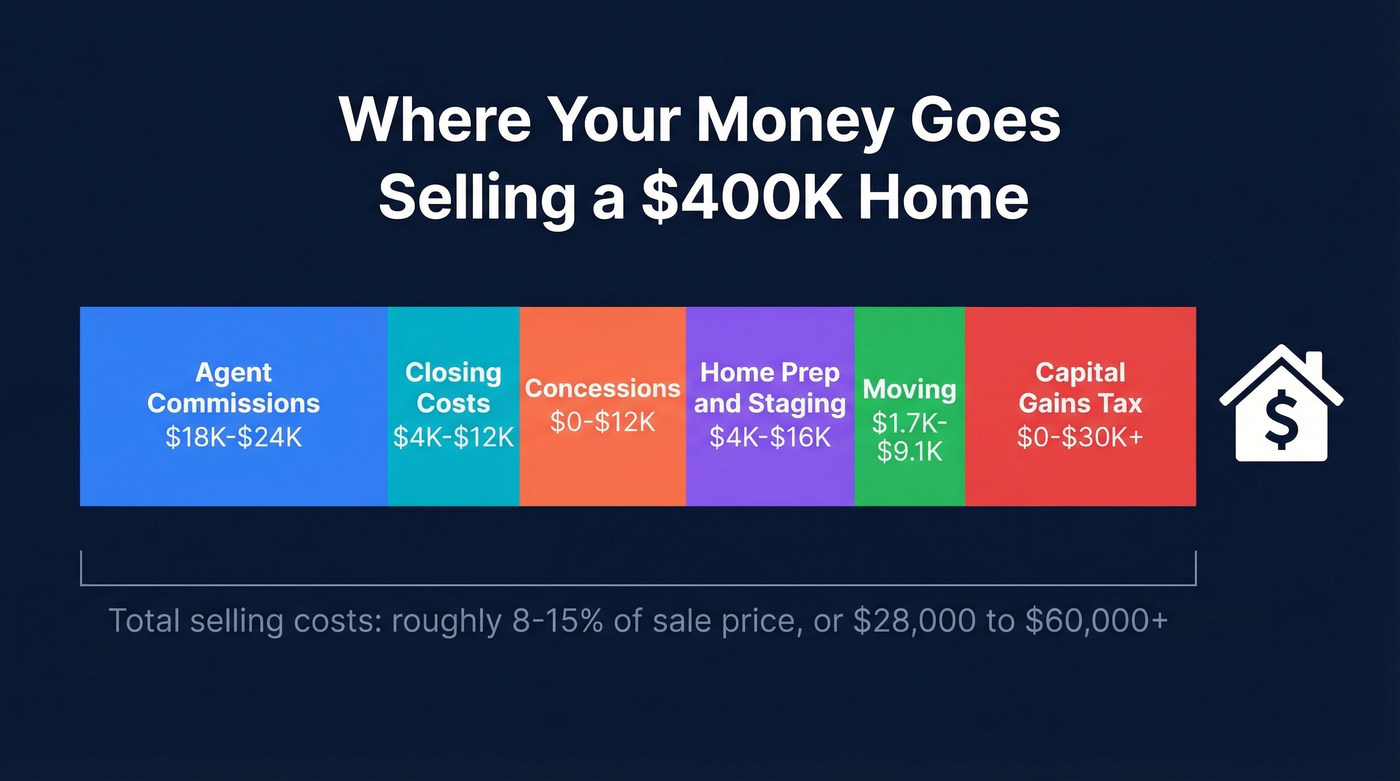
| Cost Category | % of Sale Price | At $400K |
|---|---|---|
| Agent commissions | 4.5-6% | $18,000-$24,000 |
| Closing costs | 1-3% | $4,000-$12,000 |
| Seller concessions | 0-3% | $0-$12,000 |
| Home prep & staging | 1-4% | $4,000-$16,000 |
| Moving costs | Flat fee | $1,700-$9,100 |
| Capital gains tax | 0-20%+ of gain | $0-$30,000+ |
| Total | ~8-15% | $28,000-$60,000+ |
On a $400,000 sale, you're looking at roughly $28,000 to $60,000+ in total expenses. The low end assumes a low-tax state with no concessions. The high end reflects a high-cost market with staging, concessions, and capital gains exposure.
Real Estate Commissions in 2026
Commissions remain the single biggest transaction cost for sellers, and the post-NAR settlement landscape hasn't changed them as much as the headlines suggested.
NAR agreed to a $418 million settlement in March 2024, with new commission rules taking effect August 17, 2024. The big change: buyer-agent compensation could no longer be listed on the MLS. Everyone predicted commissions would crater. They didn't.
Buyer's agent commissions averaged 2.4% in Q1 2025 - virtually unchanged from 2.43% a year earlier. Most sellers still offer buyer-agent compensation because it keeps the buyer pool as wide as possible. The rate varies by price tier: homes above $1M averaged 2.17% on the buyer side, while homes under $500K averaged 2.49%. The national average total commission sits around 5.70%, but that masks significant state-level variation.
Here's the frustrating part: 45.9% of sellers didn't even try to negotiate their commission. Only 37.4% negotiated or attempted to. The forms and disclosures have gotten more complex post-settlement - eXp SVP Holly Mabery described the new state and MLS forms as "so hard to read and understand" - but the actual dollars flowing to agents haven't moved much. In California, the forms now don't even allow cooperative compensation to be listed, adding confusion without actually reducing costs.
Commission Rates by State
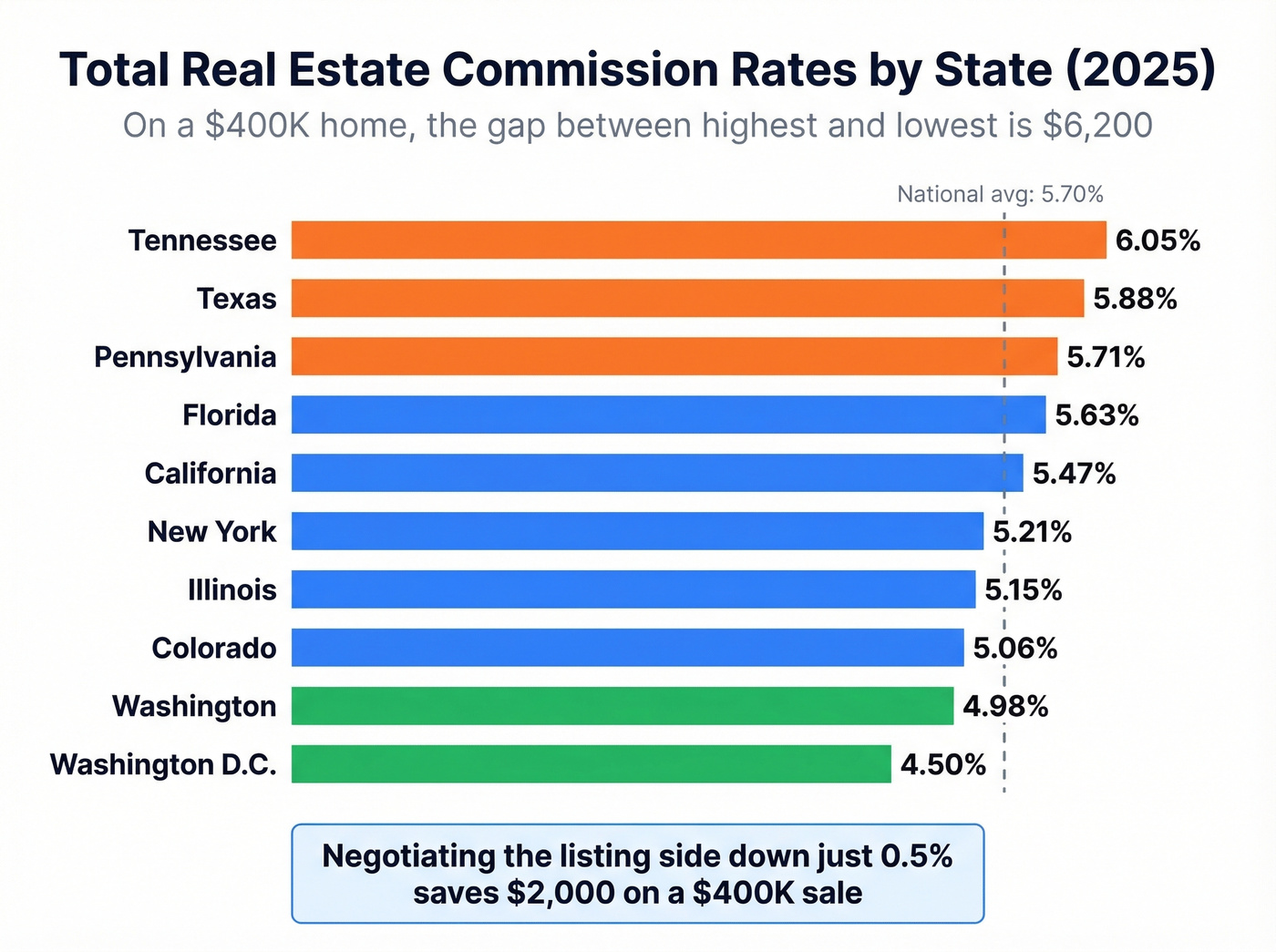
Total commission rates vary meaningfully by state. On a $400,000 home, the difference between Tennessee at 6.05% and D.C. at 4.50% is $6,200. That's not trivial.
| State | Avg. Total Commission |
|---|---|
| Tennessee | 6.05% |
| Texas | 5.88% |
| Pennsylvania | 5.71% |
| Florida | 5.63% |
| California | 5.47% |
| New York | 5.21% |
| Illinois | 5.15% |
| Colorado | 5.06% |
| Washington | 4.98% |
| Washington, D.C. | 4.50% |
If you're in a higher-commission state, negotiating the listing side down even half a point saves $2,000.
Closing Costs by State
Seller closing costs typically run 1-3% of the sale price, but the range is enormous depending on your state's transfer tax structure.
Bankrate's analysis using LodeStar data shows closing costs - including recording fees and transfer taxes - ranging from under 1% to nearly 3%:
| State | Closing Cost % | At $400K |
|---|---|---|
| Delaware | 2.99% | $11,960 |
| New York | 2.47% | $9,880 |
| Washington, D.C. | 2.39% | $9,560 |
| Texas | 0.93% | $3,720 |
| California | 0.74% | $2,960 |
| South Dakota | 0.46% | $1,840 |
The biggest variable is transfer taxes. Fourteen states have no transfer tax at all: Alaska, Idaho, Indiana, Kansas, Louisiana, Mississippi, Missouri, Montana, New Mexico, North Dakota, Oregon (most counties), Texas, Utah, and Wyoming. Selling in one of these states pushes your closing costs toward the low end.
Which costs the seller pays versus the buyer varies by contract and regional custom. In some markets, sellers cover the title insurance policy; in others, that's on the buyer. Your agent should walk you through local norms, but budget 1-3% on the seller side to be safe.
Seller Concessions in 2026
Concessions are the line item most sellers forget to budget for. Credits you give the buyer toward closing costs, repairs, or mortgage-rate buydowns have become standard in most markets - and they're climbing.
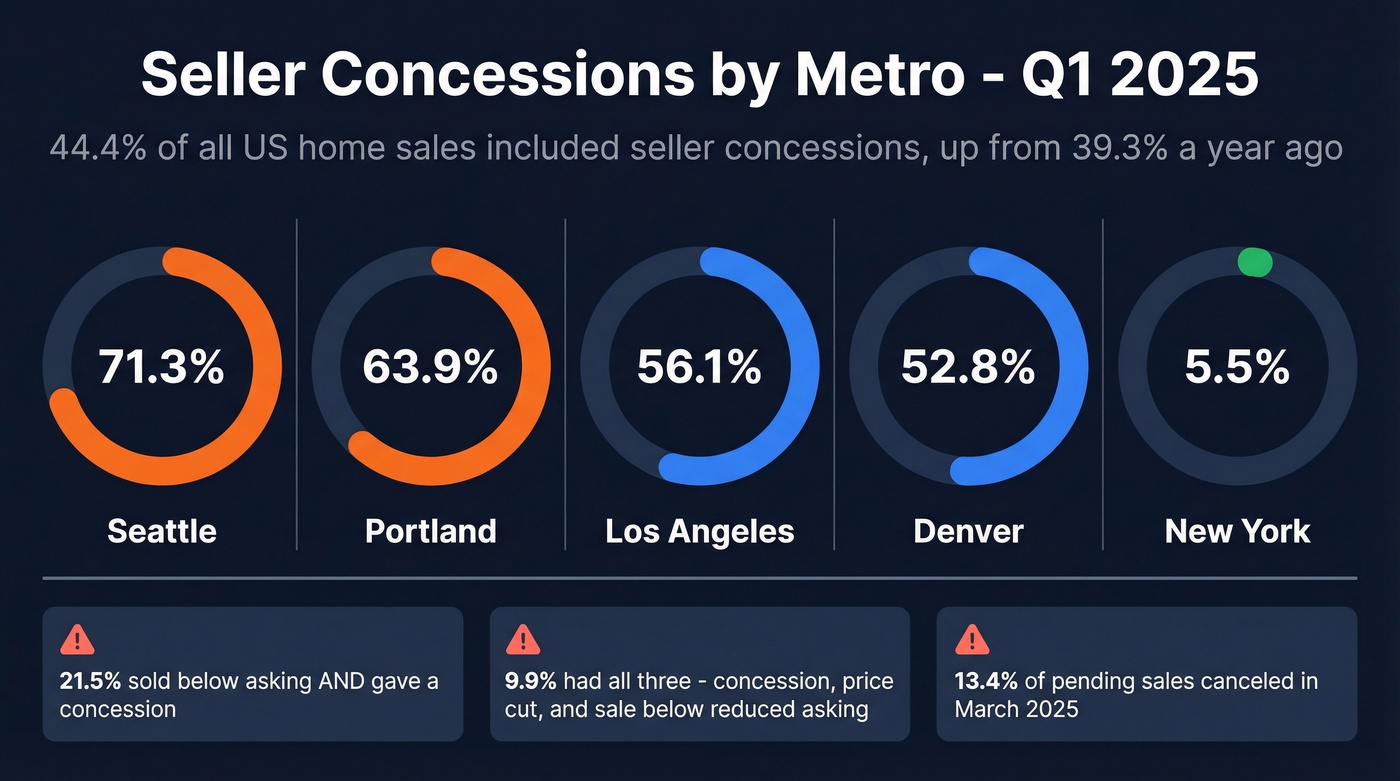
44.4% of U.S. home sales included seller concessions in Q1 2025, up from 39.3% a year earlier and approaching the record of 45.1% set in early 2023. These aren't price reductions. They're additional costs on top of whatever you negotiated on the sale price.
The metro-level variation is staggering:
| Metro | % of Sales w/ Concessions |
|---|---|
| Seattle | 71.3% |
| Portland | 63.9% |
| Los Angeles | 56.1% |
| Denver | 52.8% |
| New York | 5.5% |
In Seattle, more than seven out of ten sellers gave concessions. In New York, almost nobody did. Your market matters more than any national average.
The layering effect is what really eats into your proceeds. In Q1 2025, 21.5% of sales closed below asking and included a concession, while another 9.9% had all three: a concession, a price cut during listing, and a final sale below the already-reduced asking price. When these stack, your net proceeds can drop dramatically from what you expected when you listed.
And 13.4% of pending sales were canceled in March 2025 - roughly 52,000 deals - often because buyers and sellers couldn't bridge the gap on concessions and repairs. Budget 1-3% of your sale price for concessions in softer markets, and zero in competitive ones.

Every percentage point matters when selling costs stack up. If you're a real estate agent or broker prospecting for listings, bad data burns money just like hidden closing fees. Prospeo delivers 98% accurate emails at $0.01 each - so your outreach actually reaches sellers, not spam traps.
Stop losing deals to bad contact data. Find verified seller leads in seconds.
Capital Gains Tax
If you've owned and lived in your home for at least two years, you're probably fine. If you haven't, this could be your biggest single expense.
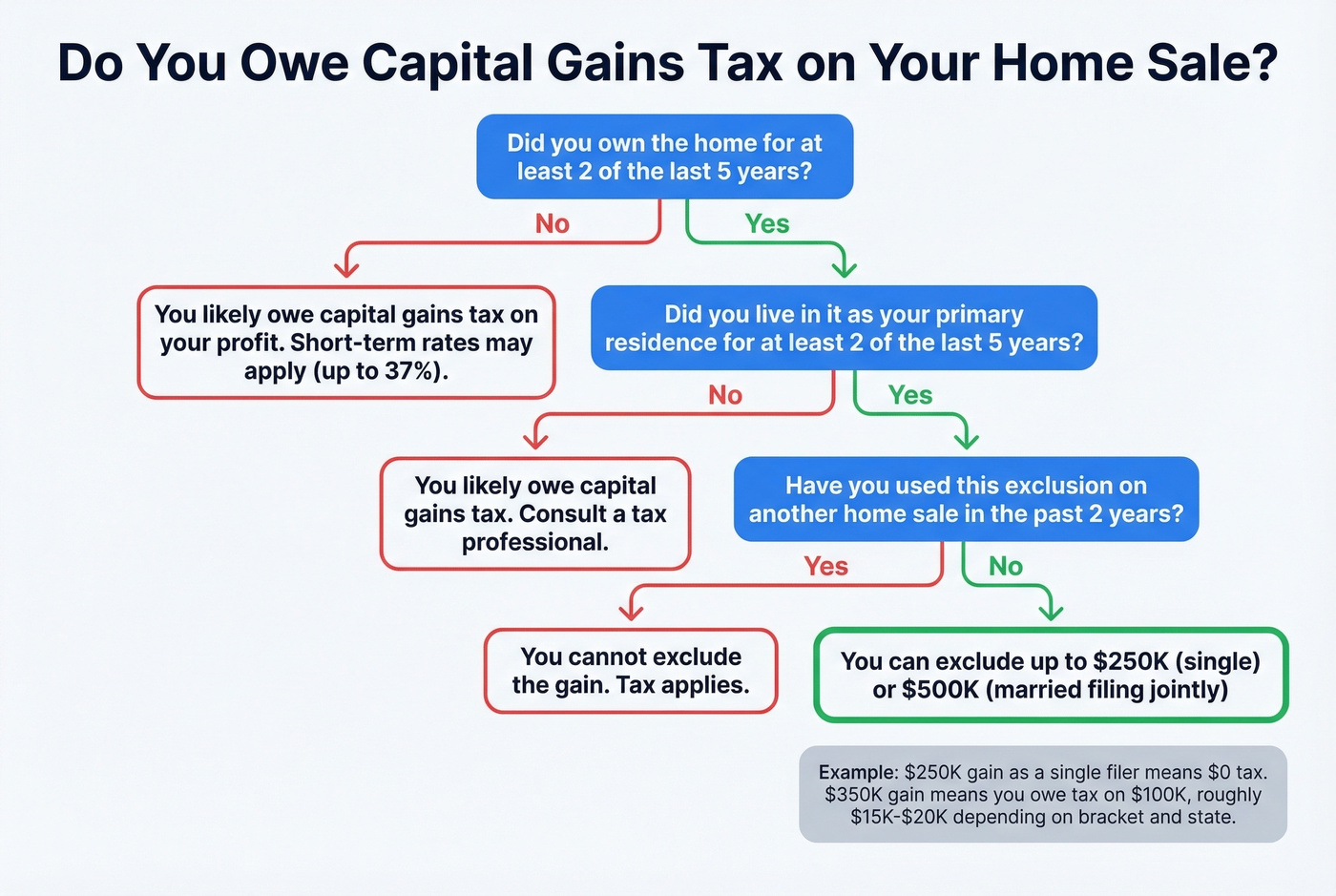
The IRS home sale exclusion lets single filers exclude up to $250,000 in gain and married couples filing jointly up to $500,000. To qualify, you need to pass two tests:
- Ownership test - You owned the home for at least 24 of the last 60 months
- Use test - You used it as your primary residence for at least 24 of the last 60 months
You also can't have excluded gain on another home sale within the prior two years. For married couples filing jointly, both spouses must meet the use test, but only one needs to meet the ownership test. If you receive a Form 1099-S from the closing, you must report the sale on your tax return even if the entire gain is excludable. Military members on qualified extended duty can suspend the five-year test period for up to 10 years.
The average seller held their home for 8.55 years before selling in Q4 2025, well past the two-year threshold - but investors, job-changers, and divorcees often fall short.
Let's break down a quick example. Say you bought a home for $300,000 five years ago and you're selling for $550,000. Your gain is $250,000. As a single filer, you'd exclude the full amount. But if your gain is $350,000, you'd owe capital gains tax on $100,000 - potentially $15,000-$20,000 depending on your income bracket and state taxes. Married couples have more room, but in high-appreciation markets like the Bay Area or Austin, even the $500,000 exclusion isn't always enough.
Home Prep, Staging, and Moving
These costs hit before you see a dime from the sale, which makes them easy to underestimate.
A 2023 Zillow survey found sellers spend $14,000+ on average preparing a home for sale. That money typically goes toward full interior paint at $3,000-$8,000 (the single biggest prep expense for most sellers), staging at $1,600-$2,400, professional photography at $250-$1,000, move-out deep cleaning at $400-$600, and minor repairs and touch-ups at $1,000-$5,000 depending on condition.
Professional photography is the highest-ROI spend on that entire list. Don't skip it.
If your home is in a market where listings sell in under two weeks with multiple offers, skip professional staging. Clean, declutter, photograph well, and save $2,000. Staging matters in slower markets where buyers need help imagining themselves in the space. In a bidding war, it's decorating for your own ego.
Then there's moving. Typical local moves with professional movers range from $882 to $2,567, with an average around $1,711. Long-distance moves can land around $9,100. Get at least three quotes - pricing varies 2-3x between movers for the same job.
Don't forget carrying costs during the listing period. Every month your home sits on the market, you're paying the mortgage, utilities, insurance, and property taxes. At a $2,500/month mortgage payment, a three-month listing period costs you $7,500 in carrying costs alone. Tools like Zillow's Home Sale Proceeds Calculator or Opendoor's Home Sale Calculator can give you a quick estimate, but they won't capture concessions, carrying costs, or state-specific transfer taxes - which is exactly why this breakdown matters.
What You'll Actually Net
Two realistic scenarios show how much your state, price point, and market conditions change the math.
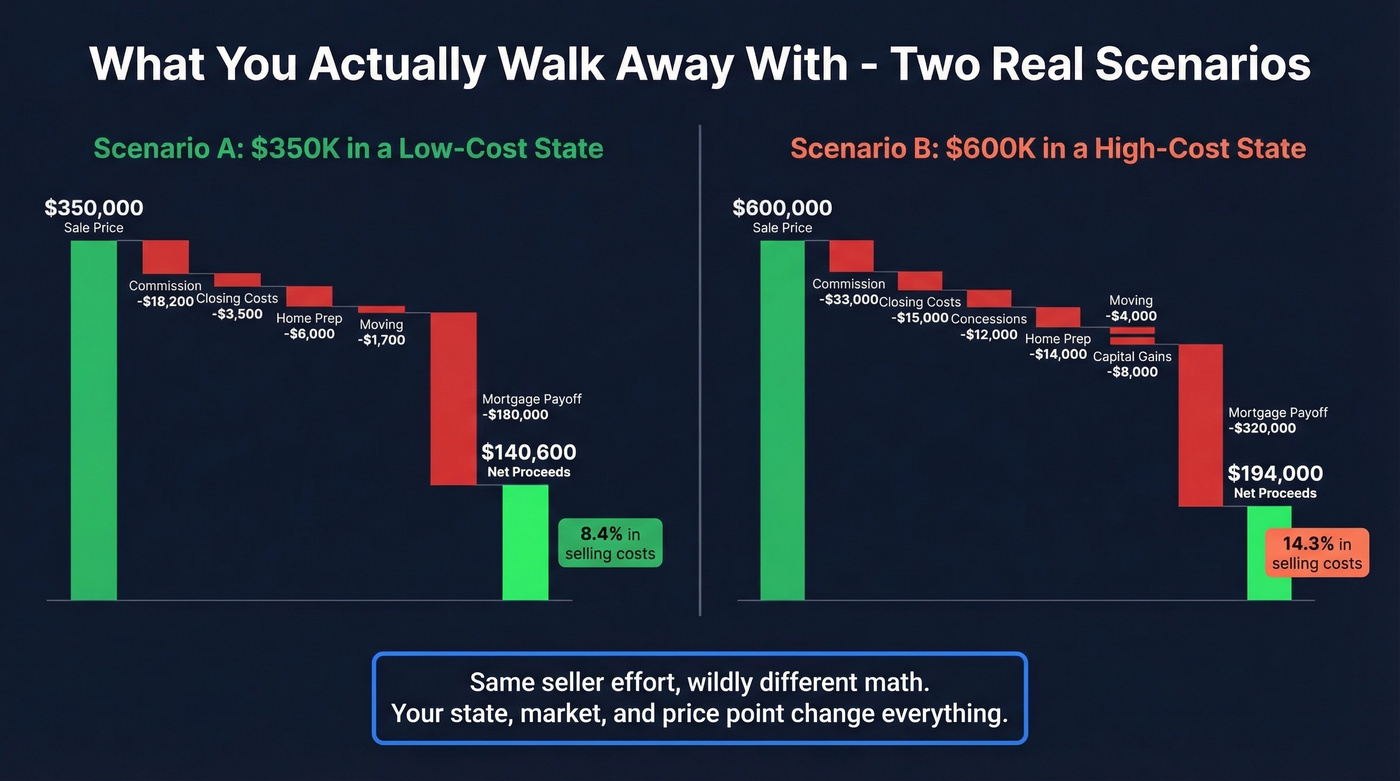
Scenario A: $350K in a Low-Cost State
| Line Item | Amount |
|---|---|
| Sale price | $350,000 |
| Commission at 5.2% | -$18,200 |
| Closing costs at 1% | -$3,500 |
| Concessions | $0 |
| Home prep | -$6,000 |
| Moving, local | -$1,700 |
| Capital gains tax | $0 |
| Remaining mortgage | -$180,000 |
| Net proceeds | $140,600 |
| Total selling costs (excluding mortgage payoff) | ~8.4% |
Scenario B: $600K in a High-Cost State
| Line Item | Amount |
|---|---|
| Sale price | $600,000 |
| Commission at 5.5% | -$33,000 |
| Closing costs at 2.5% | -$15,000 |
| Concessions at 2% | -$12,000 |
| Home prep & staging | -$14,000 |
| Moving, long-distance | -$9,100 |
| Capital gains tax | -$8,000 |
| Remaining mortgage | -$320,000 |
| Net proceeds | $188,900 |
| Total selling costs (excluding mortgage payoff) | ~15.2% |
The difference between 8.4% and 15.2% in total costs is $40,000+ in real money. Same process, same country, wildly different outcomes. "It costs about 10% to sell a house" is a meaningless statement without context.
How to Reduce Selling Expenses
In our experience, the biggest savings come from negotiating the listing commission - it's the largest single cost and the one most sellers accept without question.
Negotiate your listing agent's commission. 37.4% of sellers negotiated or tried to. You don't need to be aggressive - just ask. A half-point reduction on a $400K sale saves $2,000. If you want a framework for how to do it without getting awkward, use an anchor and set a clear walk away point.
Consider a flat-fee MLS listing. Services that list your home on the MLS for $300-$500 let you handle showings and negotiations yourself while still getting buyer-agent exposure. This works best if you've sold before and are comfortable with the process.
Weigh FSBO carefully. Selling without any agent eliminates the listing commission entirely, but you'll handle marketing, negotiations, legal paperwork, and showings. We've seen it work well for experienced sellers in hot markets and go sideways for everyone else. The consensus on r/RealEstate tends to agree - FSBO saves money only if you actually know what you're doing.
Compare iBuyer offers. Companies like Opendoor will make a cash offer, but their service fees of 5-6% plus below-market pricing often net you less than a traditional sale. Still worth getting the number as a baseline.
Time the sale to avoid capital gains. If you're close to the 24-month ownership threshold, waiting a few months could save you tens of thousands in taxes.
Get multiple moving quotes. Three quotes takes an hour and can save $1,000+.
If you're an agent reading this, the same math applies to your business: track your cost to acquire customer and run a more data-driven selling process so you don't leak margin.
FAQ
How much does it cost to sell a $400,000 house?
Expect $28,000-$60,000 in total selling costs, or roughly 8-15% of the sale price. The exact figure depends on your state's transfer taxes, commission norms, whether you give concessions, and how much prep work the home needs.
Do sellers still pay the buyer's agent commission?
In most transactions, yes. Buyer-agent commissions averaged 2.4% in Q1 2025 - barely different from pre-settlement levels - because sellers still offer compensation to attract the widest buyer pool.
What are seller concessions?
Credits sellers give buyers toward closing costs, repairs, or rate buydowns. 44.4% of sales included concessions in Q1 2025, up from 39.3% a year earlier. Budget 1-3% in softer markets.
How do I avoid capital gains tax when selling my home?
Live in the home as your primary residence for at least 24 of the last 60 months. Single filers exclude up to $250,000 in gain; married couples filing jointly exclude up to $500,000.
What's the cheapest way to sell a house?
FSBO with a flat-fee MLS listing eliminates the listing commission while still exposing your home to buyer agents. In a strong seller's market, this approach can save $10,000+ on a $400K home compared to a traditional 5-6% commission structure.
This guide is published by Prospeo, a B2B data platform that finds verified emails and direct dials for decision-makers. If your next chapter after the sale involves business development or sales outreach, Prospeo covers 300M+ professional profiles with 98% email accuracy - free to start, no contracts. For more on building pipeline, see our guide to sales prospecting techniques and a practical list of free lead generation tools.
Concessions, commissions, and closing costs already shrink seller margins to 49%. Real estate teams scaling outbound can't afford bounced emails on top of that. Prospeo's 7-day data refresh and 143M+ verified emails mean your prospecting lists connect you to real homeowners and decision-makers - not dead ends.
Prospect smarter: 300M+ profiles, 30+ filters, zero annual contracts.