


Crawlbase Pricing, Reviews, Pros and Cons: The Full 2026 Breakdown
You're staring at Crawlbase's pricing page and you spot the $0.60 per 1,000 requests price point at volume. Looks great. Then you notice the three complexity tiers, the LinkedIn surcharge, and the proxy subscriptions underneath, and the math stops being simple.
This breakdown covers Crawlbase pricing, reviews, pros and cons so you can figure out whether it fits your stack - or whether you need something else entirely.
30-second verdict: Crawlbase scores 4.2-4.7 across G2, Trustpilot, and Capterra, though sample sizes are small. It's a budget-friendly pick for high-volume standard web scraping, but the complexity-tier model means your actual costs depend heavily on what you're scraping. Support is responsive, setup is easy, the dashboard feels dated, and protected sites will test your patience. If your real goal is verified B2B contact data - emails, phone numbers, direct dials - skip the scraping API entirely and use a purpose-built platform like Prospeo (or compare options in our guide to B2B lead generation software).
What Is Crawlbase?
Crawlbase, previously called ProxyCrawl (you'll still see the old name on some review sites), is a web scraping platform for developers pulling data at scale. The suite includes a Crawling API for anonymous scraping, a Smart AI Proxy for rotating proxies, a Leads API, and Cloud Storage. You get 1,000 free requests to start, no credit card required.
Crawlbase Pricing Breakdown
Most reviews get this wrong because the pricing structure changed significantly in late 2024. Let's break it down tier by tier.
Crawling API (Pay-As-You-Go)
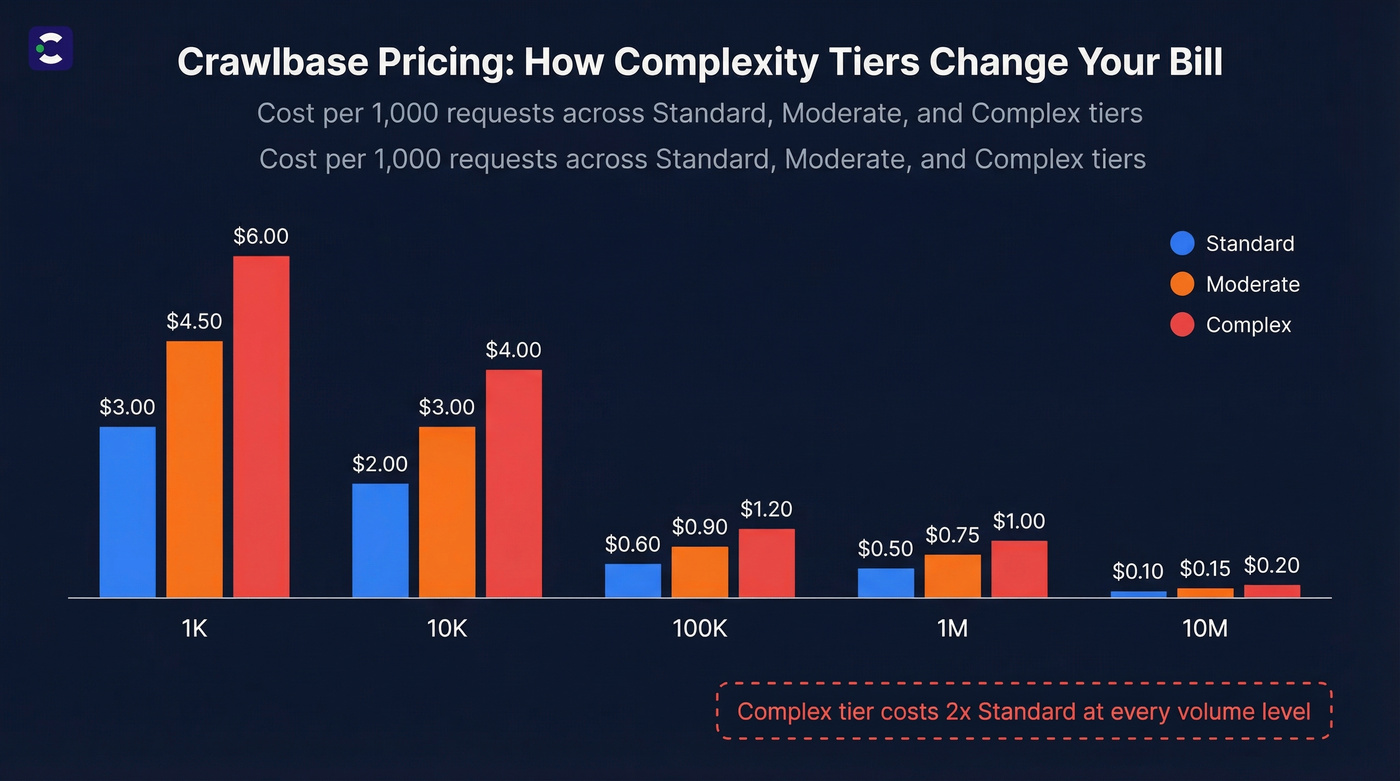
You only pay for successful requests. Pricing scales down with volume across three complexity tiers:
| Volume Tier | Standard | Moderate | Complex |
|---|---|---|---|
| 0-1K | $3.00/1K | $4.50/1K | $6.00/1K |
| Next 10K | $2.00/1K | $3.00/1K | $4.00/1K |
| Next 100K | $0.60/1K | $0.90/1K | $1.20/1K |
| Next 1M | $0.50/1K | $0.75/1K | $1.00/1K |
| Next 10M | $0.10/1K | $0.15/1K | $0.20/1K |
| Next 100M | $0.05/1K | $0.07/1K | $0.10/1K |
| Next 1B | $0.04/1K | $0.06/1K | $0.08/1K |
| After 1B | $0.02/1K | $0.03/1K | $0.04/1K |
The gap between Standard and Complex is 2x at every tier. Check crawlbase.com/pricing for the full schedule.
Smart AI Proxy Plans
These are subscription-based rotating proxies with session control and JS rendering:
| Plan | Monthly | Annual | Threads | Credits |
|---|---|---|---|---|
| Free Trial | $0 | - | 5 | 5,000 |
| Starter | $149/mo | $1,599/yr | 20 | 200K |
| Advanced | $229/mo | $2,249/yr | 40 | 1M |
| Premium | $449/mo | $4,140/yr | 80 | 3M |
JS rendering costs 2 credits per request - roughly 3x cheaper in credits than Scrapfly's JavaScript rendering. Factor that into your credit math if you're rendering a lot of dynamic pages.
LinkedIn & Cloud Storage
LinkedIn scraping carries a flat $15 per 1,000 successful crawls, public pages only. Free credits don't apply.
Cloud Storage runs on its own tiers: Free at 10K requests with 14-day retention, Developer at $29/mo for 100K requests with 30-day retention, and Business at $249/mo for 1M requests with 30-day retention. Enterprise pricing is custom.
What You'll Actually Pay
We ran the numbers on 50,000 Standard-tier pages/month: first 1K at $3, next 10K at $2/1K, remaining 39K at $0.60/1K. Total: roughly $48/month. That's cheap.
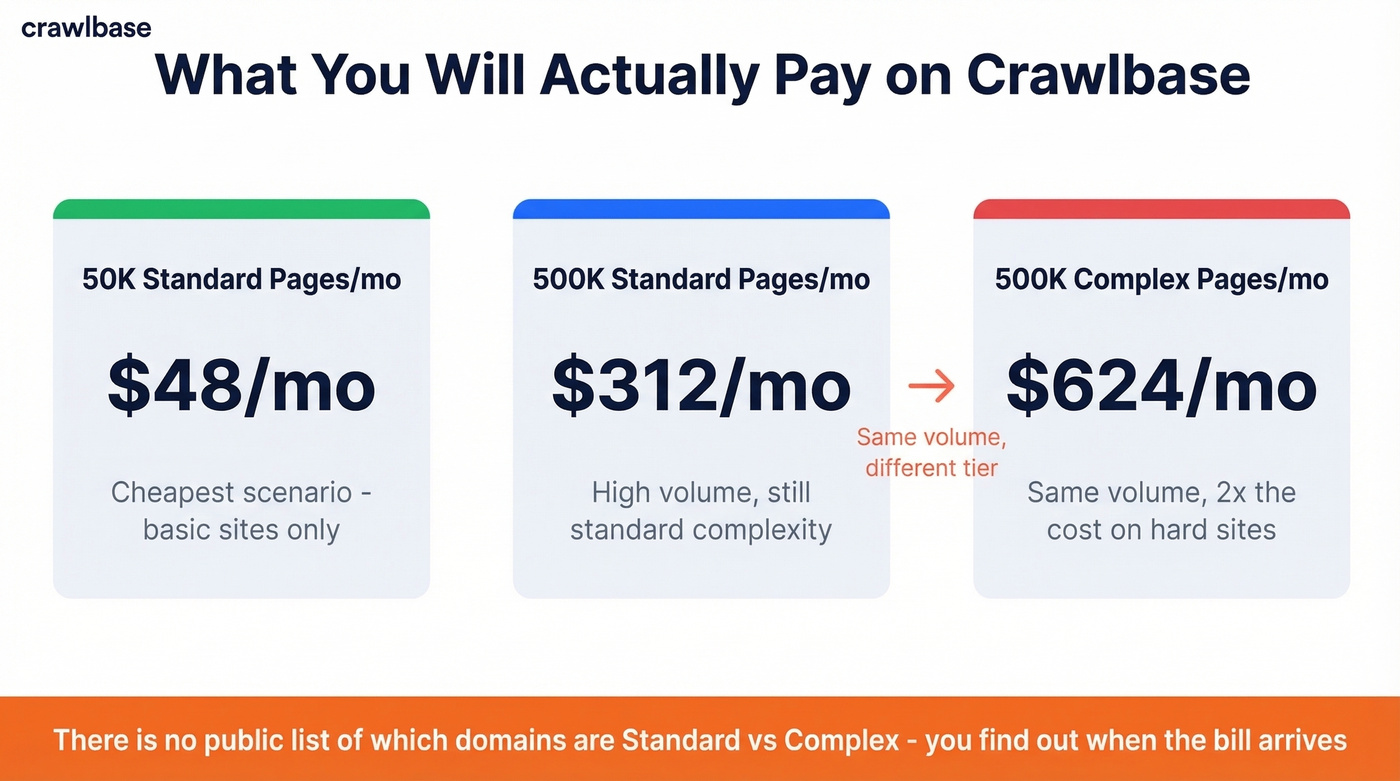
Scale to 500K Standard-tier pages/month and you're around $312/month. Switch those same 500K requests to Complex-tier domains and the bill jumps to ~$624/month. The tier classification makes or breaks your budget, and here's the frustrating part - there's no public list telling you which domains fall into which tier. You find out when the bill arrives.
If you're doing this to build outreach lists, it's worth sanity-checking whether you actually need scraping at all (see: bulk email extractors and sales contact database software).
The December 2024 Pricing Change
If older reviews show different numbers, that's because Crawlbase shifted from a single "Standard" category to three complexity tiers effective December 1, 2024, with updated billing starting January 1, 2025. Volume discounts stayed, but per-request cost now depends on target site difficulty.
Pros and Cons
What works well:
- Affordable at scale for standard-complexity domains - $0.10/1K at the 10M+ tier is hard to beat
- Easy API setup with SDKs for Python, Node, PHP, Ruby, Scrapy middleware, .NET, and Java
- Responsive support - reviewers highlight fast fixes, often under 24 hours
- 1,000 free requests let you test before committing, or 10,000 if you add payment info
- Built-in CAPTCHA and anti-bot bypass to reduce blocks on standard sites
Where it falls short:
- Protected sites cause real pain. One enterprise reviewer put it bluntly: "Sometimes the tool lags a bit, and I spend a lot of time retrying multiple times."
- No public classification list for Standard vs. Moderate vs. Complex domains
- The dashboard UI needs work - a March 2026 Trustpilot reviewer called it "a mess" and complained that SOCKS5 setup was clunky
- No scheduling, no cloud hosting for your code, and no native third-party integrations - features Apify includes out of the box
- HTTP 200 responses on blocked or empty pages can count as "successful" requests, meaning you pay for garbage data without realizing it
Here's the thing: Crawlbase is the Ryanair of scraping APIs. The base fare is unbeatable, but the moment your needs get even slightly complex, the surcharges pile up fast. That's fine if you know what you're buying.

You're comparing scraping API costs to pull contact data from the web. But scraping LinkedIn costs $15/1K crawls on Crawlbase - and you still don't get verified emails. Prospeo gives you 143M+ verified emails at 98% accuracy and 125M+ direct dials for ~$0.01/email. No proxies, no complexity tiers, no parsing.
Skip the scraping pipeline. Get verified B2B data in seconds.
What Real Users Say
Crawlbase sits at 4.2/5 on G2 (5 reviews), 4.2 on Trustpilot (12 reviews), and 4.7 on Capterra (23 reviews). Those are small sample sizes - a 4.7 from 23 reviews, mostly from people scraping a few hundred pages, doesn't tell you much about enterprise reliability.
From the Reddit threads we've seen, there isn't much authentic Crawlbase-specific practitioner feedback; most discussions on r/webscraping focus on tools like Scrapy, Playwright, or premium providers like Bright Data. The recurring theme across review platforms: support is excellent and setup is fast, but the gap between "easy sites" and "protected sites" is wide. If you're only scraping standard-complexity pages, you'll probably love it. The moment you hit a Cloudflare-protected target, expect frustration.
If you're building a pipeline specifically for outbound, you'll also want to think about list hygiene and verification (see: how to verify an email address and data validation).
Crawlbase vs. Alternatives
| Tool | Starting Price | Best For | Key Limit |
|---|---|---|---|
| Crawlbase | Free (1K reqs) | Budget standard scraping | Anti-bot on hard sites |
| Apify | $0-$999/mo | Full-stack automation | Overkill for simple jobs |
| ScraperAPI | ~$49/mo | Simple API, good docs | Pricier at scale |
| Zyte | ~$0.13/1K HTTP reqs | Hardest anti-bot targets | Steeper learning curve |
| Scrapfly | ~$30/mo | High success on protected sites | Smaller ecosystem |
| ZenRows | ~$69/mo | Anti-bot focus | Limited free tier |
| Bright Data | ~$499/mo | Enterprise proxy network | Expensive entry point |
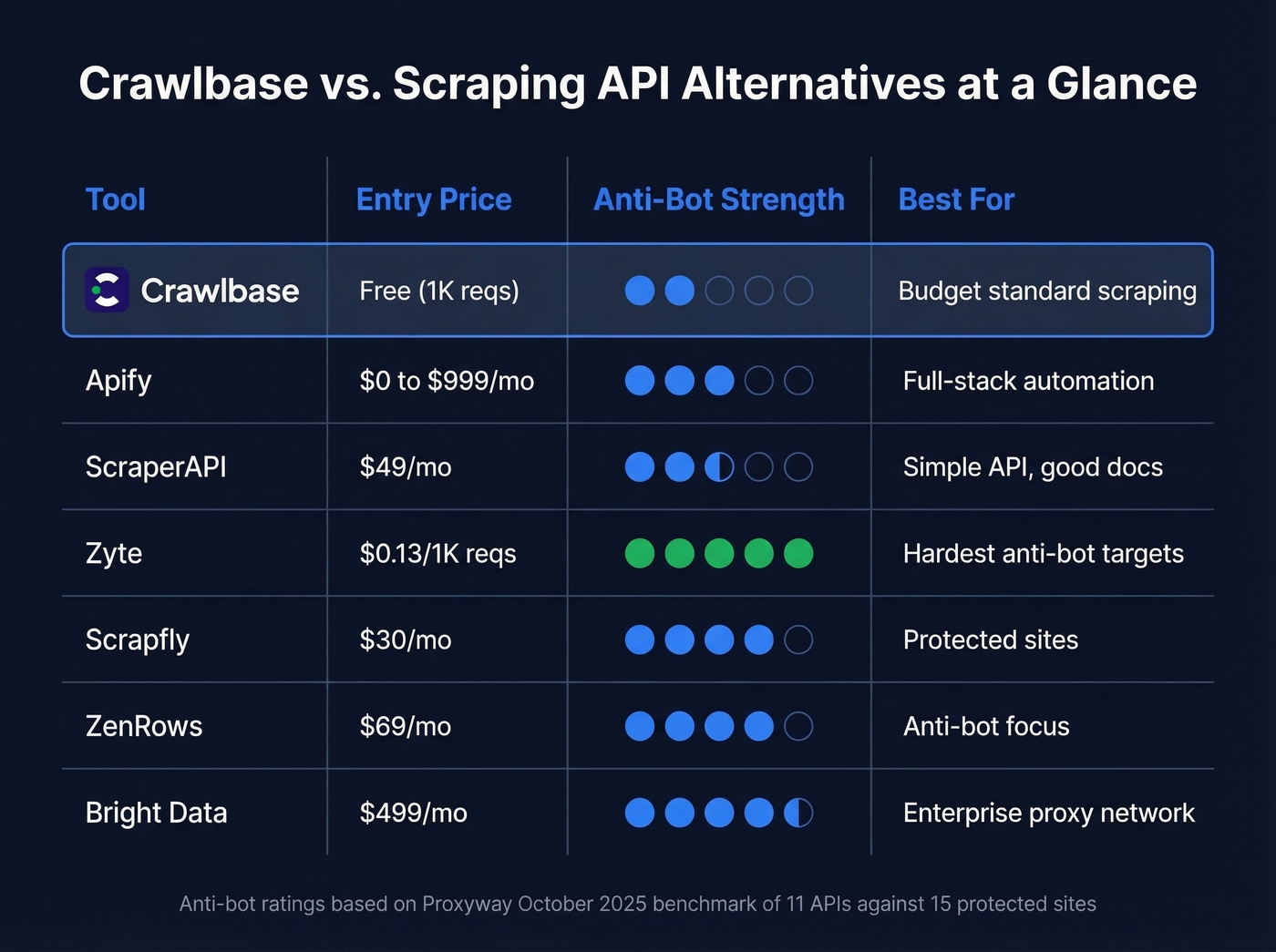
Proxyway's October 2025 benchmark tested 11 scraping APIs against 15 protected websites. Zyte, Decodo, and Oxylabs led on the hardest targets. Budget APIs and premium anti-bot performance rarely coexist - that's the fundamental tradeoff you're making.
When Crawlbase Is the Wrong Tool
Use Crawlbase if you're a developer scraping standard-complexity sites at volume and want the cheapest per-request cost possible. For straightforward e-commerce data, news aggregation, or public directory scraping, it's genuinely hard to beat on price.
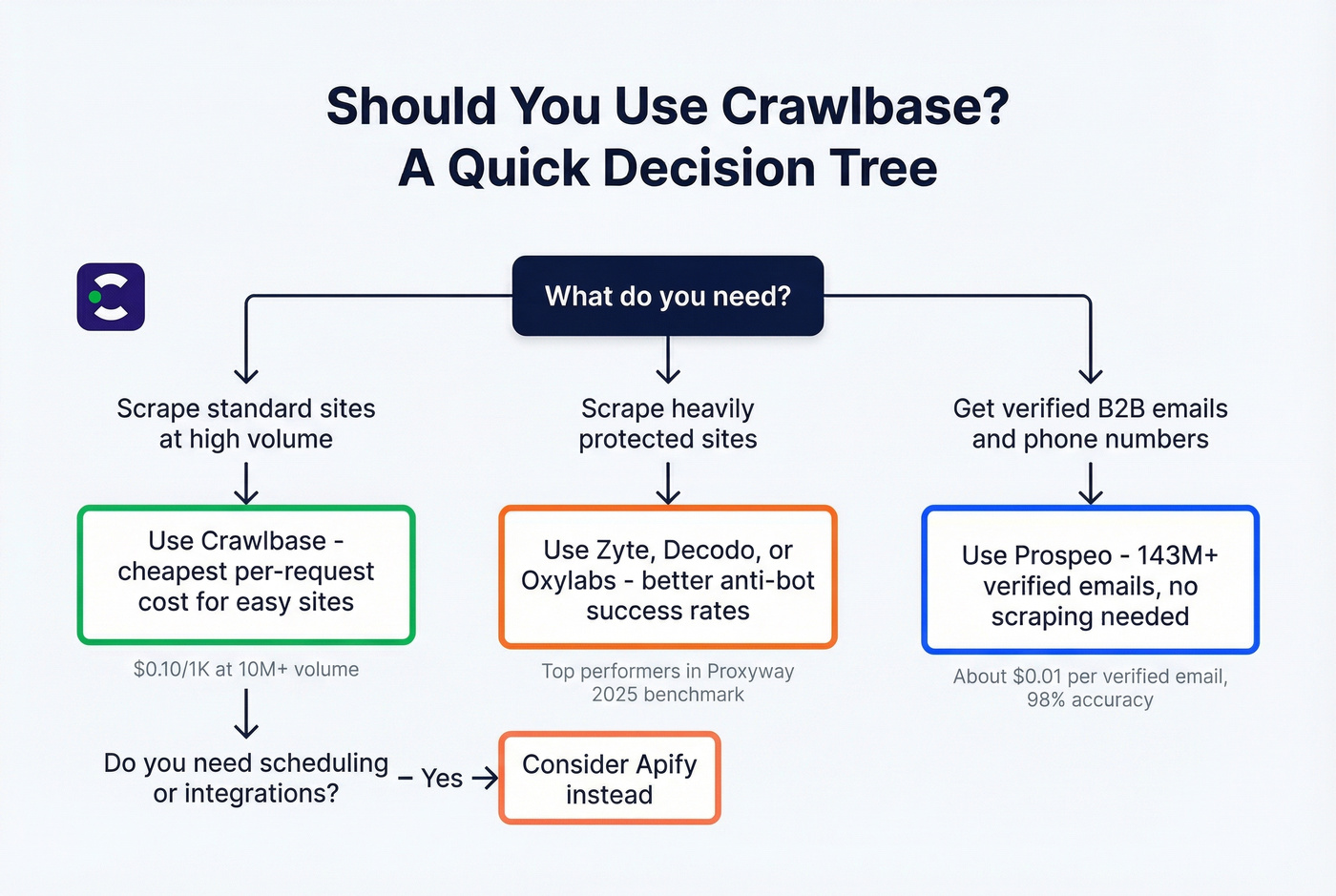
Skip Crawlbase if you need scheduling, cloud code hosting, broad integrations, or reliable performance on heavily protected sites. For enterprise-grade anti-bot unblocking, go with Zyte, Decodo, or Oxylabs.
Skip scraping entirely if your actual goal is verified B2B contact data. We've talked to dozens of teams who built elaborate scraping pipelines just to extract business emails and phone numbers from the web - and most of them wasted weeks of engineering time. Prospeo already has 143M+ verified emails at 98% accuracy and 125M+ verified mobile numbers, at roughly $0.01 per email. No API setup, no proxy costs, no parsing HTML. If contact data is what you're after, scraping is the long way around (and if you're doing cold outreach, pair it with a solid cold email sequence).

Crawlbase charges $0.60-$6.00 per 1,000 requests depending on site complexity - and you still need to parse, deduplicate, and verify every contact you extract. Prospeo delivers 50+ data points per contact, pre-verified on a 7-day refresh cycle, with 30+ search filters including buyer intent and technographics. No scraping infrastructure required.
Pay for clean data, not failed requests on protected sites.
Final Verdict
Crawlbase is a solid budget scraping API for standard-complexity sites at scale. The pricing is competitive at high volumes, and in our experience, the support team punches above its weight for a tool at this price point. But the complexity tiers mean your actual bill depends on what you're scraping, the dashboard needs a refresh, and protected sites will burn your patience.
Weigh these pros and cons carefully. For anything beyond straightforward scraping - especially if your end goal is B2B contact data - there are better, purpose-built tools for the job (start with best email lookup APIs if you still want an API-first workflow).
FAQ
Does Crawlbase have a free plan?
Yes. You get 1,000 free Crawling API requests with no credit card, or 10,000 if you add payment info. The Smart AI Proxy offers a 5,000-credit trial. LinkedIn requests aren't included in any free credits.
Is Crawlbase reliable on protected websites?
Mixed results. Standard sites work well, but users consistently report lag and retries on heavily protected targets. Proxyway's 2025 benchmark found Zyte, Decodo, and Oxylabs outperforming most competitors on the hardest sites. Expect 90%+ success rates on standard domains, but significantly lower on complex ones.
What's the best alternative for B2B emails?
If you want verified business emails rather than raw web scraping, Prospeo is purpose-built for that - 143M+ verified emails, 98% accuracy, free tier with 75 emails per month. At roughly $0.01 per email, it's cheaper and faster than building a scraping pipeline to extract contact data yourself.