

How to Build a Cold Email Sequence That Gets Replies in 2026
You launched 500 emails last week. Open rate: 12%. Replies: three. The instinct is to rewrite subject lines and tweak copy, but we've watched teams burn months optimizing words when the real problem was infrastructure. Your cold email sequence isn't broken - your sending setup is.
Let's fix that.
What You Need Before Writing a Word
Before you draft a single subject line, nail these four things:
- Set up 3-5 secondary domains with SPF, DKIM, and DMARC (scale to 10+ for high volume).
- Verify every address - bounce rates above 2% get mailboxes throttled and wreck deliverability.
- Build a 4-7 step sequence with graduated spacing (2, 4, 7, 14 days).
- Keep emails under 80 words, plain text, no links, soft CTA.
Skip any of these and you're optimizing copy that never reaches an inbox.
What Good Sequences Actually Return
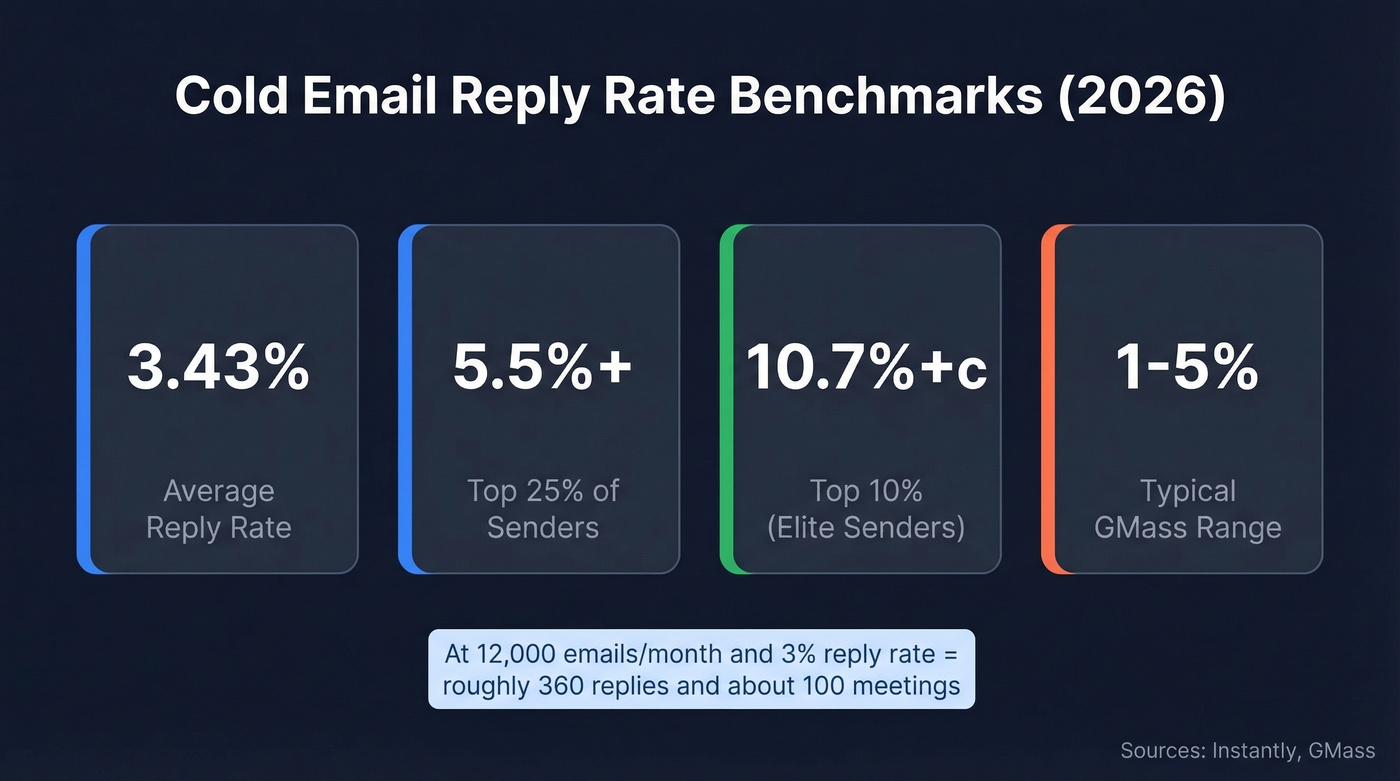
At 12,000 emails per month and a 3% reply rate, that's roughly 360 replies turning into about 100 meetings. A real pipeline engine - but only if your emails land in inboxes. One subject line worth remembering: "Quick question" pulled 39% opens in one test, while "Partnership opportunity" came in under 19%.
The Deliverability Foundation Most Guides Skip
Here's the thing: 87% inbox placement is achievable with proper infrastructure. Without it, you're looking at 40-70%. That gap is the difference between a working channel and a waste of money. (If you want the full technical breakdown, start with this email deliverability guide.)
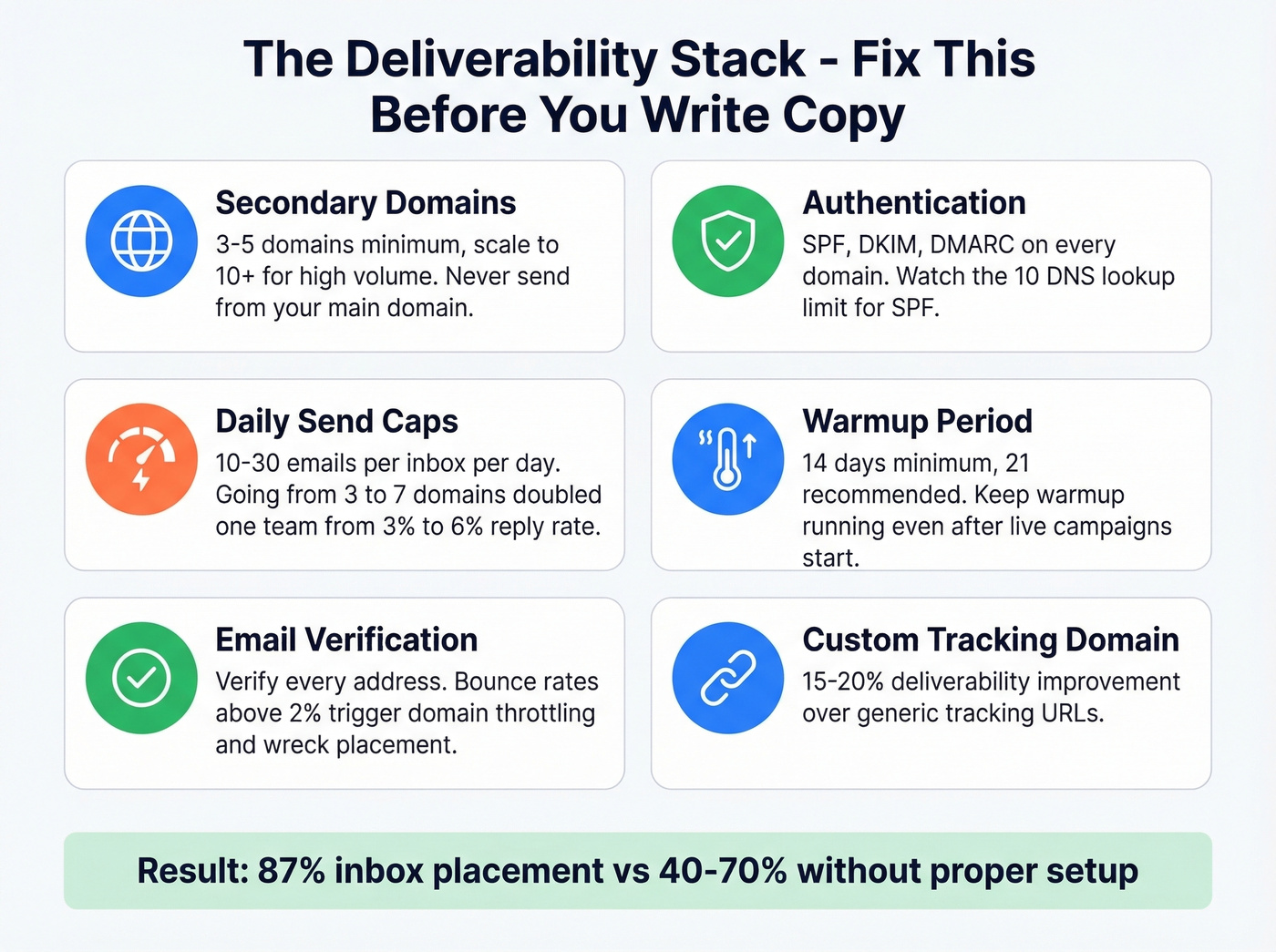
Secondary domains are non-negotiable. Never cold email from your main domain. Use Google Workspace or Microsoft 365 inboxes, not free Gmail or Yahoo accounts.
Daily caps matter more than most people think. Keep sends to 10-30 emails per inbox per day. A B2B marketer documented on Reddit how expanding from 3 to 7 domains and capping at 26 per day doubled their reply rate from 3% to 6%. That's not a copy change - it's pure infrastructure.
Authentication means SPF, DKIM, and DMARC on every domain. One gotcha: SPF has a 10 DNS lookup limit, and exceeding it causes silent failures that tank your placement.
Custom tracking domains deliver a 15-20% deliverability improvement over generic tracking URLs. Warmup takes 14 days minimum, 21 recommended, and you should keep warmup running even after you start sending live campaigns. (More on setup in our tracking domain guide.)
Verify every address before it enters your sequence. Prospeo's 5-step verification catches spam traps and honeypots - a single bad batch pushes bounce rates past 2% and triggers domain throttling. If you're troubleshooting, start with email bounce rate benchmarks and fixes, then move to spam trap removal.

At scale, teams run 100+ inboxes across dozens of domains. Budget roughly $420/month for a full sending stack covering domains, inboxes, warmup, sending platform, and verification.

Bounce rates above 2% wreck your sequence before anyone reads your copy. Prospeo's 5-step verification - with spam-trap removal, honeypot filtering, and catch-all handling - delivers 98% email accuracy. At $0.01 per email, cleaning your entire list costs less than one bounced domain recovery.
Stop optimizing copy that bounces. Fix the data first.
Cold Email Sequence Structure That Works
The sweet spot is 4-7 touchpoints. 58% of replies come from step 1, which means 42% come from follow-ups. Skip them and you leave nearly half your replies on the table. (For more examples, see our B2B cold email sequence guide.)
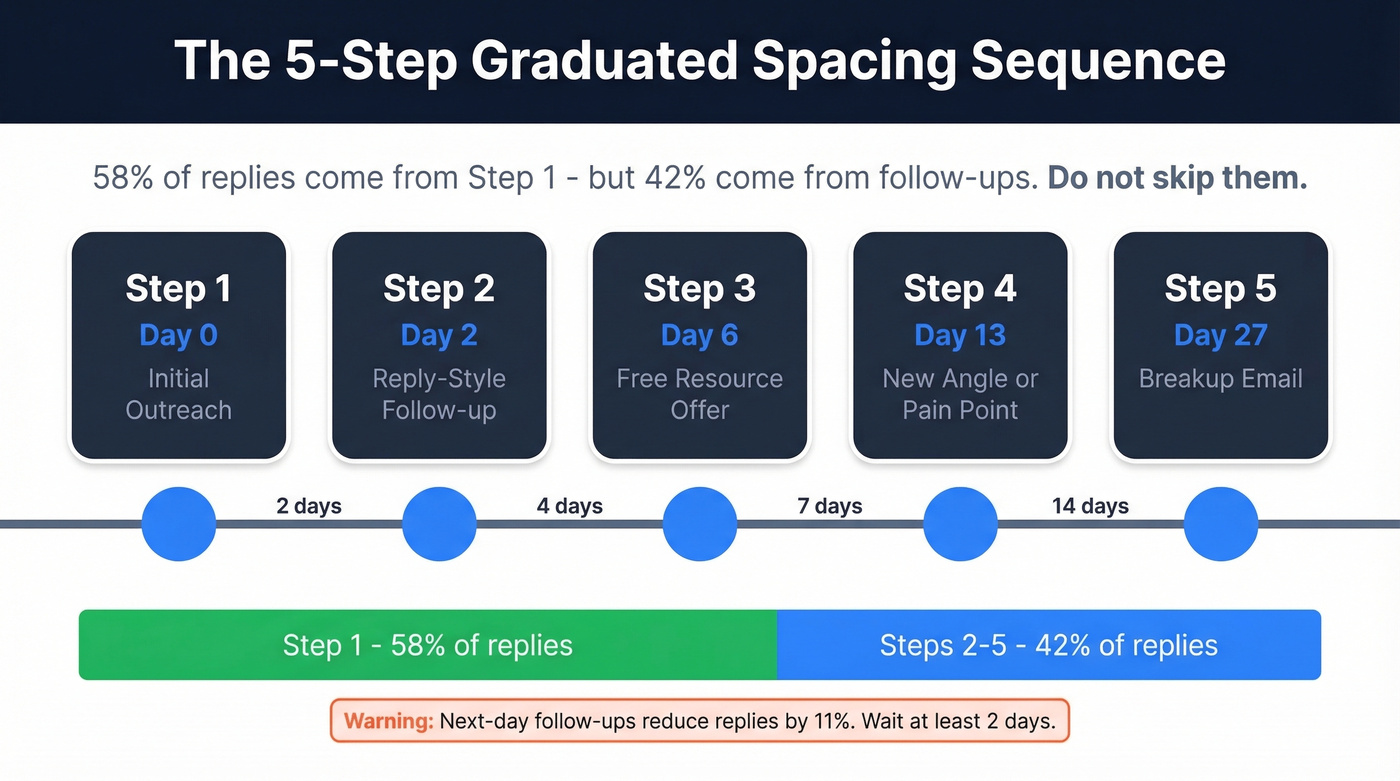
But timing matters more than volume. Next-day follow-ups reduce replies by 11%, while waiting three days increases them by 31%. Use graduated spacing, not static intervals:
Step 1 → 2 days → Step 2 → 4 days → Step 3 → 7 days → Step 4 → 14 days → Step 5
Static spacing looks automated to both recipients and spam filters. Graduated spacing mimics how a real person follows up - because that's exactly what you're trying to simulate.
Our hot take: most teams over-invest in email copy and under-invest in channel mix. No more than 50% of your sequence steps should be email. The rest should be phone, social touches, or other channels. The biggest account one practitioner ever closed came after receiving a 7-part sequence three times over a year. Play the long game.
Step-by-Step Templates You Can Steal
SMB Sequence (5 Steps)
Step 1 - Day 0: Under 56 words. One question. No links.
Subject: Quick question
Hi {{firstName}}, noticed {{company}} just {{trigger event}}. We help similar teams {{one-line value prop}}.
Is this worth a quick chat?
Step 2 - Day 2: Reply-style follow-up. Reply-style emails outperform formal follow-ups by roughly 30%, so keep it casual: "Bumping this - we may not be a fit, but happy to share what's working for {{similar company}}." (If you want more options, pull from these cold email follow-up templates.)
Step 3 - Day 6: Offer a free resource. Don't link it - describe it and offer to send.
Step 4 - Day 13: New angle. Different pain point, different persona, or a specific result you've driven for a similar company.
Step 5 - Day 27: Breakup. "Should I close the file on this? If {{pain point}} comes back up, I'm here."
Mid-Market Multichannel (8 Steps, 14 Days)
- Day 1: Email - initial outreach, under 80 words, soft CTA
- Day 2: Social - connect on a professional network, no pitch
- Day 4: Email follow-up with new value angle
- Day 5: Call attempt + voicemail referencing your emails
- Day 7: Social - engage with their content
- Day 9: Email - different pain point, fresh angle
- Day 11: Social DM if connected, referencing prior touchpoints
- Day 14: Breakup email
Before launching either sequence, you need verified contacts. Prospeo's Chrome extension pulls verified emails from any company website or professional profile in one click - 40,000+ users rely on it for exactly this workflow. (If you're still building lists, start with how to generate an email list.)

Best send window: Tuesday through Thursday, 9-11 AM in the recipient's timezone. Reply to every response within 12 hours. Speed matters more than polish. (More data here: best time to send cold emails.)
Writing Copy That Converts
Keep every email under 80 words. One practitioner cut emails from 141 to 56 words and saw measurable improvement. Plain-text feel - no images, no tracking pixels. Skip links in the first email entirely; they trigger spam filters and distract from your ask. If you want to go deeper on structure and phrasing, use this email copywriting guide.
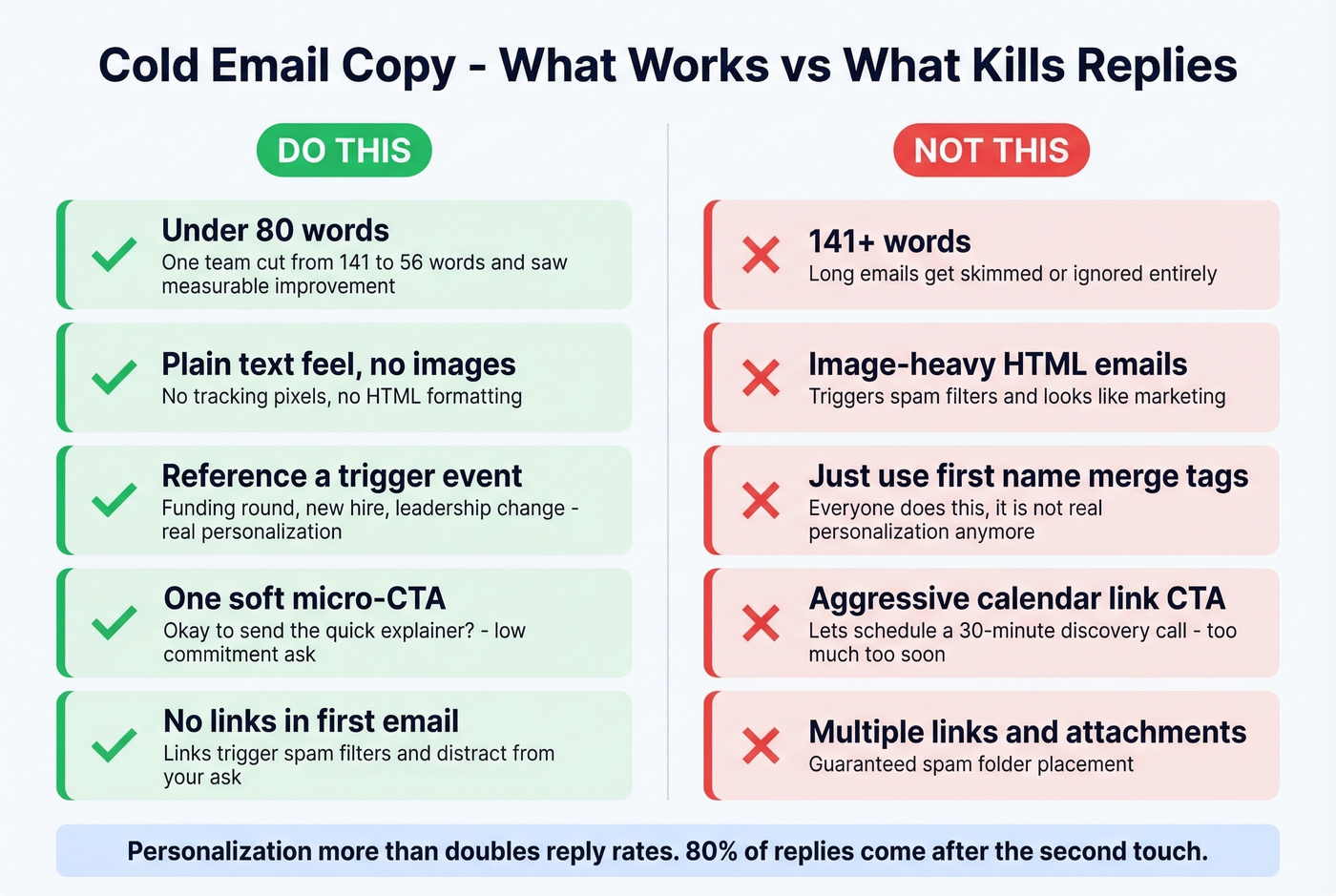
Personalization more than doubles reply rates. Reference a trigger event - funding round, new hire, leadership change - not just their first name. Use one micro-CTA per email: "Okay to send the quick explainer?" converts better than "Let's schedule a 30-minute discovery call."
And remember: 80% of replies come after the second touch. A/B test subject lines and CTAs weekly. Top performers iterate constantly, and the teams we've seen hit 10%+ reply rates treat every send as an experiment, not a broadcast. (For more angles, see cold email subject line examples.)
Compliance You Can't Ignore
CAN-SPAM carries fines up to $53,088 per email. Include a physical address and honor opt-outs within 10 business days. GDPR penalties reach up to EUR20M or 4% of global turnover - document your Legitimate Interest Assessment before sending to EU contacts. For bulk senders, one-click unsubscribe headers (RFC 8058) are required, spam complaints must stay under 0.3%, and bounces under 2%.
One spam complaint spike can torch months of domain warmup. Any outbound strategy that ignores legal requirements is building on sand.
Building a 4-7 step sequence means nothing if you're emailing outdated contacts. Prospeo refreshes 300M+ profiles every 7 days - not the 6-week industry average. Pull verified emails and direct dials from any company site with the Chrome extension 40,000+ prospectors already use.
Every follow-up needs a real inbox behind it. Start with verified contacts.
FAQ
How many emails should a cold email sequence have?
Four to seven steps is the proven sweet spot. Beyond seven, diminishing returns kick in unless each step adds genuinely new value. Keep emails to 50% or fewer of total multichannel steps - mix in calls and social touches for the rest.
What's a good reply rate for cold outreach?
Average is 3.43% and the top 10% of senders exceed 10.7%. If you're consistently below 1%, check your bounce rate and domain reputation before rewriting copy. Deliverability issues kill results faster than weak messaging.
How do I stop cold emails from going to spam?
Configure SPF, DKIM, and DMARC on secondary domains, verify every address before sending, and keep daily sends under 30 per inbox. Use a custom tracking domain, run warmup continuously, and monitor your sender reputation weekly. The consensus on r/coldemail is that infrastructure fixes outperform copy changes by a wide margin.
What's the best day and time to send cold emails?
Tuesday through Thursday between 9-11 AM in the recipient's local timezone consistently outperforms other windows. Avoid Mondays when inboxes are overloaded and Fridays when people check out early. Always respond to replies within 12 hours regardless of when they land.