

The Best CRM for Prospecting - And the Layer Most Teams Forget
You imported 500 contacts from a trade show last quarter. Sixty days later, 30% of those emails bounced. Your sequences tanked, your domain reputation took a hit, and your SDRs spent two weeks manually Googling replacements. The CRM did its job - it stored the contacts. It just didn't tell you the data was garbage.
That's the gap nobody warns you about when choosing a CRM for prospecting: almost 20% of cold emails get flagged as spam, and bad contact data is the silent driver behind most of it.
Our Picks (TL;DR)
| Tool | Best For | Starting Price | Prospecting Strength |
|---|---|---|---|
| Prospeo | Verified data + CRM enrichment | Free (75 emails/mo) | 98% accuracy, 7-day refresh, native CRM integrations |
| HubSpot Sales Hub | All-in-one for scaling teams | $20/seat/mo | Deep ecosystem, Breeze AI, sequences at Professional |
| Pipedrive | Visual pipeline for SMBs | $14/seat/mo | Clean UI, drag-and-drop pipeline |
| Apollo.io | Database + sequences on a budget | Free tier available | 210M+ contacts, built-in sequences, lightweight CRM |
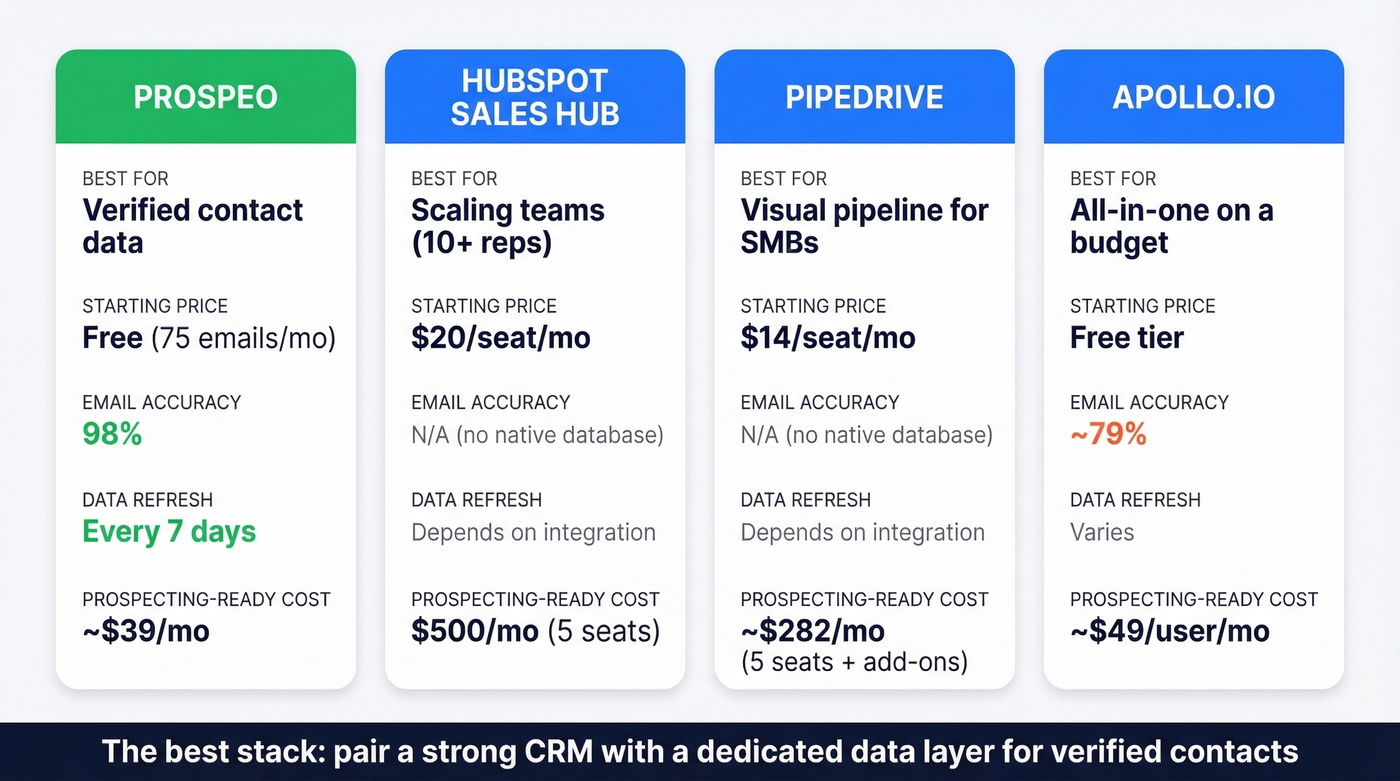
HubSpot and Pipedrive are the strongest pure CRMs on this list. Apollo blurs the line between database and SDR CRM in a way that works for lean teams. But none of them solve the data quality problem that quietly kills outbound - that requires a dedicated data layer underneath.
Why Your CRM Isn't Built for Prospecting
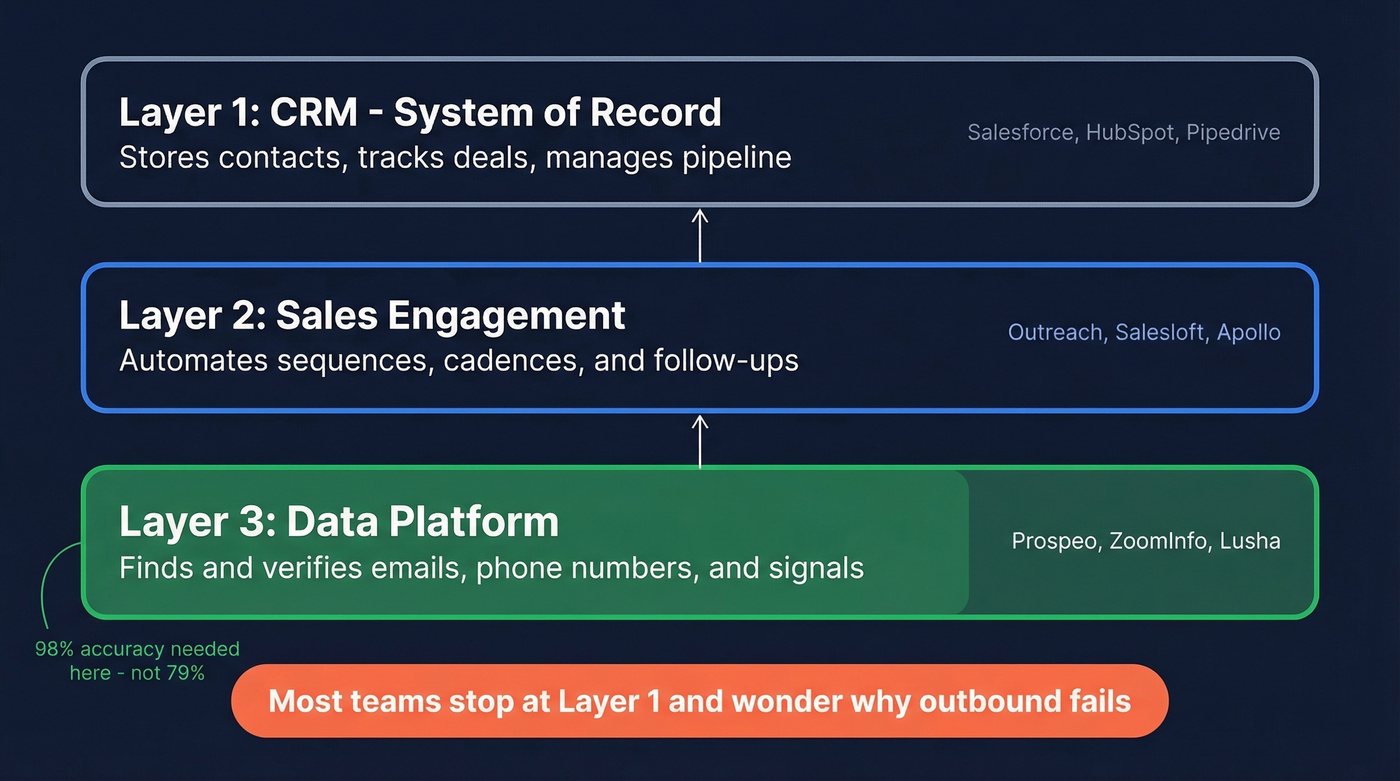
Three categories get lumped together constantly, and they're not the same thing.
| Layer | What It Does | Examples |
|---|---|---|
| CRM | System of record for contacts and deals | Salesforce, HubSpot, Pipedrive |
| Sales Engagement | Automates outreach sequences and cadences | Outreach, Salesloft, Apollo |
| Data Platform | Finds and verifies contact data | Prospeo, ZoomInfo, Lusha |
A B2B sales CRM stores your pipeline. A sales engagement tool runs your sequences. A data platform gives you accurate emails and direct dials to feed into both. Most teams are stuck at level one - storing contacts - when they need an execution engine with verified data flowing through it.
Here's the math that should make you uncomfortable: cold calling converts at 2.3%. Cold email response rates average 5.1%. Those numbers are already brutal, and they assume you're reaching real inboxes. When a big chunk of your ICP list is stale, your effective response rate drops to nearly nothing.
Best CRMs for Sales Prospecting in 2026
Prospeo - Best for Verified Contact Data
Prospeo covers 300M+ professional profiles, 143M+ verified emails, and 125M+ verified mobile numbers with a 98% email accuracy rate and a 30% mobile pickup rate. The database refreshes every 7 days - roughly six times faster than the industry average. You get 30+ search filters including buyer intent powered by Bombora, technographics, job changes, and funding signals.

We've seen the before-and-after on this firsthand. Snyk's team of 50 AEs was running a 35-40% bounce rate before switching. After adding Prospeo, bounces dropped under 5%, AE-sourced pipeline jumped 180%, and they generated 200+ new opportunities per month. That's not a marginal improvement - it's a different business.
Pricing runs about $0.01 per email on a credit-based model. The free tier gives you 75 verified emails and 100 Chrome extension credits per month. No contracts, no sales calls required. Native integrations push directly into Salesforce, HubSpot, Lemlist, Instantly, Smartlead, and Clay.
Use this if you need the most accurate contact data available and want to pair it with any prospecting CRM on this list. Skip this if you're looking for a standalone pipeline manager - Prospeo is the data engine, not the deal tracker.
HubSpot Sales Hub - Best All-in-One for Scaling Teams
HubSpot is the CRM most teams evaluate first, and for good reason. The ecosystem is deep, the free tier handles basic contact management, and the learning curve is gentle. For sales leaders managing growing teams, it's often the first platform worth serious evaluation.
The free plan covers contact management and limited email tracking. Starter runs $20/seat/month. That's reasonable. Here's the thing, though: sequences - the feature SDRs actually need for prospecting - are locked behind Professional at $500/month for 5 seats. That's $100/seat/month, plus a mandatory $1,500 onboarding fee. Enterprise jumps to $1,200/month for 10 seats with a $3,500 onboarding fee.
Gating sequences behind a $500/month tier is frustrating, especially for teams that picked HubSpot specifically because it looked affordable. Breeze AI adds prospecting intelligence at higher tiers, but the core workflow most SDR teams need requires a real budget commitment.
Use this if you're scaling past 10 reps and want CRM, marketing, and sales engagement under one roof. Skip this if your budget is under $300/month - you'll hit feature walls fast.
Pipedrive - Best Visual Pipeline for SMBs
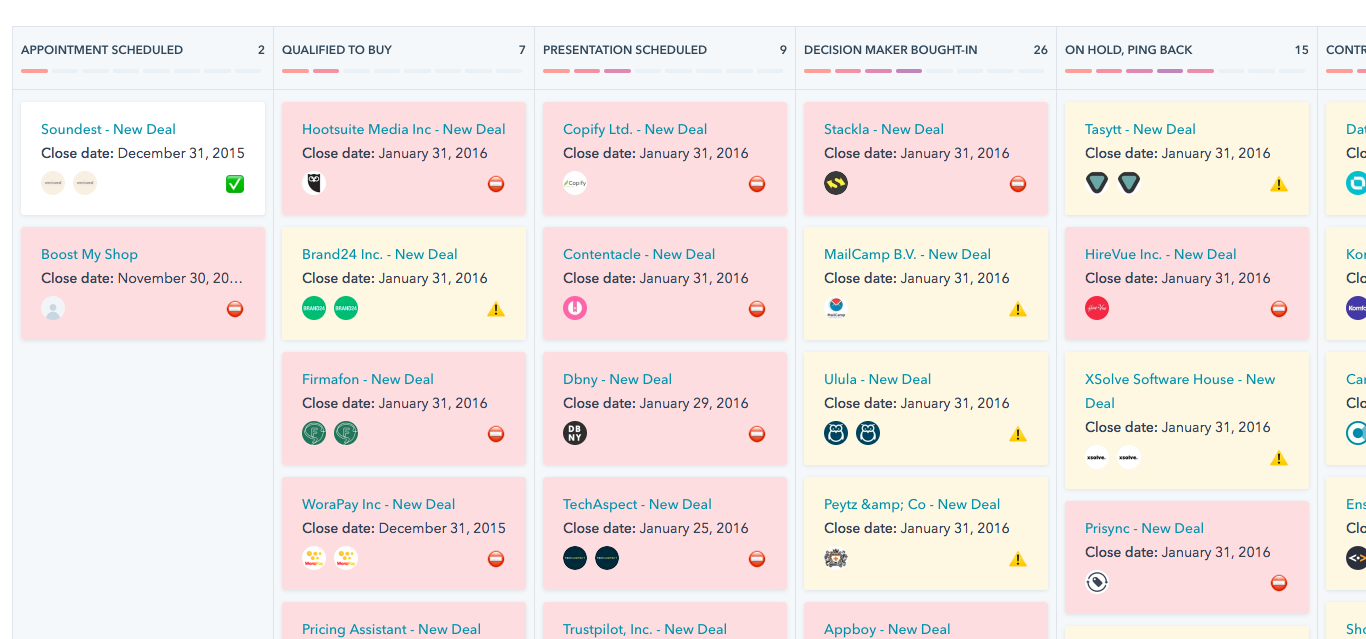
Pipedrive does one thing exceptionally well: visual pipeline management. The drag-and-drop interface is the cleanest in the category, and adoption rates are higher when reps actually enjoy the tool.
Base pricing starts at $14/seat/month for Lite, with higher tiers at $39 (Growth), $59 (Premium), and $79 (Ultimate). Now here's the add-on math that catches people off guard: LeadBooster starts at $32.50/month, Web Visitors tracking adds $41/month, and Campaigns cost another $13.33/month. A 5-person team on Growth with all three add-ons is looking at about $282/month before you've touched integrations.
Pipedrive is excellent for pipeline visibility but mediocre for prospecting out of the box. The base product is a deal tracker, not a lead finder. Pair it with a dedicated data source and you've got a solid stack; rely on it alone and you'll be disappointed.
Apollo.io - Best All-in-One on a Budget
Apollo blurs the line between CRM and data platform more than any other tool here. You get 210M+ contacts, 30M+ companies, built-in email sequences, and a lightweight CRM - with a free tier that's workable for teams under 5. Paid plans start around $49/user/month.
The trade-off is accuracy. Apollo runs about 79% email accuracy, compared to 98% from dedicated verification platforms. That gap means more bounces, more domain risk, and more manual cleanup. If email deliverability is the backbone of your motion, the accuracy gap will cost you more than you save on tooling.
Apollo is the best value for teams that want database, sequences, and basic CRM in one tool and whose average deal size is high enough to absorb some data quality trade-offs. For teams where every bounce matters - agencies running client campaigns, for instance - it's a risk.
Salesforce Sales Cloud - Enterprise Standard
Let's be honest: Salesforce is overkill for roughly 80% of teams shopping for a prospecting-ready CRM.
Base pricing runs $25/user/month (Starter) to $100/user/month (Pro Suite) to $175/user/month (Enterprise) to $350/user/month (Unlimited). A 5-person SDR team on Enterprise with the Sales Engagement add-on ($75/user/month) and a fractional admin easily hits $1,250-$8,000+/month. Implementation runs $5k-$75k depending on complexity.
If you're already on Salesforce, add prospecting layers on top rather than migrating. If you're a team under 20 reps, you'll spend more on configuration than on actual selling.
monday CRM - Flexible Workflows
monday CRM starts free for 2 seats, with paid plans from $9-$19/seat/month. The work OS flexibility is real - you can build almost any workflow. But native prospecting features are shallow, and you'll need external tools for email finding, verification, and sequences. Best for teams that want a customizable deal tracker and already have their data and outreach stack figured out.
Zoho CRM - Budget Option with AI
Zoho CRM serves 250,000+ businesses and offers a free tier with paid plans from about $14/user/month. It's feature-rich for the price. The catch: Zia AI - which handles predictive lead scoring and best-time-to-contact suggestions - is restricted to higher tiers around $40+/user/month. Good for budget-conscious teams willing to grow into the AI features over time.

Your CRM is only as good as the data inside it. Prospeo enriches your Salesforce or HubSpot pipeline with 98% accurate emails and verified direct dials - refreshed every 7 days, not every 6 weeks. Snyk's 50 AEs cut bounce rates from 40% to under 5% and added 200+ opportunities per month.
Stop feeding stale data into your CRM. Start with 75 free verified emails.
What You'll Actually Pay
| Tool | Base Price | Prospecting-Ready | Hidden Costs |
|---|---|---|---|
| Prospeo | Free (75 emails/mo) | ~$39/mo paid tier | None - credit-based |
| HubSpot | $20/seat/mo | $500/mo (5 seats, Professional) | $1,500 onboarding |
| Pipedrive | $14/seat/mo | ~$282/mo (5 seats + add-ons) | Add-on stacking |
| Apollo | Free tier | ~$49/user/mo | Bounce remediation |
| Salesforce | $25/user/mo | $1,250-$8,000+/mo | Implementation, admin |
| monday CRM | Free (2 seats) | $9-$19/seat/mo | External tool costs |
| Zoho CRM | Free tier | ~$40/user/mo for AI | Zia tier gating |
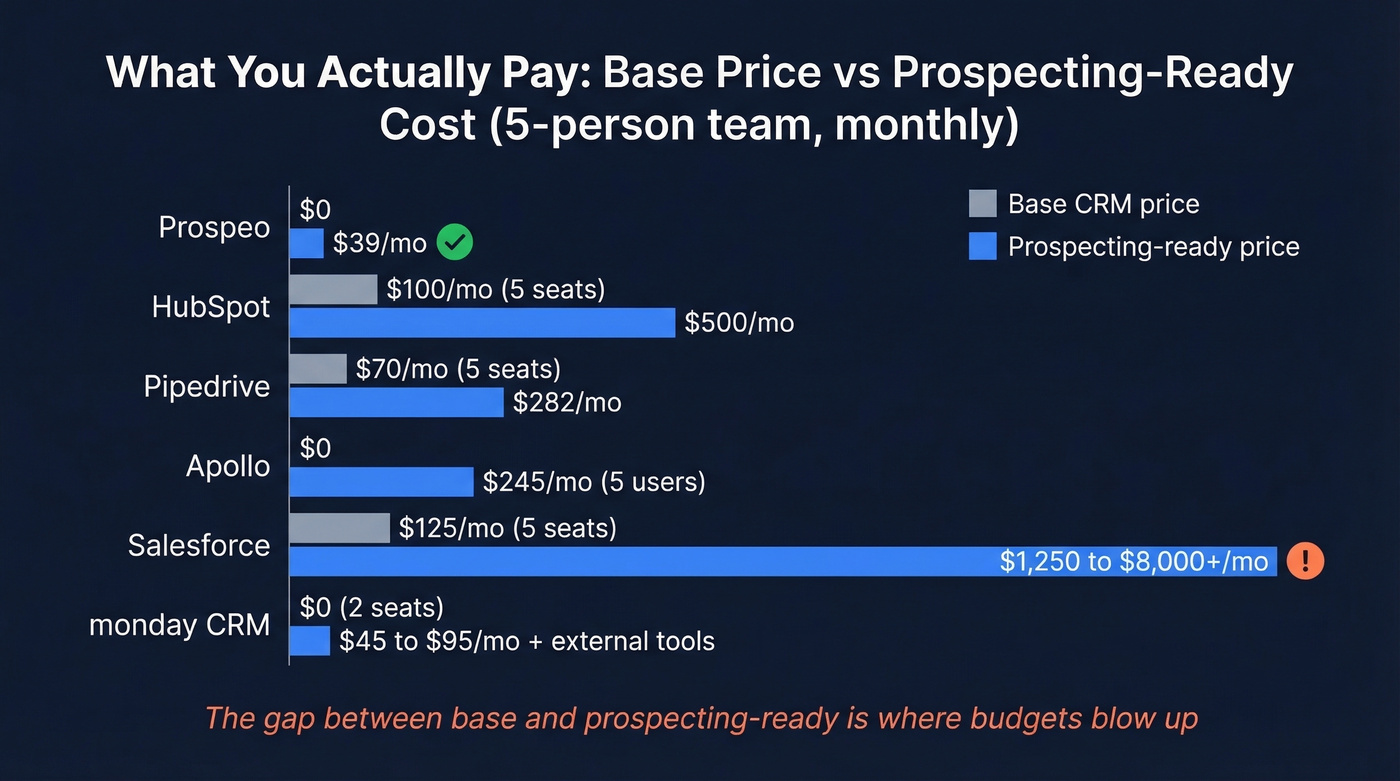
The pricing gap between "base CRM" and "actually ready to prospect" is where most teams get surprised. Pipedrive looks cheap at $14/seat until you add LeadBooster, Web Visitors, and Campaigns. HubSpot looks affordable at $20/seat until you realize sequences require a 25x price jump.
If your average deal size is under $15k, you probably don't need a $500/month CRM tier or ZoomInfo-level data spend. A $14/seat pipeline tool paired with a $39/month data layer will outperform a bloated enterprise stack that nobody on your team fully uses.
Workflows to Set Up on Day One
The teams that get the most from their prospecting stack automate the boring stuff immediately. In our experience, these four workflows are worth configuring in your first week:
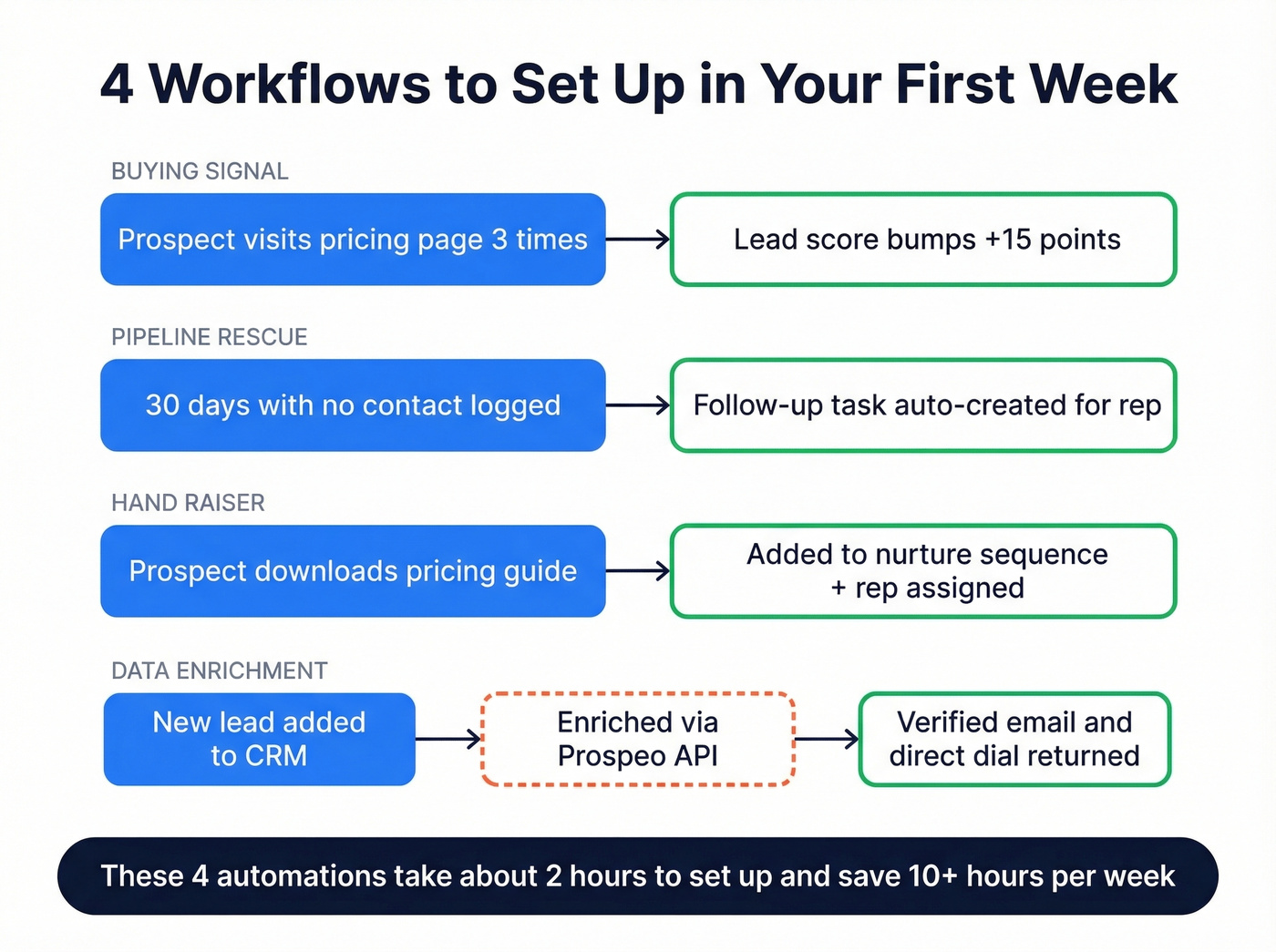
Pricing page visits (3x) - bump lead score by 15 points. This surfaces buying signals without reps manually checking analytics. Most CRMs support this natively or through a simple Zapier trigger.
30-day no-contact - create follow-up task. Prospects slip through cracks. This automation catches them before they go cold. It's dead simple to set up and it'll save deals you didn't even know you were losing.
Pricing guide download - add to nurture sequence + assign rep. The prospect raised their hand. Don't make them wait.
New lead added - enrich via data platform API - verified contact returned. Every new lead enters your CRM with a verified email, direct dial, and company context attached. LivePerson cut per-prospect research from 20 minutes to 2 minutes using this kind of AI-powered workflow.
Teams using AI-powered automation in their prospecting workflows save 4-7 hours per week. Track bounce rate, reply rate, and meetings booked weekly for the first 90 days to validate your stack.
The Data Problem Nobody Talks About
Every CRM comparison focuses on features, UI, and pricing tiers. Almost none address the fact that your prospecting CRM is only as good as the data inside it.
Contact data decays constantly. People change jobs, companies get acquired, email servers get reconfigured. Without regular refreshes, a big chunk of your list goes bad within months - and it compounds every week you keep prospecting on stale records. That's not a hypothetical. We've seen it happen to teams running $50k/year tech stacks who couldn't figure out why reply rates kept dropping. When almost 20% of cold emails get flagged as spam, the data layer isn't optional - it's the foundation your entire outbound motion sits on.

The CRM stores your deals. The engagement tool runs your sequences. But neither one checks if the email address is real. Prospeo plugs into HubSpot, Salesforce, and Pipedrive to enrich every contact with 50+ data points at $0.01 per email - 90% cheaper than ZoomInfo with higher accuracy.
Add the data layer your prospecting CRM is missing.
How to Choose the Right Stack
Three scenarios, three stacks. You don't need 12 tools. You need three, configured well.
$200/month budget: Pair a free or starter data tier with Pipedrive Lite ($14/seat) or HubSpot Starter ($20/seat). Verified data flowing into a clean pipeline for under $200/month covers 90% of what a 2-5 person SDR team needs.
All-in-one, budget flexible: HubSpot Professional ($500/month for 5 seats) or Apollo's paid tier give you CRM plus engagement in one platform. Apollo is cheaper but trades off data accuracy. HubSpot is pricier but the ecosystem depth pays off as you scale past 10 reps.
Enterprise, already on Salesforce: Keep Salesforce as your system of record. Add a dedicated data layer for enrichment, then layer Salesloft or Outreach on top for sequences. This three-tool stack outperforms most bloated enterprise bundles we've evaluated.
The contrarian take? A CRM for prospecting, a data layer, and a sequencer. Everything else is optimization - and optimization only matters once the foundation is solid.
FAQ
What's the difference between a CRM and a sales engagement platform?
A CRM is your system of record for contacts, deals, and pipeline stages - think Salesforce or HubSpot. A sales engagement platform automates outreach sequences, call cadences, and follow-up workflows. Most prospecting teams need both, plus a data layer for verified contact information.
Can I use a free CRM for prospecting?
Yes - HubSpot Free and Zoho Free both handle basic pipeline management. But prospecting features like automated sequences, lead scoring, and enrichment are locked behind paid tiers, often at 5-10x the base price. Budget $50-100/month minimum for a functional outbound workflow.
How often does CRM contact data go stale?
Contact data decays at roughly 2-3% per month as people change roles, companies merge, and emails bounce. Without regular refreshes, 20-30% of your list can go bad within a year. A 7-day refresh cycle dramatically reduces the risk of stale data silently killing your outbound.
What's the most affordable prospecting stack?
Prospeo's free tier (75 verified emails/month) paired with a 1-seat Pipedrive Lite setup ($14/month) gives you verified data and pipeline management for about $14/month total. That's a functional stack for founders and small teams running targeted outbound.
Do I need a separate email finder if my CRM has built-in data?
Usually, yes. Built-in databases typically run 79-87% email accuracy. A dedicated email finder delivering 98% accuracy means fewer bounces, better deliverability, and less time cleaning up bad data after sequences have already run.