

Best CRM for Small Business: 8 Tools That Won't Waste Your Time
A RevOps lead we know ran a three-tool CRM bake-off last quarter. The winner wasn't the tool with the most features - it was the one reps actually opened every morning. The runner-up had better AI, better reporting, and a slick mobile app. Nobody used it.
Most CRM failures for small business teams aren't about the software. They're about the data inside it. Pick a tool your team will use, then fix what goes into it.
What a Small Business CRM Actually Needs
The CRM market is projected to hit $126.17B in 2026, and vendors are racing to add AI, intent signals, and conversation intelligence to justify higher price tags. Small businesses don't need most of that. You need four things working reliably:
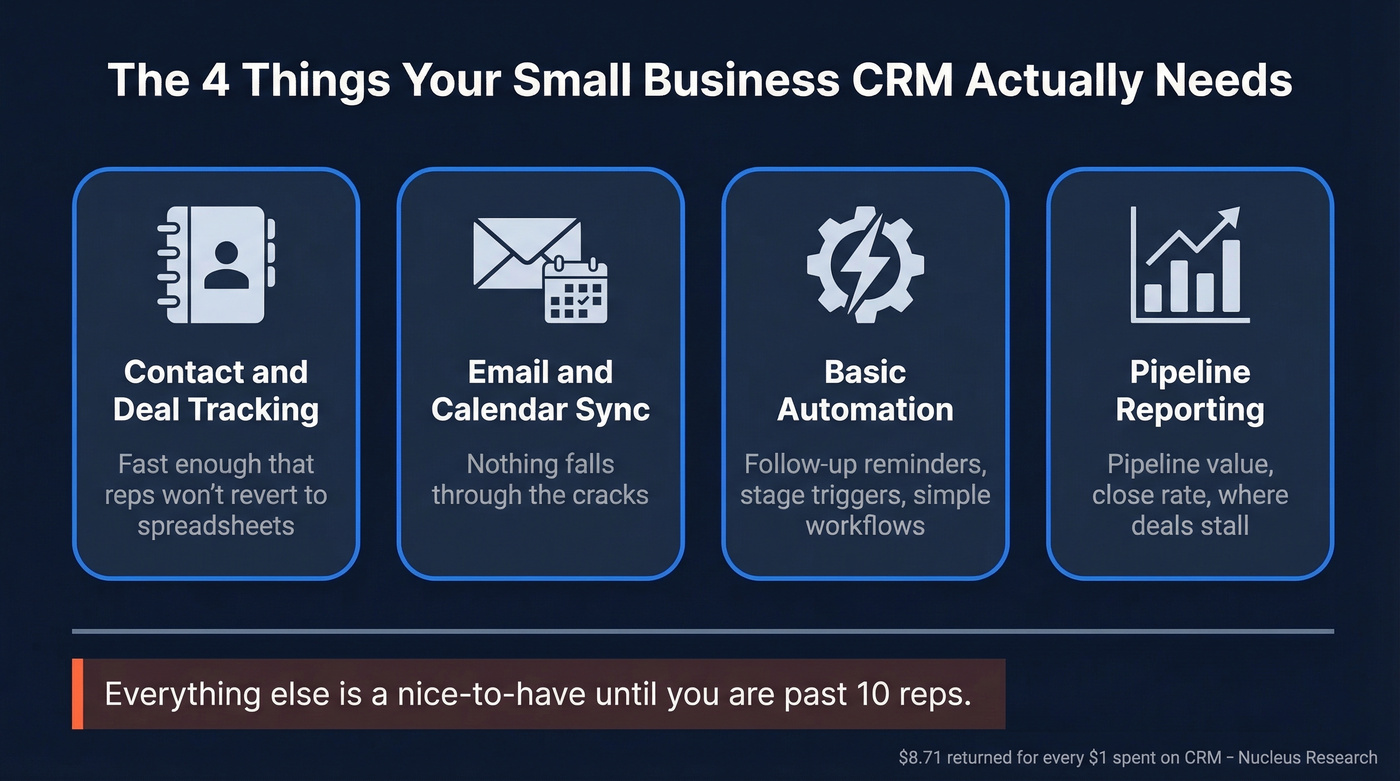
- Contact and deal tracking that's fast enough reps won't revert to spreadsheets
- Email and calendar sync so nothing falls through cracks
- Basic automation - follow-up reminders, stage-change triggers, simple workflows
- Reporting that tells you pipeline value, close rate, and where deals stall
That's it. Everything else is a nice-to-have until you're past 10 reps.
CRM delivers roughly $8.71 for every $1 spent per Nucleus Research, and 83% of small businesses report positive ROI from their investment. But that ROI only materializes if the tool gets adopted. A $7/user tool that reps use daily beats a $40/user platform gathering dust every single time, and we've watched it happen at dozens of companies firsthand - the expensive tool sits there while the team quietly runs deals out of a Google Sheet.
Our Picks (TL;DR)
| Pick | Best For | Starting Price |
|---|---|---|
| Bigin by Zoho | Best overall for small teams | $7/user/mo |
| Freshsales | Best free plan with room to grow | Free (3 users) |
| HubSpot CRM | Best ecosystem for marketing + sales | Free (limited) |
| Prospeo | Best add-on for verified contact data | Free (75 emails/mo) |
Bigin wins on simplicity and price - it's the platform most small teams should start with. Freshsales wins on free-tier generosity, giving you 3 real users with actual support. HubSpot wins on ecosystem breadth, but the upgrade costs will make your eyes water.
And Prospeo isn't a CRM at all - it's the enrichment layer that keeps whichever tool you pick from filling up with garbage data. If you're comparing options, it helps to look at a few examples of a CRM side-by-side before you commit.
Hot take: If your average deal size is under $5,000, you don't need a platform that costs more than $15/user/month. Spend the savings on clean data instead. The most expensive mistake isn't picking the wrong tool - it's running outbound sequences off stale contact records.
What Small Business CRMs Actually Cost
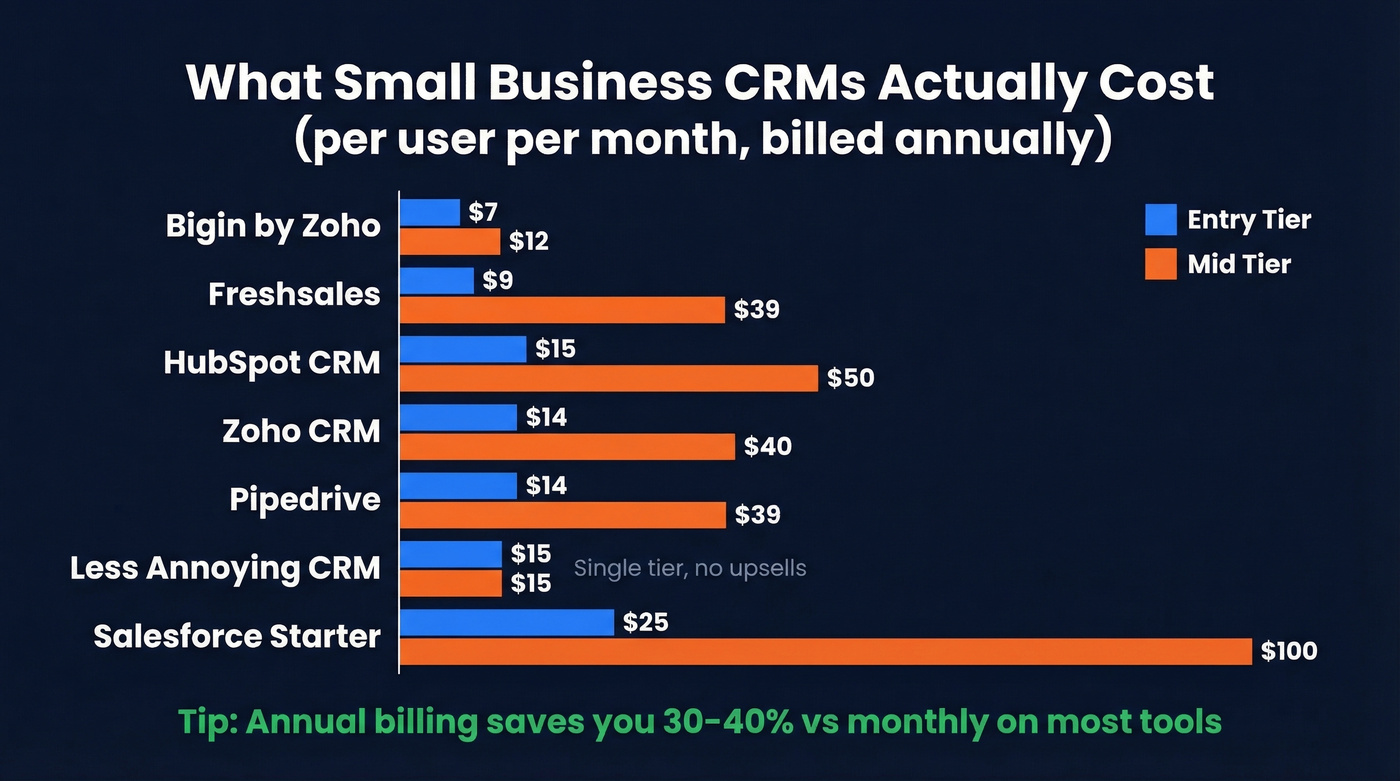
Entry-level plans average about $15/user/month. Mid-tier plans with automation and reporting run ~$60/user/month. Enterprise tiers start around $150/user/month and climb fast.
| Tool | Free Plan | Starts At (annual) | Mid-Tier | Best For |
|---|---|---|---|---|
| Bigin by Zoho | 1 user / 500 records | $7/user/mo | $12/user/mo | Very small teams |
| Freshsales | 3 users | $9/user/mo | $39/user/mo | Growing teams + AI |
| HubSpot CRM | 2 users / 1,000 contacts | $15/user/mo | $50/mo per seat (Pro) | Marketing + sales |
| Zoho CRM | 3 users / 5,000 records | $14/user/mo | $40/user/mo | Budget flexibility |
| Pipedrive | None | $14/user/mo | $39/user/mo | Sales-focused teams |
| Less Annoying CRM | None (1-mo trial) | $15/user/mo | Single tier | Simplicity-first |
| Salesforce Starter | None | $25/user/mo | $100+/user/mo | Salesforce ecosystem |
| Prospeo | 75 emails + 100 ext. credits/mo | ~$0.01/email | Credit-based | Contact data layer |
A few things jump out. The annual vs. monthly spread is significant - Zoho CRM's Standard plan runs $14/user/mo billed annually but $20 monthly. Pipedrive's Lite tier is $14 annual vs. $24 monthly. If you're committing for a year, you're saving 30-40% across most tools. At 5+ seats, that's real money.
If you're planning to run outbound alongside your CRM, make sure you can connect outreach tool to CRM cleanly before you buy.

The CRM you pick matters less than the data you put in it. Prospeo enriches your CRM contacts with 98% verified emails and 125M+ direct dials - refreshed every 7 days, not every 6 weeks. At ~$0.01 per email, it costs less than one bad bounce.
Stop running outbound off stale records. Fix your CRM data today.
Free CRM Plans - What You Actually Get
Free plans are great for getting started. They're terrible for staying on long-term.
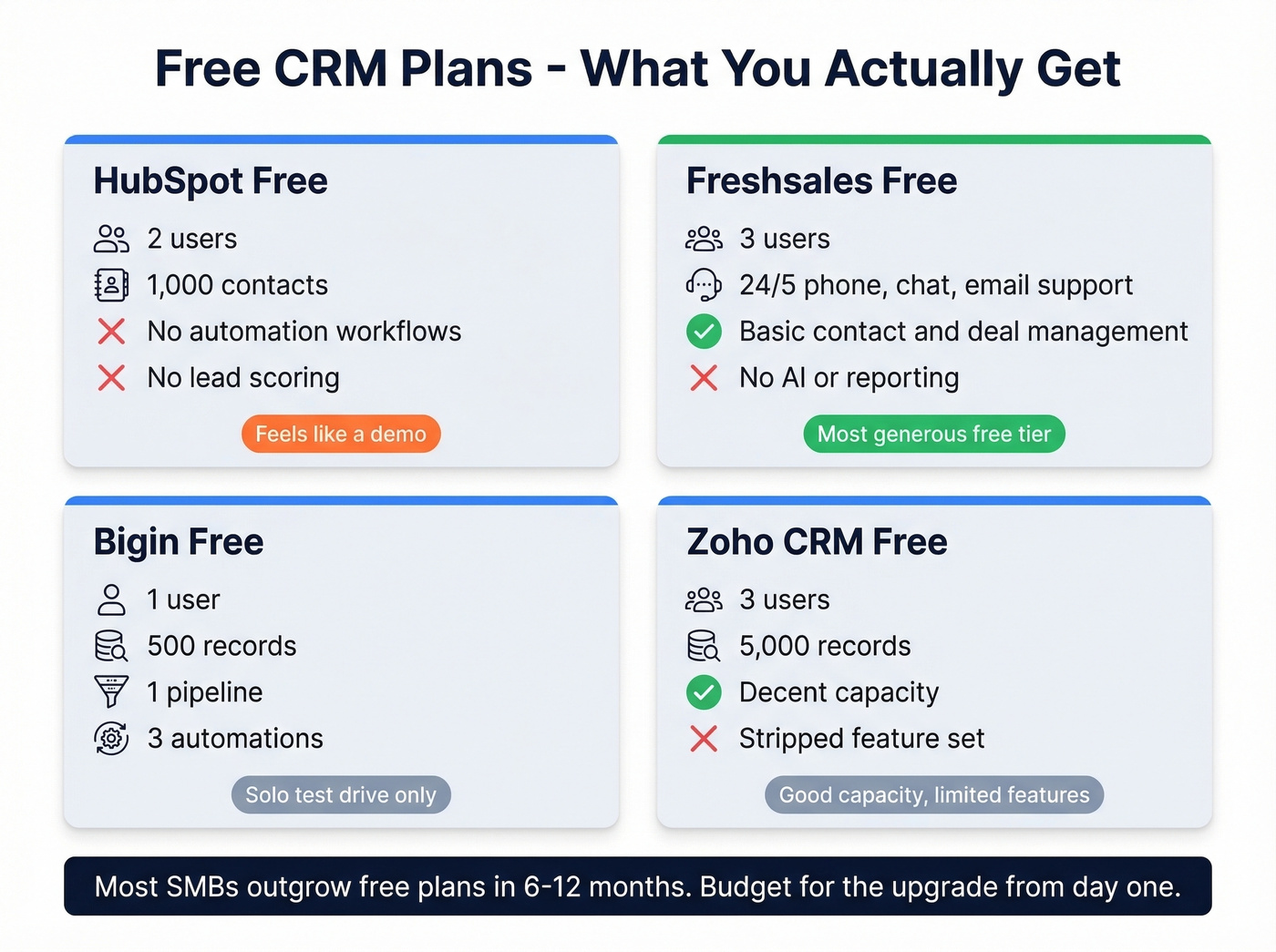
HubSpot Free gives you up to 2 users and 1,000 contacts. No automation workflows. No lead scoring. Limited API access. It's a demo disguised as a product.
Freshsales Free is more generous - 3 users with 24/5 support included. You get basic contact and deal management, but reporting and AI features are locked behind paid tiers.
Bigin Free covers a single user with 500 records, 1 pipeline, and 3 automations. Tight, but enough for a solopreneur testing the waters.
Zoho CRM Free supports 3 users and 5,000 records. Decent capacity, though the feature set is stripped compared to paid tiers.
Most SMBs outgrow free plans in 6-12 months. The trigger is almost always the same: you need a workflow automation, a custom report, or a fourth user. Budget for the upgrade from day one.
Top CRM Tools for Small Business in 2026
Bigin by Zoho - Best Overall
PCMag named Bigin "Best Overall" for small business CRM software, and it's easy to see why. The Express plan at $7/user/mo gives you 3 pipelines, 50,000 records, and 30 automations. That's more than most 5-person teams need for the first two years. The top-tier Bigin 360 plan at $18/user/mo unlocks 15 pipelines, 1M records, and 100 automations - still cheaper than most competitors' entry-level paid plans.

Built-in telephony sets Bigin apart from most budget tools: place and receive calls, IVR, call routing - one fewer tool to buy. If calling is core to your motion, it’s worth comparing CRM + dialer stacks (see cold calling system) before you lock in.
The gap? No AI-powered features and no dedicated Windows desktop app. The free plan (1 user, 500 records, 3 automations) is too tight for anything beyond a solo test drive. But at $7-$18/user/mo across paid tiers, the upgrade is painless.
Freshsales - Best Free Plan to Scale
Freshsales has the most practical free tier in this roundup - 3 users with real support (24/5 phone, chat, and email). That's not a trial. That's a functional platform for a founding team.

The upgrade path is where Freshsales shines. Growth at $9/user/mo adds sales sequences and custom fields. Pro at $39/user/mo unlocks Freddy AI - contact scoring, deal insights, and AI-generated sales emails. Enterprise at $59/user/mo adds forecasting and audit logs. The 21-day free trial lets you test any paid tier before committing.
Where it falls short: marketing automation. Freshsales is sales-focused software first and foremost. For marketing + sales under one roof, HubSpot's ecosystem is harder to beat - if you can afford it. If you need reps to follow a consistent cadence, keep a set of sales follow-up templates handy so the CRM doesn’t become a graveyard of “next steps.”
HubSpot CRM - Best Ecosystem (at a Price)
HubSpot is one of the most widely adopted free CRMs on the market. It's also the one most likely to frustrate you within a year. The free plan's limits - 1 pipeline, 10 custom properties, no workflows, no lead scoring - are designed to get you hooked before the real pricing kicks in.
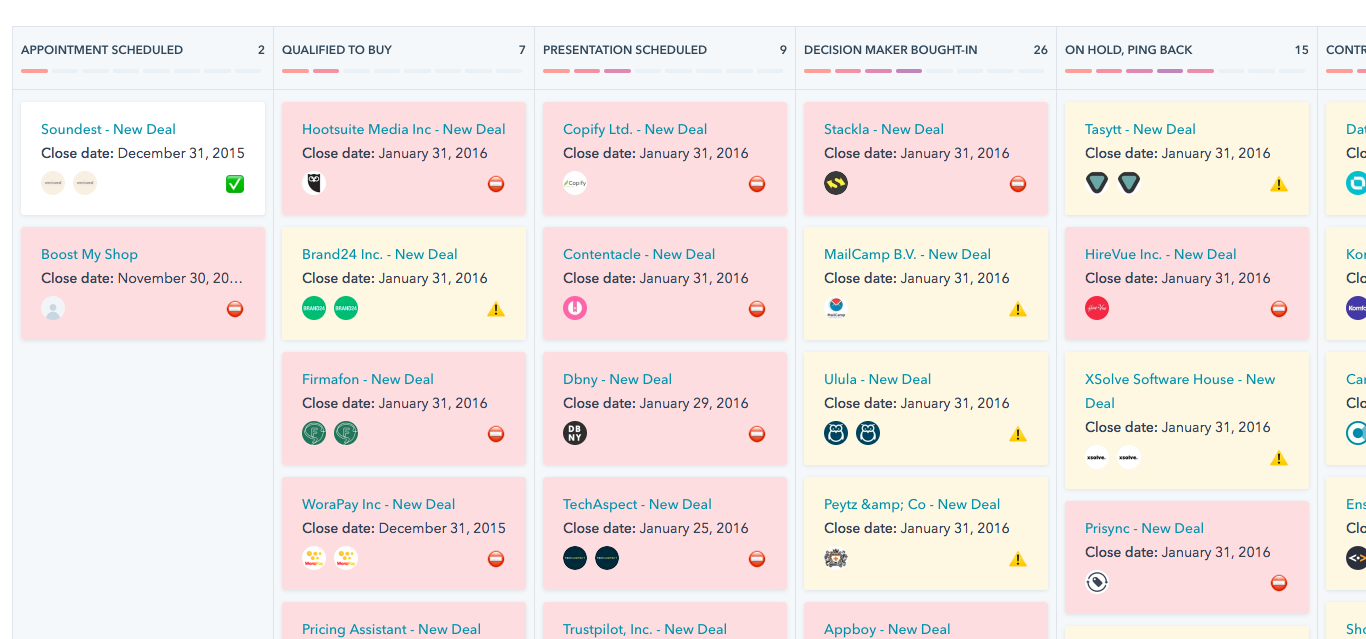
HubSpot makes sense when you're investing in both marketing and sales. The 2,000+ app integrations, content tools, and reporting ecosystem are best-in-class. No other platform matches HubSpot's breadth.
Here's the thing: the Starter-to-Pro jump is brutal. One Reddit user switching away from HubSpot reported a ~$900/month quote for Pro-tier features like automation workflows, custom reporting, and campaign management. That's $10,800/year for features that cost $39/user/mo on Freshsales. The fact that HubSpot doesn't make this pricing jump obvious until you're already invested is genuinely frustrating. If your budget is tight, start somewhere else.
Pipedrive - Best for Sales Teams
Pipedrive does one thing well: visual pipeline management for salespeople. The UI is built around deals, not contacts or marketing campaigns, and it shows. Pricing runs $14-$79/user/mo on annual billing, with 400+ integrations covering most common sales tools.
The consensus on r/sales is that Pipedrive is the go-to HubSpot alternative for teams that don't need marketing features. If your workflow is "find leads, move them through stages, close deals," Pipedrive won't distract you with anything else. It's the CRM equivalent of a sharp knife - does less, does it better.
Skip this if you need built-in marketing automation or a generous free tier. Pipedrive doesn't offer either.
Zoho CRM - Budget Flexibility
Zoho CRM packs enterprise-grade features into SMB pricing - $14-$52/user/mo across four tiers, plus a free plan for 3 users. The Zwitch migration tool makes switching from another platform relatively painless.
Let's be honest about the tradeoffs, though. One small business owner on r/smallbusiness reported wasting roughly 15 hours in a single month fighting performance issues - reports crashing, custom fields glitching, email threads dropping. The 100MB/user storage limit also catches teams off guard. Zoho's feature set is impressive on paper; the execution can be uneven.
Less Annoying CRM - Simplicity, Full Stop
$15/user/mo. One tier. No upsells. No feature gates.
The name is the value proposition. Free phone and email support even if you're not paying yet. AWS-hosted. Keep your database under ~50,000 contacts and you'll be fine. The tradeoff is limited reporting - if you need custom dashboards or advanced analytics, you'll outgrow it. For teams that want a tool that stays out of the way, nothing else comes close at this price.
Salesforce Starter - For Growing Into Enterprise
Salesforce Starter runs $25/user/mo and gives you the Salesforce ecosystem at its simplest. Realistic SMB spend lands between $25-$100+/user/mo once you add features. PCMag flags it as "Pricey," and it still lacks AgentForce AI chatbot functionality - a notable gap given how aggressively Salesforce markets its AI capabilities.
Worth considering only if you know you'll grow into enterprise Salesforce. Otherwise, you're paying a premium for a brand name when Bigin or Freshsales deliver more at half the cost.
How to Choose the Right CRM
Don't overthink this. Three questions get you to the right tool.
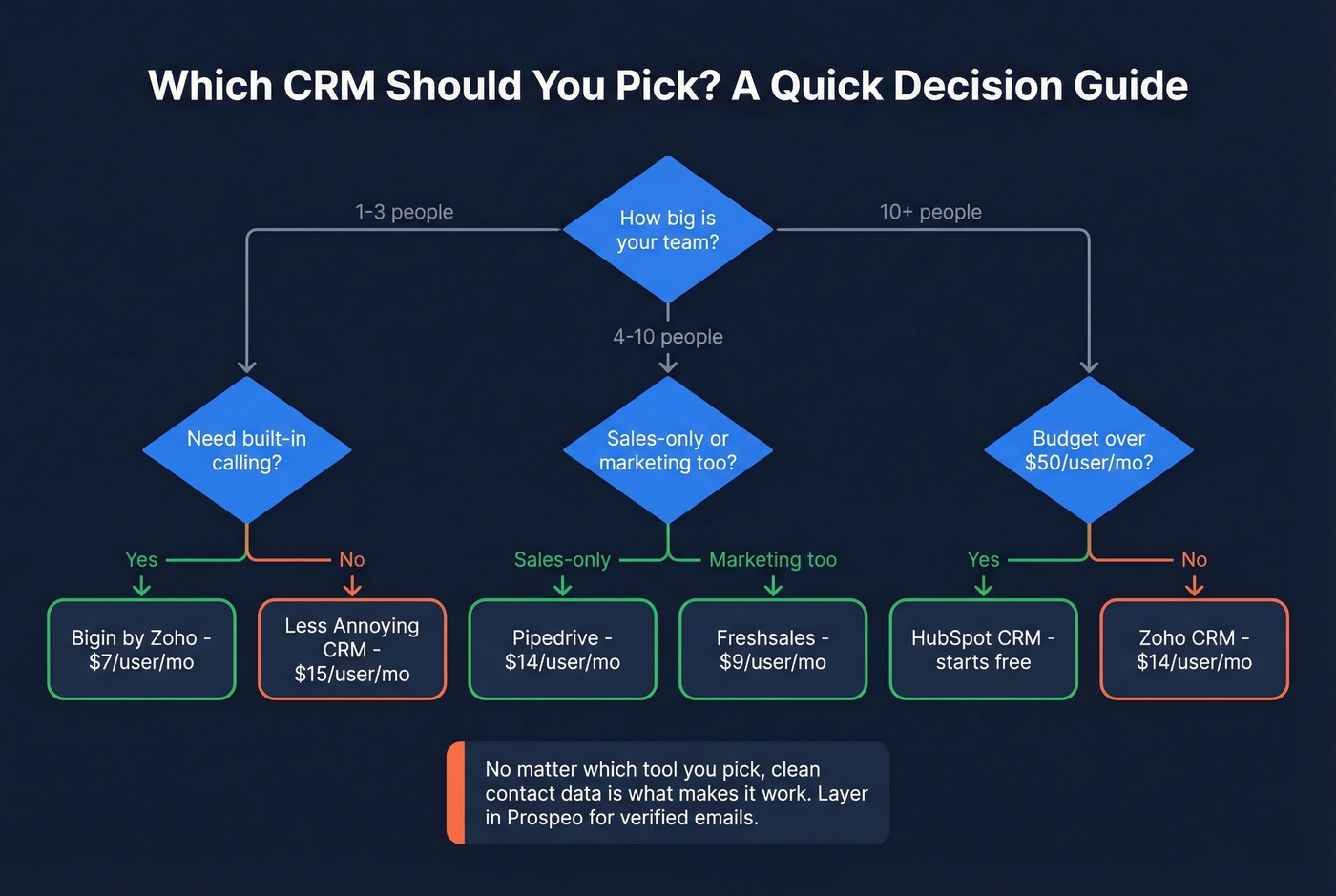
How big is your team? Solo or 1-3 people: Bigin or Less Annoying CRM. Four to ten people: Freshsales or Pipedrive. Beyond ten: HubSpot or Zoho CRM.
What must integrate on day one? Every tool on this list syncs email and calendar. If you need built-in calling, Bigin has it native. If you need accounting integration, check Zoho's ecosystem or Pipedrive's marketplace. For marketing automation, HubSpot is the only real answer here.
How much automation do you need right now? If you don't need automation yet, Less Annoying CRM or Bigin Free will keep things simple. For basic follow-up sequences, Freshsales Growth or Pipedrive will do the job. For advanced workflows with branching logic, you're looking at HubSpot Pro or Zoho Enterprise - and the price tags that come with them.
The biggest implementation mistakes we see: not defining what "a qualified deal" means before setup, not getting reps involved in choosing the tool, and importing dirty data on day one. Schedule data cleanups twice a year at minimum. Build a weekly reporting habit too - 76% of small businesses report increased reporting accuracy after CRM adoption, but only 20% of owners actually check analytics weekly. The other 80% are flying blind. If you want a tighter operating rhythm, track a few sales operations metrics consistently.
Your CRM Is Only as Good as Its Data
Most roundups compare features, pricing, and UI. Almost none talk about what happens six months after implementation, when half your contact records have stale emails, disconnected phone numbers, and job titles from two roles ago.
That's the real problem for any small business CRM - not the software, but the data rotting inside it.
In our experience, teams that skip data hygiene regret it within two quarters. A platform full of stale data is just an expensive address book. This is where Prospeo fits into the stack - a 7-day data refresh cycle keeps your contacts current automatically, with 98% email accuracy so your outbound sequences actually land. It integrates natively with Salesforce, HubSpot, Smartlead, Instantly, Lemlist, Clay, Zapier, and Make, and at roughly a penny per verified email, it's the cheapest line item in your stack with arguably the highest ROI. If you’re evaluating vendors, start with a shortlist of data enrichment services and compare refresh cadence and match rates.
Small business CRMs decay fast - 30% of B2B contact data goes stale every year. Prospeo's CRM enrichment returns 50+ data points per contact with a 92% match rate, plugging directly into HubSpot, Salesforce, or any CSV export. No contracts, no sales calls.
Clean data in, closed deals out. That's the real CRM ROI.
FAQ
How much does a small business CRM cost?
Entry-level plans average $15/user/month, with mid-tier plans around $60/user/month. Free plans from HubSpot, Freshsales, Bigin, and Zoho cap automation, reporting, and user counts. Budget $10-$25/user/mo for a realistic starting point - and factor in annual billing discounts of 30-40%.
Can I use a free CRM long-term?
Most small businesses outgrow free plans within 6-12 months. The breaking point is usually needing workflow automation, custom reporting, or adding a fourth user. Free tiers work for testing and solo use, but plan for a paid upgrade within your first year.
What's the best CRM for small business in 2026?
Bigin by Zoho is the best overall for teams under five people at $7/user/mo. Freshsales offers the strongest free plan for growing teams with 3 users and real support. HubSpot wins if you need combined marketing and sales - but expect steep upgrade costs past the Starter tier.
What's the biggest CRM implementation mistake?
Importing dirty data on day one. Bad emails, duplicate records, and outdated job titles compound fast. Use a verification tool to clean contact lists before import, and schedule data audits at least twice a year.
How long does CRM setup take for a small team?
Most small teams can be operational in 1-2 weeks with basic pipeline setup and data import. Spend the first 30 days refining deal stages, building a weekly reporting habit, and training reps on the specific workflows they'll use daily.