

The Best CRM Software for Sales Management in 2026
You bought a CRM to close more deals. Six months later, reps are Googling prospects because 40% of the phone numbers in the system are dead, half the contacts have bounced emails, and your "single source of truth" is a graveyard of stale data. The CRM isn't the problem - the data inside it is.
The CRM market will hit $126.17B in 2026. Hundreds of options exist. Most teams need one that fits their workflow, their budget, and their tolerance for complexity - plus clean data feeding it from day one. We've evaluated the top CRM software for sales management across real sales orgs, and the right pick depends less on feature checklists than on how your reps actually work.
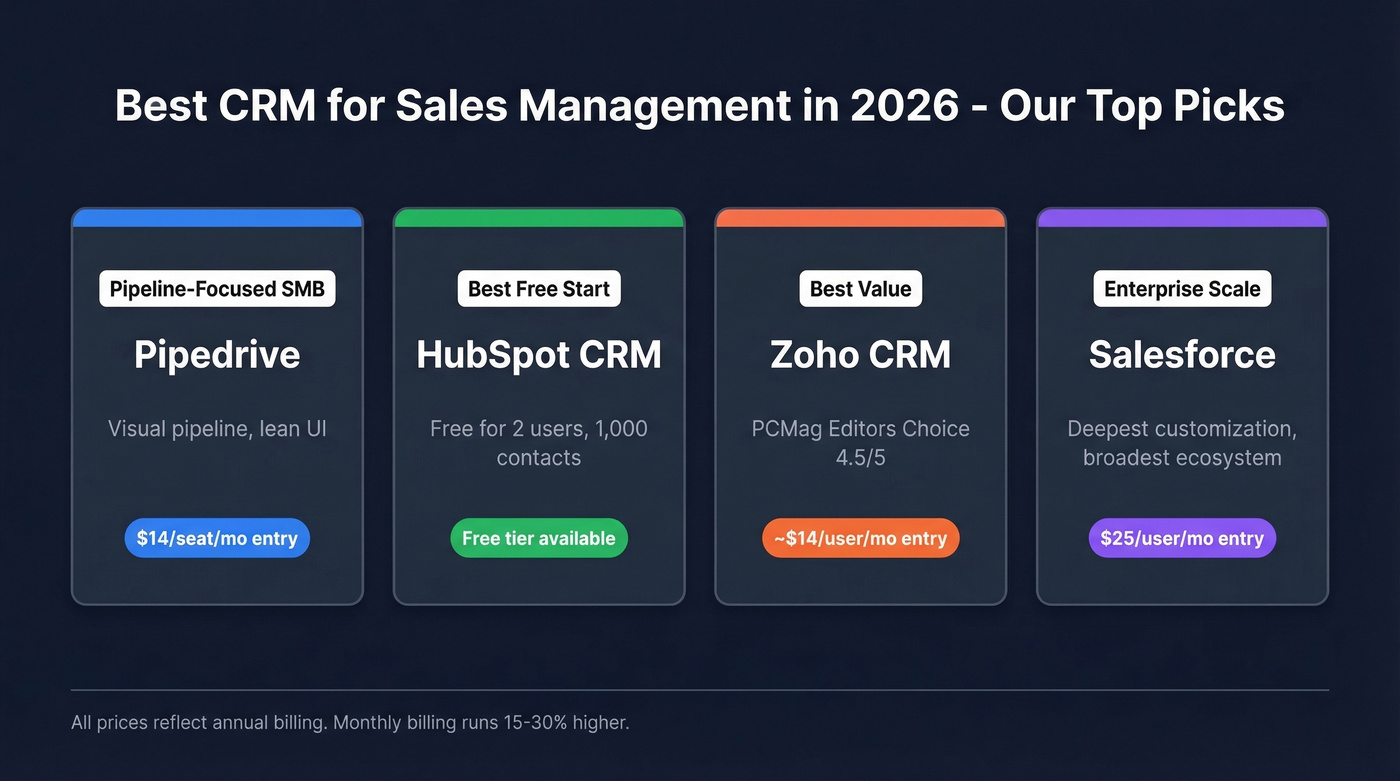
Our Picks (TL;DR)
| Use Case | Pick | Why |
|---|---|---|
| Pipeline-focused SMB teams | Pipedrive | Visual pipeline, lean UI, $14/seat/mo entry |
| Best free starting point | HubSpot CRM | Free for 2 users, 1,000 contacts, massive ecosystem |
| Best value for feature depth | Zoho CRM | PCMag Editors' Choice, strong features per dollar |
| Enterprise scale | Salesforce | Deepest customization, broadest ecosystem |
CRM by the Numbers
The ROI case for CRM software isn't theoretical anymore:
- $8.71 return for every $1 spent on CRM (Nucleus Research)
- 29% increase in sales revenue for companies using CRM
- 34% productivity gain across sales teams
- 42% improvement in forecast accuracy
- 91% of companies with 11+ employees already use a CRM
- 65% quota attainment for sales teams using mobile CRM vs. 22% without

The question isn't whether you need a CRM. It's which one won't waste your money or your reps' time.
Top Sales CRM Platforms Reviewed
Pipedrive - Best for Pipeline-Obsessed Teams
Use it if you want a CRM that does one thing exceptionally well: visual pipeline management. Pipedrive's entire UX is built around the deal view. Drag deals between stages, set activity reminders, and get AI-powered reporting without drowning in menus. For SMB sales teams running 50-500 deals at a time, it's one of the most intuitive options on the market. If you're comparing options, it helps to look at a few examples of a CRM to see how different platforms structure pipelines and records.
Pricing is straightforward: $14/seat/mo (Lite), $39 (Growth), $59 (Premium), $79 (Ultimate) - all billed annually. Every tier includes AI features, though the good stuff like AI-powered multi-email tools lives at Premium and above. The LeadBooster add-on runs $32.50/mo at the company level for chatbots and web forms. 14-day free trial, no credit card required.

Skip it if you need deep marketing automation, complex CPQ workflows, or a platform that scales past 100 reps. Pipedrive is a sales tool, not a GTM suite - and that's exactly why the teams who love it, love it.
HubSpot CRM - Best Free Starting Point
HubSpot's free CRM is a popular entry point in B2B sales, and for good reason - it's 100% free with no expiration date for up to 2 users and includes 1,000 contacts. You get a deal pipeline, email tracking, meeting scheduling, and basic reporting without spending a dollar. The ecosystem is massive, integrations are everywhere, and Breeze AI shows up across paid tiers. If you're building a modern outbound stack around it, pairing CRM with the right SDR tools can reduce manual logging and keep activity data clean.
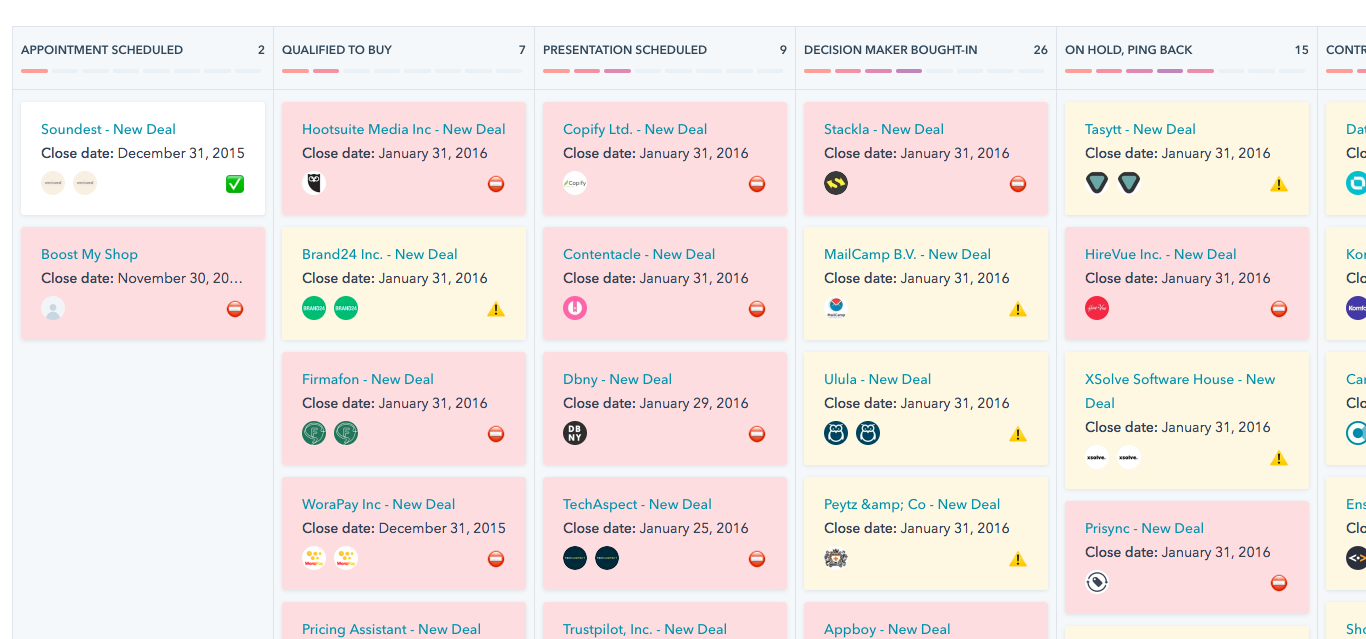
Here's the thing about "free," though. The moment you need more users, automation, or advanced reporting, you're looking at Starter ($15/seat/month), Professional ($50/seat/month), or Enterprise ($75/seat/month). If you're a small team, plan for the upgrade early - free tiers are designed to get you started, not to run your entire sales org forever.
Zoho CRM - Best Value for Feature Depth
Zoho CRM earned PCMag's Editors' Choice at 4.5/5, and the rating makes sense when you look at what you get per dollar. Paid plans start around $14/user/month and scale into the mid-$50s depending on features. Even mid-tier plans include workflow automation, Zia AI for predictions and anomaly detection, and Zoho's canvas-style layout tools for custom UI. If your CRM is also doubling as a lightweight database, you may want to compare it against dedicated contact management software.
Zoho's free edition supports up to 3 users and 5,000 records - more generous than HubSpot's free tier. The tradeoff is UX polish. Zoho packs enormous feature depth into an interface that can feel cluttered compared to Pipedrive's simplicity, and we've heard the same complaint echoed across r/sales threads whenever someone asks about budget CRMs. If your team values configurability over elegance, Zoho delivers more CRM per dollar than almost anything else on the market.
Salesforce Sales Cloud - The Enterprise Standard
Salesforce is the CRM you graduate to, not the one you start with. With 20+ reps, complex approval workflows, and a dedicated admin, it's the platform with the deepest customization and the broadest ecosystem - 4.4/5 on G2 across 25,000+ reviews. Einstein AI supports forecasting, lead scoring, and automation depending on tier. If forecasting is a core requirement, it’s worth comparing CRM-native features with dedicated sales forecasting solutions.
Pricing starts lower than people expect: Starter Suite at $25/user/mo, Pro Suite at $100/user/mo, Enterprise at $175/user/mo. Pro and Enterprise require annual contracts, and transaction fees apply to Starter and Pro. Let's be honest: for a 10-person team, Pipedrive or HubSpot Starter delivers 90% of what you need at a fraction of the cost. Salesforce earns its price tag at scale, not before.
monday CRM - Best for monday.com Teams
If your company already runs on monday.com for project management, their CRM module is a natural extension. The visual board interface makes pipeline tracking feel like managing a project - which is either brilliant or confusing, depending on how your reps think. If you're trying to standardize what "good" looks like in the pipeline, start with clear sales activities examples your team can log consistently.
Pricing is competitive: free for 2 seats, then $9 (Basic), $12 (Standard), $19 (Pro) per seat/month on annual billing. The catch is automation limits. Standard caps you at 250 automations/month and 250 integration actions/month, which a 5-person team can burn through fast if they're running any kind of multi-step workflow.
Freshsales
Built for inside sales teams that live on the phone. Freddy AI handles lead scoring and deal insights, and the built-in dialer means fewer tabs. Free for 3 users, paid plans run from about $9-$59/user/mo. Solid if phone-heavy outbound is your primary motion. If you're building a repeatable calling motion, a documented cold calling system helps keep activity and outcomes consistent across reps.
Close
Close is the CRM for SDR teams who measure success in dials per day. Built-in calling, SMS, and email sequencing - no integrations needed. Plans run around $29-$149/user/mo. It's opinionated software for an opinionated workflow: high-volume outbound. If you're running sequences at scale, tightening sequence management is often a bigger win than switching CRMs.
Less Annoying CRM
One plan. $15/user/month. No tiers, no upsells, no annual contracts. Forbes lists it among the best simple CRMs for a reason. If you want a contact database with pipeline tracking and nothing else, this is refreshingly honest software.

Every CRM on this list has the same weakness: garbage data in, garbage pipeline out. Prospeo enriches your CRM with 98% accurate emails and 125M+ verified mobile numbers - refreshed every 7 days, not every 6 weeks. Native integrations with Salesforce and HubSpot mean 50+ data points per contact flow directly into your pipeline.
Stop letting stale data rot your CRM. Enrich it with Prospeo.
Pricing Comparison
| Tool | Free Plan | Entry Paid | Mid-Tier | Top Tier |
|---|---|---|---|---|
| Pipedrive | 14-day trial | $14/seat/mo | $39/seat/mo | $79/seat/mo |
| HubSpot | 2 users | $15/seat/mo | $50/seat/mo | $75/seat/mo |
| Zoho CRM | 3 users | ~$14/user/mo | ~$23/user/mo | ~$52/user/mo |
| Salesforce | Free (2 users) | $25/user/mo | $100/user/mo | $175/user/mo |
| monday CRM | 2 seats | $9/seat/mo | $12/seat/mo | $19/seat/mo |
| Freshsales | 3 users | ~$9/user/mo | ~$39/user/mo | ~$59/user/mo |
| Close | - | $29/user/mo | $99/user/mo | $149/user/mo |
| Less Annoying | - | $15/user/mo | - | - |
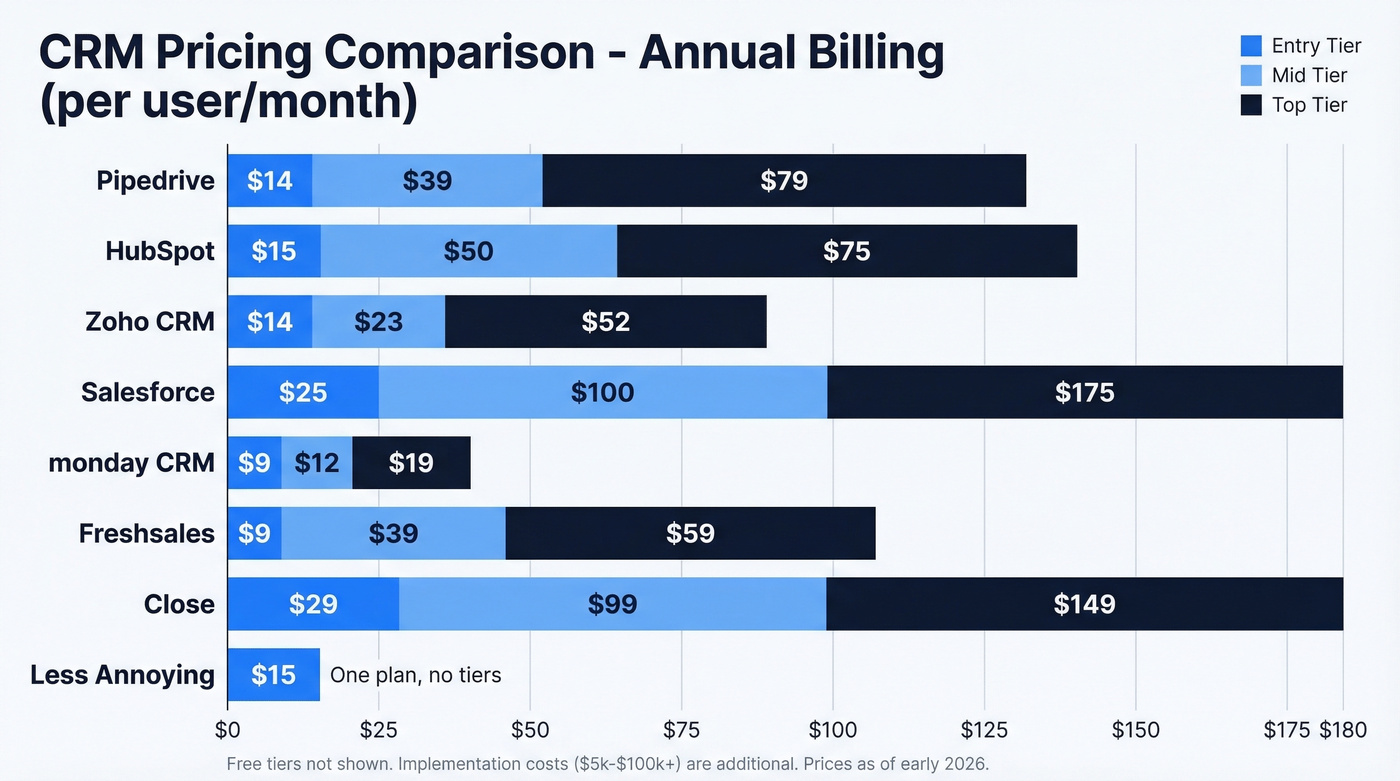
All paid prices reflect annual billing where available. Monthly billing typically runs 15-30% higher. Salesforce Pro Suite and above require annual contracts. Beyond per-seat costs, budget $5,000-$100,000+ for implementation depending on complexity and customization needs.
Where AI kicks in: Most CRMs include lightweight AI in lower tiers for writing help, summaries, and basic insights. Predictive features like forecasting, scoring, and deal risk analysis are usually gated behind mid-to-top tiers.
AI Features Worth Paying For
Every CRM vendor markets AI prominently now. But the features that actually save rep time are usually locked behind higher tiers, and the gap between "AI-powered" marketing copy and real utility is wide.
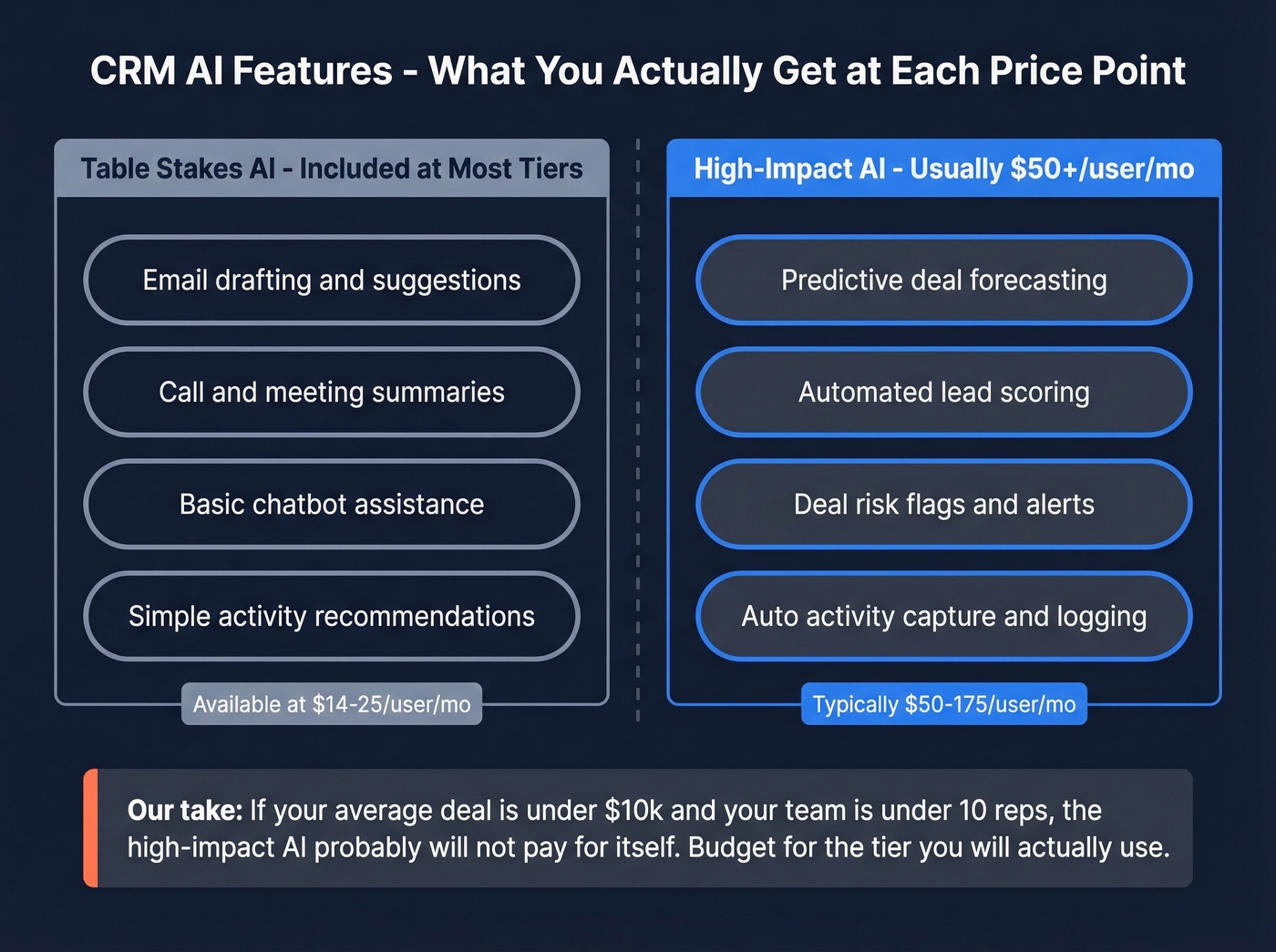
The practical breakdown looks like this. Table-stakes AI - email drafting, summarization, basic suggestions - ships with nearly every tool at every tier. High-impact AI - automated activity capture, deal risk flags, predictive forecasting, and lead scoring - lives at $50+/user/month across the board.
Here's our take after watching teams adopt these features: email drafting is commoditized. Every tool has it. The AI that genuinely moves the needle is predictive forecasting and deal risk flagging, and those features only pay for themselves when your average deal size justifies the cost. If your average deal is under $10k and your team is under 10 reps, a well-maintained spreadsheet and a good manager will outperform a $79/seat AI feature your team never opens. Budget for the tier that includes the AI you'll actually use, not the AI you saw in the demo.
CRM Mistakes That Kill Adoption
Around 70% of CRM implementations underperform expectations. We've seen these five mistakes account for most of that failure rate.
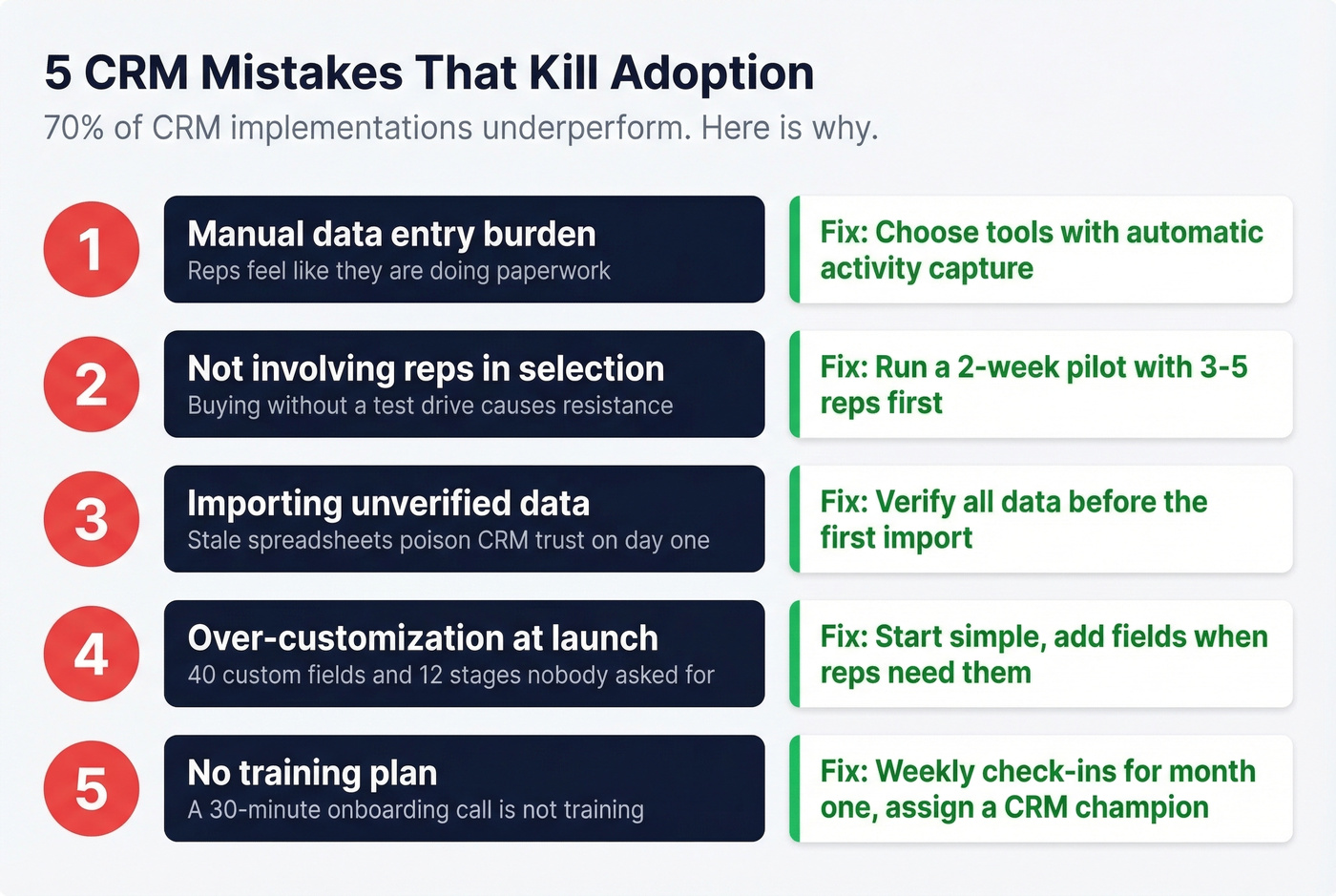
Manual data entry burden. This is the #1 reason reps abandon a CRM. If the system feels like paperwork - manually logging calls, updating fields, entering contacts - adoption craters within 90 days. Prioritize tools with automatic activity capture.
Not involving reps in selection. Buying a CRM without letting your sales team test-drive it is a recipe for resistance. Run a 2-week pilot with 3-5 reps before signing anything.
Importing unverified data. Dumping a stale spreadsheet into a new CRM poisons trust immediately. Run your list through a verification tool before the first import. 98% email accuracy on day one sets the tone for CRM trust.
Over-customization at launch. Adding 40 custom fields and 12 pipeline stages before anyone's used the tool creates complexity nobody asked for. Start simple. Add fields when reps actually need them.
No training plan. A 30-minute onboarding call isn't training. Budget for weekly check-ins during the first month and designate a CRM champion on the team who owns adoption. A simple 30-60-90 day plan for sales reps can also make adoption measurable instead of vague.

Your CRM Data Is the Real Problem
B2B contact data decays at roughly 30% per year. People change jobs, companies rebrand, phone numbers rotate. Six months after your CRM launch, a third of your contacts are degrading - and your reps are learning to distrust the system.
This is the problem most CRM buying guides ignore entirely. You can pick the perfect CRM, nail the implementation, train your team flawlessly - and still watch adoption collapse because the data is wrong. No sales management tool can compensate for contacts that bounce or ring dead numbers. If you're evaluating vendors to fix this upstream, start with a shortlist of data enrichment services.
When reps click a contact and the phone number works, they use the CRM. When it doesn't, they don't.
You just read about CRMs that cost $25-$175/seat/month. Now imagine your reps burning those seats Googling prospects because 40% of contact data is dead. Prospeo fills your CRM with verified contacts at $0.01/email - 92% match rate on enrichment, catch-all handling included, zero bounced-email surprises.
Great CRM software deserves great data. Start with 75 free verified emails.
FAQ
What's the best free CRM for sales teams?
HubSpot CRM offers the most polished free experience for 2 users and 1,000 contacts. Zoho CRM is more generous with 3 users and 5,000 records. Freshsales and monday CRM both offer free plans for 2-3 seats. Treat all free plans as starting points - you'll outgrow them within a quarter or two.
How much does CRM software for sales management cost?
Expect $9-$175/user/month depending on the tool and tier. A capable SMB setup runs $15-$50/user/month. Enterprise deployments on Salesforce Pro Suite or above start at $100/user/month with annual contracts. Add-ons and integrations can tack on 20-40% to your base cost.
What's the #1 reason CRM implementations fail?
Data entry burden and bad data quality cause most failures. Reps abandon CRMs when the information they rely on is stale or wrong. Verify and enrich contacts before your first import - tools like Prospeo deliver 98% email accuracy and refresh records every 7 days, so your CRM stays trustworthy without manual cleanup.
Do I need Salesforce for a 10-person sales team?
Almost certainly not. Pipedrive, HubSpot Starter, or Zoho CRM deliver 90% of what a 10-person team needs at 20-50% of the cost, with faster implementation. Salesforce earns its premium when you've got 20+ reps, complex workflows, and a dedicated admin.
What CRM AI features actually matter in 2026?
Predictive forecasting, deal risk flags, and automated activity capture save the most rep time. Email drafting is commoditized - every tool has it now. The features that genuinely move pipeline are gated behind mid-to-top tiers at $50+/user/month across most platforms.