

Cross Selling: Definition, Data, and the Framework Most Companies Are Missing
A VP of Sales walks into a QBR and says, "We need to cross-sell more." No framework. No KPIs. No cross selling definition beyond "sell them more stuff." The team nods, sends a few bundled offers to the install base, and three months later nothing's changed.
Sound familiar? Up to 90% of cross-selling initiatives fail, and the reason isn't that cross-selling doesn't work. It's that most companies treat the definition as the strategy - "recommend complementary products" - and skip the measurement, segmentation, and data quality that actually make it work. Let's fix that.
The Quick Version
One-sentence definition: recommending a complementary product or service to a customer who's already buying, or has already bought, something else.
You're 60-70% likely to sell to an existing customer versus just 5-20% for a new prospect. That's the single most compelling stat in all of sales.
But here's what nobody mentions up front: 1 in 5 cross-buying customers is actually unprofitable, and that segment accounts for 70% of a firm's total customer loss, per a landmark HBR study. Most teams have no measurement framework. If you can't calculate your attach rate, you don't have a cross-selling strategy. You have a suggestion box.
What Cross Selling Actually Means
Cross-selling is a sales strategy where a business encourages an existing customer to purchase additional products or services that complement their original purchase. When McDonald's asks "would you like fries with that?" or Amazon shows "customers also bought," that's cross-selling. It differs from upselling, which pushes a higher-tier version of the same product.
Here's the thing: the "fries with that" analogy has done more harm than good. It makes the tactic sound like a reflexive add-on, something you bolt onto checkout and forget. In reality, effective cross-selling requires knowing which customer wants fries, which one wants a salad, and which one will return the fries and call support about it. The analogy strips out all the complexity that separates an up to 30% revenue lift from a customer experience disaster.
The better mental model: cross-selling is a data problem disguised as a sales tactic. "Recommend complementary products" isn't a strategy without accurate customer data to determine which product, for which customer, at which moment. Most advice skips this entirely, which is why most initiatives fail.
Cross Selling vs. Upselling
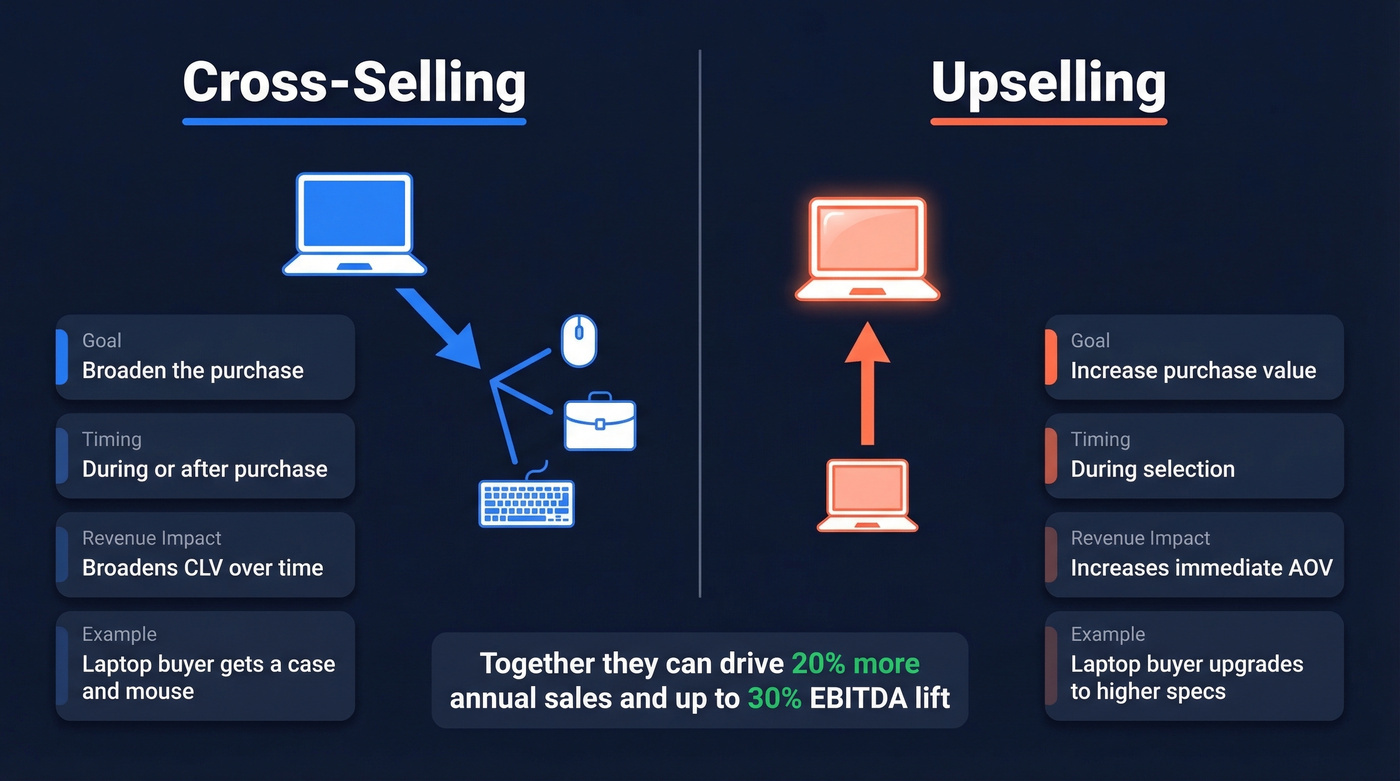
These two get conflated constantly, but the distinction matters for how you measure and time each motion.
| Cross-Selling | Upselling | |
|---|---|---|
| Definition | Complementary product | Higher-tier version |
| Goal | Broaden the purchase | Increase purchase value |
| Timing | During or after purchase | During selection |
| Example | Laptop → case + mouse | Laptop → higher-spec model |
| Revenue impact | Broadens CLV over time | Increases immediate AOV |
The timing distinction is the one most teams miss. Upselling happens while the customer is still choosing - "for $200 more, you get double the storage." Cross-selling happens during or after the purchase - "you bought the laptop, here's a case that fits it." Running a cross-sell motion at the wrong moment, before the customer has committed to the primary product, feels pushy and confuses the decision.
Together, cross-selling and upselling can drive a 20% increase in annual sales and up to a 30% lift in EBITDA. But they require different playbooks, different timing, and different measurement. Treating them as interchangeable is a common and expensive mistake.

The article is clear: 85% of customers ignore irrelevant cross-sell attempts. Precision targeting is the difference between a 30% revenue lift and a wasted campaign. That starts with accurate contact data. Prospeo gives you 300M+ profiles with 30+ filters - buyer intent, technographics, headcount growth - so you reach the right customer with the right offer at the right time. 98% email accuracy means your cross-sell campaigns actually land.
Stop cross-selling blind. Start with data that connects you to real buyers.
Cross Selling by the Numbers
Let's ground this in data. These benchmarks set the ceiling and the floor for what cross sales can actually deliver.
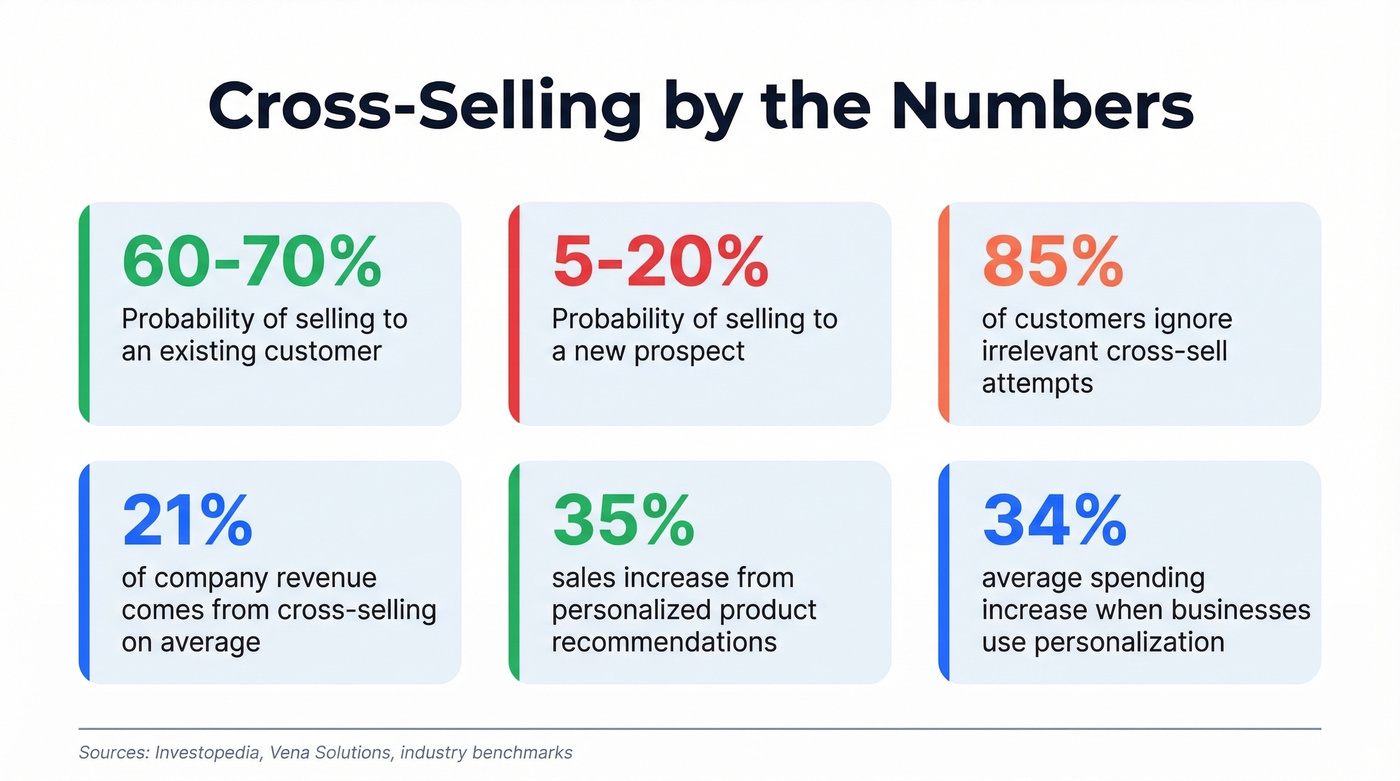
60-70% probability of selling to an existing customer, versus 5-20% for a new prospect. That's the foundational stat that justifies every cross-sell program. Meanwhile, 85% of customers ignore irrelevant cross-sell attempts - only about 15% are receptive at all. Your targeting has to be precise. Blanket campaigns are dead on arrival.
The scale of the opportunity is hard to overstate. 87% of sales professionals cross-sell, and the practice contributes an average of 21% of company revenue. That makes it a major revenue source, not a niche tactic. Personalized product recommendations based on customer data drive roughly a 35% sales increase, while 80% of businesses report that personalization increases customer spending by an average of 34%.
The pattern is unmistakable: cross-selling works when it's personalized and targeted. It fails when it's generic. The difference between those outcomes is almost entirely a data quality problem.
When Cross Selling Backfires
The Four Unprofitable Customer Types
This is where most "cross-selling is amazing!" articles stop being useful. A landmark Harvard Business Review study by Denish Shah and V. Kumar analyzed customer datasets from five Fortune 1,000 companies - spanning B2B financial services, IT services, retail banking, catalog retail, and fashion - over four to seven years. The finding that should make every RevOps leader pause: 1 in 5 cross-buying customers is unprofitable, and that segment accounts for 70% of a firm's total customer loss.
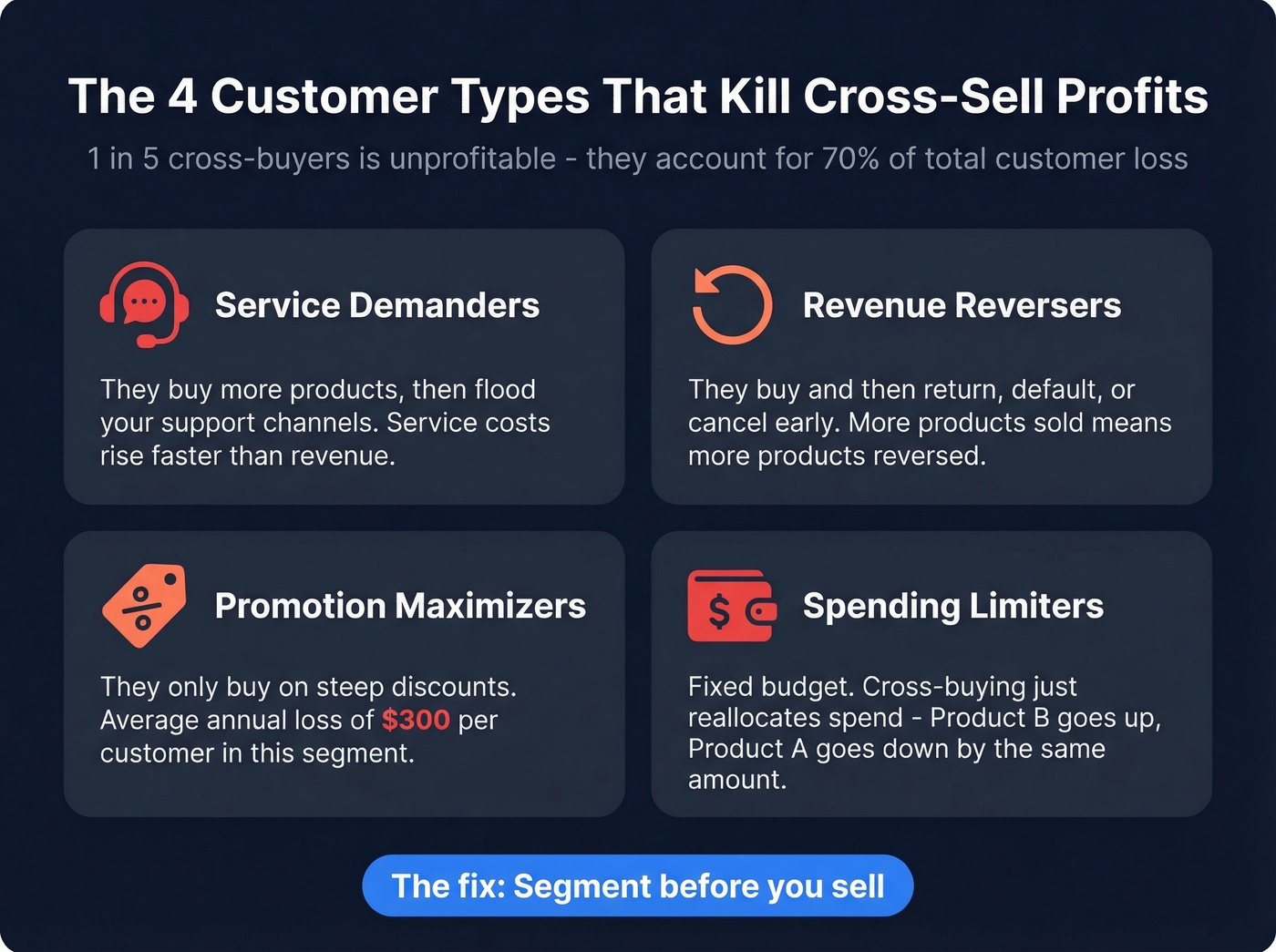
The study identified four archetypes that destroy cross-sell economics:
- Service demanders cross-buy more products and then overuse support channels. Their service costs rise faster than their revenue contribution.
- Revenue reversers buy and then return, default, or terminate early. More products sold means more products reversed.
- Promotion maximizers only buy on steep discounts. The catalog and fashion retailers in the study saw an average annual loss of $300 per customer in this segment. They're buying, but you're losing money on every transaction.
- Spending limiters have a fixed budget. Cross-buying doesn't increase their total spend - it just reallocates it. You sell them Product B, and Product A revenue drops by the same amount.
The takeaway isn't "don't cross-sell." It's "segment before you sell." Blanket campaigns treat all customers as equally valuable, and they're not.
The Wells Fargo Cautionary Tale
The most infamous cross-selling failure in modern business. Wells Fargo employees opened millions of unauthorized accounts to hit aggressive cross-sell targets. The result was a $185 million fine, $2.8 million in customer refunds, and more than 5,300 employees terminated.
The lesson isn't subtle. Cross-selling without suitability checks - without asking "does this customer actually benefit from this product?" - doesn't just fail. It destroys trust, invites regulatory action, and can take years to recover from.
Strategies That Actually Work
Post-Purchase Page Offers
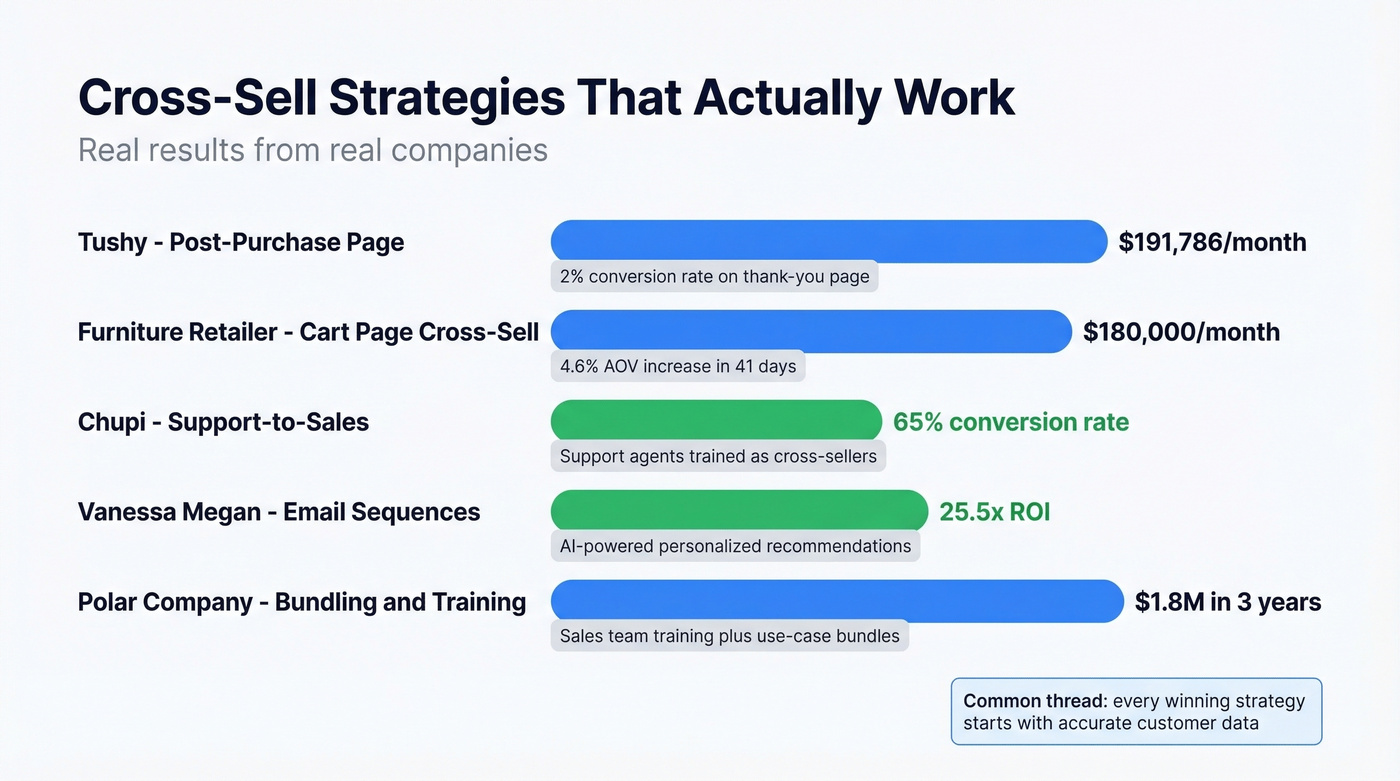
The thank-you page is the most underutilized real estate in ecommerce. Tushy ran a post-purchase cross-sell using their order confirmation page and generated $191,786 in monthly incremental sales at a 2% conversion rate. An unnamed furniture retailer moved their complementary product recommendation from a product page to the cart page and saw $180,000 in additional monthly revenue within 41 days - a 4.6% AOV increase.
The customer has already committed. The friction is gone. That's when the cross-sell converts.
Support-to-Sales Handoffs
Your support team talks to customers more than your sales team does. Chupi turned that into a 65% conversion rate by training support agents to cross-sell on product pages and during live interactions. Mizzen+Main takes a similar approach - their support agents act as "personal shoppers," using purchase history and sizing data to recommend complementary items.
When 94% of customers say they're more likely to buy again after a positive service experience, the support channel becomes your best-performing cross-sell surface. Most companies ignore it entirely.
Personalized Email Sequences
Vanessa Megan, an Australian skincare brand, deployed AI-powered email recommendations and saw a 25.5x ROI from personalized cross-sell sequences. The key wasn't just sending emails - it was matching product recommendations to individual purchase history. Email remains one of the most effective channels when the targeting is right.
Bundling and Loyalty Programs
The Polar Company (industrial fluids) generated $600,000 in cross-sell revenue by year one and $1.8 million within three years - driven primarily by training their sales team on complementary product positioning and building bundles around customer use cases. Bundling also solves the "promotion maximizer" problem from the HBR study: instead of discounting individual products, you package complementary items at a combined price that protects margins while giving the customer perceived value.
Fix the Data First
Look, here's my frustration with most cross-sell advice: it jumps straight to tactics without asking whether your data can support them. If your average deal size is above $5K and your CRM data is more than 90 days stale, you shouldn't be running cross-sell campaigns at all. You're burning trust with the wrong offers to the wrong people.
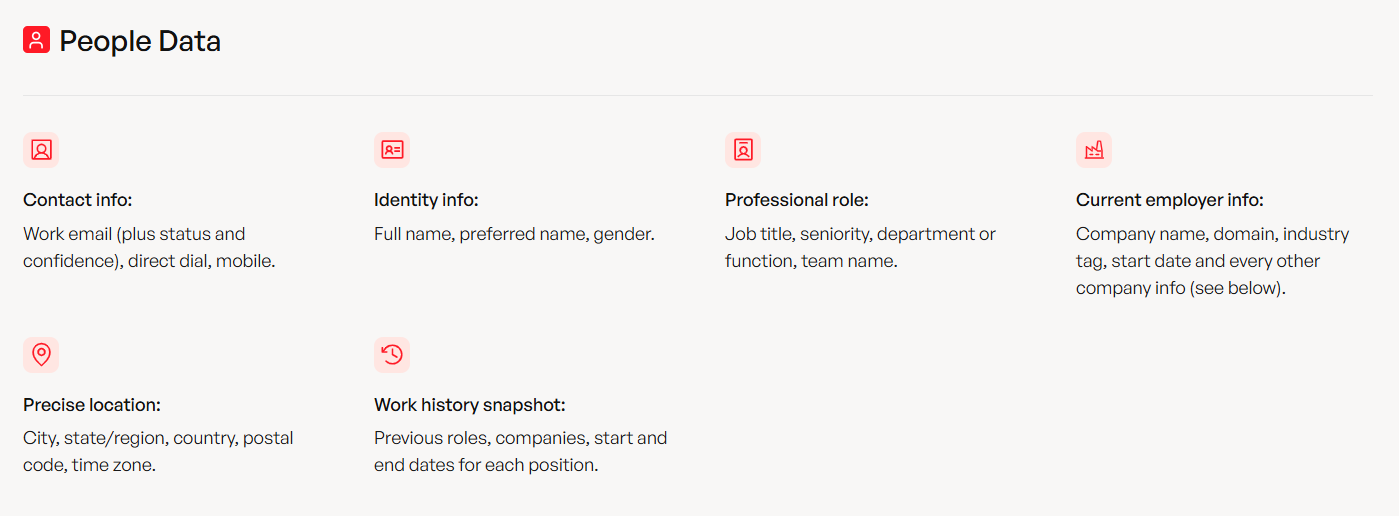
When 80% of businesses say personalization increases spending by 34%, the question isn't whether to personalize - it's whether your data is accurate enough to do it. Stale job titles, outdated company sizes, and bouncing email addresses mean your "personalized" recommendations are hitting the wrong person with the wrong offer. We've seen teams triple their cross-sell conversion rates just by cleaning and enriching their CRM before launching a single campaign. Prospeo's CRM enrichment fills those gaps - returning 50+ data points per contact with an 83% enrichment match rate on a 7-day refresh cycle.
How to Measure Cross Sales
If you can't measure it, you're guessing. Here's the KPI framework that separates real cross-sell programs from "we sent some emails."
| Metric | Formula / Definition | Why It Matters |
|---|---|---|
| Attach Rate | Revenue Product B / Revenue Product A | Forecasts cross-sell revenue |
| Cross-Sell Conversion | Purchases / Offers made | Measures offer effectiveness |
| ARPA | Total revenue / Total accounts | Tracks revenue expansion |
| CLV | Avg value x frequency x lifespan | Shows long-term impact |
| Product Penetration | Customers w/ 2+ products / Total | Gauges adoption breadth |
| Time to Cross-Sell | Days from first purchase to cross-sell | Identifies optimal timing |
| Expansion MRR | New MRR from cross-sell / Total new MRR | Isolates cross-sell growth |
Attach rate is the metric most teams should start with. If you sold $200K of Product B to customers who originally bought Product A (which generated $500K), your attach rate is 40%. That 40% becomes a forecasting tool: if you expect $500K in new Product A revenue next quarter, you can project roughly $200K in Product B cross-sell revenue at the same attach rate. Cohort by first product purchased, and you'll see which product pairings have the strongest natural attach rates - that's where you focus your campaigns first.
In our experience, teams that start with attach rate before anything else see results 2-3x faster than those tracking vanity metrics like "number of cross-sell emails sent." Track conversion by channel too - you'll quickly discover which surface actually moves revenue, and which just generates activity.
One caveat: your attach rate calculations are only as good as your underlying data. If a meaningful share of your customer emails bounce, you're measuring a distorted picture. (If you need a baseline, start with email bounce rate benchmarks and fixes.)
FAQ
What's the difference between cross-selling and bundling?
Cross-selling recommends individual complementary products based on what a customer is buying. Bundling packages multiple products at a combined price upfront. Bundling works best for price-sensitive customers; cross-selling works best when extending a specific primary need.
Is cross-selling ethical?
Yes, when the recommendation genuinely benefits the customer. It becomes unethical when reps push products for quota regardless of fit - exactly what happened at Wells Fargo, resulting in $185 million in fines. If you can't articulate why this product helps this customer, don't offer it.
What's a good cross-sell conversion rate?
Post-purchase page offers typically convert at 1-3%, support-led recommendations at 5-15%, and personalized email sequences at 2-5%. Track your own baseline first - your quarter-over-quarter trend matters more than industry averages.
How do I cross-sell without annoying customers?
Base recommendations on actual purchase history, not blanket campaigns. The 85% ignore rate comes from irrelevant offers. If the customer just bought running shoes and you recommend running socks, that's helpful. If you recommend a blender, that's spam.
What tools support effective cross-selling?
At minimum: a CRM with clean, enriched customer data, a way to segment by purchase history and profile, and a channel to deliver recommendations. For B2B teams, Prospeo's CRM enrichment fills data gaps with 50+ data points per contact at an 83% match rate so your segmentation reflects reality.
Cross-selling fails when it's treated as a checkout trick. It works when it's treated as a data-driven revenue strategy - with segmentation, measurement, and clean customer records behind every recommendation. The cross selling definition is simple; the execution is where 90% of companies fall short. That failure rate isn't inevitable. It's a choice most companies make by skipping the hard parts.
If you want a deeper breakdown of the distinction and benchmarks, see cross-selling and upselling and the Investopedia explainer on Cross Selling vs. Upselling.
The HBR study found 1 in 5 cross-buyers is unprofitable. The fix? Segment before you sell. Prospeo's intent data tracks 15,000 topics so you can identify which existing customers are actively researching complementary solutions - and skip the ones who'll drain your margins. Layer in job change signals and department headcount filters to time your cross-sell perfectly.
Segment your cross-sell targets with intent data, not guesswork.