

CUFinder vs D7 Lead Finder: Which One Actually Fits Your Workflow?
Comparing CUFinder vs D7 Lead Finder is a bit misleading - they serve fundamentally different jobs. CUFinder is a B2B sales intelligence platform with 419M+ contacts. D7 Lead Finder pulls local business leads by keyword and city. They don't really compete, and lumping them together does a disservice to anyone trying to make a real buying decision.
Let's be honest: if you're here, you're probably evaluating lead-finding tools and these two showed up on the same shortlist. We've dug into both so you don't have to waste credits or trial periods figuring out which one actually fits.
30-Second Verdict
Pick CUFinder if you need B2B prospecting, enrichment, extensions, and CRM integrations. It carries a 4.8/5 on G2 across 988 reviews.
Pick D7 Lead Finder only if you exclusively need local business scraping on a tight budget. It has a 3.7/5 on G2 with just 5 reviews, and its G2 profile hasn't been active for over a year.
Skip both if verified email accuracy at scale is the priority. Prospeo delivers 98% email accuracy across 300M+ profiles with a free tier - no commitment required.
At-a-Glance Comparison
| Feature | CUFinder | D7 Lead Finder | Winner |
|---|---|---|---|
| G2 Rating | 4.8/5 (988 reviews) | 3.7/5 (5 reviews) | CUFinder |
| Database Size | 419M+ contacts | 65M+ leads | CUFinder |
| Starting Price | Free (50 credits/month) | ~$45-$120/mo | CUFinder |
| CRM Integrations | 10+ | None native | CUFinder |
| Chrome Extension | Yes | No | CUFinder |
| Local Business Scraping | Not a core feature | Yes (keyword + city) | D7 |
| G2 Profile Status | Active listing | Inactive 1+ year | CUFinder |
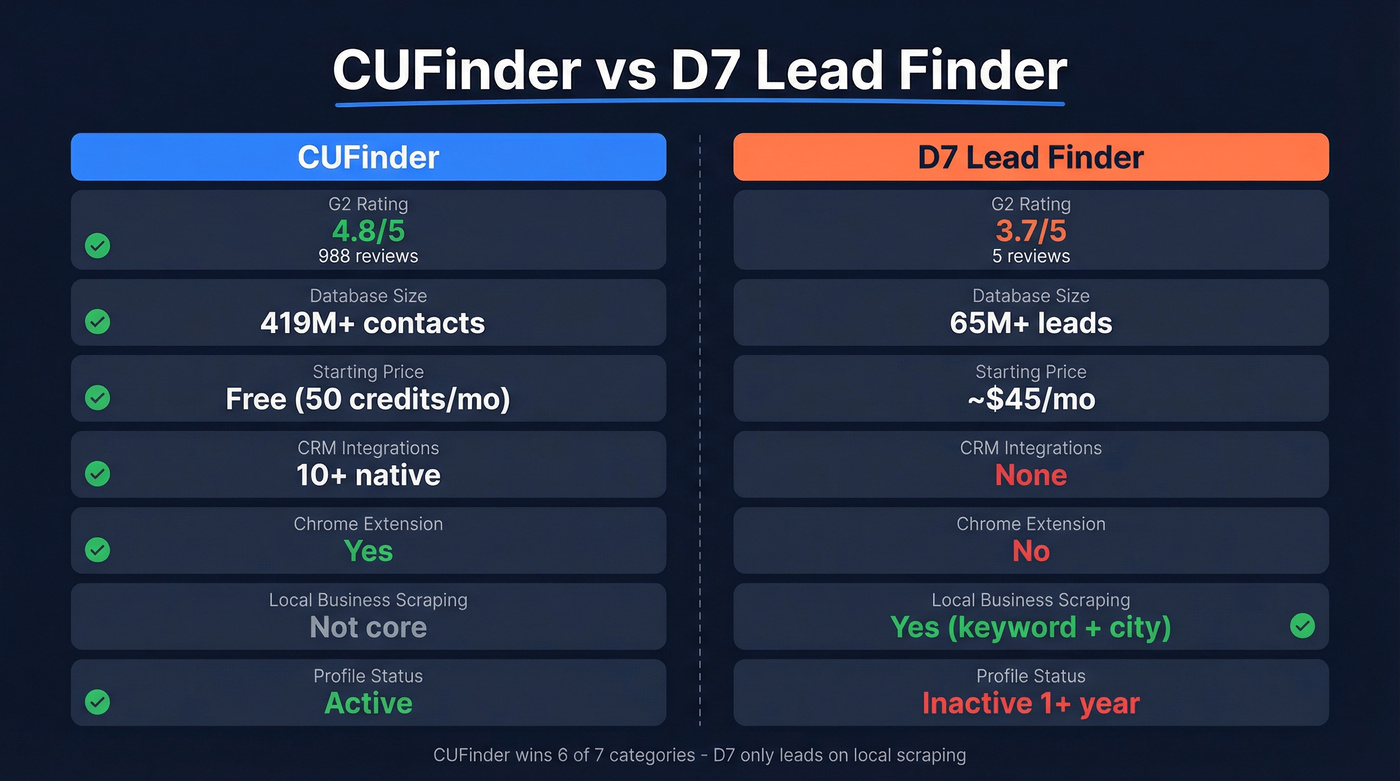
CUFinder wins most rows. D7's only edge is its local scraping workflow - a niche most B2B teams don't need.
What Is CUFinder?
CUFinder is a B2B sales intelligence platform covering 262M+ companies and 419M+ contacts. It combines prospecting, enrichment, and Chrome extensions into one product, with 10+ CRM integrations. Pricing runs from free to $299/mo.
CUFinder guarantees 98% accuracy. One G2 reviewer reported accuracy was "around 95 for my email lists and over 90 for phones" - solid numbers in practice, and consistent with what we've seen from other mid-tier platforms.
Pros:
- 30+ search filters with deep enrichment
- Chrome extensions for prospecting workflows
- 10+ CRM integrations
- Free tier with 50 credits/month
Cons:
- Users want more advanced filtering options
- Occasional missing emails on niche contacts
- UI can feel cluttered on first use
What Is D7 Lead Finder?
D7 Lead Finder is a local business lead tool. Enter a keyword and a city, get up to 1,200 business leads per search from a 65M+ database. It was free until 2019 before moving to paid plans, and it's built for agencies doing local SEO outreach - not B2B sales teams targeting enterprise accounts.

Pricing runs around $45-$120/month depending on the plan. Plans are capped by daily searches: Starter gets 10/day, Agency gets 30/day, Professional gets 100/day with 5 sub-accounts. The pricing page mentions Bitcoin and PerfectMoney as payment options, which tells you something about the target audience.
Pros:
- Fast local business scraping by keyword + city
- Sub-accounts on the Professional tier
- Simple interface, minimal learning curve
Cons:
- A G2 reviewer gave it 0.5/5 and titled their review "Zero Customer Support"
- On Reddit, a user complained that D7 "capped me, gave partial data, or stopped working randomly"
- Data can be inconsistent at scale, and you'll likely do manual cleanup after exports
Here's the thing: if your outbound strategy depends on a tool whose G2 profile has been inactive for over a year, you're building on sand.

D7's data goes stale. CUFinder's accuracy hovers around 95%. Prospeo refreshes 300M+ profiles every 7 days and delivers 98% verified email accuracy - so your bounce rate stays under 4%, not climbing toward domain damage.
Stop cleaning up bad data. Start with data that's already clean.
Feature Breakdown
| Capability | CUFinder | D7 Lead Finder |
|---|---|---|
| Search Filters | 30+ (industry, role, etc.) | Keyword + city |
| Enrichment | Deep B2B enrichment | Business-level listing data |
| Email Verification | Built-in | Not a core strength |
| Chrome Extension | Yes | No |
| CRM Integrations | 10+ | None native |
| Best Fit | B2B prospecting + enrichment | Local keyword-by-city list building |
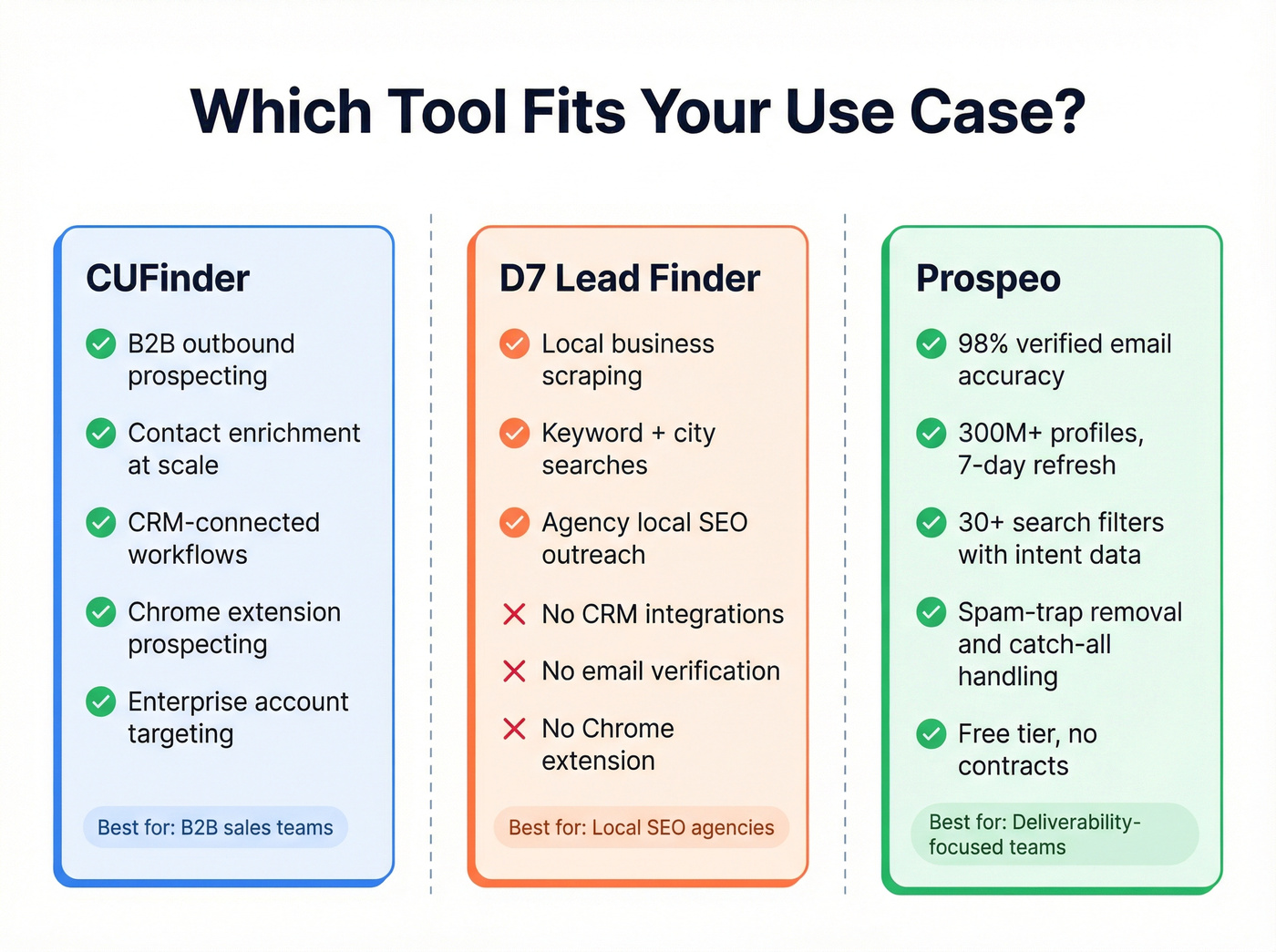
These tools aren't really in the same category. CUFinder is built for B2B prospecting and enrichment workflows. D7 is built for pulling local business lists quickly - think "plumbers in Phoenix," not "VP of Engineering at Series B SaaS companies."
Pricing Side by Side
| CUFinder | D7 Lead Finder | |
|---|---|---|
| Entry | Free (50 credits/month) | ~$45/mo (10 searches/day) |
| Mid | $129/mo (3,000 credits/month) | ~$55/mo (30 searches/day) |
| Top | $299/mo (10,000 credits/month) | ~$120/mo (100 searches/day) |
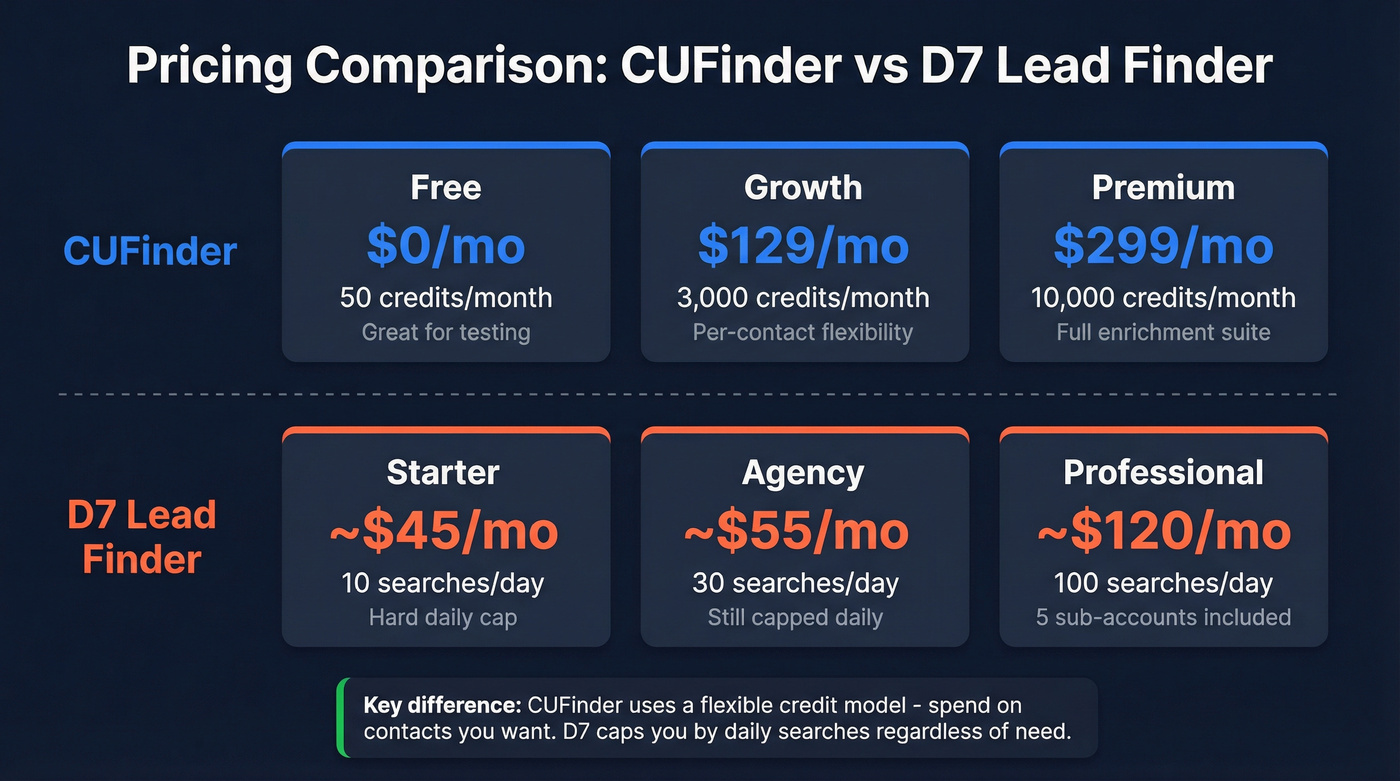
CUFinder's credit model gives you more flexibility - you spend credits on the contacts you actually want. D7's daily search cap limits you regardless of whether you need 50 leads or 5,000 on a given day.
Data Quality and Reviews
Across 988 G2 reviews, CUFinder's most-mentioned positives are accuracy (27 mentions), data accuracy (25), and accurate data (22). That's the dominant theme. People buy it for accuracy and it delivers.
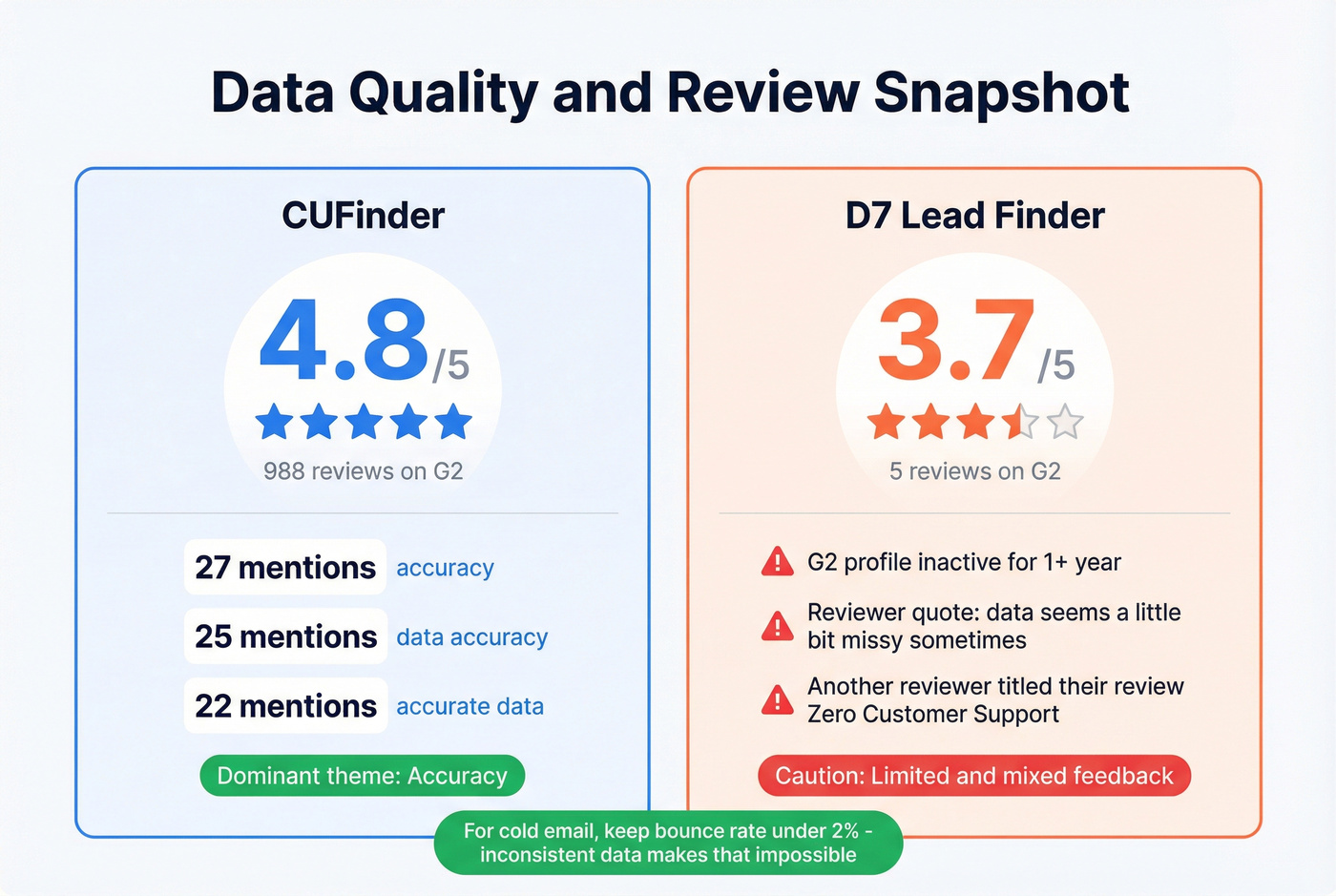
D7's picture is different. Five reviews, a 3.7/5 rating, and an inactive profile. One reviewer noted the "data seems a little bit missy sometimes" and recommended spreadsheet cleanup after exports. Saleshandy's review flags that the database doesn't update frequently enough for ongoing outreach and that accuracy becomes inconsistent when scaling. For cold email, your bounce rate should stay at 2% or under to maintain a good sender reputation - and inconsistent data makes that nearly impossible.
We've seen this pattern before: tools that stop investing in their G2 presence have usually stopped investing in the product too.
Final Verdict
Use CUFinder for B2B outbound and enrichment depth. It's a legitimate sales intelligence platform competing alongside Apollo and Lusha.
Use D7 Lead Finder if you're an agency scraping local listings on a shoestring - and you're okay with inconsistent data and manual cleanup. Skip it for anything else.
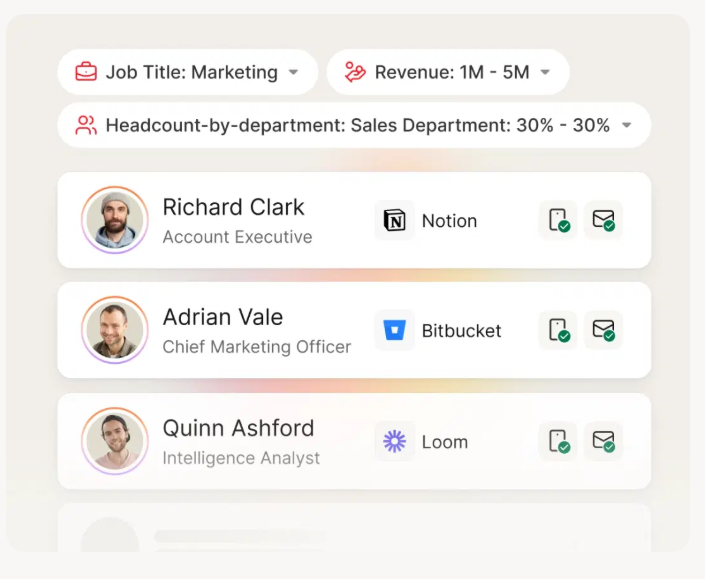
For most B2B teams weighing CUFinder vs D7 Lead Finder, D7 isn't really in the consideration set. And if neither tool fits - especially if deliverability is your top concern - Prospeo covers 300M+ profiles with 98% email accuracy on a 7-day data refresh cycle. The search interface lets you filter by 30+ criteria including buyer intent and technographics, and every result shows verification status in real time. Our team has watched bounce rates drop below 4% consistently across customer accounts, with some teams like Stack Optimize maintaining sub-3% bounces across all their clients. Free tier, no contracts, GDPR compliant.

If you're comparing CUFinder vs D7 Lead Finder, deliverability is probably on your mind. Prospeo's 5-step verification with spam-trap removal and catch-all handling keeps teams like Stack Optimize at sub-3% bounce rates - at roughly $0.01 per email.
Enterprise-grade data without the enterprise contract. Free tier included.
FAQ
Is D7 Lead Finder still actively maintained?
D7's G2 profile hasn't been active for over a year, and multiple users highlight weak support and inconsistent data. There's no public changelog or product update history. Proceed with caution, especially if you need reliable ongoing outreach data.
Can CUFinder replace D7 for local leads?
Not directly. CUFinder is B2B-focused with role-based and industry filters, but it doesn't replicate D7's keyword-by-city local scraping. If you need local business lists specifically, D7 or a Google Maps scraper is a better fit for that particular job.
What's the most accurate email finder between these two?
CUFinder guarantees 98% accuracy, and G2 reviewers consistently confirm it. D7 has a much smaller review footprint and mixed data-quality feedback. For maximum deliverability, Prospeo independently verifies emails at 98% accuracy with a 7-day refresh cycle and proprietary catch-all handling - outperforming both on data freshness.