


CUFinder vs Harmonic: They're Not Really Competitors
You're an SDR manager comparing data tools and you just landed on a page pitting CUFinder against Harmonic. Here's the problem: Harmonic is built for investors and teams sourcing early-stage startups, not for sales teams booking meetings. These tools serve completely different buyers, and comparing them means you need to re-clarify what you actually need. Poor data costs organizations $12.9 million per year according to Gartner - so picking the wrong category of tool isn't just inconvenient, it's expensive.
30-Second Verdict
Pick Harmonic if you're a VC, growth equity firm, or corporate innovation team sourcing early-stage startups. It's a deal-flow intelligence engine, not a general B2B database.
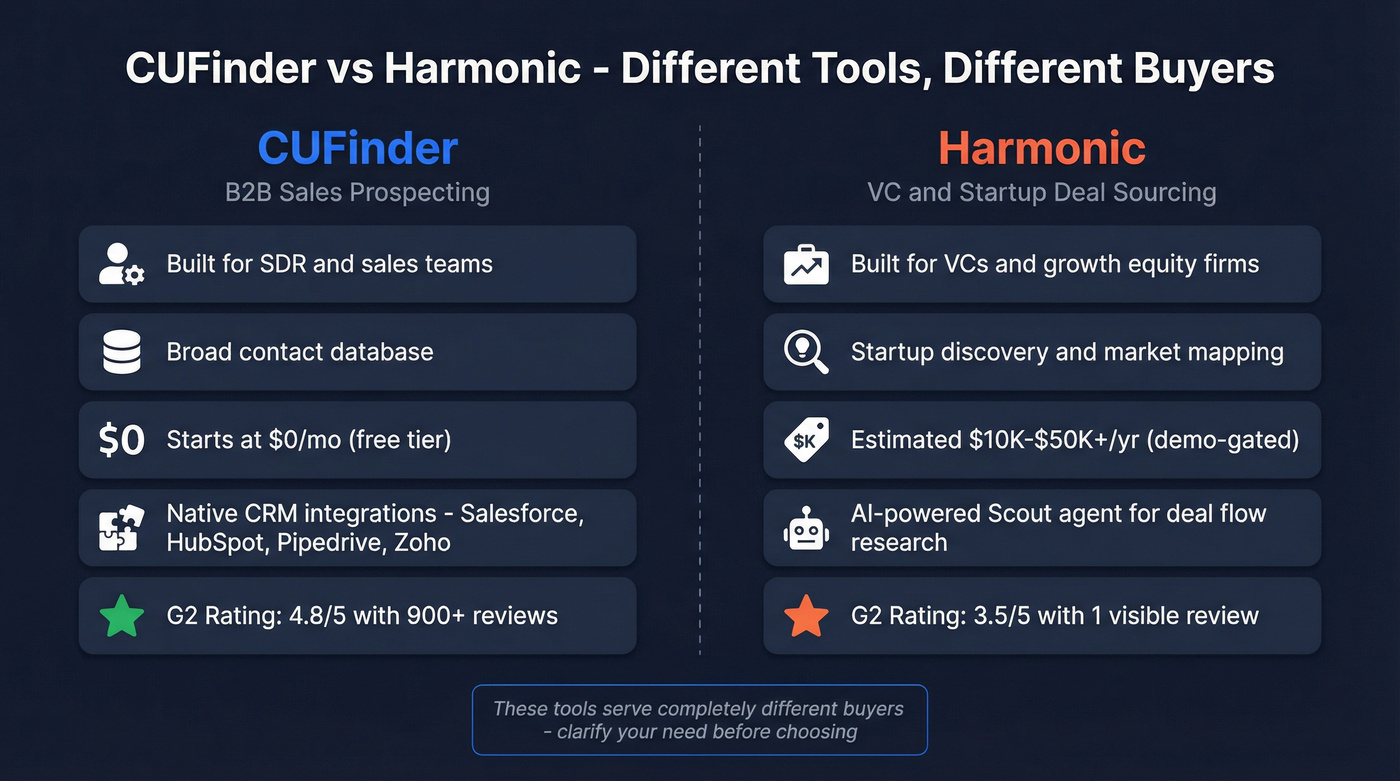
Pick CUFinder if you're a sales team running broad B2B prospecting. Transparent pricing and CRM integrations out of the box.
What Each Tool Actually Does
Harmonic
Harmonic calls itself a "Bloomberg Terminal for startups", and that's the most accurate one-liner you'll find. It's a startup discovery platform purpose-built for investors and BD teams at firms like a16z, Accel, Brex, and Notion. The company has raised $30M to date.
The core product is Scout, an AI agent that maps markets, generates research reports on founding teams and competitive positioning, tracks growth trajectories, and drafts outreach messaging. You're not searching a contact database - you're running natural-language queries like "find AI infrastructure startups with ex-Google founders that raised seed rounds in the last 6 months." Harmonic also maps your team's existing network by syncing inboxes and calendars, helping you spot relationship paths and collaboration opportunities. It's genuinely impressive tech for a very specific audience.
The only visible G2 review we found sits at 3.5/5 and praises the "comprehensive, real-time view of early-stage startups" but notes the platform "can feel overwhelming and complex." Harmonic's G2 page also displays a confusing 4.4/5 widget that doesn't line up with the visible review count - check the fine print if you're doing due diligence there.
If you need to find the VP of Marketing at a mid-market SaaS company, Harmonic won't help you.
CUFinder
CUFinder is a straightforward B2B prospecting platform. Credit-based model, starts at $0/month. It's the kind of tool an SDR team picks up on Monday and runs sequences from by Wednesday.
Integrations span Salesforce, HubSpot, Pipedrive, Zoho, Copper, and Marketo, all connecting natively. There's a Chrome extension for on-the-fly prospecting and an API for enrichment workflows. CUFinder advertises 98% data accuracy and is rated 4.8/5 on G2 with 900+ reviews - genuinely impressive social proof for a tool at this price point.
We've seen SDR teams waste weeks evaluating Harmonic before realizing it's not built for them. CUFinder is the tool most of those teams actually needed.
Feature-by-Feature Comparison
| Feature | CUFinder | Harmonic |
|---|---|---|
| Primary use case | B2B sales prospecting | Startup/VC deal sourcing |
| Database coverage | Broad people + company database | 20M-35M companies, 150M-195M people (varies by product) |
| Pricing model | Credit-based, public | Demo-gated, enterprise |
| Entry price | $0/mo (free tier) | ~$10K-$50K+/yr est. |
| Chrome extension | Yes | Yes |
| CRM integrations | Salesforce, HubSpot, Pipedrive, Zoho, Copper, Marketo | Feeds/syncs to CRM (demo-gated) |
| API | Yes | Yes (REST + GraphQL) |
| Data refresh | Not specified | Weekly (Bulk Data) |
| GDPR/compliance | Yes | Enterprise security & compliance |
| G2 rating | 4.8/5 (900+ reviews) | 3.5/5 (1 visible review) |
A note on Harmonic's database numbers: their own site lists 20M+ companies in the FAQ, 35M on the Enterprise Console section, and 29M for Bulk Data. The numbers shift depending on which product you're looking at. Not a dealbreaker for VC teams, but worth clarifying during a demo.
The G2 gap tells a real story. In our experience, review volume is the most honest signal of who actually uses a tool day-to-day. CUFinder has hundreds of reviews because lots of sales teams rely on it. Harmonic has one visible review because its buyer base is a narrow slice of the market - VC and growth equity firms who don't typically leave G2 reviews.

CUFinder claims 98% accuracy but doesn't publish a data refresh cycle. Harmonic refreshes weekly but isn't built for sales. Prospeo gives you both: 98% verified email accuracy on a 7-day refresh cycle, with 30+ filters to target exactly the buyers you need - no demo call required.
Stop comparing tools built for someone else. Start with 75 free verified emails.
Pricing Breakdown
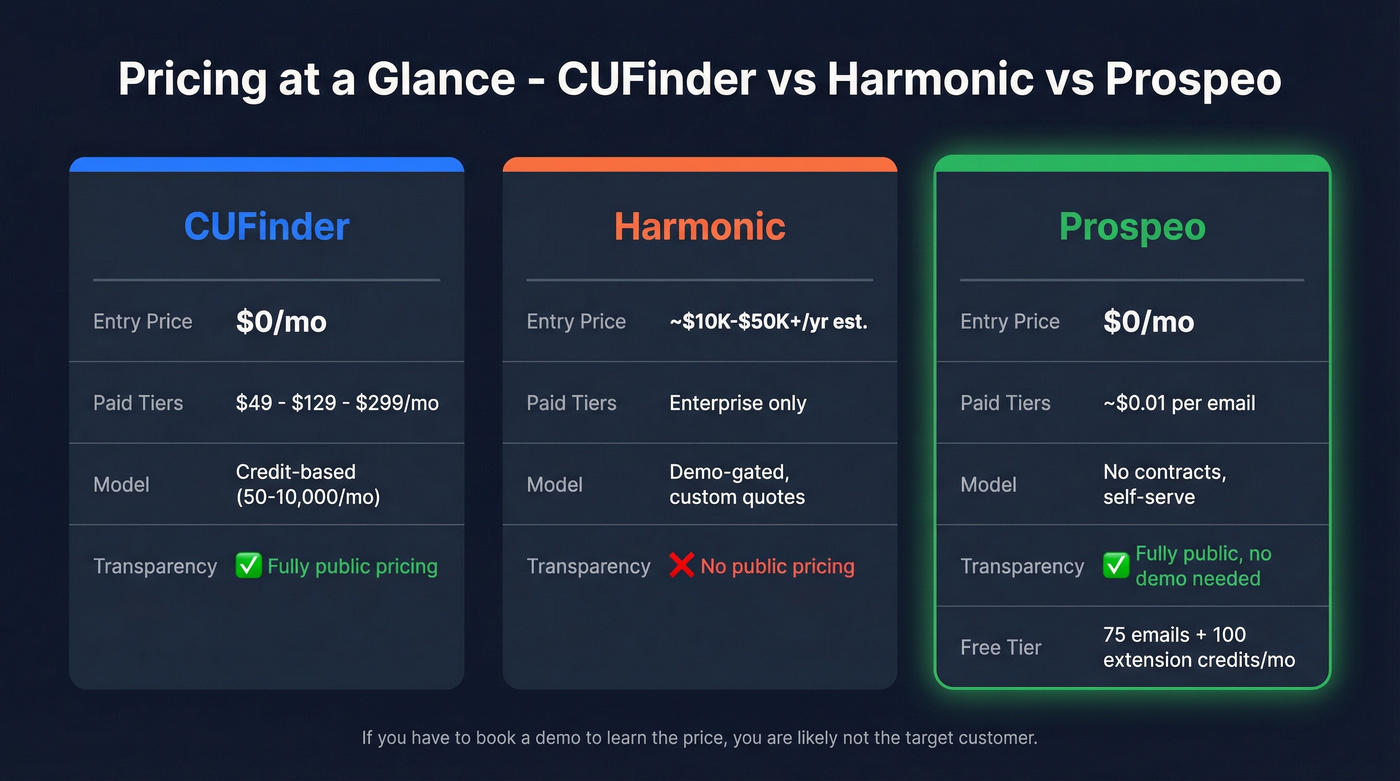
CUFinder publishes every price. Harmonic doesn't publish any.
| Tool | Entry Price | Model | Notes |
|---|---|---|---|
| CUFinder | $0/mo (free tier) | Credits: 50-10,000/mo | $49, $129, $299 paid tiers |
| Harmonic | ~$10K-$50K+/yr est. | Enterprise, demo-gated | Console, API, Bulk Data |
| Prospeo | $0/mo (free tier) | ~$0.01/email, no contracts | 75 emails + 100 ext. credits/mo free |
If you have to book a demo to learn the price, you're likely not the target customer unless you're running a fund.
Let's be honest: most sales teams evaluating these two platforms don't actually need either tool's full database. If your average deal size is under $25K and your outbound motion is email-first, you need verified emails that don't bounce - not a massive database you'll never exhaust. Accuracy beats volume every time. (If you're tightening your outbound motion, start with proven sales prospecting techniques and a clean lead generation workflow.)
Who Should Pick Which
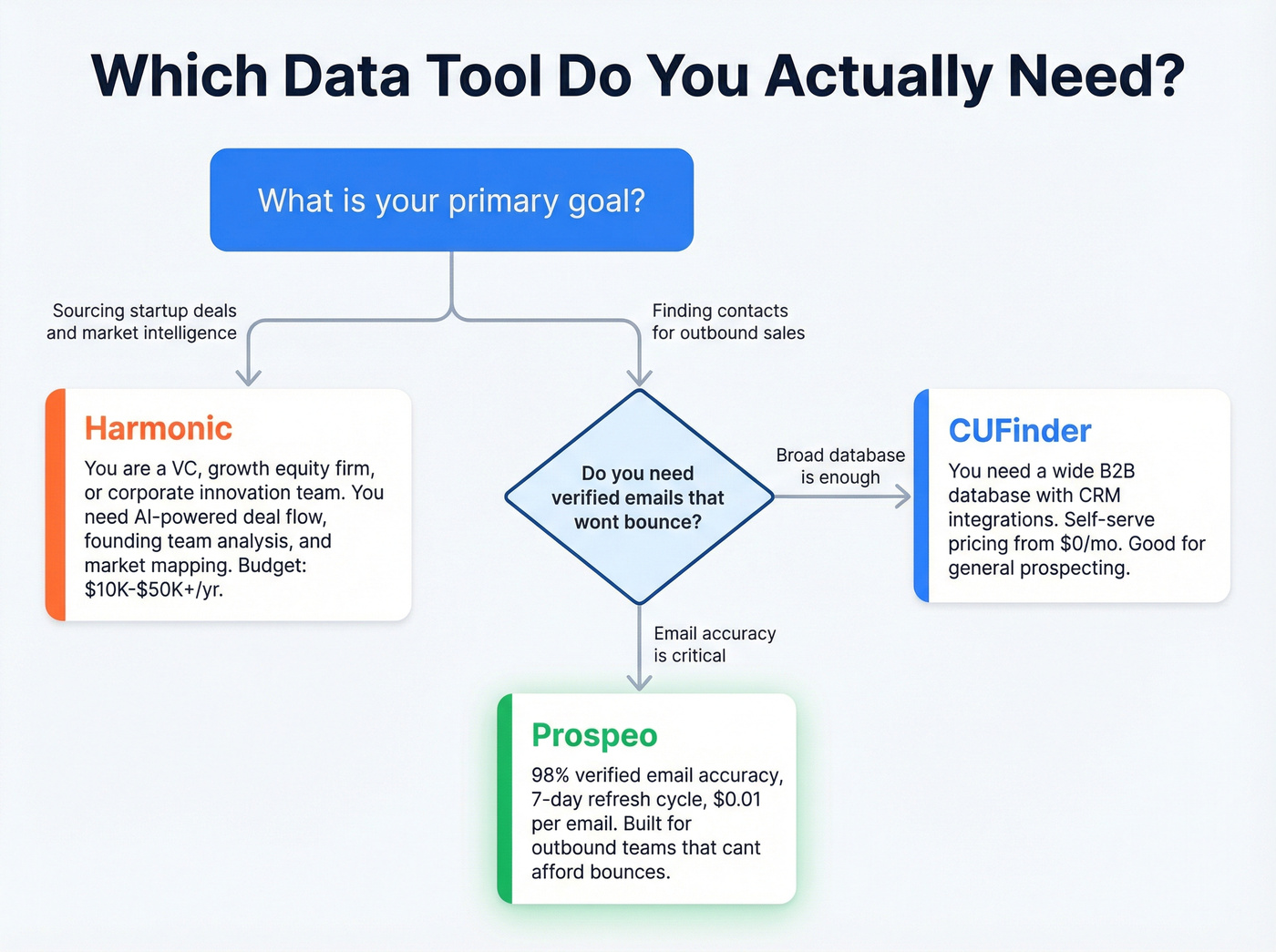
Pick Harmonic if you:
- Run a VC fund, growth equity firm, or corporate innovation team
- Need AI-powered startup discovery, market mapping, and deal-flow research
- Have an enterprise budget ($10K+/year) and prefer demo-based onboarding
Pick CUFinder if you:
- Run B2B outbound sales or demand gen campaigns
- Need a broad contact database with native CRM integrations
- Want transparent, self-serve pricing starting at $0
If you're genuinely torn between these two, that's a signal to step back. They serve different buyers solving different problems. Clarify whether you're sourcing deals or sourcing contacts - the answer picks the tool for you.
When Neither Tool Fits
Here's the thing: if your actual need is verified emails and direct dials for outbound sequences, neither CUFinder nor Harmonic is purpose-built for that.
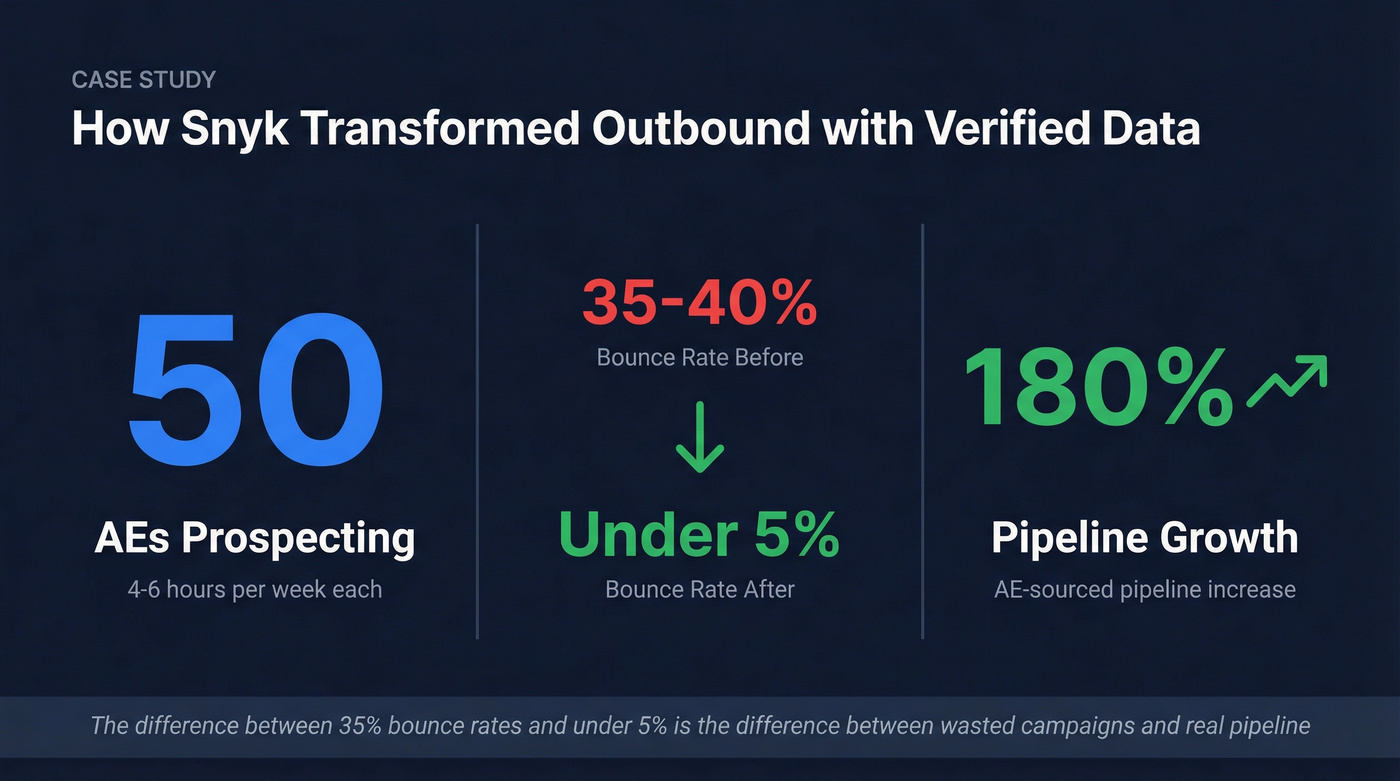
One of our customers, Snyk, had 50 AEs prospecting 4-6 hours per week with bounce rates hovering around 35-40%. After switching, bounce rates dropped under 5% and AE-sourced pipeline jumped 180%. That's the difference accurate data makes at scale. If you're diagnosing deliverability, start with your email bounce rate and then work through an email deliverability guide.

If you're an SDR team that landed here looking for accurate contact data, you don't need a VC deal-sourcing engine or a broad database with unverified refresh rates. Snyk's 50 AEs cut bounce rates from 35% to under 5% and grew pipeline 180% - because every email actually reached a real inbox.
Verified emails at $0.01 each. No contracts, no demo gates, no bounced campaigns.
FAQ
Is Harmonic a CRM?
No. Harmonic is a startup discovery and research tool for investors. It syncs with CRMs but doesn't replace them - you'll still need Salesforce or HubSpot for pipeline management.
Can CUFinder handle VC deal sourcing?
Not effectively. CUFinder is built for broad B2B prospecting by role and industry. It lacks Harmonic's startup-specific signals like founding team analysis, growth trajectory tracking, and AI-powered market mapping.
Which tool has the best email accuracy for outbound?
Neither CUFinder nor Harmonic specializes in email verification for outbound sales. Prospeo delivers 98% email accuracy across 143M+ verified addresses on a 7-day refresh cycle, with a 5-step verification process that includes catch-all handling, spam-trap removal, and honeypot filtering.
Is the CUFinder vs Harmonic comparison even valid?
Barely. CUFinder targets sales teams running B2B prospecting; Harmonic targets investors sourcing startup deals. If you're comparing them, first clarify whether you need contact data for outbound sequences or market intelligence for deal flow - the answer eliminates one tool immediately.