


CUFinder vs LeadsForge: Which B2B Data Tool Deserves Your Budget?
Your 5-person SDR team is split. One rep found CUFinder on G2 and loves the 988 reviews. Another saw LeadsForge in a Salesforge demo and wants the AI chat interface. Here's the data you need to settle the debate before the quarter closes.
30-Second Verdict
Pick CUFinder for a mature, standalone platform with tiered pricing and nearly 1,000 G2 reviews backing it up.
Pick LeadsForge if you're already in the Salesforge ecosystem and want AI chat-based prospecting baked into your outreach workflow.
Feature Comparison at a Glance
| Feature | CUFinder | LeadsForge |
|---|---|---|
| Database size | 262M contacts | 500M+ (listed on G2) |
| Search method | Filter-based | AI chat / NLP |
| Email verification | Included | Validation can require extra credits |
| Chrome extension | Yes | Not highlighted publicly |
| G2 rating | 4.8/5 (988 reviews) | 4.5/5 (12 reviews) |
| CRM integrations | Salesforce, HubSpot | Salesforce, HubSpot, Attio, Folk, Breakcold |
| API access | Yes | Yes |
| GDPR compliance | Stated | Stated |
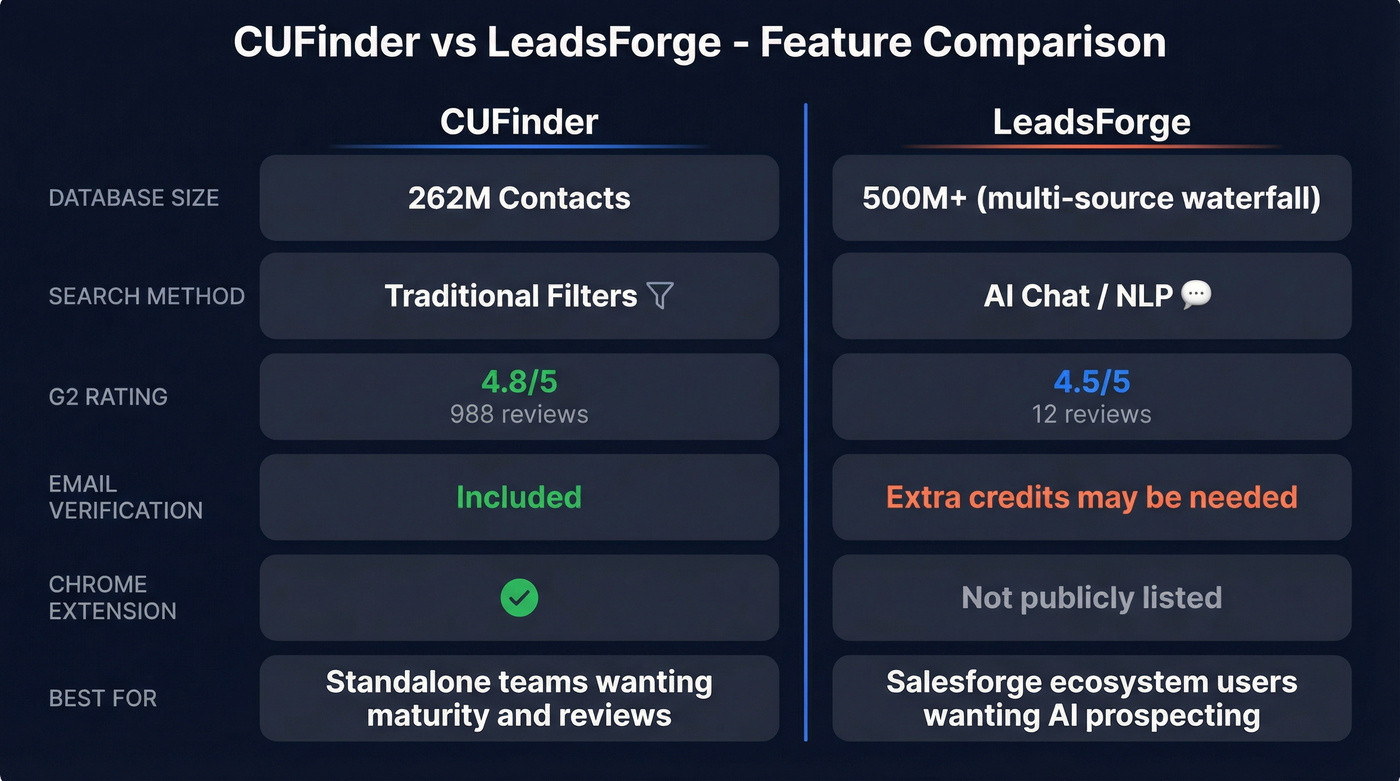
The database size gap looks dramatic on paper, but it's misleading. LeadsForge's 500M+ figure comes from scanning across multiple databases using a "waterfall enrichment process" that combines several sources. CUFinder sits at 262M contacts.
Here's the thing: raw contact count matters far less than deliverability. When records are wrong, teams feel it fast - bounces, wasted credits, and more time re-checking data than actually prospecting.
On CUFinder's side, a Capterra reviewer reports "almost 1 out of 10 records isn't right." LeadsForge G2 reviewers call out needing extra validation credits, plus occasional accuracy and export cleanliness issues.
Pricing Breakdown
| CUFinder | LeadsForge | |
|---|---|---|
| Free tier | 50 credits/mo | 100 credits on signup |
| Starter paid | $49/mo (1K credits) | ~$49/mo (2K credits) |
| Mid tier | $129/mo (3K credits) | Not public |
| Top tier | $299/mo (10K credits) | Not public |
| Cost per credit | ~$0.049 | ~$0.0245 |
| Cost per verified email | ~$0.049 | ~$0.05 with validation credits |
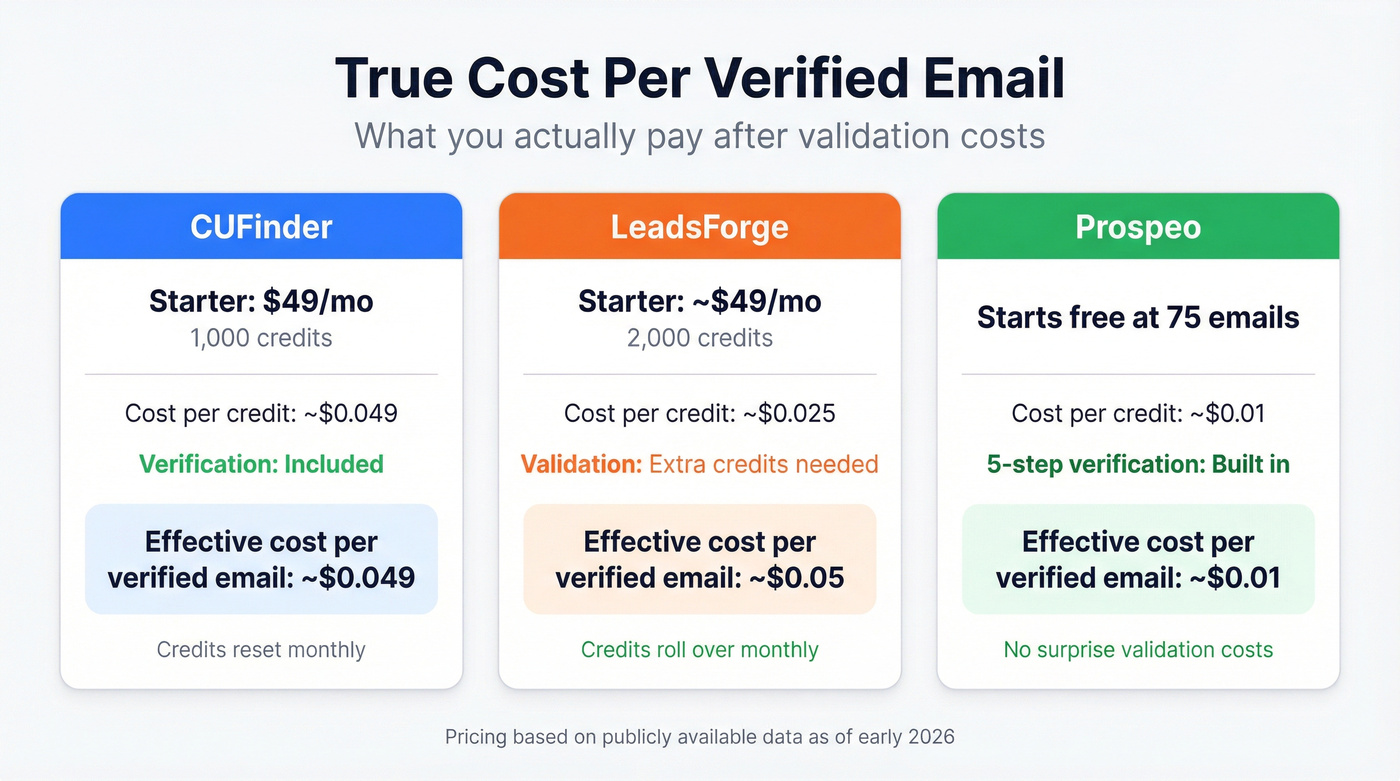
If you've seen CUFinder's Growth plan listed at $34/mo, that's outdated. The current pricing page shows $49/mo.
LeadsForge looks cheaper per credit at first glance, but validation can require purchasing additional credits on top of your base plan - pushing the effective cost to around $0.05 per verified email. One genuine LeadsForge advantage: unused credits carry over month-to-month, which is nice for teams with uneven prospecting volume. CUFinder credits reset monthly.
LeadsForge doesn't have a public pricing page. The ~$49/mo figure shows up in third-party directories and Salesforge add-on pricing ($49/mo for 2,000 credits). Expect to talk to their team for anything beyond the basics.

Both CUFinder and LeadsForge make you pay extra to validate your data. Prospeo's 5-step verification is built into every credit - 98% email accuracy, no surprise validation costs. At ~$0.01 per verified email, you're paying a fraction of either tool's effective per-contact cost.
Stop paying twice - once for data, again to verify it.
What Real Users Say
We've all been there: you export 500 leads, 40 bounce in the first hour, and suddenly your domain reputation is taking hits. That scenario shows up constantly in reviews of both tools.
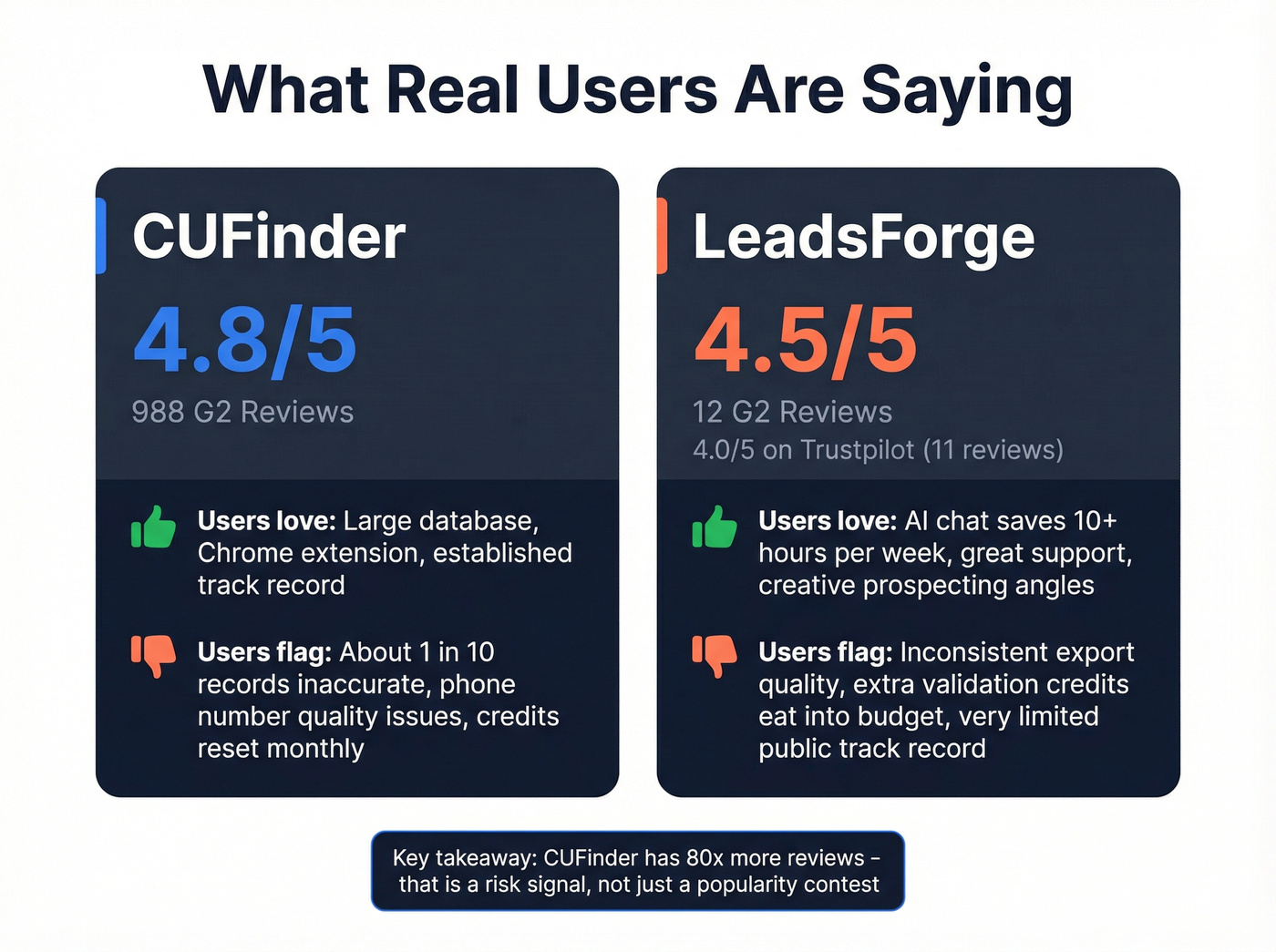
CUFinder carries a strong 4.8/5 on G2 across 988 reviews. Capterra reviewers highlight that accuracy can make or break a campaign - including one who says "almost 1 out of 10 records isn't right," plus recurring complaints about phone number quality.
LeadsForge sits at 4.5/5 on G2 with just 12 reviews and 4.0/5 on Trustpilot from 11 reviews. One agency user wrote it "saves us 10 hours of manual research a week," and support gets consistent praise. But the negatives are pointed: "data quality when exporting leads can be inconsistent," and reviewers flag extra validation credit costs eating into their budget.
Reddit discussion is sparse for both. Most cold email practitioner chatter on r/sales and r/coldemail centers on bigger names like Apollo or ZoomInfo, so you won't find much community-level validation for either CUFinder or LeadsForge yet.
Key Differences That Actually Matter
Standalone vs. Ecosystem
CUFinder is a single-product purchase. LeadsForge is part of the Salesforge "Forge Stack" - designed to feed leads directly into Salesforge sequences. If you aren't using Salesforge for outreach, you're paying for native integration you'll never touch.
Filter-Based vs. AI Chat
CUFinder uses traditional search filters. LeadsForge lets you describe your ICP in natural language and the AI builds a lead list. The chat approach is genuinely faster for a first-pass list - Trustpilot reviewers say it gets you "about 90% there, then you tweak." LeadsForge also supports prospecting angles like lookalike company contacts and company followers search, which is a creative touch we haven't seen in many competitors.
If you're building repeatable outbound, it helps to standardize your sales prospecting techniques so list quality doesn't depend on who prompts the AI best.
Review Maturity
CUFinder has about 80x more G2 reviews than LeadsForge. That's not necessarily a quality judgment - it's a risk signal. With 12 reviews, you're betting on a product with a very limited public track record. For teams that need to justify a tool purchase to leadership, that gap matters.
If Neither Fits
Both CUFinder and LeadsForge users end up caring about the same thing: can you trust the data without adding extra verification steps?
In our experience testing dozens of B2B data providers, the tools that skip built-in verification always cost more in the long run. Bounced emails, burned domains, wasted rep time - it adds up quietly until someone pulls a report and the numbers are ugly.
Prospeo eliminates that problem. Every credit includes verification - 98% email accuracy, 7-day data refresh, 300M+ professional profiles with 125M+ verified mobile numbers. It's GDPR compliant with self-serve pricing starting free at 75 verified emails per month. No annual contracts, no surprise validation costs.
For context, Meritt tripled pipeline from $100K to $300K/week while dropping bounce rates from 35% to under 4% after switching. At roughly $0.01 per email, that's a fraction of what either CUFinder or LeadsForge charges per verified contact.
If you're comparing verification-first options, start with email verification and then map it to your email deliverability workflow.

CUFinder refreshes on unknown cycles. LeadsForge doesn't disclose theirs. Prospeo refreshes all 300M+ profiles every 7 days - so your SDRs never waste credits on stale contacts. Teams like Snyk dropped bounce rates from 35% to under 5% and added 200+ opportunities per month.
Your reps deserve data that's less than a week old.
The Verdict
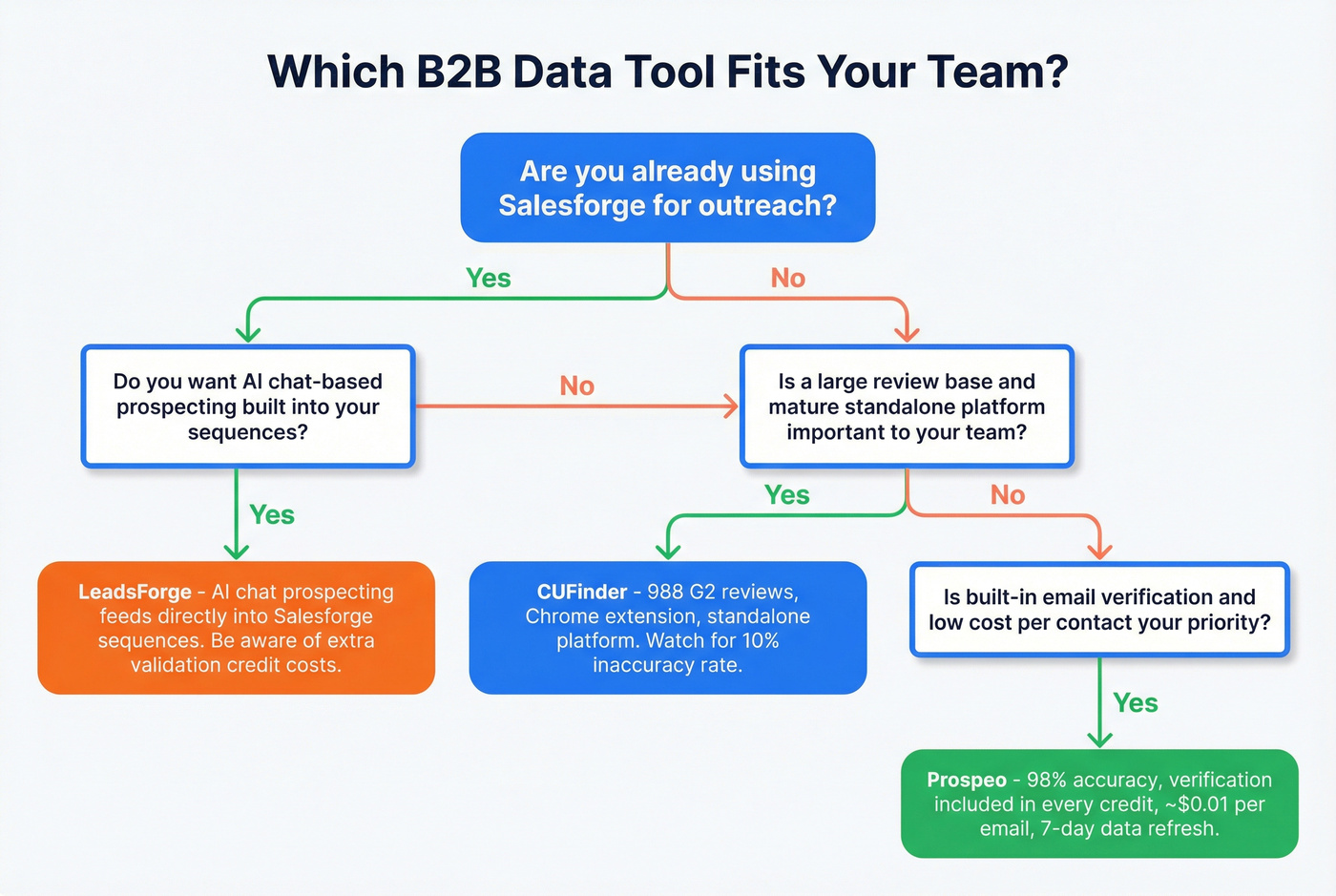
For most teams weighing CUFinder vs LeadsForge, the deciding factor is whether you're already in the Salesforge ecosystem.
CUFinder if you want a mature standalone platform with a Chrome extension and the confidence of 988 G2 reviews. LeadsForge if you're running Salesforge for outreach and want AI chat prospecting feeding directly into sequences.
Let's be honest, though: if your average deal size is under $15k, you probably don't need a platform-locked tool like LeadsForge. Buy standalone data, plug it into whatever sequencer you want, and keep your options open.
If you're still evaluating your stack, it can help to benchmark against broader SDR tools and outbound lead generation tools before you commit.
FAQ
Is LeadsForge a standalone tool?
No. It's part of the Salesforge Forge Stack. You can buy it as an add-on at ~$49/mo for 2,000 credits, but if you aren't using Salesforge for outreach, you're paying for integration you won't use.
Which has better data accuracy?
Neither tool guarantees clean exports out of the box. CUFinder's Capterra reviews report roughly 1 in 10 records being inaccurate, while LeadsForge reviewers flag inconsistent export quality and extra validation credit costs. If deliverability is your top concern, look for a provider with built-in verification and a short data refresh cycle.
Do unused credits roll over?
LeadsForge credits carry over month-to-month, which is a genuine advantage for teams with variable prospecting volume. CUFinder credits reset monthly.