


CUFinder vs Pubrio: Honest Comparison (2026)
Two tools, very different bets. CUFinder is the established global contact database with nearly 1,000 G2 reviews and deep CRM integrations. Pubrio is the APAC-specialist newcomer pulling from 50+ localized sources most Western databases ignore. If you're weighing CUFinder vs Pubrio, here's how to decide - and what to do if neither wins your bake-off.
30-Second Verdict
- Pick CUFinder if you need a proven global database with real social proof (4.8/5 on G2, 988 reviews) and native integrations with Salesforce, HubSpot, and Pipedrive.
- Pick Pubrio if your ICP lives in APAC - Singapore, India, Japan, Vietnam - and you need localized data from 50+ regional sources that CUFinder and most competitors don't index.
- Skip both if email deliverability matters most. Prospeo's 98% verified email accuracy on a 7-day refresh cycle outperforms both on the metric that actually drives reply rates.
Feature Comparison at a Glance
| Dimension | CUFinder | Pubrio |
|---|---|---|
| Database size | 419M individuals | 275M global contacts |
| Emails | 180M | 156M |
| Phone numbers | 452M verified | 120M direct dials and mobile |
| Accuracy claim | 98-99% | 90% |
| Update cadence | Monthly | Daily (claimed) |
| G2 rating | 4.8/5 (988 reviews) | 5.0/5 (2 reviews) |
| Compliance | GDPR, CCPA, SOC 2 Type II | No published certifications |
| Price (headline) | $299/mo (Unlimited) | $199/year (Corporate) |
| Integrations | Salesforce, HubSpot, 10+ CRMs | Chrome extension, API |
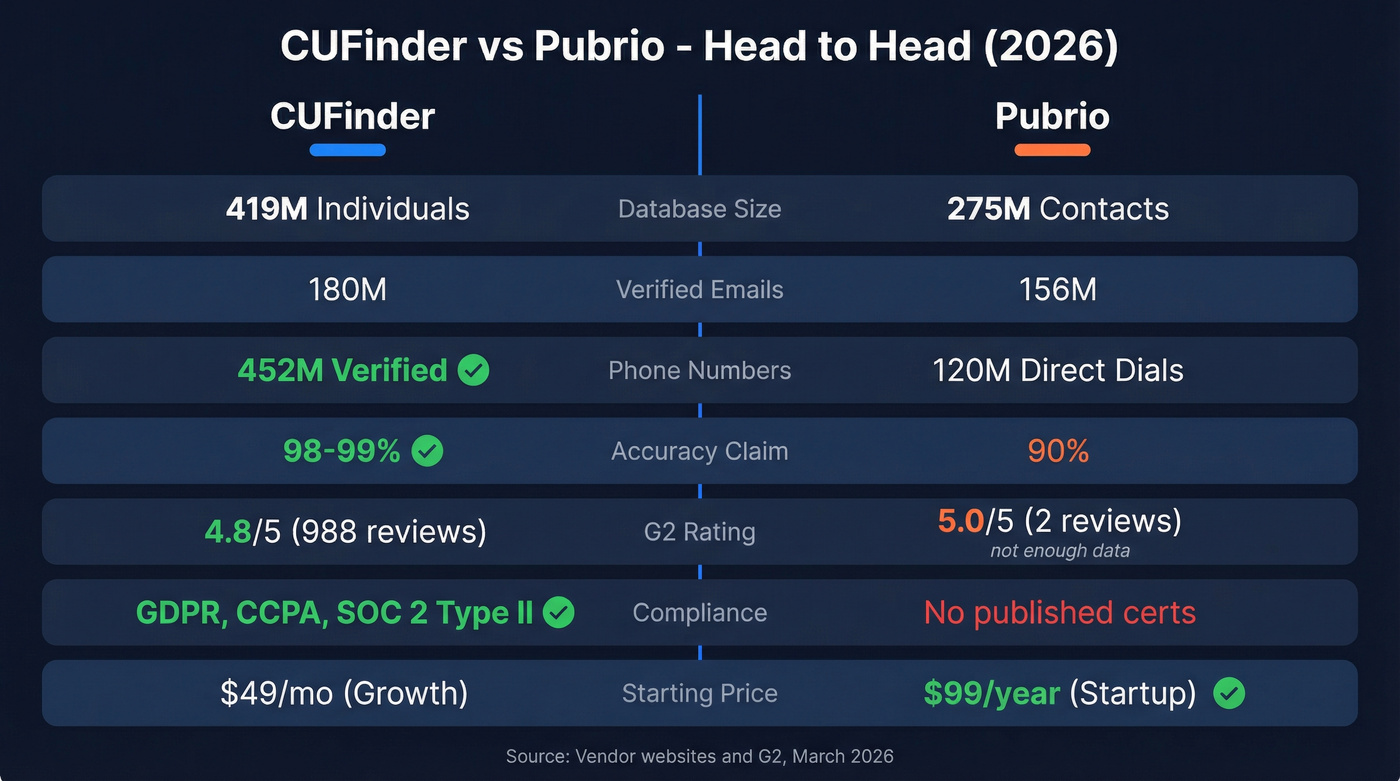
CUFinder takes database size, phones, compliance, and integrations. Pubrio takes price. Update cadence is harder to call: CUFinder publishes a monthly cycle, while Pubrio positions its database as daily-updated - but with only two G2 reviews, there's no independent confirmation of that claim.
Pricing Breakdown
CUFinder bills monthly at 1 credit = 1 lookup across four tiers: Free (50 credits), Growth ($49/mo, 1,000 credits), Premium ($129/mo, 3,000 credits), and Unlimited ($299/mo, 10,000 credits). At Growth, that's roughly $0.049 per lead.
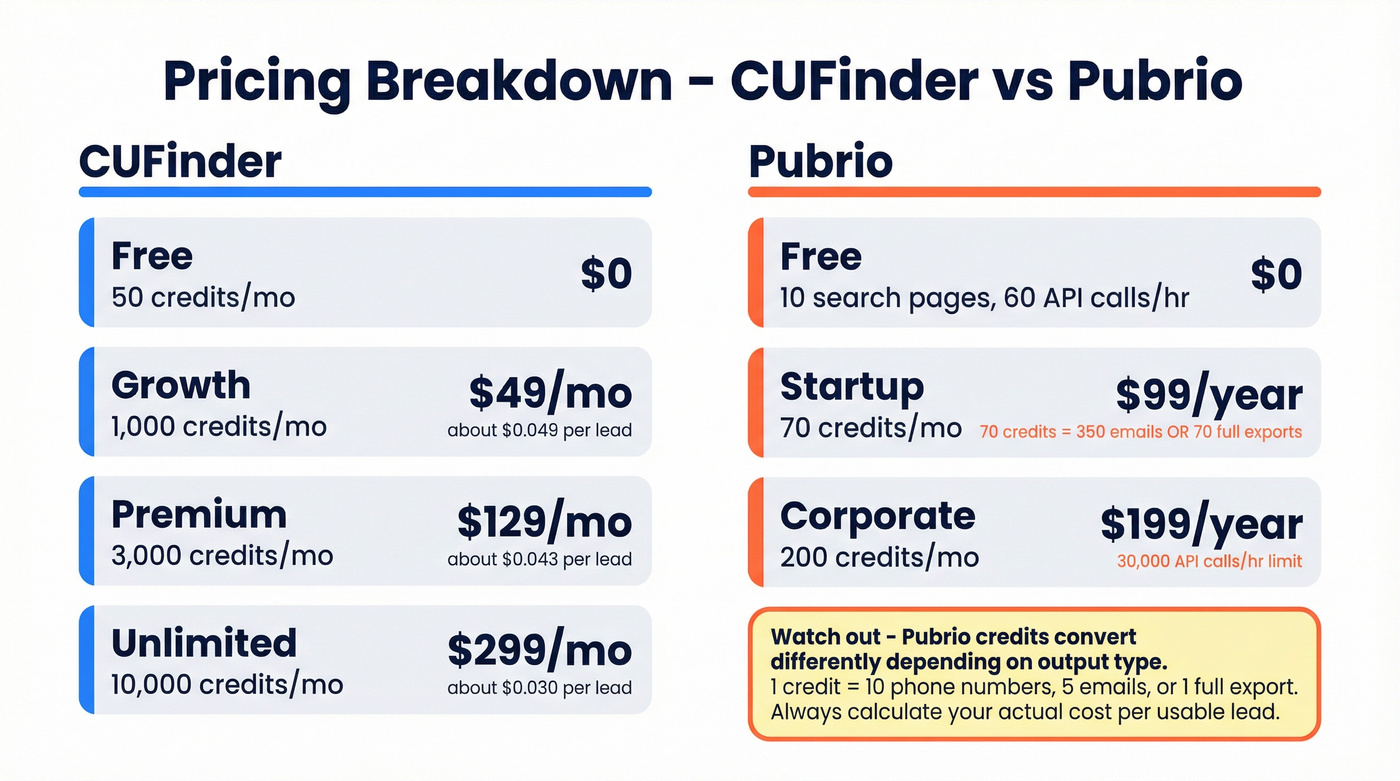
Pubrio's pricing page tells a different story. There's a free plan and annual paid plans: Startup at $99/year, Corporate at $199/year, and Organization (custom). Cheap on paper. But credit conversion matters - 70 credits buys you 700 phone numbers, 350 emails, or just 70 full exports. Top-up credits run $0.015-$0.025 each, and API call limits range from 60/hour on Free to 30,000/hour on Corporate, which is a real constraint if you're running automated enrichment at any scale.
Let's be honest: Pubrio can look cheaper fast, but only if the credit-to-output mapping matches your workflow. Do the math against your actual process before committing.

Comparing credit costs between CUFinder and Pubrio? Prospeo delivers verified emails at ~$0.01 each - 98% accurate, refreshed every 7 days. No annual contracts, no credit math headaches.
Stop calculating credits and start closing deals.
Data Quality and Coverage
This is where the comparison gets interesting - and where we'd encourage you to trust your own testing over either vendor's marketing claims.
CUFinder positions its database at 269M company profiles and 419M individual profiles, with 180M verified email addresses and 452M verified phone numbers. It describes verification using AI and NLP alongside other matching methods, and it publishes a monthly update cadence. CUFinder also lists a compliance stack that includes GDPR, CCPA, and SOC 2 Type II - which matters if procurement has strict vendor-risk requirements. On review sites, it holds 4.8/5 on G2 (988 reviews) and 4.9/5 on Capterra (22 reviews). Minor complaints include occasional stale records and UI/reporting limitations. One Capterra reviewer reported a case where a phone number returned belonged to a prospect's family member rather than the prospect themselves - not great.
Pubrio is built around an APAC angle. It connects and normalizes data from 50+ localized sources into a single business graph, with Singapore, India, Japan, and Vietnam commonly highlighted as strengths. Published coverage numbers are large: 1B+ company profiles, 275M contacts, 156M emails, and 120M direct dials. Pubrio also publishes outcome metrics like 85% more leads and 75% reduced research time.
Here's the thing: Pubrio's 5.0/5 G2 rating is based on exactly 2 reviews. That's not social proof - that's a rounding error. And Pubrio doesn't publish compliance certifications on its site. No GDPR documentation, no CCPA, no SOC 2. If your procurement team requires formal compliance attestation, that's a blocker, full stop.
We also weren't able to find much usable Reddit or forum sentiment for either tool, so treat this as a "test it yourself" decision more than a community-consensus one.
Who Should Pick Which
You're prospecting heavily in APAC. Pubrio wins. If your target accounts sit in Singapore, India, Japan, or Vietnam, Pubrio's localized sourcing surfaces contacts and company records that many global databases miss entirely. Just go in with eyes open about the compliance gap.
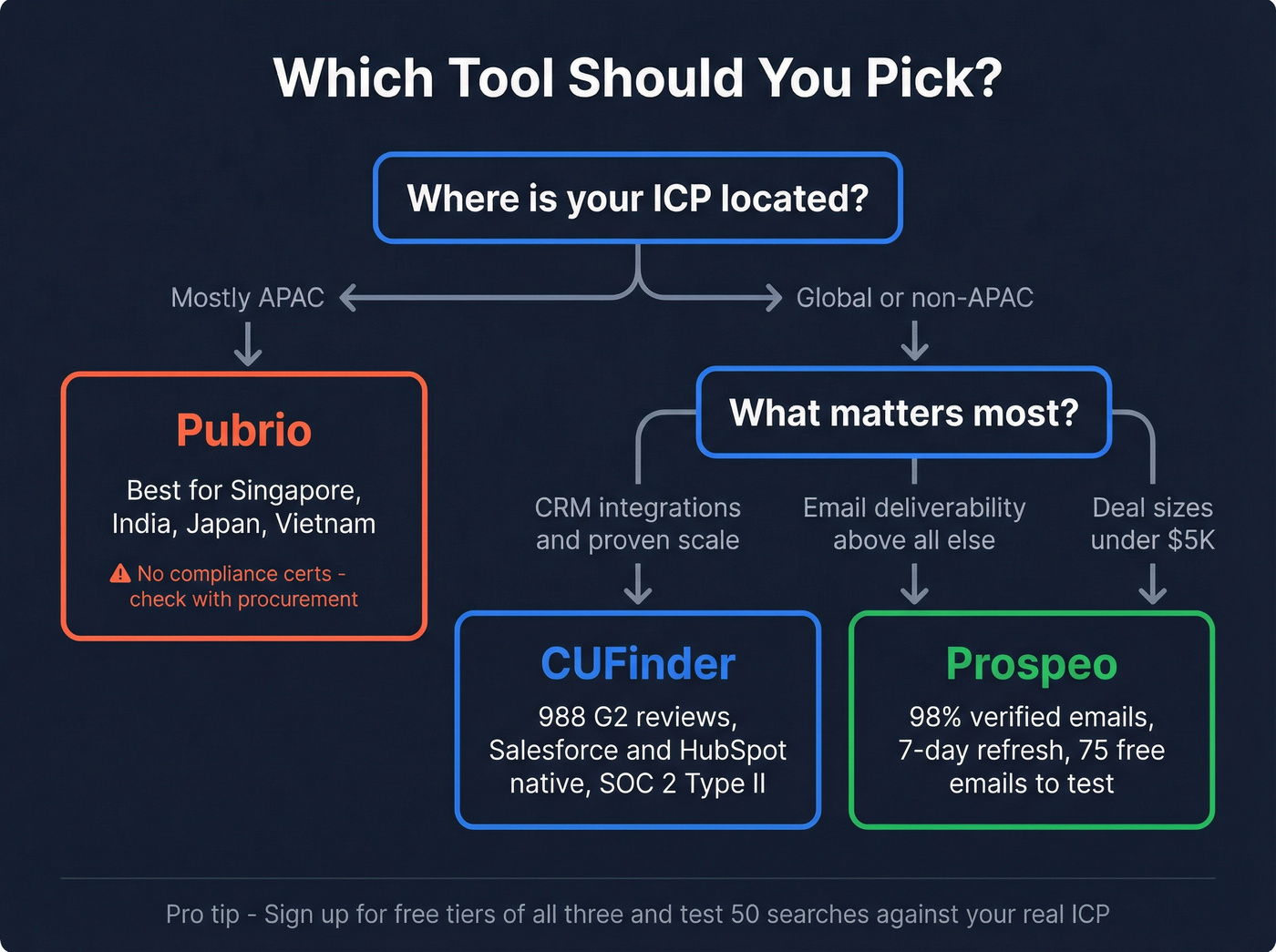
You need global coverage with proven integrations. CUFinder wins. Native connections to Salesforce, HubSpot, Zoho, Pipedrive, and Marketo mean your enrichment workflows run without custom workarounds. Nearly 1,000 G2 reviews give you confidence the tool performs at scale.
Your deal sizes are under $5K and you're selling outside APAC. Skip the evaluation entirely. Grab a self-serve platform with verified emails, run your campaigns, and invest the saved hours into actual selling.
Best move regardless: sign up for both free tiers, run 50 searches against your actual ICP, and compare results. A 30-minute test beats reading comparison articles - including this one.
When Neither Wins Your Bake-Off
If the gap you keep hitting is verified email accuracy and keeping your outreach list clean, that's where teams feel the pain fastest. CUFinder publishes a monthly update cycle. Pubrio positions its data as daily-updated. But the bigger question for outbound isn't how often the database refreshes - it's whether the emails you pull are actually deliverable when you hit send.
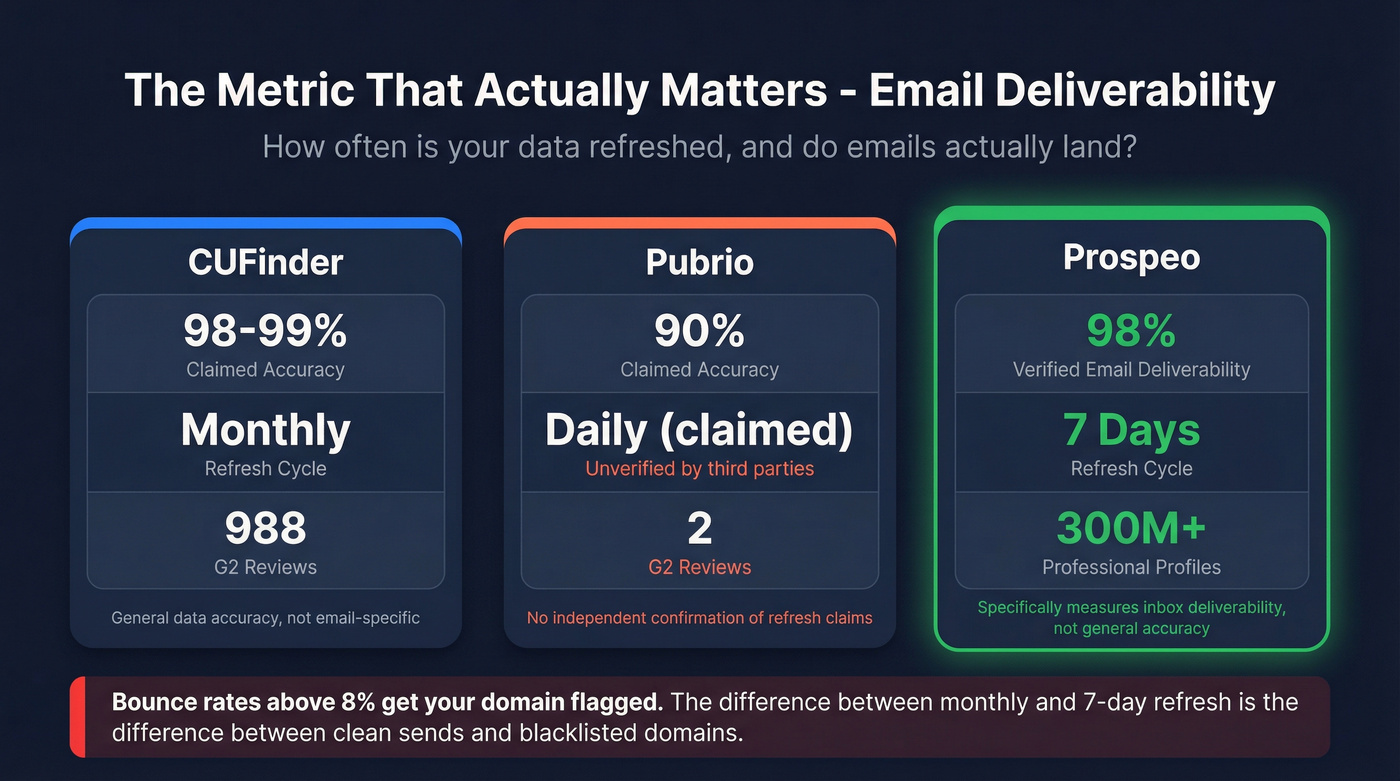
We've seen this pattern repeatedly: teams pull thousands of contacts from a database that looks great on paper, load them into Instantly or Smartlead, and watch their bounce rate climb past 8%. That's how domains get flagged.
Prospeo's 7-day refresh cycle reduces stale records, and the platform is built around 98% verified email deliverability - not general "data accuracy," but specifically whether your emails land in inboxes. It covers 300M+ professional profiles and includes 125M+ verified mobile numbers with a 30% pickup rate. Self-serve, free tier with 75 verified emails per month, no contracts. For teams finding gaps in both CUFinder and Pubrio, Prospeo's proprietary email-finding infrastructure plus 30+ search filters (buyer intent, technographics, job changes, headcount growth) often closes the evaluation faster than either option.
If you want a deeper playbook on keeping lists clean, see CRM data hygiene and verifying email addresses.
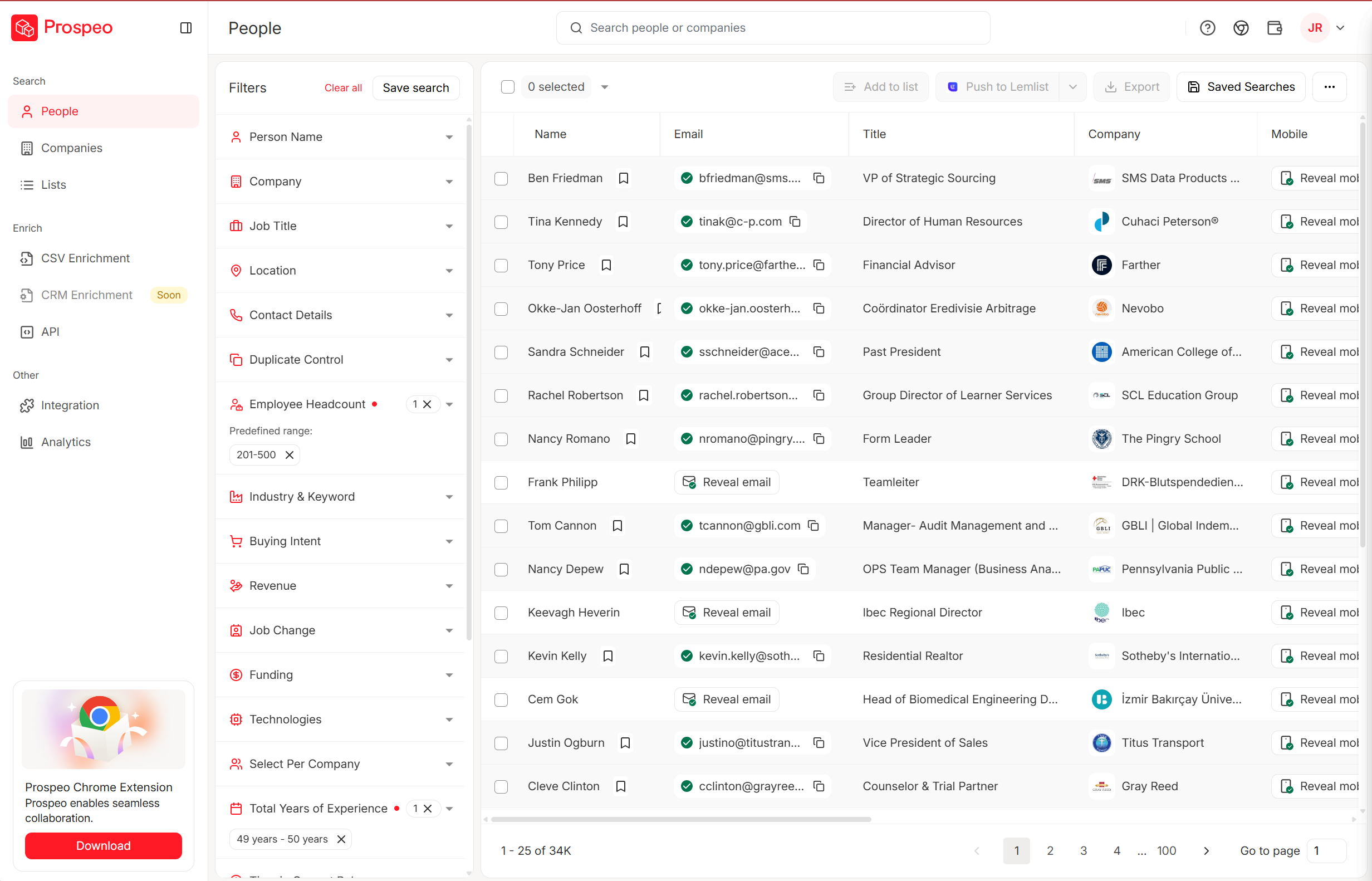
Neither CUFinder's monthly refresh nor Pubrio's unverified daily claims solve the real problem: bounced emails killing your domain. Prospeo's proprietary 5-step verification and 7-day refresh cycle keep bounce rates under 4%.
Protect your domain with emails that actually land.
FAQ
Does CUFinder or Pubrio have a free plan?
Both do. CUFinder gives 50 credits per month - enough to test, not enough to run campaigns. Pubrio's free plan includes 10 search pages and 60 API calls per hour. Either works for a quick evaluation.
Which tool has more accurate data?
CUFinder markets 98-99% accuracy and has 988 G2 reviews behind it. Pubrio publishes 90% accuracy but only has 2 G2 reviews. Neither publishes independent benchmarks, so test both against your own ICP before trusting the numbers.
Is Pubrio only useful for APAC?
No - it covers 130+ countries. But its real differentiator is APAC-localized data from 50+ regional sources, including non-English records most global databases skip. For global prospecting without an APAC focus, CUFinder offers a larger verified database with far stronger social proof.