

The ICP Business Guide That Actually Shows You a Finished One
Your SDRs are booking meetings with companies that never close. Marketing generates leads that sales ignores. Everyone agrees you need a better ICP - the single most important targeting concept in business - so someone Googles it, reads five articles full of abstract frameworks, and nothing changes. The ICP stays in a Google Doc nobody opens.
We've watched teams burn entire quarters chasing accounts that were never going to close. The fix isn't another framework deck. It's a filled-out template, a scoring model, and a plan to actually use the thing.
What You Need (Quick Version)
Building a useful ICP comes down to three steps:
- Define 3 core attributes your best customers share - industry, size, and one behavioral signal is the minimum viable profile
- Score accounts on a 100-point model so reps know where to spend their time
- Operationalize with enrichment tools that turn ICP criteria into a filtered, verified prospect list you can export in minutes
Everything below unpacks those three steps with real examples, filled-out templates, and benchmarks.
What Does ICP Mean in Business?
ICP stands for Ideal Customer Profile - a detailed description of the company most likely to buy your product, succeed with it, and stick around. If you've seen the abbreviation in sales decks and wondered about the ICP meaning in business, it's simply the account-level filter that tells your team which companies deserve outbound effort and which ones don't.
Why does this matter? The median B2B conversion rate across industries is 2.9%. That means 97 out of 100 prospects don't convert. Poor data quality costs the average organization $12.9M per year according to Gartner, and B2B contact data decays at roughly 2.1% per month - so even a good list rots fast. A sharp ideal customer profile is the single biggest lever you have to improve those numbers.
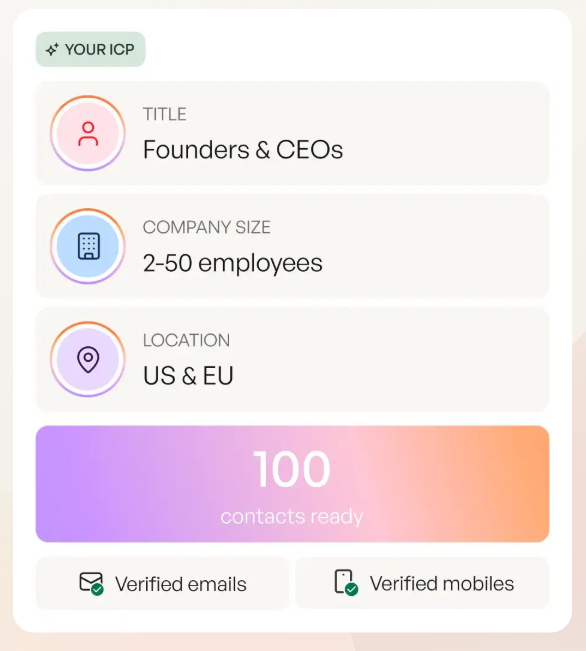
Most ICPs fail for three reasons, and Reddit practitioners on r/b2b_sales call them out consistently: they're built on gut feel instead of win/loss data, they're too broad to be useful, and they're created once and never revisited. If yours hasn't been updated in over a year, it's fiction.
ICP vs. Persona vs. Target Market
These terms get used interchangeably, and that's where the confusion starts. They're different tools for different jobs.
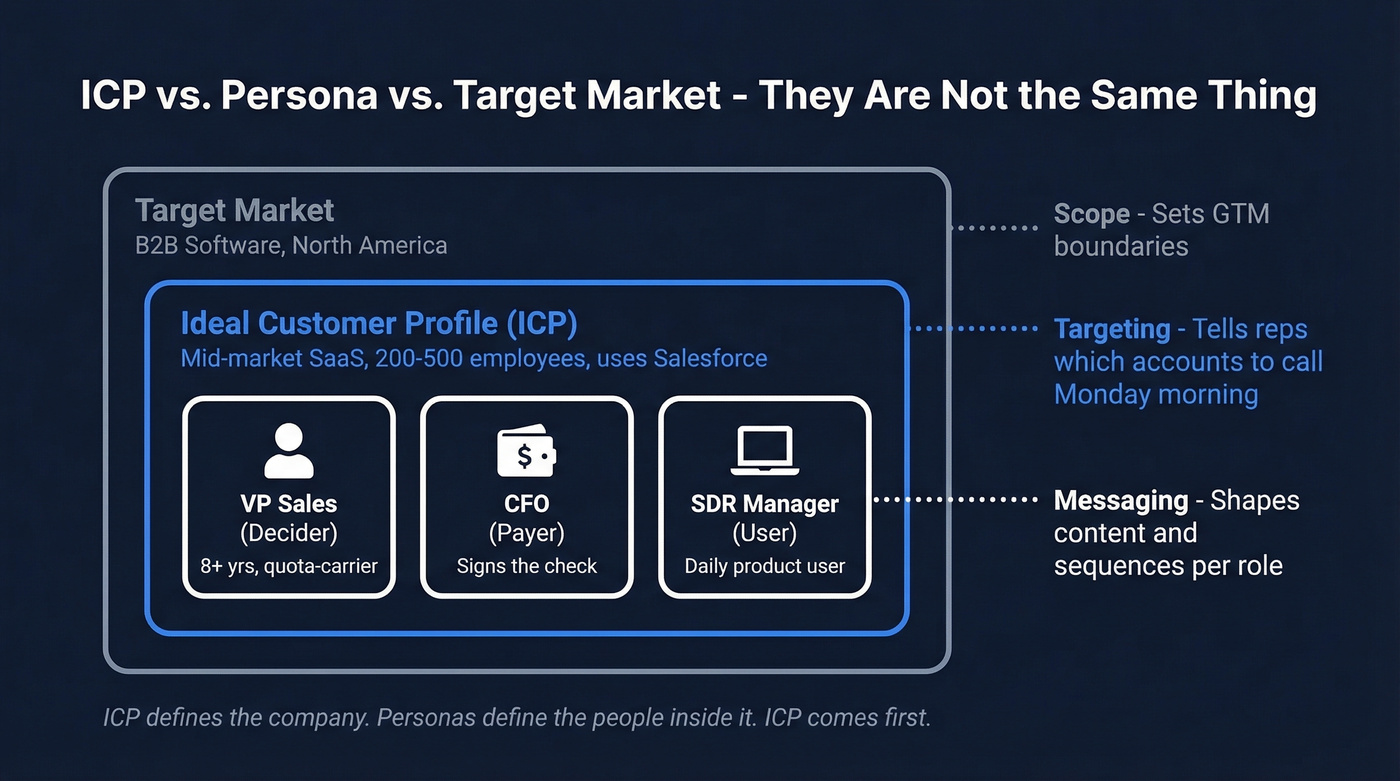
| Concept | Describes | Example | Used For |
|---|---|---|---|
| ICP | The company | Mid-market SaaS, 200-500 emp | Account targeting |
| Buyer Persona | The person | VP Sales, 8+ yrs, quota-carrier | Messaging & content |
| Target Market | The segment | B2B software, North America | GTM scope |
| TAM/SAM/SOM | The math | $4.2B TAM, $120M SOM | Pitch decks |
TAM/SAM/SOM is pitch deck math - useful for investors, mostly irrelevant for day-to-day targeting. Your ideal customer profile is operational. It tells reps which accounts to call on Monday morning.
The decider/payer/user distinction matters here too. In B2B, the person who chooses your product, the person who signs the check, and the person who uses it daily are often three different people. Your ICP defines the company; your personas define those roles within it. ICP comes first. Personas live inside it.
The r/b2bmarketing crowd has a term for personas built without talking to customers or sales: "fairytale personas." They're right. If your personas were built in a workshop with sticky notes and no CRM data, start over.
What Goes Into an ICP Definition
You don't need 20 attributes. You need 3 that actually matter - plus enough context to make them actionable.
B2B ICP Template (Filled Out)
| Attribute | Example Value |
|---|---|
| Industry | B2B SaaS, FinTech |
| Company Size | 200-500 employees |
| Annual Revenue | $20-50M |
| Geography | US, UK, Canada |
| Tech Stack | Salesforce, HubSpot, Slack |
| Annual Budget | $50k-$100k |
| Pain Points | Manual prospecting, bad data quality |
| Buying Triggers | New VP Sales hire, funding round |
B2C ICP Template (Filled Out)
| Attribute | Example Value |
|---|---|
| Demographics | Women 28-42, urban, $75k+ income |
| Psychographics | Health-conscious, values convenience |
| Price Sensitivity | Medium - pays premium for quality |
| Preferred Channels | Instagram, email, podcast ads |
| Purchase Behavior | Subscribes monthly, refers friends |
Notice the tech stack and buying triggers rows in the B2B version - those are the attributes that separate a useful profile from a generic one. Firmographics alone aren't enough. You need signals that indicate readiness to buy.

Your ICP is only useful if you can act on it. Prospeo's 30+ search filters - including buyer intent, technographics, headcount growth, and funding signals - map directly to ICP criteria. Build a scored, verified list from 300M+ profiles at 98% email accuracy.
Stop letting your ICP collect dust in a Google Doc.
Build Your ICP: 5-Phase Framework
This framework draws from Cornell Azar's SaaS ICP methodology and maps to how the best RevOps teams we've worked with actually build theirs.
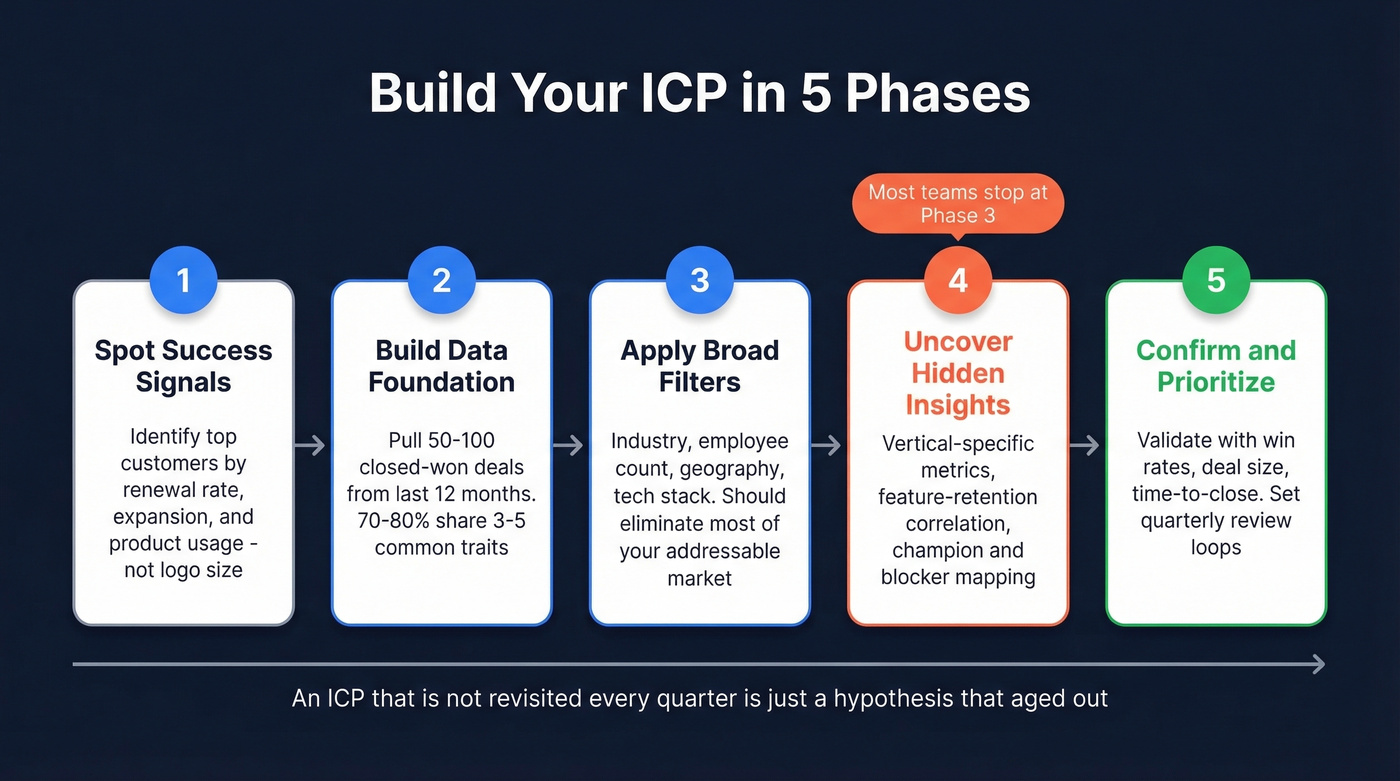
Phase 1: Spot Success Signals
Look at your best customers - not the biggest logos, but the ones with the highest commercial health, strongest product usage, and best strategic fit. Which accounts renewed without a fight? Which ones expanded? Those patterns are your starting point.
Phase 2: Build Your Data Foundation
Pull 50-100 closed-won deals from the last 12 months and analyze them. In our experience, 70-80% of your wins share 3-5 common traits - industry, company size, tech stack, buying trigger, or some combination. If you're early-stage with fewer deals, supplement with qualitative interviews. Talk to your 10 best customers and ask why they bought.
Phase 3: Apply Broad Filters
Turn patterns into filters: industry verticals, employee count ranges, geography, and technology stack. These are your first-pass criteria. They should eliminate most of the addressable market. If they don't, you're still too broad.
Phase 4: Uncover Hidden Insights
Here's the thing - this is where most teams stop, and it's where the real edge lives. Look for vertical-specific metrics like "SaaS companies with 50+ AEs" rather than just "SaaS companies." Map product usage patterns to identify which features correlate with retention. Identify champions and blockers in the buying committee: end users engage early, technical specialists during evaluation, CFOs show up late for approval.
Phase 5: Confirm and Prioritize
Validate your profile against hard numbers: win rates by segment, average deal size, time-to-close, product adoption scores, and customer satisfaction. Run win/loss interviews. Set up quarterly review loops. An ICP that isn't revisited every quarter is just a hypothesis that aged out.
Real-World ICP Examples
Abstract frameworks are useful. Seeing how real companies defined their ideal customer profile is better.
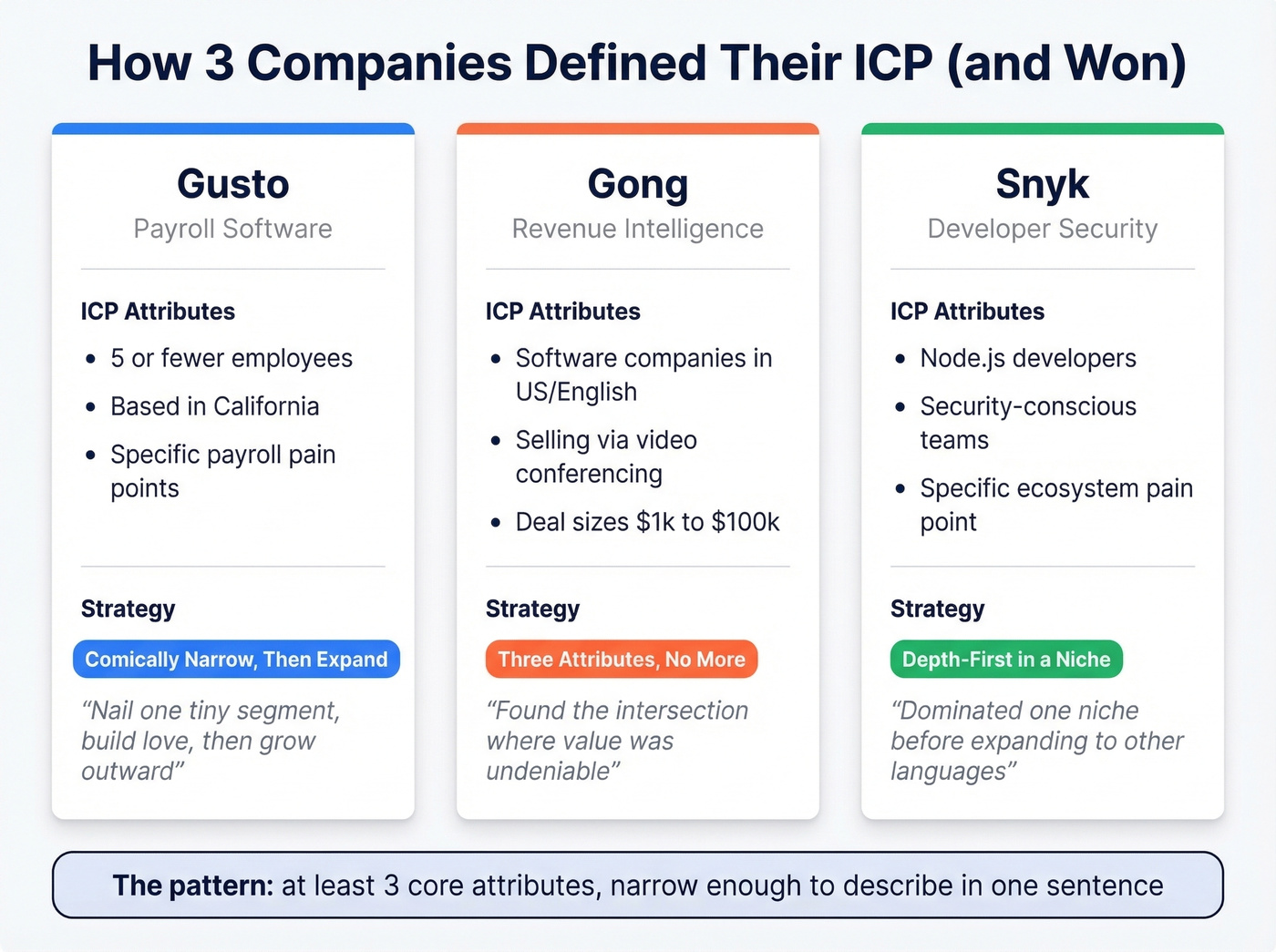
Gusto: Comically Narrow, Then Expand
Gusto started with a profile so narrow it felt absurd: companies with five or fewer employees, based in California, with specific payroll pain points. They nailed that segment, built intense customer love, then expanded methodically. Per Lenny's Newsletter, this "start comically narrow" approach is a pattern across successful companies.
Gong: Three Attributes, No More
Gong's initial ICP was software companies selling in the US/English, selling via video conferencing, with deal sizes between $1k and $100k. Three attributes. That's it. They found the intersection where their product created undeniable value and went deep.
Snyk: Depth-First in a Niche
Snyk targeted Node.js developers who were security-conscious. Not all developers. Not all security tools. A specific ecosystem with a specific pain point. They dominated that niche before expanding to other languages and frameworks.
The pattern across all three is at least 3 core attributes, narrow enough to describe in one sentence. This maps to Geoffrey Moore's "bowling pin" strategy - dominate one narrow segment, then expand to adjacent ones. As Front's CEO put it: "We did not think about ICP. I wish we did earlier on." That regret is universal among founders who tried to sell to everyone.
If your average deal is under five figures, you probably don't need ZoomInfo-level data or a 40-attribute profile. Three attributes, a good enrichment tool, and disciplined execution will outperform a bloated targeting framework every time.
Score and Tier Your Accounts
Once you've defined your ICP, you need a system to score accounts against it. This isn't lead scoring - that's contact-level behavioral engagement like email opens and pricing page visits. Account scoring is about structural fit.
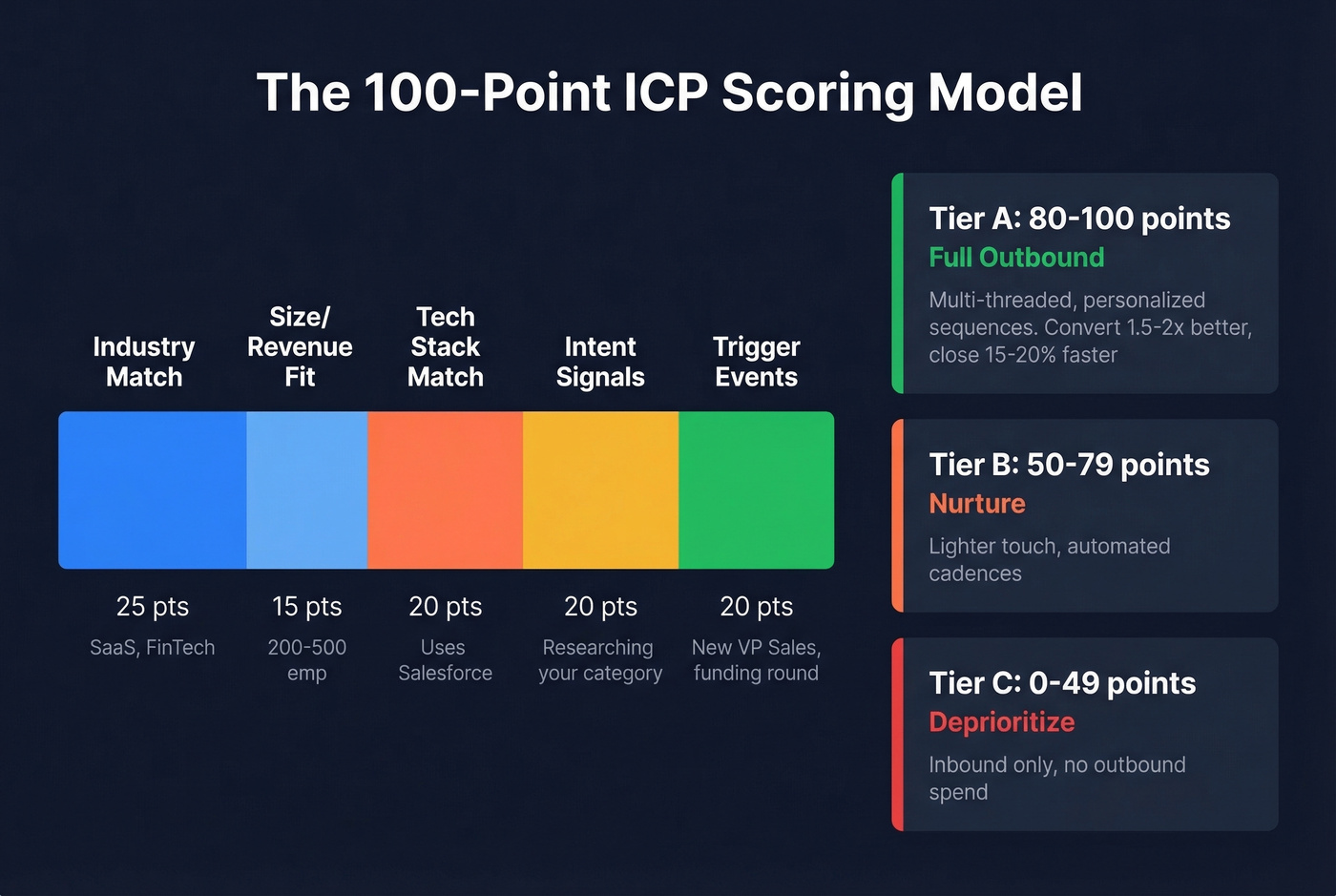
Here's a 100-point rubric:
| Category | Criteria | Points |
|---|---|---|
| Firmographics | Industry match | 0-25 |
| Firmographics | Size/revenue fit | 0-15 |
| Technographics | Uses key tech stack | 0-20 |
| Behavioral | Intent signals (topic research) | 0-20 |
| Trigger Events | Funding, new hire, expansion | 0-20 |
The behavioral row is where intent data earns its keep. An account that fits your ICP and is actively researching your category is worth 3x the outbound effort of one that just fits the profile on paper. Prospeo tracks 15,000 intent topics via Bombora, which lets you layer that "actively in-market" signal directly onto firmographic criteria.
Tier your accounts based on total score:
- Tier A (80-100): Full outbound - multi-threaded, personalized sequences
- Tier B (50-79): Nurture - lighter touch, automated cadences
- Tier C (0-49): Deprioritize - inbound only, no outbound spend
Tier A accounts convert at 1.5-2x the rate of Tier B and close 15-20% faster. That's the whole point - concentrating effort where it compounds.
Funnel Benchmarks for ICP-Driven Teams
Your ideal customer profile directly impacts every conversion rate in your funnel. Here are the Convertify "Golden Funnel" benchmarks for B2B companies selling above $5k ACV:
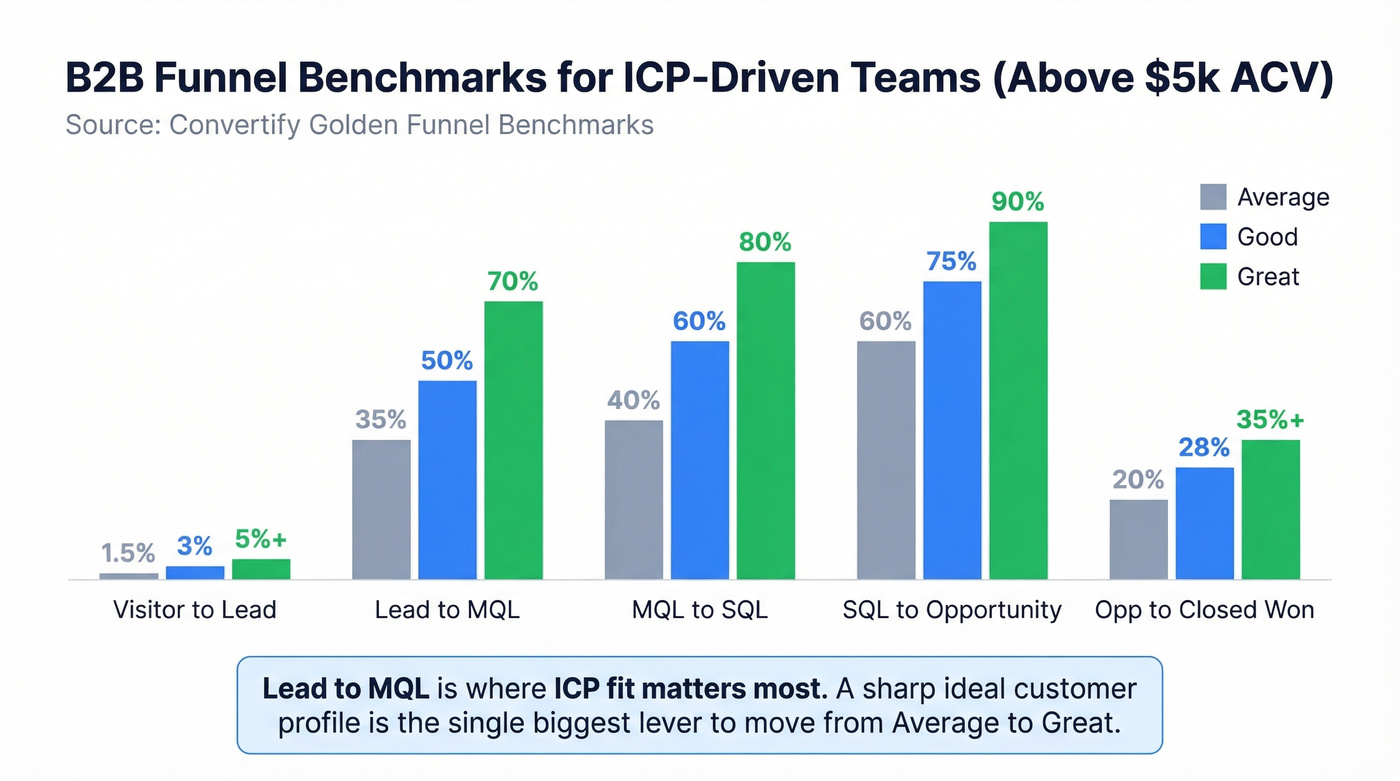
| Stage | Average | Good | Great |
|---|---|---|---|
| Visitor to Lead | 1.5% | 3% | 5%+ |
| Lead to MQL | 35% | 50% | 70% |
| MQL to SQL | 40% | 60% | 80% |
| SQL to Opportunity | 60% | 75% | 90% |
| Opp to Closed Won | 20% | 28% | 35%+ |
Lead to MQL is where ICP fit matters most. If your MQL definition is explicitly tied to profile criteria rather than just "downloaded a whitepaper," you should see 50%+ of leads qualifying. When you're stuck at the 35% average, your targeting is either too broad or your lead sources aren't aligned. For enterprise SaaS with high-touch sales, Demo to Close rates of 20-30% are the benchmark to beat.
Operationalize Your ICP
A profile in a Google Doc is worthless. If your sales team can't pull a list of ICP-fit accounts in 30 seconds, your ideal customer profile doesn't exist operationally.
Operationalizing means segmenting your CRM by account tier, setting up lead scoring rules that reflect your criteria, and connecting to a data enrichment tool that lets you find new accounts matching your profile.

Prospeo is the best starting point for most teams. Its 30+ search filters map almost 1:1 to ICP criteria - buyer intent, technographics, headcount growth, funding rounds, department size, job changes. You define your profile, set the filters, and export verified contacts with 98% email accuracy on a 7-day refresh cycle. Snyk cut bounce rates from 35-40% to under 5% and grew AE-sourced pipeline 180% after switching. We've seen teams cut list-building from 15 hours to 2-3 hours per week. The free tier gives you 75 emails plus 100 Chrome extension credits per month to test the workflow, and paid plans run about $0.01 per email.
Skip ZoomInfo if you're a sub-50-person company. It starts at roughly $15,000/year and scales to $35,000-$45,000+ with intent data. The database is massive at 321M+ profiles, but you're paying for a full GTM platform when you might just need accurate contact data.
Apollo.io is the obvious choice for bootstrapped teams - the free tier is generous, paid plans start at $49/user/month, and the database covers 270M+ contacts. Email accuracy doesn't match 98%, but it's a solid starting point. Clay ($149/month) is a power tool for RevOps teams building complex enrichment workflows with waterfall logic across multiple data sources - overkill for simple search-and-export. Cognism typically runs $1,500-$10,000/year on lower tiers and up to $25,000/year+ on higher tiers; it shines in EMEA with strong mobile verification and GDPR compliance, but skip it if you're US-only. And note that Clearbit is now Breeze by HubSpot - check whether native enrichment covers your needs before buying a separate tool.
If you want a deeper breakdown of list sources, start with a sales prospecting database comparison, then map your workflow to outbound lead generation tools and a repeatable lead generation workflow.
Snyk's 50 AEs cut bounce rates from 35% to under 5% and generated 200+ new opportunities per month - because their ICP was backed by data that actually connected them to real buyers. Prospeo refreshes every 7 days so your ICP targeting never runs on stale contacts.
Turn ICP attributes into pipeline for $0.01 per verified email.
FAQ
What does ICP stand for in business?
ICP stands for Ideal Customer Profile - a data-driven description of the company most likely to buy, succeed with, and renew your product. Sales, marketing, and RevOps teams use it to prioritize accounts and align go-to-market motions around the same targeting criteria.
What's the difference between an ICP and a buyer persona?
An ICP describes the company - firmographics, tech stack, buying triggers, and revenue range. A buyer persona describes the individual decision-maker inside that company. Build your ICP first, then layer personas for key roles like VP Sales or CFO within ICP-fit accounts.
How often should you update your ICP?
Quarterly at minimum. B2B contact data decays about 2.1% per month, and your product-market fit evolves constantly. Review win/loss data, check conversion rates by segment, and adjust attributes every 90 days to keep your targeting current.
How narrow should your ICP be?
Narrower than feels comfortable. Gusto, Gong, and Snyk all landed on 3 core attributes that fit in one sentence. If you can't describe yours that concisely, it's too broad - and your reps are wasting cycles on accounts that won't close.
What tools help you find accounts that match your ICP?
Prospeo's 30+ filters - intent signals, tech stack, headcount growth, funding - map directly to ICP criteria and return contacts with 98% email accuracy at about $0.01 per lead. Apollo.io offers a generous free tier for bootstrapped teams, while ZoomInfo suits enterprise budgets above $15k/year.