

CRM Data Hygiene Best Practices: Fix Upstream, Not Downstream
A RevOps lead on r/revops shared a painful lesson: they spent two weeks scrubbing exported CRM data - names, emails, phones, duplicates, field values - before realizing roughly 30% of those fields weren't even used by anyone. Two weeks, gone. That's not an outlier. A Validity survey of 602 CRM users found 76% say less than half their CRM data is accurate and complete. The problem isn't that teams don't follow CRM data hygiene best practices - it's that they clean the wrong things in the wrong order.
Quick version: Audit field relevance before cleaning anything. Standardize, deduplicate, then verify emails - in that order. Automate upstream enrichment so you stop mopping the same floor every quarter. The cadence table and [tools section](#fix-it-upstream - verification - enrichment-tools) below have the specifics.
The Real Cost of Dirty CRM Data
The Validity numbers hit hard. 37% of organizations lose revenue directly due to data quality issues, and 1 in 4 companies report a 20%+ drop in annual revenue because of it. Companies lose an average of 16 sales deals per quarter from bad data alone.
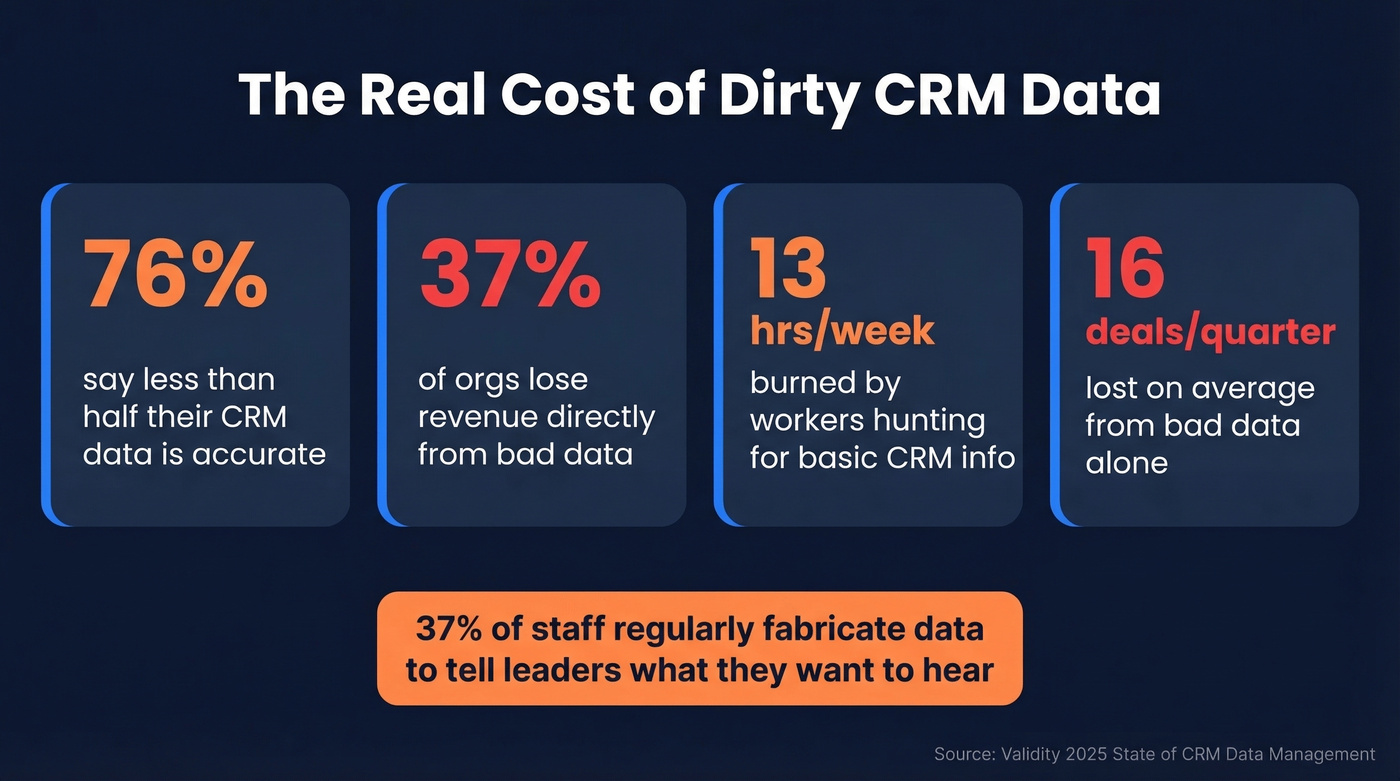
Then there's the human cost: workers burn 13 hours per week hunting for basic CRM information. And the stat that should make every VP of Sales uncomfortable? 37% of staff regularly fabricate data to tell leaders what they want to hear. Without consistent, trustworthy records, reps lose faith in the system and start working around it.
A WinPure case study puts a finer point on it: a company believed they had 70,000 records. After a proper audit, they had 32,000. Nearly half their "database" was duplicates, ghosts, and junk - and they'd been running direct mail campaigns against it with 30% return rates. With AI agents now acting autonomously on CRM data, flawed inputs don't just waste money. They generate flawed outputs at scale.
Why CRM Data Gets Dirty
- Manual entry errors. Reps type fast and move on. Misspelled company names, wrong phone formats, and inconsistent job titles compound daily.
- Outbound scaling chaos. Once volume ramps, duplicates, half-enriched accounts, and outdated titles pile up faster than anyone can patch them.
- Rep neglect and CRM complexity. Overly complicated Salesforce setups plus account managers who don't update records make segmentation nearly impossible.
- Integration conflicts. Marketing automation, enrichment tools, and form submissions all writing to the same fields with different formats. Broken workflows are especially dangerous - they multiply bad data at scale without anyone noticing.
- Natural decay. People change jobs, companies rebrand, emails bounce. Data decays an estimated 25-30% per year whether you touch it or not.
- Compliance exposure. Dirty data means you can't confidently honor GDPR opt-outs or suppression lists, turning a quality problem into a legal one.

Data decays 25-30% per year. Prospeo's 7-day refresh cycle catches job changes, new emails, and outdated titles before they rot your CRM - returning 50+ data points per contact at a 92% match rate.
Enrich your CRM once and stop mopping the same floor every quarter.
The Right Sequence (Most Guides Skip Step 1)
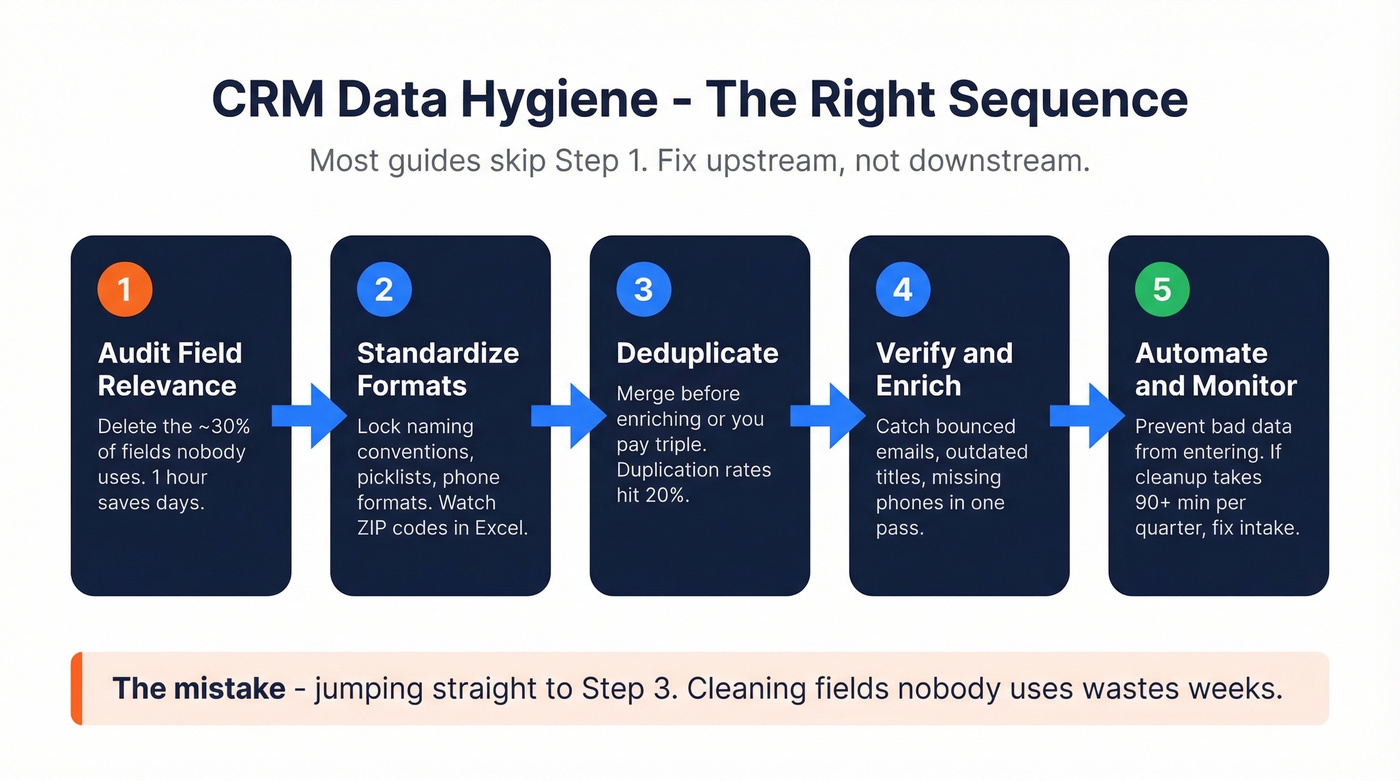
Here's the thing: most guides on CRM data hygiene best practices jump straight to deduplication. That's step 3, not step 1. The r/revops practitioner learned this the hard way. Fix upstream, not downstream.
1. Audit Field Relevance
Spend one hour with your CRM users identifying which fields are actually used. We've seen teams consistently find ~30% of fields are noise that shouldn't be cleaned - they should be deleted.
2. Standardize Formats
Lock down naming conventions, picklist values, and phone formats before cleaning. One gotcha worth flagging: ZIP codes with leading zeros get stripped when you save or reopen CSVs in Excel. That affects roughly 27 million Americans. Format the column as text before you save the file or re-import it.
The goal is to standardize your CRM so every record follows the same structure. When reps encounter predictable formats, they're far more likely to maintain them.
3. Deduplicate
CRM duplication rates can hit 20%. Merge before you enrich, or you'll enrich the same contact three times and pay triple.
4. Verify and Enrich
Run your contacts through a verification and enrichment tool. This is where you catch bounced emails, outdated titles, and missing phone numbers in one pass. If email deliverability is a KPI for your team, it’s worth aligning this step with your broader email deliverability process.
5. Automate and Monitor
Establish a database of record and automate updates. The goal is preventing bad data from entering, not perpetually cleaning what's already there.
If you're spending more than 90 minutes per quarter on CRM cleanup, you have an intake problem, not a hygiene problem. Every hour spent scrubbing records downstream is a symptom of missing validation upstream.
CRM Data Hygiene Cadence Table
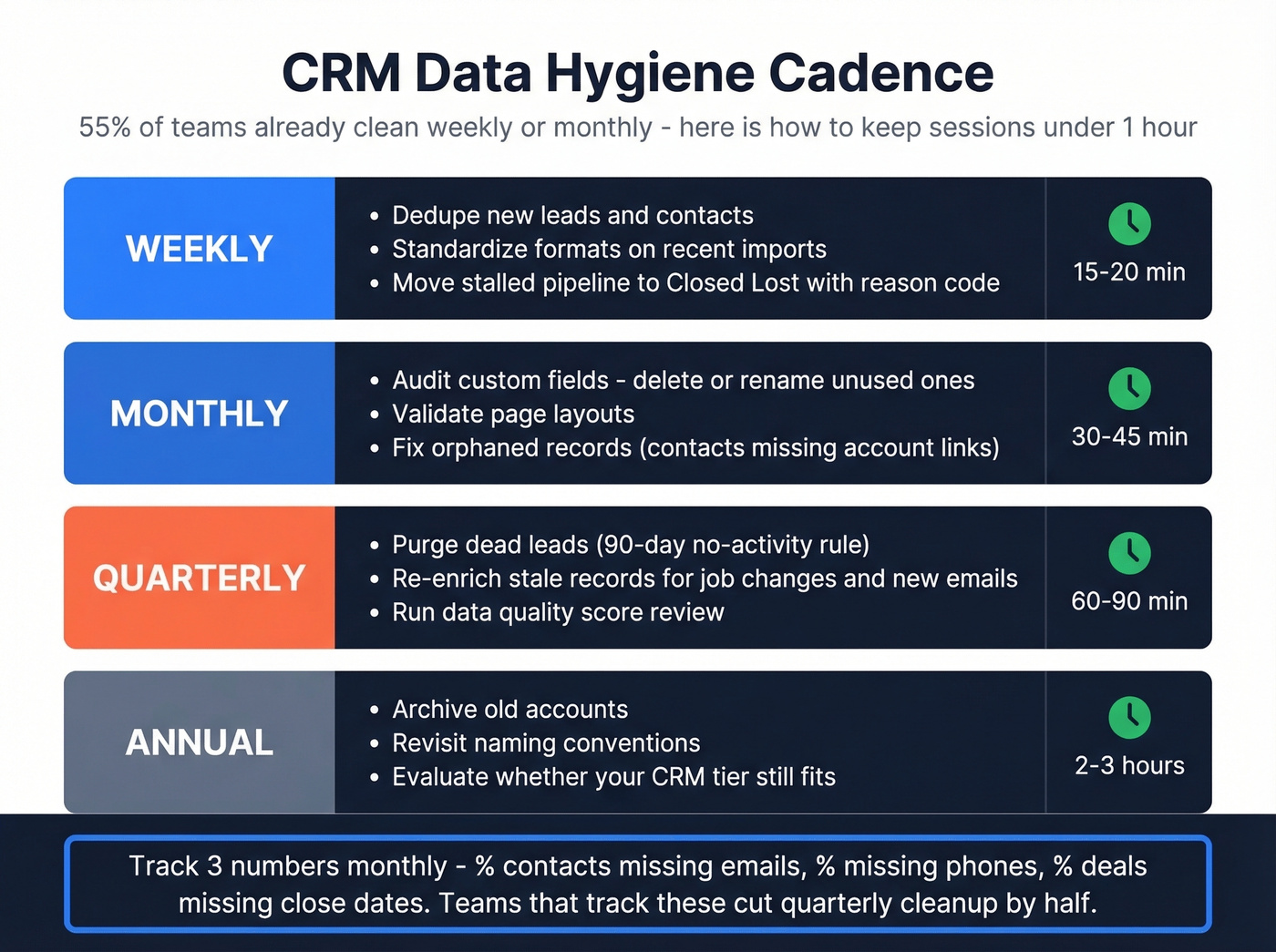
Over 55% of teams already clean weekly or monthly, and ~30% spend 4+ hours per session. This cadence keeps sessions short by spreading the work - but it only works if someone owns it. Assign a data quality owner, even if it's a rotating responsibility. Without clear ownership, cadences become suggestions that nobody follows.
| Cadence | Tasks |
|---|---|
| Weekly | Dedupe new leads/contacts. Standardize formats on recent imports. Move stalled pipeline to Closed Lost with a reason code. |
| Monthly | Audit custom fields - delete or rename unused ones. Validate page layouts. Fix orphaned records (contacts missing account links). |
| Quarterly | Purge dead leads (90-day no-activity rule). Re-enrich stale records to catch job changes and new emails. Run a data quality score review. |
| Annual | Archive old accounts. Revisit naming conventions. Evaluate whether your CRM tier still fits. |
What's a data quality score? Track three numbers: % of contacts missing emails, % missing phone numbers, and % of deals missing close dates. In our experience, teams that track these monthly cut quarterly cleanup time by more than half - because problems get caught at 50 bad records, not 5,000. If you want a tighter operational view, pair this with a simple pipeline health dashboard.
Fix It Upstream - Verification & Enrichment Tools
The smartest move from the r/SaaS thread on keeping databases clean? Centralize enrichment upstream - push only clean, structured data into your CRM. Verification and enrichment happen before the sync, not after. This is the same logic behind modern lead enrichment workflows.
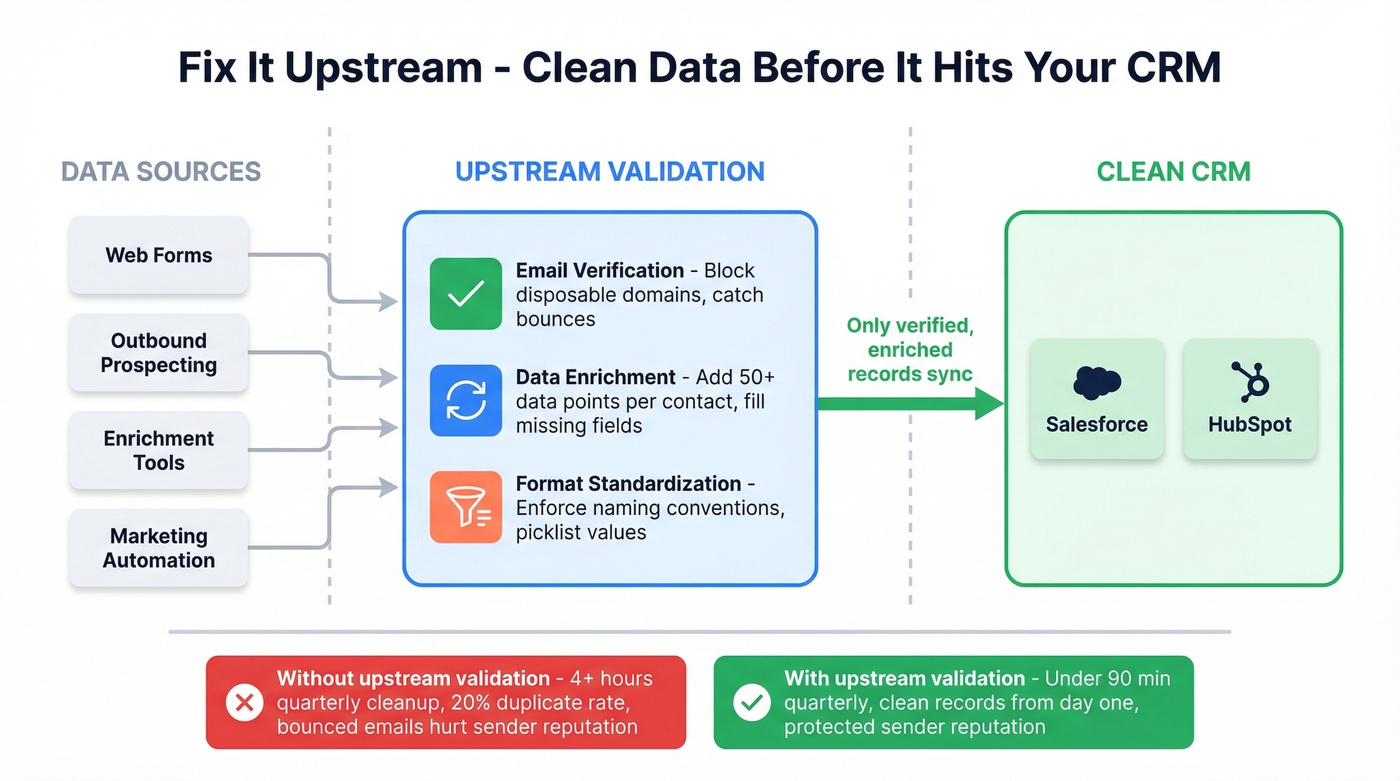
Block disposable emails at intake using a public blocklist on your forms. Then pick a verification tool that fits your volume and budget. If you’re comparing vendors, start with a shortlist of data enrichment services and narrow by match rate + integrations.
| Tool | Price | Accuracy | Best For |
|---|---|---|---|
| ZeroBounce | 2,000 for $16 | 99% claimed | Fast validation with HubSpot/Zoho integrations |
| DeBounce | $10 for 5,000 | ~95% | Budget bulk list cleaning |
| MillionVerifier | 10,000 for $37 | ~95% | Continuous daily re-checking via "Everclean" |
| Apollo.io | Free tier; paid from $49/mo | 70-80% hit rate | Prospecting + basic enrichment combo |
| FullEnrich | From $29/mo | 85%+ match rate | Waterfall enrichment across multiple providers |
For deduplication specifically, Insycle handles merge rules and bulk cleanup well. We've tested most of these tools across client CRMs, and the pattern is clear: teams that verify and enrich before syncing to their CRM spend a fraction of the time on quarterly cleanups compared to those who clean after the fact.
Skip Apollo if email accuracy is your priority - a 70-80% hit rate means 1 in 4 or 5 emails bounce, which will torch your sender reputation over time.
Merging duplicates and verifying emails manually burns hours. Prospeo's CRM enrichment pushes 98% accurate emails and 125M+ verified mobiles directly into Salesforce or HubSpot - upstream, before bad data ever enters.
Fix intake at the source for $0.01 per verified email.
FAQ
How often should you clean CRM data?
Weekly deduplication and format checks, monthly field audits, and quarterly deep cleans with re-enrichment. Spreading tasks across cadences keeps each session under an hour. Teams that batch everything quarterly typically spend 4+ hours and still miss issues.
What's the biggest data hygiene mistake?
Cleaning before auditing field relevance. Practitioners report ~30% of CRM fields are unused noise that should be deleted, not scrubbed. One hour of auditing saves days of wasted effort on fields nobody touches.
Can you automate CRM data hygiene?
Deduplication, format standardization, and email verification automate well - tools like Insycle handle deduplication at scale, and enrichment platforms catch stale records automatically. Governance decisions and field relevance audits still require human judgment. No tool can tell you which fields your team actually uses.
What's a good free tool for CRM email verification?
Prospeo offers 75 free email verifications per month with full enrichment at 98% accuracy. ZeroBounce provides 100 free monthly validations focused on verification only. For teams running real outbound campaigns, Prospeo's free tier returns 50+ data points per contact - not just a valid/invalid flag.