

Best Email Deliverability Services to Fix Inbox Placement in 2026
Your emails are "delivered." Your ESP dashboard says 97% delivery rate. And yet half your list never sees a single message.
That's the gap between delivery and deliverability, and it's exactly what email deliverability services exist to fix. An Unspam benchmark study across millions of tests found only 60% of emails reached a visible inbox. Another 36% landed in spam. The remaining 4% were blocked outright. As Litmus puts it, delivery means the server accepted your email without bouncing it - deliverability means someone can actually see it. You can have 98% delivery and 40% inbox placement, and most teams don't realize the difference until reply rates crater.
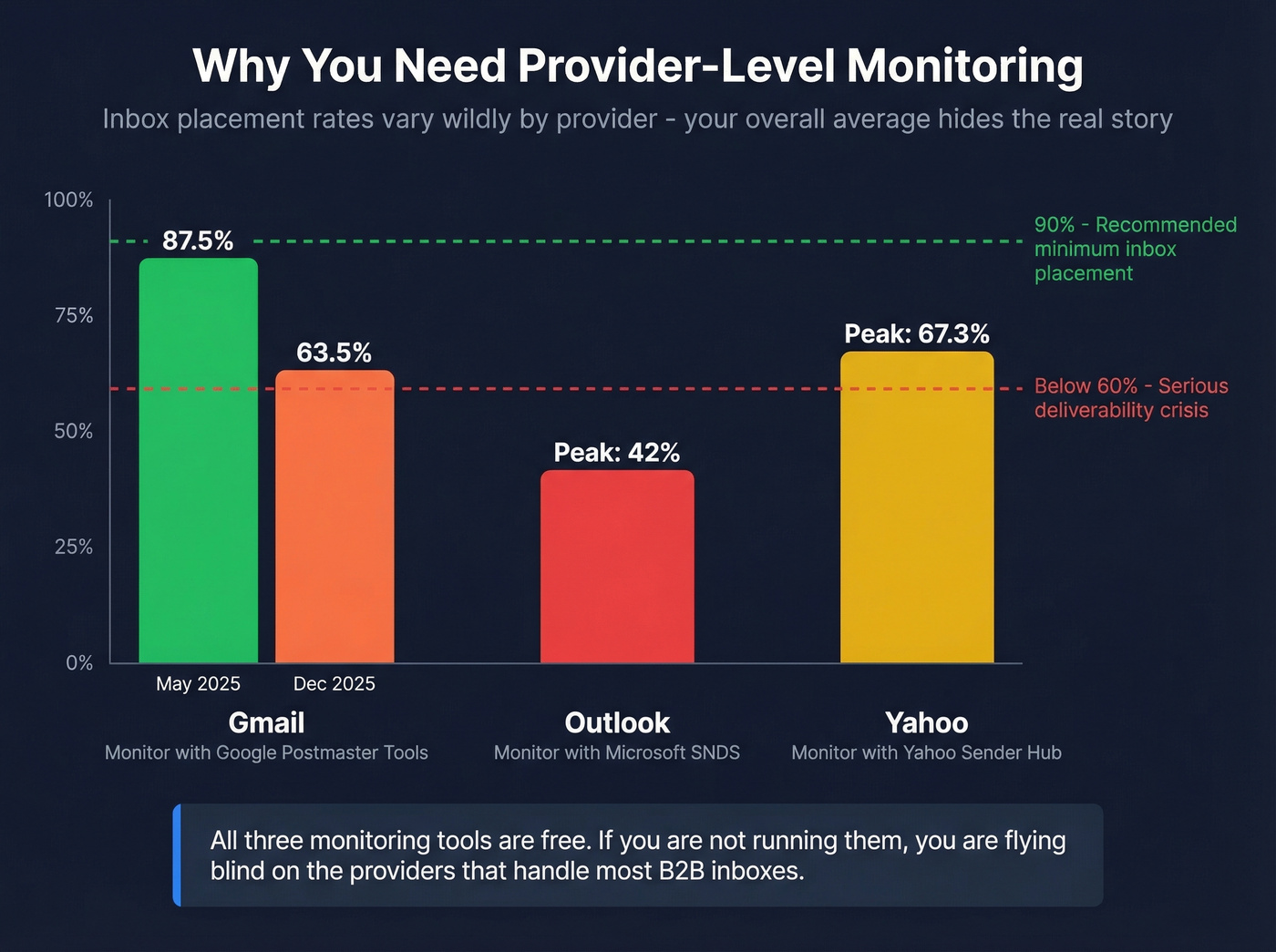
Those numbers get worse when you zoom in by provider. Gmail inbox placement peaked at 87.5% in May 2025 but dropped to 63.5% by December. Outlook never cracked 42%. Yahoo peaked at 67.3%. If your buyers live in Outlook, you're fighting uphill before you even write a subject line.
The tools and services below fix this. Some prevent the problem through clean data and verified emails, some diagnose it with inbox placement testing, and some hand it off entirely through managed consulting. Here's what's worth your time and money.
Our Picks (TL;DR)
| Pick | Best For | Starting Price |
|---|---|---|
| Prospeo | Preventing bounces at the source | ~$0.01/email, free tier |
| GlockApps | Diagnosing inbox placement | From $85/mo |
| Kickbox | Expert consulting + verification | Custom ($200-$500/hr typical) |
Prospeo kills the #1 deliverability problem - bad data - before it reaches your sending infrastructure. 98% email accuracy, a 7-day refresh cycle, and a 5-step verification pipeline that catches spam traps and honeypots. If your bounce rate is above 3%, start here. (If you want a deeper framework, see our Email Deliverability Guide.)
GlockApps shows you exactly where emails land across Gmail, Outlook, and Yahoo. You can't fix what you can't measure, and most ESPs don't give you real inbox placement data.
Kickbox pairs verification with hands-on deliverability consulting - a 2-week audit followed by 12 weeks of monitoring. For teams that have tried the self-serve route and still can't crack 90% placement.
Regardless of which tools you pick: Google Postmaster Tools, Microsoft SNDS, and Yahoo Sender Hub are free, mandatory, and non-negotiable. Set them up today.
What "Deliverability Services" Actually Means
Most teams expect one tool that fixes everything. That tool doesn't exist. Deliverability is a stack, and you need to understand the layers before you buy anything.
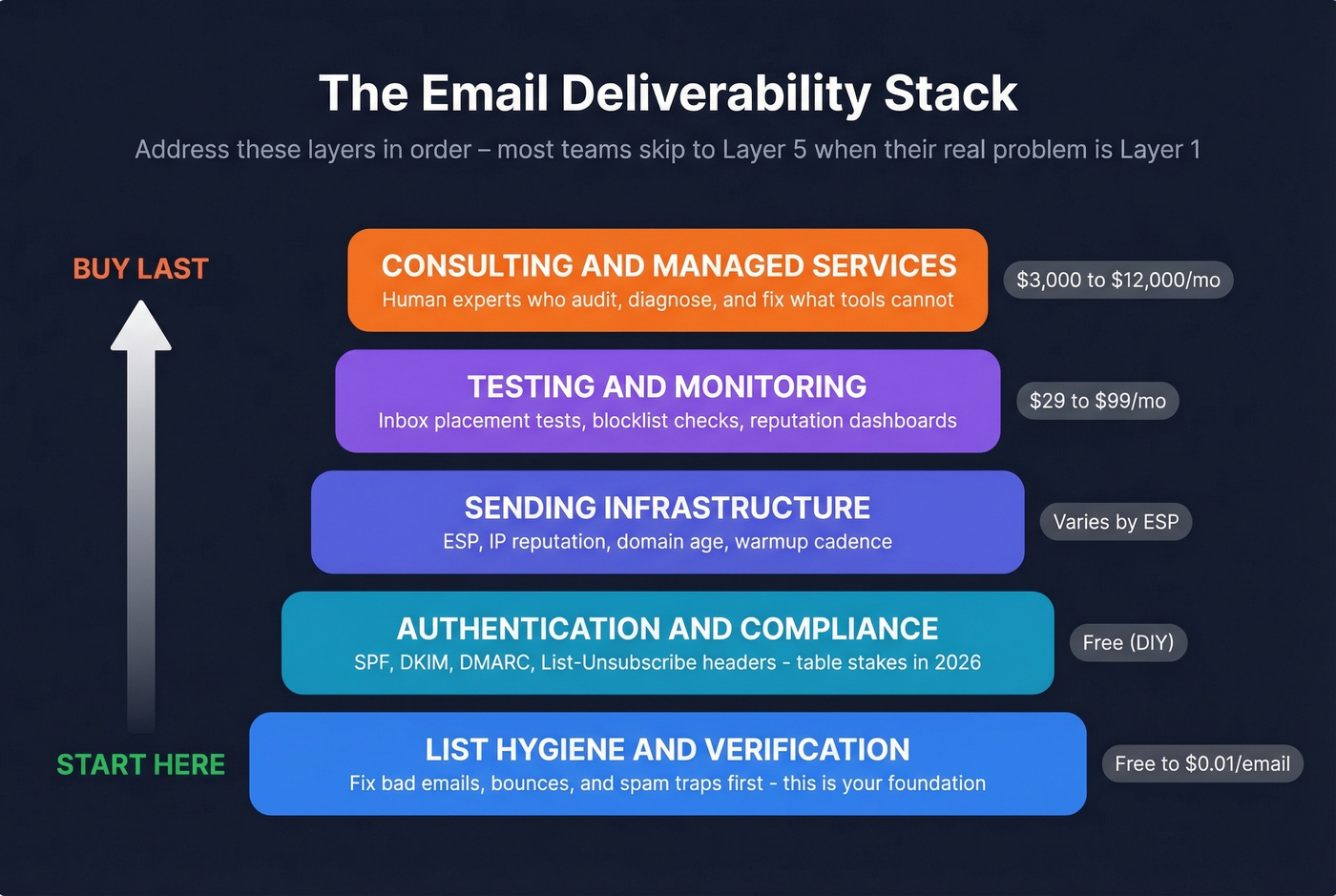
Here are the five categories, in the order you should address them:
1. List hygiene and verification. The foundation. Bad emails cause bounces, bounces tank sender reputation, and reputation determines inbox placement. Fix this first - everything downstream depends on it. (Related: Email Bounce Rate benchmarks and fixes.)
2. Authentication and compliance. SPF, DKIM, DMARC, List-Unsubscribe headers. Table stakes in 2026. Google, Yahoo, and Microsoft all enforce them now. Missing any one can push you straight to spam. (If you’re troubleshooting alignment, see DMARC alignment and these SPF record examples.)
3. Sending infrastructure. Your ESP, IP reputation, domain age, sending volume, and warmup cadence. The plumbing that carries your emails. (Also worth reading: Email Velocity for safe sending limits.)
4. Testing and monitoring. Inbox placement testing, blocklist checks, reputation dashboards. You need visibility into where emails actually land - not just whether they bounced. Litmus found that marketers who describe their programs as successful are 22% more likely to actively monitor deliverability. That's not a coincidence.
5. Consulting and managed services. Human experts who audit your setup, diagnose root causes, and manage remediation. The most expensive layer, and the one you should buy last. This is where specialized deliverability companies and agencies earn their keep.
Here's the thing: most teams skip straight to layer 5 when their real problem is layer 1. Litmus recommends investigating immediately if inbox placement drops below 90%. But you can't hit 90% if 8% of your list bounces on every send. Start with hygiene. Always.
Top Tools and Services Compared
Prospeo
Deliverability starts before you hit send. It starts when you build your list. (If you’re building lists at scale, see How to Generate an Email List.)
Prospeo's 5-step verification pipeline catches the contacts that destroy sender reputation: catch-all domains that silently fail, spam traps, and honeypot addresses that get your domain blocklisted. The result is 98% email accuracy across 143M+ verified emails, drawn from a database of 300M+ professional profiles.
The 7-day data refresh cycle is where Prospeo pulls ahead on deliverability specifically. The industry average is six weeks. Email addresses decay at 2-3% per month, which means a list verified six weeks ago has already degraded enough to spike your bounce rate. Prospeo catches those changes while other providers are still serving stale records.
We've seen the results in production: Stack Optimize, an outbound agency running Prospeo across all client campaigns, maintains 94%+ deliverability, sub-3% bounce rates, and zero domain flags. At ~$0.01 per email with a free tier of 75 verifications per month, there's no reason not to verify before every send.
Use this if: Your bounce rate is above 2-3%, you're sending outbound at scale, or you've been burned by stale data from another provider. (If you’re comparing verifiers, start with Bouncer alternatives.)
GlockApps
GlockApps answers the question your ESP can't: where did my email actually land?
It runs inbox placement tests across Gmail, Outlook, Yahoo, and other providers using seed-based testing. You send to their seed list, and GlockApps shows you the exact percentage that hit inbox, spam, promotions, or went missing entirely. Most teams know their delivery rate is 97% but have no idea that 36% of "delivered" emails are sitting in spam.

Plans start at $85/mo for self-serve diagnostics. The interface isn't flashy, but the data is actionable - you can test individual campaigns before full sends, monitor placement trends over time, and catch reputation drops before they become crises.
Use this if: You need visibility into actual inbox placement across providers, not just bounce/delivery metrics.
Skip this if: You're only sending transactional email with a clean, opt-in list. Your ESP's built-in analytics are probably sufficient.
Kickbox
Kickbox occupies a unique position: it's both a verification tool and a full-service deliverability consultancy. The verification side competes with other tools in this list. The consulting side is where it differentiates.
Their deliverability audit typically takes two weeks, followed by 12 weeks of monitoring and remediation support. The team has 30+ years of aggregate experience across authentication, IP warming, ESP migration, and blocklist recovery. PetMeds reported their open rate nearly doubled after a three-month engagement. Another client - a dog supplement company - saw open rates jump from 18% to 50%.
Consulting pricing isn't published. Based on market rates for comparable services, expect $200-$500/hr for on-demand support, or $3,000-$12,000/mo for retainer engagements. Project-based work like IP warming or ESP migration is scoped separately.
Use this if: You've fixed the basics - clean list, authentication in place - and placement still won't budge. You need human expertise, not another dashboard.
Skip this if: Your budget is under $3k/mo for deliverability. Start with self-serve tools first.
Mailgun Optimize
The overage warning first, because it matters more than the features. One practitioner on r/Emailmarketing reported 10 million unexpected validations hitting their account on Christmas Day 2024, followed by another 6 million spike in early 2025 - resulting in an invoice north of $30,000 after their contract ended. Account blocks without warning are a recurring G2 complaint.
That said, the platform itself bundles email validation, inbox placement testing, reputation monitoring, and blocklist checks into a single tool. G2 reviewers give it 4.2/5 across 322 reviews, consistently praising the API, delivery reliability, and detailed reporting. Optimize pricing starts at $49/mo (Pilot) and $99/mo (Starter), with a 1-month free trial.
Use this if: You're a developer-heavy team sending at scale who wants analytics and validation in one platform - and you have someone monitoring usage closely. (If you’re evaluating it against verification-first stacks, see Mailgun vs Prospeo.)
Free Provider Tools
Google Postmaster Tools, Microsoft SNDS, and Yahoo Sender Hub. Free. Mandatory. No excuses.
- Google Postmaster Tools - domain and IP reputation, spam rate, authentication pass rates for Gmail traffic
- Microsoft SNDS - IP reputation data, spam complaint rates, trap hits for Outlook/Hotmail
- Yahoo Sender Hub - feedback loops, complaint rates, reputation signals for Yahoo/AOL
These are reactive, not predictive - they tell you what happened, not what will happen. But they're the baseline every sender needs before spending a dollar on paid tools. If you're not running all three, you're flying blind on the providers that handle the majority of B2B inboxes. (Next step: How to Improve Sender Reputation.)
ZeroBounce
ZeroBounce pairs email verification with a deliverability toolkit that includes blocklist monitoring, inbox placement testing, and email scoring. It's the "I want one vendor for verification and monitoring" option. Plans start at $49/mo.
The verification is solid for teams that need a combined platform. Where it falls short for high-volume outbound is data freshness - competitors with weekly refresh cycles and more aggressive catch-all handling have a meaningful edge when you're sending thousands of emails per day and every bounce compounds.
Use this if: You want verification and basic deliverability monitoring in a single platform without managing multiple tools.
Everest by Validity
Everest is Validity's inbox placement monitoring platform, backed by trillions of global inbox data points. Their 2026 benchmark report is the industry reference for placement trends. Entry plans start at $29/mo.
Use this if: You're an enterprise sender who needs continuous placement monitoring with industry benchmarks.
Skip this if: You're a smaller team. GlockApps gives you similar placement testing at a more accessible price point.
Belkins
Belkins is a managed cold email deliverability agency that handles the entire process end-to-end: infrastructure setup, warmup, monitoring, and ongoing optimization. Their G2 rating sits at 4.8/5 across 93 reviews, with a 95% client retention rate.
For teams that want deliverability handled without building internal expertise, Belkins is the premium hands-off option - essentially done-for-you setup and management. Expect agency-tier retainers in the $4,000-$10,000/mo range based on scope.
Use this if: You want someone else to own deliverability completely and you have the budget for it.
Skip this if: You're comfortable with self-serve tools and have someone on the team who understands DNS records.
MXToolbox
Blocklist and DNS diagnostics. MXToolbox checks whether your sending IPs or domains are on major blocklists, validates SPF/DKIM/DMARC records, and monitors DNS health. Delivery Center starts at $129/mo; Plus runs $399/mo. Essential for troubleshooting, not for ongoing optimization. (If you’re actively remediating, see Spamhaus blacklist removal.)
SendForensics
Predictive deliverability scoring before you send. SendForensics analyzes your email content, authentication, and sender reputation to predict inbox placement. From $49/mo. Useful as a pre-send check, especially for marketing teams running high-volume campaigns. (Pair with an email spam checker workflow.)
InboxAlly
Engagement-based reputation repair. InboxAlly generates positive engagement signals - opens, clicks, moves from spam to inbox - to rebuild sender reputation with mailbox providers. From $149/mo. A niche tool for a specific problem: if your domain reputation is already damaged and you need to warm it back up through engagement patterns.
Side-by-Side Comparison
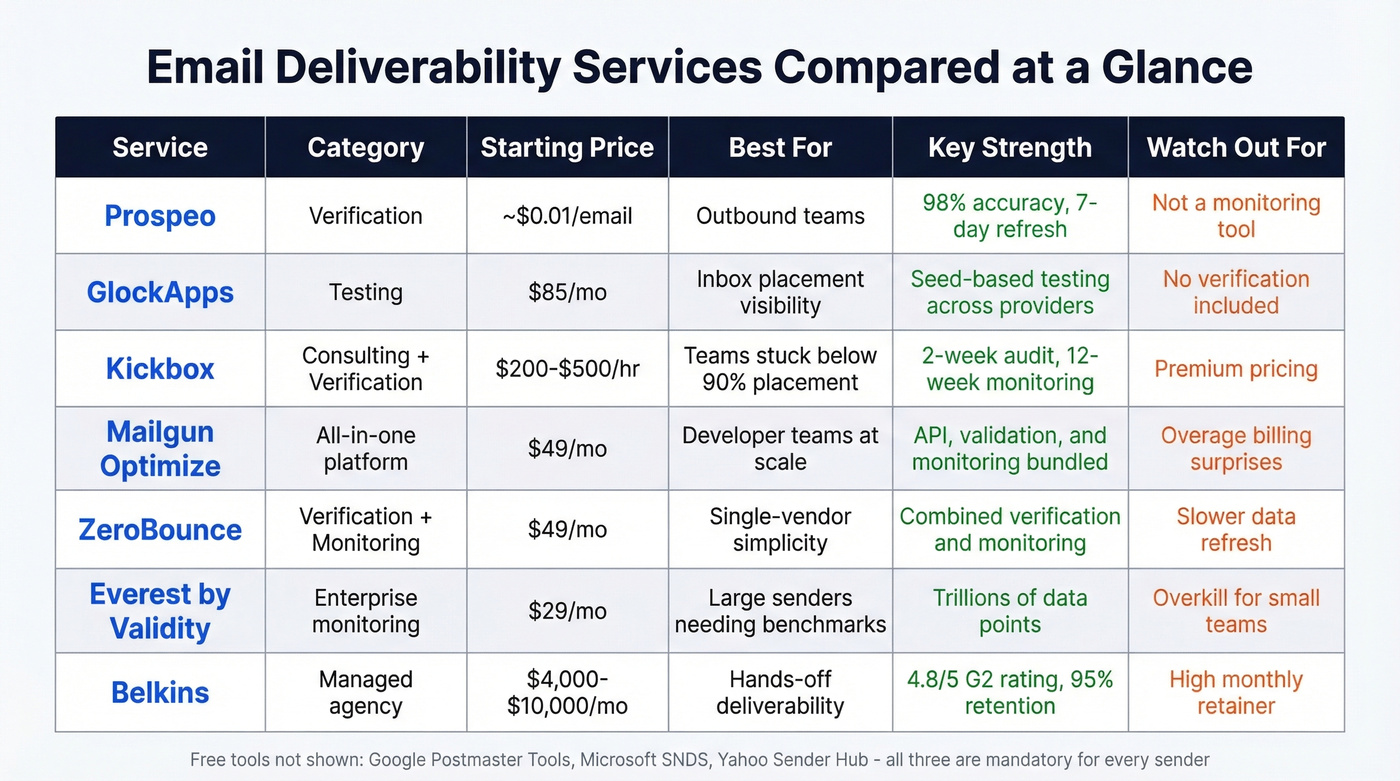
Pick the tool that matches your actual problem. If you're not sure where to start, the recommended stacks below the table will point you in the right direction.
| Tool | Category | Price From | Best For | Free Tier? |
|---|---|---|---|---|
| Prospeo | List Hygiene | ~$0.01/email | Bounce prevention | Yes |
| GlockApps | Placement Testing | $85/mo | Inbox diagnostics | No |
| Kickbox | Consulting + Verification | $200-$500/hr | Expert audits | No |
| Mailgun Optimize | Monitoring + Analytics | $49/mo | Dev teams at scale | No |
| ZeroBounce | Verification + Monitoring | $49/mo | All-in-one verification | Yes |
| Everest (Validity) | Placement Monitoring | $29/mo | Enterprise monitoring | No |
| Belkins | Managed Agency | ~$4,000/mo | Hands-off deliverability | No |
| MXToolbox | DNS Diagnostics | $129/mo | Blocklist troubleshooting | Partial |
| SendForensics | Predictive Scoring | $49/mo | Pre-send checks | No |
| InboxAlly | Reputation Repair | $149/mo | Engagement-based warmup | No |
Recommended Stacks by Budget
Under $200/mo: Prospeo for verification + Free Provider Tools for monitoring + GlockApps for placement testing. This covers 80% of deliverability problems.
$500-$1,000/mo: Add ZeroBounce or Everest for continuous monitoring. Layer in MXToolbox if you're troubleshooting blocklist issues.
$3,000+/mo: Consider Kickbox consulting or Belkins for managed deliverability. Only after you've exhausted the self-serve route.

Bad data is the #1 deliverability killer - and the easiest to fix. Prospeo's 5-step verification catches spam traps, honeypots, and catch-all failures before they tank your sender reputation. 98% email accuracy, 7-day data refresh, ~$0.01/email.
Stop diagnosing deliverability problems you could prevent entirely.
What These Services Actually Cost
The range is enormous, so let's break down real numbers.
Self-serve tools are the affordable end. Prospeo runs ~$0.01 per email verified, with a free tier. GlockApps starts at $85/mo. ZeroBounce and Everest both start under $50/mo. For a team doing basic list hygiene and placement monitoring, you're looking at $100-$300/mo total.
Consulting and managed services are a different universe. Based on agency pricing data, monthly retainers run $2,000-$15,000 for most teams, with enterprise engagements hitting $8,000-$25,000+/mo. Hourly consulting is $200-$500/hr. One-time setup or audit fees typically land at $1,500-$5,000.
What catches teams off guard: the hidden costs. Tooling, secondary domains, enrichment, and infrastructure can add 30-50% on top of base retainers. That $5,000/mo agency engagement becomes $7,500 once you factor in the supporting stack. And usage-based pricing creates overage risk - always set hard caps and alerts on any tool that charges per action.
If your deals average under five figures, you almost certainly don't need a managed deliverability agency. The self-serve stack at $200/mo will get you 90%+ of the way there. Save the consulting budget for when you've genuinely exhausted the basics and still can't crack 90% placement.
Deliverability for Agencies and Outbound Teams
Agencies running outbound lead generation face unique deliverability challenges. You're managing multiple client domains, each with its own reputation, authentication records, and sending cadence. A deliverability failure on one client's domain can cascade into reputation damage across your shared infrastructure.
This requires a layered approach: verify every client's list independently, maintain separate sending domains per client, and monitor placement at the account level - not just in aggregate. Cold email agencies like Belkins handle this complexity as a managed service, but agencies with technical chops can build the same stack in-house using verification tools for list cleaning, GlockApps for per-client placement testing, and free provider tools for ongoing monitoring. (For sequencing strategy, see B2B cold email sequence.)
The key metric for outbound deliverability is reply rate, not open rate. If your clients' prospects aren't replying, inbox placement is the first thing to audit - before you touch copy, targeting, or sequencing. (Related: Follow-Up Email Reply Rate.)
2026 Compliance Checklist
Authentication requirements aren't optional anymore. Google and Yahoo started enforcing in February 2024. Microsoft followed in May 2025. If you're sending more than 5,000 emails per day, here's what's required:
- SPF and DKIM must both pass - not one or the other, both
- DMARC required with at least p=none (p=quarantine or p=reject is better)
- SPF or DKIM alignment with your sending domain
- One-click List-Unsubscribe header in every commercial email
- Spam complaint rate below 0.3% (Google's threshold)
For senders under 5,000/day, the bar is lower - SPF or DKIM must pass, DMARC is optional. But "optional" today becomes "required" tomorrow. Set it up now.
How Far Behind Most Senders Are
The Unspam benchmark data paints a grim picture. DMARC adoption sits at just 69%. List-Unsubscribe compliance is a dismal 14%. And 74% of emails tested had HTML structural issues that made them 18-25% more likely to land in spam.
Industry-specific placement rates tell a similar story:
| Industry | Avg. Inbox Placement |
|---|---|
| Travel | 68% |
| Retail | 62% |
| Software / Tech | 58% |
| Financial Services | 57% |
If you're in SaaS and think your deliverability is "fine," the data says you're probably landing in spam for nearly half your list. Check your Postmaster Tools data, verify your authentication records, and clean your list before the next send.
Common Deliverability Killers
We've seen teams spend months debugging deliverability when the root cause was obvious in hindsight. Here are the patterns that keep showing up.
Bad data is the #1 killer. Not content. Not subject lines. Not send time. Dirty lists cause bounces, bounces destroy sender reputation, and reputation is what mailbox providers use to decide whether you hit inbox or spam. A list that's even 5% invalid will compound into a reputation problem within weeks.
Warmup isn't a magic fix. Google banned automated warmup for Gmail accounts in May 2023, and the consensus on r/coldemail has shifted accordingly. One practitioner who rebuilt their entire cold email infrastructure described ditching warmup tools entirely - instead ramping manually from 2-3 emails/day up to 10-15/day per inbox, and shortening sequences from 5-8 steps down to 3. Their reasoning: later-step replies had effectively died, and centralized warmup services were creating more risk than value.
Automation without personalization. The r/EmailWhisperers community flags this constantly - teams blast their entire list with identical sequences, skip segmentation, and over-send until fatigue triggers spam complaints. The fix isn't less automation. It's better targeting and shorter, more relevant sequences.
Look, the Unspam data tells the whole story: even with SPF, DKIM, and DMARC all passing, spam placement can exceed 30%. Authentication is necessary but not sufficient. Clean data, proper sending cadence, and genuine relevance are what separate the 60% average from the 95%+ top performers.
Stack Optimize built a $1M agency on Prospeo data: 94%+ deliverability, sub-3% bounce rates, zero domain flags across every client. The secret isn't better sending infrastructure - it's never loading bad emails into it. 143M+ verified emails refreshed every 7 days.
Fix layer 1 first - clean your list before you touch anything else.
FAQ
What's the difference between email delivery and deliverability?
Delivery means the recipient's mail server accepted your email without bouncing it - an SMTP-level confirmation. Deliverability means where that email actually lands: inbox, spam, or promotions. You can have 98% delivery and 40% inbox placement simultaneously. Always measure visible inbox placement, not just SMTP acceptance rates.
How much do deliverability consultants charge?
Monthly retainers run $2,000-$15,000 for most teams, scaling to $8,000-$25,000+ for enterprise engagements. Hourly consulting is $200-$500/hr, and one-time audit fees typically cost $1,500-$5,000. Factor in an additional 30-50% for supporting tooling, domains, and enrichment costs that agencies don't always include in quotes.
Do I need a consultant or just better tools?
Start with tools. Verify your list, set up Google Postmaster Tools and Microsoft SNDS for free monitoring, and run inbox placement tests with GlockApps. That covers 80% of problems for under $200/mo. Hire a consultant only after you've fixed authentication, cleaned your data, and placement still won't break 90%.
What inbox placement rate should I target?
The industry average is just 60% visible inbox placement - that's a warning, not a target. Investigate immediately if you drop below 90%. Top performers maintain 95%+ by combining verified lists, proper authentication, controlled sending cadence, and active monitoring across all major mailbox providers.
How often should I verify my email list?
Before every campaign, at minimum. Email addresses decay at 2-3% per month as people change jobs and mailboxes get deactivated. Real-time verification on send is ideal. A 5-step pipeline that includes catch-all handling, spam-trap removal, and honeypot filtering catches the contacts that destroy sender reputation fastest.