

CUFinder vs Thomson Data: Self-Serve Platform or Managed List Vendor?
An SDR needs 1,000 contacts by Friday. One tool lets them pull a filtered list in minutes. The other requires a sales call, a custom quote, and a CSV delivered sometime next week. That's the core difference here - and it matters more than any database size claim either vendor makes.
CUFinder is a self-serve enrichment platform with public pricing. Thomson Data is a managed DaaS vendor that builds custom B2B mailing lists to spec. Comparing them is like comparing a SaaS subscription to a consulting engagement, so let's break down where each one actually makes sense.
30-Second Verdict
Pick CUFinder if you want self-serve prospecting with credit-based plans starting at $49/mo and no sales calls required.
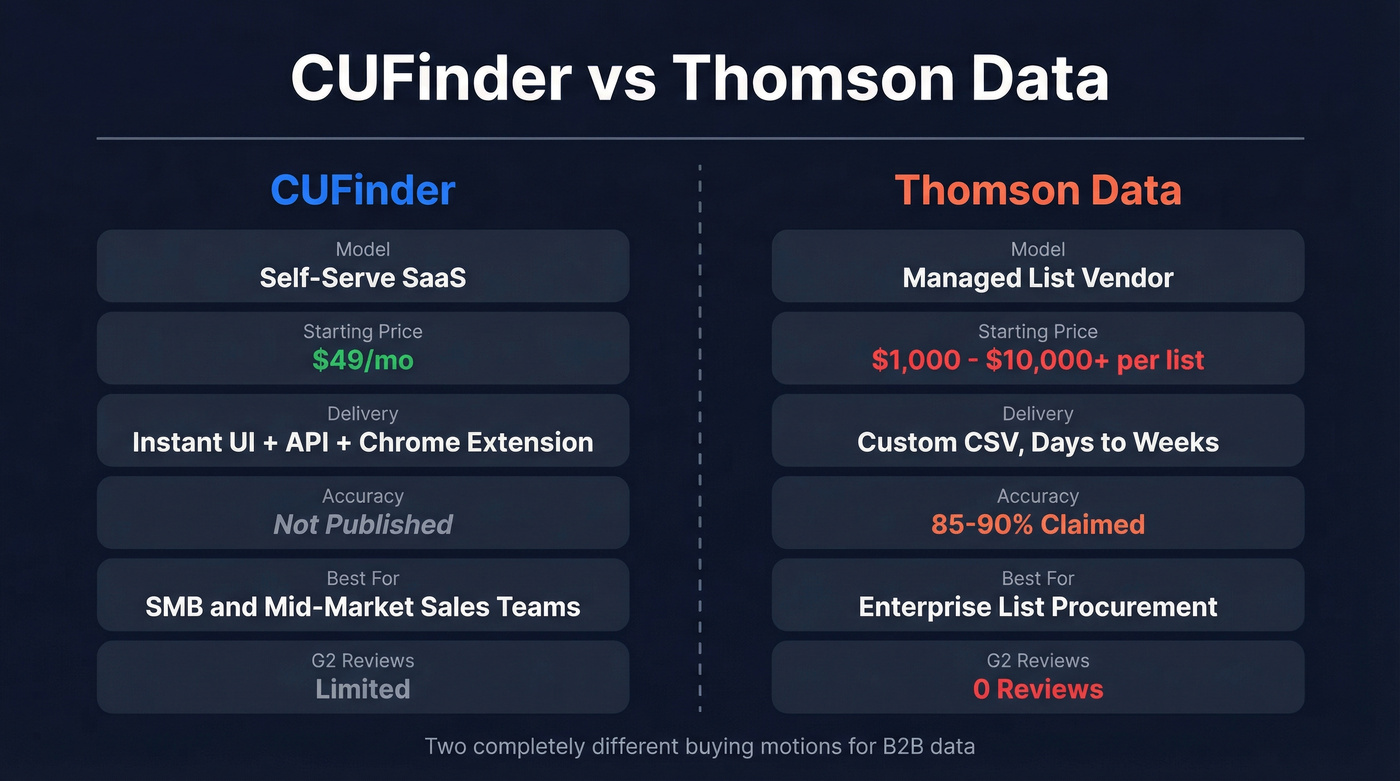
Pick Thomson Data if you need custom-built B2B mailing lists delivered to spec and you've got $5K+ to spend per project.
Feature Comparison
| CUFinder | Thomson Data | |
|---|---|---|
| Model | Self-serve SaaS | Managed list vendor / DaaS |
| Founded | - | 2010, Plano, TX |
| Database | Not public | 70M-323M (conflicting claims) |
| Pricing | $49-$299/mo (credit-based) | Quote-based, ~$1K-$10K+ per list |
| Accuracy (claimed) | Not published | 85-90% |
| Refresh cycle | Not published | Every 30 days |
| Delivery | UI + API + Chrome extension | Custom CSV delivery |
| Best for | SMB/mid-market sales teams | Enterprise list procurement |
| G2 reviews | - | 0 reviews |
How Data Quality Compares
On the CUFinder side, SoftwareFinder rates it 4.9/5 across 12 verified reviews, with satisfaction subscores of 9/10 for functionality and 10/10 for ease of use and value. The review sample is small, but the consistency is notable.
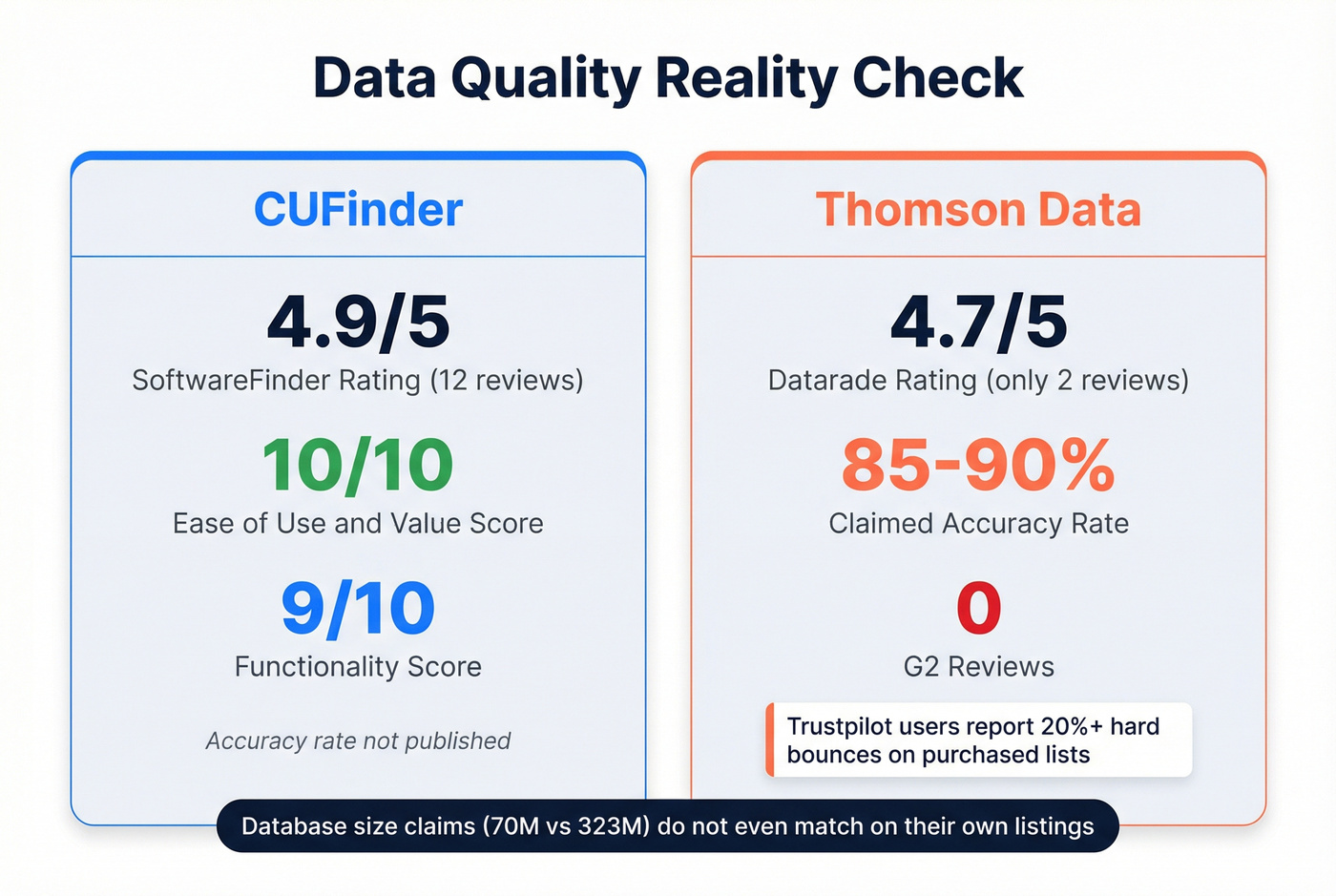
Thomson Data's Datarade listing shows 4.7/5 from just 2 reviews - too thin to draw any real conclusions. Their own accuracy page states plainly: "100% accuracy and reliability is a myth." They guarantee 85-90% accuracy and 80-85% delivery rates. The homepage touts 35% more leads and 3.4X ROI in case studies, but Trustpilot reviews include multiple users describing 20%+ hard bounces on purchased lists. Thomson Data replaced those contacts, which is fair - but we've seen teams burn sending domains after a single bad batch like that, and deliverability damage is cumulative and brutally hard to reverse.
Here's the thing: Thomson Data also has zero reviews on G2. That tells you something about adoption in the modern sales stack.
Even their own numbers don't line up. The Datarade listing shows 70M contacts versus the 323M+ profiles promoted on their homepage. That kind of discrepancy doesn't inspire confidence when you're about to hand over thousands of dollars for a list.

Thomson Data guarantees 85-90% accuracy and charges $5K+ per list. CUFinder doesn't publish accuracy at all. Prospeo delivers 98% email accuracy across 300M+ profiles on a 7-day refresh cycle - no sales calls, no $5K minimums, no mystery CSVs.
Stop paying thousands for data that bounces on first send.
Freshness and Sourcing
Thomson Data updates data once every 30 days. In practice, sourcing methodology matters just as much as cadence.
Their credible sources page lists magazines, B2B directories, events, and newsletters - subscriptions like Workforce (about 360,000 registered users) and Chief Executive (over 42,000 CEOs). That traditional list-rental sourcing builds breadth but introduces lag. By the time a conference attendee list gets processed and merged, the contact may have changed roles entirely.
CUFinder's self-serve model at least lets you pull results on demand rather than waiting for a batch delivery.
Stop comparing database size. A 323M-record database means nothing if 15% of those records bounce on first send. In our experience, workflow speed and verification depth beat raw record counts every time.
Workflow Fit
CUFinder gives you a prospecting engine, enrichment workflows, APIs, a Chrome extension, a Google Sheets add-on, and CRM integrations. An SDR can go from search to exported CSV in minutes - no phone calls, no waiting on a rep to scope your project.
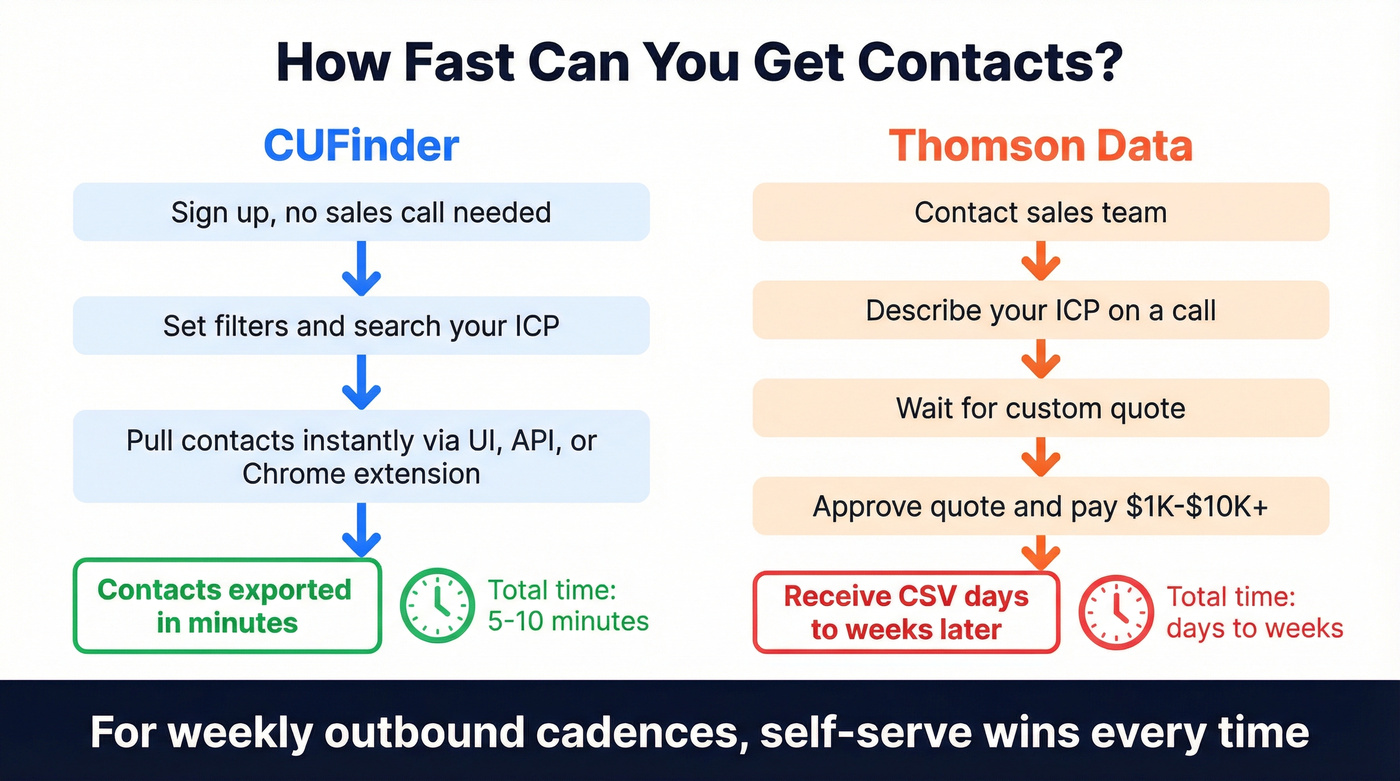
Thomson Data is a completely different buying motion. You describe your ICP, they build a custom list, and you receive a CSV. For enterprise teams running large-scale direct mail campaigns or one-time account profiling projects, that model works fine. For weekly outbound cadences? Too slow. Thomson Data has virtually no Reddit presence - search results return Thomson Reuters instead, which tells you something about brand awareness in the sales community.
Pricing Breakdown
| CUFinder | Thomson Data | |
|---|---|---|
| Free tier | 50 credits/mo | None |
| Entry paid | $49/mo (Growth) | ~$1,000 per list |
| Mid-tier | $129/mo (Premium) | ~$3,000-$5,000 |
| High-end | $299/mo (Unlimited) | $5,000-$10,000+ |
| Pricing model | Published, credit-based | Quote-only, project-based |
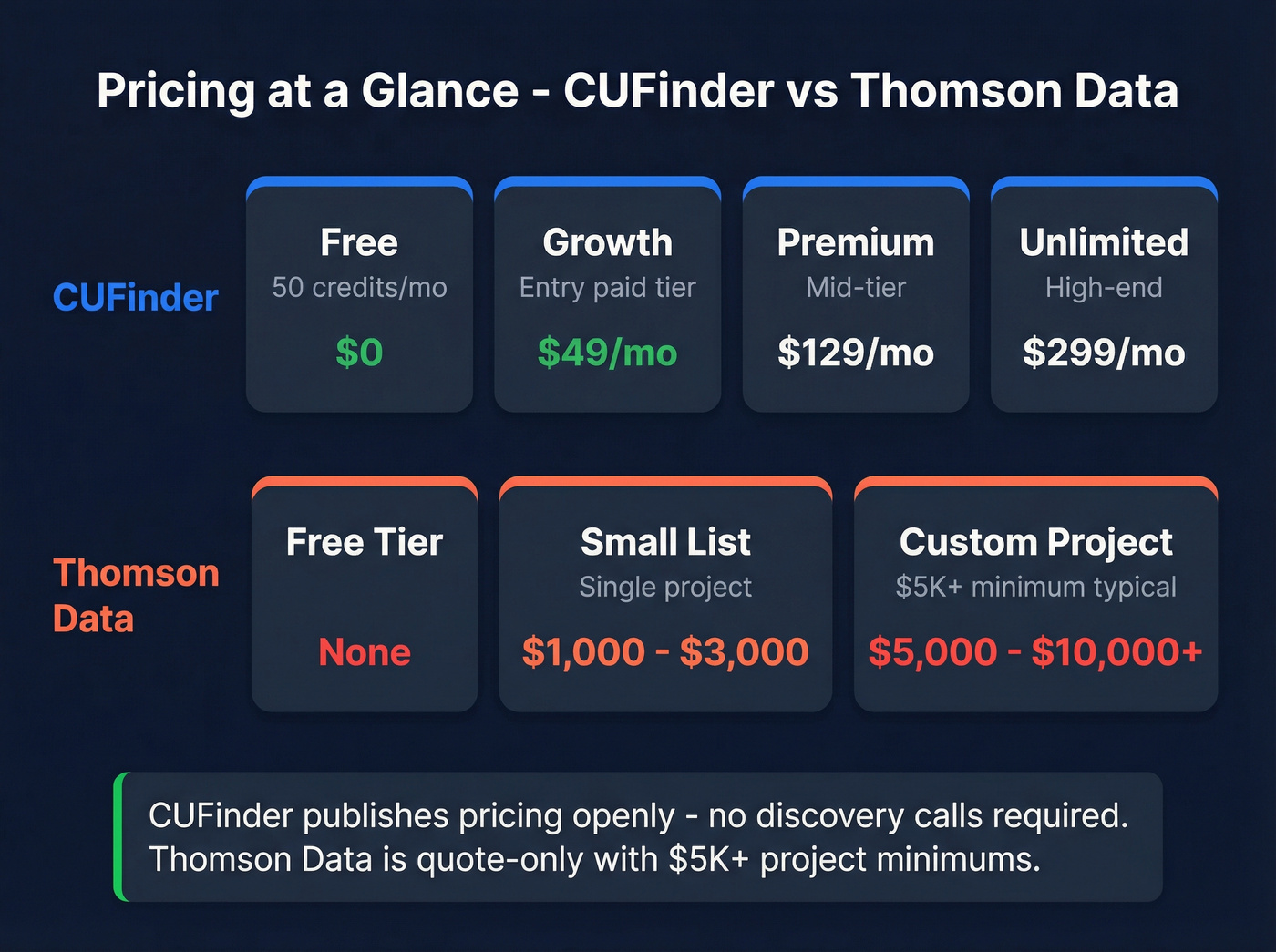
CUFinder publishes pricing openly with credit-based tiers you can evaluate before talking to anyone. That transparency alone is a win for teams that just want to test a tool without a 45-minute discovery call.
Thomson Data doesn't publish pricing tiers. Their Clutch profile lists a $5,000+ minimum project size, and customized dataset pricing varies by requirements, so expect $1,000-$10,000+ per dataset depending on scope and targeting.
The "contact sales" pricing model wastes time when you just need to test 500 contacts this week.
A Faster Alternative to Both
If the decision between these two tools hinges on verification and freshness, Prospeo solves both problems. It covers 300M+ professional profiles with 143M+ verified emails at 98% accuracy on a 7-day refresh cycle - catching job changes that 30-day updates miss. Pricing starts at roughly $0.01 per email with a free tier of 75 emails/month plus 100 Chrome extension credits/month, and the Chrome extension has 40K+ users with native CRM integrations built in. For outbound teams where domain reputation is everything, Prospeo's 5-step verification with catch-all handling and spam-trap removal is protection neither CUFinder nor Thomson Data advertises.

30-day refresh cycles miss job changes that wreck your deliverability. Prospeo refreshes every 7 days with 5-step verification, catch-all handling, and spam-trap removal - the protection neither CUFinder nor Thomson Data offers. Start free with 75 emails/month.
Test Prospeo on your own list - no contracts, no quote requests.
FAQ
Is Thomson Data the same as Thomson Reuters?
No. Thomson Data (thomsondata.com) is a B2B mailing list provider founded in 2010 in Plano, TX. Thomson Reuters is a separate multinational corporation. The name similarity causes constant confusion, but they're completely unrelated companies.
Does Thomson Data publish pricing?
No public tiers exist. Expect $1,000-$10,000+ per list, with $5,000+ as a common project floor based on their Clutch profile.
What's CUFinder's accuracy rate?
CUFinder doesn't publish a specific accuracy percentage. SoftwareFinder gives it a 4.9/5 rating across 12 verified reviews with a 9/10 functionality score and 10/10 for ease of use and value.
Which tool is best for small outbound teams?
CUFinder wins over Thomson Data for small teams - self-serve access, a free tier, and credit-based pricing that scales with usage. Thomson Data's $5,000+ minimums make it impractical for testing small batches. For even better accuracy, Prospeo's free plan gives small teams 75 emails/month at 98% verified accuracy with zero upfront cost.