

The Customer-Centric Sales Approach: A Practitioner's Playbook for 2026
You're two weeks from end-of-quarter, sitting at 60% of quota. Your manager wants more activity. Your VP wants bigger deals. And somewhere in the back of your mind, you remember that onboarding deck about "putting the customer first." Right now, the customer feels like an obstacle between you and your number.
That tension is real. Every guide that tells you to "just listen more" without showing you what to actually say is useless. This playbook gives you the scripts, the frameworks, and the data infrastructure to run a customer-centric sales approach - even when quota pressure is screaming in your ear. If you only read one section, read the discovery call scripts. That's the gap between philosophy and execution.
What Is Customer-Centric Selling?
The term traces back to Michael Bosworth's work in the 1980s, but the core idea is simple: organize every sales interaction around the buyer's problems, goals, and decision process - not your product's feature list. It sounds obvious. It's not how most teams actually sell.
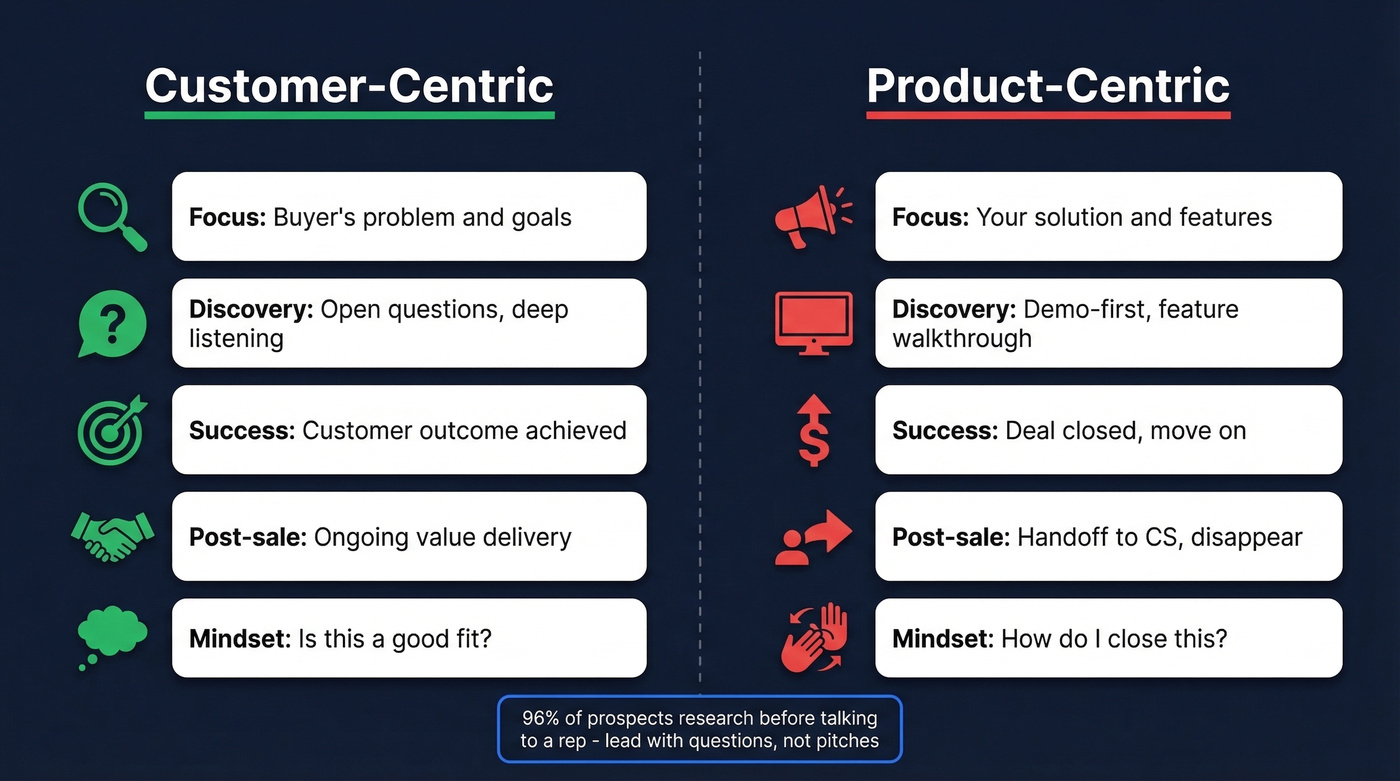
The original Customer Centered Selling book feels dated - even experienced reps say the cultural references haven't aged well - but the core concepts remain sound. What's changed is the infrastructure to execute them. Today, customer-focused selling isn't just a philosophy. It's an operational model backed by real-time data and AI.
Here's the difference in practice:
| Dimension | Customer-Centric | Product-Centric |
|---|---|---|
| Focus | Buyer's problem | Your solution |
| Discovery style | Open questions, deep listening | Demo-first, feature walkthrough |
| Success metric | Customer outcome achieved | Deal closed |
| Post-sale relationship | Ongoing value delivery | Handoff to CS, move on |
| Rep mindset | "Is this a good fit?" | "How do I close this?" |
The shift matters more now than ever. 96% of prospects research before engaging a sales rep, and 71% prefer independent research over talking to one. By the time someone takes your call, they've already formed opinions. If you lead with a pitch, you're redundant. Lead with questions that sharpen their thinking, and you're valuable.
Why It Matters in 2026
The business case for customer-centricity isn't soft. It's financial.
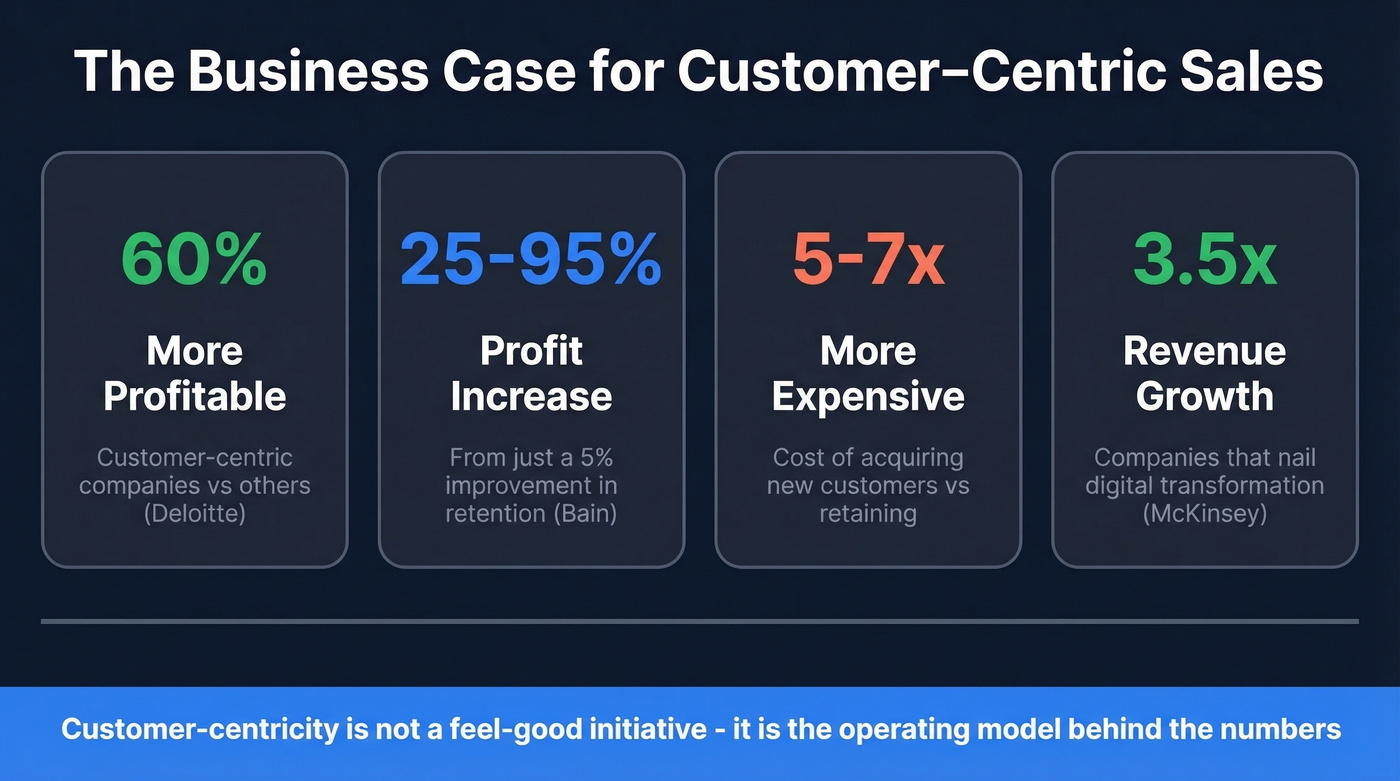
Customer-centric companies are 60% more profitable than those that don't focus on the customer experience, per Deloitte research. A 5% improvement in retention can drive a 25-95% increase in profits, per Bain's widely cited research. Acquiring a new customer costs 5-7x more than retaining an existing one. These aren't aspirational numbers - they're the math that makes CFOs pay attention.
On the leadership side, only 52% of CEOs express confidence in their go-to-market growth plans, per SBI Growth Advisory. But those who nail their GTM strategy are 2x more likely to meet revenue targets, with 74% achieving or surpassing goals. Companies that succeed in digital transformations see a 3.5x increase in revenue CAGR.
Customer-centricity isn't a feel-good initiative. It's the operating model behind the numbers.
Core Principles
Seven principles. Tape these to your monitor.
- Listen first. Track your talk-to-listen ratio - if you're above 40% talk time, you're pitching, not discovering. Pay attention to what buyers don't say, too. Hesitation, deflection, and silence often signal the real objection.
- Lead with questions. Your first call should generate insight for the buyer, not just information for your CRM.
- Qualify ruthlessly. Bad fits waste everyone's time. Walking away from a deal that won't close is the most customer-centric thing you can do.
- Map the buying committee. You're not selling to one person. In complex B2B deals, you're navigating 6-10 stakeholders with different priorities.
- Sell outcomes. "You'll reduce churn by 15%" beats "We have an AI-powered retention module." Frame outcomes emotionally, not just financially - help buyers feel what life looks like after the problem is gone.
- Stay engaged post-sale. The handoff to CS shouldn't feel like abandonment. Your credibility compounds when customers succeed.
- Data quality. You can't put the customer first when you're calling the wrong person at a disconnected number.
These principles aren't just talking points - they form the foundation of a customer-centric sales process optimization strategy that compounds over time.
The Discovery Call Playbook
This is the article's centerpiece, and the biggest gap in every other guide on this topic.
Your 20-Minute Agenda
Open with a version of this: "I'd like to learn more about your current situation, understand your challenges, and see if our solution is a good fit. Does that sound good?"
That's adapted from Nextiva's discovery framework, and it works because it sets expectations, signals respect for the buyer's time, and positions the call as collaborative rather than extractive. Don't try to cram a demo into a 15-30 minute discovery call. 85% of business leaders say their org needs more shared responsibility for CX - discovery is where that starts.
15 Discovery Questions by Category
Process questions (understand their current state):
- "Can you walk me through your current process for [problem area]?"
- "What tools are you using today, and where do they fall short?"
- "Who's involved in this process day-to-day?"
Goals questions (understand where they want to be):
- "What does success look like in the next 6 months?"
- "If this problem were solved tomorrow, what would change for your team?"
- "What's driving the urgency to fix this now?"
Impact questions (quantify the pain):
- "If you had to quantify the impact - in time, money, or missed opportunities - what would that look like?"
- "How is this affecting your team's ability to hit their targets?"
- "What happens if nothing changes in the next quarter?"
Timeline and decision questions (qualify the opportunity):
- "What's your timeline for making a decision?"
- "Who else needs to weigh in before you can move forward?"
- "Have you evaluated other solutions? What did you like or dislike?"
- "Is there a budget allocated for this, or is that part of the conversation?"
- "What would make this a clear 'no' for you?"
- "What's the one thing that would make you confident this is the right move?"
Don't ask all fifteen. Pick 6-8 based on what you already know. The goal is depth, not coverage.
5 Problem-Centric Questions
These come from Cerebral Selling's framework, and they're the sharpest discovery questions we've encountered. We've seen reps who master these five close at nearly double the rate of those running generic SPIN:
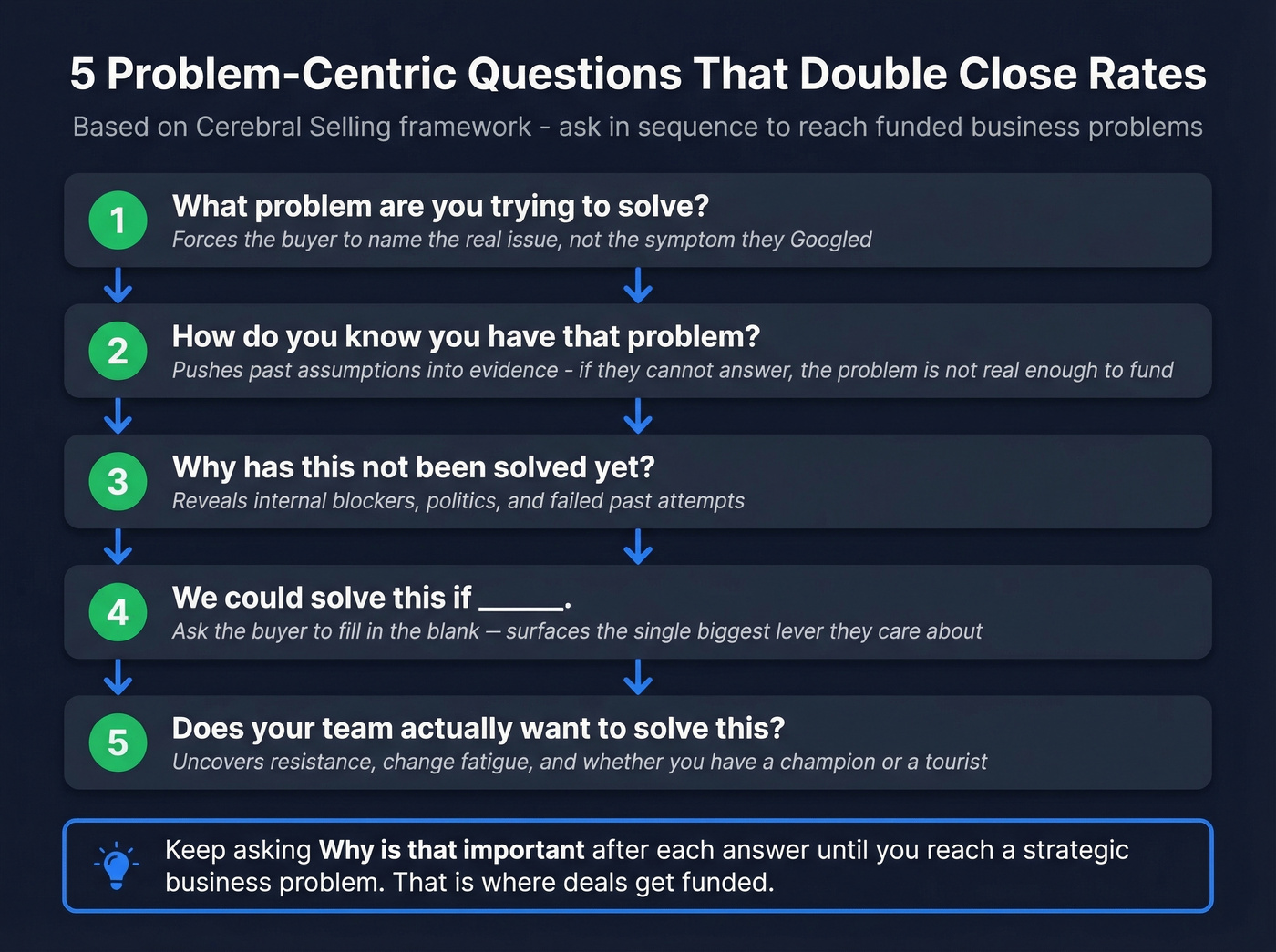
- "What problem are you trying to solve?" - Forces the buyer to articulate the real issue, not the symptom they Googled.
- "How do you know you have that problem?" - Pushes past assumptions into evidence. If they can't answer this, the problem isn't real enough to fund.
- "Why hasn't this been solved yet?" - Reveals internal blockers, politics, and failed past attempts. Gold for positioning.
- "We could solve this if ____." - Ask the buyer to fill in the blank. This surfaces the single biggest lever they care about.
- "Does your team actually want to solve this?" - The question nobody asks. Uncovers resistance, change fatigue, and whether you're selling to a champion or a tourist.
Keep asking "Why is that important?" after each answer until you reach a strategic business problem. That's where deals get funded.
SPIN vs. MEDDIC vs. Challenger
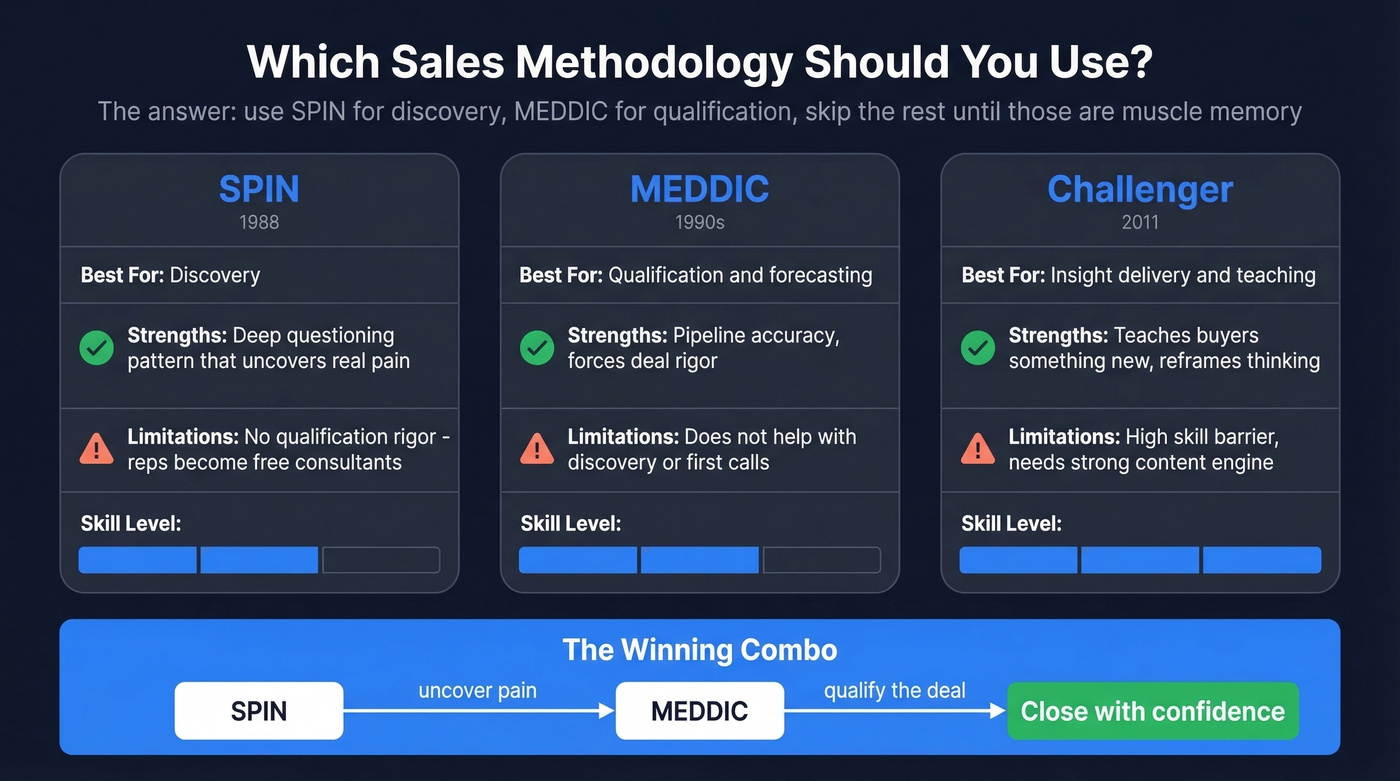
The r/sales consensus is that all methodologies "pretty much sound the same" - need, budget, stakeholders, timeline. They're not wrong. But the frameworks solve different problems, and knowing which one to reach for matters.
| Framework | Origin | Best For | Strengths | Limitations |
|---|---|---|---|---|
| SPIN | 1988 | Discovery | Deep questioning pattern | No qualification rigor |
| Challenger | 2011 | Insight delivery | Teaches buyers something new | High skill barrier |
| MEDDIC | 1990s | Qualification | Pipeline accuracy | Doesn't help with discovery |
SPIN's biggest risk is turning reps into free consultants - great at diagnosing problems, terrible at advancing deals. SPIN pairs naturally with MEDDIC: use SPIN to uncover pain, then run MEDDIC to qualify whether the deal is real. Challenger works brilliantly when reps can actually teach, but it's not for every culture and pairs best with a strong content engine that arms reps with industry insights. MEDDIC shines in complex enterprise deals with long cycles and big buying committees, but it won't help you run a better first call.
Here's the thing: the best teams don't pick one. They use SPIN for discovery, MEDDIC for qualification, and skip everything else until those two are muscle memory. Methodology debates are a distraction. Execution isn't.

You can't put the customer first when you're calling the wrong person at a disconnected number. Prospeo's 300M+ profiles with 98% email accuracy and 125M+ verified mobiles mean your discovery calls land with real decision-makers - not gatekeepers or dead ends.
Stop wasting discovery prep on bad data. Start every conversation with the right buyer.
Five Mistakes That Kill Deals
1. Emphasizing price over value. The moment you lead with pricing, you've commoditized yourself. Lead with the outcome, quantify the ROI, and let price become a line item - not the conversation.
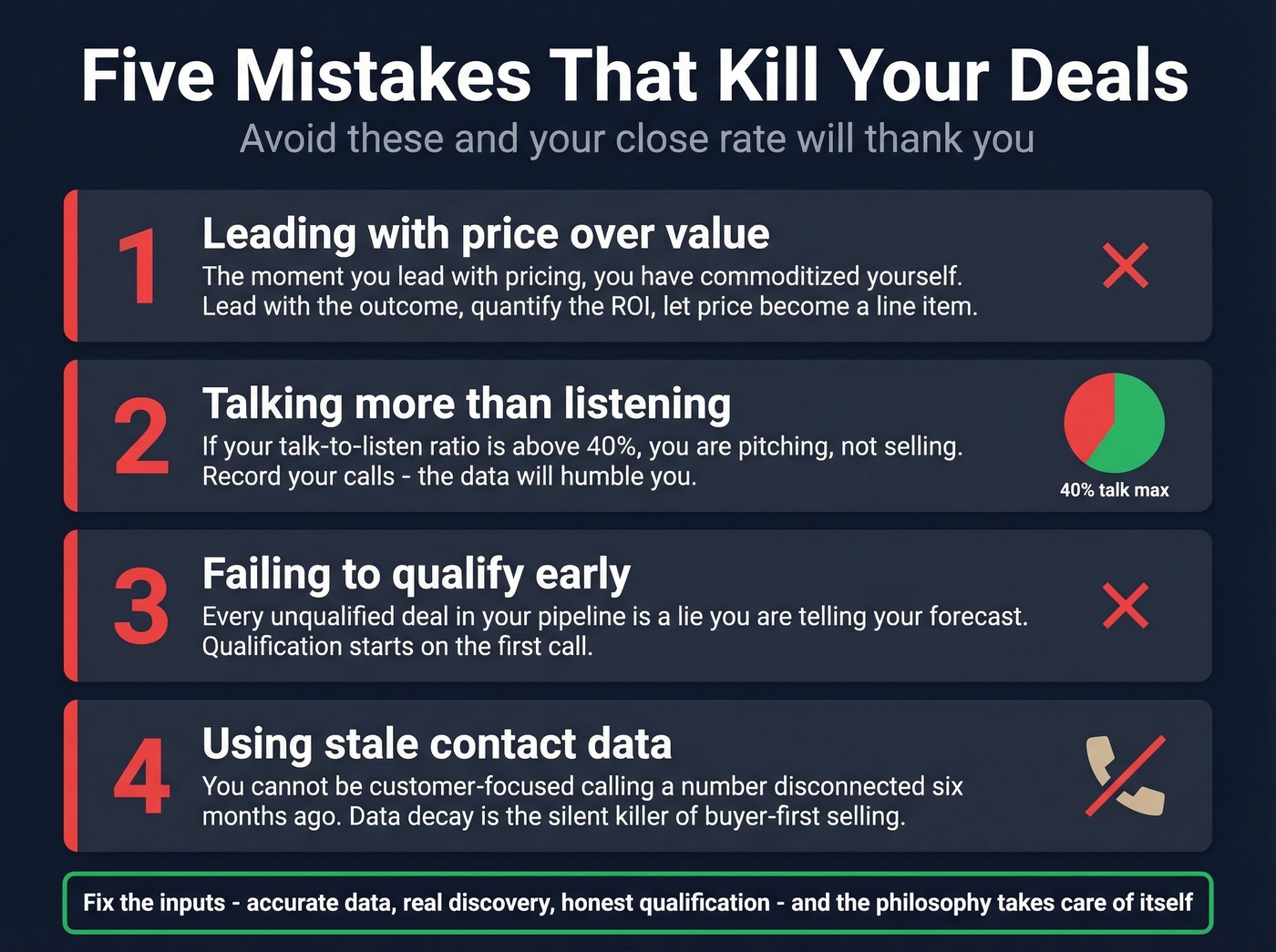
2. Talking more than listening. If your talk-to-listen ratio is above 40%, you're pitching, not selling. Record your calls. The data will humble you.
3. Failing to qualify early. Qualification isn't something you do in stage 2. It starts on the first call. Every unqualified deal in your pipeline is a lie you're telling your forecast.
5. Using stale contact data. You can't be customer-focused if you're calling a number that's been disconnected for six months. Data decay is the silent killer of buyer-first selling, and most teams don't realize how bad their data is until bounce rates spike.
Aligning Your Process to the Buyer
This is the tension that lives on every BDR's mind: how do you stay customer-first when you're staring at a number you're not going to hit?
If your average deal size is under $10K, you probably don't need a complex methodology. You need accurate contact data and five great discovery questions. Most quota misses aren't caused by insufficient customer-centricity - they're caused by wasted cycles on bad-fit prospects and unreachable contacts. Fix the inputs and the philosophy takes care of itself.
Three things to remember when the pressure spikes:
Better qualification means fewer wasted cycles. Every hour you spend on a bad-fit deal is an hour you're not spending on one that'll close. A customer-centric sales process isn't slower - it's more efficient.
The probability of selling to an existing customer is 60-70%, versus 5-20% for a new prospect. Investing in relationships pays compounding returns.
Walking away from bad fits protects your pipeline long-term. A deal you force-close today becomes a churn number next quarter and a reputation hit the quarter after that. Your future quota depends on the deals you say no to now.
Real talk: the tension doesn't disappear. But reps who invest in discovery consistently outperform quota-chasers over a full year. We've watched teams transform their pipeline accuracy in weeks just by fixing their contact data and tightening their first-call scripts.
AI and Data Quality - The Modern Layer
McKinsey's latest framing for customer-centricity is four words: customer-centered, business-focused, people-led, AI-enabled. That last piece - AI-enabled - is what separates 2026 customer-centric selling from the 1998 version.
AI automation reclaims up to 40% of time spent on admin tasks. AI-powered forecasting improves accuracy by up to 20%. Adobe increased cross-selling success by 25% using AI-driven recommendations. One industrial company using McKinsey's customer-back model cut supply/demand balancing time by 80% and added billions in profit.
But here's what most AI-in-sales conversations miss: organizations capture less than one-third of expected value from digitalization. The gap isn't the AI - it's the data underneath it. Your call transcription tool is useless if you're transcribing a conversation with the wrong stakeholder. Your AI forecasting model is garbage if half the contacts in your pipeline have bounced emails.
The most customer-centric thing you can do before a discovery call is make sure you're calling the right person at a working number. Prospeo covers 300M+ professional profiles with 98% email accuracy and a 7-day data refresh cycle - versus the 6-week industry average. With 30+ search filters including buyer intent powered by Bombora, technographics, and job-change signals, you can build lists that match your ICP precisely. At roughly $0.01 per email with a free tier of 75 emails per month, it costs less than a single bad discovery call.

Mapping a 6-10 person buying committee requires data you can trust. Prospeo's 30+ search filters - including department headcount, job changes, and buyer intent across 15,000 topics - let you identify every stakeholder before your first call.
Know the entire buying committee before you ever pick up the phone.
How to Measure Customer-Centricity
You can't improve what you don't measure. These six KPIs tell you whether your team is actually buyer-focused or just saying they are.
| KPI | What It Measures | Benchmark |
|---|---|---|
| Discovery-to-close ratio | Quality of early conversations | Improving quarter-over-quarter |
| Talk-to-listen ratio | Rep listening discipline | 40% talk / 60% listen |
| NPS or CSAT | Customer satisfaction | Competitive for your category and improving |
| Customer retention rate | Post-sale value delivery | High and improving year-over-year |
| Deal velocity | Efficiency of sales process | 47% win rate within 50 days |
| Expansion revenue % | Depth of customer relationships | Meaningful and growing share of revenue |
The deal velocity stat is worth highlighting: opportunities closed within 50 days have a 47% win rate, versus roughly 20% after that threshold. Customer-centric discovery doesn't slow deals down - it accelerates them by building conviction earlier.
Case Study: Steel Manufacturer
A Chinese steel manufacturer - not exactly a company you'd associate with customer-centricity - partnered with McKinsey on a full "diagnose, design, deliver" transformation. The implementation took 2-3 years.
They built a structured question library with customized questionnaires by stakeholder type, deployed multichannel feedback collection through sales interviews, mobile surveys, and QR-code support portals, and turned every customer touchpoint into a data collection opportunity. The entire effort was designed to align their selling process to the customer rather than to internal production schedules.
The results: an estimated 4% increase in gross profit and 8% increase in pretax profit. In steel manufacturing. If a commodity business can generate measurable financial returns from putting the buyer first, your SaaS company has no excuse.
FAQ
What's the difference between customer-centric and consultative selling?
Consultative selling is a technique - asking diagnostic questions to recommend solutions. A customer-centric sales approach is a broader philosophy that shapes discovery, qualification, post-sale engagement, and even how you build your contact lists. Consultative selling is one tool inside a customer-centric model, not a synonym for it.
Which sales methodology is most customer-centric?
None owns the label. SPIN excels at discovery, MEDDIC at qualification, Challenger at insight delivery. The most buyer-focused teams combine elements from multiple frameworks and focus on execution over acronyms. Pick the pieces that fit your sales cycle and stop debating logos.
How do you ensure accurate contact data for buyer-first selling?
Use a platform with verified, frequently refreshed records. Prospeo refreshes its 300M+ profiles every 7 days and delivers 98% email accuracy. The free tier of 75 emails/month lets you validate the data quality before committing budget.