

Customer Focused Selling: The System Behind the Slogan
It's the 15th of the month. You're at 40% of quota. Your manager just pinged you about pipeline coverage, and in the same Slack thread, reminded the team to "stay customer focused." You're supposed to care deeply about the buyer's journey while also closing $47k in the next two weeks. Every rep trying to practice customer focused selling feels that tension.
Here's the thing: the consensus on r/business is that "customer-centric" is corporate lip service - a slogan slapped on decks while the org optimizes for profit. And honestly? When it's just a mindset poster on the breakroom wall, they're right. But a customer-first sales approach done properly isn't a personality trait or a vibe. It's a repeatable system that actually closes more deals.
What Is Customer Focused Selling?
Customer focused selling means structuring every conversation around the buyer's goals, constraints, and decision process - not your product's feature list. That's the two-sentence version.
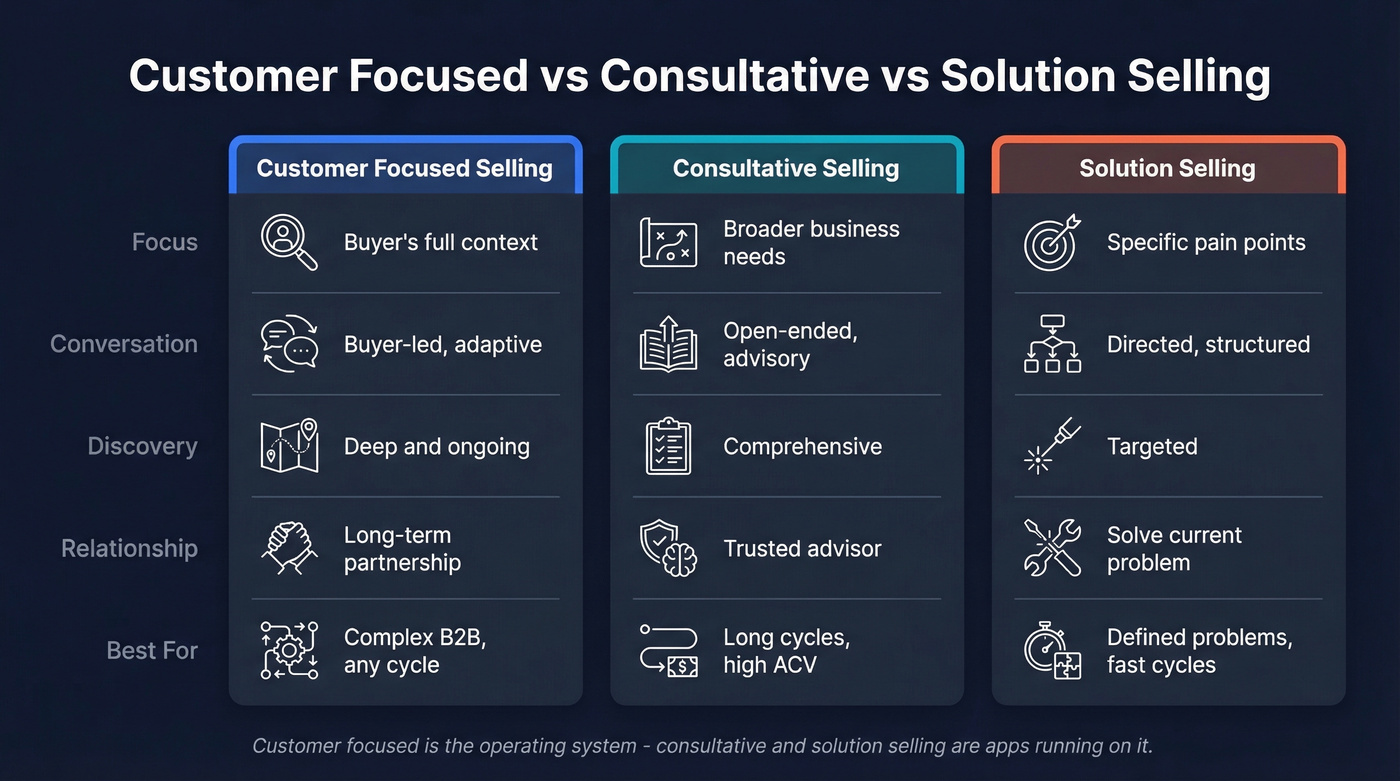
The nuance is in how it differs from its tactical cousins. Frank Watts coined "solution selling" in the 1970s, and Michael Bosworth formalized it into an organization in 1983. Since then, the methodology family tree has branched considerably:
| Customer Focused | Consultative | Solution | |
|---|---|---|---|
| Focus | Buyer's full context | Broader business needs | Specific pain points |
| Conversation Style | Buyer-led, adaptive | Open-ended, advisory | Directed, structured |
| Discovery Depth | Deep + ongoing | Comprehensive | Targeted |
| Relationship Goal | Long-term partnership | Trusted advisor | Solve current problem |
| Best For | Complex B2B, any cycle | Long cycles, high ACV | Defined problems, fast cycles |
The buyer-focused approach is the outcome you're aiming for: a sales process organized around the buyer. Consultative and solution selling are two common tactics you deploy inside that motion depending on the deal. The buyer's reality shapes the conversation, not your slide deck.
Why It Matters in 2026
Buyers do 57-70% of their research before they ever talk to a rep. By the time you get the meeting, they've already read the G2 reviews, watched the demo video, and compared your pricing page to two competitors. Feature-first pitching falls flat because the buyer already knows the basics. Selling the way customers want to buy means meeting them where they are in that research journey, not dragging them back to square one.
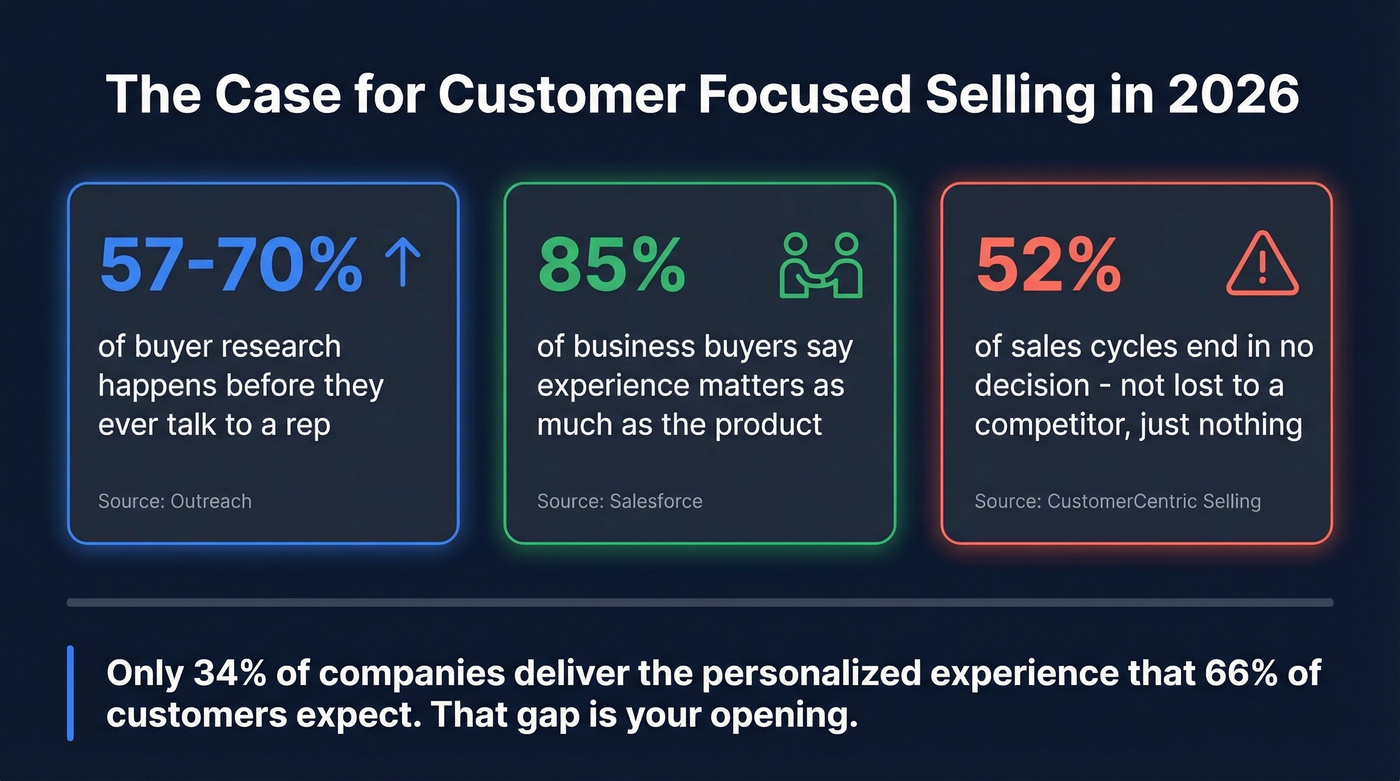
The numbers make this stark. Salesforce found that 85% of business buyers and 79% of consumers say the experience a company provides matters as much as its products. Yet only 34% of companies deliver on the personalized experience that 66% of customers expect. That gap is your opening.
And here's the stat that should haunt every sales leader: 52% of sales cycles end in "no decision." Not "lost to competitor." Not "budget cut." Just... nothing. In many teams, that's driven by weak discovery and unclear change urgency. A buyer-centric approach directly attacks this problem by surfacing real stakes early.
Frameworks That Drive Results
You don't need six methodologies. You need one framework and 10 good questions.
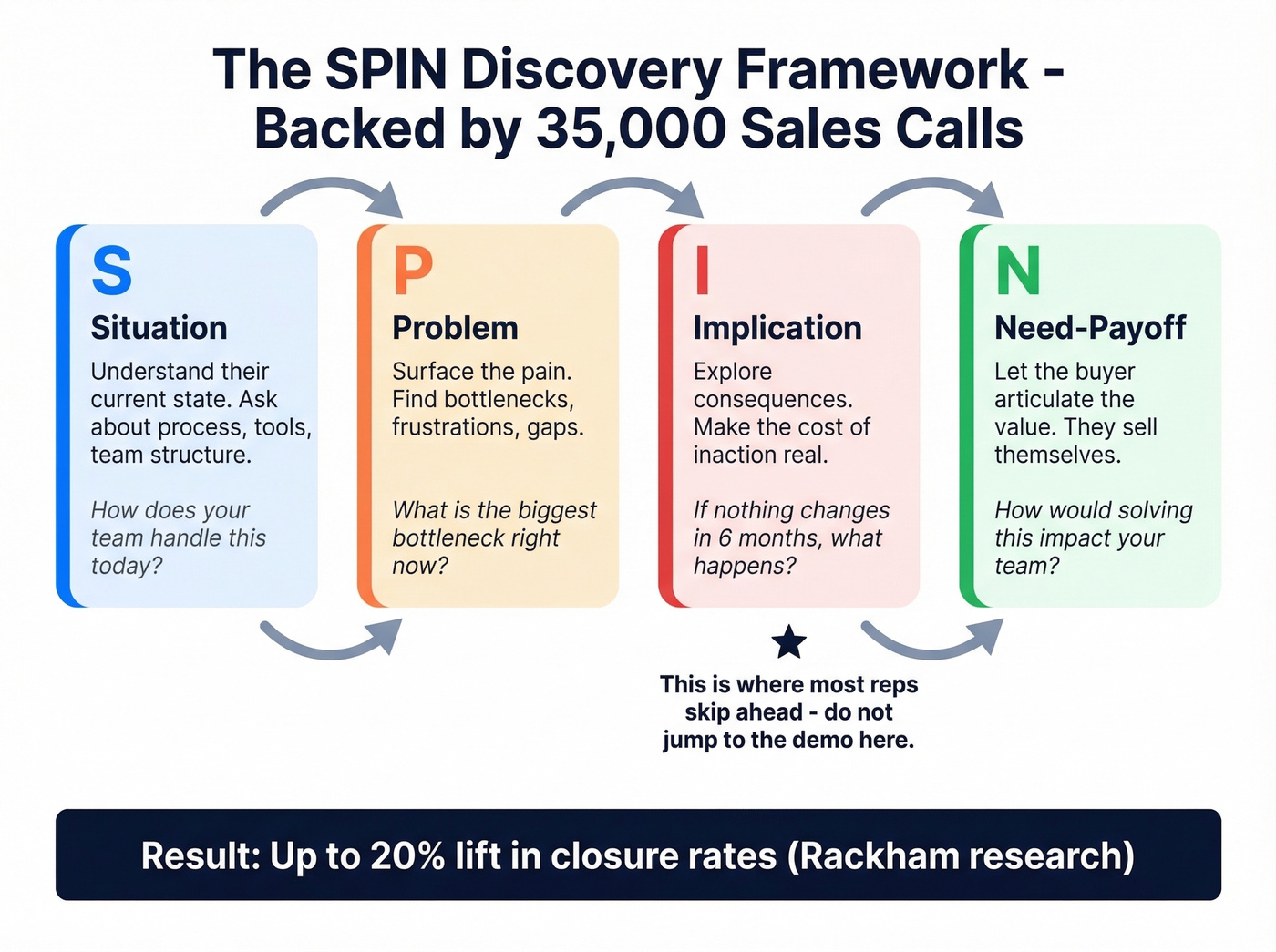
Start with SPIN. Neil Rackham's research across 35,000 sales calls found that structured questioning - Situation, Problem, Implication, Need-payoff - can lift closure rates by 20%. It's the most research-backed discovery framework in sales, and it works because it forces you to explore consequences before pitching solutions. We've seen reps on our team transform their first calls just by committing to the Implication step instead of jumping straight to the demo.
Use LAER for objections. Carew's [Listen, Acknowledge, Explore, Respond] framework keeps you from jumping to "let me address that" mode. The Acknowledge step alone changes the dynamic - it tells the buyer you heard them before you pivot.
Qualify inbound with four questions. Before you invest hours in a "researcher" who found your site, run through this checklist:
- Are key players aware of this evaluation?
- What business goals have been identified?
- Has budget been allocated?
- Has a cost/benefit sanity check been done?
If the answer to the first two is "no," you're not in a deal. You're in a conversation. MEDDIC and Challenger are worth studying too, but these three tools cover most of what a rep selling to customer needs requires day-to-day.

Great discovery questions mean nothing if you're talking to the wrong people. Prospeo's 30+ search filters - including buyer intent, job changes, and department headcount - let you build lists of decision-makers who match your ICP before you ever pick up the phone. 98% email accuracy means your outreach actually lands.
Stop discovering prospects who were never going to buy.
Discovery Questions You Can Steal
Every sales training deck says "ask better questions." None of them tell you which ones. Here are questions you can copy into your call prep doc today.
Situation and Context
- Walk me through how your team handles [process] today - from trigger to completion.
- Who else touches this workflow, and where do handoffs break down?
Pain and Problem
- What's the biggest bottleneck in that process right now?
- When this problem shows up, what does it cost you - in hours, deals, or headcount?
Impact and Implication
- If nothing changes in the next 6 months, what happens to [specific metric]?
- If you had to quantify the impact of this problem - in time, money, or missed opportunities - how would you frame it?
Decision Process and Stakeholders
- Besides yourself, who needs to sign off before this moves forward?
- What killed the last initiative like this - budget, timing, or internal politics?
That "quantify the impact" question is borrowed from Pepsales, and it's one of the best forcing functions in discovery. It makes the buyer do the ROI math themselves, which is infinitely more persuasive than you doing it for them on a slide. The prospect articulates the value, not you. That's buyer-driven selling in practice.
When It Goes Wrong
Customer focused doesn't mean pushover. Here are the five ways reps screw this up.
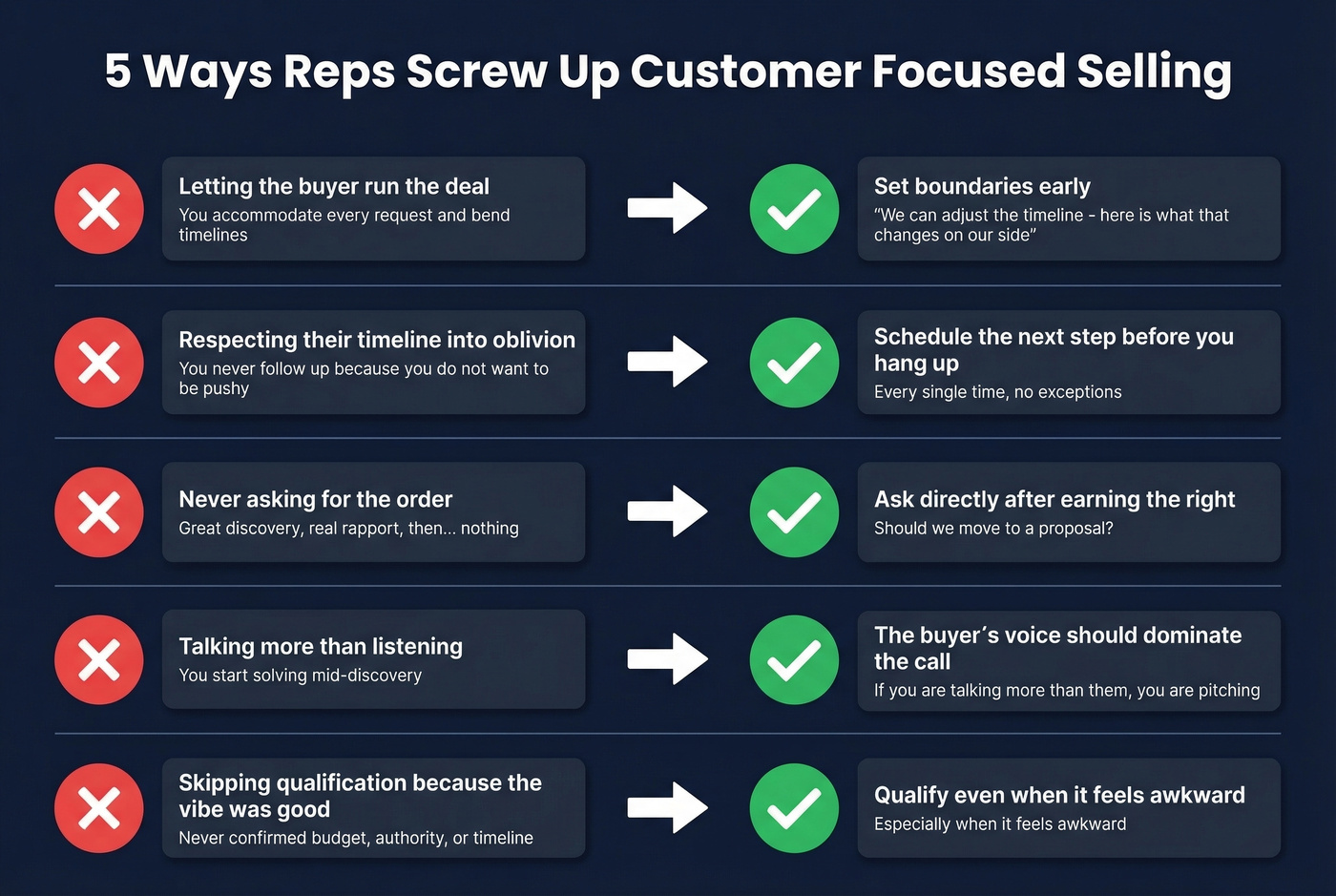
Letting the buyer run the deal. You accommodate every request and bend timelines - then wonder why internal teams hate working with you. Set boundaries early: "We can absolutely adjust the timeline. Here's what that changes on our side."
"Respecting their timeline" into oblivion. You don't follow up because you don't want to be pushy. Meanwhile, the deal dies quietly. The fix is simple: schedule the next step before you hang up. Every single time. (If you need a starting point, keep a few follow up options ready.)
Never asking for the order. You had a great discovery call, built real rapport, and then... waited. That 52% no-decision rate? A lot of it lives here. After you've earned the right, ask directly: "Based on what you've told me, this solves X and Y. Should we move to a proposal?"
Talking more than listening. You're so excited about the buyer's problem that you start solving it mid-discovery. If you're talking more than the buyer, you're pitching, not discovering. The buyer's voice should dominate the call, not yours.
Skipping qualification because the vibe was good. That "great conversation" that ended in ghosting? You never confirmed budget, authority, or timeline. Qualify even when it feels awkward - especially when it feels awkward.
Balancing Buyer Focus With Quota
Here's my hot take: most reps don't have a "customer focus" problem. They have a targeting problem. They're being deeply thoughtful with prospects who were never going to buy.
Let's be honest about the structural issue first. If your comp plan punishes a customer-first approach - if reps get dinged for longer cycles or lose accelerators when they disqualify bad-fit prospects - no amount of training fixes it. That's a leadership problem, not a rep problem.

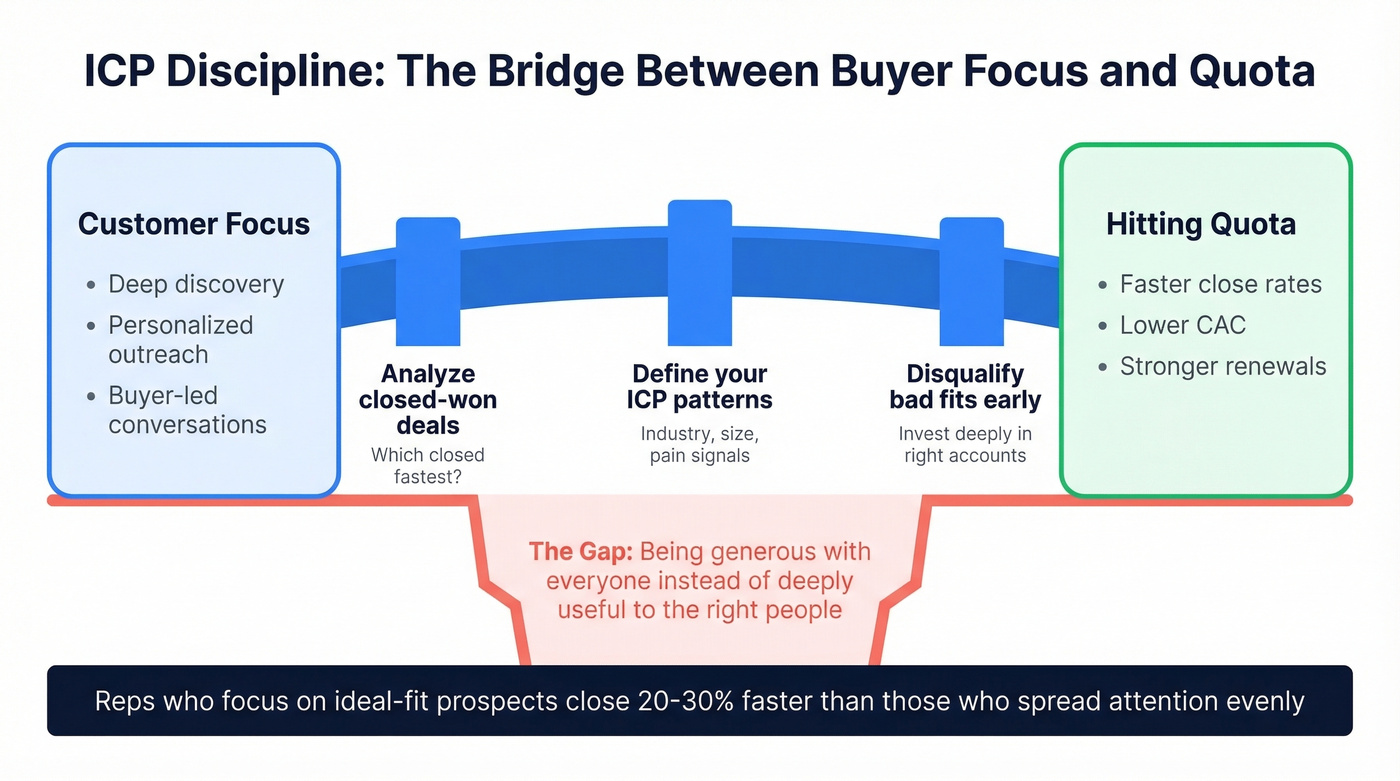
For reps who do have room to operate, ICP discipline is the bridge between buyer focus and quota. Analyze your closed-won deals: which ones closed fastest, had the lowest CAC, renewed without drama? Those patterns define who you should be spending time with. Customer focused selling isn't about being generous with everyone - it's about being deeply useful to the right people. When you combine tight ICP targeting with buyer-centric habits, you spend less time chasing and more time closing.
None of this works if your outreach never reaches the prospect. We use Prospeo to verify emails and direct dials before outreach - 98% email accuracy, data refreshed every 7 days - so the buyer-focused approach doesn't die in the inbox.
52% of deals die in no-decision. Half the battle is reaching the right stakeholders early. Prospeo surfaces verified emails and direct dials for entire buying committees - 125M+ mobile numbers with a 30% pickup rate - so you can multi-thread deals instead of single-threading into silence.
Reach every stakeholder in the deal, not just the one who replied.
FAQ
What's the difference between customer focused selling and consultative selling?
Customer focused selling is the broader philosophy of organizing your entire sales process around the buyer's goals and constraints. Consultative selling is one tactical approach within it, emphasizing deep discovery and advisory positioning. Think of customer focused as the operating system; consultative selling is one app running on it.
How do you measure a customer-first sales approach?
Track win rates, deal cycle length, "no decision" rates, and net revenue retention - not just activity metrics. A genuinely buyer-centric team should see fewer stalled deals (below that 52% no-decision benchmark) and stronger retention over 12 months. If those numbers aren't moving, the approach needs structural changes, not more training.
What tools support a buyer-centric sales process?
A CRM for tracking conversation context, a data platform like Prospeo for verified contact data, and a call recording tool like Gong or Chorus for coaching discovery skills. The data layer matters more than most reps think - you can't personalize outreach to someone you can't reach.
Can you be customer focused and still hit aggressive quotas?
Yes - but only with tight ICP discipline. Reps who focus discovery time on well-qualified, ideal-fit prospects close 20-30% faster than those who spread attention evenly. The key is disqualifying bad fits early so you can invest deeply in accounts that'll actually close and renew.