

Customer Profile Template That Actually Gets Used
A RevOps lead we work with spent three weeks building a gorgeous customer profile template - color-coded fields, stakeholder maps, the works. Six months later, not a single rep had opened it. The template wasn't the problem. The data inside it was.
That's the pattern we see over and over. Teams download a 40-field PDF, stare at the blank rows, and quietly abandon the whole exercise. Meanwhile, 71% of consumers expect personalized interactions and 76% get frustrated when it doesn't happen. The Zendesk Customer Experience Trends Report pushes the point further: 61% of consumers now want AI-driven personalization, and 74% say hyper-personalization directly improves their experience. The gap between "we have a template" and "we actually use it" is where pipeline goes to die.
What You Need (Quick Version)
- One profile, not eight. Start with your highest-LTV segment. Expand later.
- B2B profiles need firmographics, buying committee roles, tech stack, and account health signals.
- B2C profiles need psychographics, behavioral triggers, and identity cues - not just demographics.
- Score every profile with a simple A/B/C tier system so reps know where to focus.
- Skip the static PDF. Use a living doc in your CRM, Notion, or Google Sheets.
- Fill the blank fields. A template is worthless without data. Enrichment tools can populate firmographic, technographic, and contact fields automatically from a CSV upload.
→ Copy the Google Sheets template (B2B and B2C tabs included - duplicate and customize)
Profile vs. ICP vs. Buyer Persona
These three terms get used interchangeably, and it causes real confusion. They're related but distinct.
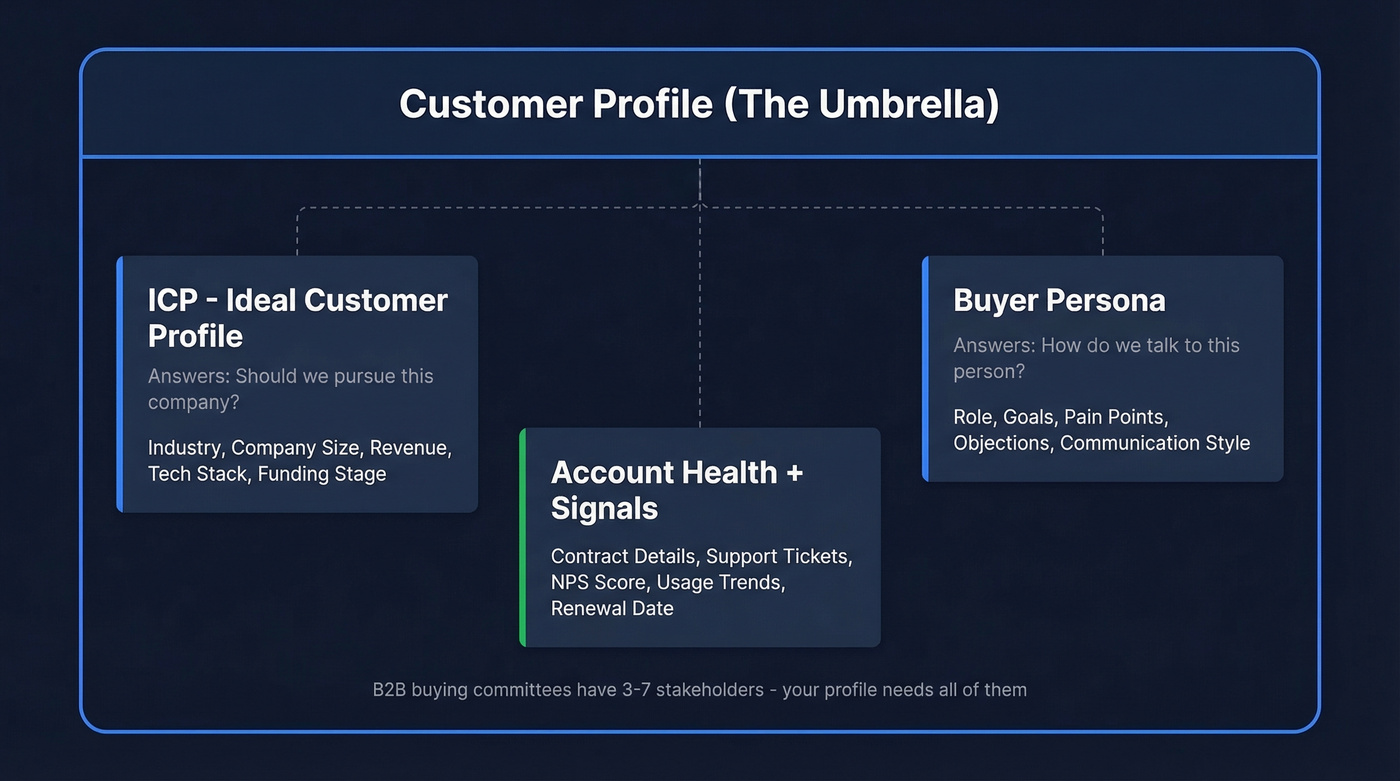
| Term | What It Describes | Key Fields | When to Use |
|---|---|---|---|
| ICP | Ideal company | Industry, size, revenue, tech | Account qualification |
| Buyer Persona | Individual stakeholder | Role, goals, objections | Message personalization |
| Customer Profile | Both (umbrella) | All of the above + health | Ongoing account mgmt |
An ICP answers "should we pursue this company?" A buyer persona answers "how do we talk to this specific person?" A customer profile is the umbrella document that holds both - plus account health data, contract details, and buying committee mapping.
For B2B, this distinction matters because buying committees involve 3-7 stakeholders. You don't sell to a company - you sell to a group of people with different priorities inside that company. The VP of Ops cares about efficiency, the Security Director cares about compliance, and the Finance Manager cares about ROI. Your profile needs to capture all of them, not just the person who signed the contract.
What to Include in Your Template
B2B Fields
B2B profiles need to go well beyond company name and industry. Here's what actually matters:
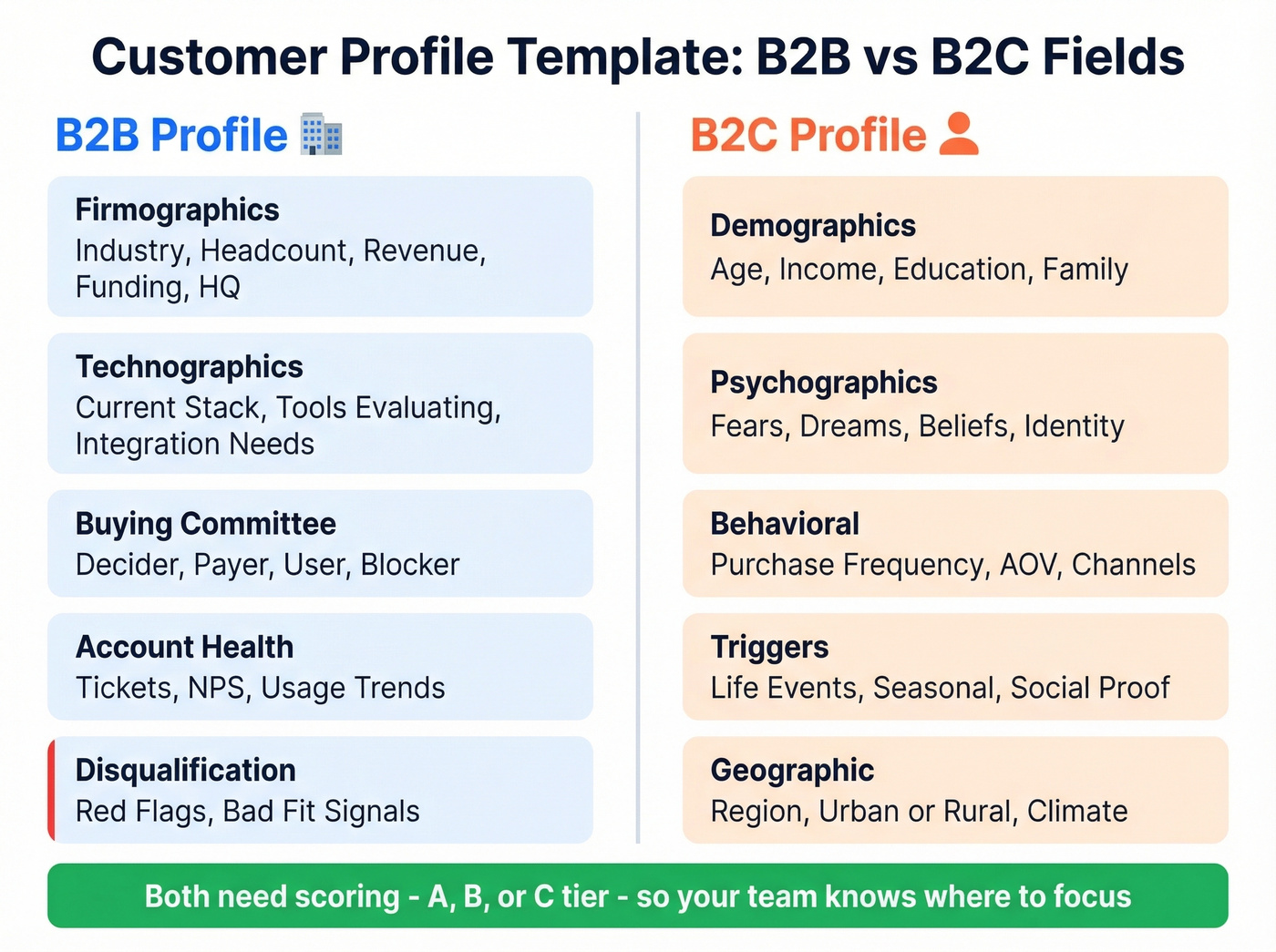
| Category | Fields |
|---|---|
| Firmographics | Industry, headcount, annual revenue, funding stage, HQ location |
| Technographics | Current tech stack, tools they're evaluating, integration needs |
| Buying Committee | Decider, Payer, User, Blocker |
| Account Health | Support ticket volume, NPS/health score, product usage trends |
| Contract Details | Contract value, renewal date, billing cycle, expansion potential |
| Disqualification | Red flags that signal bad fit |
The disqualification row is the one most templates miss. Sometimes knowing who to say no to matters more than knowing who to pursue - especially if your product doesn't fit every vertical. A r/b2bmarketing thread on persona problems reinforces this: teams waste months chasing accounts they should have filtered out on day one.
B2C Fields
B2C profiles lean harder on psychographics and behavioral data. Demographics alone won't differentiate your messaging.
| Category | Fields |
|---|---|
| Demographics | Age range, income bracket, education, family status |
| Psychographics | Biggest fears, biggest dreams, core beliefs, identity cues |
| Behavioral | Purchase frequency, AOV, preferred channels, content consumption |
| Geographic | Region, urban/suburban/rural, climate-relevant factors |
| Triggers | Life events or moments that prompt a purchase decision |
The psychographic fields are where most basic templates fall short. Buyers respond more to outcomes like "get home on time" than generic claims like "increase revenue." A practitioner framework on r/SaaS drives this home - the fears, dreams, and beliefs fields force you to think about what actually drives a purchase, not just who's buying.
Filled-Out Examples
B2B: Mid-Market SaaS Account
A blank template is useless. Here's a realistic mid-market SaaS account:
| Field Category | Field | Example |
|---|---|---|
| Firmographics | Company | Pylon (SaaS) |
| Firmographics | Headcount | 252 employees |
| Firmographics | Revenue | $10M ARR |
| Firmographics | Funding | Series B |
| Firmographics | HQ | San Francisco |
| Technographics | Stack | Zendesk, Slack, Salesforce |
| Buying Committee | Decider | VP of Ops |
| Buying Committee | Blocker | Security Director |
| Buying Committee | Payer | Finance Manager |
| Buying Committee | Champions | End-user team leads |
| Account Health | Tickets | 25 last quarter (up from 8) |
| Account Health | Score | Dropped 78 → 62 |
| Contract | Value | $50k/year |
| Contract | Renewal | Annual, Q4 |
| Disqualification | Red flags | <50 employees, no IT team |
Look at the account health signals. Support tickets tripled. Health score dropped 16 points. Renewal is in three months. This isn't just a profile - it's an early warning system.
A CSM who sees this data acts immediately. A CSM working from a static PDF with just company name and industry finds out at renewal time, when it's too late. The buying committee mapping is equally critical: the VP of Ops is the decider, but the Security Director can block the deal entirely. If your reps are only talking to champion end-users, they'll be blindsided when Security raises a compliance objection in week six.
B2C: DTC Fitness Brand
| Field Category | Field | Example |
|---|---|---|
| Demographics | Name | "Busy Sarah" |
| Demographics | Age/Context | 34, two kids, dual income |
| Psychographics | Biggest fear | Losing her health/energy |
| Psychographics | Biggest dream | Feeling strong and in control |
| Psychographics | Beliefs | "Fitness shouldn't require 2 hours at a gym" |
| Psychographics | Identity | Sees herself as a doer, not a quitter |
| Behavioral | Purchase trigger | New Year, post-vacation guilt, friend's rec |
| Behavioral | Channels | Instagram, podcast ads, email |
| Behavioral | Avg order | $65, buys quarterly |
| Geographic | Location | Suburban Midwest |
The "what keeps them up at night" question is the most valuable field here. For Sarah, it's not "I need to lose weight" - it's "I'm too tired to play with my kids after work." That single insight changes your ad copy, your email subject lines, and your product positioning entirely.

Your customer profile template has 40 fields. How many are actually filled? Prospeo's CRM and CSV enrichment returns 50+ data points per contact - firmographics, technographics, verified emails, direct dials - with an 83% match rate. Upload your account list and get complete profiles back in minutes, not weeks.
Stop building templates you can't fill. Enrich them automatically.
How to Build a Customer Profile
Start With Your Best Customers
Don't start with assumptions. Pull 50-100 closed-won deals from the last 12 months and look for clusters where 70-80% of wins share 3-5 traits.
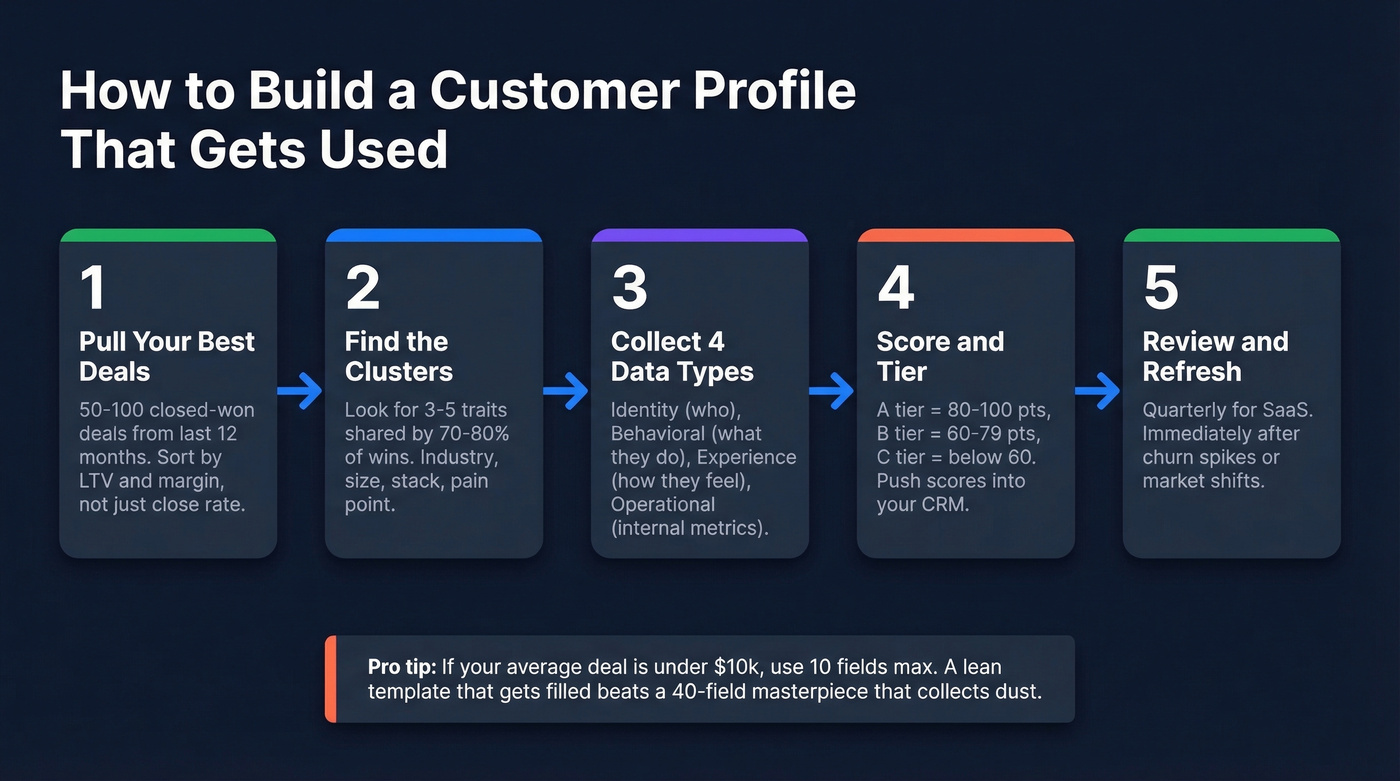
Apply a profitability lens too. Not all customers are equal - 20% of your customers typically drive 80% of your profit. The account that churns after three months and files 40 support tickets isn't your ideal customer, even if they matched your firmographic criteria perfectly. Sort by LTV and margin, not just close rate.
Here's the thing: if your average deal size is under $10k, you probably don't need a 40-field profile. A 10-field version that your reps actually fill out beats a 40-field masterpiece that collects dust. Start lean, add fields only when a rep says "I keep losing deals because I don't know X."
Collect the Right Data
You need four types of customer data. Identity data tells you who they are. Behavioral data shows what they do. Experience data reveals how they feel about you. Operational data tracks internal metrics like ticket volume and usage.
Collect from multiple channels: your CRM holds deal history and contact details, support tickets reveal pain points and friction, customer surveys capture satisfaction and feature requests, and analytics show product usage patterns. The payoff is real - McKinsey found that companies using behavioral insights outperform peers by 85% in sales growth and 25% in gross margin.
The key distinction is between first-party data from your own systems, zero-party data that customers give you voluntarily through surveys, and third-party enrichment data that fills the gaps at scale. For B2B profiles, tools like Prospeo can populate firmographic and technographic fields automatically - upload a CSV of target accounts and get back 50+ verified data points per contact, with data refreshed every 7 days so your profiles don't go stale.
Segment, Score, and Operationalize
Once you've collected the data, rank accounts - don't just describe them. A profile without a score is a description. A profile with a score is a prioritization tool.
Push your profile fields and scoring rules into your CRM. Set up automated scoring so new accounts get tiered on import. Align sales, marketing, and support around the same definitions.
Establish a review cadence: quarterly for SaaS and tech, biannually for stable industries. Trigger an immediate review after major market shifts, new product launches, or a churn spike from a specific segment. Before you finalize any profile, run three mandatory checks: Does this account have the budget? Is there urgency or just curiosity? Are they actually ready to change their current workflow?
How to Score and Tier Profiles
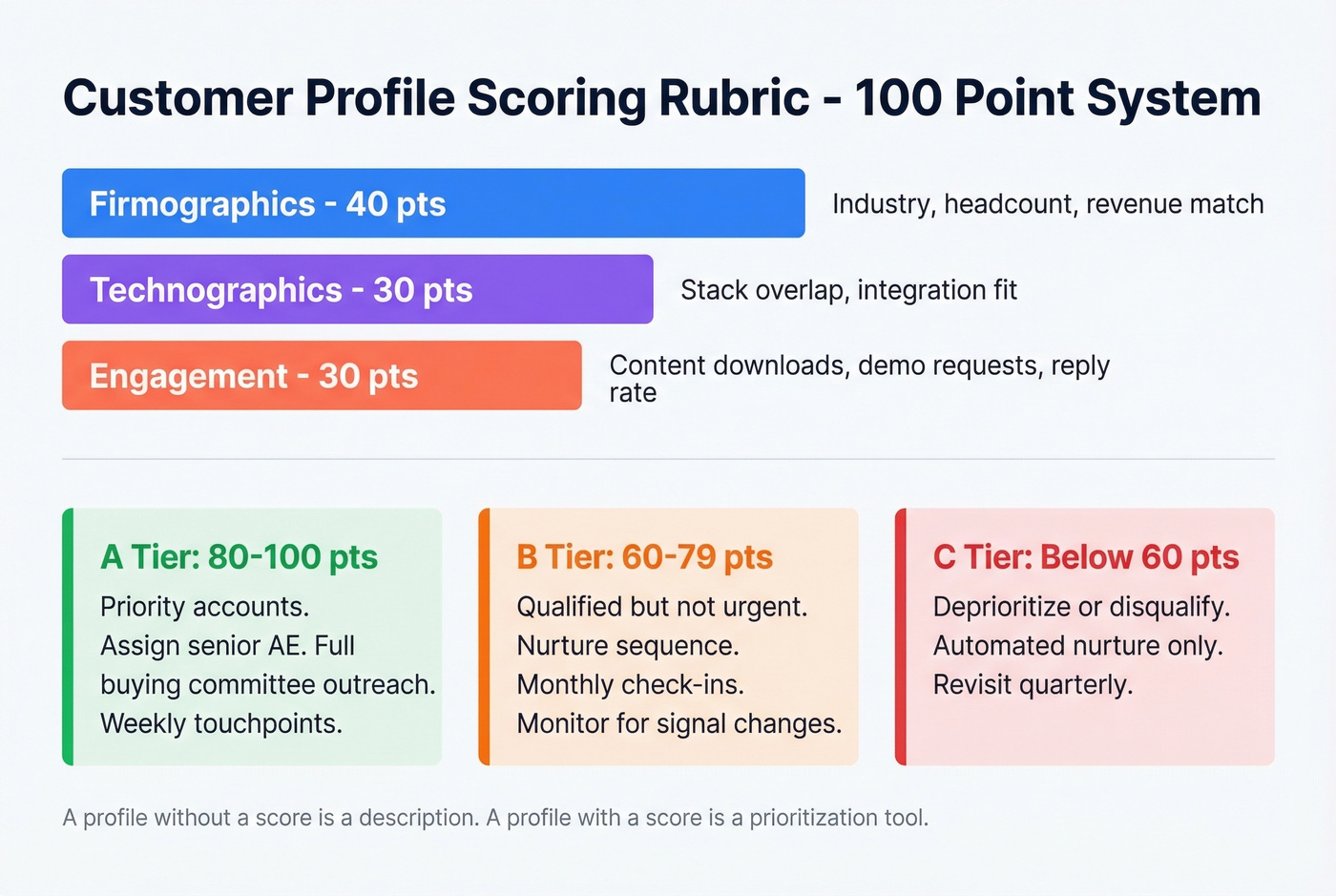
A scoring rubric turns your customer profile from a descriptive document into a decision-making tool. Here's a 100-point framework we've seen work well:
| Category | Weight | Criteria | Example Score |
|---|---|---|---|
| Firmographics | 40 pts | Industry, headcount, revenue match | 35/40 |
| Technographics | 30 pts | Tech stack overlap, integration fit | 20/30 |
| Behavioral | 15 pts | Website visits, content engagement | 10/15 |
| Trigger Events | 15 pts | Funding, hiring, leadership change | 15/15 |
Tier thresholds:
- A (80-100): High-priority. Route to senior reps immediately.
- B (50-79): Good fit, needs nurturing. Marketing sequences and SDR outreach.
- C (0-49): Low priority. Automate or deprioritize.
The validation benchmark: your Tier A accounts should convert at 1.5-2x the rate of Tier B, with sales cycles 15-20% shorter. If they don't, your scoring criteria need recalibration - you're weighting the wrong attributes.
One clarification that trips teams up: ICP scoring isn't lead scoring. ICP scoring measures structural fit - is this the right type of company? Lead scoring measures behavioral engagement - is this specific person showing buying signals? A Tier A account with no engagement is still a Tier A account. It just needs outbound, not inbound follow-up.
9 Mistakes That Kill Profiles
Treating the profile as a wishlist. Build from closed-won data, not the Fortune 500 logos you wish you had.
Waiting for "enough" data. You have more data than you think. Start with 50 closed-won deals and your CRM.
Relying solely on firmographics. Industry and headcount aren't enough. Technographics, buying triggers, and behavioral signals separate good-fit accounts from look-alikes that never close.
Being too narrow. If your ICP excludes 90% of your actual revenue, it's too tight.
Building in a marketing bubble. Profiles created without sales, support, and product input become what practitioners call "fairytale personas" - pretty documents that no one trusts.
Never updating. Your customers change. Your market changes. Review quarterly at minimum. Early adopters look different from mainstream buyers.
Never operationalizing it. If it's not in your CRM, it's not real. If reps can't see the score on an account record, the scoring rubric doesn't exist.
Ignoring profitability. Some "ideal" customers cost more to serve than they're worth. Factor in support load and margin, not just close rate.
Skipping disqualification criteria. Knowing who to say no to is as valuable as knowing who to pursue.
Which Format to Use
| Format | Best For | Price | Limitation |
|---|---|---|---|
| Notion | Startups, small teams | Free-paid | Less CRM integration |
| Google Sheets | Any size, collaboration | Free | Gets messy at scale |
| CRM-native | 10+ salespeople | Included with CRM plan | Setup complexity |
| PDF/Word | Presentations only | Free | Static, never updated |
For teams under 10 people, Notion or Google Sheets is the right call. They're collaborative and flexible enough to evolve as your customer profile template matures. Once you have 10+ salespeople, move to CRM-native profiles in HubSpot or Salesforce - reps need to see profile data on the account record, not in a separate doc.
Static PDFs are presentation tools, not working profiles. If your profile lives in a PDF that gets emailed around, it's already dead.
Tools for Enriching Profiles
Let's be honest: the best template in the world is useless with blank fields. The "blank template problem" is the #1 reason customer profiles fail - teams build the structure but never populate the data.
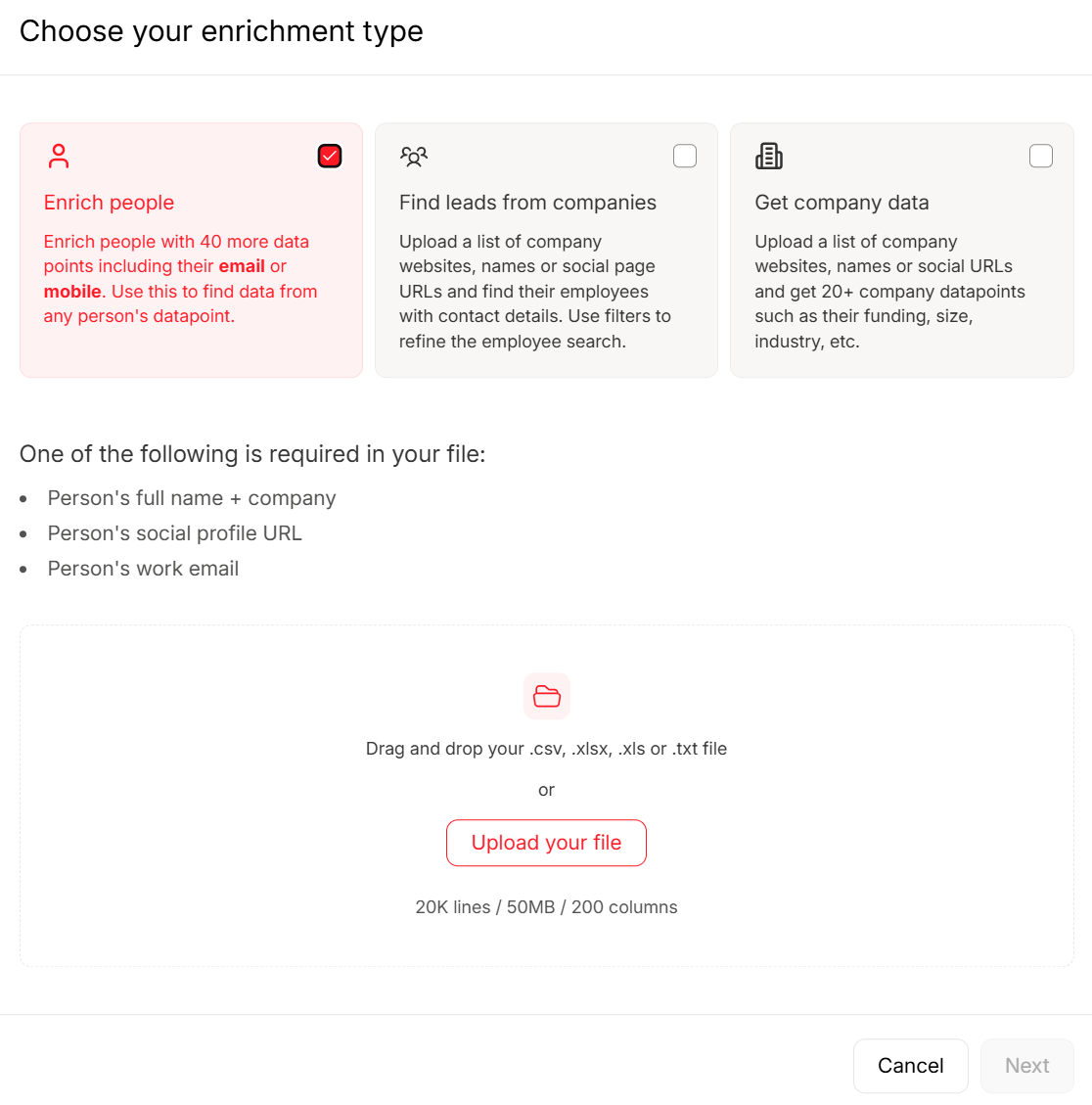
Prospeo is the fastest path from blank template to actionable profile. Upload a CSV of target accounts and get back verified emails, direct dials, tech stack, funding stage, and headcount data - 98% email accuracy, 83% enrichment match rate, 50+ data points per contact. Data refreshes every 7 days versus the 6-week industry average. At roughly $0.01 per email with a free tier of 75 emails/month plus 100 Chrome extension credits/month, it turns a blank profile into a populated one in minutes. Native integrations with Salesforce, HubSpot, and Clay mean enriched data flows straight into your CRM without manual imports.
HubSpot and Salesforce both offer built-in enrichment, but it's basic - company name, industry, maybe headcount. For technographics, buying signals, and verified contact data, you need a dedicated enrichment layer on top. HubSpot CRM is free; Salesforce starts around $25/user/month.
ZoomInfo is the enterprise option at $15-40k/year. Deep US database, strong intent data, but massive overkill for teams that just need to populate profile fields. We've seen teams buy ZoomInfo for enrichment and end up paying for 15 features they never touch. Skip it unless you're running enterprise ABM with a six-figure tech budget.
Mapping a buying committee means nothing if you can't reach them. Prospeo gives you 98%-accurate emails and 125M+ verified mobile numbers for the VP of Ops, the Security Director, and the Finance Manager - every stakeholder on the profile. Data refreshes every 7 days so your profiles never go stale.
Turn every buying committee field into a verified contact you can actually reach.
FAQ
How often should I update my customer profile?
Quarterly for fast-moving industries like SaaS and tech; biannually for stable industries with longer sales cycles. Don't wait for the scheduled cadence if the data is screaming at you - trigger an immediate review after major market shifts, product launches, or a churn spike from a specific segment.
What's the difference between an ICP and a buyer persona?
An ICP describes the ideal company - firmographics, tech stack, revenue range, industry. A buyer persona describes individual stakeholders inside that company: their role, goals, objections, and communication preferences. You need both. The ICP qualifies the account; the persona personalizes outreach to each buying committee member.
How many profiles do I need?
Most companies need 2-4 max - one per distinct segment you actively sell to. If you have more than five, you're either too fragmented or haven't prioritized. Start with one for your highest-LTV segment, validate it against closed-won data, then expand.
How do I fill in a profile without enough data?
Start with your CRM - analyze 50-100 closed-won deals for common traits in industry, headcount, and tech stack. Supplement with customer interviews and support ticket analysis for qualitative insights. For firmographic and technographic fields at scale, CSV enrichment tools can return 50+ data points per contact, populating fields in minutes instead of hours of manual research.
Do I need a full or basic template?
For deals under $15k with short sales cycles, a basic 10-15 field template covering firmographics, one or two psychographic fields, and a disqualification row is enough. For enterprise deals with six-month cycles and multi-stakeholder buying committees, you need technographics, buying committee mapping, account health signals, and contract details. Start simple and add complexity only when the data gap costs you deals.