

The Best Data Hygiene Companies for B2B Teams in 2026
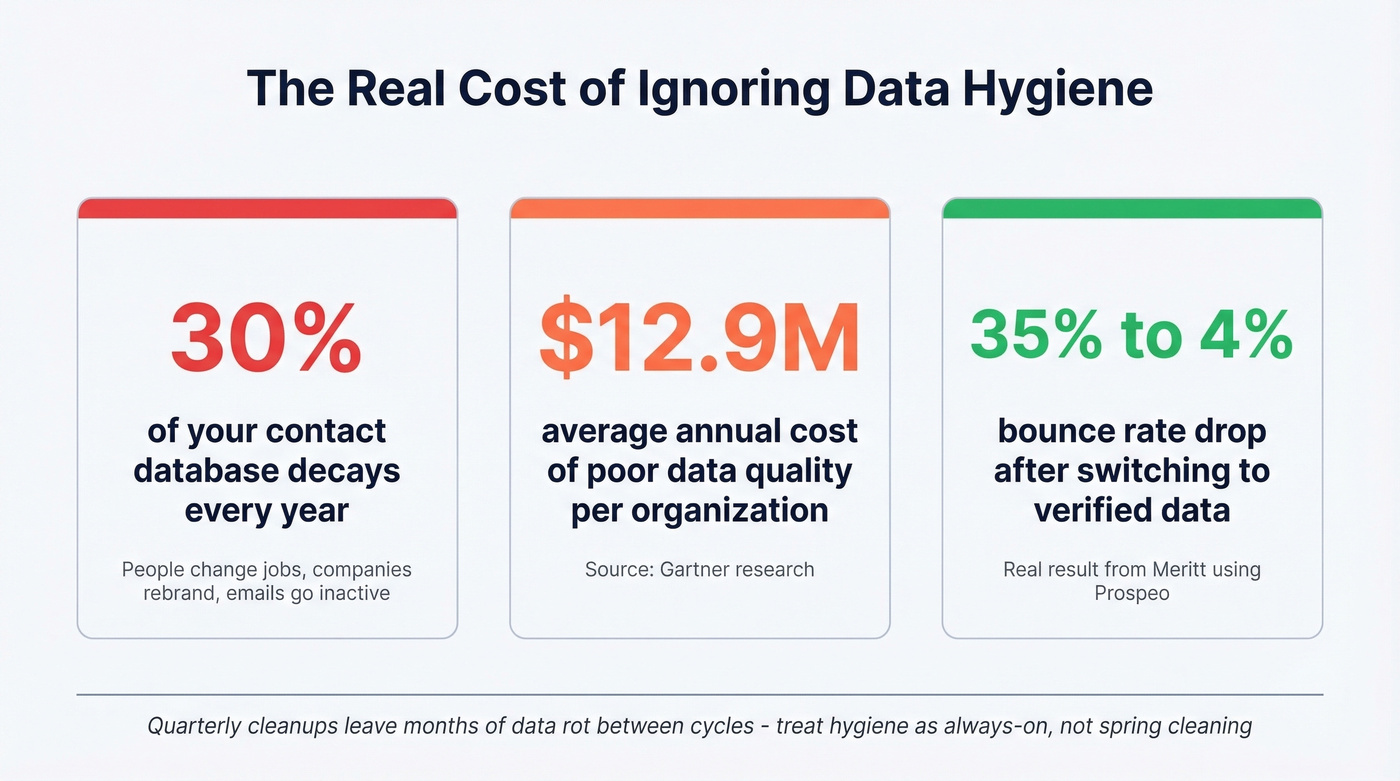
Contact data decays at roughly 30% per year. That means nearly a third of your database goes stale annually - and poor data quality costs organizations an average of $12.9M according to Gartner research. We've evaluated the major data hygiene companies most B2B teams shortlist, from verification specialists to enterprise governance platforms. Here's who actually delivers.
Our Picks
| Use Case | Pick |
|---|---|
| Email & phone verification | Prospeo |
| All-in-one B2B data + hygiene | ZoomInfo |
| Enterprise data quality | Informatica |
| Salesforce-native cleanup | Validity DemandTools |
| Address/postal verification | Melissa |
| Multi-vendor data orchestration | Openprise |
What Data Hygiene Actually Means
Data hygiene, data cleansing, and data enrichment solve different problems - though vendors blur the lines constantly. Hygiene is the ongoing discipline of keeping your database accurate through deduplication, validation, and standardization. Cleansing is the act of fixing what's already broken. Enrichment adds data points you didn't have before.
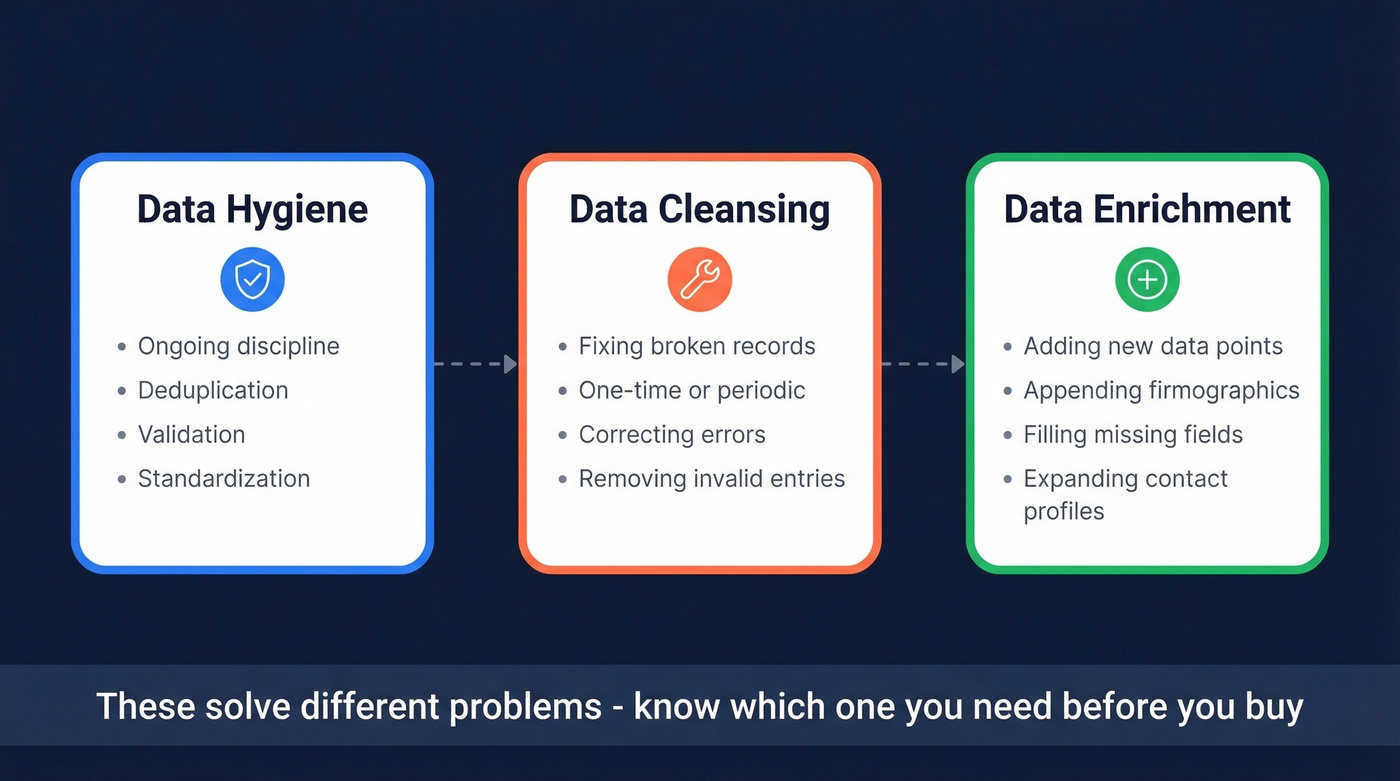
For B2B teams, the core question is usually contact hygiene: are the emails valid, are the phone numbers current, are duplicates clogging your CRM? That's a fundamentally different problem than enterprise data governance, which deals with data lineage, profiling, and cross-system consistency at scale. Know which one you're solving before you buy.
Top Data Hygiene Platforms Reviewed
Prospeo - Best for Email & Phone Verification
Prospeo's database covers 300M+ professional profiles, 143M+ verified emails, and 125M+ verified mobile numbers, all refreshed on a 7-day cycle. Most competitors refresh every 4-6 weeks, so they're handing you stale data by default.
The 5-step verification process handles catch-all domains, spam traps, and honeypots, delivering 98% email accuracy. CRM enrichment returns 50+ data points per contact with a 92% API match rate. Native integrations cover Salesforce, HubSpot, Lemlist, Instantly, and Clay.
Real results: Meritt dropped their bounce rate from 35% to under 4% after switching. That's not marginal - that's the difference between burning your sender domain and running sustainable outbound at scale.
Use this if: You need verified emails and direct dials at scale without a five-figure annual contract. Pricing starts at ~$0.01/email with a free tier of 75 emails/month. For teams that also need enterprise governance, Prospeo handles the verification layer while tools like Informatica cover profiling and lineage.
ZoomInfo - Best All-in-One B2B Platform
ZoomInfo's database spans 500M contacts across 100M companies, with 135M+ verified phone numbers. It's the biggest name in B2B data, and for good reason - the breadth is hard to match. (If you're comparing providers, see our ranked list of the best B2B databases.)
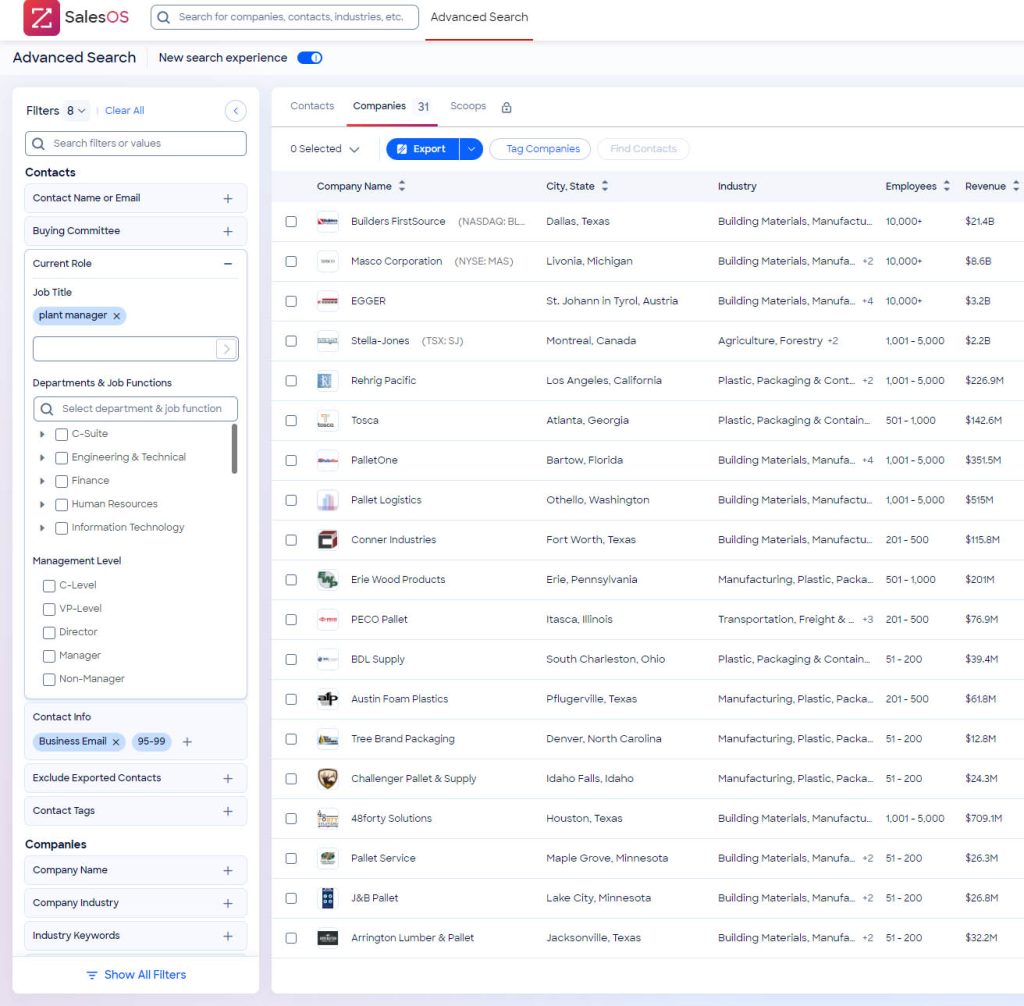
Email verification comes via the NeverBounce add-on at roughly $3,000 extra. Hygiene isn't baked into the base product; it's bolted on.
Use this if: You want a single platform for prospecting, enrichment, intent data, and verification - and you've got the budget. Base pricing starts at $15K/year, but most teams pay $30K-$75K+. Vendr data shows 200-headcount orgs paying $24.8K-$44.2K, while 1,000+ headcount enterprises run $83K-$162K. ZoomInfo pushes 2-3 year contracts hard, and auto-renewal windows are often 60-90 days. Watch for those clauses.
Skip this if: You're a sub-50 person team. The cost-per-verified-contact math collapses at that scale.
Informatica - Best Enterprise Platform
Informatica's IDMC platform is the standard enterprise pick for data profiling, cleansing, matching, and monitoring. If you've got a data engineering team and complex multi-system environments, this is what they'll reach for. Consumption-based pricing scales with data volume, and enterprise deployments commonly land in the $25K-$150K+/year range depending on scope.
One thing to watch: PowerCenter hits end-of-life in March 2026, so existing customers face a cloud migration whether they want one or not. The learning curve is steep. This tool solves data architecture problems, not outbound hygiene.
Melissa - Best for Address Verification
Melissa specializes in postal validation and geocoding. It's the go-to for teams where physical address accuracy matters - shipping, direct mail, compliance. Credit-based pricing starts with a free tier of 1,000 credits/month, scaling to $1,395 for 500K credits. Products span Lookups, Listware, and Clean Suite for CRM integration.
This is a verification specialist, not a B2B prospecting tool.
Openprise - Best for Data Orchestration
Openprise sits between your data vendors and your CRM, orchestrating multi-vendor enrichment waterfalls with no-code automation. The real value is precedence rules - you define which data source wins when two vendors disagree about a contact's title or company. Professional plans start at $35K/year with unlimited seats and 400+ pre-built connectors, while enterprise pricing climbs to $5K-$15K/month.
For RevOps teams managing three or more data vendors, this eliminates the spreadsheet-and-prayer approach to data routing.
Validity DemandTools - Best for Salesforce
If your CRM is Salesforce and your problem is duplicates, DemandTools is one of the most direct solutions available. It handles deduplication, mass merging, and field standardization without leaving Salesforce. Pricing runs ~$15-$35/user/month. Simple, focused, effective.
Other Notable Vendors
Experian brings consumer and business data hygiene together - address verification, identity resolution, and data profiling. It offers a free 30-day trial with no credit card required. Enterprise pricing typically runs $20K-$80K+/year. Best for organizations needing both B2C and B2B data quality from one vendor.
Talend (now Qlik) offers hybrid deployment with an open-source edition for budget-conscious teams. Commercial plans start around ~$12K/year. Solid for data integration teams who also need quality modules, though the Qlik acquisition has created some uncertainty around the product roadmap.
Data Ladder focuses on code-free deduplication and matching at ~$500-$1,500/month. Good for one-time cleanup projects where you don't need an ongoing platform.
Dun & Bradstreet is the firmographic enrichment giant. Custom pricing ranges from $10K-$200K+/year depending on data sets and volume. Overkill for contact hygiene, essential for firmographic standardization at scale. (If you're buying lists, also review B2B list providers to sanity-check fit and pricing.)

Data hygiene starts with data that's actually fresh. Prospeo refreshes 300M+ profiles every 7 days - not every 6 weeks like most vendors on this list. With 98% email accuracy, catch-all handling, and spam-trap removal built into a 5-step verification process, you skip the cleanup entirely.
Stop cleaning bad data. Start with data that doesn't need cleaning.
Pricing Comparison
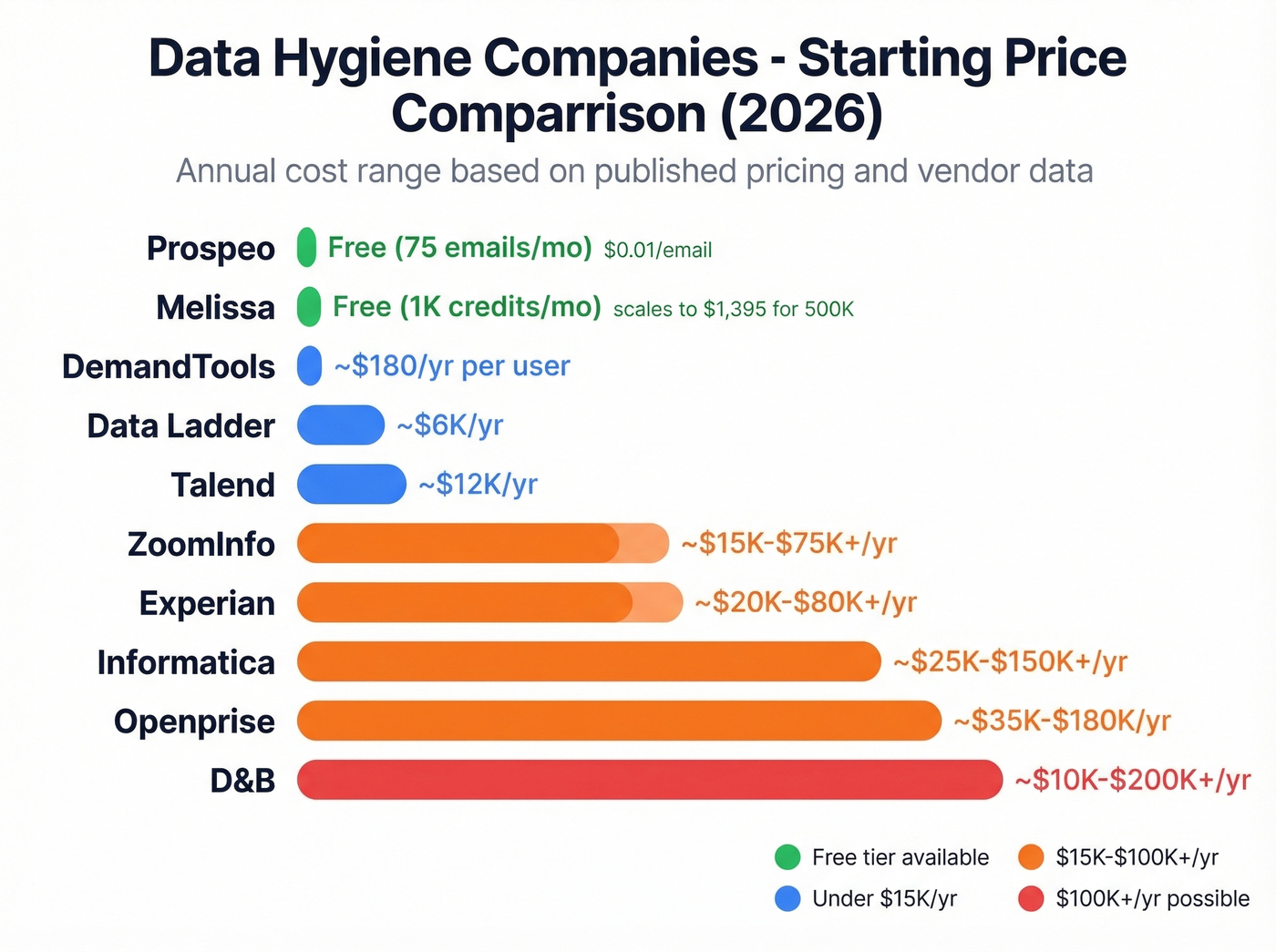
Most data hygiene companies don't publish pricing. We pulled numbers from every source we could find so you don't have to sit through 10 demo calls.
| Tool | Starting Price | Model | Best For |
|---|---|---|---|
| Prospeo | Free (75 emails/mo) | Per-credit, ~$0.01/email | Email/phone verification |
| ZoomInfo | ~$15K/year | Annual contract + add-ons | All-in-one B2B data |
| Informatica | ~$25K/year | Consumption (IPU) | Enterprise governance |
| Melissa | Free (1K credits/mo) | Credit tiers | Address verification |
| Openprise | $35K/year | Annual contract | Data orchestration |
| DemandTools | ~$15/user/mo | Per-user | Salesforce cleanup |
| Experian | ~$20K/year | Custom enterprise | B2B + B2C quality |
| Talend | ~$12K/year | Subscription | Data integration + quality |
| Data Ladder | ~$500/mo | Monthly subscription | Deduplication |
| D&B | ~$10K/year | Custom enterprise | Firmographic enrichment |
How to Choose the Right Vendor
Here's the thing: most B2B teams need two layers, not one. A verification layer that answers "are these emails and phones valid?" and a deduplication layer that answers "is our CRM clean?" Trying to solve both with a single enterprise platform almost always means overpaying. If your average deal size is under $15K, you almost certainly don't need a $50K data governance suite.
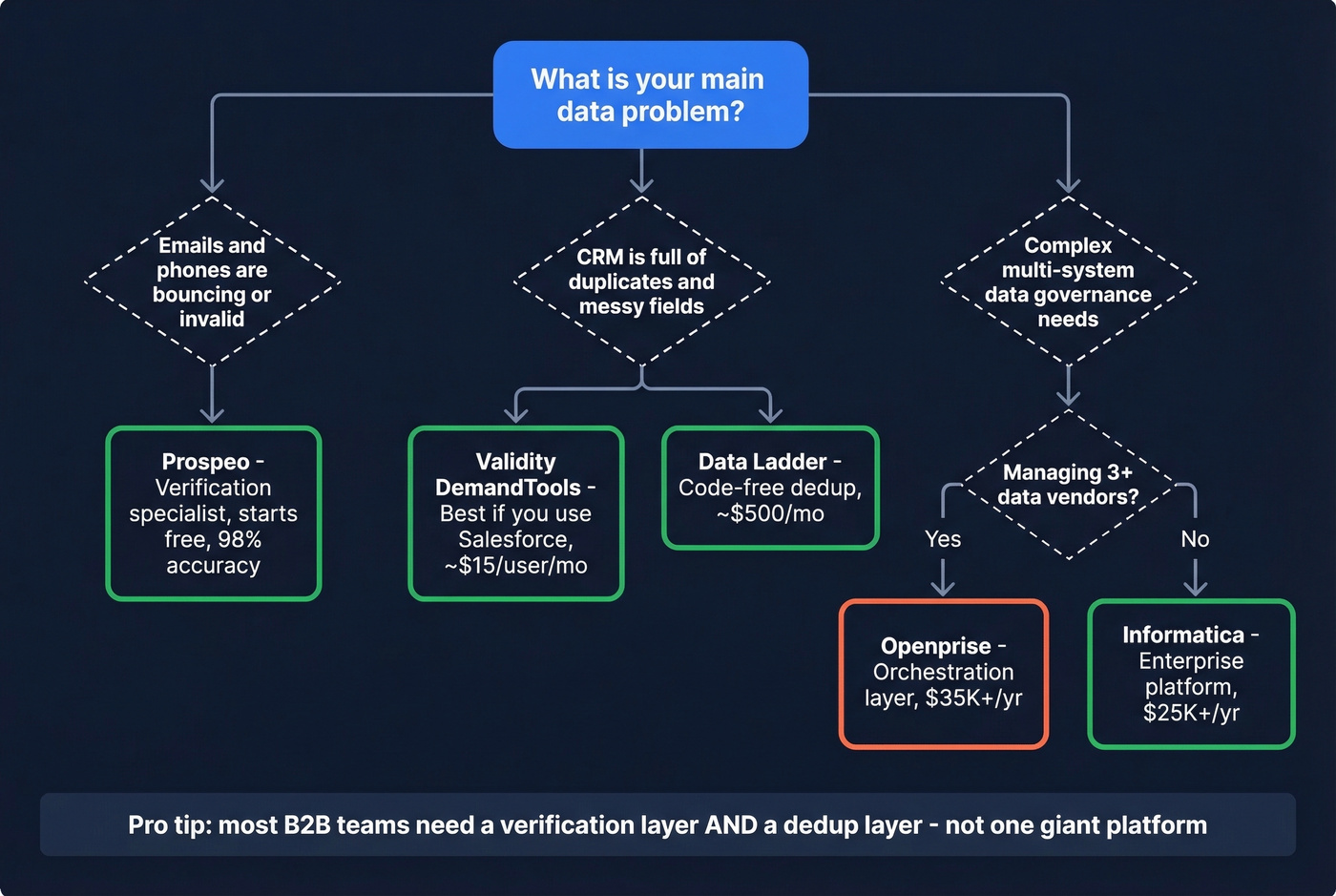
The practical workflow looks like this: audit your current data quality first, then standardize formats, verify contacts, deduplicate records, enrich gaps, and set up ongoing monitoring. Most teams skip straight to buying tools and wonder why the problems come back six months later.
When evaluating vendors, prioritize GDPR/CCPA compliance and security attestations like SOC 2 Type II or ISO 27001. Make sure the tool supports both batch and real-time processing, provides health reports with audit trails rather than black-box outputs, integrates deeply with your CRM, and offers clear SLAs on uptime and processing speed. The consensus on r/salesops is that compliance and security evaluation is the part most teams regret skipping - don't be that team.
Mistakes That Waste Your Budget
Treating hygiene as a quarterly project. Data decays continuously. Quarterly cleanups leave months of rot between cycles. The teams that win treat hygiene as an always-on capability, not a spring cleaning ritual.
The enrichment paradox. More data sources sound better until three vendors disagree about a contact's job title and your automation picks the wrong one. Without precedence rules and confidence metadata, enrichment can overwrite reliable first-party data with garbage. And if you're feeding CRM data into AI tools for personalization or scoring, duplicates and stale records compound into plausible-sounding but wrong outputs. That's a problem that gets worse, not better, as you adopt more automation. (If you're scaling outbound, pair hygiene with outbound email spam prevention so deliverability doesn't collapse.)
Buying an enterprise platform for a verification problem. We've seen teams spend $40K on a data governance suite when a $39/month verification tool would've solved 80% of their pain. Match the tool to the actual problem - dedicated data cleansing services often deliver faster ROI than all-in-one suites for teams whose core issue is contact accuracy. (If you're troubleshooting bounces, start with what a soft bounce rate actually indicates.)
Let's be honest: the vendor you pick matters less than whether you actually run the process consistently. The best data hygiene tool in the world can't fix a team that imports unverified lists every Monday.
Meritt cut their bounce rate from 35% to under 4% with Prospeo - no $15K annual contract required. At ~$0.01 per verified email with a free tier to start, you get enterprise-grade data hygiene at a fraction of what ZoomInfo or Informatica charge.
Get 98% accurate emails for a penny each. No demo calls, no contracts.
FAQ
What is data hygiene?
Data hygiene is the ongoing process of keeping your database accurate by removing duplicates, correcting errors, standardizing formats, and verifying contact information. It differs from one-time cleansing because it requires continuous monitoring - data decays at roughly 30% per year, so a "clean" database today is 30% dirty twelve months from now.
How often should you clean your CRM data?
Continuously, not quarterly. With 30% annual decay, quarterly cleanups leave months of degradation between cycles. Use tools with automated weekly or real-time verification to catch rot before it compounds.
What's the difference between data cleansing and data enrichment?
Cleansing fixes what's already in your database - duplicates, formatting errors, outdated records. Enrichment adds new data points you didn't have, like direct dials or technographics. Most B2B teams need both, but they require different tools and budgets.
How much do data hygiene services cost?
Pricing ranges from free tiers to $150K+/year for enterprise platforms like Informatica. Most mid-market B2B teams spend $5K-$50K annually depending on whether they need contact verification, deduplication, or full governance.