

The Best Data Intelligence Tools in 2026, Sorted by What They Actually Do
Most "data intelligence" roundups are just BI dashboard listicles wearing a different label - Tableau, Power BI, Looker, repeat. That's not data intelligence. It's one slice of it.
The actual category spans four distinct layers: BI and analytics, data catalogs and governance, data quality and observability, and B2B data platforms. The global data analytics market is projected to grow from $69.54B to $302.01B by 2030 at a 28.7% CAGR. Here's what's worth your time across all four - with pricing, satisfaction scores, and honest picks.
Our Picks at a Glance
| Category | Top Pick | Why |
|---|---|---|
| BI & Analytics | Power BI (value) / Qlik (depth) | Best coverage per dollar |
| Data Catalog & Governance | Atlan (AI-native) / dataspot. (highest satisfaction) | Innovation vs. proven user love |
| Data Quality & Observability | Monte Carlo | Most mature observability platform |
| B2B Data Intelligence | Prospeo | 98% email accuracy, 7-day refresh, self-serve pricing |
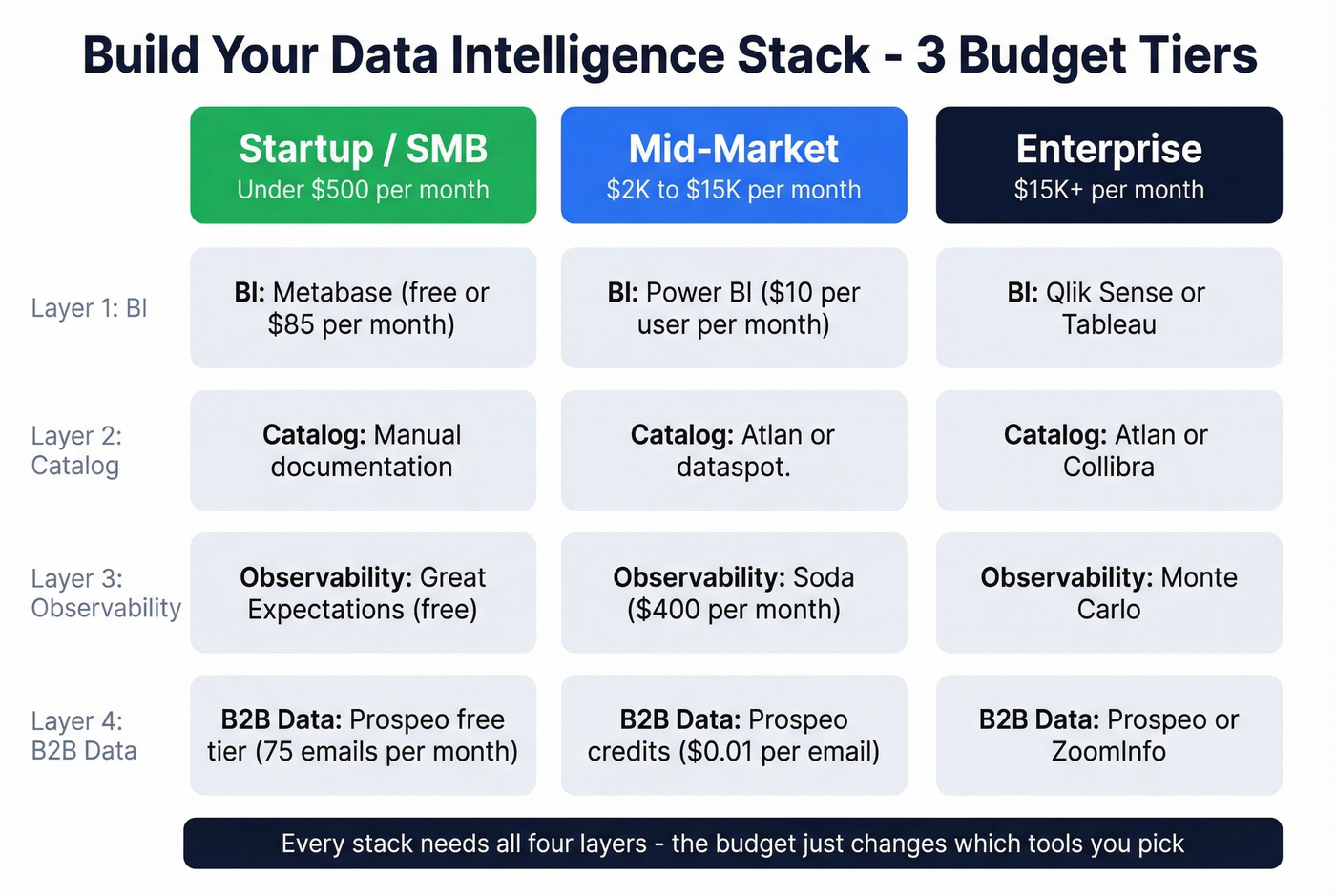
| Budget-Friendly Stack | Metabase + free B2B data tier | Enterprise-grade results, SMB budget |
Power BI wins on value if you're already in the Microsoft ecosystem. Qlik earns the nod when you need associative exploration that goes beyond predefined queries. For catalogs, Atlan is pushing the "catalog as an AI context layer" future, while dataspot. quietly posts the highest user satisfaction in the category. And if your sales team is bouncing emails while your BI dashboards look pristine, your stack has a hole that most articles pretend doesn't exist.
The 4 Pillars of Data Intelligence
Data intelligence isn't a product category - it's a stack. Gartner's data and analytics trends for 2026 highlight metadata management solutions and agentic analytics as the shifts that matter most, and both cut across multiple layers:
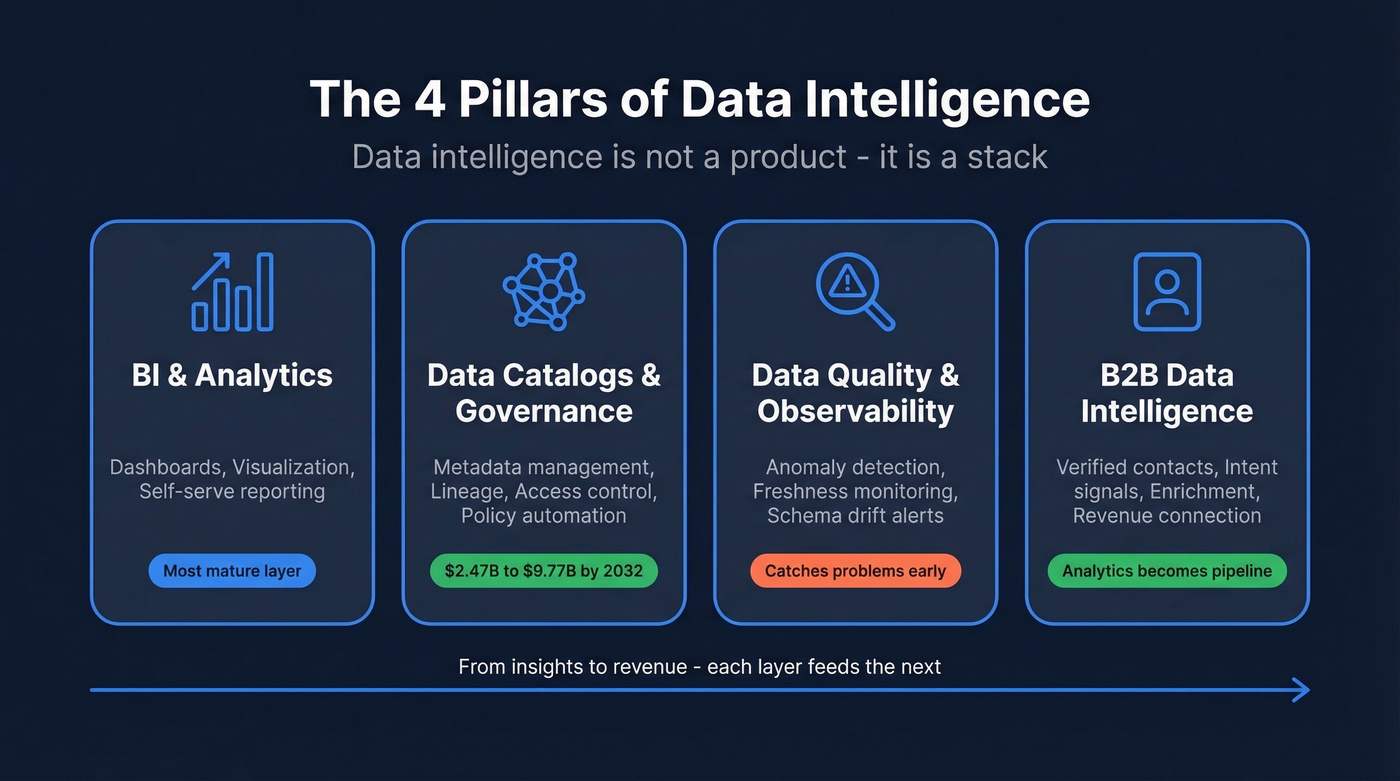
- BI & Analytics - Dashboards, visualization, self-serve reporting. The layer everyone thinks of first.
- Data Catalogs & Governance - Metadata management, lineage, access control, policy automation. This market alone is projected to grow from $2.47B to $9.77B by 2032.
- Data Quality & Observability - Anomaly detection, freshness monitoring, schema drift alerts. Where problems get caught before they corrupt your dashboards.
- B2B Data Intelligence - Verified contact data, intent signals, enrichment. Where analytics becomes pipeline and insights connect to actual revenue.
Best BI & Analytics Platforms
The BI layer is mature. A 20-year analysis of Gartner's Magic Quadrant history shows mega-vendor consolidation through acquisitions - Tableau to Salesforce, Looker to Google, Cognos to IBM - and no new entrants in the last two years. Your real decision is between incumbents, not some exciting upstart.
Microsoft Power BI
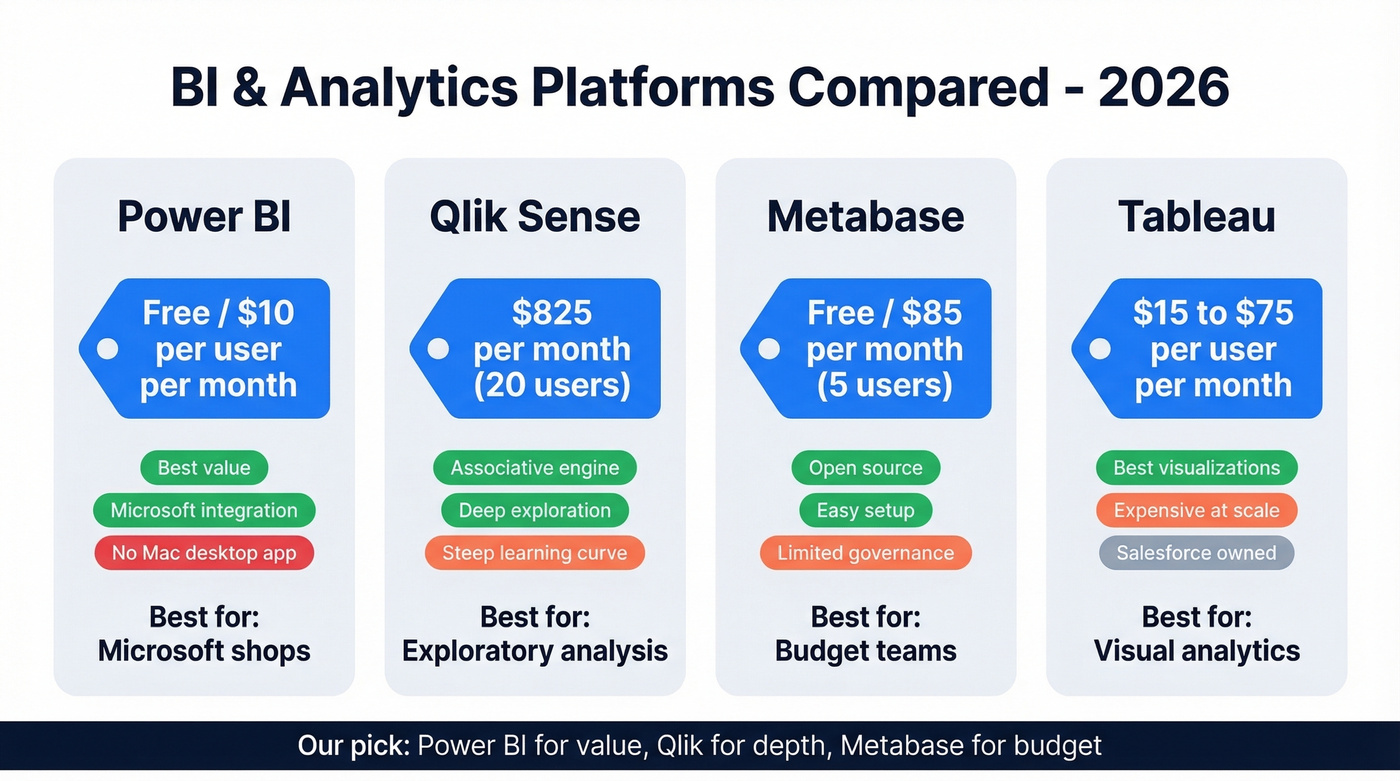
Use this if you're a Microsoft shop. Teams on Azure, SharePoint, or Office 365 get the smoothest experience, and the integration depth is hard to beat. Power BI Pro runs $10/user/month, and there's a genuinely useful free tier for individual analysts.
Skip this if your team runs Macs. Power BI Desktop doesn't have a native Mac app, and that friction adds up fast.
Qlik Sense
Qlik's associative engine is unlike anything else in the BI space. Instead of predefined queries and rigid data models, analysts click through relationships across datasets without writing joins - the engine highlights connected data and grays out unrelated records in real time. We've seen teams discover patterns in their data they'd never have found with a traditional dashboard approach.
The tradeoff is cost and complexity. Qlik Cloud Analytics Standard starts at $825/month for up to 20 users, and the learning curve is steeper than Power BI's. For teams that need exploratory depth and can invest in training, it's worth it. For straightforward dashboarding, it's overkill.
Metabase
Use this if you want real analytics without the enterprise price tag. Metabase is open-source, web-based, and runs on Mac, Windows, or Linux. Cloud hosting starts at $85/month for 5 users. It comes up constantly in Reddit threads alongside Apache Superset when teams want web-based BI without Tableau pricing.
Skip this if you need enterprise-grade governance or deep embedded analytics. Metabase is great for getting started; it's not where you land at 500 employees.
Tableau
Tableau remains the gold standard for visualization quality, but it's Salesforce-owned and priced accordingly. Viewer licenses run $15/user/month, and Creator licenses are $75/user/month. For new deployments, it's hard to justify the premium over Power BI unless your team already has deep Tableau expertise or you're building heavily customized visual analytics.
| Tool | Best For | Starting Price | Deployment | Key Limitation |
|---|---|---|---|---|
| Power BI | Microsoft shops | Free / $10/user/mo | Cloud + Desktop | No native Mac desktop app |
| Qlik Sense | Associative exploration | $825/mo (20 users) | Cloud | Steeper learning curve |
| Metabase | Budget teams | Free / $85/mo (5 users) | Self-hosted or cloud | Limited governance |
| Tableau | Visualization depth | $15-$75/user/mo | Cloud | Expensive at scale |
Best Catalog & Governance Platforms
This is where the real innovation is happening. While the BI layer consolidates, catalogs are evolving from static metadata indexes into AI-powered context layers that serve both humans and AI agents. Gartner predicts 60% of AI projects will miss value targets by 2027 due to fragmented governance structures - which makes this layer a high-leverage investment right now.
Atlan
Atlan is one of the clearest examples of the "data catalog for AI" direction. Its architecture bootstraps 80% of the context layer from SQL history, BI semantics, and pipeline code before human review even begins.
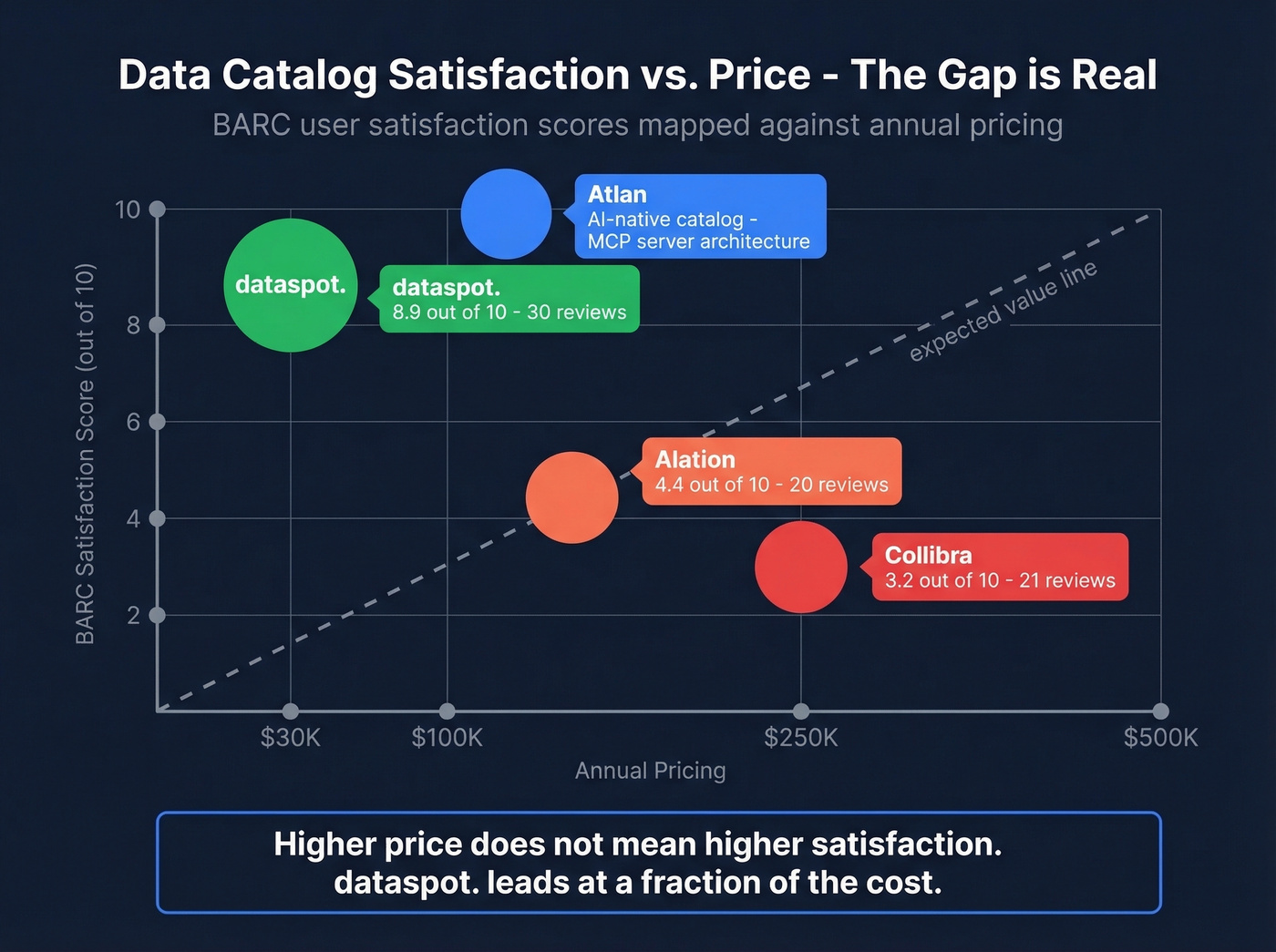
What sets Atlan apart is the MCP server concept: a machine-readable context layer that delivers governed metadata to AI agents at inference time. The platform also uses an Iceberg-based "metadata lakehouse" as a queryable context store. Pricing commonly lands in the $75K-$200K/year range for mid-market deployments. For teams building AI workflows that need governed data context, Atlan is the frontrunner.
dataspot.
Use this if you want the highest user satisfaction in the category. BARC rates dataspot. at 8.9/10 across 30 reviews - the highest score in the data intelligence platforms category. It's a mid-market solution with strong metadata management and governance workflows, typically falling in the $30K-$80K/year range, well below Collibra or Alation.
Skip this if you need deep enterprise policy automation or have complex multi-cloud environments requiring broader integration suites.
Collibra
Mature role-based access, deep enterprise governance features, and strong audit trails. But the BARC satisfaction score tells a different story: 3.2/10 across 21 reviews. Modular pricing plus professional services can push TCO to $100K-$500K+/year. Let's be honest - that satisfaction gap should give any buyer pause.
Informatica IDMC
Informatica's Intelligent Data Management Cloud covers hybrid and multi-cloud scanning, classification, and lineage. Broad but complex to deploy, with pricing often running $100K-$300K/year. Best suited for large enterprises already invested in the Informatica ecosystem.
Alation is a Leader in the 2026 Gartner Magic Quadrant for Data and Analytics Governance and strong on search-driven discovery, but its BARC satisfaction score of 4.4/10 across 20 reviews suggests implementation friction that analyst positioning doesn't capture. Expect $75K-$250K+/year. Other governance players worth evaluating include Ataccama ONE, Immuta, and erwin.
| Tool | BARC Score | Reviews | Pricing Range | Best For |
|---|---|---|---|---|
| dataspot. | 8.9/10 | 30 | $30K-$80K/yr | Highest satisfaction |
| Collibra | 3.2/10 | 21 | $100K-$500K+/yr | Enterprise policy |
| Alation | 4.4/10 | 20 | $75K-$250K+/yr | Gartner MQ Leader |
The gap between brand recognition and actual user satisfaction in governance tools is striking. The platforms that shift to outcome-based governance - measuring success by risk reduction and speed rather than documentation checklists - will close that gap first.

Your data intelligence stack has four layers - but most teams ignore the one that drives revenue. Prospeo fills the B2B data pillar with 300M+ profiles, 98% email accuracy, and a 7-day refresh cycle that's 6x faster than the industry average.
Close the gap between your dashboards and your pipeline.
Best Data Quality & Observability Tools
Data observability is the monitoring layer that catches pipeline failures, schema drift, and freshness issues before they corrupt your dashboards. Monte Carlo is the most mature platform here, commonly landing in the $50K-$150K/year range for mid-market deployments. It monitors data warehouses and lakes for anomalies, provides automated root-cause analysis, and integrates with major catalog platforms.
For teams that can't justify Monte Carlo's price tag, Great Expectations offers free, open-source data validation - you define expectations for your data, and it flags violations. Soda sits in a similar space with a more polished UI and SaaS pricing starting around $400/month.
When evaluating any of these, look at three lineage views: table-level (which tables feed which), column-level (field-by-field tracking), and business lineage (who owns what and why it matters). In our experience, teams that skip column-level lineage end up debugging data issues blind.
If you're formalizing checks beyond dashboards, start with data validation and treat it like production code.
Best B2B Data Intelligence Tools
Here's the thing: if your data intelligence stack handles dashboards and governance beautifully but you're seeing 30% email bounce rates, your stack has a hole in it. Deloitte's 2026 AI survey found 25% of organizations cite inadequate infrastructure and data as a barrier to AI ROI - and bad contact data is one of the most visible symptoms.
If your average deal size is under $15K, you probably don't need a $30K/year data platform. A credit-based tool with verified data will outperform an enterprise suite full of modules you never activate.
Prospeo
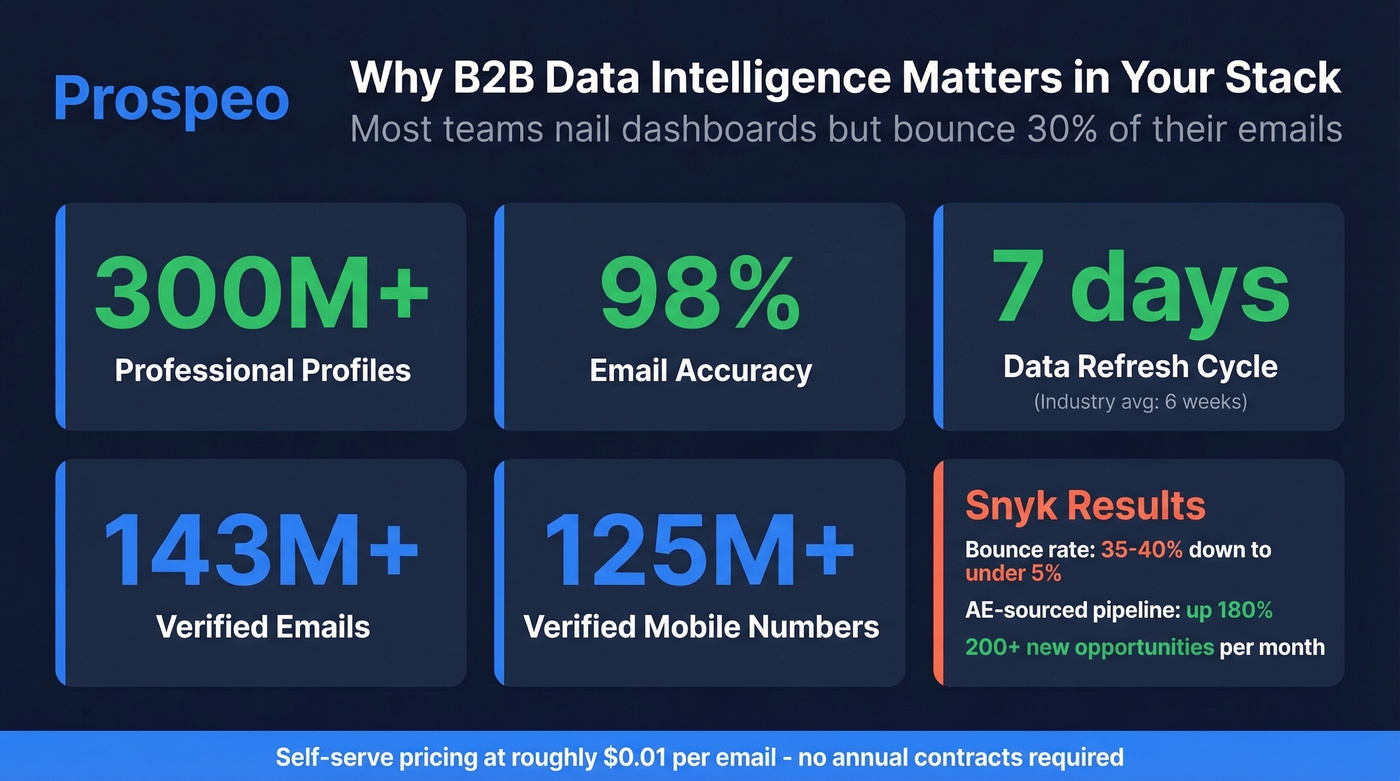
Prospeo is the strongest option for teams that care about data accuracy over feature bloat. The numbers: 300M+ professional profiles, 143M+ verified emails, and 125M+ verified mobile numbers, all refreshed on a 7-day cycle. The industry average is 6 weeks, which means most databases serve stale contacts by default. Email accuracy runs at 98%.
Snyk deployed Prospeo across 50 AEs and watched bounce rates drop from 35-40% to under 5%, with AE-sourced pipeline up 180% and 200+ new opportunities per month. The search interface offers 30+ filters including buyer intent powered by 15,000 Bombora topics, technographics, and job change signals. Pricing is self-serve and credit-based at roughly $0.01 per email, with a free tier offering 75 emails and 100 Chrome extension credits per month. No annual contracts required.

ZoomInfo
Use this if you're an enterprise team that needs a broad US database plus intent data, chat, and workflow features in one platform. Expect $15K-$40K/year depending on seats and modules.
Skip this if you're a Series A company or you're tired of paying for modules you never activate. The consensus on r/sales is that ZoomInfo's bundling means you're paying for features your team doesn't touch. No free tier.
Apollo
Apollo is the obvious starting point for startups on tight budgets. The free tier is generous, paid plans start at $49/user/month, and the built-in sequencing tools mean you don't need a separate outreach platform immediately. The tradeoff is data quality - email accuracy runs at 79%, which means roughly one in five emails bounces. For teams doing high-volume outbound, that adds up to real domain reputation damage.
Cognism
Cognism is the pick for teams selling into EMEA. GDPR compliance is baked in, not bolted on, and their European mobile number coverage is stronger than US-centric competitors. Pricing typically runs $1,000-$3,000/month for small teams.
| Tool | Verified Emails | Email Accuracy | Data Refresh | Starting Price | Free Tier |
|---|---|---|---|---|---|
| Prospeo | 143M+ | 98% | 7 days | ~$0.01/email | Yes (75/mo) |
| ZoomInfo | Not public | 87% | 4-6 weeks | ~$15K-$40K/yr | No |
| Apollo | 275M+ | 79% | ~Monthly | $49/user/mo | Yes |
| Cognism | Not public | Not public | ~Monthly | ~$1K-$3K/mo | No |
If you're comparing providers primarily on accuracy, see our full breakdown of the best B2B databases.
You're spending $75K+ on catalogs and governance to keep data clean. Meanwhile, your sales team is bouncing 35% of emails from a provider that refreshes every six weeks. Prospeo delivers verified contacts at $0.01/email with 98% accuracy - no contracts, no sales calls.
Stop letting bad contact data undermine your entire intelligence stack.
2026 Trends Reshaping the Category
Three shifts are defining where data intelligence goes next.
AI-powered catalogs are becoming active metadata platforms. Static data dictionaries are dead. The new generation auto-classifies assets, infers lineage from code, runs semantic search, and automates policy enforcement. Gartner's trends call out metadata management solutions and agentic analytics as top priorities, and the "catalog as context layer for AI agents" concept is moving from whitepaper to production.
The gap between AI spending and AI value is enormous. 91% of organizations plan to increase AI spend, but many teams still struggle to turn that investment into outcomes. The bottleneck isn't models or compute - it's data foundations. Governance, lineage, and quality monitoring are prerequisites, not nice-to-haves. Practitioners on Reddit are even more measured - one BI lead noted AI hasn't matched the output of experienced analysts in day-to-day analytics work. AI-driven workflows are only as good as the data feeding them, which is why B2B data accuracy and freshness matter more than ever.
Innovation has shifted from BI to the middle and bottom of the stack. The BI layer is consolidated and mature. The real action is in catalogs, governance, observability, and B2B platforms - where refresh cycles, verification methods, and metadata automation are the battlegrounds that separate good stacks from broken ones.
How to Choose the Right Stack
You don't need 15 tools. You need 3-4 chosen deliberately.
For teams under 50 people: Metabase for analytics plus a free-tier B2B data tool for contact verification. You can build a functional stack for under $200/month. Add Great Expectations if you're running data pipelines that need validation.
Mid-market teams (50-500): Power BI for analytics, Atlan for catalog and governance, and a credit-based B2B data platform. Your stack should cover dashboards, metadata management, and verified contact data without enterprise pricing. Budget roughly $100K-$150K/year all-in.
Enterprise (500+): Qlik for deep analytics, Collibra or Atlan for governance, Monte Carlo for observability, and an enterprise B2B data platform. Base platform fees are just the start - factor in customization, implementation services, and ongoing support. Enterprise stacks run $300K-$1M+/year across all layers.
The biggest mistake we see? Teams buying a $200K governance platform before they've defined what "governed" means for their organization. Start with the use case, not the vendor demo.
If you're trying to keep the stack lean, map it to your RevOps tech stack and cut anything that doesn't move pipeline.
FAQ
What's the difference between data intelligence and business intelligence?
Business intelligence is one layer - dashboards and visualization. Data intelligence spans the full stack: catalogs, governance, data quality, lineage, and B2B data platforms that make analytics trustworthy and actionable.
How much do data intelligence tools cost?
BI platforms range from free to $75/user/month. Data catalogs run $30K-$500K+/year depending on scale. B2B data solutions range from free tiers to $40K+/year for enterprise platforms. A mid-market stack typically costs $100K-$200K/year across all layers.
What tools do I need before deploying AI?
At minimum: a data catalog for metadata and lineage, a quality monitoring tool, and governance policies. Without these foundations, Gartner predicts 60% of AI projects will miss value targets by 2027.
Are there free options worth using?
Yes. Metabase and Apache Superset are free open-source BI platforms. Great Expectations handles data validation at no cost. Prospeo's free tier includes 75 verified emails and 100 Chrome extension credits monthly - enough for small teams running real outbound campaigns.