

Database Enrichment: What It Is, How It Works, and Which Tools Are Worth Your Money
Your CRM data decays roughly 22.5% per year. That's a quarter of your database going stale every twelve months - and with every team now layering AI models and automated sequences on top of CRM records, the gap between teams that enrich well and teams that don't is widening fast. Database enrichment isn't a growth hack. It's infrastructure maintenance.
What You Need (Quick Version)
- Apollo: Bundled enrichment plus sequencing from $49/user/month. Best all-in-one for SMBs.
- Cognism: European phone data with human verification. Best for EMEA-heavy pipelines.
You can build a working enrichment stack for under $200/month. You don't need a $40K ZoomInfo contract to get clean data.
What Is Database Enrichment?
Database enrichment is the process of appending new, verified data points to existing records in your CRM or data warehouse. It's distinct from data cleansing - removing duplicates, fixing formatting, deleting invalid records - and from data enhancement, which improves existing fields like correcting a misspelled name or standardizing a phone format. Enrichment specifically means appending new fields from external sources.
Firmographic, demographic, technographic, behavioral, geographic, and intent data all fall under the enrichment umbrella. The goal is to make your data model smarter, more connected, and more trustworthy for every downstream system that touches it.
The "database" part matters too. Real enrichment operates at the schema and relational level - linking contacts to accounts, normalizing company hierarchies, resolving entities across systems. It's not just appending a phone number to a spreadsheet row.
Why Enrichment Is Non-Negotiable in 2026
It's Monday morning. Someone in RevOps drops a Slack message: "Why did 23% of last week's outbound sequence bounce?" You check the CRM. Half the contacts were enriched eight months ago. The VP of Engineering left that company in March. The CFO's email domain changed after an acquisition in June. Your "enriched" database is fiction - and your reps are sending sequences into the void.
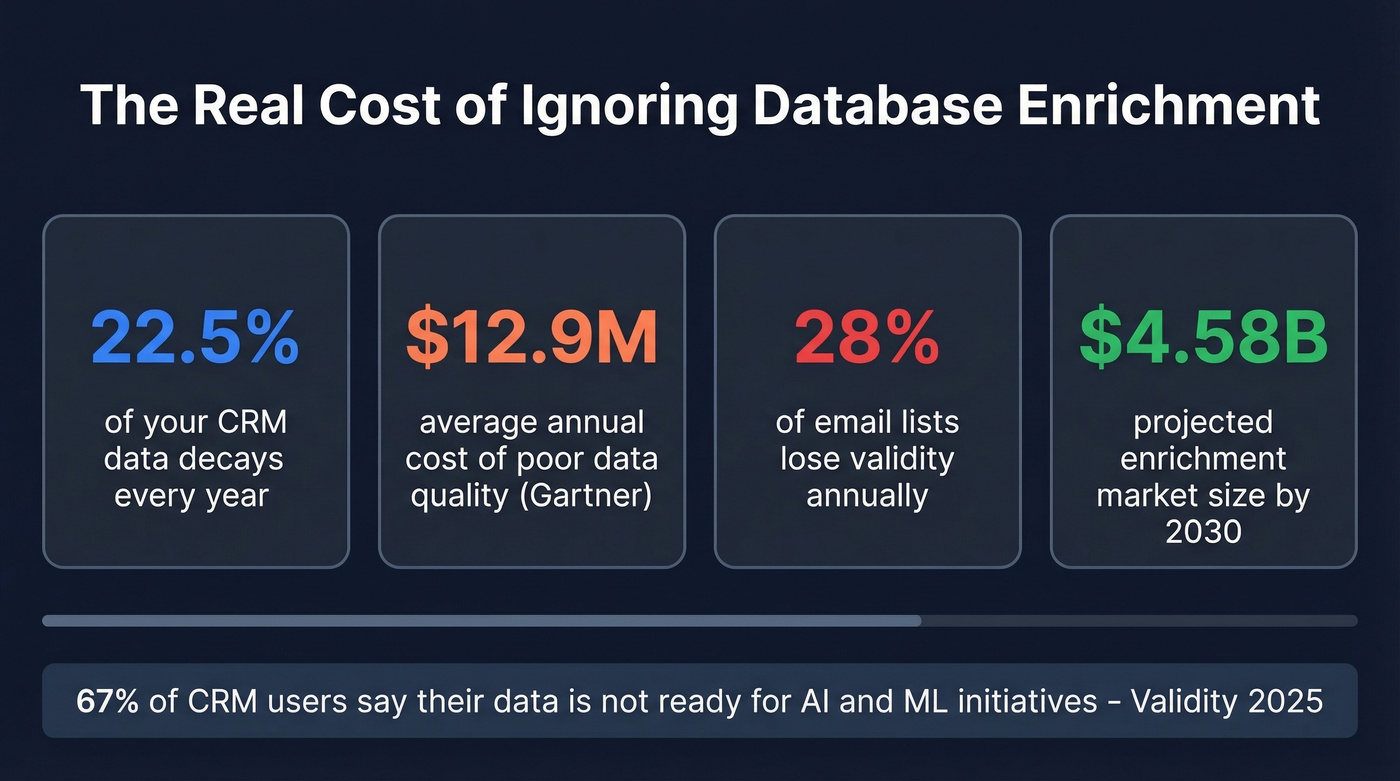
B2B data decays at roughly 2.1% per month. Email lists lose about 28% of their validity annually. The data enrichment market hit $2.37B in 2023 and is projected to reach $4.58B by 2030 at a 10.1% CAGR - because every company is waking up to this problem at the same time.
The financial impact is brutal. Gartner estimates poor data quality costs organizations $12.9 million per year. Experian found that 85% of businesses say poor data harms efficiency. That's not just bounced emails - it's misrouted leads, wasted ad spend, broken automations, and forecasts built on fiction.
The stakes got higher this year. With every team rushing to layer AI on top of their CRM - predictive lead scoring, automated sequencing, AI-generated personalization - data quality is the foundation everything else sits on. Validity found that 67% of CRM users are concerned their data isn't ready for AI and ML initiatives, and 21% cite bad data as a major barrier to automation and personalization.
Your forecasting model is only as good as the records feeding it. A 10-rep team spending 5 hours per week on manual data research burns 2,600 hours a year - roughly $130K in loaded salary cost. Automated enrichment cuts that to near zero.
Here's the thing most people miss: coverage isn't the bottleneck anymore. Freshness is. A provider with 500M stale records is less useful than one with 300M records refreshed every 7 days. We've seen this firsthand - teams that switch from a "big database" provider to a fresher one see bounce rates drop by double digits within weeks.
How the Enrichment Process Works
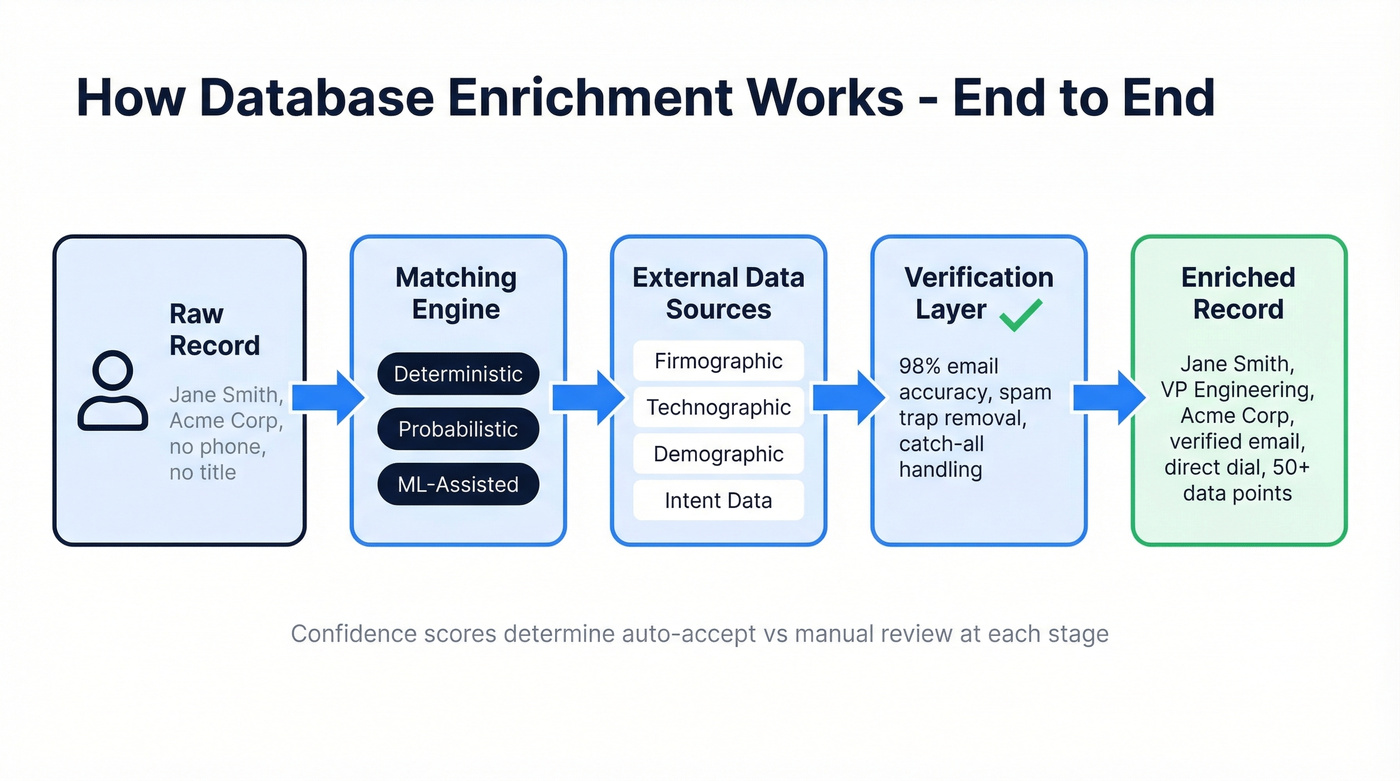
Under the hood, enrichment is a matching problem. You have a record - Jane Smith at Acme Corp - and you need to find the right Jane Smith across external data sources, then merge the new data back without creating duplicates or overwriting good information with bad.
Matching Techniques
Matching approaches range from simple to sophisticated. Exact matching uses strict field equality: fast but brittle, since "Jane Smith" won't match "J. Smith." Deterministic matching applies predefined rules like "match on email OR first name + last name + company domain" - transparent and auditable, but maintenance-heavy.
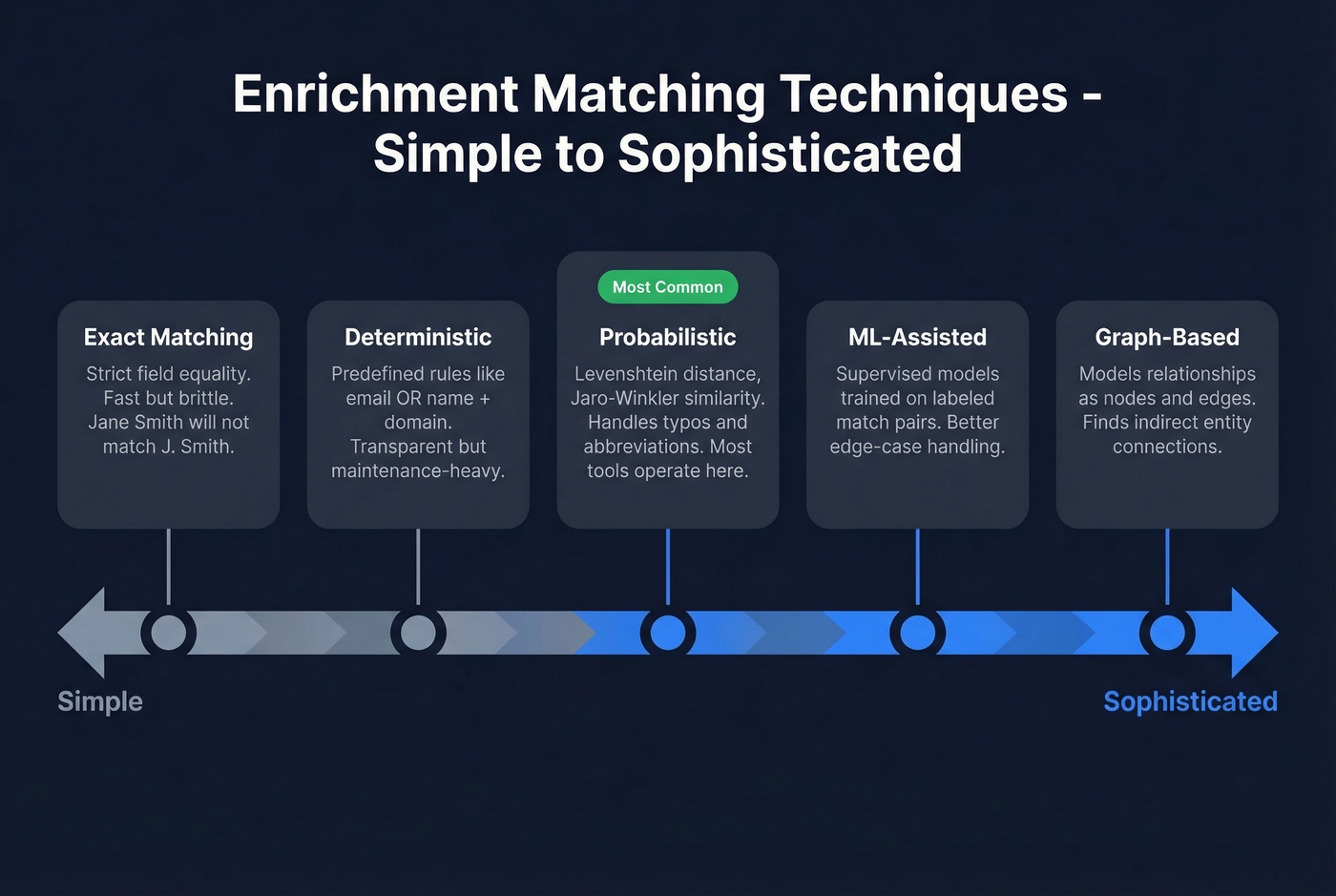
Probabilistic matching uses algorithms like Levenshtein distance and Jaro-Winkler similarity to handle typos, abbreviations, and name variants. This is where most modern enrichment tools operate. Beyond that, ML-assisted matching trains supervised models on labeled match/non-match pairs for better edge-case handling, and graph-based matching models relationships as nodes and edges to find indirect connections between entities.
API Mechanics
Most enrichment tools expose REST APIs. You send a lookup key - an email address, a name-plus-domain pair, or a professional profile URL - and receive a structured JSON response with the enriched data. Good APIs return confidence scores per field so you can set thresholds for auto-acceptance versus manual review.
Real-Time vs Batch
| Real-Time | Batch | |
|---|---|---|
| Volume | 1-100 contacts/call | 1,000-100,000+ |
| Latency | 1-3 seconds | Minutes to hours |
| Use case | Form fills, CRM triggers | Database cleanup, campaigns |
| Cost | Higher per credit | More economical at scale |
For async batch processing, most providers support webhook architecture - they POST results to your endpoint when the job completes, so you're not polling an API in a loop.

The article says it: freshness beats coverage. Prospeo refreshes 300M+ profiles every 7 days - not every 6 weeks. Our enrichment API returns 50+ data points per contact at a 92% match rate, with 98% email accuracy built on proprietary verification infrastructure.
Stop enriching your CRM with data that's already decaying.
Waterfall Enrichment: Why One Source Isn't Enough
Single-source enrichment structurally caps your email accuracy at roughly 80-85%. On a 10,000-contact outbound campaign, that means 1,500-2,000 contacts with missing or incorrect data. That's not a rounding error. It's a pipeline gap.
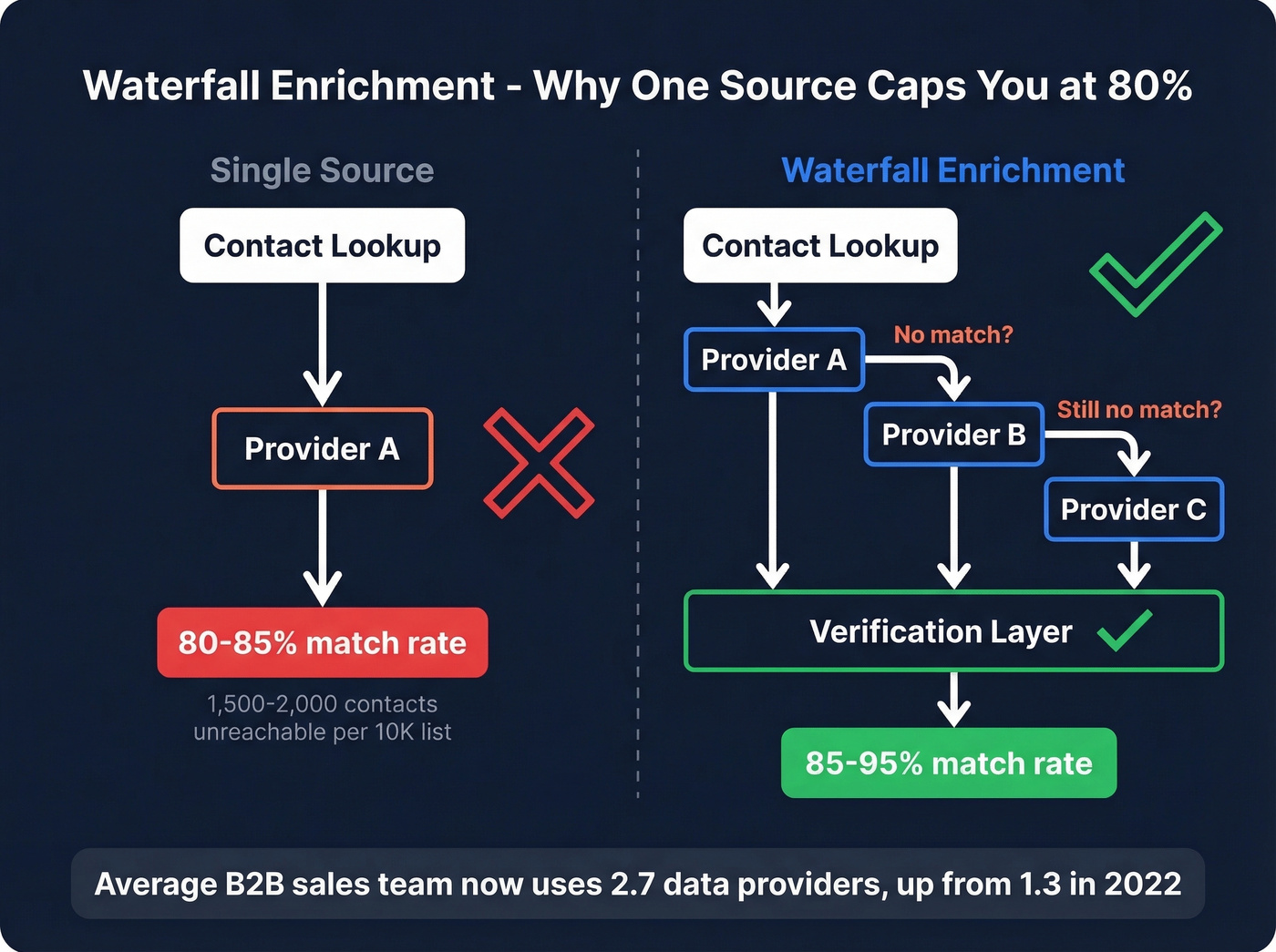
Relying on one provider typically leaves 40-60% of qualified prospects unreachable. The average B2B sales team now uses 2.7 data providers simultaneously, up from 1.3 in 2022.
Waterfall enrichment solves this by querying multiple providers sequentially until a verified contact is found. Provider A doesn't have a valid email? The system automatically tries Provider B, then C. Practitioners in the HubSpot community report hitting 85%+ match rates with multi-source approaches - a meaningful jump from single-source ceilings.
The consensus on r/revops is telling: even teams paying $15K-40K/year for ZoomInfo report disappointment with enrichment results, especially for enterprise accounts and European coverage. On r/SaaS, practitioners describe most enrichment databases as "static by design," arguing that freshness matters more than raw record count.
The verification layer is what separates useful waterfall enrichment from just stacking bad data from multiple sources. Without it, you're appending more garbage faster. With it, you're building a database you can actually trust.
Best Tools for Database Enrichment in 2026
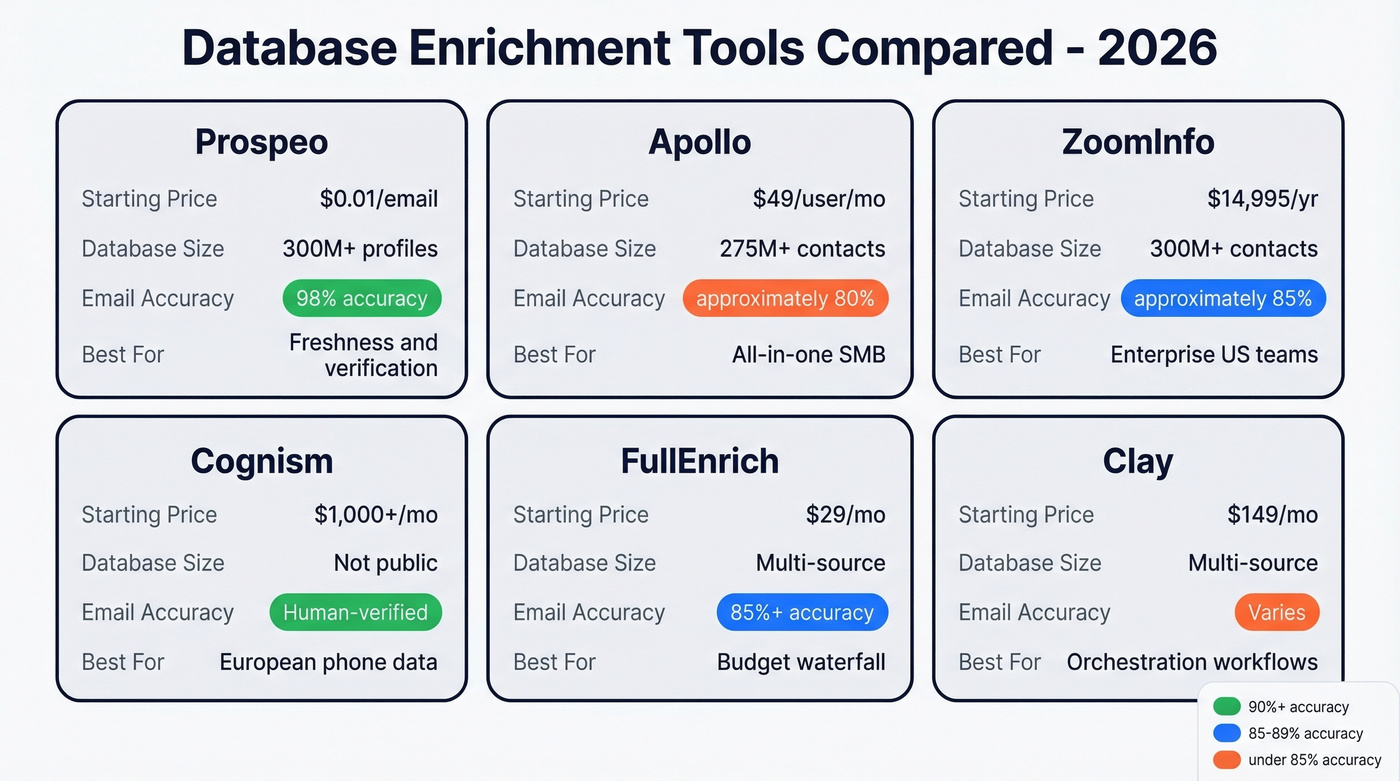
| Tool | Starting Price | Database Size | Email Accuracy | Best For |
|---|---|---|---|---|
| Apollo | $49/user/mo | 275M+ contacts | ~80% | Enrichment + sequencing |
| ZoomInfo | ~$14,995/yr | 300M+ contacts | ~85% | Enterprise US teams |
| Cognism | ~$1,000+/mo | Not public | Human-verified | European phone data |
| Clearbit/Breeze | $30-$700/mo | 250M+ profiles | ~85% | HubSpot-native enrichment |
| FullEnrich | From $29/mo | Multi-source | 85%+ | Budget waterfall |
| Lusha | ~$22/user/mo | Not public | Not public | Quick contact lookups |
| Kaspr | $49/user/mo | 120M+ European | Not public | European prospecting |
| Enricher.io | $279/mo (10K credits) | Not public | Not public | High-volume API |
| Clay | ~$149/mo | Multi-source | Varies | Orchestration workflows |
Prospeo
This is where we'd start. The platform covers 300M+ professional profiles, 143M+ verified emails, and 125M+ verified mobile numbers, all refreshed on a 7-day cycle. The industry average for data refresh is six weeks. That gap alone makes the difference between reaching someone and bouncing.
The 98% email accuracy comes from a 5-step proprietary verification process that includes catch-all handling, spam-trap removal, and honeypot filtering - built on proprietary infrastructure, not third-party email providers. The API match rate runs 92%, enrichment returns 50+ data points per contact, and 83% of leads come back with contact data.
Beyond raw enrichment, Prospeo layers in intent data tracking 15,000 topics via Bombora, 30+ search filters, and native integrations with Salesforce, HubSpot, Smartlead, Instantly, Lemlist, Clay, Zapier, and Make. Pricing starts at roughly $0.01 per email with a free tier offering 75 emails per month. No contracts, no sales calls required. One of our customers, Snyk, dropped their bounce rate from 35-40% to under 5% and saw AE-sourced pipeline jump 180% after switching their enrichment workflow.
Apollo
Apollo is the obvious starting point if you want enrichment and outbound sequencing in one platform. The database covers 275M+ contacts, and the built-in sequencer means you can find a contact, enrich it, and drop it into a multi-step email sequence without leaving the tool. For SMB teams that don't want to manage five different subscriptions, that's genuinely valuable.
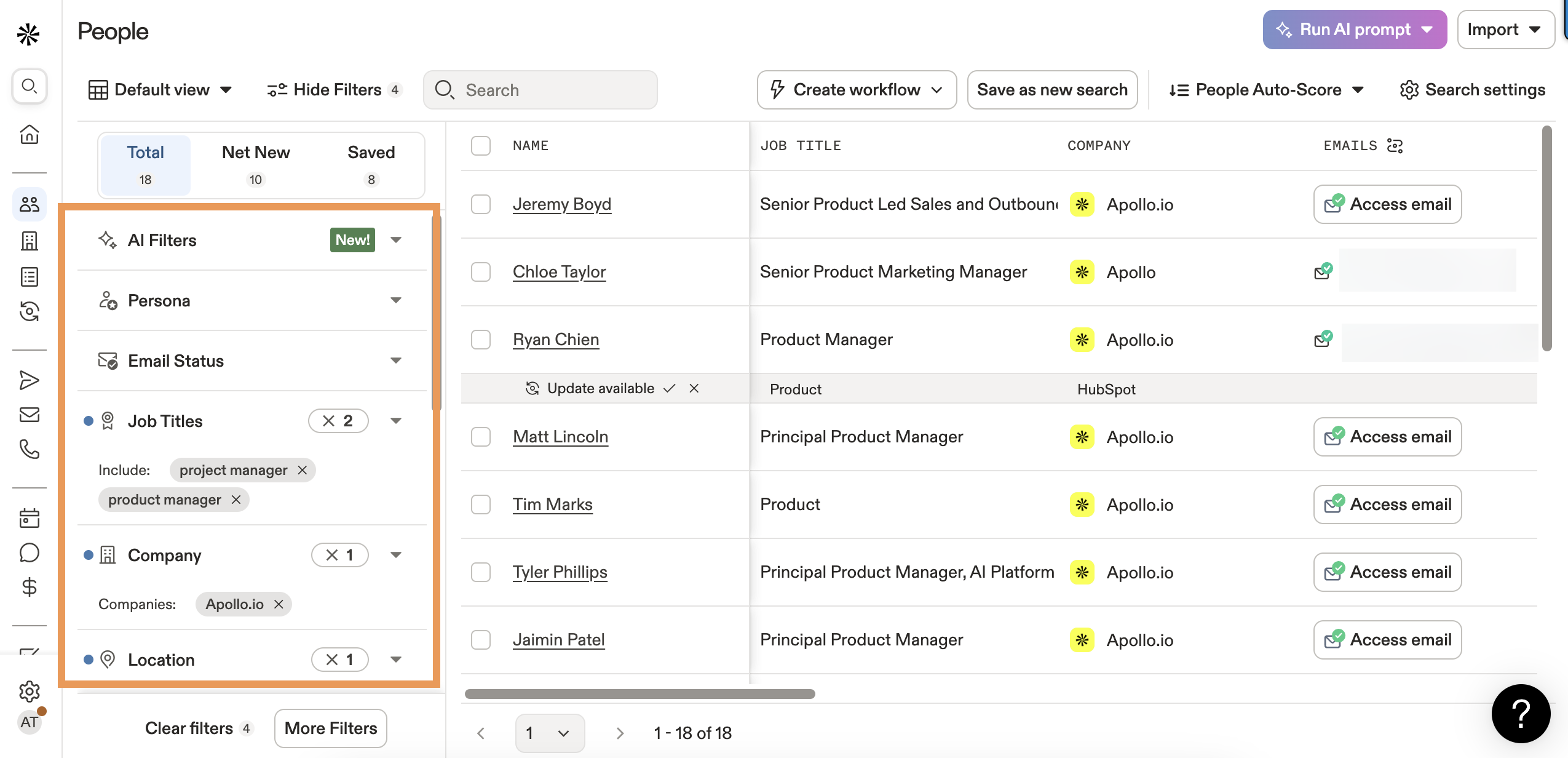
The trade-off is accuracy. Practitioners consistently report 70-80% email hit rates - solid, but noticeably below verification-first tools. Pricing runs $49/user/month (Basic), $79 (Professional), and $119 (Organization), all billed annually. A free tier is available and surprisingly generous for individual prospectors. Worth noting: Apollo experienced data breaches in 2018 and 2021, so evaluate their security posture if that matters to your compliance team.
ZoomInfo
ZoomInfo is the incumbent, and for US-focused enterprise sales teams, it's still the deepest database available. 300M+ contacts, strong firmographic coverage, and a platform spanning intent data, chat, workflow automation, and more.
The problem: most teams don't use most of it. A 5-seat Professional contract starts at ~$14,995/year. Advanced runs ~$24,995. Elite hits ~$39,995. Annual contracts only, and add-ons push the real cost higher.
EMEA and APAC coverage is the other weak spot. Reviewers consistently say it's hard to find European phone numbers, and regional coverage gaps in APAC are well-documented. If you're selling into the UK or Germany, ZoomInfo alone won't cut it.
Cognism
Use this if you're selling into Europe and need verified phone numbers. Cognism's human-verified mobile data is genuinely differentiated - they have people manually checking numbers, which is why connect rates on their "Diamond Data" tend to be higher than competitors. GDPR compliance is baked in, not bolted on.
Skip this if you're US-only and budget-conscious. Pricing runs ~$1,000-$3,000/month for small teams, with full platform access at $15K+/year.
Clearbit / Breeze Intelligence
Breeze Intelligence (Clearbit in HubSpot's ecosystem) covers 250M+ decision-makers with over 100 verified attributes per record. If you're already deep in HubSpot, enrichment happens inside your existing workflows without a separate tool. Credit packs range from $30/month for 100 credits to $700/month for 10,000 credits. Accuracy sits around 85% - solid for firmographic and technographic data, less impressive for direct dials.
FullEnrich
FullEnrich runs waterfall enrichment across 20+ sources, and practitioners in the HubSpot community report 85%+ match rates with triple-verified emails. Starting at $29/month with credits that roll over, the price-to-coverage ratio is hard to beat for smaller teams.
Quick Lookups and Niche Picks
Lusha handles quick contact lookups at ~$22/user/month (Pro) or ~$52 (Premium), with a free tier available. Best for individual reps who need a phone number fast, not for systematic enrichment. Kaspr runs $49/user/month with 120M+ European contacts and GDPR/CCPA alignment - a solid pick for European prospecting teams that don't need Cognism's premium pricing. Enricher.io is API-first enrichment at $279/month for 10,000 credits, built for developers plugging enrichment into custom pipelines.
Clay
Clay is an orchestration layer that chains multiple enrichment sources together, starting at ~$149/month. The concept is powerful - build custom enrichment workflows with AI agents. But the cost skepticism from practitioners is real. Reddit threads flag that Clay might deliver "just 2% more emails" than cheaper alternatives for significantly more money. Worth evaluating if you have complex, multi-step enrichment logic; overkill for straightforward CRM enrichment.
Build Your Enrichment Pipeline
A working enrichment pipeline follows six stages. Let's break them down.
1. Ingestion. Pull records from your CRM, marketing automation platform, or inbound forms. Set up triggers for new leads, deal stage changes, or target account additions.
2. Cleaning and preprocessing. Strip formatting inconsistencies, remove obvious duplicates, standardize fields. Normalize phone numbers to E.164 format and parse company names.
3. Standardization. Decompose compound fields - full name into first and last - normalize addresses via APIs, and ensure consistent formatting across your dataset.
4. Matching. Query your enrichment providers using compound keys: email plus name plus company domain, not just email alone. Use a status field to make workflows idempotent and resumable.
5. Resolution decision. Auto-accept high-confidence matches. Flag low-confidence matches for manual review. Log every match decision for auditability.
6. Output and integration. Push enriched records back to your CRM. Version your rules. Monitor match rates and false positives over time.
Process in batches of ~500 records with rate-limit waits between calls. For orchestration, tools like Zapier, Make, n8n, or Clay connect the pieces without custom code. Expect 1-3 days for basic CRM-trigger enrichment, and 2-6 weeks for a governed multi-source pipeline with monitoring.
Mistakes That Create Frankenrecords
A Frankenrecord is what happens when bad enrichment stitches together data from the wrong sources - Jane Smith's email, John Doe's phone number, and a company that was acquired two years ago. We've debugged enough of these to know the patterns.
Ambiguous matches. Matching on email alone isn't enough. Use compound keys: email + name + country, or website + name + country. Single-field matching is how you get Frankenrecords.
Trusting outdated sources. Don't re-enrich every record on a fixed schedule. Prioritize high-value records - active pipeline, hand-raisers, target accounts. Low-priority records can wait.
No conflict resolution. When Provider A says "VP Sales" and Provider B says "Director of Revenue," which wins? Store source and timestamp per field. First-party data - what the prospect entered themselves - always takes precedence.
Company aliasing. "Alphabet Inc." and "Google" and "Google LLC" are the same company. Maintain a canonical "Legal Company Name" field and map aliases to it.
Skipping verification. Look - enrichment without verification just adds garbage faster. Keep bounce rates below 3-5% to protect your domain reputation. If you're appending emails without verifying them, you're building a liability, not an asset. (If you need a deliverability-first checklist, start with inbox placement and domain reputation.)
Single-source dependency. One provider caps you at 80-85% accuracy. The ceiling is structural, not a quality issue with any individual tool. Use waterfall enrichment or accept the gap.
Waterfall enrichment works - but what if your first source handled most of the heavy lifting? Prospeo's enrichment returns verified contact data for 83% of leads at $0.01 per email. That's 90% cheaper than ZoomInfo with higher accuracy and a 7-day refresh cycle.
Make Prospeo the first stop in your enrichment waterfall.
FAQ
What's the difference between data enrichment and data cleansing?
Data cleansing removes duplicates, fixes formatting errors, and deletes invalid records - it's subtractive. Enrichment adds new data points like firmographics, technographics, and verified contact info to existing records. Cleanse first to establish a clean baseline, then enrich to fill gaps.
How often should I re-enrich my CRM?
B2B data decays roughly 2.1% per month, so quarterly enrichment is the minimum. High-value accounts and active pipeline contacts should be refreshed monthly or in real time via API triggers on deal-stage changes. Waiting a full year means ~22.5% of records are stale.
What is waterfall enrichment?
Waterfall enrichment queries multiple data providers sequentially until a verified contact is found. Instead of relying on one source - which caps accuracy at roughly 80-85% - you chain two to four providers and reach 85-95%+ match rates. Prospeo, FullEnrich, and Clay all support this approach natively.
How much do enrichment tools cost?
It ranges widely. Prospeo starts at ~$0.01 per email with a free tier. Apollo runs $49-$119/user/month. ZoomInfo starts at ~$14,995/year. Most mid-market teams spend $100-$500/month. The metric that matters is cost per verified contact, not sticker price.
Can I enrich data without violating GDPR?
Yes - use GDPR-compliant providers that source data lawfully, honor opt-out requests, and provide Data Processing Agreements. Minimize PII collection, store only what's necessary, and confirm your vendor has documented compliance processes. Cognism and Kaspr both offer GDPR-aligned enrichment, as does Prospeo.