


Deal Intelligence Review 2026: Pricing, Pros, Cons, and Honest Verdict
Your VP just forwarded a Deal Intelligence demo invite with a note that says "thoughts?" You pull up Google looking for real pricing, user reviews, and an honest breakdown of pros and cons - and there's almost nothing. Five reviews. Zero Reddit threads. No teardown from anyone who's actually used it at scale. For a tool that starts at $16K/year, that's a problem.
Let's fix it.
30-Second Verdict
Deal Intelligence is a niche competitive intelligence tool that surfaces relationship-based intent signals for $16K-$49K/year. It's best fit for mid-market teams that want narrow, high-fidelity competitive alerts - not a broad intent firehose. The 5.0/5 rating comes from just five reviews, at least one incentivized, so treat that as "not enough data" rather than "perfect product." The biggest gaps: limited contact details and no API, so you'll still need a separate contact data provider if you run outbound.
What Is Deal Intelligence?
Deal Intelligence positions itself as an AI competitive intelligence platform for B2B revenue teams. The core pitch: most GTM teams learn about competitive threats too late, usually after a competitor's name surfaces on a sales call.
Here's the thing - 94% of B2B buying groups rank their preferred vendors before ever talking to sales, consuming an average of 13 content pieces along the way. The window for competitive intervention is shrinking fast, and Deal Intelligence tries to widen it.
Instead of tracking website visits or keyword searches like traditional intent providers, it monitors professional communities and social networks for verified interactions between your accounts and competitors. Think relationship-based intelligence: actual conversations and new connections, not anonymous page views. The output is a handful of actionable alerts delivered into Salesforce and Slack. Whether the signal quality justifies the price depends entirely on your deal volume and competitive landscape.
Pricing Breakdown
Deal Intelligence runs three annual tiers:
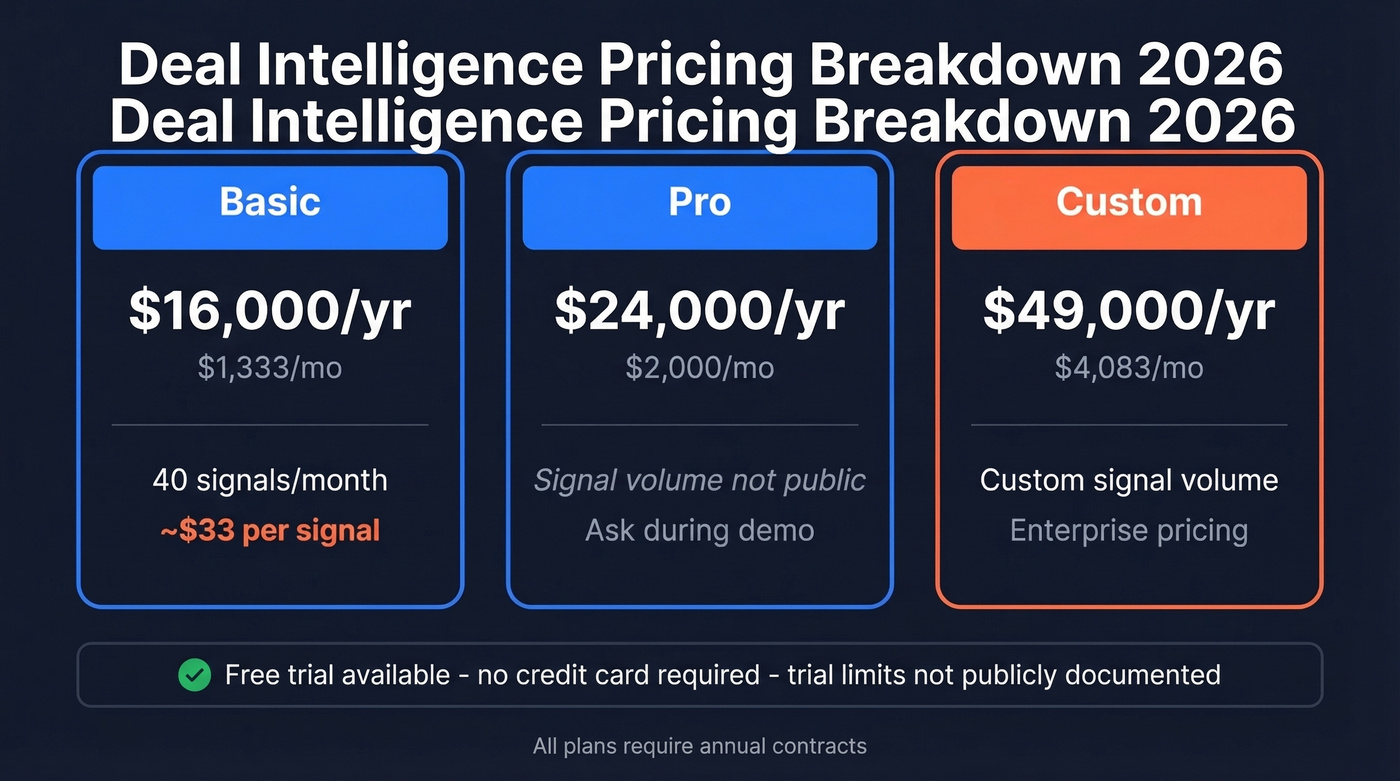
| Plan | Annual Cost | Signals/Month | Cost per Signal |
|---|---|---|---|
| Basic | $16,000 | 40 | ~$33 |
| Pro | $24,000 | Not public | - |
| Custom | $49,000 | Custom | - |
Forty signals per month at $16K/year works out to roughly $1,333/month, or about $33 per competitive signal. That's not cheap. But if even one signal saves a six-figure deal from slipping to a competitor, the math pencils out fast.
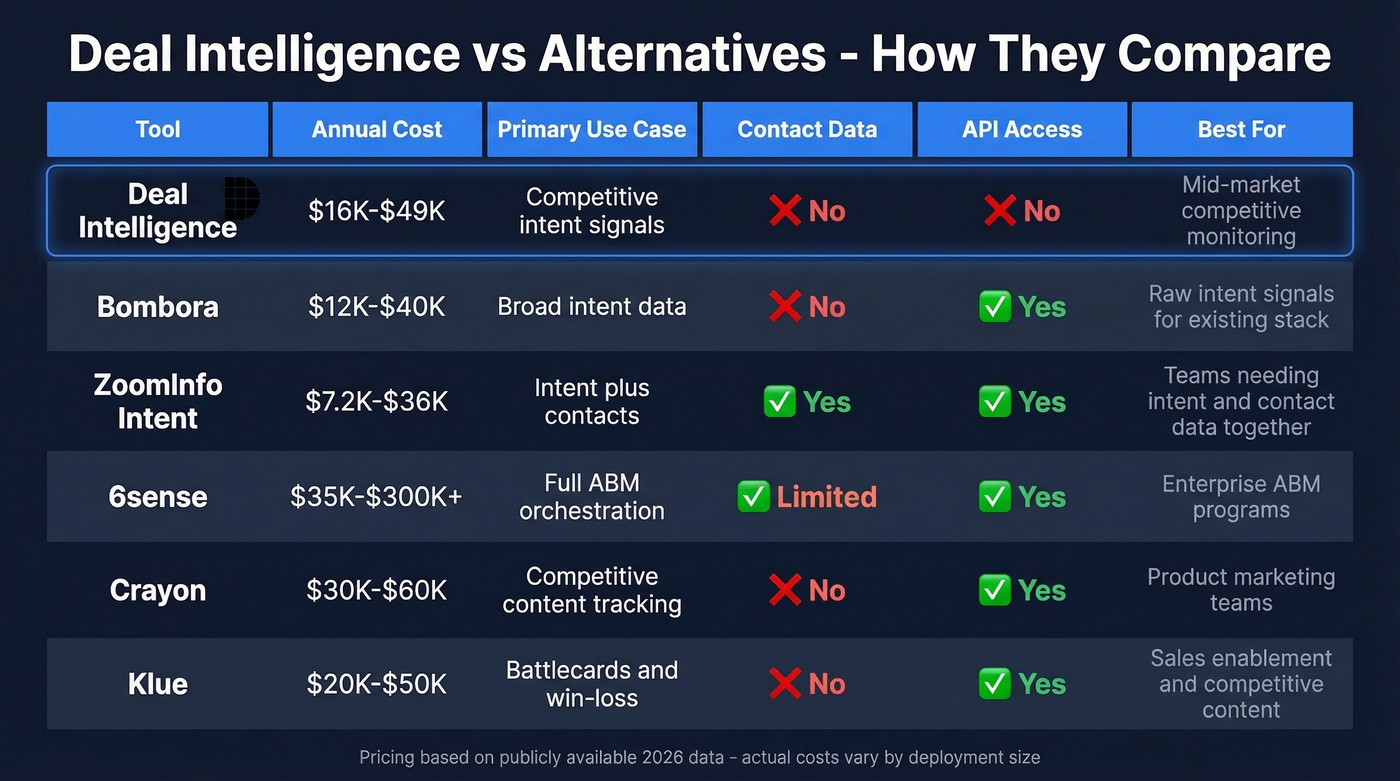
For context, here's how it stacks up against other intent data providers:
| Provider | Annual Cost Range |
|---|---|
| Deal Intelligence | $16,000-$49,000 |
| Bombora | $12,000-$40,000 |
| ZoomInfo Streaming Intent | $7,200-$36,000 |
| 6sense | $35,000-$300,000+ |
Deal Intelligence lands squarely in mid-market territory - cheaper than 6sense, more expensive than entry-level Bombora or ZoomInfo intent add-ons. The B2B intent data market is projected at $4.49B in 2026 and expected to reach $20.89B by 2035, so pricing pressure across the category will only increase.
Expect an annual contract. There's a free trial with no credit card required, though trial duration and feature limits aren't publicly documented - clarify during your demo.
Pros and Cons
Pros:
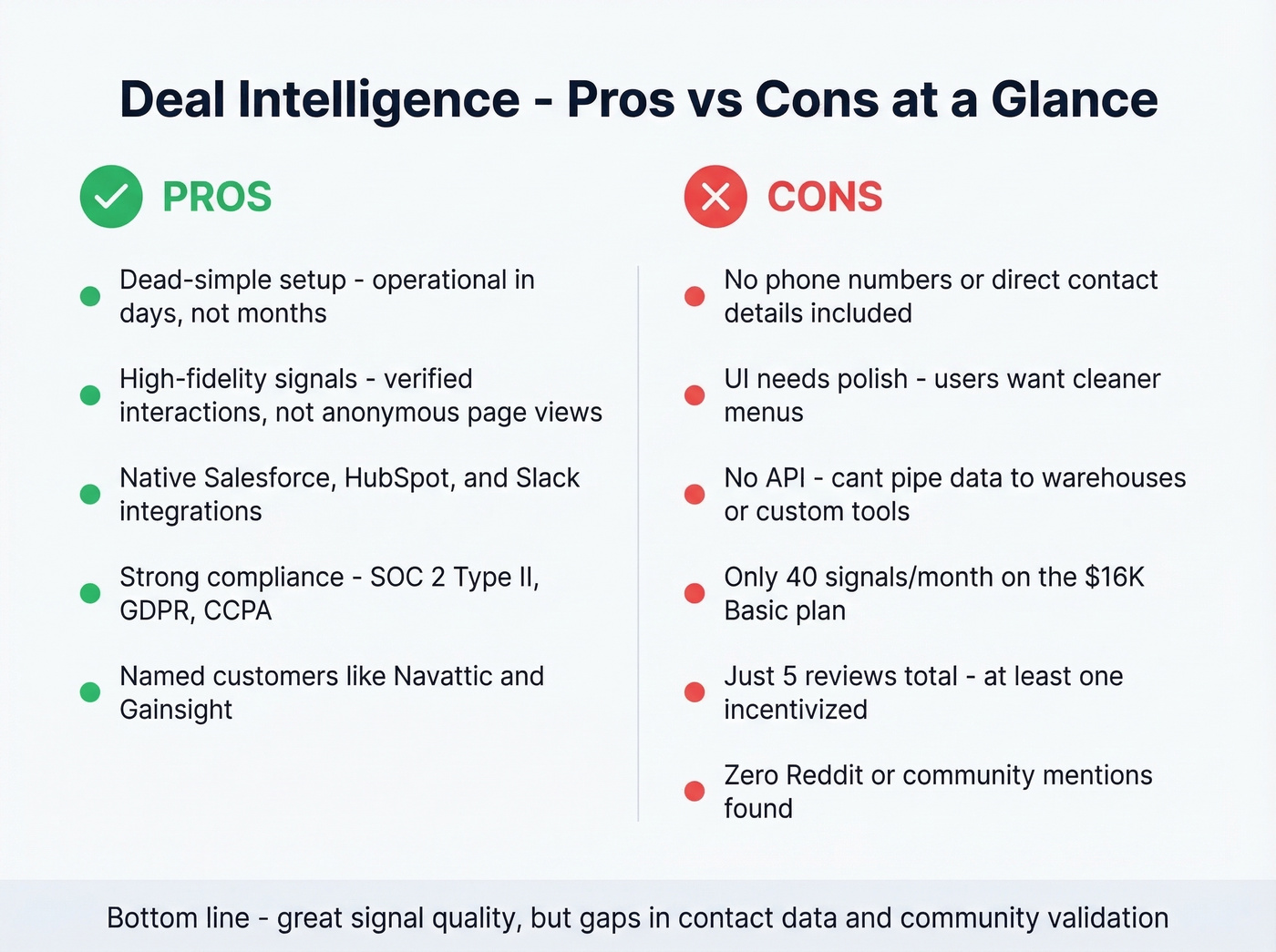
- Dead-simple setup. A CRO called it "simple to set up from an operations perspective." For a $16K tool, that matters - you don't want a three-month implementation.
- Signal quality over quantity. You're getting a handful of verified competitive interactions, not a spreadsheet of 10,000 accounts that "showed intent." For teams drowning in noisy intent data, this is the appeal.
- Native integrations where it counts. Salesforce, HubSpot, and Slack. Alerts land in the tools reps already live in, so adoption friction stays low.
- Serious compliance stack. SOC 2 Type II, AES-256 encryption, ISO 9001:2017, and GDPR/CCPA compliance. Plenty of smaller vendors skip this entirely.
- Named customers. Navattic, Gainsight, Athenian, and Auxi are listed as customers, which adds credibility for a tool with minimal public presence.
Cons:
- Limited contact details. A reviewer specifically flagged wanting phone numbers alongside signals. If you're running outbound, you'll need a separate data provider for direct dials.
- The UI needs work. A Product Marketing Manager's review requested "cleaner menus." Not a dealbreaker, but for a premium tool, polish matters.
- No API. RevOps teams can't programmatically pull signals into a data warehouse or custom workflow. Everything flows through the native integrations or nothing.
- 40 signals/month on Basic is tight. If you're a 20-rep team covering hundreds of accounts, 40 competitive signals won't go far. You'll likely need Pro or Custom.
- Tiny review footprint. Five reviews - all five-star, at least one incentivized - don't constitute validated social proof.
- Zero community presence. We couldn't find a single Reddit mention in the threads we checked. For a tool charging $16K+/year, that silence is unusual.

Deal Intelligence caps you at 40 signals/month on its $16K Basic plan - and none of them include direct contact data. Prospeo fills that gap with 125M+ verified mobiles (30% pickup rate) and 143M+ emails at 98% accuracy, refreshed every 7 days. At ~$0.01/email, you spend less on contacts than one month of Deal Intelligence.
Turn competitive signals into booked meetings - don't let them die in Slack.
What Users Actually Say
The review sample is tiny, so let's be precise about what exists.
A CRO at a small business reported a "tangible boost" in per-rep performance during a pilot and praised the operational simplicity, but wanted more contact details like phone numbers. A Senior Product Marketing Manager liked how it streamlined complex competitive insights but wanted a cleaner UI. Another reviewer highlighted that signals tie into their Salesforce account list and that the platform recommends a sales play for each intent signal - a nice touch for reps who don't want to interpret raw data.
Five five-star reviews don't constitute proof. And the complete absence of Reddit discussion is unusual for any B2B tool at this price point. We've seen tools with half this price tag generate heated threads in r/sales and r/SaaS. Run the free trial hard before signing anything.
Filling the Contact Data Gap
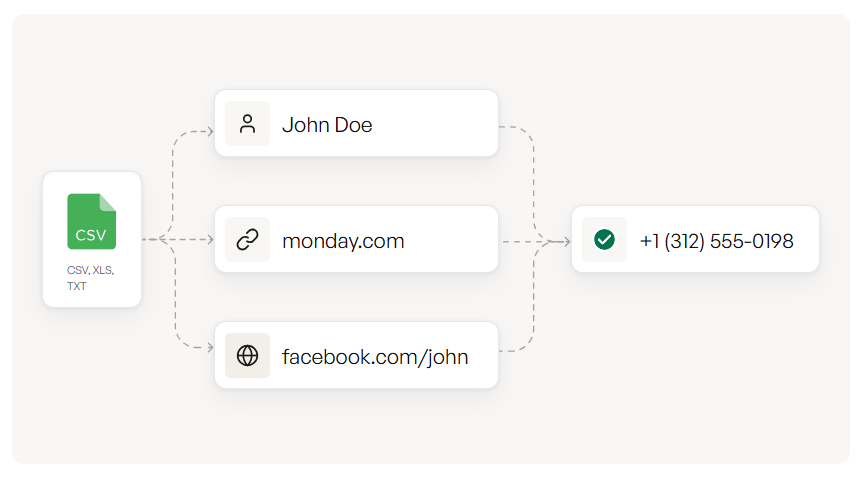
Deal Intelligence tells you which accounts are evaluating competitors. It doesn't give you direct dials to reach the decision-makers at those accounts. That's a real workflow gap - your SDR gets a competitive signal, then spends 20 minutes hunting for a working phone number.
We've tested this exact handoff with Prospeo. Upload the accounts Deal Intelligence flags, and you get back 98% accurate emails and verified mobile numbers from a database of 125M+ verified mobiles. Data refreshes every seven days, so you're not calling numbers that went stale six weeks ago. The free tier lets you test the workflow before committing - emails run about $0.01 each, mobiles at 10 credits per number.
If you're evaluating vendors to close that gap, start with a shortlist of data enrichment services and sales prospecting databases so you can compare coverage, refresh rates, and verification methodology.
Every reviewer flagged the same Deal Intelligence gap: no phone numbers, no direct dials. Your SDRs get a competitive alert, then waste 20 minutes hunting for contact info. Prospeo's 300M+ profile database with 30+ filters - including buyer intent powered by Bombora - gives you the signal and the contact in one workflow.
Stop paying $33 per signal and still missing the phone number.
Alternatives Worth Knowing
If your team searches for "deal intelligence," half the results will be conversation intelligence tools like Gong and Clari - a completely different category. Make sure you're comparing apples to apples.
Gong analyzes sales calls for patterns, objections, and deal risk. Pricing commonly lands around $200-$250/user/month plus a $5,000-$50,000 annual platform fee, so it gets expensive fast at scale. It won't monitor competitors externally, but the internal deal insights are strong. If your real problem is understanding why deals stall rather than which competitors are circling, Gong is the better fit.
Crayon and Klue both serve competitive enablement from different angles. Crayon tracks competitor website changes, messaging shifts, and market positioning at roughly $30K-$60K/year - though Reddit threads in r/ProductMarketing flag content noise as a recurring issue. Klue focuses on battlecards, win/loss analysis, and rep-facing intel at $20K-$50K/year and functions more as a content platform than a signal engine.
6sense is the heavyweight. Broad intent data plus ABM orchestration, starting around $35K/year and scaling well past $100K for enterprise deployments. If you want account-level intent across your entire TAM, not just competitive signals, 6sense is the category leader - but the price tag and implementation complexity reflect that.
Bombora provides pure intent data at $12K-$40K/year. Skip it if you want a proprietary UI layer, but for raw intent signals piped into your existing stack, it's straightforward and well-understood.
For teams that need contact data rather than intent signals, that's a different problem entirely - and one where tools like Prospeo operate at a fraction of the cost of these platforms.
The Verdict
Deal Intelligence fits a specific buyer: a mid-market B2B team running Salesforce, competing in a defined market with 3-5 key competitors, and wanting narrow competitive alerts rather than a broad intent firehose. If that's you, the $33/signal math can pencil out quickly - one saved enterprise deal covers the annual contract.
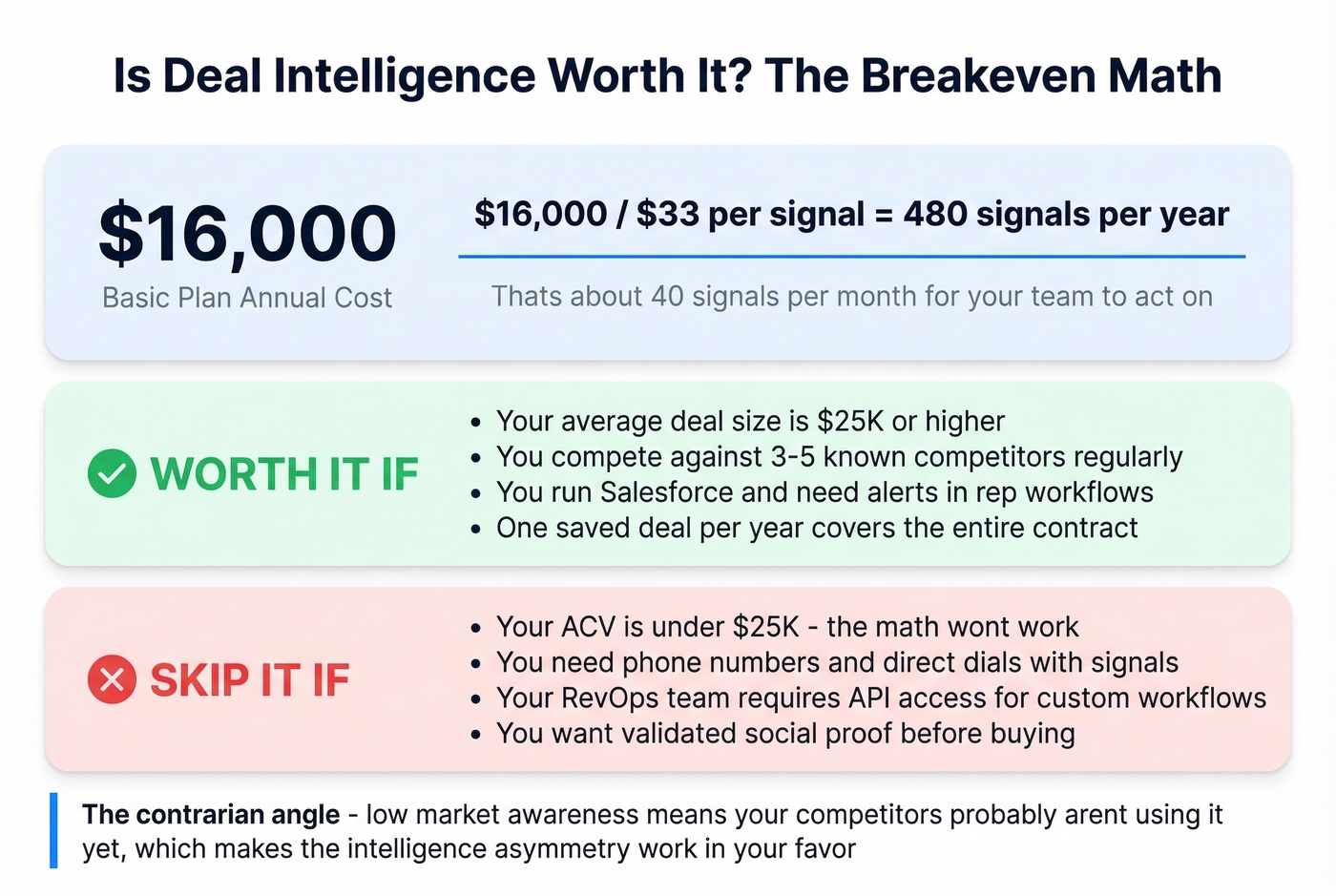
Skip it if you need contact data alongside signals, if your RevOps team requires API access, or if you're uncomfortable buying a $16K+ tool with essentially zero community validation.
In our experience, if your average contract value is under $25K, this tool's pricing usually doesn't make sense. You'd need to save roughly one $25K deal per year just to break even on Basic. Spend that $16K on a solid intent data provider plus a contact data platform, and you'll cover more ground for less money.
The contrarian angle - low market awareness means less signal noise, and if your competitors aren't using it, the intelligence asymmetry works in your favor. But with only five public reviews, you're making a bet on potential, not proof.
FAQ
Does Deal Intelligence offer a free trial?
Yes. Deal Intelligence offers a free trial with no credit card required. Trial duration and feature limits aren't publicly documented, so ask during your demo before committing to an annual contract.
What CRMs integrate with Deal Intelligence?
It connects natively with Salesforce, HubSpot, and Slack for real-time competitive alerts. There's no open API, so custom integrations with data warehouses or BI tools aren't currently possible.
Is 40 signals per month enough on the Basic plan?
For a team of 5-10 reps covering fewer than 200 named accounts, 40 signals can work. Larger teams or broader account lists will burn through that cap quickly - expect to upgrade to Pro at $24K/year or Custom at $49K/year.
What's a cost-effective way to act on Deal Intelligence signals?
Pair Deal Intelligence with a contact data provider to close the workflow gap. Prospeo's 98% email accuracy and 125M+ verified mobiles let you reach flagged accounts immediately, starting at $0.01 per email with a free tier of 75 credits per month.