

Deal Stages: The Operational Playbook for Building a Pipeline That Actually Works
Most sales pipelines produce fictional forecasts. The stages are vague, the probabilities are CRM defaults nobody's touched, and deals sit in "Proposal Sent" for weeks without a buyer ever opening the document. Gartner pegs the annual cost of poor data quality at $12.9 million per organization. A huge chunk of that starts right here - in how you define and manage the stages a sale moves through.
We've watched teams rebuild their pipelines in a single afternoon and immediately see their forecast accuracy jump 20-30%. It's not magic. It's structure.
What Are Deal Stages?
A deal stage is a discrete step in your sales pipeline representing where a potential sale sits between first contact and closed revenue. In CRM terms, a pipeline is the defined set of stages, and a deal (or opportunity) is the individual record moving through them.
Nail this down early: a pipeline isn't a funnel. Your sales pipeline tracks internal process stages - what your team does to advance a deal. Your sales funnel tracks the buyer's journey - awareness, interest, desire, action. Stages live inside the pipeline. They reflect seller actions and buyer milestones, not marketing awareness metrics.
Quick Setup Checklist
If you're setting up or fixing your pipeline stages:
- Use 5-8 stages built around buyer decisions, not rep activities
- Define exit criteria for every stage - no deal advances without proof
- Calibrate probabilities from your own historical data, not CRM defaults
- Review stage conversion rates quarterly and adjust accordingly
- Keep it simple enough that reps actually update it - adoption beats theoretical perfection
- Verify the data entering your pipeline, because bad contacts at the top corrupt every stage below (see data enrichment)
Why Stage Design Drives Forecasts
It's Monday morning pipeline review. Your VP of Sales is staring at a $4.2M weighted forecast that everyone in the room knows is fiction. Half the deals haven't moved in three weeks. The "Proposal Sent" stage has 37 deals, but only 8 buyers have actually reviewed the proposal.
That's what broken stage design costs you. Not just bad forecasts, but bad decisions built on bad data. The causal chain is direct: well-defined stages with clear exit criteria produce accurate forecasts, which produce reliable revenue projections, which let you hire, invest, and plan without guessing. When stages are vague or activity-based, deals pile up in the middle of your pipeline. Your weighted pipeline says $6M. Reality says $2M. That gap is where missed quarters come from. (If this sounds familiar, it usually shows up in your pipeline health metrics first.)
Common Frameworks and Templates
Starter Template (SaaS / General B2B)
For most SaaS and B2B teams, six stages cover the ground:
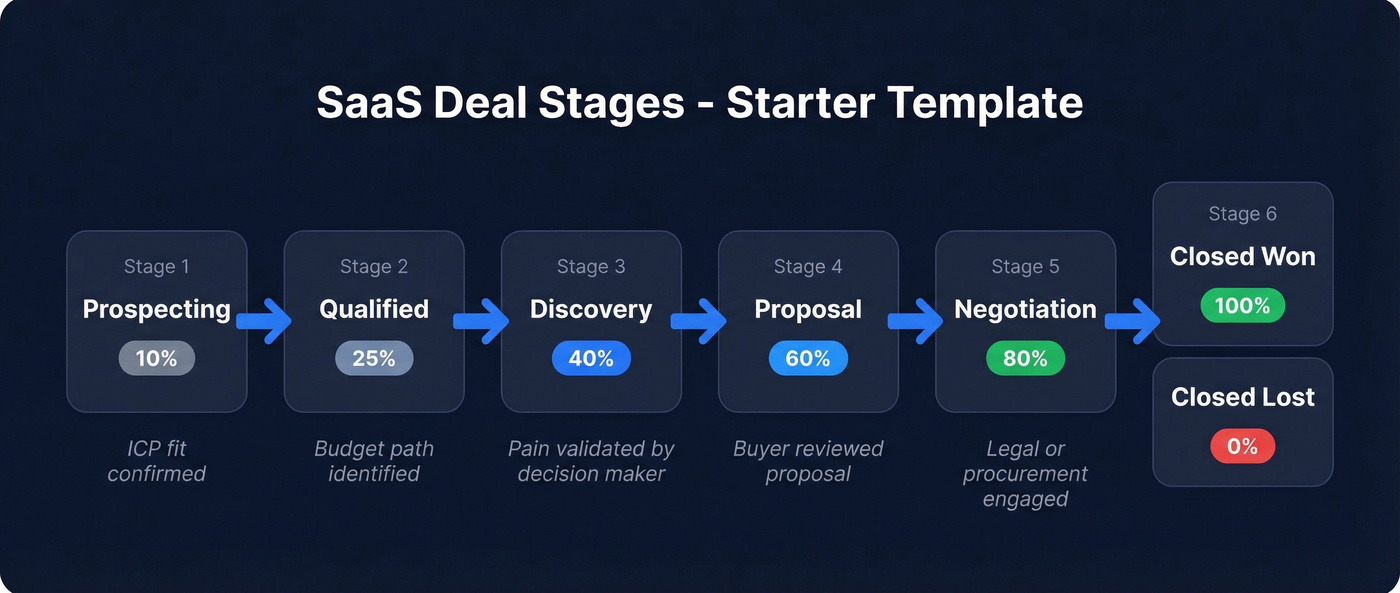
- Prospecting - 10%
- Qualified - 25%
- Discovery - 40%
- Proposal - 60%
- Negotiation - 80%
- Closed Won / Closed Lost - 100% / 0%
Those probability defaults come from Hubjoy's forecasting framework. For complex sales with longer buying committees, Forecastio offers a buyer-validation variant worth considering: seven stages from Initial Discovery at 20% through Contract Review at 85% and Closed Won at 95%, each mapped to a specific buyer commitment.
Manufacturing / Long-Cycle Sales
Most pipeline guides are SaaS-centric, and Reddit practitioners call this out regularly. For manufacturing and physical goods with 6-12 month cycles, work backwards from the Purchase Order. Start with the final commitment - PO signed - and reverse-engineer the buyer milestones that precede it.
A typical manufacturing pipeline runs: Initial Nurture, Customer Shows Interest, Inventory Review, Stocking Proposal, Pricing Discussion, Purchase Order Issued. Every stage represents something the buyer did, not something your rep did. That shift alone usually tightens forecasting because stage movement reflects real buyer progress.
Agency / Services: A Before-and-After
A real agency pipeline posted on Reddit tells the story perfectly.
Before: Lead Interested, Info Request, Meeting Request, Never Replied to Book Meeting, Meeting Booked, Missed Call, Meh Call, Great Call, Proposal Sent, Won, Lost.
The author's own assessment: "seems like overkill." They're right - half of those are activity states, not buyer milestones.
After: Qualified Lead, Discovery Call Completed, Proposal Reviewed, Negotiation, Closed Won/Lost.
Five stages. Each one requires the buyer to do something, not just the rep. That's the difference between a pipeline and a to-do list.
How Many Stages Should You Have?
The consensus across practitioners and frameworks lands on 5-8 stages for most B2B teams:
| Sales Motion | Recommended Stages |
|---|---|
| Transactional / SMB | 4-5 |
| Mid-market SaaS | 6-7 |
| Enterprise w/ procurement | 7-8 |
ActiveCampaign's CRM technically allows unlimited stages, and most CRMs are the same. But "no limit" doesn't mean you should add more. Every additional stage is friction for reps.
We've seen this pattern repeatedly: teams design an elegant 10-stage pipeline, and within two months reps are dragging deals straight from "Qualified" to "Closed Won" because the middle stages feel like busywork. If your team won't update it consistently, the stage doesn't exist. (This is one of the most common sales pipeline challenges in the wild.)

Bad contact data at the top of your pipeline corrupts every deal stage below it. Prospeo's 98% email accuracy and 7-day data refresh mean fewer dead deals clogging your stages and more accurate forecasts.
Stop forecasting on fiction - start with verified data at $0.01 per email.
Activity-Based vs. Buyer-Milestone Stages
Here's the thing - this is where most pipelines go wrong.
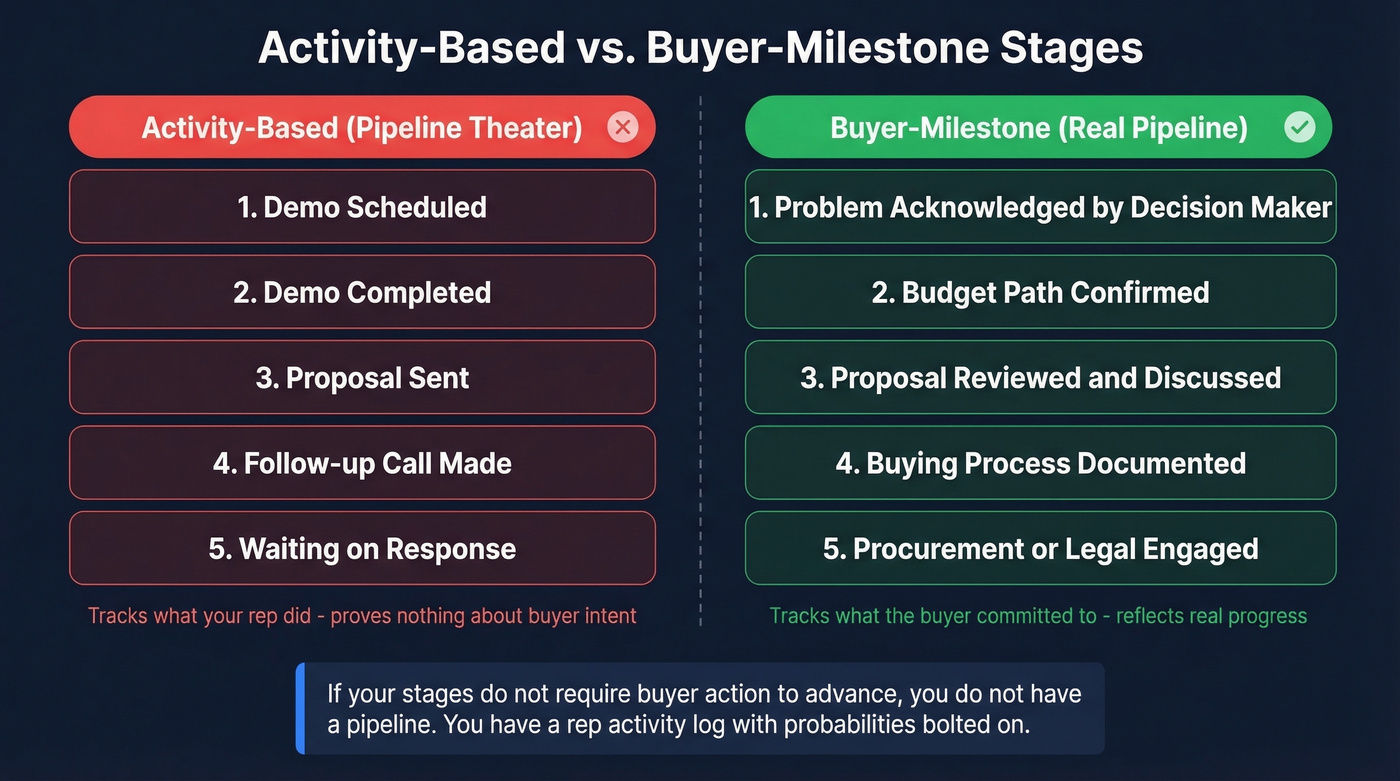
Activity stages track what your rep did: demo completed, proposal sent, follow-up call made. They feel productive but prove nothing about buyer intent. Campaign Creators calls this "pipeline theater" - stages that make the pipeline look full without reflecting real buyer commitment.
Milestone stages track what the buyer committed to: qualified problem acknowledged by a decision maker, budget confirmed, buying process documented. These require "decision proof" - verifiable evidence that the buyer reached a meaningful internal milestone.
If your stages don't require buyer action to advance, you don't have a pipeline. You have a rep activity log with probabilities bolted on. "Demo completed" tells you the rep did their job. It tells you nothing about whether the buyer is moving forward. Switch to milestone stages or accept that your forecast is fiction. (If you need a clean list of what to track, start with these sales activities examples.)
Exit Criteria and Methodology Alignment
Every stage needs a gate. Without exit criteria, deals sit in stages for weeks while reps "nurture the relationship" - which usually means they're avoiding the hard conversation about budget or timeline. Clear definitions for each stage prevent ambiguity and keep your team aligned on what advancement actually means.
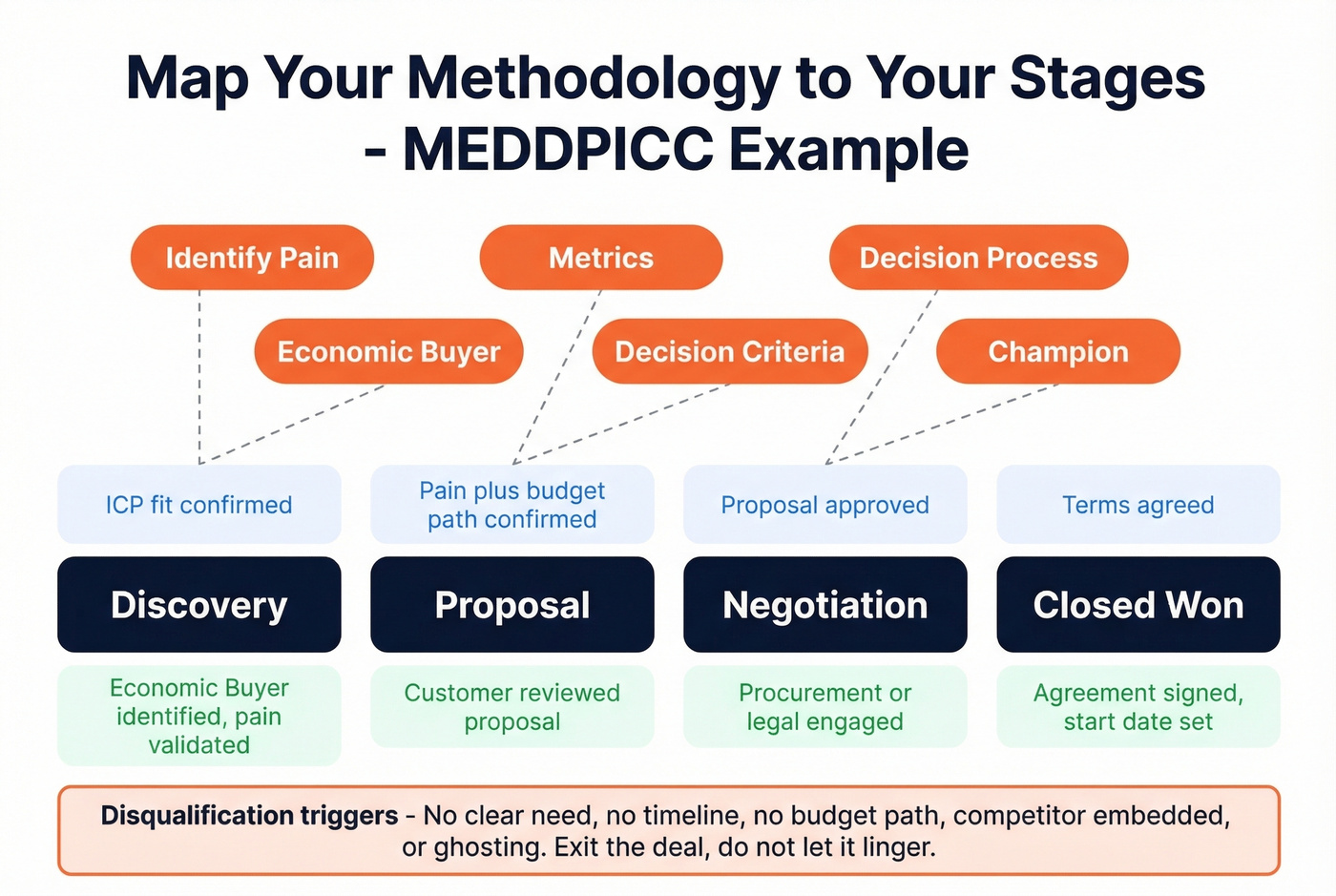
A practical exit criteria framework, adapted from Domestique's advancement model:
| Stage | Entry Criteria | Exit Criteria |
|---|---|---|
| Discovery | ICP fit confirmed | Economic Buyer identified, pain validated |
| Proposal | Pain + budget path confirmed | Customer reviewed proposal |
| Negotiation | Proposal approved | Procurement/legal engaged |
| Closed Won | Terms agreed | Agreement signed, start date confirmed |
If you're using MEDDPICC - Metrics, Economic Buyer, Decision Criteria, Decision Process, Identify Pain, Champion - map each element to the stage where it should be validated. BANT works similarly; a 2023 Gartner Digital Markets survey found 52% of salespeople still consider it reliable for qualification. (For deeper qualification, see MEDDIC sales qualification.)
Disqualification matters too. Explicit fail conditions include no clear need, no timeline, no budget path, competitor embedded, or ghosting. If a deal hits any of these, it should exit the pipeline - not linger in "Negotiation" for another quarter.
Probability Mapping That Reflects Reality
Default Probability Table
Two common default probability maps side by side:
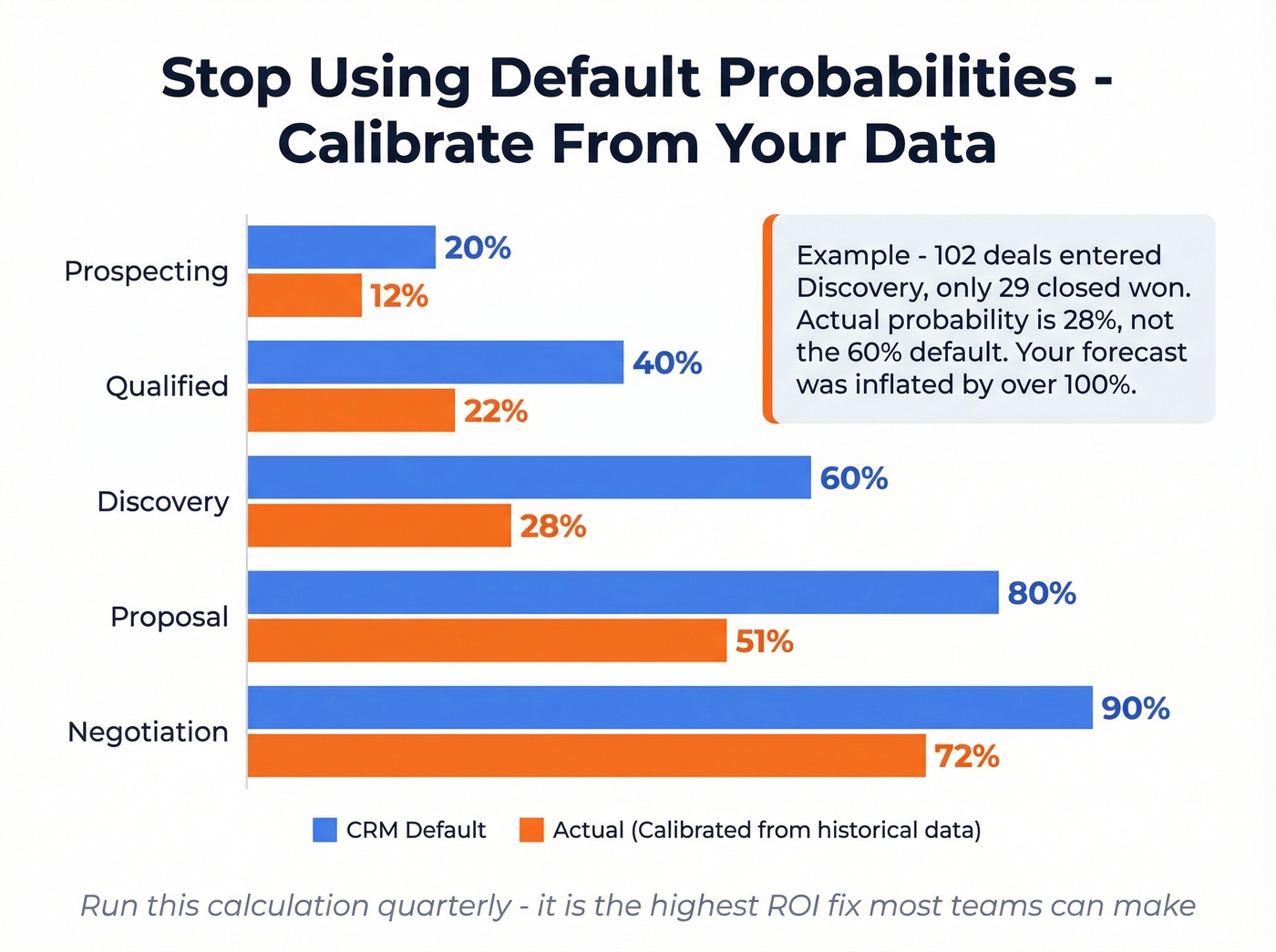
| Stage | Hubjoy Model | HubSpot Defaults |
|---|---|---|
| Prospecting / Appt Scheduled | 10% | 20% |
| Qualified | 25% | 40% |
| Discovery / Presentation | 40% | 60% |
| Proposal | 60% | 80% |
| Negotiation / Contract Sent | 80% | 90% |
| Closed Won | 100% | 100% |
Across 100+ HubSpot customers discussed in the HubSpot Community, nobody keeps the defaults. They're starting points, not answers.
Calibrate from Your Own Data
The formula is straightforward, sourced from the HubSpot Community:
(Deals that passed through stage AND ended Closed Won) / (Total deals that entered stage) = Actual probability
Worked example: 29 deals closed won out of 102 that entered Discovery = 28.43% actual probability. If your CRM says Discovery is 40%, your forecast is inflated by nearly 40%. Multiply that across every stage and you see why Monday pipeline reviews feel like fiction.
In our experience, recalibrating probabilities from historical data is the single highest-ROI fix most teams can make. Run this calculation quarterly. (If you're evaluating tooling, compare sales forecasting solutions that support custom probability models.)
Conversion Benchmarks by Industry
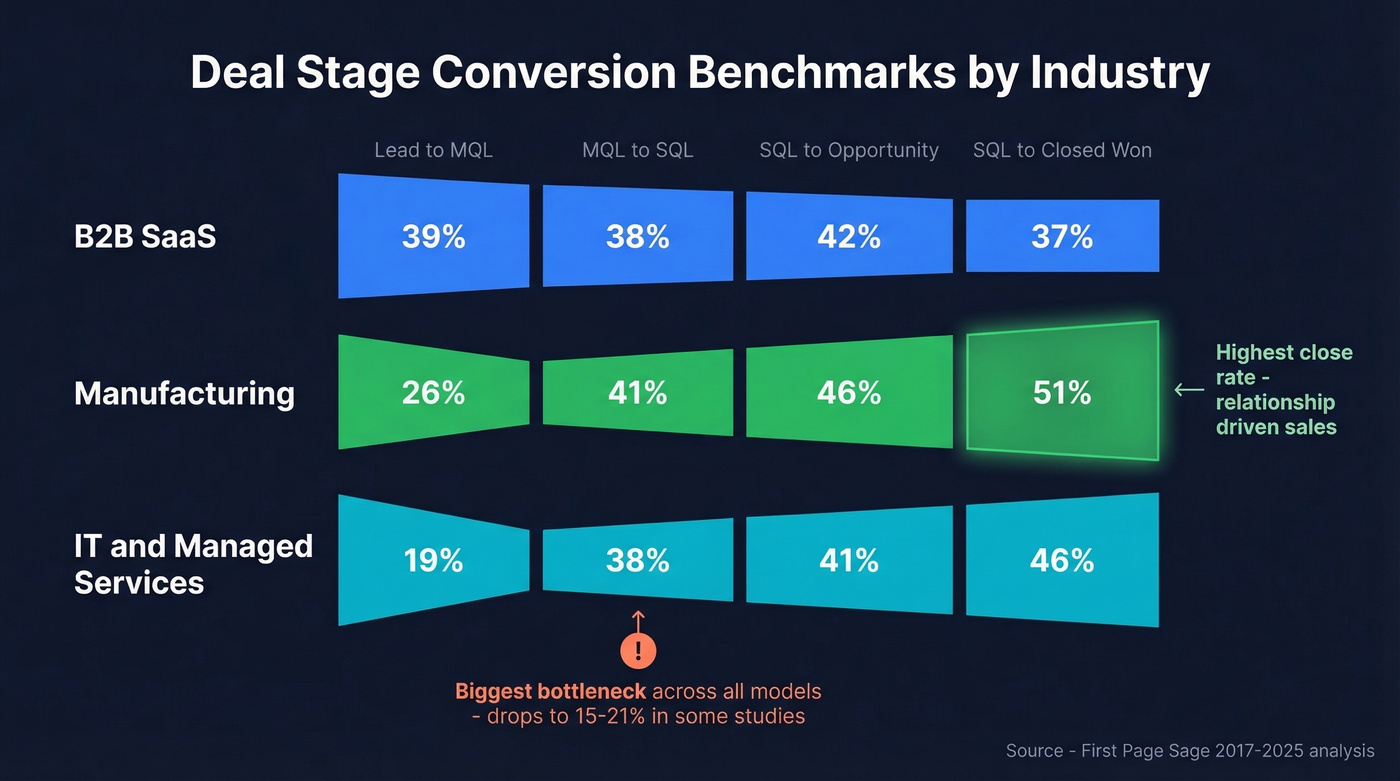
These benchmarks come from First Page Sage's analysis spanning 2017-2025:
| Industry | L to MQL | MQL to SQL | SQL to Opp | SQL to CW |
|---|---|---|---|---|
| B2B SaaS | 39% | 38% | 42% | 37% |
| Manufacturing | 26% | 41% | 46% | 51% |
| IT & Managed Services | 19% | 38% | 41% | 46% |
Manufacturing has the lowest lead-to-MQL rate but the highest SQL-to-Closed rate - which makes sense for relationship-driven sales with longer qualification periods. B2B SaaS converts leads faster but closes at a lower rate, reflecting higher volume and more competitive deals.
The Digital Bloom benchmark compilation adds a useful SMB vs. enterprise split: MQL-to-SQL runs 39% for SMB versus 31% for enterprise. The biggest bottleneck across all models? MQL-to-SQL, which drops to 15-21% in some studies. If your pipeline is leaking, that's where to look first.
How Long Should Each Stage Take?
Time-in-stage is one of the most underused pipeline health metrics. Benchmarks from Focus Digital broken down by stage:
| Industry | Initial Contact | Proposal | Negotiation | Closing |
|---|---|---|---|---|
| Software | 14 days | 30 days | 25 days | 21 days |
| Manufacturing | 18 days | 45 days | 35 days | 32 days |
| Energy | 30 days | 50 days | 40 days | 35 days |
Total cycle lengths: Software ~90 days, Manufacturing ~130 days, Energy ~155 days.
Company size matters enormously. Teams of 1-10 employees average 38-day cycles. Organizations with 10,001+ employees average 185 days. Deal value drives cycle length just as much - contracts under $50K average 75 days, while $500K+ deals stretch to 270 days.
Let's tie it together with the pipeline velocity formula: (Number of Opportunities x Avg Deal Value x Win Rate) / Sales Cycle Length. This gives you a single number - revenue throughput per period - that captures the combined effect of volume, value, conversion, and speed.
Common Pipeline Mistakes
Too many stages. Remember the 11-stage agency pipeline from earlier? That's not an outlier. Teams add stages for every internal handoff, every edge case. The result is a pipeline nobody updates. Stick to 5-8 and resist the urge.
Activity-based stages. "Demo Completed" and "Proposal Sent" tell you what the rep did, not what the buyer committed to. If your stages don't require buyer action, your pipeline is theater.
No exit criteria. A deal in "Negotiation" for 45 days without procurement engaged isn't being negotiated - it's stalled. Define what must be true before a deal moves, and enforce it.
Never calibrating probabilities. CRM defaults are guesses. If you haven't run the historical probability formula in the last quarter, your weighted pipeline is fiction.
Bad data at the top of the funnel. Your SDR team booked 40 meetings last month, but only 12 became real opportunities. When contacts have bounced emails, wrong titles, or outdated company data, your pipeline gets polluted fast. Your deal stages are only as good as the data entering them - tools like Prospeo exist specifically to solve this problem before it poisons your pipeline, verifying emails at 98% accuracy on a 7-day refresh cycle so your Prospecting stage isn't built on phantom contacts. (If you're building top-of-funnel volume, start with sales prospecting techniques and a shortlist of free lead generation tools.)

You just redesigned your deal stages around buyer milestones. Now make sure the contacts filling those stages are real. Prospeo delivers 143M+ verified emails and 125M+ mobile numbers so reps spend time advancing deals, not chasing bounces.
Verified contacts in, accurate forecasts out. That's how pipelines should work.
FAQ
What's the difference between a sales pipeline and a sales funnel?
A sales pipeline tracks your internal process - the actions your team takes to advance a deal through defined stages. A sales funnel tracks the buyer's journey from awareness to decision. Deal stages live inside the pipeline; the funnel is a marketing construct measuring drop-off at each level.
How many deal stages should a B2B company have?
Five to eight works for most B2B teams. Transactional or SMB sales can get by with 4-5; enterprise deals involving procurement and legal typically need 7-8. More than eight means reps won't update consistently, and an unused pipeline is worse than a simple one.
Should stage probabilities be the same for every company?
No. Default probabilities are starting points only. Calibrate from your own data using: (deals that passed through stage and closed won) / (total deals that entered stage). Review quarterly, because conversion rates shift as your team, product, and market evolve.
How do you keep deal data accurate from the first stage?
Start with verified contact data before anything enters your pipeline. Regular enrichment, CRM hygiene rules, and duplicate removal keep records clean. A 7-day data refresh cycle - rather than the industry-standard 6 weeks - means your Prospecting stage is built on reachable contacts rather than bounced emails that create phantom opportunities.