


DeBounce vs Prospeo: Verification Tool or Full Data Platform?
A practitioner on r/coldemail tested around 100 leads across multiple verifiers and found roughly 40% got different results depending on which tool ran the check. That stat tells you everything about the verification market: the tool you pick matters less than the data feeding it.
When you compare DeBounce vs Prospeo, you're not really comparing competitors. One's a spell-checker, the other is the word processor that includes spell-check. The real question isn't which verifier is better - it's whether you need a standalone verifier at all.
30-Second Verdict
Pick DeBounce if you already have a list and just need cheap bulk verification. It starts at $10 for 5,000 checks.
Pick Prospeo if you need to find and verify contacts. It replaces the need for a standalone verifier - 300M+ profiles, 98% email accuracy, 7-day data refresh.
Skip both if you send fewer than 100 emails a month. Most sequencers include basic verification built in.
The Core Difference
DeBounce is a verification utility. You bring it a list, it tells you which emails are valid. No database, no prospecting, no enrichment.
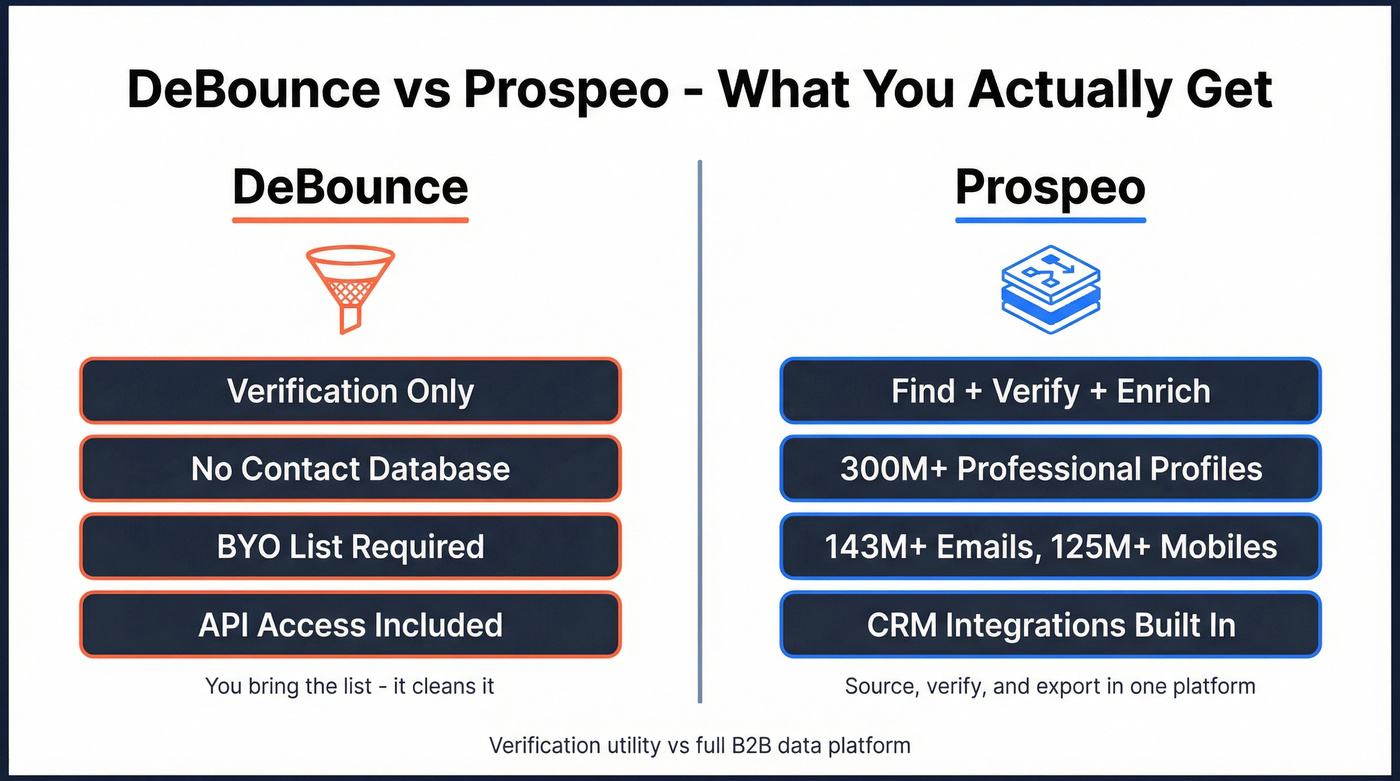
Prospeo is a B2B data platform that includes verification. You search 300M+ professional profiles across 30+ filters, export verified contacts with 143M+ emails and 125M+ mobile numbers, and push them straight into your CRM. DeBounce is the car wash. Prospeo is the car that comes with a built-in car wash.
What DeBounce Offers
Use this if you've got a purchased list or scraped CSV that needs cleaning before it hits your sequencer. DeBounce handles this fast and cheap - G2 gives it 4.5/5 across 172 reviews, Capterra 4.7/5 from 229 reviews. One reviewer reported their bounce rate dropping from 21% hard bounces to roughly 1%. Processing speed is solid at 10K emails in 10 minutes, and API access is included on every package with no separate API credits.
Skip this if you need to actually find contacts. DeBounce can struggle with spam and temporary email detection - a recurring theme in G2 reviews. One reviewer reported DeBounce incorrectly marked a large batch of contacts as opted out, disrupting their sales outreach for over a month. Rare, but the kind of thing that keeps you up at night.

What Prospeo Offers
Here's where the comparison gets lopsided. Prospeo covers the full outbound pipeline: finding prospects, verifying contact info, and pushing records into your sequencer.
Every email runs through a 5-step verification process - catch-all handling, spam-trap removal, honeypot filtering - delivering 98% accuracy on a 7-day refresh cycle. The platform is GDPR compliant with DPAs available, which matters if you're selling into the EU.
Native connections to Salesforce, HubSpot, Smartlead, Instantly, Lemlist, Clay, Zapier, and Make mean you aren't duct-taping workflows together. Real numbers from real teams: Meritt went from a 35% bounce rate to under 4% after switching. Stack Optimize keeps bounce rates under 3% across all clients with zero domain flags. One tool instead of three - that's the pitch, and the numbers back it up.


You're reading this because you're stacking a verifier on top of a lead source. Prospeo replaces both - 300M+ profiles, 98% email accuracy, 7-day refresh cycle. No catch-all credit multipliers, no hidden math.
Stop paying for verification you don't need. Start with better data.
Feature-by-Feature Comparison
| Category | DeBounce | Prospeo |
|---|---|---|
| Primary function | Email verification | Find + verify + enrich |
| Database | None (BYO list) | 300M+ profiles, 143M+ emails |
| Email accuracy | 97.5% (vendor claim) | 98% |
| Data freshness | Verifies what you give it | 7-day refresh cycle |
| Catch-all handling | 10 credits per check | Included |
| Mobile numbers | No | 125M+ verified |
| Free tier | 100 free credits | 75 emails/month + 100 extension credits/month |
| Starting price | $10 (one-time credits) | $39/mo (Starter) |
| Integrations | API | Salesforce, HubSpot, Smartlead, Instantly, Lemlist, Clay, Zapier, Make |
| G2 rating | 4.5/5 (172 reviews) | 4.5/5 |
Two things jump out. First, DeBounce charges 10 credits per catch-all verification - 10x the cost of a standard check. On B2B lists, catch-all domains are everywhere. Second, DeBounce only verifies. You still need to source contacts from somewhere else, and that somewhere else costs money too.
Pricing: The Hidden Math
DeBounce looks cheap at first glance. Pay-as-you-go, credits never expire, and pricing starts at $10 for 5,000 verifications. They advertise rates as low as $0.00045 per check. Sounds great on paper.
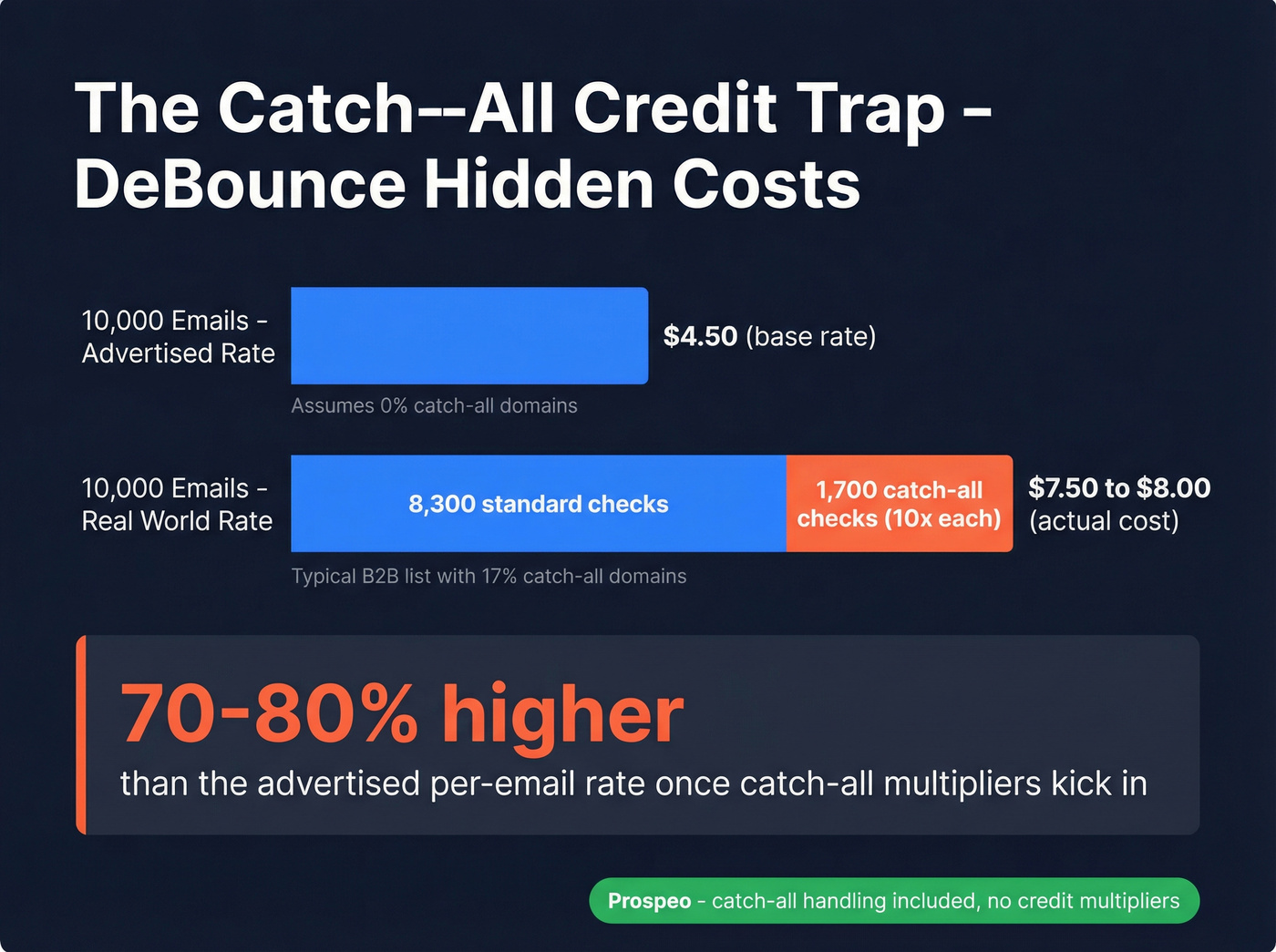
Here's what trips up buyers. On a typical B2B list, roughly 17% of domains are catch-all. Each catch-all check costs 10 credits instead of 1. Run the math on a 10,000-email list: your effective cost per email jumps 70-80% above the base rate. That $1.50-$2 per thousand estimate you see in benchmarks assumes zero catch-alls. Nobody has zero catch-alls.
There's a reason Reddit threads call verifier pricing "a scam" - the margins are enormous once catch-all multipliers kick in.
Prospeo's pricing works differently: Free tier at 75 emails/month, Starter at $39/mo, Growth at $99/mo, Pro at $199/mo. But you're getting sourcing, verification, 125M+ mobile numbers, intent data across 15,000 topics, and CRM integrations in one subscription. We've seen teams compare the total cost of a lead source plus a standalone verifier against Prospeo's all-in-one pricing, and the math almost always favors consolidation.
Accuracy: What Actually Matters
Every verifier claims 97-99% accuracy. DeBounce says 97.5%. Clearout's own comparison page puts DeBounce at 85%. That r/coldemail test found roughly 40% of leads got different results depending on which tool checked them.
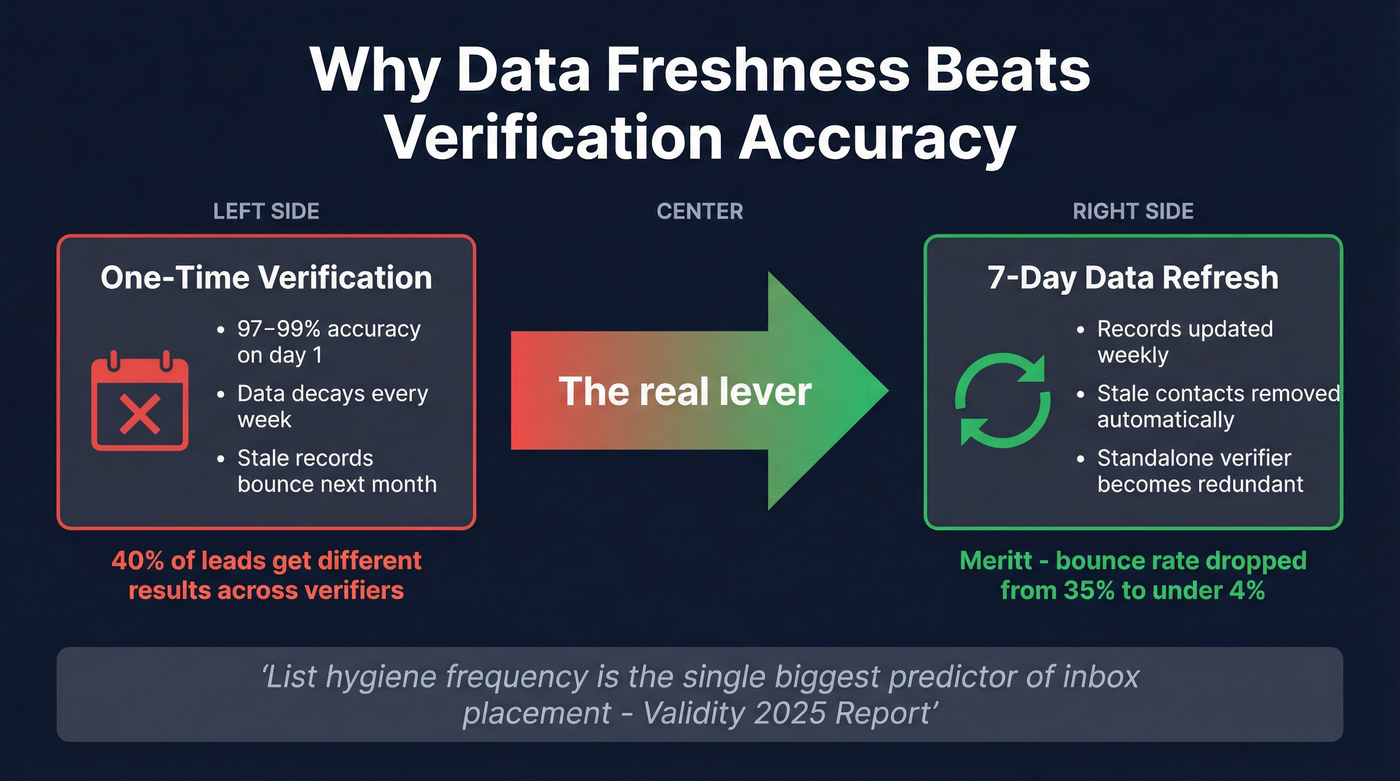
Let's be honest: the accuracy number on a vendor's homepage is marketing.
What actually protects your deliverability is data freshness. Verification checks if an address exists right now, but cleaning removes the ones that'll hurt you. A "valid" result against six-month-old data means nothing next Tuesday. In our testing, the structural advantage is a short refresh cycle - weekly data refresh makes standalone verification largely redundant because you're never working with stale records in the first place. Validity's 2025 email deliverability report confirms that list hygiene frequency is the single biggest predictor of inbox placement.
If you're troubleshooting bounces at the ops level, start with email bounce handling and a basic domain health check before you blame the verifier.
The Verdict
DeBounce wins one narrow use case: you've got a list, you need it cleaned, you want to spend as little as possible. For that job, it's excellent.
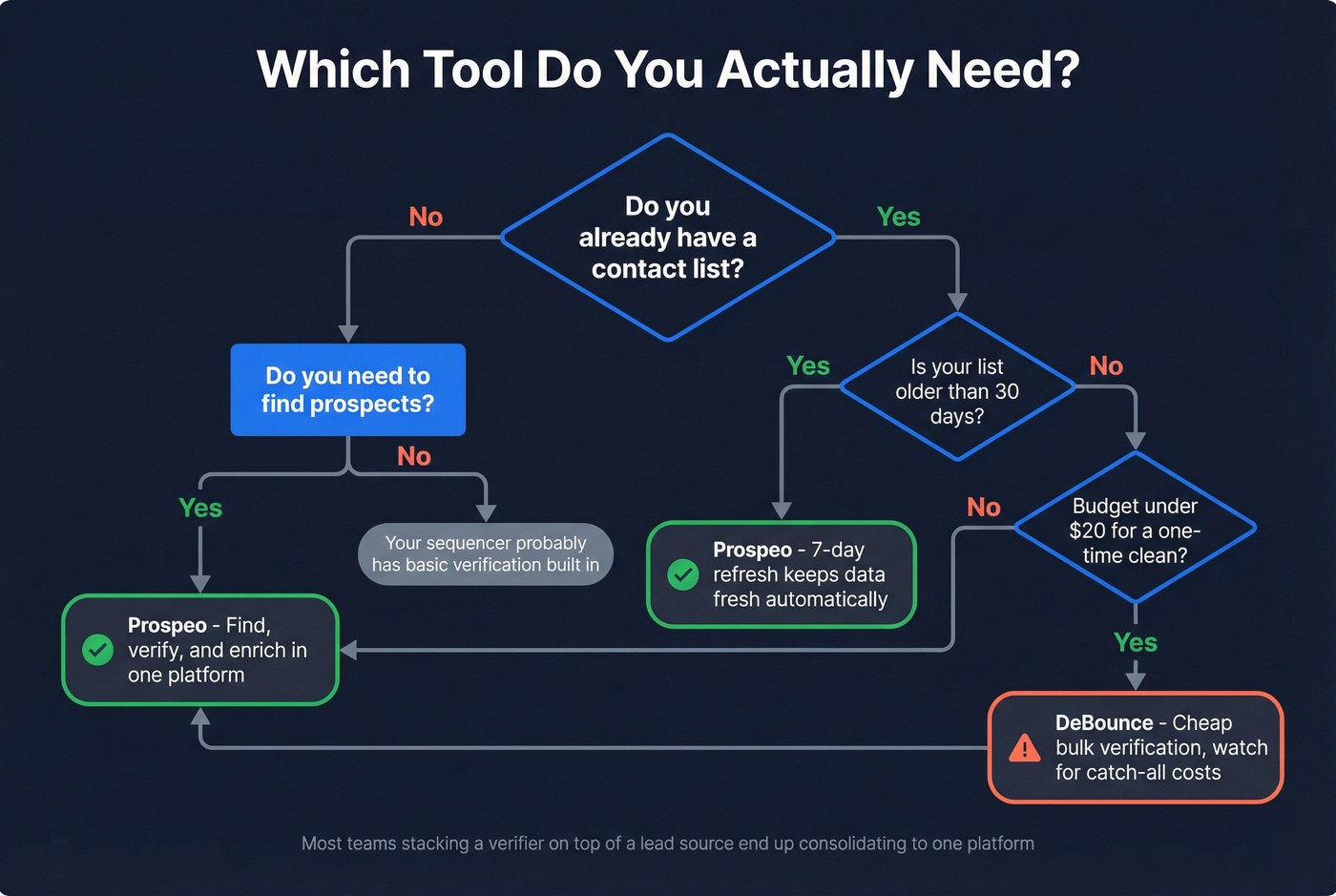
Here's the thing - most teams buying DeBounce don't actually need it. They need better source data. If your workflow starts with a platform that verifies on export, adding a standalone verifier on top is paying twice for the same job. We've watched teams realize this after months of stacking tools, and the moment they consolidated, bounce rates dropped and costs followed. In the DeBounce vs Prospeo decision, the answer usually comes down to whether you've already solved sourcing. If you haven't, a verification-only tool is a band-aid on a sourcing problem.
If you're still building lists manually, it helps to revisit list building and the basics of B2B lead generation.
Meritt cut their bounce rate from 35% to under 4%. Stack Optimize runs under 3% across every client with zero domain flags. Both ditched standalone verifiers when they switched to Prospeo's all-in-one platform.
Consolidate your stack and watch bounce rates drop - free tier, no contract.
FAQ
Is DeBounce cheaper than Prospeo?
For verification alone, yes - it starts at $10 for pay-as-you-go credits. But factor in sourcing costs and the 10x catch-all credit multiplier, and the total workflow cost often favors an all-in-one platform.
Can Prospeo replace DeBounce entirely?
Yes. Prospeo's 5-step verification covers everything DeBounce does - catch-all handling, spam-trap removal, honeypot filtering - while also sourcing 300M+ contacts with 98% email accuracy. Stack Optimize runs under 3% bounce rates without any standalone verifier.
Which tool is better for cold email deliverability?
A 7-day data refresh beats any one-time verification check. Freshness is the real deliverability lever - not the verification algorithm itself. Meritt cut bounce rates from 35% to under 4% by switching to a platform with weekly refresh rather than layering verifiers on stale data.